| English | 释义 | 拼音 |
|---|---|---|
| recognition/ˌrekəɡˈnɪʃn/ | 认可 | rèn kě |
| piece rate/piːs reɪt/ | 计件工资 | jì jiàn gōng zī |
| salary/ˈsæləri/ | 薪水 | xīn shuǐ |
| commission/kəˈmɪʃn/ | 佣金 | yòng jīn |
| bonus/ˈbəʊnəs/ | 奖金 | jiǎng jīn |
| profit-sharing/ˈprɒfɪt ˈʃeərɪŋ/ | 利润分享 | lì rùn fēn xiǎng |
| fringe benefits/frɪndʒ ˈbenɪfɪts/ | 附加福利 | fù jiā fú lì |
| job rotation/dʒɒb rəʊˈteɪʃn/ | 工作轮换 | gōng zuò lún huàn |
| enlargement/enˈlɑːdʒmənt/ | 工作扩大化 | gōng zuò kuò dà huà |
| job enrichment/dʒɒb enˈrɪtʃmənt/ | 工作丰富化 | gōng zuò fēng fù huà |
| empowerment/emˈpaʊəmənt/ | 授权 | shòu quán |
| commitment/kəˈmɪtmənt/ | 投入感 | tóu rù gǎn |
200 engineers and accountants, 1959
- In 1959 Frederick Herzberg and his colleagues published interviews with about 200 engineers and accountants in Pittsburgh, USA. Asked when they had felt very good or very bad at work, people described good days in terms of achievement, recognition 认可 and responsibility — and bad days in terms of pay, supervision and working conditions.
- Herzberg concluded that pay can prevent dissatisfaction but rarely motivates on its own. Businesses therefore combine financial and non-financial motivators.
Motivation methods lab
Compare financial and non-financial ways to raise effort.
In Herzberg's study, what did people link to good days at work?
难度 1/5 · 今日首次完成可获 100 金币及少量额外奖励
Pay was linked to bad days.
Payment systems
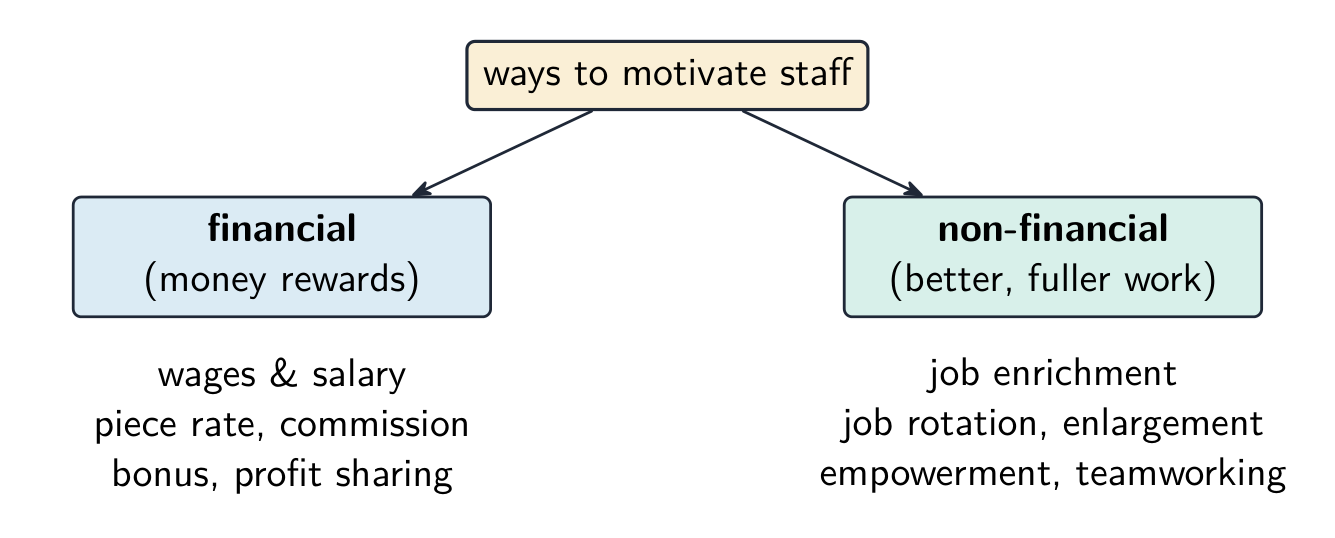
- Piece rate 计件工资: pay per unit produced — links pay to output, but may lower quality. Salary 薪水: a fixed annual amount, paid monthly — security, but no direct link to effort.
- Commission 佣金: a percentage of sales value, common for sales staff; it can encourage pushy selling.
Match each payment system to its description.
难度 2/5 · 今日首次完成可获 140 金币及少量额外奖励
Three payment systems.
A salesperson earns 4% commission on sales of $25,000. What is the commission in dollars?
难度 2/5 · 今日首次完成可获 140 金币及少量额外奖励
0.04 × 25,000.
Extra financial rewards
- A bonus 奖金 is a one-off payment for meeting a target. Profit-sharing 利润分享 gives employees a share of profits, so they gain when the firm does well.
- Fringe benefits 附加福利 are non-cash extras with a money value: a company car, health insurance, staff discounts.
Which is a fringe benefit?
难度 1/5 · 今日首次完成可获 100 金币及少量额外奖励
A non-cash extra.
Non-financial motivators
- Job rotation 工作轮换: moving between tasks at the same level — variety. Job enlargement 工作扩大化: more tasks at the same level.
- Job enrichment 工作丰富化: more responsibility and challenge. Empowerment 授权: the freedom to make decisions about one's own work. These build commitment 投入感.
Match each method to its meaning.
难度 2/5 · 今日首次完成可获 140 金币及少量额外奖励
Non-financial motivators.
Worked example: choose for a call centre
A call centre has high staff turnover; workers say the job is repetitive and they have no say.
- Financial: a team bonus for customer-satisfaction scores rewards quality, not just call numbers (piece rate would rush calls).
- Non-financial: job rotation between sales, complaints and training; empowerment to give refunds up to $50 without a manager.
- Evaluation: Herzberg suggests the non-financial changes tackle the real cause; the bonus helps only if pay is not already seen as unfair.
Piece rate per call might reduce call quality in a call centre.
难度 1/5 · 今日首次完成可获 100 金币及少量额外奖励
It rewards speed.
Evaluating motivators
- The right mix depends on the job (can output be measured?), the workforce (skills, expectations) and cost.
- Money matters most when pay is low or unfair; once it is fair, recognition and responsibility usually matter more.
Job enlargement is not job enrichment. Adding more tasks of the same level (enlargement) is different from adding responsibility and decision-making (enrichment).
Job enlargement and job enrichment mean the same thing.
难度 1/5 · 今日首次完成可获 100 金币及少量额外奖励
More tasks versus more responsibility.
Financial motivators include piece rate, salary, commission, bonus, profit-sharing and fringe benefits. Non-financial ones include job rotation, enlargement, enrichment, empowerment and recognition. Choose and evaluate them against the job, the workers and the cost.
Evaluate whether a hotel should introduce profit-sharing to motivate its cleaning staff.
Evaluation.