Business objectives · 企业目标
| English | 中文 | Pinyin · 拼音 |
|---|---|---|
| start-up/stɑːt ʌp/ | 初创企业 | chū chuàng qǐ yè |
| objective/ɒbˈdʒektɪv/ | 目标 | mù biāo |
| survival/səˈvaɪvl/ | 生存 | shēng cún |
| profit maximisation/ˈprɒfɪt ˌmæksɪmaɪˈzeɪʃn/ | 利润最大化 | lì rùn zuì dà huà |
| market share/ˈmɑːkɪt ʃeə/ | 市场份额 | shì chǎng fèn é |
| shareholder value/ˈʃeəhəʊldə ˈvæljuː/ | 股东价值 | gǔ dōng jià zhí |
| ethical/ˈeθɪkl/ | 道德 | dào dé |
| CSR/ˌsiː es ˈɑː/ | 企业社会责任 | qǐ yè shè huì zé rèn |
| mission/ˈmɪʃn/ | 使命 | shǐ mìng |
| aims/eɪmz/ | 目的 | mù dì |
| specific/spəˈsɪfɪk/ | 具体的 | jù tǐ de |
| measurable/ˈmeʒərəbl/ | 可衡量的 | kě héng liáng de |
| achievable/əˈtʃiːvəbl/ | 可实现的 | kě shí xiàn de |
| time-bound/taɪm baʊnd/ | 有时限的 | yǒu shí xiàn de |
What is a business actually for?
- "To make money" is the obvious answer — but it's not the whole story. A charity, a start-up 初创企业 and a giant corporation chase very different goals.
- A business needs clear objectives 目标 to guide every decision.
一个企业实际上是为了什么?
- "为了赚钱"是显而易见的答案——但它不是全部。一个慈善机构、一个初创企业和一个巨型公司追逐非常不同的目标。
- 一个企业需要清晰的目标(objectives)来引导每一个决策。
Business objectives lab · 企业目标实验室
Match business examples to the objective they reveal. · 将商业实例与其揭示的目标进行匹配。
The most likely main objective of a brand-new business is: · 新成立企业最可能的主要目标是:
New firms prioritise survival before profit or growth. · 新公司在追求利润或增长之前优先考虑生存。
Common business objectives
- Survival 生存 — the priority for a new or struggling firm.
- Profit maximisation 利润最大化 — the classic goal of private firms.
- Growth, market share 市场份额, and increasing shareholder value 股东价值.
- Social and ethical 道德 objectives (CSR 企业社会责任).
Internal and external stakeholders all have an interest in the business
常见的企业目标
- 生存(survival)——一个新的或挣扎的企业的优先事项。
- 利润最大化(profit maximisation)——私人企业的经典目标。
- 增长、市场份额和增加股东价值。
- 社会和伦理目标(CSR)。

内部和外部利益相关者都对企业有兴趣
Which is a SMART objective? · 哪一个是 SMART 目标?
It is specific, measurable and time-bound. · 它是具体的、可衡量的且有明确时限的。
Which words does SMART stand for? (Select all that apply.) · SMART 代表哪些单词?(选择所有适用项。)
SMART = Specific, Measurable, Achievable, Realistic, Time-bound. · SMART = 具体的 (Specific)、可衡量的 (Measurable)、可实现的 (Achievable)、现实的 (Realistic)、有时限的 (Time-bound)。
The overall purpose of a business is its . · 企业的总体目的即为其。
Mission → aims → objectives. · 使命 → 宗旨 → 目标。
From mission 使命 to objectives
- A mission is the overall purpose; aims 目的 are broad goals; objectives are specific 具体的 targets.
- Good objectives are SMART: Specific, Measurable 可衡量的, Achievable 可实现的, Realistic, Time-bound 有时限的.
A broad mission narrows down to specific aims, then to SMART objectives and day-to-day tactics
Worked example. "Be the best" is a vague aim. "Grow sales by 10% within 12 months" is a SMART objective — specific, measurable and time-bound, so progress can be checked.
从使命到目标
- 一个使命(mission)是整体目的;目的(aims)是宽泛的目标;目标(objectives)是具体的指标。
- 好的目标是 SMART:Specific(具体)、Measurable(可测量)、Achievable(可实现)、Realistic(现实)、Time-bound(有时限)。
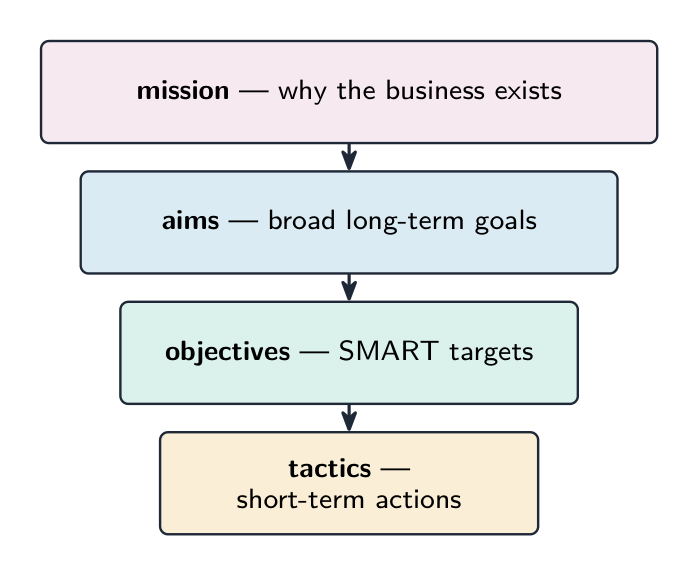
一个宽泛的使命收窄到具体的目的,再到 SMART 目标和日常战术
例题。 "成为最好的"是一个模糊的目的。"在 12 个月内把销售增长 10%"是一个 SMART 目标——具体、可测量且有时限,所以进展能被检查。
A firm's objectives can change as it grows from a start-up to an established business. · 随着企业从初创发展到成熟,其目标可能会发生变化。
Survival gives way to profit and growth objectives over time. · 随着时间的推移,生存让位于利润和增长目标。
Why objectives change
- A start-up prioritises survival; an established firm shifts to profit or growth.
- Objectives also reflect the owners' values and external pressures (e.g. demands for ethical behaviour).
SMART objectives: Specific, Measurable, Achievable, Realistic, Time-bound
为什么目标改变
- 一个初创企业优先考虑生存;一个成熟的企业转向利润或增长。
- 目标也反映所有者的价值观和外部压力(例如对伦理行为的要求)。
You've got it
- objectives include survival, profit, growth, market share and social/ethical goals
- mission → aims → objectives; good objectives are SMART
- objectives change as a firm matures (survival → profit/growth)
你掌握了
- 目标包括生存、利润、增长、市场份额和社会/伦理目标
- 使命 → 目的 → 目标;好的目标是 SMART
- 目标随一个企业成熟而改变(生存 → 利润/增长)