| English | 释义 | 拼音 |
|---|---|---|
| output/ˈaʊtpʊt/ | 产出 | chǎn chū |
| average cost/ˈævrɪdʒ kɒst/ | 平均成本 | píng jūn chéng běn |
| per unit/pɜː ˈjuːnɪt/ | 每单位 | měi dān wèi |
| economies of scale/ɪˈkɒnəmiz ɒv skeɪl/ | 规模经济 | guī mó jīng jì |
| optimal/ˈɒptɪml/ | 最优的 | zuì yōu de |
| diseconomies of scale/ˌdɪsɪˈkɒnəmiz ɒv skeɪl/ | 规模不经济 | guī mó bù jīng jì |
| purchasing/ˈpɜːtʃɪsɪŋ/ | 采购 | cǎi gòu |
| bulk-buying/bʌlk ˈbaɪɪŋ/ | 批量采购 | pī liàng cǎi gòu |
| coordination/kəʊˈɔːdɪneɪʃn/ | 协调 | xié tiáo |
| motivation/ˌməʊtɪˈveɪʃn/ | 激励 | jī lì |
Why bigger can be cheaper
- A bakery making 10,000 loaves can buy flour far more cheaply per bag than one making 100.
- As output 产出 grows, the average cost 平均成本 per unit 每单位 often falls — the power of economies of scale 规模经济.
Economies of scale occur when, as output rises:
难度 1/5 · 今日首次完成可获 100 金币及少量额外奖励
Average (per-unit) cost falls with greater scale.
The shape of average cost
- Economies of scale: as output rises, average cost falls.
- Beyond an optimal 最优的 size, diseconomies of scale 规模不经济 set in and average cost rises again.
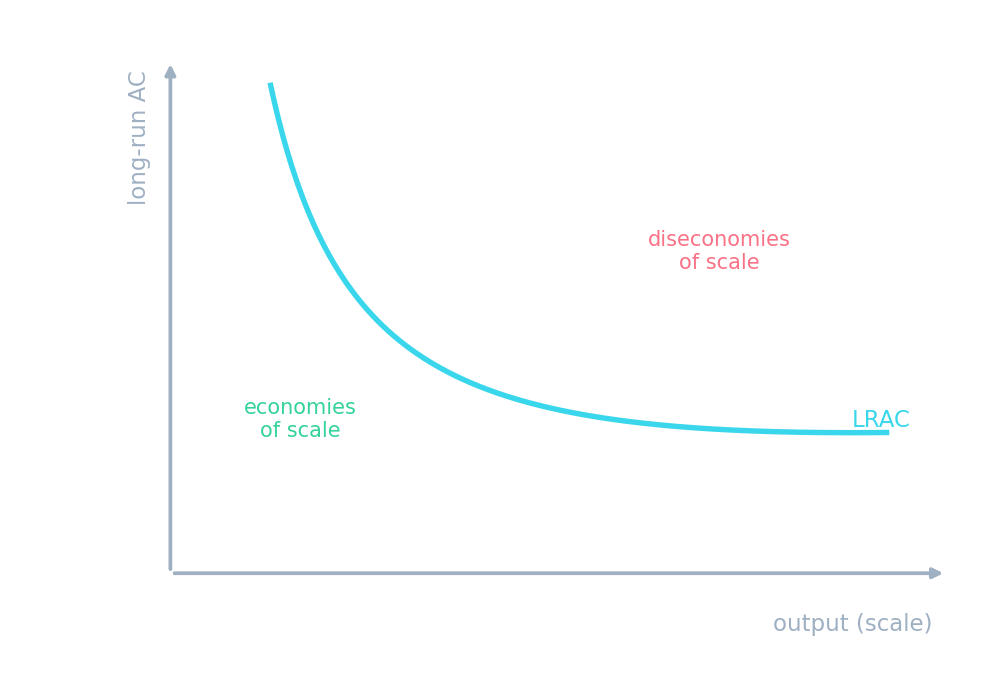
Average cost falls as the firm grows, reaches a minimum, then rises if it grows too large.
Economies of scale
y = ax² + bx + c
平均成本 falls then rises — economies, then diseconomies, of scale.
Which are sources of economies of scale? (Select all that apply.)
难度 2/5 · 今日首次完成可获 140 金币及少量额外奖励
Poor communication is a diseconomy, not an economy.
Sources of economies of scale
- Purchasing 采购: bulk-buying 批量采购 discounts.
- Technical: large, efficient machines spread over more output.
- Financial: big firms borrow more cheaply.
- Managerial: afford specialist managers.
- Marketing: one national TV advert costs less per unit when spread over millions of sales.
- Risk-bearing: a large firm sells many products in many markets, so one failure does less harm.
- These are internal economies: they come from the firm's own growth. External economies come from the whole industry growing in one area: skilled workers, specialist suppliers and good transport nearby (for example, electronics firms around Shenzhen).
Diseconomies of scale cause average cost to:
难度 1/5 · 今日首次完成可获 100 金币及少量额外奖励
Beyond the optimal size, average cost rises again.
When a firm grows so large that average cost rises, it suffers ______ of scale.
难度 1/5 · 今日首次完成可获 100 金币及少量额外奖励
Communication and coordination problems drive diseconomies.
Diseconomies of scale
- Communication breaks down in large organisations.
- Coordination 协调 gets harder and slower.
- Motivation 激励 falls as workers feel like a small cog.
- Firms limit diseconomies by decentralising decisions, splitting into smaller business units with their own managers, and using clear communication systems.
Economies of scale are about average cost, not total cost. Total cost still rises with output — it's the cost per unit that falls. Don't confuse the two.
Economies of scale mean that total cost falls as a firm increases its output.
难度 1/5 · 今日首次完成可获 100 金币及少量额外奖励
False. Economies of scale lower the average cost per unit. Total cost still rises with output; it simply rises more slowly than output does.
Worked example: average cost at two sizes
A bakery makes 2,000 loaves a week at a total cost of £3,000. It expands to 8,000 loaves at £9,600. Later, at 20,000 loaves, total cost is £28,000. Calculate average cost at each size and explain the pattern.
- AC = total cost ÷ output: £3,000 ÷ 2,000 = £1.50; £9,600 ÷ 8,000 = £1.20; £28,000 ÷ 20,000 = £1.40.
- From 2,000 to 8,000 AC falls: economies of scale, for example purchasing (bulk flour) and technical (larger ovens). From 8,000 to 20,000 AC rises: diseconomies, such as poorer communication across several sites and lower motivation.
Total cost is £45,000 for 15,000 units. What is the average cost per unit, in pounds?
难度 2/5 · 今日首次完成可获 140 金币及少量额外奖励
45,000 ÷ 15,000 = £3.
A large firm borrows at a lower interest rate than a small one. This is a:
难度 1/5 · 今日首次完成可获 100 金币及少量额外奖励
Lenders see big firms as less risky.
You've got it
- economies of scale: average cost falls as output rises (purchasing, technical, financial, managerial)
- diseconomies of scale: average cost rises if too large (communication, coordination, motivation)
- it is average (per-unit) cost that falls, not total cost
Write from an average cost of 7
- Average cost falls from 12 to 7 as output rises.
- Say what that fall is called, and what it does not say about total cost.
As a factory increases output, average cost falls from 12 to 7. What is that fall called, and does it mean total cost fell?
A lower cost per unit is an economy of scale.
What is the average cost after the rise in output?
难度 1/5 · 今日首次完成可获 100 金币及少量额外奖励
The per-unit cost fell to 7. Other options — 12 (the original average cost); A lower total cost (which the average does not prove).