| English | 释义 | 拼音 |
|---|---|---|
| genetic engineering/dʒɪˈnetɪk ˌendʒɪˈnɪərɪŋ/ | 基因工程 | jī yīn gōng chéng |
| recombinant DNA/ˌriːˈkɒmbɪnənt ˌdiː en ˈeɪ/ | 重组DNA | chóng zǔ DNA |
| reverse transcriptase/rɪˈvɜːs trænˈskrɪpteɪs/ | 逆转录酶 | nì zhuǎn lù méi |
| plasmid/ˈplæzmɪd/ | 质粒 | zhì lì |
| vector/ˈvektə/ | 媒介 | méi jiè |
| restriction endonuclease/rɪˈstrɪkʃn ˈendəʊnjuːklɪeɪs/ | 限制性内切酶 | xiàn zhì xìng nèi qiè méi |
| sticky ends/ˈstɪki endz/ | 黏性末端 | nián xìng mò duān |
| promoter/prəˈməʊtə/ | 启动子 | qǐ dòng zi |
| marker gene/ˈmɑːkə dʒiːn/ | 标记基因 | biāo jì jī yīn |
| gene editing/dʒiːn ˈedɪtɪŋ/ | 基因编辑 | jī yīn biān jí |
Genetic engineering 基因工程
- Recombinant DNA 重组DNA is DNA joined from two different sources.
- Genetic engineering deliberately changes an organism's genes — often by transferring a gene so it is expressed.
- It uses a clever toolkit of enzymes and carriers.
Recombinant DNA is:
难度 1/5 · 今日首次完成可获 100 金币及少量额外奖励
Recombinant DNA combines DNA from two sources — e.g. a human gene joined into a bacterial plasmid.
Recombinant DNA is made by joining DNA from two different sources (e.g. a human gene into a bacterial plasmid).
难度 1/5 · 今日首次完成可获 100 金币及少量额外奖励
Because the genetic code is universal, a human gene works inside a bacterium that takes it up.
Getting the gene
The gene to transfer can be obtained by:
- cutting it out of a donor's DNA,
- making it from mRNA using reverse transcriptase 逆转录酶,
- building it chemically from nucleotides.
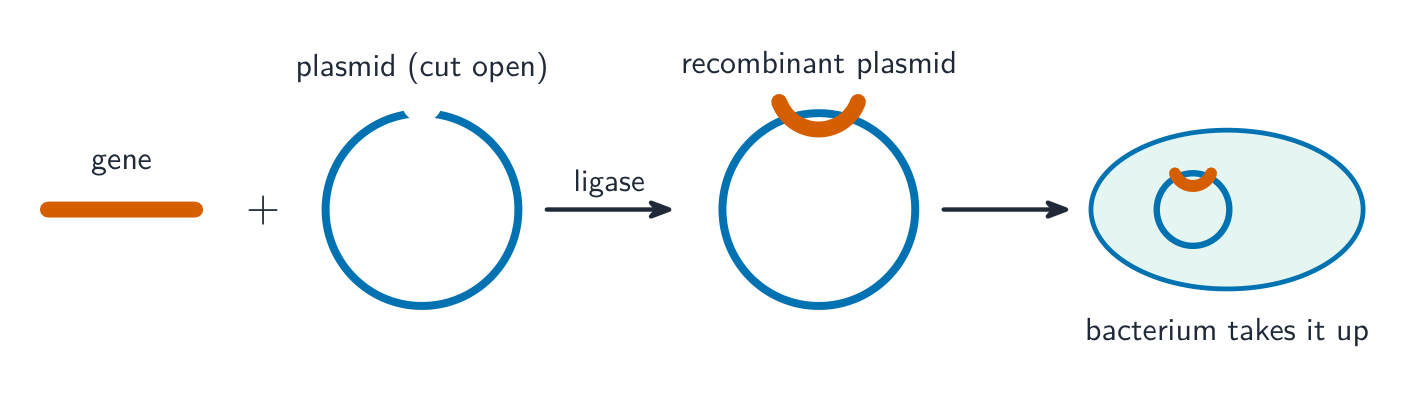
A gene inserted into a plasmid 质粒 vector 媒介 and taken up by a bacterium
The tools of genetic technology
Genetic engineering moves a useful gene into another organism so it makes a desired protein.
Reverse transcriptase is used to:
难度 1/5 · 今日首次完成可获 100 金币及少量额外奖励
Reverse transcriptase builds a DNA copy from mRNA — one way of obtaining the gene to transfer.
The tools
| Tool | Role |
|---|---|
| restriction endonuclease 限制性内切酶 | cuts DNA at a specific sequence, leaving sticky ends 黏性末端 |
| DNA ligase | joins DNA pieces together |
| plasmid | a DNA ring used as a vector to carry the gene into a cell |
| reverse transcriptase | makes DNA from an mRNA template |
- A promoter 启动子 (the "switch") must go in too, or the gene stays silent.
- A marker gene 标记基因 (e.g. one that glows) shows the transfer worked.
Which tool cuts DNA, leaving "sticky ends"?
难度 1/5 · 今日首次完成可获 100 金币及少量额外奖励
Restriction enzymes cut at specific sequences leaving sticky ends; ligase then joins matching ends.
A plasmid is used in genetic engineering as a:
难度 1/5 · 今日首次完成可获 100 金币及少量额外奖励
The plasmid is a cloning vector: the gene is joined into it and the recombinant plasmid is taken up by a cell.
A gene that shows (e.g. by glowing) which cells took up the new gene is a ______ gene.
难度 1/5 · 今日首次完成可获 100 金币及少量额外奖励
A marker gene (e.g. coding for a fluorescent product) reveals which cells were successfully transformed.
Match each tool to its job.
难度 2/5 · 今日首次完成可获 140 金币及少量额外奖励
Cut with restriction enzymes, join with ligase, carry with a plasmid vector; reverse transcriptase makes the gene from mRNA.
Gene editing 基因编辑
- Gene editing is a precise form of genetic engineering.
- It inserts, deletes or replaces DNA at an exact site in the genome.
Worked example: making human insulin in bacteria
Outline how the gene for human insulin is put into E. coli so the bacteria make insulin.
- Get the gene: take insulin mRNA from pancreas β cells and use reverse transcriptase to make cDNA (with no introns, which bacteria could not remove). Add a bacterial promoter. Cut a plasmid with the same restriction enzyme, so their sticky ends are complementary, and join them with DNA ligase.
- Put the recombinant plasmids into bacteria. Only a few take them up, so a marker gene (for example, one for a fluorescent protein) identifies the transformed bacteria, which are grown in fermenters and make insulin.
Why is the insulin gene made from mRNA rather than cut from human DNA?
难度 1/5 · 今日首次完成可获 100 金币及少量额外奖励
mRNA has already had its introns removed.
Cutting the plasmid and the gene with the same restriction enzyme gives complementary sticky ends.
难度 1/5 · 今日首次完成可获 100 金币及少量额外奖励
The single-stranded overhangs can then base-pair.
You've got it
- recombinant DNA = DNA joined from two sources; genetic engineering transfers a gene to be expressed
- get the gene by cutting it out, reverse transcriptase (from mRNA), or synthesis
- tools: restriction enzyme (sticky ends), ligase (join), plasmid vector, plus a promoter + marker gene
- gene editing = precise insert/delete/replace at an exact site
Write from this case
- A wanted gene is cut out of a donor genome.
- The same enzyme cuts a plasmid.
What enzyme makes the cuts?
Restriction enzymes recognise a sequence and cut there.
What cuts the DNA at a specific sequence?
难度 1/5 · 今日首次完成可获 100 金币及少量额外奖励
The restriction enzyme is the cutting tool.