| English | 释义 | 拼音 |
|---|---|---|
| closed double circulation/kləʊzd ˈdʌbl ˌsɜːkjʊˈleɪʃn/ | 闭锁双循环 | bì suǒ shuāng xún huán |
| pulmonary circulation/ˈpʌlmənəri ˌsɜːkjʊˈleɪʃn/ | 肺循环 | fèi xún huán |
| systemic circulation/sɪˈstemɪk ˌsɜːkjʊˈleɪʃn/ | 体循环 | tǐ xún huán |
| vein/veɪn/ | 静脉 | jìng mài |
| artery/ˈɑːtəri/ | 动脉 | dòng mài |
| aorta/eɪˈɔːtə/ | 主动脉 | zhǔ dòng mài |
| lumen/ˈluːmen/ | 管腔 | guǎn qiāng |
| capillary/kəˈpɪləri/ | 毛细血管 | máo xì xuè guǎn |
The body's transport network
- Mammals have a closed double circulation 闭锁双循环.
- Closed: blood stays inside vessels the whole time.
- Double: blood passes through the heart twice per full trip.
A "closed double circulation" means that:
难度 1/5 · 今日首次完成可获 100 金币及少量额外奖励
Closed = blood always in vessels; double = it passes through the heart twice (pulmonary then systemic).
Two loops
- The pulmonary circulation 肺循环 carries blood from the heart to the lungs and back.
- The systemic circulation 体循环 carries blood from the heart to the rest of the body and back.
- Blood flows: arteries → arterioles → capillaries → venules → veins 静脉.
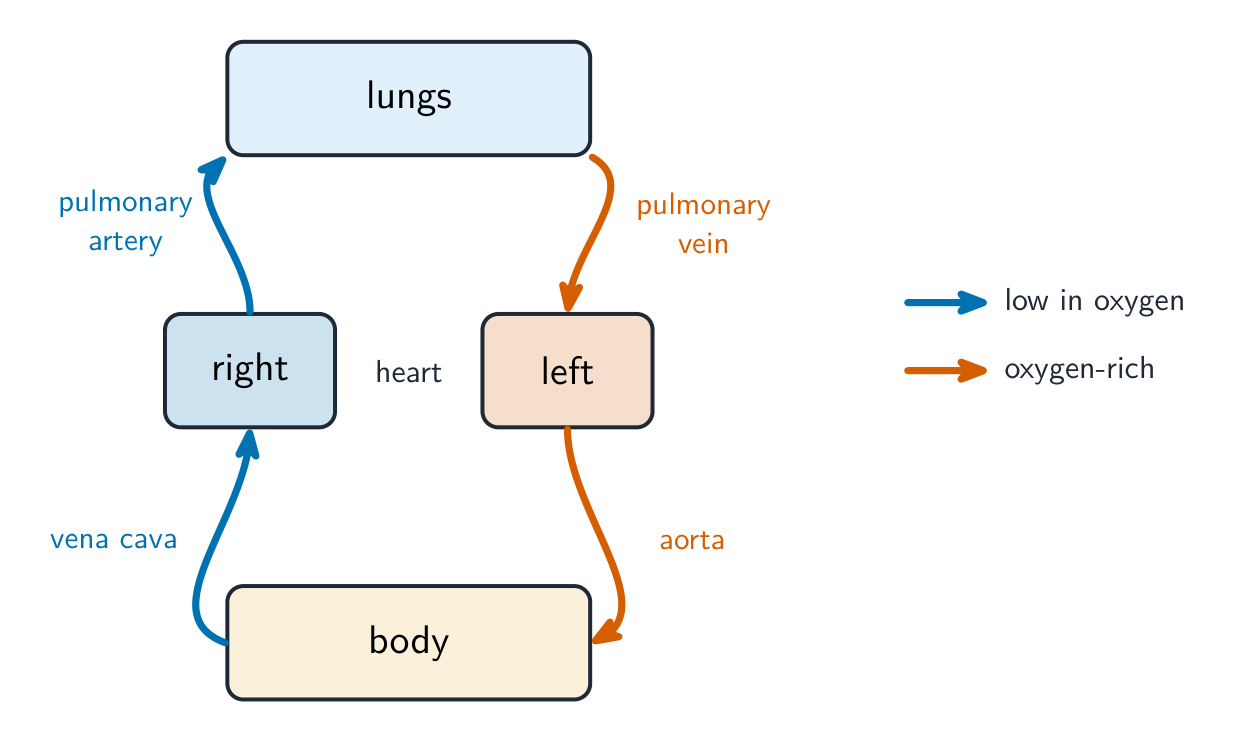
Closed double circulation through the heart, lungs and body
Double circulation
Follow one red blood cell around the loop. It passes through the heart twice each circuit — once to the lungs, once to the body.
The circulation that carries blood from the heart to the lungs and back is the ______ circulation.
难度 1/5 · 今日首次完成可获 100 金币及少量额外奖励
Pulmonary = to the lungs; systemic = to the rest of the body.
Why two loops are better than one
- Lung capillaries are very thin and delicate. In the pulmonary loop the right ventricle pumps at low pressure, so the capillaries are not damaged and tissue fluid does not flood the alveoli.
- Blood then returns to the heart, and the left ventricle pumps it out again at high pressure. This drives blood quickly to every organ, which mammals need for their high metabolic rate. In a fish's single circulation, pressure falls in the gills and stays low.
Why is it an advantage that blood returns to the heart after the lungs?
难度 1/5 · 今日首次完成可获 100 金币及少量额外奖励
Pressure falls in the lung capillaries; the left ventricle pumps it out again at high pressure to the body.
The main vessels
- pulmonary artery 动脉 — heart → lungs (low oxygen).
- pulmonary vein — lungs → heart (oxygen-rich).
- aorta 主动脉 — heart → body (oxygen-rich).
- vena cava — body → heart (oxygen-poor).
Vessels suited to their jobs
| Vessel | Wall | Why |
|---|---|---|
| artery 动脉 | thick, with elastic fibres and smooth muscle; narrow lumen 管腔 | withstands high pressure |
| arteriole 小动脉 | lots of smooth muscle | contracts or relaxes to control flow to an organ |
| capillary 毛细血管 | one cell thick (endothelium) | short diffusion distance |
| vein 静脉 | thin, wide lumen, valves | low pressure; valves stop backflow |
- Elastic fibres in artery walls stretch when the ventricle contracts and recoil between beats. This keeps blood moving and evens out the pressure.
- Veins are squeezed by the skeletal muscles around them. Their valves make sure the blood can only move towards the heart.
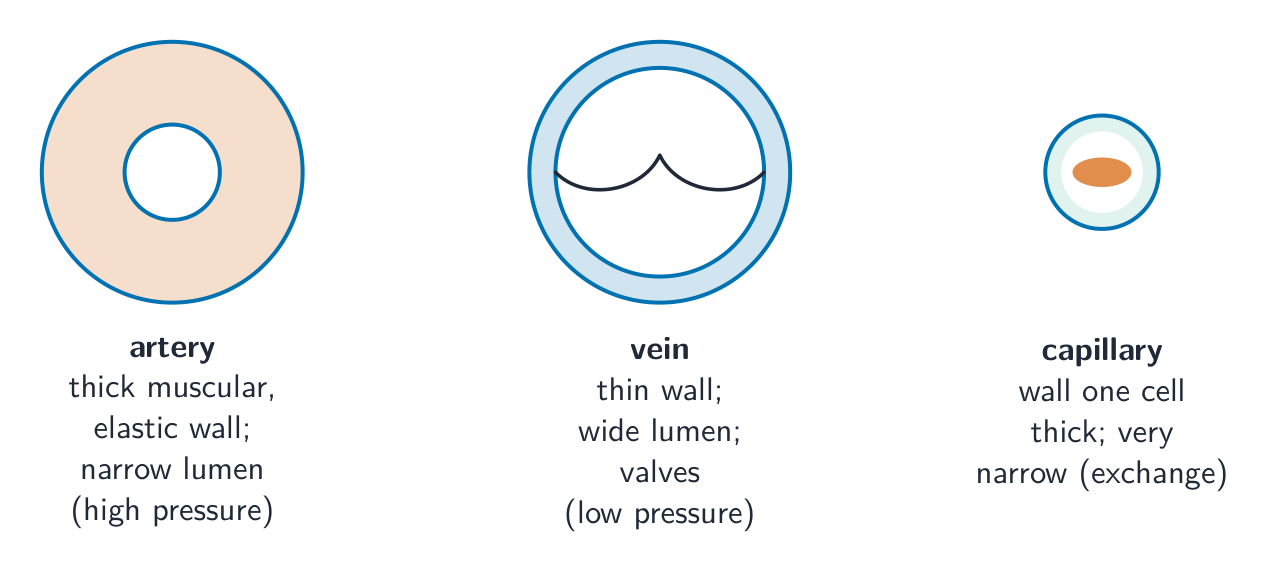
Cross-sections of an artery (thick wall), vein (wide lumen, valves) and capillary (one cell thick)
Match each vessel to its feature.
难度 2/5 · 今日首次完成可获 140 金币及少量额外奖励
Arteries carry high-pressure blood away; veins return it (valves stop backflow); capillaries are where exchange happens.
Arteries have thick, elastic, muscular walls because they:
难度 1/5 · 今日首次完成可获 100 金币及少量额外奖励
High-pressure blood leaving the heart needs strong walls that stretch and recoil to smooth the flow.
Arteries contain valves because their blood is at low pressure.
难度 1/5 · 今日首次完成可获 100 金币及少量额外奖励
False. Veins carry blood at low pressure and contain valves to stop backflow. Arteries carry high-pressure blood and have no valves along their length.
A capillary wall is just one cell thick because this:
难度 1/5 · 今日首次完成可获 100 金币及少量额外奖励
A one-cell-thick wall means a short diffusion distance, so substances exchange quickly.
Pressure along the circulation
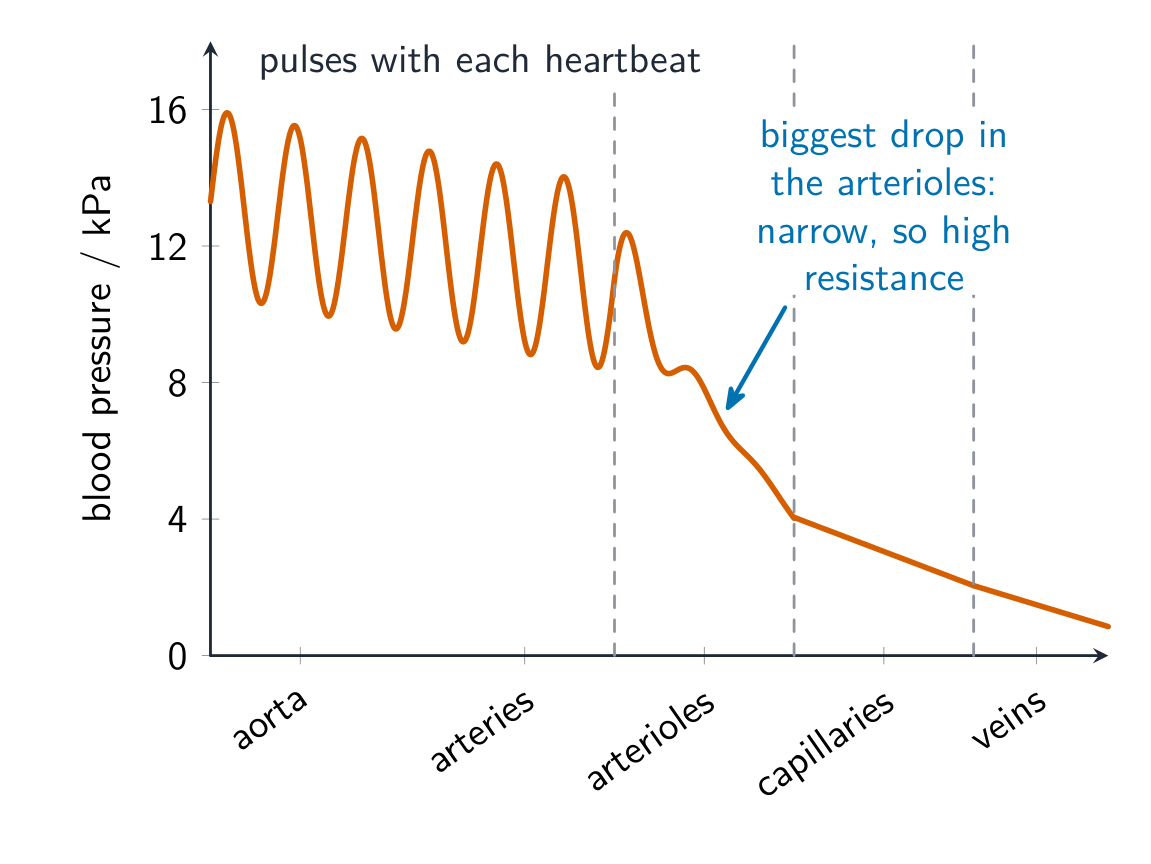
- Pressure is highest in the aorta and pulses with each heartbeat. Elastic recoil makes the pulse smaller as blood moves away from the heart.
- The biggest drop is in the arterioles: they are narrow, so they resist flow. By the capillaries the pressure is low and steady, which suits exchange. In veins it is lowest of all.
Which vessels carry blood away from the heart?
Artery means away from the heart in this course.
In which vessels does blood pressure fall the most?
难度 1/5 · 今日首次完成可获 100 金币及少量额外奖励
Arterioles are narrow and resist flow, so pressure drops most there.
Worked example: tracing a red blood cell
A red blood cell leaves a capillary in a muscle of the leg. Trace its route until it next returns to the leg, naming the vessels and heart chambers.
- Leg capillary → venule → vein → vena cava → right atrium → right ventricle → pulmonary artery → lung capillaries (picks up oxygen) → pulmonary vein → left atrium.
- → left ventricle → aorta → artery → arteriole → leg capillary. It passed through the heart twice, once in each loop: this is double circulation.
Which vessel carries oxygen-rich blood from the lungs to the heart?
难度 1/5 · 今日首次完成可获 100 金币及少量额外奖励
Veins carry blood to the heart; this one comes from the lungs.
Every artery carries oxygen-rich blood.
难度 1/5 · 今日首次完成可获 100 金币及少量额外奖励
The pulmonary artery carries oxygen-poor blood to the lungs.
Worked exam question: the artery wall
Question (4 marks). Explain how the structure of the wall of an artery is related to its function.
- The wall is thick, so it can withstand the high pressure of blood from the ventricles without bursting (1 mark).
- It contains elastic fibres, which stretch when the ventricle contracts and recoil between beats (1 mark).
- This recoil evens out the pressure surges and keeps blood flowing (1 mark).
- Smooth muscle in the wall can contract to narrow the lumen and control blood flow, and the smooth endothelium reduces friction (1 mark).
Why answers lose marks: "the muscle pumps the blood". Arteries do not pump: only the heart does. Also, "elastic fibres let the artery stretch" earns nothing without recoil.
Without looking back: explain how the structure of a vein is related to its function (3 marks).
Compare with the artery answer: every feature links to the pressure.
You've got it
- closed double circulation: blood in vessels, through the heart twice
- pulmonary loop = lungs; systemic loop = body
- double circulation: low pressure to the lungs, high pressure to the body
- artery: thick, elastic (stretch and recoil); arteriole: muscle controls flow; vein: valves, low pressure
- pressure pulses in arteries, drops most in arterioles, is low in capillaries and lowest in veins
- capillary: one cell thick → fast exchange
Which vessels leave the heart?
难度 1/5 · 今日首次完成可获 100 金币及少量额外奖励
Arteries carry blood away. Veins bring it back.