The universe and its history
The universe is billions of galaxies; each galaxy is billions of stars; the Sun is one star in the Milky Way. Gravity shapes every orbit in it, stars are born and die in patterns set by their mass, and the red-shift of distant galaxies tells us the whole universe is expanding — evidence for a beginning: the Big Bang.
Edexcel International GCSE Physics 4PH1, Section 8 (statements 8.1–8.18P). P-suffixed statements are the Physics-only extension (Paper 2P).
Motion in the universe
Universe 宇宙 → billions of galaxies 星系 → each billions of stars → our solar system lies in the Milky Way. Gravitational field strength g varies with mass and size — weaker on the Moon, stronger on Jupiter. Gravity holds every orbit: moons orbit planets, planets and comets orbit the Sun, artificial satellites orbit the Earth.
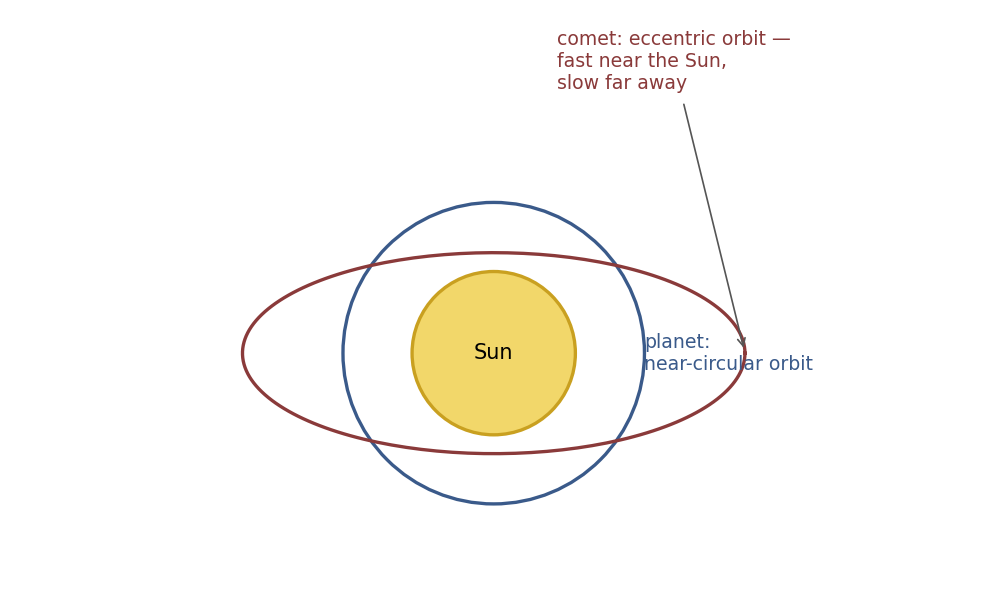
Planetary orbits are nearly circular; comet orbits are highly eccentric — fast near the Sun, slow far away. Orbital speed comes from circumference ÷ period:
Worked check. A satellite at orbital radius 7000 km (r measured from Earth's centre) with period 5800 s: $v = 2\pi \times 7.0 \times 10^6/5800 \approx 7580$ m/s ≈ 7.6 km/s.
Stellar evolution
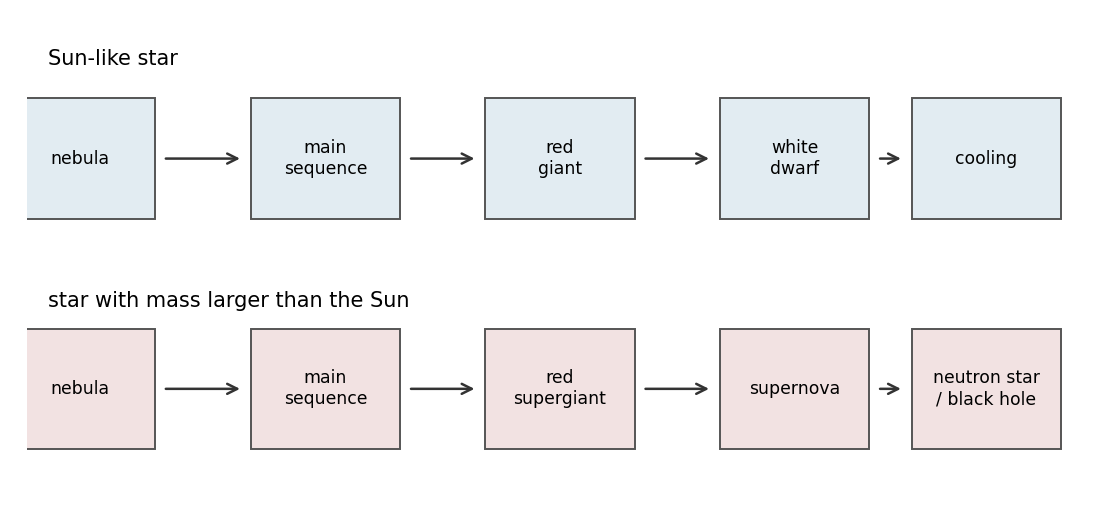
Stars are classified by colour, which follows surface temperature: blue hottest → red coolest. A Sun-like star runs nebula → main sequence (fusion balances gravity for billions of years) → red giant → white dwarf; a star more massive than the Sun runs nebula → main sequence → red supergiant → supernova → neutron star or black hole.
(P) A star's brightness is compared using absolute magnitude at a standard distance; the Hertzsprung–Russell diagram plots absolute magnitude against temperature, with the main sequence, giants and white dwarfs as its main bands.
Cosmology (P)
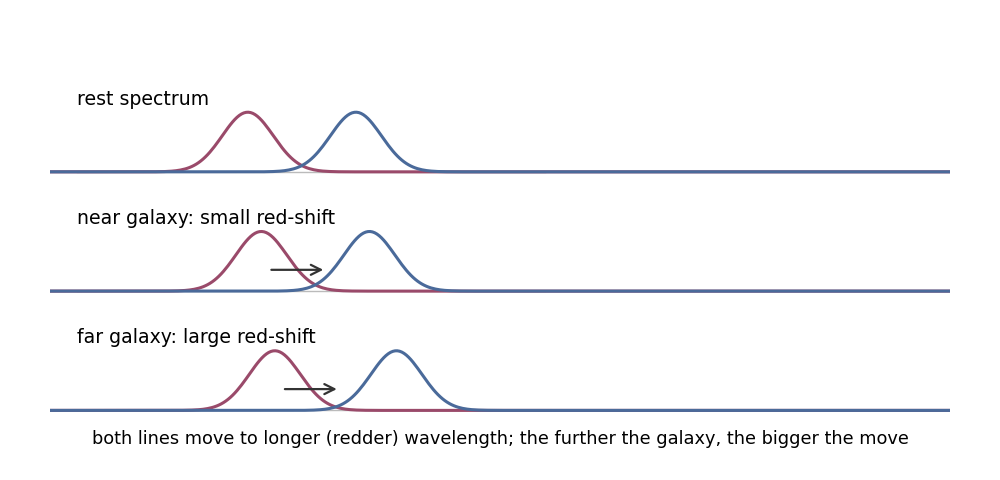
A moving wave source changes the observed wavelength (red-shift 红移 for recession). Galaxy red-shift grows with distance, and the relationship is quantified as:
Worked check. A spectral line at 500 nm appears at 505 nm in a distant galaxy: $\Delta\lambda/\lambda_0 = 5/500 = 0.01$, so $v = 0.01c = 3000$ km/s.
Red-shift increasing with distance means the galaxies are receding faster the further they are — the universe is expanding, which points back to a hot, dense beginning: the Big Bang 大爆炸. The cosmic microwave background (CMB) — faint microwaves from every direction — is the cooled remnant of that early radiation, the second pillar of evidence.
Check yourself
- Put in order of size: galaxy, solar system, universe, star.
- Why does g differ between the Earth and the Moon?
- Name the two orbit shapes of comets and planets.
- Calculate the orbital speed of a satellite at r = 42 000 km with T = 24 hours.
- State the two stages after the main sequence for a Sun-like star.
- What does a star's colour tell you?
- (P) Which two quantities does the HR diagram plot?
- (P) A line at 400 nm shifts to 404 nm. Calculate v/c.
- (P) State the two pieces of evidence for the Big Bang.
- (P) Why does red-shift increase with distance?
Answers: 1 star (smallest) → solar system → galaxy → universe (largest); 2 g depends on the body's mass and radius — the Moon is smaller and less massive, so its g is about 1.6 N/kg; 3 planets — nearly circular; comets — highly eccentric ellipses; 4 $r = 4.2 \times 10^7$ m, $T = 86\,400$ s; $v = 2\pi \times 4.2\times10^7/86\,400 \approx 3060$ m/s ≈ 3.1 km/s; 5 red giant, then white dwarf; 6 its surface temperature — blue hottest, red coolest; 7 (P) absolute magnitude against temperature (or colour); 8 (P) $\Delta\lambda/\lambda_0 = 4/400 = 0.01 = v/c$; 9 (P) the red-shift of galaxies increasing with distance, and the cosmic microwave background radiation; 10 (P) the further the galaxy, the faster it recedes — space itself expands, so recession speed grows with distance, shifting the light further to the red.