Matter under pressure
The same substance can be solid, liquid or gas, and its molecules never stop moving. This section measures matter: density and pressure, the (P) energy needed to heat or melt things, and the ideal-gas behaviour that links pressure, volume and temperature.
Edexcel International GCSE Physics 4PH1, Section 5 (statements 5.1–5.22). Units include the pascal (Pa), kelvin (K) and (P) J/kg °C.
Density and pressure
Density is measured directly — mass on a balance, volume by displacement (irregular solid) or dimensions (regular shape). Pressure in a fluid at rest acts equally in all directions, and the pressure difference between two depths comes from the weight of fluid between them.
Worked check. A diver at 10 m in water ($\rho = 1000\ \mathrm{kg/m^3}$, $g = 10$ N/kg): pressure difference $= 10 \times 1000 \times 10 = 100\,000$ Pa on top of atmospheric pressure.
Change of state (P)
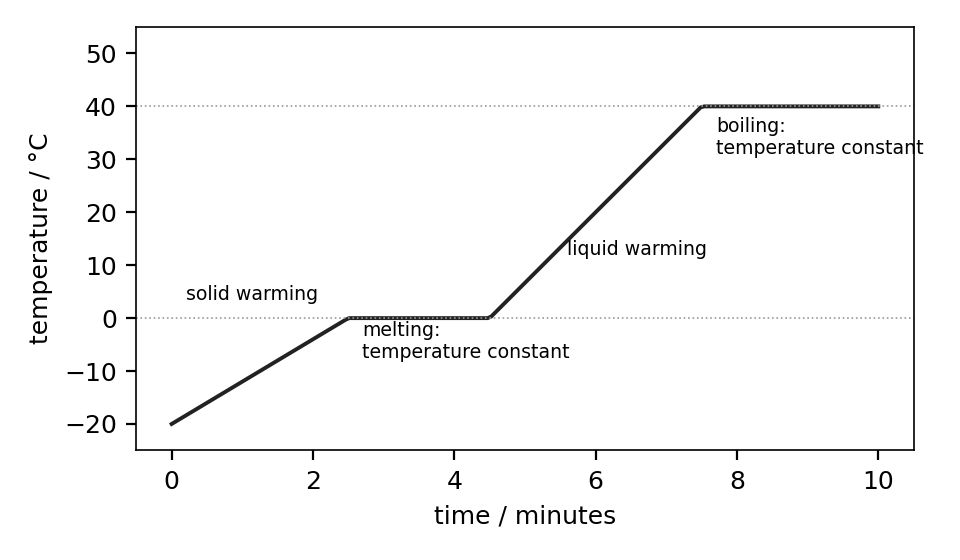
Heating raises the energy stored in a system — either its temperature rises, or at a melting point or boiling point the extra energy breaks bonds while the temperature stays constant. Particles: solids vibrate about fixed points; liquids move randomly but touch; gases move fast, far apart, in straight lines between collisions. Specific heat capacity 比热容 is the energy needed to raise 1 kg by 1 °C:
Worked check. Heating 2 kg of water ($c = 4200\ \mathrm{J/(kg\ °C)}$) by 30 °C: $\Delta Q = 2 \times 4200 \times 30 = 252\,000$ J.
Ideal gas molecules
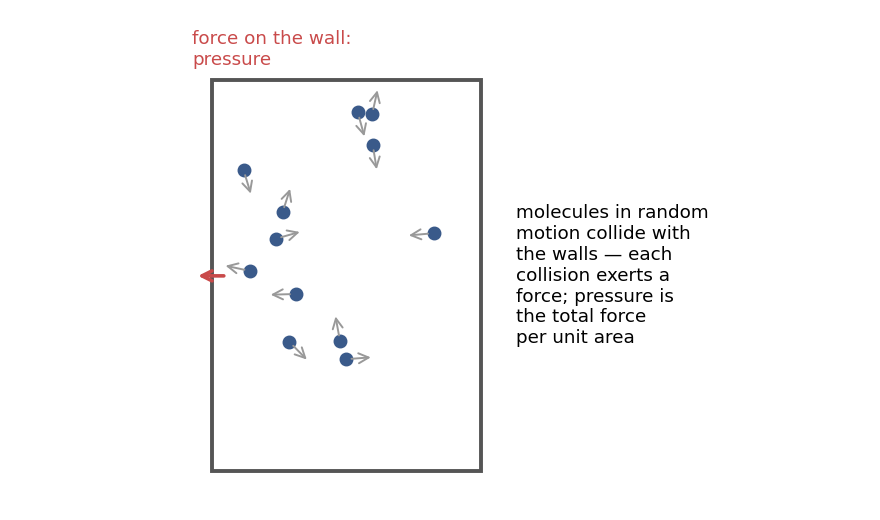
Gas molecules move randomly, exerting force — and so pressure — on the walls at every collision. Absolute zero 绝对零度 (−273 °C) is the temperature at which molecular kinetic energy is minimum: K = °C + 273. Higher temperature → faster average molecular speed, and the Kelvin temperature is proportional to the average kinetic energy of the molecules.
For a fixed mass of gas: at constant temperature, pressure × volume is constant (squeeze it and the molecules hit the walls more often); at constant volume, pressure/T (K) is constant (hotter molecules hit harder):
Worked check. A gas at 100 kPa and 300 K is heated (constant volume) to 450 K: $p_2 = 100 \times 450/300 = 150$ kPa. Squashed from 2 dm³ to 0.5 dm³ at constant temperature: $p_2 = 100 \times 2/0.5 = 400$ kPa.
Check yourself
- A 240 g block has volume 40 cm³. Calculate its density in kg/m³.
- State the pressure equation and its unit.
- Calculate the pressure under a 500 N boot heel of area 0.01 m².
- (P) What stays constant in a substance's temperature while it melts?
- (P) Calculate the energy to heat 0.5 kg of aluminium (c = 900 J/(kg °C)) by 40 °C.
- Convert 27 °C to kelvin, and 373 K to °C.
- Why does a gas exert pressure on its container?
- What happens to average molecular speed as temperature rises?
- A gas at 120 kPa in 3 dm³ is compressed to 1 dm³ at constant temperature. Find the new pressure.
- State two conditions that make a gas's pressure double.
Answers: 1 $m = 0.24$ kg, $V = 4.0 \times 10^{-5}\ \mathrm{m^3}$; $\rho = 0.24/4.0\times10^{-5} = 6000\ \mathrm{kg/m^3}$; 2 $p = F/A$, in pascals (N/m²); 3 $p = 500/0.01 = 50\,000$ Pa; 4 (P) temperature — the energy goes to breaking intermolecular bonds, not to faster molecules; 5 (P) $\Delta Q = 0.5 \times 900 \times 40 = 18\,000$ J; 6 300 K; 100 °C; 7 its molecules collide with the walls, each collision exerting a force; the total force per unit area is the pressure; 8 it increases; 9 $p_2 = 120 \times 3/1 = 360$ kPa; 10 doubling the Kelvin temperature at constant volume, or halving the volume at constant temperature.