Magnetism to mains
A magnet moves, and current appears in a wire kilometres away. This section builds that chain: permanent magnets and field patterns, the magnetic effect of a current, the motor force with its left-hand rule, induction in coils and generators, and (P) the transformers that move electrical energy across a country.
Edexcel International GCSE Physics 4PH1, Section 6 (statements 6.1–6.20P). P-suffixed statements are the Physics-only extension.
Magnetism
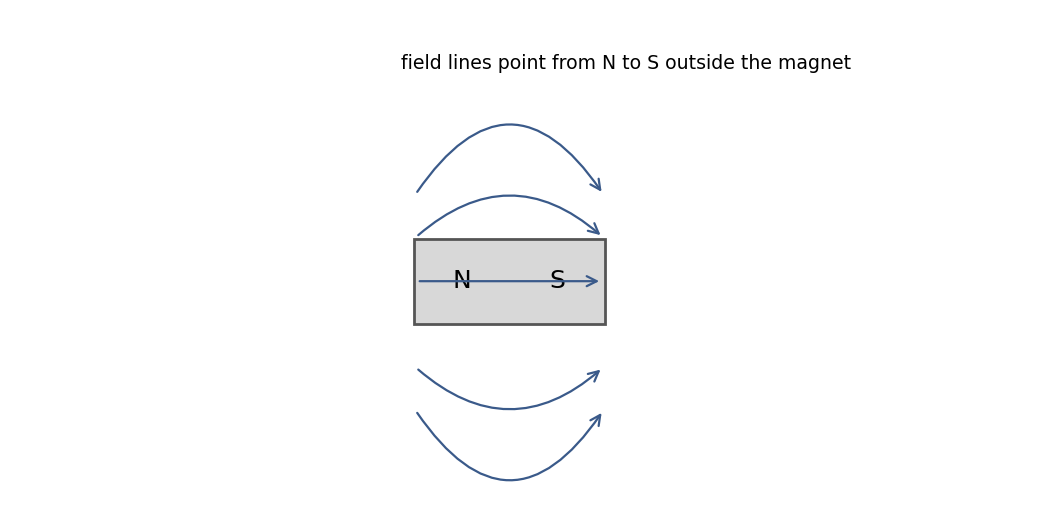
Magnets repel like poles and attract unlike ones, and attract magnetic materials (iron, steel, nickel, cobalt). Magnetically hard materials (steel) keep their magnetism — permanent magnets; soft materials (iron) magnetise and demagnetise easily — electromagnet cores. Field lines 磁感线 point from N to S outside a magnet (never cross); magnetism is induced in a magnetic material placed in a field. Two unlike poles facing each other give a uniform field 匀强磁场 between them.
Electromagnetism and the motor effect
A current in a conductor creates a magnetic field around it — concentric circles, right-hand grip rule. (P) Electromagnets: a coil (solenoid) 螺线管 around a soft-iron core, switchable and adjustable. (P) Field patterns for a straight wire, flat coil and solenoid.
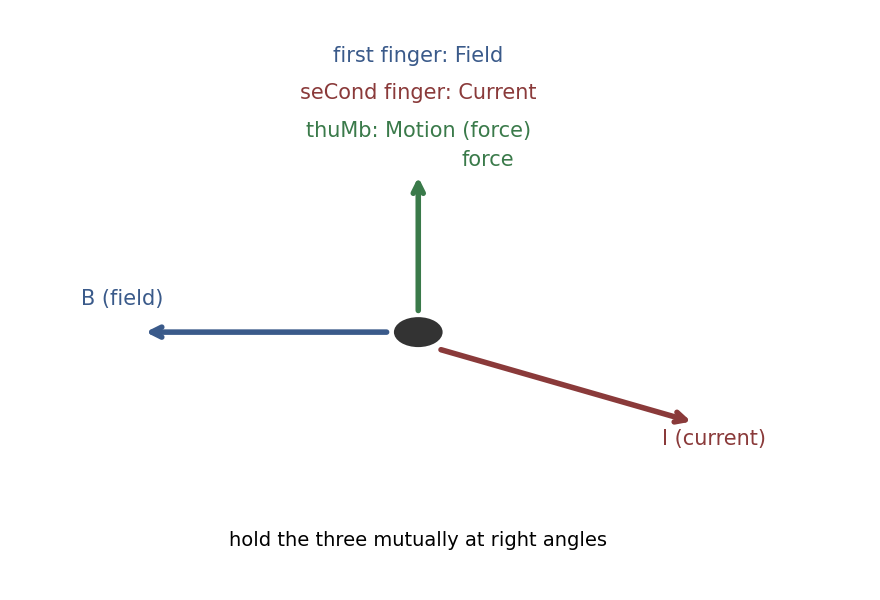
A wire carrying current across a magnetic field feels a force — the motor effect, used in d.c. motors (rotating coil + commutator) and loudspeakers. Predict the direction with the left-hand rule 左手定则: first finger Field, seCond finger Current, thuMb Motion. The force grows with stronger field and larger current, and reverses if either reverses.
Electromagnetic induction
A voltage is induced 感生 in a conductor or coil when it moves through a magnetic field or when the field through it changes. The induced voltage is larger with faster movement, a stronger field, more turns and (for generators) faster rotation. Generators rotate a magnet inside a coil (or a coil inside a magnet) — the size and frequency of the induced a.c. follow the rotation.
(P) Transformers change an alternating voltage using two coils on an iron core:
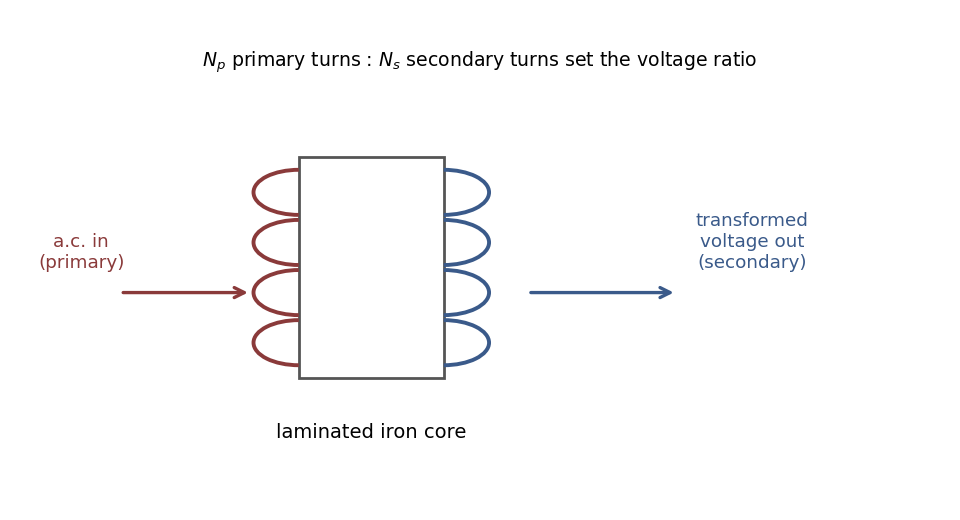
Step-up transformers raise the voltage (and cut the current) for transmission — high voltage means low current, so far less energy lost as heat in the cables; step-down transformers bring it back to safe levels for use.
Worked check. A transformer has 200 primary turns and 50 secondary turns; the primary is 230 V. $V_s = 230 \times 50/200 = 57.5$ V — a step-down. If the primary current is 0.5 A: $I_s = 230 \times 0.5/57.5 = 2.0$ A.
Check yourself
- State two differences between magnetically hard and soft materials.
- In which direction do field lines point outside a magnet?
- Describe how to produce a uniform magnetic field with two bar magnets.
- What does a current in a wire create around it?
- State the left-hand rule's three fingers.
- Name two factors that increase the force on a current-carrying wire in a field.
- State two ways to induce a voltage in a coil.
- Name two factors that increase the size of an induced voltage.
- (P) A step-down transformer has 1000 primary and 100 secondary turns; input 230 V. Calculate the output.
- (P) Why is electricity transmitted at high voltage?
Answers: 1 hard keeps its magnetism (permanent magnets, steel); soft loses it easily (temporary, iron — electromagnet cores); 2 from N to S; 3 place N and S poles facing each other with a gap — the parallel field lines between them are uniform; 4 a magnetic field of concentric circles (grip rule); 5 first finger Field, second finger Current, thumb Motion; 6 stronger field; larger current.
Answers continued: 7 move the coil or magnet so the coil cuts field lines, or change the field through a stationary coil; 8 faster movement; stronger magnet; more turns; 9 (P) $V_s = 230 \times 100/1000 = 23$ V; 10 (P) high voltage gives low current for the same power; cable heating is $I^2R$, so losses fall sharply over long distances.