Waves: energy that travels
Ripples cross a pond, light crosses a room, sound crosses air — waves carry energy and information without transferring matter. This section gives you their vocabulary and equations, the electromagnetic spectrum with its uses and dangers, and the behaviour of light and (P) sound: reflection, refraction and total internal reflection.
Edexcel International GCSE Physics 4PH1, Section 3 (statements 3.1–3.29P). Units: degree (°), hertz (Hz), metre (m), m/s, second (s).
Properties of waves
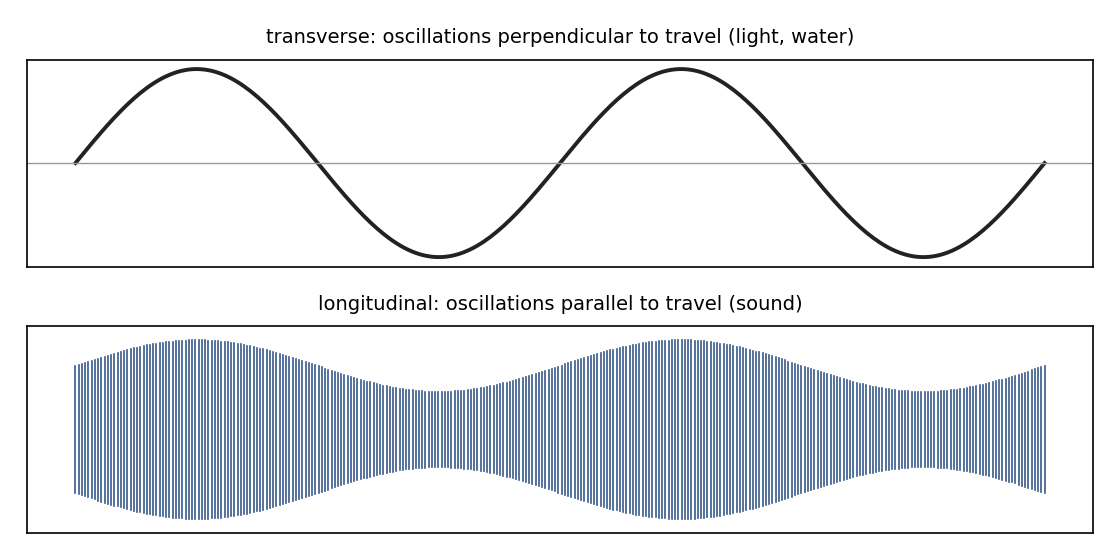
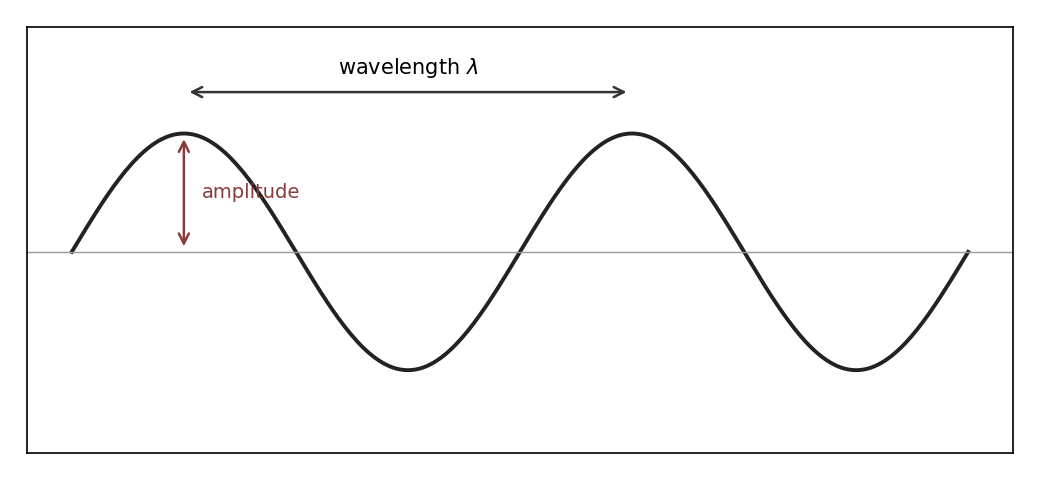
Transverse waves 横波 oscillate perpendicular to travel (light, water). Longitudinal waves 纵波 oscillate along the travel direction as compressions and rarefactions (sound). Vocabulary: amplitude 振幅 (maximum displacement), wavelength λ 波长 (one crest to the next), frequency f 频率 (waves per second, Hz), period T (time per wave), wavefront (a line of simultaneous crests).
Worked check. A 340 Hz sound wave at 340 m/s: $\lambda = 340/340 = 1$ m; period $= 1/340 \approx 2.9$ ms. The Doppler effect 多普勒效应: a source moving towards an observer bunches wavefronts — higher observed frequency; moving away stretches them — lower.
The electromagnetic spectrum
One family, same speed in free space, ordered by decreasing wavelength (increasing frequency): radio → microwave → infrared → visible (red to violet) → ultraviolet → X-ray → gamma.
| Radiation | Use | Danger |
|---|---|---|
| radio | broadcasting, communications | — |
| microwave | cooking, satellite TV | internal heating of tissue |
| infrared | heaters, night vision | skin burns |
| visible | optical fibres, photography | — |
| ultraviolet | fluorescent lamps | damage to surface cells, blindness |
| X-ray | imaging inside objects/bodies | cancer, mutation (ionising) |
| gamma | sterilising food and equipment | cancer, mutation |
Protection: limit exposure time, shielding, sun cream (UV).
Light and sound
Light is transverse and reflects and refracts. Law of reflection: angle of incidence = angle of reflection. Refraction 折射: entering glass (optically denser), light slows and bends towards the normal; leaving, it bends away.
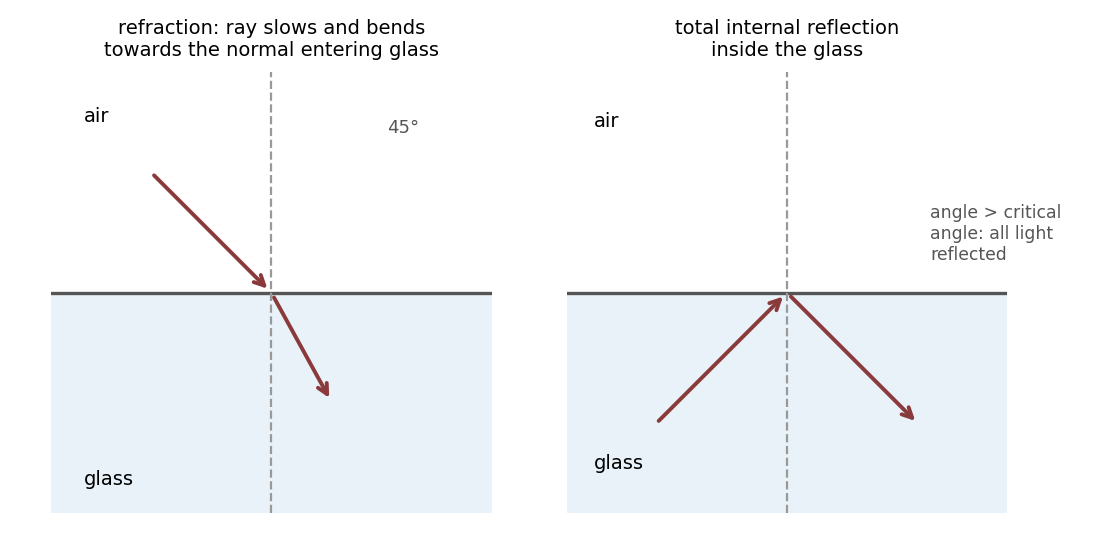
Total internal reflection 全内反射 happens when the angle inside the denser medium exceeds the critical angle 临界角 — the principle of optical fibres (communications, endoscopes) and prisms in periscopes.
Worked check. Glass with $n = 1.5$: $\sin c = 1/1.5 = 0.667$, so $c \approx 41.8°$. A ray inside the glass hitting the boundary at 45° exceeds 41.8° — totally internally reflected.
(P) Sound is longitudinal, 20–20 000 Hz for human hearing; pitch rises with frequency, loudness with amplitude. An oscilloscope with a microphone displays the wave; practicals time echoes or resonances to find the speed of sound in air.
Check yourself
- Give one similarity and one difference between transverse and longitudinal waves.
- Define amplitude, wavelength and frequency.
- A wave of frequency 500 Hz travels at 340 m/s. Calculate its wavelength.
- State the order of the electromagnetic spectrum by increasing frequency.
- Give one use each of microwaves, infrared and gamma rays, and one danger of UV.
- State the law of reflection.
- Which way does light bend entering glass, and leaving it?
- Glass has n = 1.5. Calculate the critical angle.
- (P) State the human hearing frequency range, and what raises pitch and loudness.
- (P) How does an oscilloscope trace change when a sound gets louder at the same pitch?
Answers: 1 both transfer energy without transferring matter; transverse oscillates across the travel direction (light), longitudinal along it as compressions (sound); 2 amplitude — maximum displacement from the rest position; wavelength — distance between successive identical points; frequency — number of waves passing per second; 3 $\lambda = 340/500 = 0.68$ m; 4 radio, microwave, infrared, visible, ultraviolet, X-ray, gamma; 5 microwaves — cooking/satellite; infrared — heaters/night vision; gamma — sterilising; UV damages surface cells and can blind; 6 angle of incidence = angle of reflection; 7 towards the normal entering, away from the normal leaving; 8 $\sin c = 1/1.5$, $c \approx 41.8°$; 9 (P) 20–20 000 Hz; higher frequency raises pitch, larger amplitude raises loudness; 10 (P) the trace's peaks grow taller (amplitude) while the number of cycles per second (frequency) stays the same.