Energy: stored, transferred, wasted
Nothing uses energy up — energy only moves between stores and leaks along the way. This section names the stores and transfers, measures efficiency 效率 with Sankey diagrams 桑基图, follows heat by conduction, convection and radiation, links work, GPE and kinetic energy, and (P) weighs how electricity is generated.
Edexcel International GCSE Physics 4PH1, Section 4 (statements 4.1–4.19P). Units: joule (J), watt (W), newton (N), and (P) J/kg °C.
Energy transfers
Eight stores: chemical, kinetic, gravitational, elastic, thermal, magnetic, electrostatic, nuclear. Four transfer pathways: mechanically, electrically, by heating, by radiation (light and sound). Energy is conserved — the total is unchanged; devices just divert part of it from the store we want to ones we do not.
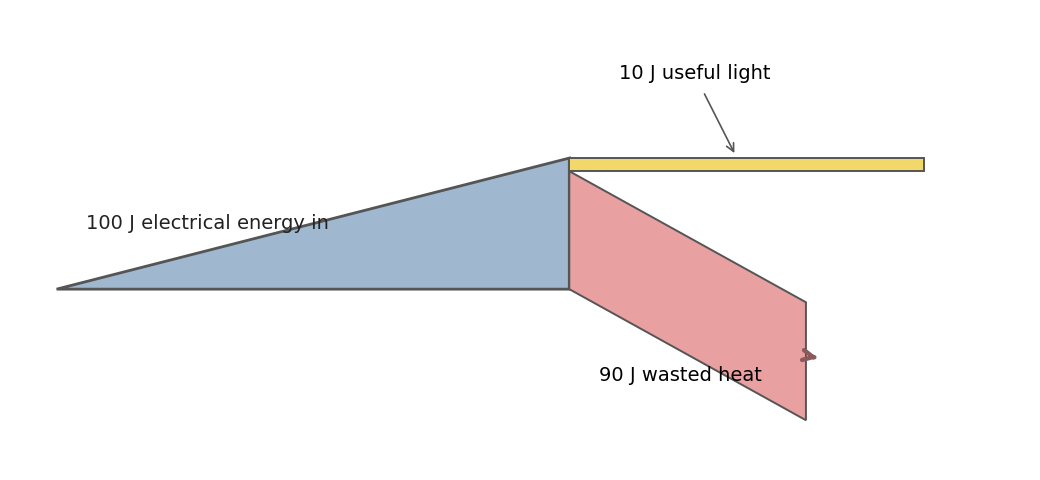
Worked check. The lamp above: efficiency $= 10/100 \times 100 = 10\%$.
Thermal energy transfer
Heat moves three ways, each with its own mechanism and each beaten by a different defence.
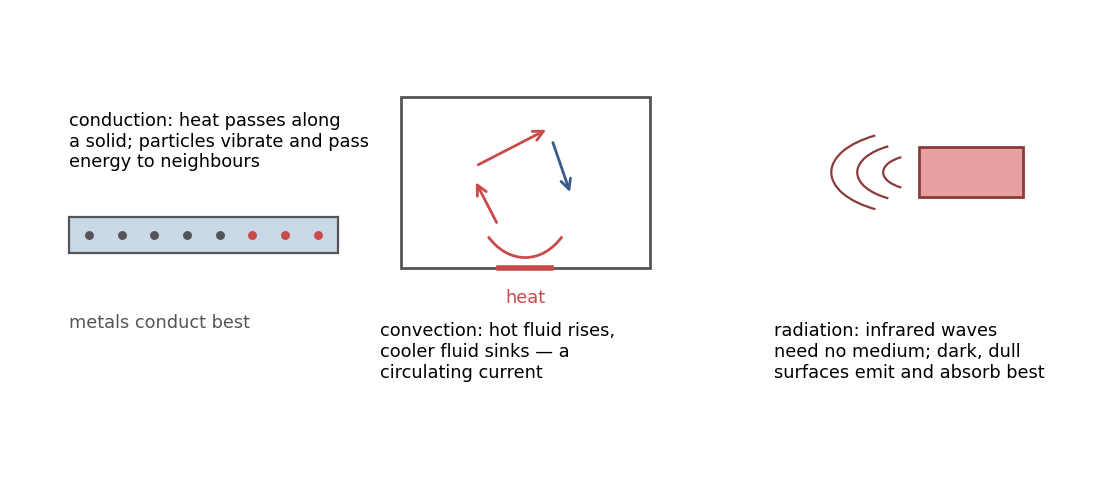
Conduction 传导: particle vibrations pass energy along a solid — fast in metals (free electrons). Convection 对流: fluid warms, expands, becomes less dense and rises; cooler fluid sinks to replace it — sea breezes, radiators heating rooms. Radiation 辐射: infrared waves travel through a vacuum; dark, dull surfaces are the best emitters and absorbers; light, shiny surfaces reflect. Reducing unwanted transfer: insulation (cavity wall, loft, double glazing cuts conduction and convection; shiny foil reflects radiation).
Work, power and the energy equations
Work done equals energy transferred. Falling, GPE converts to KE (minus work against drag).
Worked check. A 2 kg book lifted 1.5 m at g = 10 N/kg: $GPE = 2 \times 10 \times 1.5 = 30$ J. Dropped, at the ground $KE = 30$ J → $v = \sqrt{2 \times 30/2} = \sqrt{30} \approx 5.5$ m/s. A 60 W lamp runs 10 s: $W = 60 \times 10 = 600$ J.
Energy resources and electricity generation (P)
Every power station is an energy-transfer chain from a store to electricity; the table names the seven the specification requires.
| Method | Energy transfer | Advantages | Disadvantages |
|---|---|---|---|
| wind | kinetic → electrical | renewable, no fuel cost | unreliable, visual/noise impact |
| hydroelectric | gravitational → electrical | renewable, instant supply | floods valleys, few sites |
| geothermal | thermal → electrical | renewable, steady | few suitable locations |
| solar heating | thermal (hot water) | renewable, no running cost | daytime/cloud dependent |
| solar cells | light → electrical | renewable, silent | expensive, low intensity output |
| fossil fuels | chemical → thermal → electrical | reliable, concentrated | CO₂ emissions, non-renewable |
| nuclear | nuclear → thermal → electrical | huge energy per kg, no CO₂ | radioactive waste, decommissioning |
Check yourself
- Name four energy stores and two transfer pathways.
- A motor uses 500 J and delivers 350 J of useful work. Calculate the efficiency.
- Name the three thermal transfer methods and the one needing no medium.
- Which surfaces emit infrared best?
- State two ways a house reduces unwanted heat loss.
- Calculate the work done by a 40 N force moving 3 m.
- Calculate the KE of a 800 kg car at 20 m/s.
- A heater transfers 12 000 J in 30 s. Calculate its power.
- (P) Give one advantage and one disadvantage each of wind and nuclear power.
- (P) Which two renewable methods extract energy already stored as heat in the ground or in falling water?
Answers: 1 chemical, kinetic, gravitational, thermal (also elastic, magnetic, electrostatic, nuclear); mechanically and electrically (also heating, radiation); 2 $350/500 \times 100 = 70\%$; 3 conduction, convection, radiation — radiation needs no medium; 4 dark, dull (matt black) surfaces; 5 loft/cavity-wall insulation and double glazing (also reflective foil, draught excluders); 6 $W = 40 \times 3 = 120$ J; 7 $KE = \frac{1}{2} \times 800 \times 400 = 160\,000$ J; 8 $P = 12\,000/30 = 400$ W; 9 (P) wind — renewable with no fuel cost, but unreliable and visually intrusive; nuclear — enormous energy per kilogram with no CO₂, but radioactive waste must be stored safely for centuries; 10 (P) geothermal (ground heat) and hydroelectric (gravitational store of water).