The nucleus at work
Some nuclei are unstable: they throw out radiation at random, decay by half-lives, and — in reactors and stars — release energy by splitting or joining. This section covers atomic notation, the three ionising radiations with their penetrating powers, half-life calculations, the fission chain reaction, and why fusion lights the stars but not our power stations.
Edexcel International GCSE Physics 4PH1, Section 7 (statements 7.1–7.26). Units: becquerel (Bq), with time in s, min or h.
Radioactivity
An atom holds protons and neutrons in a nucleus; notation $^{A}_{Z}X$ gives mass (nucleon) number A and atomic (proton) number Z. Isotopes share Z but differ in neutrons.
Unstable nuclei emit — randomly — alpha α (helium nucleus, $^4_2$He), beta-minus β⁻ (an electron, created as a neutron turns proton) and gamma γ (high-energy electromagnetic wave, no particles). Balancing: both mass number and charge are conserved.
Worked check. Carbon-14: $^{14}_{6}C \rightarrow {}^{14}_{7}N + {}^{0}_{-1}e$ — A stays 14; charge 6 = 7 + (−1) ✓. Radon: $^{222}_{86}Rn \rightarrow {}^{218}_{84}Po + ^{4}_{2}He$.
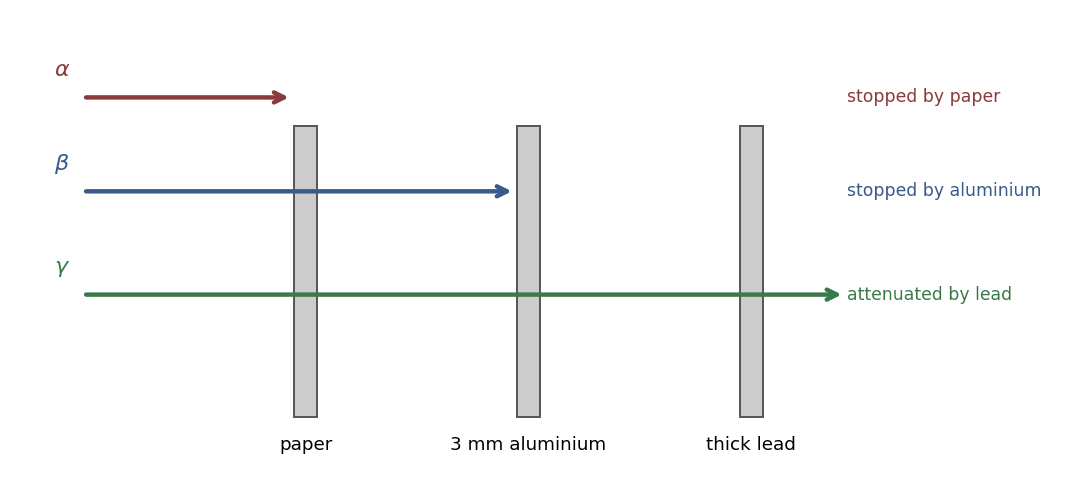
| Radiation | Nature | Ionising | Range in air |
|---|---|---|---|
| alpha | 2p + 2n | strongest | a few cm |
| beta | fast electron | medium | tens of cm |
| gamma | EM wave | weakest | metres |
Detection: photographic film (badge) or a Geiger–Müller tube. Background radiation comes from rocks and cosmic rays (space), food, medical uses and fallout.
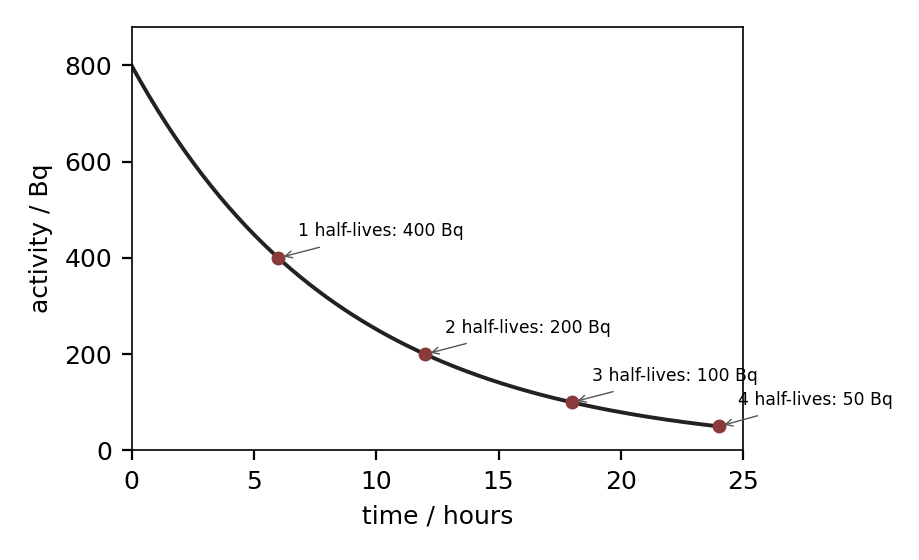
Activity 活度 (in becquerels; 1 Bq = 1 decay/s) falls steadily: the half-life 半衰期 is the time for half the undecayed nuclei to decay. Worked check. 800 Bq with half-life 6 h: after 24 h (4 half-lives) activity $= 800/2^4 = 50$ Bq.
Uses: medical tracers (short half-life, gamma), cancer treatment, sterilising, thickness control (beta through paper). Contamination (radioactive material on you — must be removed) differs from irradiation (exposure to radiation — stops when the source leaves). Dangers: mutation of DNA, cell and tissue damage; radioactive waste must be stored safely for its long half-lives.
Fission and fusion
Split a big nucleus or join two small ones — both release energy, and each powers a different machine.
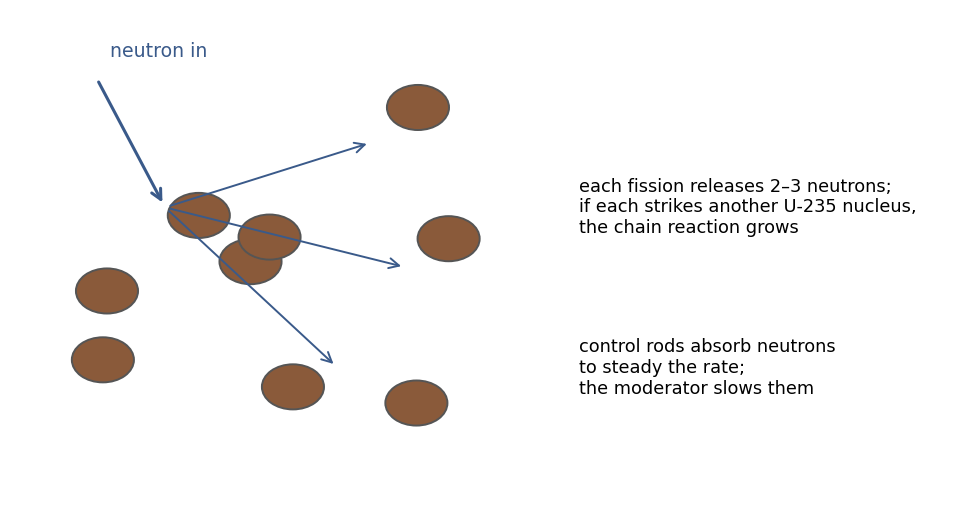
Fission 裂变: a neutron strikes U-235, splitting it into two radioactive daughter nuclei, 2–3 neutrons and kinetic energy — and if those neutrons strike more U-235, a chain reaction runs. The moderator 慢化剂 slows neutrons so they split nuclei efficiently; control rods 控制棒 absorb neutrons to hold the rate steady; shielding protects workers. Fusion 聚变 joins small nuclei into a larger one, converting mass to energy — the Sun's source. Fusion needs enormous temperature and pressure because positively charged protons electrostatically repel — the nuclei must collide fast enough to overcome that repulsion.
Check yourself
- In $^{19}_{9}F$, state the numbers of protons, neutrons and electrons in the neutral atom.
- Name the three ionising radiations and their natures.
- Write the full equation for alpha decay of $^{226}_{88}Ra$.
- Which radiation is stopped by paper, and which passes through aluminium?
- Give two sources of background radiation.
- Define half-life.
- A source of 3200 Bq has half-life 8 days. Find its activity after 32 days.
- State the difference between contamination and irradiation.
- Name the roles of the moderator, control rods and shielding in a reactor.
- Why does fusion need such high temperatures?
Answers: 1 9 protons, 10 neutrons, 9 electrons; 2 alpha — helium nucleus (2p+2n); beta-minus — fast electron; gamma — high-energy electromagnetic wave; 3 $^{226}_{88}Ra \rightarrow {}^{222}_{86}Rn + {}^{4}_{2}He$; 4 alpha stopped by paper; gamma passes aluminium (needs thick lead); 5 any two: rocks/building materials, cosmic rays, food/drink, medical, radon gas, nuclear fallout; 6 the time taken for half the undecayed nuclei (or the activity) to decay; 7 32 days = 4 half-lives: $3200 \rightarrow 1600 \rightarrow 800 \rightarrow 400 \rightarrow 200$ Bq; 8 contamination — radioactive material stuck to you, hazard remains until removed; irradiation — exposure to radiation from a source, ends when the source is removed; 9 moderator slows neutrons for efficient fission; control rods absorb neutrons to control the rate; shielding absorbs escaping radiation to protect workers; 10 the positively charged protons of two nuclei repel electrostatically, so nuclei must collide at enormous speed — only reached at very high temperature and pressure — to get close enough to fuse.