学习目标 7.1.A: 描述简谐运动。
- 7.1.A.1 简谐运动是周期性运动的一种特殊情况。
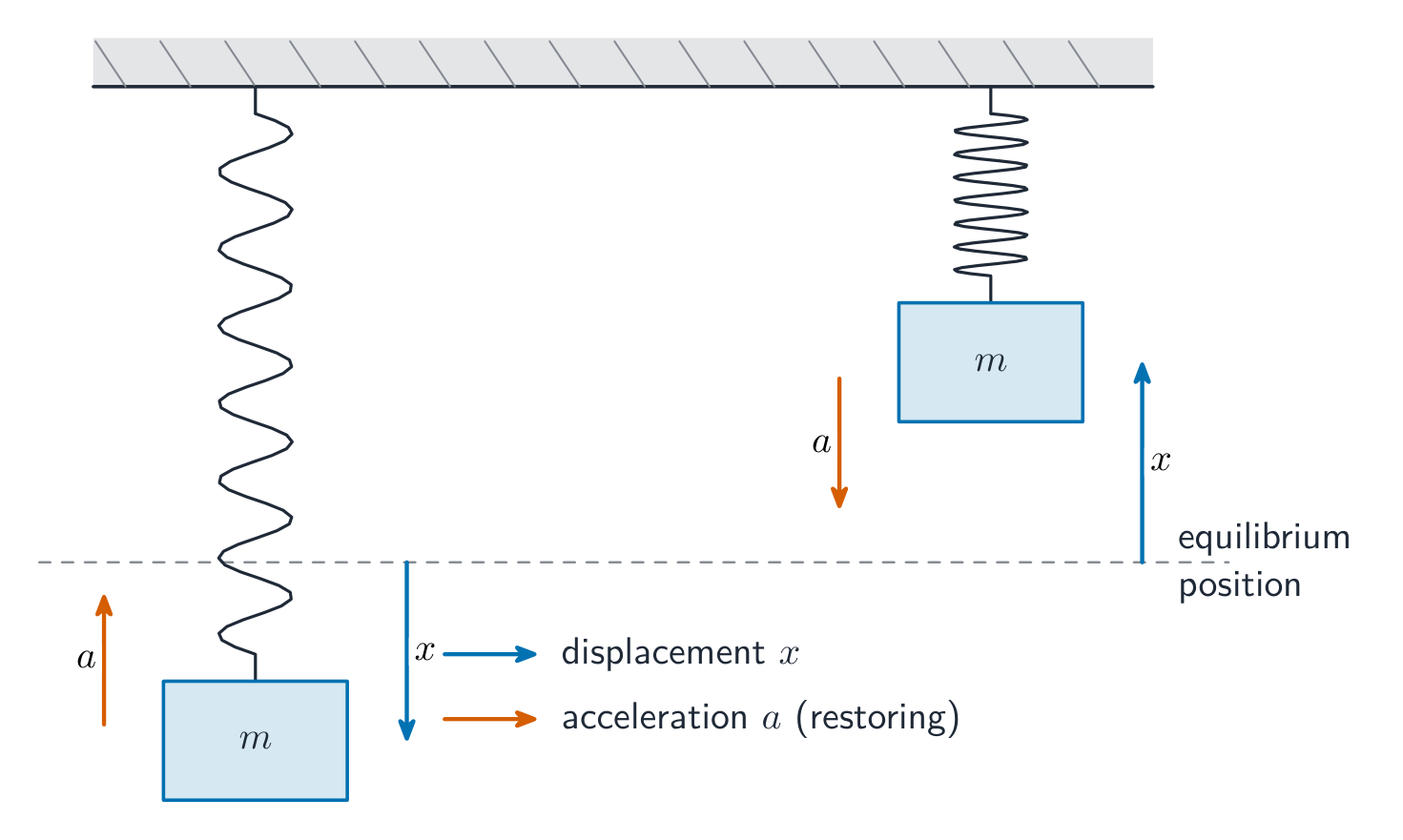
- 7.1.A.2 当作用在物体上的回复力大小与该物体偏离平衡位置的位移成正比时,就会产生简谐运动。
- 推导公式: $ma_x = -k\Delta x$
- 7.1.A.2.i 回复力是指方向与物体偏离平衡位置位移方向相反的力。
- 7.1.A.2.ii 平衡位置是指作用在物体或系统上的合力为零的位置。
AP 物理 C:力学 · 知识点 7
 8:14
振荡
在一座科学博物馆里,一颗黄铜球悬挂在一根极长的细线上。它在标记好的地板上方整天摆动,无人触碰。每一次摆动耗时都与前一次相同。……
英语旁白 · 英中内嵌字幕
学习目标 7.1.A: 描述简谐运动。
来源:College Board AP 课程与考试说明
Simple harmonic motion 简谐运动 (SHM) is a special case of periodic motion 周期运动. It appears whenever two things are true: there is an equilibrium 平衡位置 position where the net force is zero, and displacing the object produces a restoring force 回复力 – a force pointing back toward equilibrium – whose magnitude is proportional to the displacement:
Newton's second law then gives the defining differential equation 微分方程:
Its solution is sinusoidal, $x(t)=A\cos(\omega t+\phi)$. You do not need to prove this solution – you need to recognise the equation: any system whose motion obeys "$\ddot{x}=-\omega^2x$" is a simple harmonic oscillator, whatever it is made of. (A mass hanging on a vertical spring works the same way: gravity only shifts the equilibrium point; the oscillation about it is unchanged.)
简谐运动需要一个与位移成正比且指向中心的回复力。
| English | 中文 | 拼音 |
|---|---|---|
| Simple harmonic motion/ˈsɪmpl hɑːˈmɒnɪk ˈməʊʃn/ | 简谐运动 | jiǎn xié yùn dòng |
| periodic motion/ˌpɪərɪˈɒdɪk ˈməʊʃn/ | 周期运动 | zhōu qī yùn dòng |
| equilibrium/ˌiːkwɪˈlɪbrɪəm/ | 平衡位置 | píng héng wèi zhì |
| restoring force/rɪˈstɔːrɪŋ fɔːs/ | 回复力 | huí fù lì |
| differential equation/ˌdɪfəˈrenʃl ɪˈkweɪʒn/ | 微分方程 | wēi fēn fāng chéng |
学习目标 7.2.A: 描述做简谐运动物体的频率和周期。
来源:College Board AP 课程与考试说明
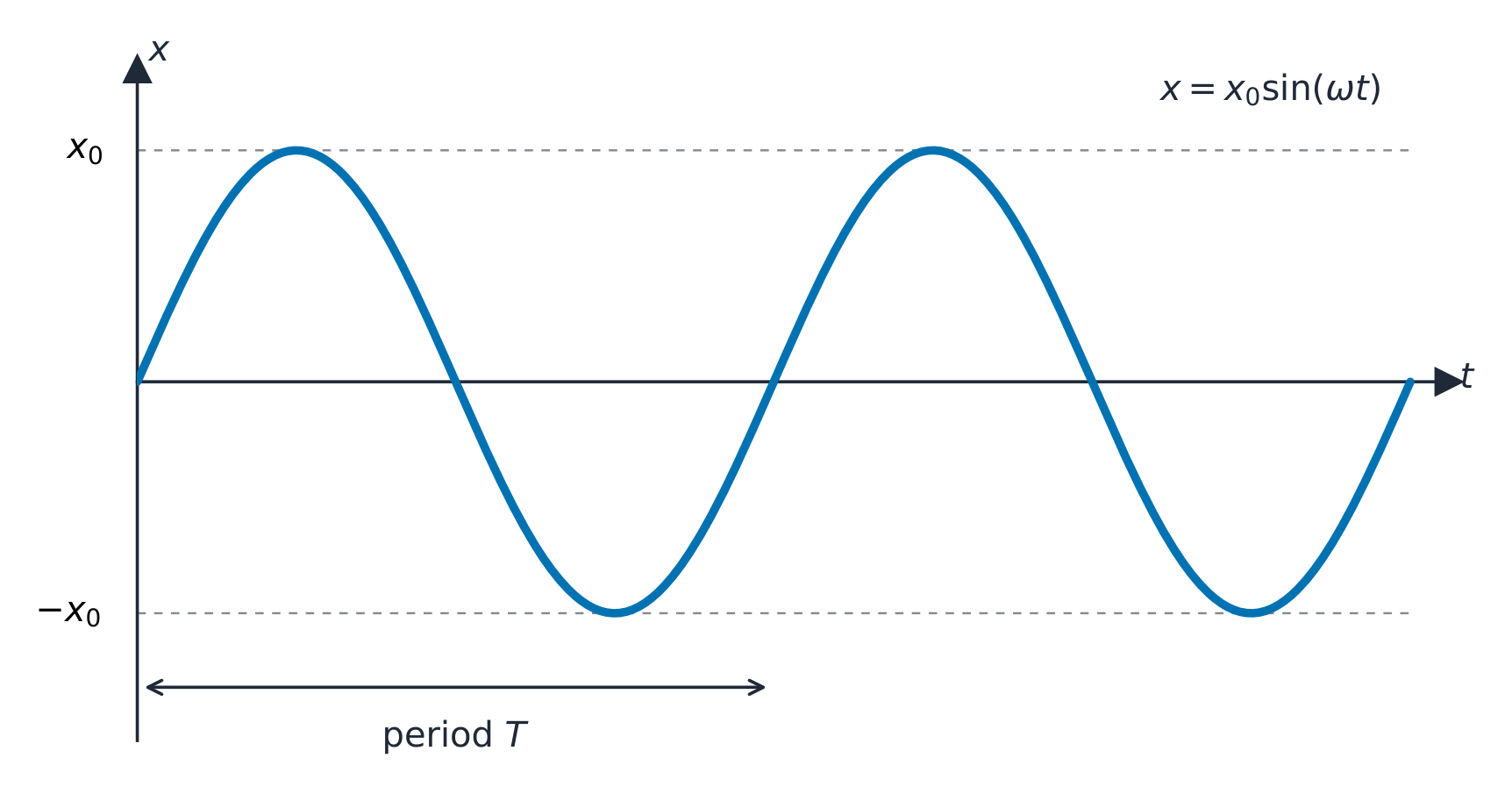
The angular frequency 角频率 $\omega$ sets the period 周期 and frequency 频率:
For the two standard systems:
Two classic conceptual traps: the period of SHM never depends on the amplitude 振幅, and each system ignores one obvious variable – the pendulum's period does not involve its mass, and the spring's period does not involve $g$ (a spring–block oscillator keeps perfect time in orbit; a pendulum clock does not).
摆的周期取决于其长度和重力,与其质量或(小)振幅无关:$T=2\pi\sqrt{L/g}$。加长它会使每次摆动耗时更长。
| English | 中文 | 拼音 |
|---|---|---|
| angular frequency/ˈæŋɡjʊlə ˈfriːkwənsi/ | 角频率 | jiǎo pín lǜ |
| period/ˈpɪərɪəd/ | 周期 | zhōu qī |
| frequency/ˈfriːkwənsi/ | 频率 | pín lǜ |
| amplitude/ˈæmplɪtjuːd/ | 振幅 | zhèn fú |
学习目标 7.3.A: 描述做简谐运动的物体的位移、速度和加速度。
边界说明: AP 物理 C:力学仅要求学生知道描述简谐运动的二阶微分方程的解,并能够识别简谐运动。AP 物理 C:力学不要求学生从数学上证明该解是正确的。
来源:College Board AP 课程与考试说明
Differentiate $x(t)=A\cos(\omega t+\phi)$ twice:
So at the ends of the swing ($x=\pm A$) the speed is zero and the acceleration is largest; passing through equilibrium ($x=0$) the acceleration is zero and the speed is largest, $v_{\max}=A\omega$. The amplitude $A$ and the phase constant 相位常数 $\phi$ come from the initial conditions: where the object starts and how fast it is moving. Eliminating $t$ (or using energy, below) gives speed as a function of position:
Worked example. A $0.50\ \text{kg}$ mass on a $k=200\ \text{N/m}$ spring: $\omega=\sqrt{k/m}=20\ \text{rad/s}$, $T=2\pi/\omega=0.31\ \text{s}$. With $A=0.10\ \text{m}$: $v_{\max}=A\omega=2.0\ \text{m/s}$ at equilibrium, and at $x=0.050\ \text{m}$ the speed is $v=\omega\sqrt{A^2-x^2}=20\sqrt{0.10^2-0.050^2}=1.7\ \text{m/s}$.
简谐振荡器的位移随时间呈余弦曲线变化。
| English | 中文 | 拼音 |
|---|---|---|
| phase constant/feɪz ˈkɒnstənt/ | 相位常数 | xiàng wèi cháng shù |
学习目标 7.4.A: 描述作简谐运动(SHM)的系统的机械能。
来源:College Board AP 课程与考试说明
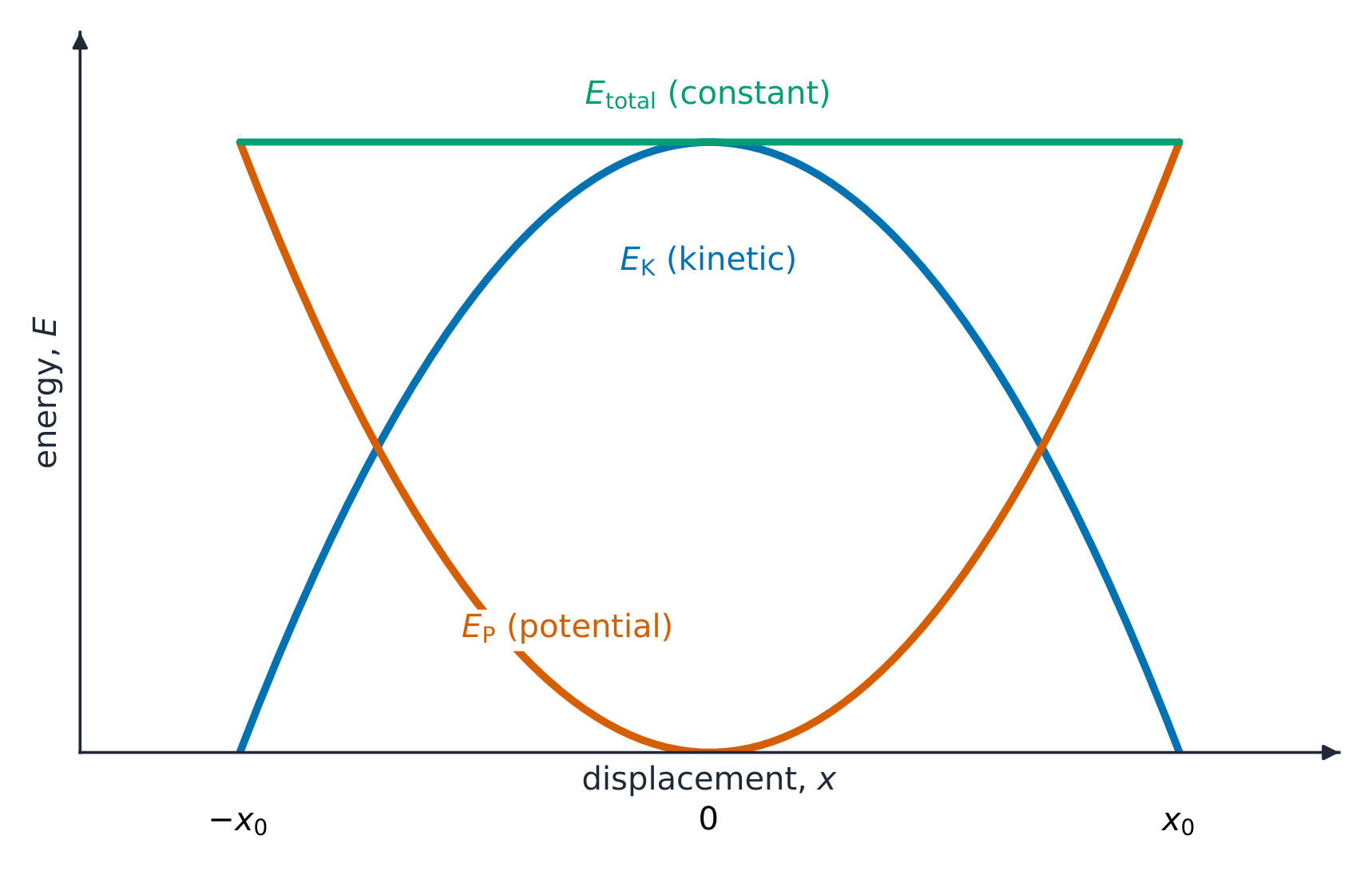
The total energy of the oscillator is the sum $E=U+K$, and with no friction it is constant – energy just trades back and forth between the spring's potential energy and the mass's kinetic energy:
All potential at the ends (where $K=0$), all kinetic at equilibrium (where $U$ is minimum). Because $E\propto A^2$, doubling the amplitude quadruples the energy.
Worked example. Where is the energy split evenly? Set $\tfrac12kx^2=\tfrac12E=\tfrac14kA^2$, so $x=A/\sqrt2\approx0.71A$ – much closer to the end than to the middle. For the system above ($A=0.10\ \text{m}$): $x=0.071\ \text{m}$.
Left alone, a system oscillates at its own natural frequency 固有频率 (set by $k$ and $m$: $f_0=\frac{1}{2\pi}\sqrt{k/m}$). With weak damping, a periodic driving force near this frequency can produce a large amplitude – resonance 共振. Well-timed pushes add energy to the motion, while damping removes it. The precise peak frequency depends on damping; for weak damping it is close to $f_0$ (as when pumping a swing in time).
在简谐运动中,能量在动能(中心处最快)和势能(极端位置最大)之间来回转换,而总能量保持不变。
| English | 中文 | 拼音 |
|---|---|---|
| natural frequency/ˈnætʃərəl ˈfriːkwənsi/ | 固有频率 | gù yǒu pín lǜ |
| resonance/ˈrezənəns/ | 共振 | gòng zhèn |
学习目标 7.5.A: 描述物理单摆的特性。
来源:College Board AP 课程与考试说明
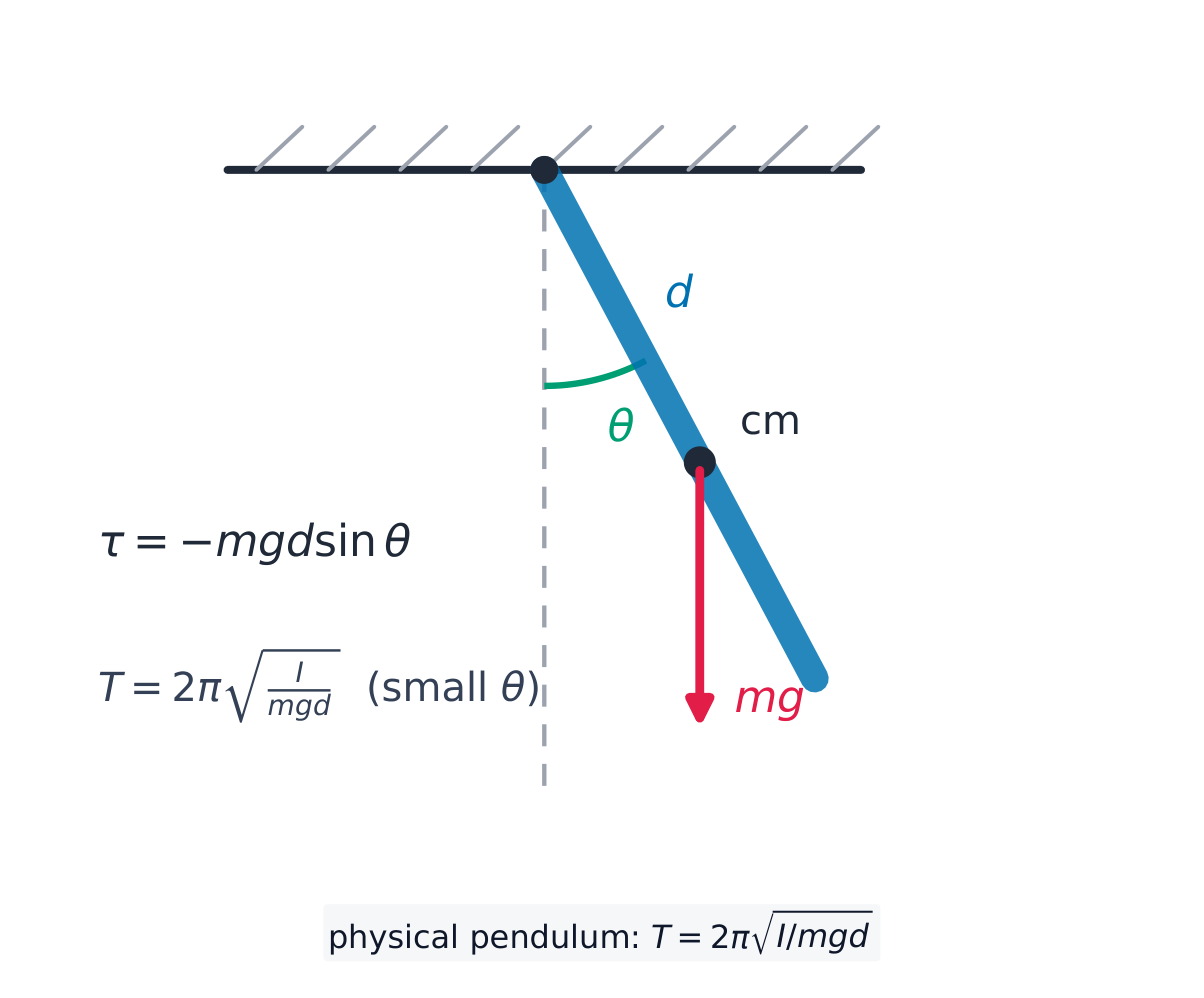
A physical pendulum 物理摆 is any rigid body swinging about a fixed pivot. Displace it by an angle $\theta$ and gravity, acting at the center of mass a distance $d$ from the pivot, supplies a restoring torque
For small angles, apply the small-angle approximation 小角度近似 $\sin\theta\approx\theta$ and Newton's second law in rotational form ($\tau=I\alpha$):
This is the same "$\ddot\theta=-\omega^2\theta$" pattern as before – recognising it is the derivation. A simple pendulum 单摆 is the special case of a point mass on a light string: $I=m\ell^2$ and $d=\ell$ give $T=2\pi\sqrt{\ell/g}$.
Worked example. A uniform rod (mass $M$, length $L$) swings from one end: $I=\tfrac13ML^2$, $d=\tfrac{L}{2}$, so
– shorter than a simple pendulum of length $L$, because the rod's mass sits nearer the pivot.
A torsion pendulum 扭摆 – a disk hanging from a wire that twists – is SHM one more time: the wire's restoring torque is proportional to the twist angle, $I\alpha=-\kappa\,\Delta\theta$, giving $T=2\pi\sqrt{I/\kappa}$.
Exam skill. Every pendulum FRQ wants the same three steps: write the restoring torque about the pivot, apply the small-angle approximation, and match the result to $\ddot\theta=-\omega^2\theta$ to read off $\omega$. State the small-angle step explicitly – it is a scored point, and it is why large-amplitude swings are not simple harmonic.
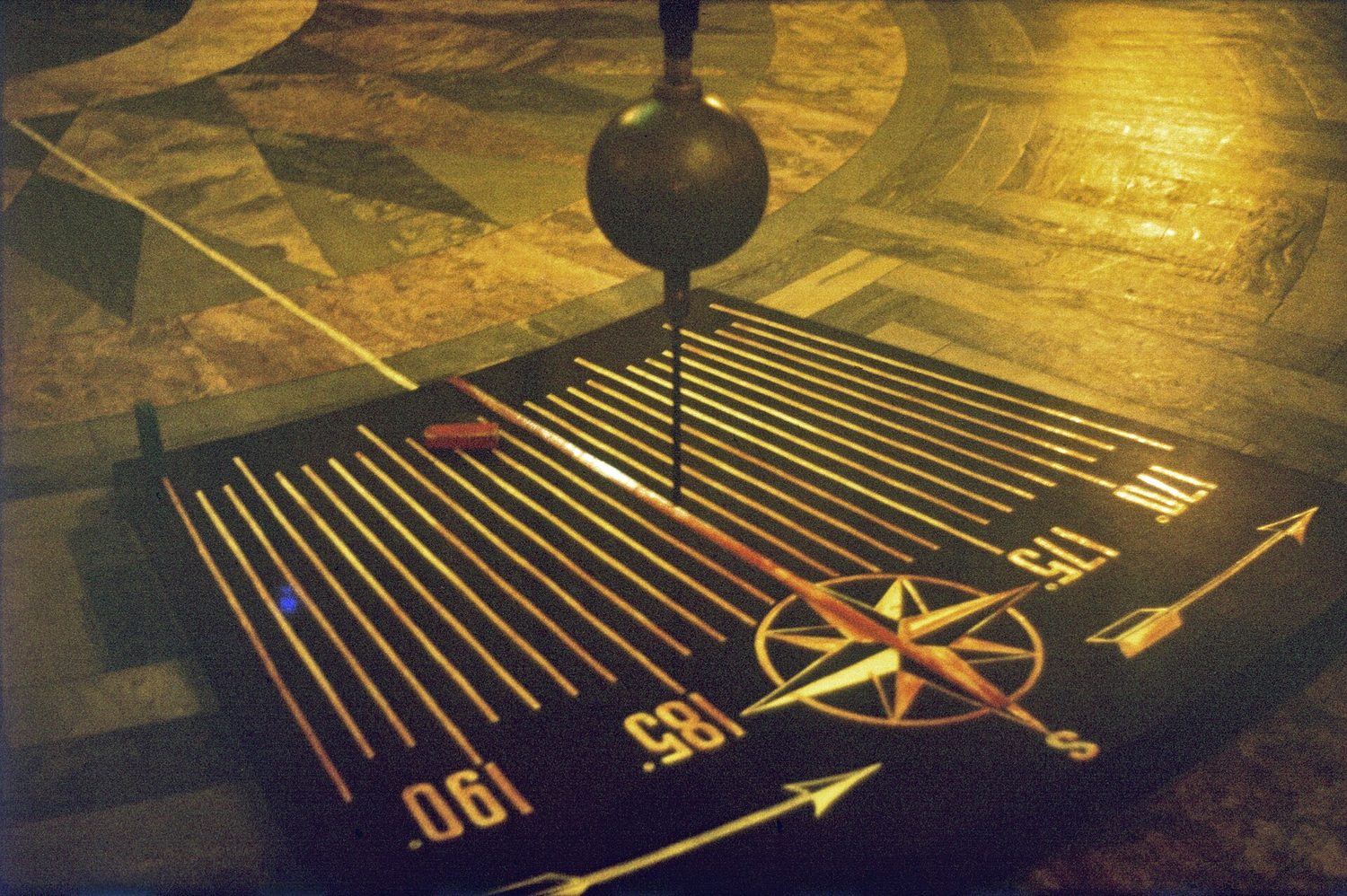
改变长度和重力,观察单摆周期的响应——振幅几乎无关紧要。
| English | 中文 | 拼音 |
|---|---|---|
| physical pendulum/ˈfɪzɪkl ˈpendjʊləm/ | 物理摆 | wù lǐ bǎi |
| small-angle approximation/smɔːl ˈæŋɡl əˌprɒksɪˈmeɪʃn/ | 小角度近似 | xiǎo jiǎo dù jìn sì |
| simple pendulum/ˈsɪmpl ˈpendjʊləm/ | 单摆 | dān bǎi |
| torsion pendulum/ˈtɔːʃn ˈpendjʊləm/ | 扭摆 | niǔ bǎi |
逐步完成,配合即时检查练习。
正在加载学科…