| Learning Objective | Essential Knowledge |
|---|---|
5.1.A |
Boundary statement: AP Physics C: Mechanics expects students to be able to mathematically manipulate the magnitudes of angular displacement, angular velocity, and angular acceleration using vector conventions. However, the directions of said vectors will not be assessed on the exam. Descriptions of the directions of rotational kinematics quantities for a point or rigid body are limited to clockwise and counterclockwise with respect to a given axis of rotation. |
力矩与转动动力学
AP 物理 C:力学 · 第 5 主题
 7:22
7:22
Torque and Rotational Dynamics
Push a door at the handle and it swings open easily. Now push just as hard, right next to the hinge. Almost nothing happens. The force was the same both times.…
英文讲解 · 内嵌中英文字幕
5.1
转动运动学
大纲
来源:美国大学理事会 AP 课程与考试说明
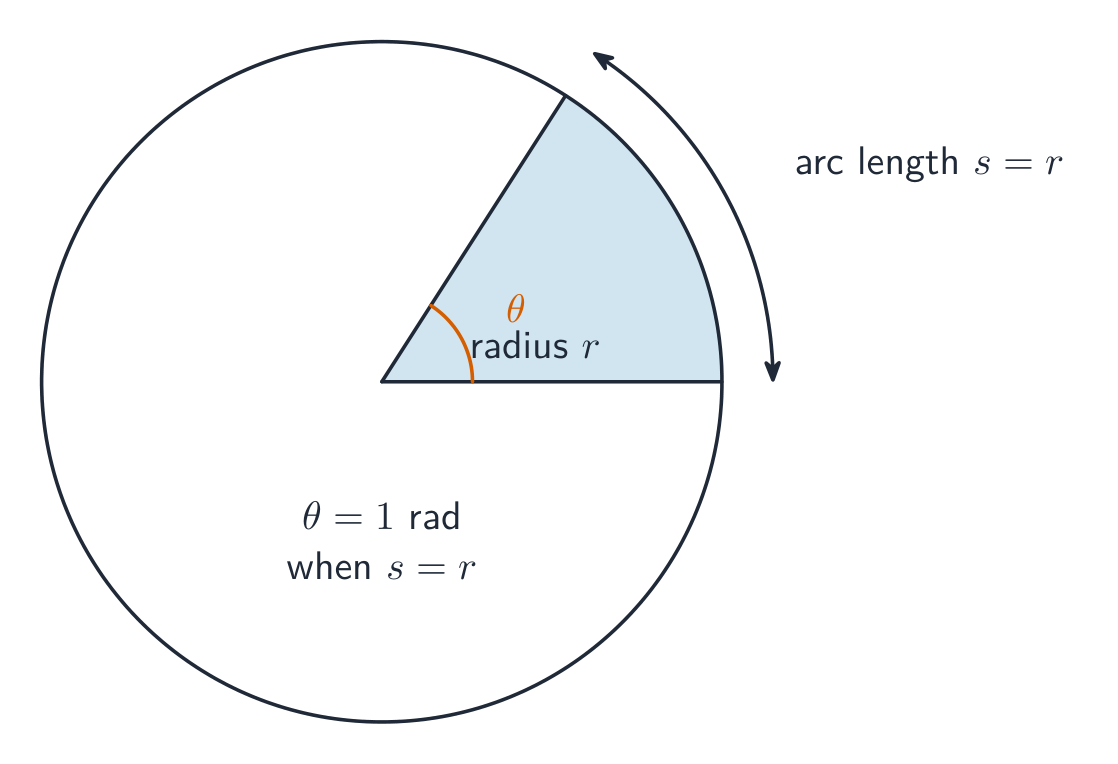
旋转用角量映照线性运动,定义为导数:
$$\omega=\frac{d\theta}{dt},\qquad \alpha=\frac{d\omega}{dt}=\frac{d^2\theta}{dt^2}.$$
这里 $\theta$ 是以弧度(radians)的角位移(angular displacement)、$\omega$ 是角速度(angular velocity),而 $\alpha$ 是角加速度(angular acceleration)。(AP 用它们的大小和符号;三维矢量方向不被评估。)对于恒定 $\alpha$,运动学方程是重新标注字母的线性方程:
$$\omega=\omega_0+\alpha t,\qquad \Delta\theta=\omega_0t+\tfrac12\alpha t^2,\qquad \omega^2=\omega_0^2+2\alpha\,\Delta\theta.$$
Worked example. 一个风扇叶片以 $\alpha=-6.0\ \text{rad/s}^2$ 从 $30\ \text{rad/s}$ 减慢到静止:它取 $t=5.0\ \text{s}$ 并转过 $\Delta\theta=\dfrac{0-30^2}{2(-6.0)}=75\ \text{rad}$ ——约 $12$ 转。
词汇表
训练
| 英文 | 中文 | 拼音 |
|---|---|---|
| angular displacement/ˈæŋɡjʊlə dɪˈspleɪsmənt/ | 角位移 | jiǎo wèi yí |
| radians/ˈreɪdɪənz/ | 弧度 | hú dù |
| angular velocity/ˈæŋɡjʊlə vəˈlɒsɪti/ | 角速度 | jiǎo sù dù |
| angular acceleration/ˈæŋɡjʊlə əkˌseləˈreɪʃn/ | 角加速度 | jiǎo jiā sù dù |
5.2
联系线运动与转动
大纲
| Learning Objective | Essential Knowledge |
|---|---|
5.2.A |
Boundary statement: AP Physics C: Mechanics expects students to be able to mathematically manipulate the magnitudes of angular displacement, angular velocity, and angular acceleration using vector conventions. However, the directions of the vectors will not be assessed on the exam. Descriptions of the directions of rotational kinematics quantities for a point or rigid body are limited to clockwise and counterclockwise with respect to a given axis of rotation. |
来源:美国大学理事会 AP 课程与考试说明
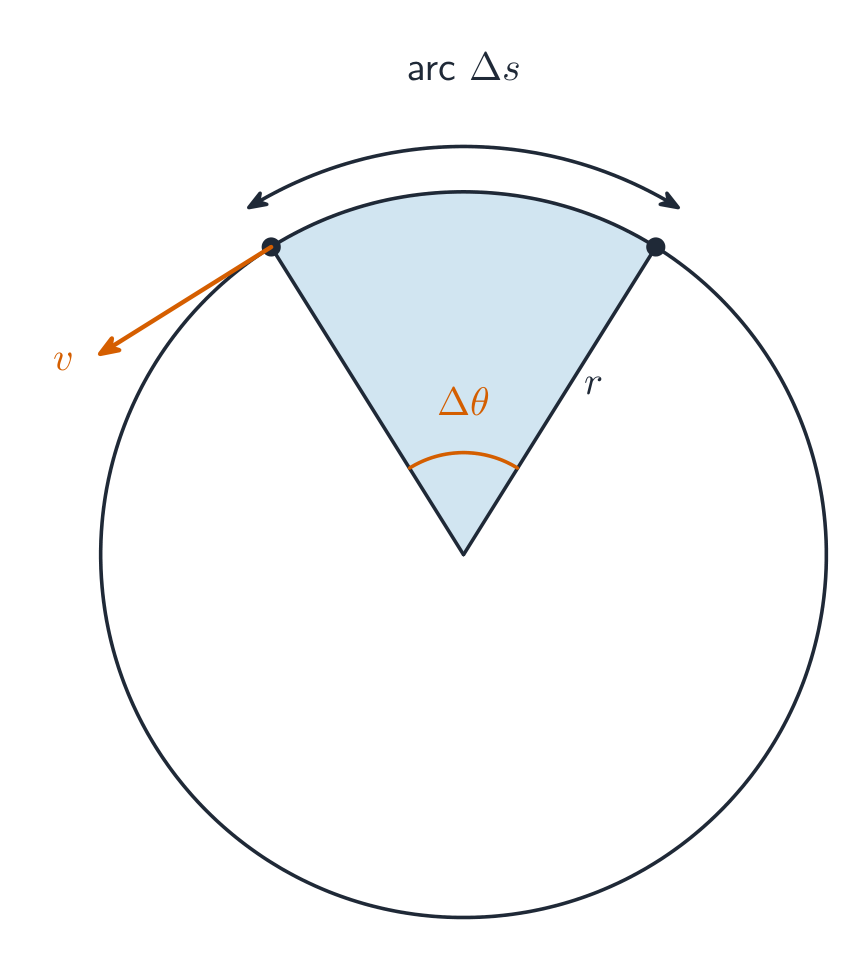
一个离轴半径 $r$ 的点沿它的弧以以下移动
$$s=r\theta,\qquad v=r\omega,\qquad a_t=r\alpha,$$
所以更远的点移动更快。一个旋转的点一般一次有两个加速度分量:切向加速度(tangential acceleration)$a_t=r\alpha$(沿弧加速)和向心加速度(centripetal acceleration)$a_c=\dfrac{v^2}{r}=r\omega^2$(转动,朝向轴)。它们垂直,所以 $a=\sqrt{a_t^2+a_c^2}$。
词汇表
训练
| 英文 | 中文 | 拼音 |
|---|---|---|
| tangential acceleration/tænˈdʒenʃl əkˌseləˈreɪʃn/ | 切向加速度 | qiè xiàng jiā sù dù |
| centripetal acceleration/senˈtrɪpɪtl əkˌseləˈreɪʃn/ | 向心加速度 | xiàng xīn jiā sù dù |
5.3
力矩
大纲
| Learning Objective | Essential Knowledge |
|---|---|
5.3.A |
|
5.3.B |
|
来源:美国大学理事会 AP 课程与考试说明
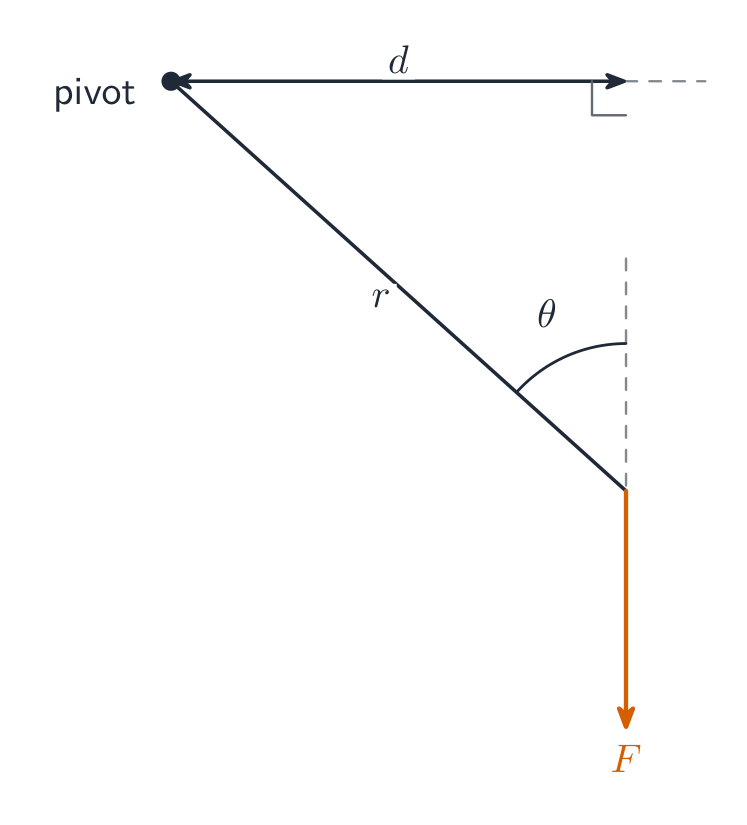
力矩(torque)是一个力的转动效应——旋转的原因,正如力是平动的原因。它是一个矢量积(vector product):
$$\vec{\tau}=\vec{r}\times\vec{F},\qquad \tau=rF\sin\theta=F\,r_\perp,$$
其中 $r_\perp$,力臂(moment arm),是从轴到力作用线的垂直距离。更多的力、施加得离轴更远、更垂直:更多力矩。一个直指(或离开)轴的力有零力矩。在一个平面里,给逆时针和顺时针力矩相反的符号并相加。
作为一个矢量积,$\vec\tau=\vec r\times\vec F$ 指向 $\vec r$ 和 $\vec F$ 所在平面的垂直方向,其方向由右手定则(right-hand rule)确定:把右手手指从 $\vec r$ 弯向 $\vec F$,拇指就指向 $\vec\tau$ ——逆时针转动时指出纸面,顺时针时指入纸面。同样的规则给出角动量 $\vec L=\vec r\times\vec p$ 的方向。
探索
Balance torques on a beam
Torque is force times perpendicular distance, $\tau=Fd$. The beam is in rotational equilibrium when the torques on each side are equal.
词汇表
训练
| 英文 | 中文 | 拼音 |
|---|---|---|
| Torque/tɔːk/ | 力矩 | lì jǔ |
| vector product/ˈvektə ˈprɒdʌkt/ | 矢量积 | shǐ liàng jī |
| moment arm/ˈməʊmənt ɑːm/ | 力臂 | lì bì |
| right-hand rule/raɪt hænd ruːl/ | 右手定则 | yòu shǒu dìng zé |
| Rotational inertia/rəʊˈteɪʃənl ɪˈnɜːʃə/ | 转动惯量 | zhuǎn dòng guàn liàng |
5.4
转动惯量
大纲
| Learning Objective | Essential Knowledge |
|---|---|
5.4.A |
|
5.4.B |
Boundary statement: AP Physics C: Mechanics only expects students to use calculus in the derivations of the rotational inertia of thin rods of uniform or nonuniform density about an arbitrary axis perpendicular to the rod, as well as derivations of the rotational inertia of a thin cylindrical shell, disk, or rigid bodies that can be considered to be made up of coaxial rings or shells about an axis that passes through their centers (e.g., annular rings). Students should have a qualitative understanding of the factors that affect rotational inertia; for example, how rotational inertia is greater when mass is farther from the axis of rotation, which is why a hoop has more rotational inertia than a solid puck of the same mass and radius. |
来源:美国大学理事会 AP 课程与考试说明
转动惯量(rotational inertia)$I$ 测量对角加速度的抵抗——质量的旋转类比,但它取决于质量坐在哪里。对于点质量,$I=\sum m_ir_i^2$;对于一个连续物体,
$$I=\int r^2\,dm.$$
离轴远的质量主导,因为 $r^2$。
Worked example (rod). 一根均匀的杆(质量 $M$、长度 $L$)绕它的中心:以线密度(linear density)$\lambda=M/L$,$dm=\lambda\,dx$,所以 $I=\displaystyle\int_{-L/2}^{L/2}x^2\,\frac{M}{L}\,dx=\frac{1}{12}ML^2$。AP 也期望非均匀杆:若在 $[0,L]$ 上 $\lambda(x)=cx$,先求 $M=\int_0^L cx\,dx=\tfrac12cL^2$,然后绕轻的一端 $I=\int_0^L x^2(cx)\,dx=\tfrac14cL^4=\tfrac12ML^2$。
Worked example (disk from rings). 一个实心圆盘是一嵌套的环:一个半径 $r$、宽度 $dr$ 的环有 $dm=\dfrac{M}{\pi R^2}\,2\pi r\,dr$,所以
$$I=\int_0^R r^2\,dm=\frac{2M}{R^2}\int_0^R r^3\,dr=\tfrac12MR^2.$$
同样的同轴壳方法处理圆柱壳和环形环。
平行轴定理(parallel-axis theorem)把任何已知的 $I$ 移到一个相距 $d$ 的平行轴:
$$I'=I_{\text{cm}}+Md^2.$$
对于绕一端的杆:$I=\tfrac1{12}ML^2+M\big(\tfrac{L}{2}\big)^2=\tfrac13ML^2$。
词汇表
训练
| 英文 | 中文 | 拼音 |
|---|---|---|
| linear density/ˈlɪnɪə ˈdensɪti/ | 线密度 | xiàn mì dù |
| parallel-axis theorem/ˈpærəlel ˈæksɪs ˈθɪərəm/ | 平行轴定理 | píng xíng zhóu dìng lǐ |
5.5
转动平衡与转动形式的牛顿第一定律
大纲
| Learning Objective | Essential Knowledge |
|---|---|
5.5.A |
Boundary statement: AP Physics C: Mechanics does not expect students to simultaneously analyze rotation in multiple planes. |
来源:美国大学理事会 AP 课程与考试说明
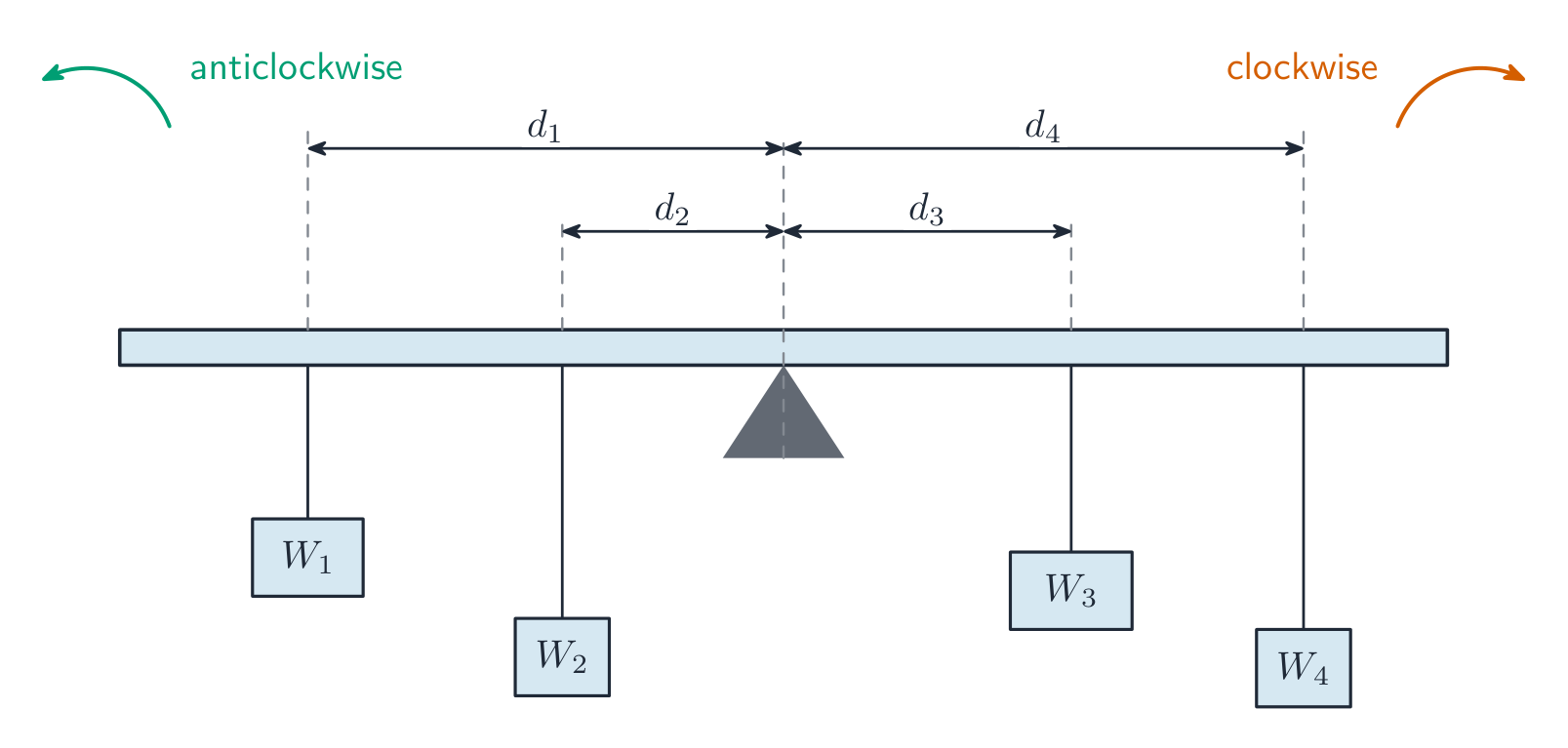
牛顿第一定律有一个旋转形式:以零合力矩,角速度恒定——一个处于转动平衡(rotational equilibrium)的物体要么不旋转要么稳定地旋转。完全的静平衡(static equilibrium)需要 $\sum F=0$ 和 $\sum\tau=0$(绕任何轴)。梁和梯子的标准做法:把轴放在一个未知力作用的点,使那个力从力矩方程里掉出来。
Worked example. 一根均匀的 $20\ \text{kg}$ 梁,$4.0\ \text{m}$ 长,在它左端被枢转并由它右端的一根竖直绳保持水平。一个 $40\ \text{kg}$ 的孩子坐在离枢轴 $1.0\ \text{m}$ 处。绕枢轴的力矩:$T(4.0)=20g(2.0)+40g(1.0)$,所以 $T=\dfrac{392+392}{4.0}=196\ \text{N}$。然后竖直力平衡给出枢轴向上的推:$F_p=(60)(9.8)-196=392\ \text{N}$。把枢轴选为轴完全从力矩方程里移除了 $F_p$。
探索
Find the balance point
For rotational equilibrium the total clockwise torque equals the total anticlockwise torque. Move the forces and distances until the beam balances.
词汇表
训练
| 英文 | 中文 | 拼音 |
|---|---|---|
| rotational equilibrium/rəʊˈteɪʃənl ˌiːkwɪˈlɪbrɪəm/ | 转动平衡 | zhuǎn dòng píng héng |
| static equilibrium/ˈstætɪk ˌiːkwɪˈlɪbrɪəm/ | 静平衡 | jìng píng héng |
5.6
转动形式的牛顿第二定律
大纲
| Learning Objective | Essential Knowledge |
|---|---|
5.6.A |
|
来源:美国大学理事会 AP 课程与考试说明
一个合力矩产生与转动惯量成比例的角加速度:
$$\alpha=\frac{\sum\tau}{I}\qquad\Big(\text{more generally }\sum\vec{\tau}=\frac{d\vec{L}}{dt}\Big).$$
像平动动力学一样解旋转动力学,$\tau\leftrightarrow F$、$I\leftrightarrow m$、$\alpha\leftrightarrow a$ ——受力图、方程、求解。
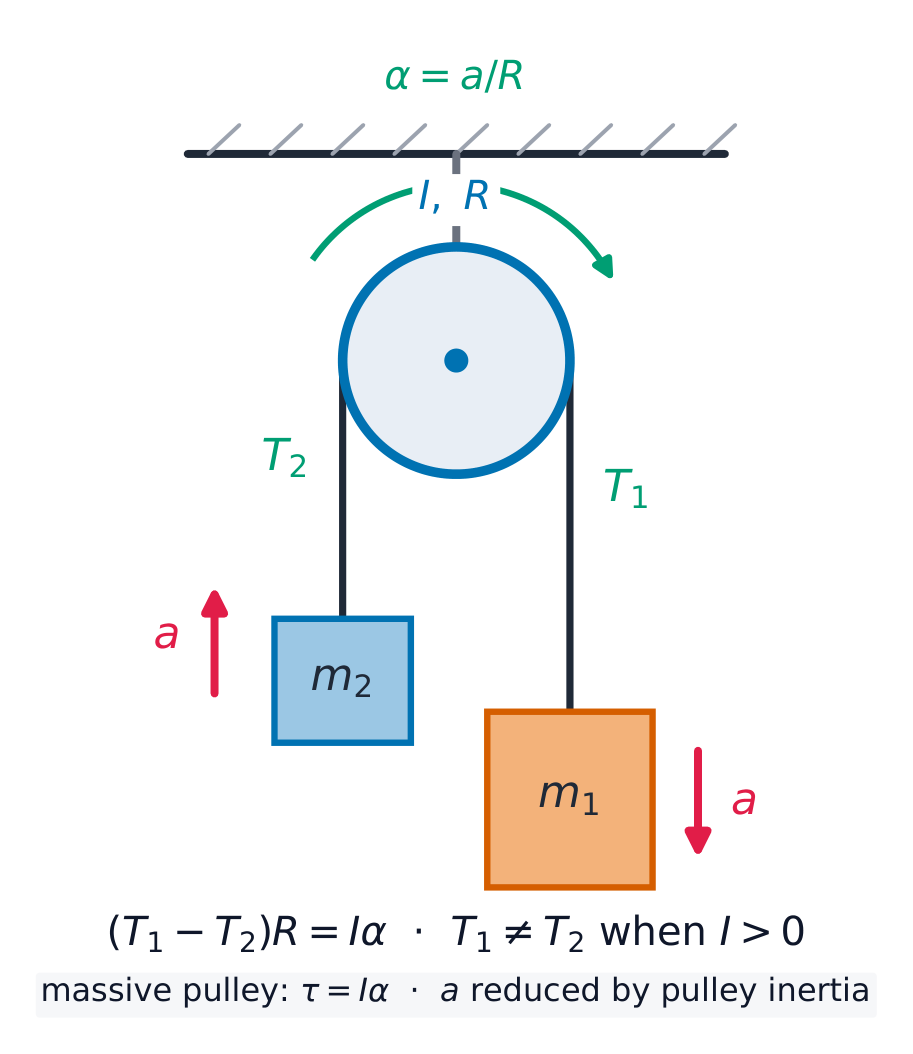
Worked example (massive pulley). 质量 $m_1=4.0\ \text{kg}$ 和 $m_2=2.0\ \text{kg}$ 从一根越过一个转动惯量 $I=0.50\ \text{kg}\cdot\text{m}^2$、半径 $R=0.20\ \text{m}$ 的滑轮(pulley)的绳悬挂。三个牛顿定律方程,每个物体一个:
$$m_1g-T_1=m_1a,\qquad T_2-m_2g=m_2a,\qquad (T_1-T_2)R=I\alpha=\frac{Ia}{R}.$$
把它们相加(以 $I/R^2=12.5\ \text{kg}$):$a=\dfrac{(m_1-m_2)g}{m_1+m_2+I/R^2}=\dfrac{19.6}{18.5}=1.1\ \text{m/s}^2$。然后 $T_1=m_1(g-a)=35\ \text{N}$ 而 $T_2=m_2(g+a)=22\ \text{N}$。张力必须不同——否则没有什么会使滑轮旋转。(若一个问题说滑轮是轻的,那么 $I\approx0$ 而张力又变得相等。)
Exam skill. 旋转 FRQ 给设置评分:每个质量和滑轮分别的受力图、陈述绳约束 $a=R\alpha$,以及符号惯例一致。单个最常见的错误是假设一根越过一个有质量滑轮的绳始终一个张力。
词汇表
训练
| 英文 | 中文 | 拼音 |
|---|---|---|
| pulley/ˈpʊli/ | 滑轮 | huá lún |
5.6
考试技巧
- 使用旋转类比:$\theta,\omega=\tfrac{d\theta}{dt},\alpha=\tfrac{d\omega}{dt}$,以恒定 $\alpha$ 方程映照线性运动学。
- 用 $v=r\omega$ 和 $a_t=r\alpha$ 在线性和角之间转换(加向心 $a_c=\tfrac{v^2}{r}=\omega^2 r$)。
- 始终保持弧度并固定一个正的旋转方向。
- 通过 $\tau=I\alpha$ 把力矩与角加速度关联。
- 画旋转轴——力臂是到它的垂直距离。
本主题的互动课程
逐步学习,并即时检测练习。