跳到主要内容

线动量

AP 物理 C:力学 · 第 4 主题

训练
讲义 词汇表
4.1

线动量

大纲
Learning ObjectiveEssential Knowledge

4.1.A
Describe the linear momentum of an object or system.

  • 4.1.A.1 Linear momentum is defined by the equation $\vec{p} = m\vec{v}$.
  • 4.1.A.2 Momentum is a vector quantity and has the same direction as the velocity.
  • 4.1.A.3 Momentum can be used to analyze collisions and explosions.
    • 4.1.A.3.i A collision is a model for an interaction where the forces exerted between the involved objects in the system are much larger than the net external force exerted on those objects during the interaction.
    • 4.1.A.3.ii As only the initial and final states of a collision are analyzed, the object model may be used to analyze collisions.
    • 4.1.A.3.iii An explosion is a model for an interaction in which forces internal to the system move objects within that system apart.

来源:美国大学理事会 AP 课程与考试说明

动量(linear momentum)是质量乘速度:

$$\vec{p}=m\vec{v}.$$

它是一个沿速度指向的矢量(vector),而它是分析碰撞(collisions)和爆炸(explosions)的那个量。一组物体能被当作一个以它质心(center of mass)速度移动的系统:

$$\vec{v}_{\text{cm}}=\frac{\sum m_i\vec{v}_i}{\sum m_i},$$

所以系统的总动量是它的总质量乘 $\vec{v}_{\text{cm}}$ ——对任何数量的部分只有一个物体量的记账。

词汇表 训练
英文 中文 拼音
Linear momentum 动量 dòng liàng
vector 矢量 shǐ liàng
collisions 碰撞 pèng zhuàng
explosions 爆炸 bào zhà
center of mass 质心 zhì xīn
4.2

动量变化与冲量

大纲
Learning ObjectiveEssential Knowledge

4.2.A
Describe the impulse delivered to an object or system.

  • 4.2.A.1 The rate of change of a system's momentum is equal to the net external force exerted on that system.
    • Equation: $\vec{F}_{\text{net}} = \dfrac{d\vec{p}}{dt}$
  • 4.2.A.2 Impulse is defined as the integral of a force exerted on an object or system over a time interval.
    • Equation: $\vec{J} = \displaystyle\int_{t_1}^{t_2} \vec{F}_{\text{net}}(t)\,dt$
  • 4.2.A.3 Impulse is a vector quantity and has the same direction as the net force exerted on the system.
  • 4.2.A.4 The impulse delivered to a system by a net external force is equal to the area under the curve of a graph of the net external force exerted on the system as a function of time.
  • 4.2.A.5 The net external force exerted on a system is equal to the slope of a graph of the momentum of the system as a function of time.

4.2.B
Describe the relationship between the impulse exerted on an object or system and the change in momentum of the object or system.

  • 4.2.B.1 Change in momentum is the difference between a system's final momentum and its initial momentum.
    • Equation: $\Delta\vec{p} = \vec{p} - \vec{p}_0$
  • 4.2.B.2 The impulse–momentum theorem relates the impulse delivered to an object and the object's change in momentum.
    • 4.2.B.2.i The impulse exerted on an object is equal to the object's change in momentum.
      • Equation: $\vec{J} = \displaystyle\int_{t_1}^{t_2} \vec{F}_{\text{net}}(t)\,dt = \Delta\vec{p}$
    • 4.2.B.2.ii Newton's second law of motion is a direct result of the impulse–momentum theorem applied to systems with constant mass.
      • Equation: $\vec{F}_{\text{net}} = \dfrac{d\vec{p}}{dt} = m\dfrac{d\vec{v}}{dt} = m\vec{a}$
    • 4.2.B.2.iii The impulse–momentum theorem also describes the behavior of a system in which the velocity is constant but the mass changes with respect to time.
      • Equation: $\vec{F}_{\text{net}} = \dfrac{d\vec{p}}{dt} = \dfrac{dm}{dt}\vec{v}$

来源:美国大学理事会 AP 课程与考试说明

牛顿第二定律实际上是一个关于动量的陈述:

$$\vec{F}_{\text{net}}=\frac{d\vec{p}}{dt},$$

当质量恒定时它简化到 $m\vec{a}$ ——而当它不恒定时处理一个变化的质量(特例 $\vec{F}=\dfrac{dm}{dt}\vec{v}$ 只在速度恒定时成立,例如一条堆到秤上的链,或落到匀速传送带上的沙;火箭不适用,因为它在加速)。一个力传递的冲量(impulse)是它的时间积分,而冲量-动量定理(impulse–momentum theorem)说它等于动量的变化:

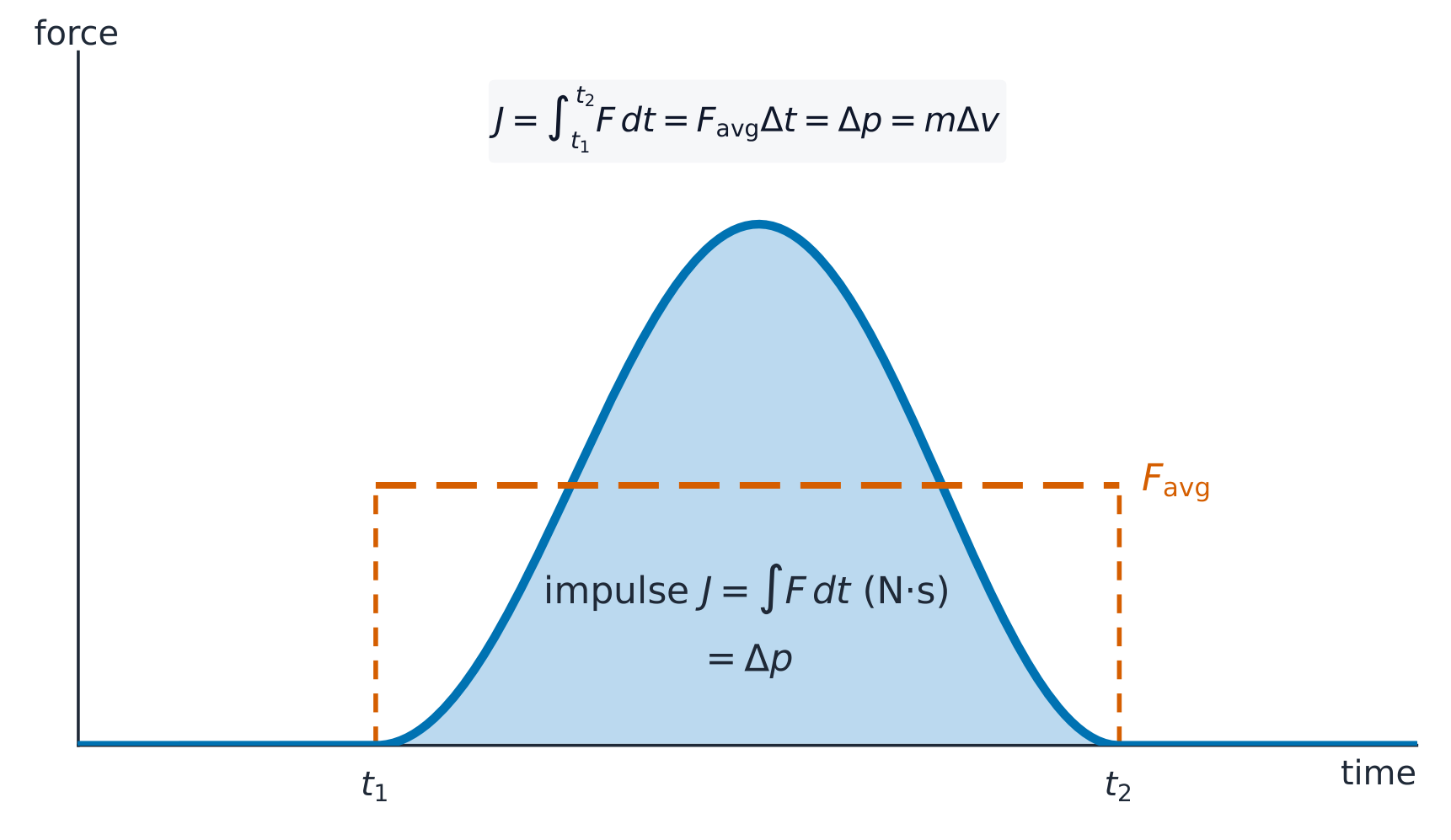
$$\vec{J}=\int_{t_1}^{t_2}\vec{F}_{\text{net}}\,dt=\Delta\vec{p}.$$

冲量是一个沿合力的矢量。从图两种方式读它:

  • 在一个力-时间图上,冲量是曲线下的面积
  • 在一个动量-时间图上,合力是每个时刻的斜率(slope)。
冲量是力-时间曲线下的面积,等于平均力乘接触时间

把同样的 $\Delta p$ 分散到一个更长的时间降低力——那就是为什么气囊、溃缩区和软着陆工作,以及为什么你着陆时弯膝。

Worked example. 一个时变力 $F(t)=10t\ \text{N}$ 作用在一个 $2.0\ \text{kg}$ 的物体上 $2.0\ \text{s}$。冲量是 $J=\displaystyle\int_0^2 10t\,dt=\big[5t^2\big]_0^2=20\ \text{N}\cdot\text{s}$,所以速率变化 $\Delta v=J/m=10\ \text{m/s}$

词汇表 训练
英文 中文 拼音
impulse 冲量 chōng liàng
impulse–momentum theorem 冲量-动量定理 chōng liàng - dòng liàng dìng lǐ
slope 斜率 xié lǜ
4.3

线动量守恒

大纲
Learning ObjectiveEssential Knowledge

4.3.A
Describe the behavior of a system using conservation of linear momentum.

  • 4.3.A.1 A collection of objects with individual momenta can be described as one system with one center-of-mass velocity.
    • 4.3.A.1.i For a collection of objects, the velocity of a system's center of mass can be calculated using the equation
      • Equation: $\vec{v}_{\text{cm}} = \dfrac{\sum \vec{p}_i}{\sum m_i} = \dfrac{\sum (m_i \vec{v}_i)}{\sum m_i}$
    • 4.3.A.1.ii The velocity of a system's center of mass is constant in the absence of a net external force.
  • 4.3.A.2 The total momentum of a system is the sum of the momenta of the system's constituent parts.
  • 4.3.A.3 In the absence of net external forces, any change to the momentum of an object within a system must be balanced by an equivalent and opposite change of momentum elsewhere within the system. Any change to the momentum of a system is due to a transfer of momentum between the system and its surroundings.
    • 4.3.A.3.i The impulse exerted by one object on a second object is equal and opposite to the impulse exerted by the second object on the first. This is a direct result of Newton's third law.
    • 4.3.A.3.ii A system may be selected so that the total momentum of that system is constant.
    • 4.3.A.3.iii If the total momentum of a system changes, that change will be equivalent to the impulse exerted on the system.
      • Equation: $\vec{J} = \Delta\vec{p}$
  • 4.3.A.4 Correct application of conservation of momentum can be used to determine the velocity of a system immediately before and immediately after collisions or explosions.

Boundary statement: AP Physics C: Mechanics only expects students to quantitatively analyze collisions and interactions in one or two dimensions. Three-dimensional collisions may be analyzed qualitatively.

4.3.B
Describe how the selection of a system determines whether the momentum of that system changes.

  • 4.3.B.1 Momentum is conserved in all interactions.
  • 4.3.B.2 If the net external force on the selected system is zero, the total momentum of the system is constant.
  • 4.3.B.3 If the net external force on the selected system is nonzero, momentum is transferred between the system and the environment.

来源:美国大学理事会 AP 课程与考试说明

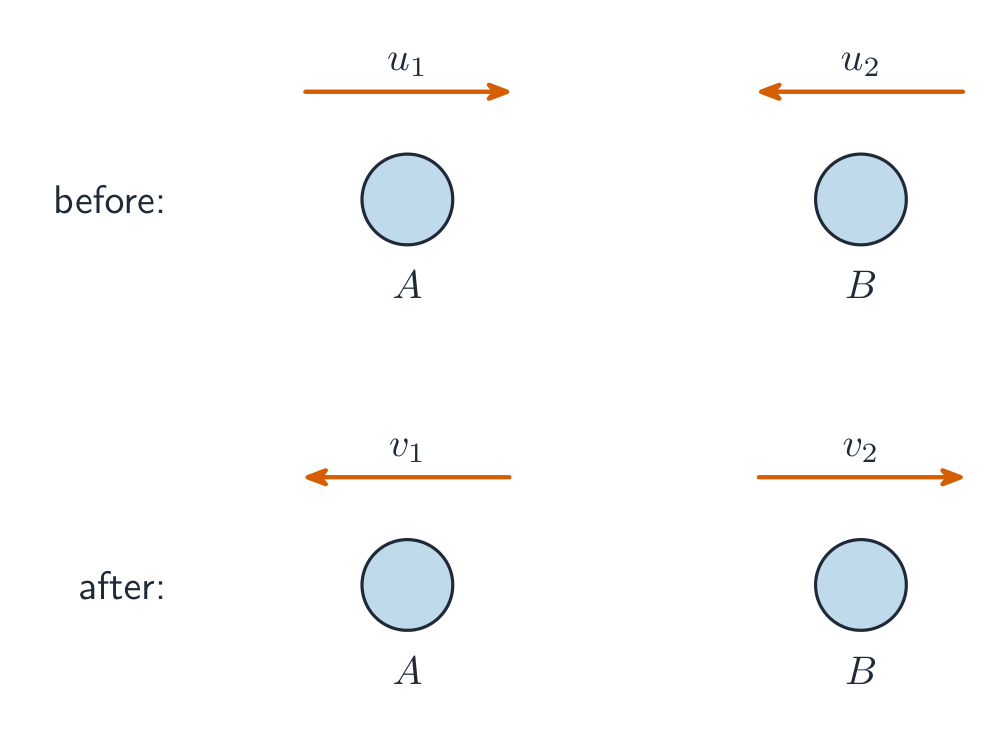
内力成牛顿第三定律对,所以它们在任何系统内抵消:它们能在部分之间移动动量但从不改变总量。动量只通过一个合力进入或离开一个系统($\vec{J}=\Delta\vec{p}$)。所以,以零合外力,总动量守恒(conserved):

$$\sum\vec{p}_{\text{before}}=\sum\vec{p}_{\text{after}}.$$

动量在每个碰撞里守恒,无论多剧烈——选择系统足够大,使碰撞力是内部的。沿每个轴分别应用守恒;AP 要求一维或二维的定量工作。

一个正面碰撞:之前的总动量等于之后的总动量

Worked example (explosion). 一个静止的 $6.0\ \text{kg}$ 弹壳分裂成一个以 $9.0\ \text{m/s}$ 向东移动的 $2.0\ \text{kg}$ 片和一个 $4.0\ \text{kg}$ 片。总动量保持零,所以重的片以 $v=\dfrac{2.0(9.0)}{4.0}=4.5\ \text{m/s}$ 向西移动。动能来自储存的(化学或弹簧)能量——动量守恒不要求动能守恒。

探索

Collide two carts and conserve momentum

In any collision the total momentum $\sum mv$ before equals the total after. Set the masses and speeds and check the momentum bookkeeping.

词汇表 训练
英文 中文 拼音
conserved 守恒 shǒu héng
4.4

弹性碰撞与非弹性碰撞

大纲
Learning ObjectiveEssential Knowledge

4.4.A
Describe whether an interaction between objects is elastic or inelastic.

  • 4.4.A.1 An elastic collision between objects is one in which the initial kinetic energy of the system is equal to the final kinetic energy of the system.
  • 4.4.A.2 In an elastic collision, the final kinetic energies of each of the objects within the system may be different from their initial kinetic energies.
  • 4.4.A.3 An inelastic collision between objects is one in which the total kinetic energy of the system decreases.
  • 4.4.A.4 In an inelastic collision, some of the initial kinetic energy is not restored to kinetic energy but is transformed by nonconservative forces into other forms of energy.
  • 4.4.A.5 In a perfectly inelastic collision, the objects stick together and move with the same velocity after the collision.

来源:美国大学理事会 AP 课程与考试说明

碰撞中的动量守恒

所有碰撞都守恒动量;它们在动能(kinetic energy)发生什么上不同:

类型 动量 动能
弹性碰撞(elastic collision) 守恒 总量守恒(各自份额可能变化)
非弹性碰撞(inelastic collision) 守恒 减少——一些变成热、声、形变(deformation)
完全非弹性碰撞(perfectly inelastic collision) 守恒 最大可能的损失——物体粘住并共享一个速度

策略:总是先写动量守恒;只在问题说"弹性"时加动能方程。两个有用的弹性事实:一维弹性碰撞里相等的质量简单地交换速度,而在质心参考系里每个物体只反转它的速度。

Worked example. 一辆 $1000\ \text{kg}$$20\ \text{m/s}$ 的车撞一辆静止的 $1500\ \text{kg}$ 的车而它们锁在一起——完全非弹性。动量:$v=\dfrac{1000(20)}{2500}=8.0\ \text{m/s}$。动能从 $2.0\times10^5\ \text{J}$ 落到 $\tfrac12(2500)(8.0)^2=8.0\times10^4\ \text{J}$:约 $60\%$ 损失,即使动量恰好守恒。

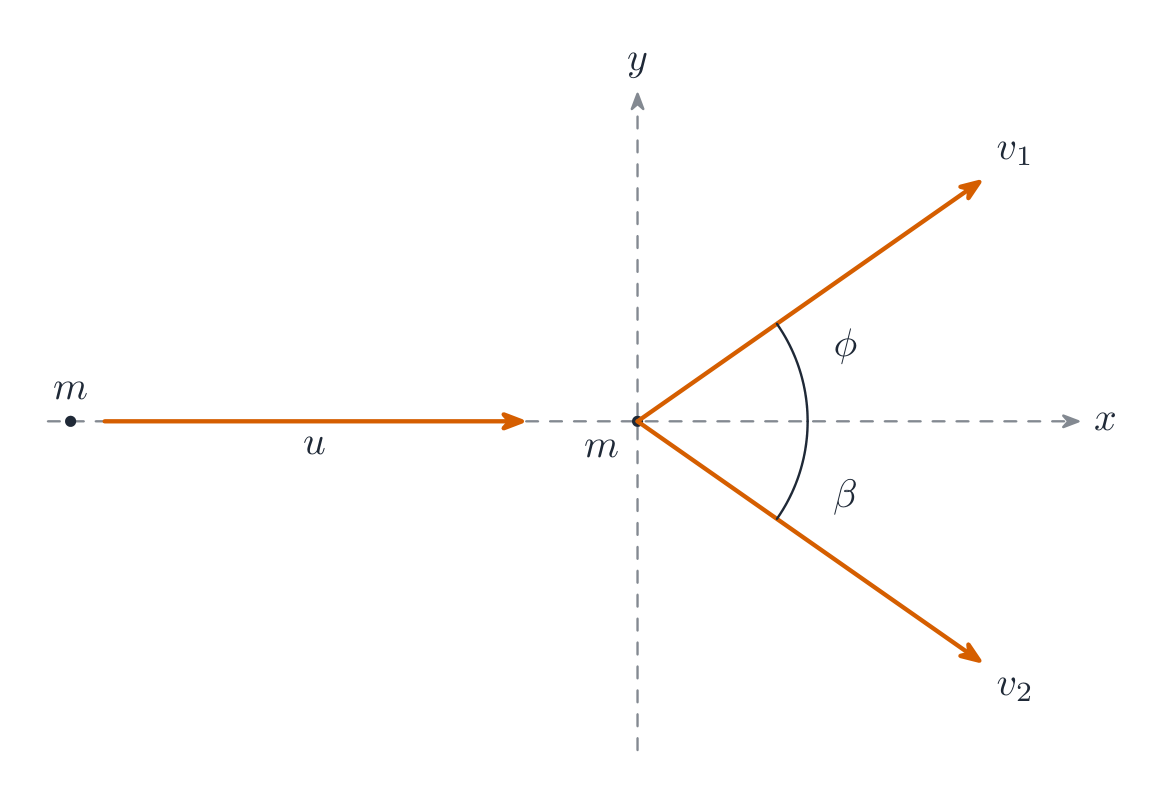
Worked example (2D). 一个向东以 $4.0\ \text{m/s}$ 移动的冰球撞一个静止的相同冰球;掠射撞击后,一个以 $2.0\ \text{m/s}$、东偏北 $60^\circ$ 移动。守恒每个轴:东-西,$m(4.0)=m(2.0)\cos60^\circ+mv_x$,所以 $v_x=3.0\ \text{m/s}$;南-北,$0=m(2.0)\sin60^\circ-mv_y$,所以 $v_y=1.7\ \text{m/s}$。第二个冰球以 $\sqrt{3.0^2+1.7^2}=3.5\ \text{m/s}$、东偏南约 $30^\circ$ 移动。

一个掠射碰撞,沿两个垂直坐标轴分解
一个掠射碰撞,沿两个垂直坐标轴分解

Exam skill. 在 FRQ 上,用条件、不是口号来论证:"碰撞期间两冰球系统上的合外力是零,所以它的总动量恒定。"若被问碰撞是否弹性,计算之前和之后的动能并比较——绝不假设。

探索

Compare elastic and inelastic collisions

Momentum is always conserved, but kinetic energy is only conserved in an elastic collision. In an inelastic one the carts stick and some energy becomes heat.

词汇表 训练
英文 中文 拼音
kinetic energy 动能 dòng néng
elastic collision 弹性碰撞 tán xìng pèng zhuàng
inelastic collision 非弹性碰撞 fēi tán xìng pèng zhuàng
deformation 形变 xíng biàn
perfectly inelastic collision 完全非弹性碰撞 wán quán fēi tán xìng pèng zhuàng
练习卷
4.4

考试技巧

  • 冲量等于动量变化:$\vec J=\int \vec F\,dt=\Delta\vec p$,而它是一个力-时间图下的面积。
  • 每当合外力是零时动量守恒——总是碰撞的首选。
  • 弹性(动能守恒)与非弹性(动能减少)碰撞区分开;在完全非弹性碰撞中物体粘住并以一个速度运动。
  • 在二维里对每个分量(x 和 y)分别应用守恒。
  • 与质心联系:总动量 $=M\vec v_{cm}$

本主题的互动课程

逐步学习,并即时检测练习。

AP 物理 C:力学历年真题

AP 物理 C:力学的更多主题

登录或创建账号

IGCSE, A-Level & AP