跳到主要内容

功、能与功率

AP 物理 C:力学 · 第 3 主题

训练
讲义 词汇表
3.1

平动动能

大纲
Learning ObjectiveEssential Knowledge

3.1.A
Describe the translational kinetic energy of an object in terms of the object's mass and velocity.

  • 3.1.A.1 An object's translational kinetic energy is given by the equation
    • Equation: $K = \dfrac{1}{2}mv^2$
  • 3.1.A.2 Translational kinetic energy is a scalar quantity.
  • 3.1.A.3 Different observers may measure different values of the translational kinetic energy of an object, depending on the observer's frame of reference.

来源:美国大学理事会 AP 课程与考试说明

动能(kinetic energy)是运动的能量,一个以焦耳(joules)(J)测量的标量(scalar):

$$K=\tfrac{1}{2}mv^2.$$

它随速率的平方增长——把速率加倍使 $K$ 变为四倍。一个值得知道的微妙之处:动能取决于观察者的参考系(reference frame)。一个在火车上走的乘客在火车里面测量有一个小的 $K$ 而从地面测量有一个巨大的——两个观察者都对,各在他们自己的参考系里。

词汇表 训练
英文 中文 拼音
Kinetic energy 动能 dòng néng
scalar 标量 biāo liàng
joules 焦耳 jiāo ěr
reference frame 参考系 cān kǎo xì
3.2

大纲
Learning ObjectiveEssential Knowledge

3.2.A
Describe the work done on an object or system by a given force or collection of forces.

  • 3.2.A.1 Work is the amount of energy transferred into or out of a system by a force exerted on that system over a distance.
    • 3.2.A.1.i The work done by a conservative force exerted on a system is path-independent and only depends on the initial and final configurations of that system.
    • 3.2.A.1.ii The work done by a conservative force on a system—or the change in the potential energy of the system—will be zero if the system returns to its initial configuration.
    • 3.2.A.1.iii Potential energies are associated only with conservative forces.
    • 3.2.A.1.iv The work done by a nonconservative force is path-dependent.
    • 3.2.A.1.v The most common nonconservative forces are friction and air resistance.
  • 3.2.A.2 Work is a scalar quantity that may be positive, negative, or zero.
  • 3.2.A.3 The work done on an object by a variable force is calculated using
    • Equation: $W = \displaystyle\int_a^b \vec{F}(r) \cdot d\vec{r}$, where the integral is taken over the path from point $a$ to point $b$.
    • 3.2.A.3.i The dot product between two vectors, $\vec{A}$ and $\vec{B}$, results in a scalar quantity of magnitude $\vec{A} \cdot \vec{B} = AB\cos\theta$.
    • 3.2.A.3.ii Only the component of the force exerted on a system that is parallel to the displacement of the point of application of the force will change the system's total energy.
    • 3.2.A.3.iii If the component of the force exerted on a system that is parallel to the displacement is constant, the work done on the system by the force is given by the derived equation $W = F_{\parallel}d = Fd\cos\theta$.
    • 3.2.A.3.iv The component of the force exerted on a system perpendicular to the direction of the displacement of the system's center of mass can change the direction of the system's motion without changing the system's kinetic energy.
  • 3.2.A.4 The work–energy theorem states that the change in an object's kinetic energy is equal to the sum of the work (net work) being done by all forces exerted on the object.
    • Equation: $\Delta K = \displaystyle\sum W_i = \sum F_{\parallel,i}\, d_i$
    • 3.2.A.4.i An external force may change the configuration of a system. The component of the external force parallel to the displacement times the displacement of the point of application of the force gives the change in kinetic energy of the system.
    • 3.2.A.4.ii If the system's center of mass and the point of application of the force move the same distance when a force is exerted on a system, then the system may be modeled as an object, and only the system's kinetic energy can change.
    • 3.2.A.4.iii The energy dissipated by friction is typically equated to the force of friction times the length of the path over which the force is exerted.
      • Equation: $\Delta E_{\text{mech}} = F_f d\cos\theta$
    • 3.2.A.5 Work is equal to the area under the curve of a graph of $F_{\parallel}$ as a function of displacement.

Boundary statement: AP Physics C: Mechanics only expects students to analyze the transfer of mechanical energy, although students should be aware that mechanical energy may be dissipated in the form of thermal energy or sound.

来源:美国大学理事会 AP 课程与考试说明

(work)是一个力作用在一个距离上转移进或出一个系统的能量。对于一个变力它是沿路径的一个积分(integral):

$$W=\int_a^b \vec{F}\cdot d\vec{r}=\int F\cos\theta\,dr.$$

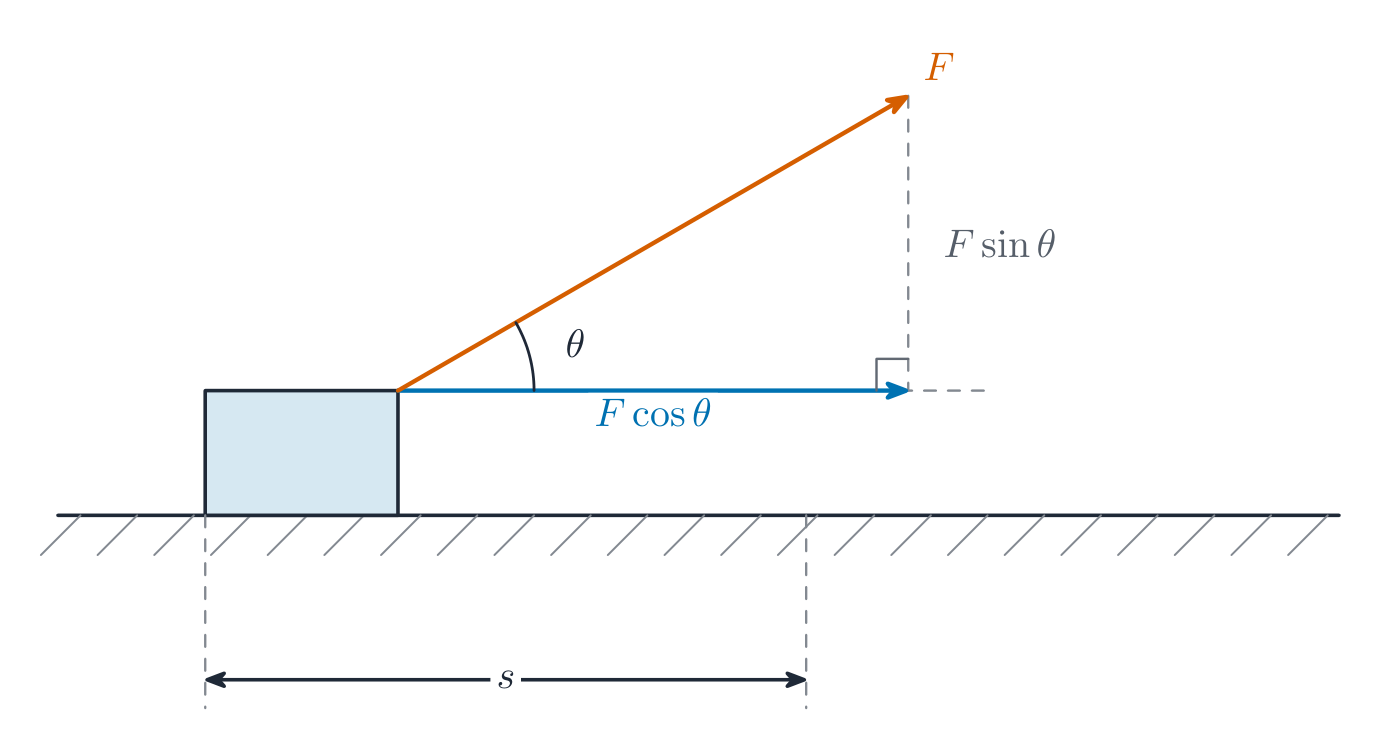
对于一个恒定力这简化到 $W=Fd\cos\theta$;在一个力-位置图上,功是曲线下的面积。功是一个带符号的标量,而这个符号是物理,不是记账:

  • ——力有一个沿运动的分量(它使物体加速)。
  • ——力反对运动(摩擦力(friction)和空气阻力做负功)。
  • ——力垂直于运动(一个滑动木块上的法向力(normal force)、一次水平移动上的重力、一次圆形摆动里的张力)。
只有沿位移的力分量做功
只有沿位移的力分量做功

动能定理(work–energy theorem)收集每个力的贡献:功等于动能的变化,

$$W_{\text{net}}=\sum W_i=\Delta K.$$

Worked example. 一个变力 $F(x)=3x^2\ \text{N}$(沿运动)从 $x=0$$x=2\ \text{m}$ 作用:$W=\displaystyle\int_0^2 3x^2\,dx=\big[x^3\big]_0^2=8\ \text{J}$。单独作用在一个从静止开始的物体上,它会把动能提高到恰好 $8\ \text{J}$

词汇表 训练
英文 中文 拼音
Work gōng
integral 积分 jī fēn
friction 摩擦力 mó cā lì
normal force 法向力 fǎ xiàng lì
work–energy theorem 动能定理 dòng néng dìng lǐ
3.3

势能

大纲
Learning ObjectiveEssential Knowledge

3.3.A
Describe the potential energy of a system.

  • 3.3.A.1 A system composed of two or more objects has potential energy if the objects within that system only interact with each other through conservative forces.
  • 3.3.A.2 Potential energy is a scalar quantity associated with the position of objects within a system.
  • 3.3.A.3 The definition of zero potential energy for a given system is a decision made by the observer considering the situation to simplify or otherwise assist in analysis.
  • 3.3.A.4 The relationship between conservative forces exerted on a system and the system's potential energy is
    • Equation: $\Delta U = -\displaystyle\int_a^b \vec{F}_{cf}(r) \cdot d\vec{r}$
  • 3.3.A.5 The conservative forces exerted on a system in a single dimension can be determined using the slope of the system's potential energy with respect to position in that dimension; these forces point in the direction of decreasing potential energy.
    • Equation: $F_x = -\dfrac{dU(x)}{dx}$
  • 3.3.A.6 Graphs of a system's potential energy as a function of its position can be useful in determining physical properties of that system.
    • 3.3.A.6.i Stable equilibrium is a location at which a small displacement in an object's position results in a force exerted on the object opposite to the direction of the small displacement, accelerating the object back toward the equilibrium position.
    • 3.3.A.6.ii Unstable equilibrium is a location at which a small displacement in an object's position results in a force exerted on the object in the same direction as the small displacement, accelerating the object away from the equilibrium position.
    • 3.3.A.6.iii In a given dimension, stable equilibrium positions exist at locations where the potential energy as a function of position in that dimension has a local minimum.
    • 3.3.A.6.iv In a given dimension, unstable equilibrium positions occur at locations where the potential energy as a function of position in that dimension has a local maximum.
  • 3.3.A.7 The potential energy of common physical systems can be described using the physical properties of that system.
    • 3.3.A.7.i The elastic potential energy of an ideal spring is given by the following equation, where $\Delta x$ is the distance the spring has been stretched or compressed from its equilibrium length.
      • Equation: $U_s = \dfrac{1}{2}k(\Delta x)^2$
    • 3.3.A.7.ii The general form for the gravitational potential energy of a system consisting of two approximately spherical distributions of mass (e.g., moons, planets, or stars) is given by the equation
      • Equation: $U_g = -G\dfrac{m_1 m_2}{r}$
    • 3.3.A.7.iii Because the gravitational field near the surface of a planet is nearly constant, the change in gravitational potential energy in a system consisting of an object with mass $m$ and a planet with gravitational field of magnitude $g$ when the object is near the surface of the planet may be approximated by the equation
      • Equation: $\Delta U_g = mg\Delta y$
  • 3.3.A.8 The total potential energy of a system containing more than two objects is the sum of the potential energy of each pair of objects within the system.

来源:美国大学理事会 AP 课程与考试说明

势能(potential energy)是一个系统通过它各部分的位置储存的能量——它只对保守力(conservative forces)存在,它们的功与路径无关。它通过功定义:

$$\Delta U=-\int_a^b\vec{F}\cdot d\vec{r},$$

而你自由地选择 $U=0$ 的地方——只有 $U$ 的变化重要,所以挑选使问题最简单的零。标准的结果:

  • 一个表面附近的重力:$\Delta U_g=mg\,\Delta y$
  • 一般的重力:$U_g=-\dfrac{Gm_1m_2}{r}$(在无限间距为零)。
  • 弹簧:$U_s=\tfrac12k(\Delta x)^2$,$\Delta x$ 从自然长度测量。

对于几个物体的系统,把每的势能相加。把定义反过来,一个保守力是它势能的负导数(derivative):

$$F_x=-\frac{dU}{dx}.$$

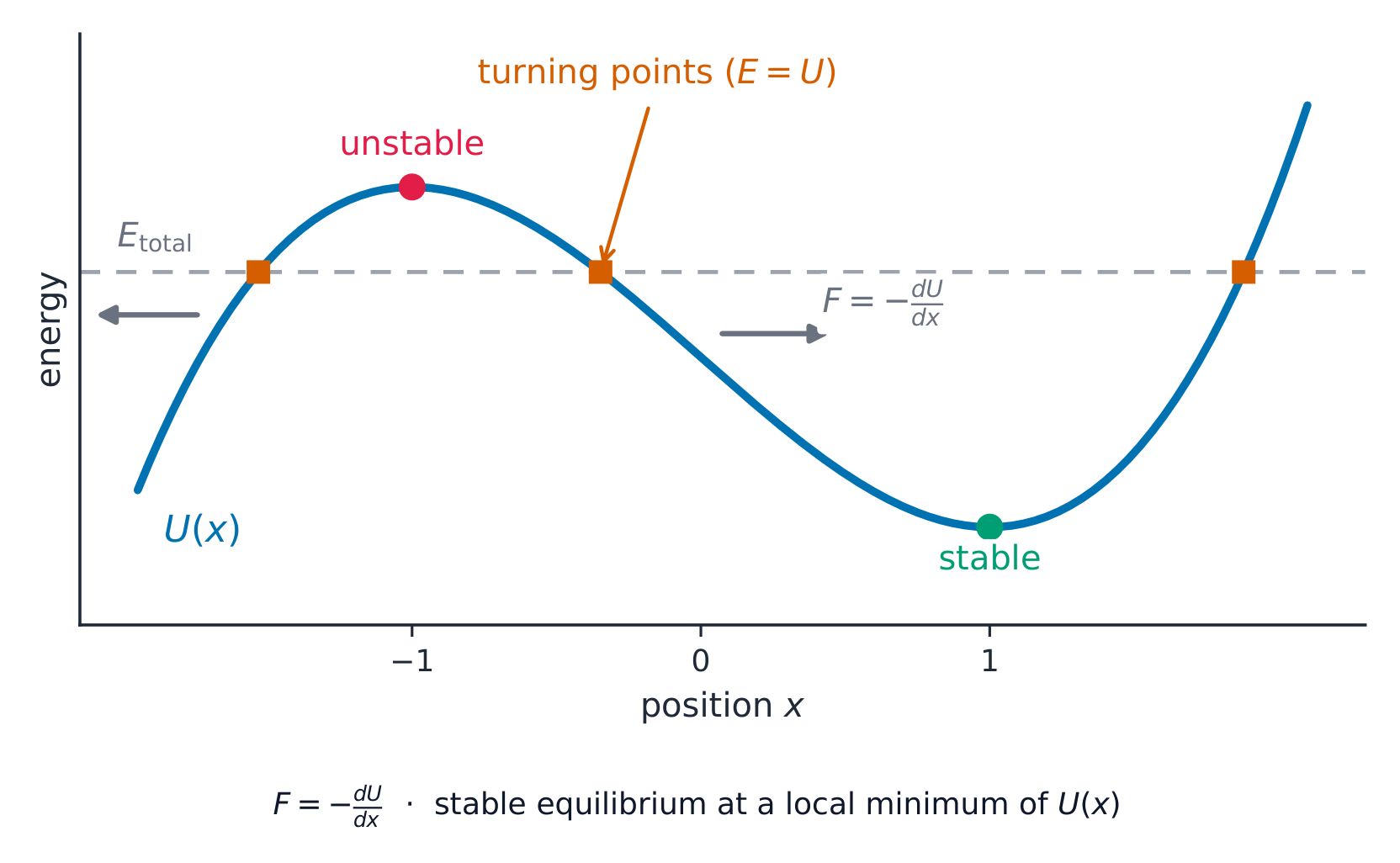
力在 $U(x)$ 曲线上指向"下坡"。平衡坐在斜率为零的地方:一个最小值是一个稳定平衡(stable equilibrium)(被移开,力推回),一个最大值是一个不稳定平衡(unstable equilibrium)(被移开,力推开)。

在一条势能曲线上力指向下坡而 E = U 标记转折点

Worked example. 给定 $U(x)=2x^3-6x$(焦耳),力是 $F=-\dfrac{dU}{dx}=6-6x^2$。平衡坐在 $F=0$:$x=\pm1$。因为 $\dfrac{d^2U}{dx^2}=12x$$x=+1$ 为正(一个最小值——稳定)而在 $x=-1$ 为负(一个最大值——不稳定),这两点表现相反。

探索

Store elastic potential energy in a spring

Stretching a spring stores elastic potential energy $\tfrac12 kx^2$ — the area under the force-extension line. Release it and that energy becomes kinetic.

词汇表 训练
英文 中文 拼音
Potential energy 势能 shì néng
conservative forces 保守力 bǎo shǒu lì
derivative 导数 dǎo shù
stable equilibrium 稳定平衡 wěn dìng píng héng
unstable equilibrium 不稳定平衡 bù wěn dìng píng héng
3.4

能量守恒

大纲
Learning ObjectiveEssential Knowledge

3.4.A
Describe the energies present in a system.

  • 3.4.A.1 A system composed of only a single object can only have kinetic energy.
  • 3.4.A.2 A system that contains objects that interact via conservative forces or that can change its shape reversibly may have both kinetic and potential energies.

3.4.B
Describe the behavior of a system using conservation of mechanical energy principles.

  • 3.4.B.1 Mechanical energy is the sum of a system's kinetic and potential energies.
  • 3.4.B.2 Any change to a type of energy within a system must be balanced by an equivalent change of other types of energies within the system or by a transfer of energy between the system and its surroundings.
  • 3.4.B.3 A system may be selected so that the total energy of that system is constant.
  • 3.4.B.4 If the total energy of a system changes, that change will be equivalent to the energy transferred into or out of the system.

3.4.C
Describe how the selection of a system determines whether the energy of that system changes.

  • 3.4.C.1 Energy is conserved in all interactions.
  • 3.4.C.2 If the work done on a selected system is zero and there are no nonconservative interactions within the system, the total mechanical energy of the system is constant.
  • 3.4.C.3 If the work done on a selected system is nonzero, energy is transferred between the system and the environment.

Boundary statement: AP Physics C: Mechanics expects students to know that mechanical energy can be dissipated as thermal energy or sound by nonconservative forces.

来源:美国大学理事会 AP 课程与考试说明

能量守恒:动能↔势能

能量在所有相互作用里守恒——问题只是它去哪里。机械能(mechanical energy)是和 $E=K+U$。若一个系统上的外功是零而它里面没有任何东西通过非保守力(nonconservative forces)作用,那么

$$K_1+U_1=K_2+U_2.$$

当摩擦或阻力作用时,它们把机械能转换成热能(thermal energy)($\Delta E_{\text{mech}}=-F_fd$),而这个平衡必须包括那一项。若外功确实被做,系统的总能量恰好变化转移的能量:$W_{\text{ext}}=\Delta E_{\text{sys}}$。选择系统就是选择记账——一个单一物体只能动能;包括地球或弹簧,系统也能储存势能。

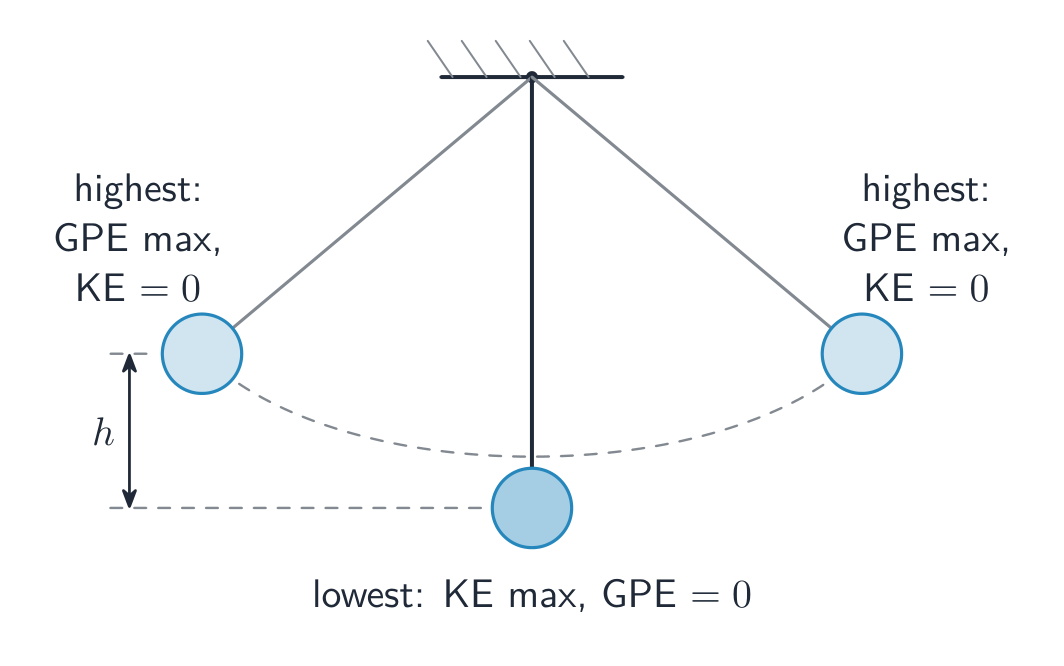
一个摆把重力势能换成动能并换回
一个摆把重力势能换成动能并换回

一条势能图是一幅完整的运动图:高度 $E$ 处的水平线是总能量、间隙 $E-U(x)$ 是每个 $x$ 处的动能,而交叉 $E=U$转折点(turning points),物体在那里暂时停止并反转。

Worked example. 一个 $2.0\ \text{kg}$ 的木块从高度 $1.5\ \text{m}$ 从静止沿一个坡道滑下,以 $4.0\ \text{m/s}$ 到达底部。能量核算:$mgh=29.4\ \text{J}$ 可得;$\tfrac12mv^2=16\ \text{J}$ 作为动能到达;所以摩擦沿途把 $29.4-16=13\ \text{J}$ 转换成热能。
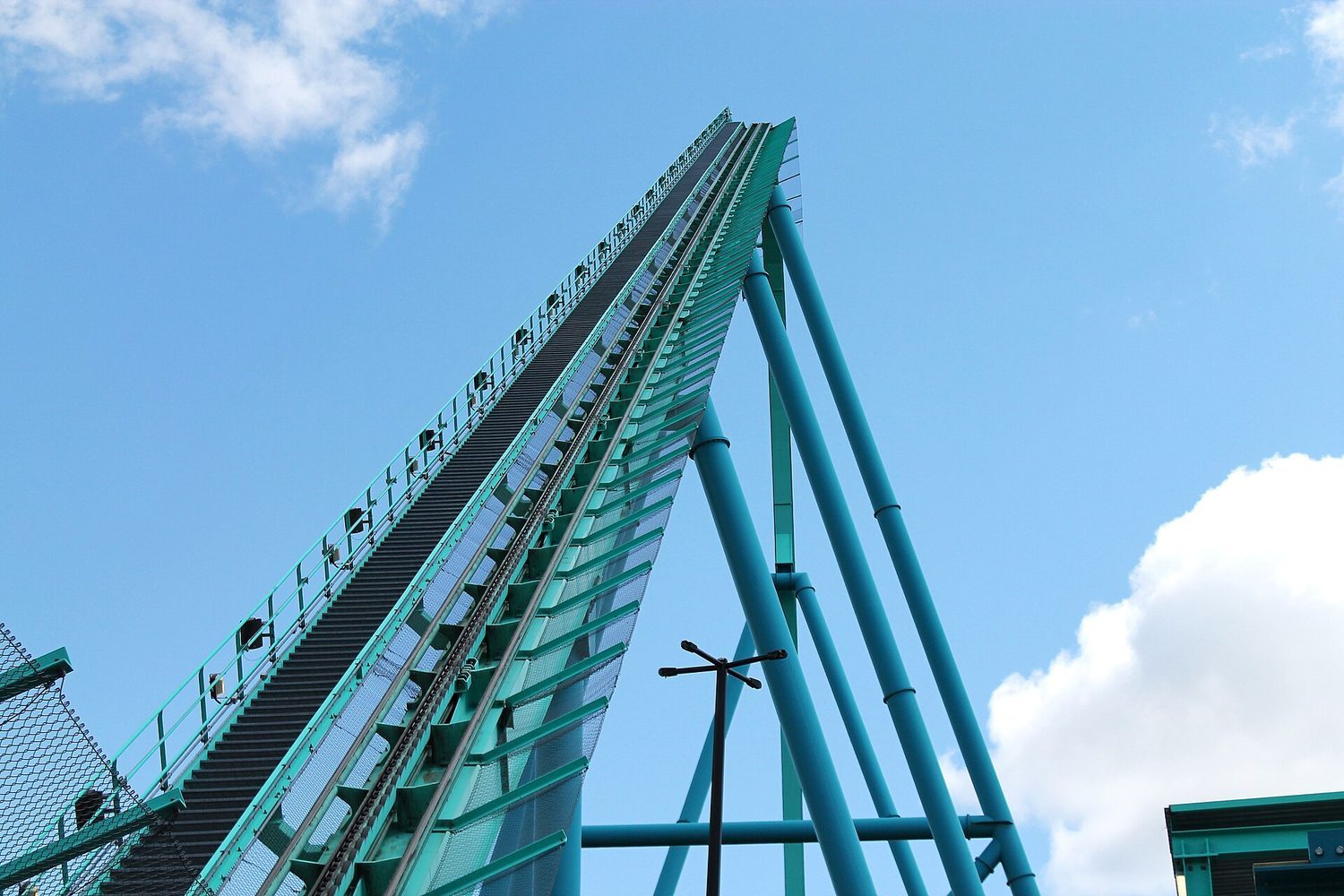
A roller coaster trades energy back and forth: highest (most PE) at the top, fastest (most KE) at the bottom
探索

Watch energy convert as an object falls

With no friction, mechanical energy is conserved: as an object falls, gravitational potential energy turns into kinetic energy while the total stays fixed.

词汇表 训练
英文 中文 拼音
Mechanical energy 机械能 jī xiè néng
nonconservative forces 非保守力 fēi bǎo shǒu lì
thermal energy 热能 rè néng
turning points 转折点 zhuǎn zhé diǎn
练习卷
3.5

功率

大纲
Learning ObjectiveEssential Knowledge

3.5.A
Describe the transfer of energy into, out of, or within a system in terms of power.

  • 3.5.A.1 Power is the rate at which energy changes with respect to time, either by transfer into or out of a system or by conversion from one type to another within a system.
  • 3.5.A.2 Average power is the amount of energy being transferred or converted, divided by the time it took for that transfer or conversion to occur.
    • Equation: $P_{\text{avg}} = \dfrac{\Delta E}{\Delta t}$
  • 3.5.A.3 Because work is the change in energy of an object or system due to a force, average power is the total work done, divided by the time during which that work was done.
    • Equation: $P_{\text{avg}} = \dfrac{W}{\Delta t}$
  • 3.5.A.4 The instantaneous power delivered to an object by a force is given by the equation
    • Equation: $P_{\text{inst}} = \dfrac{dW}{dt}$
  • 3.5.A.5 The instantaneous power delivered to an object by the component of a constant force parallel to the object's velocity can be described with the derived equation
    • Equation: $P_{\text{inst}} = F_{\parallel}v = Fv\cos\theta$

来源:美国大学理事会 AP 课程与考试说明

功率(power)是能量转移的速率,以瓦特(watts)(W):

$$P_{\text{avg}}=\frac{\Delta E}{\Delta t}=\frac{W}{\Delta t},\qquad P_{\text{inst}}=\frac{dW}{dt}=\vec{F}\cdot\vec{v}.$$

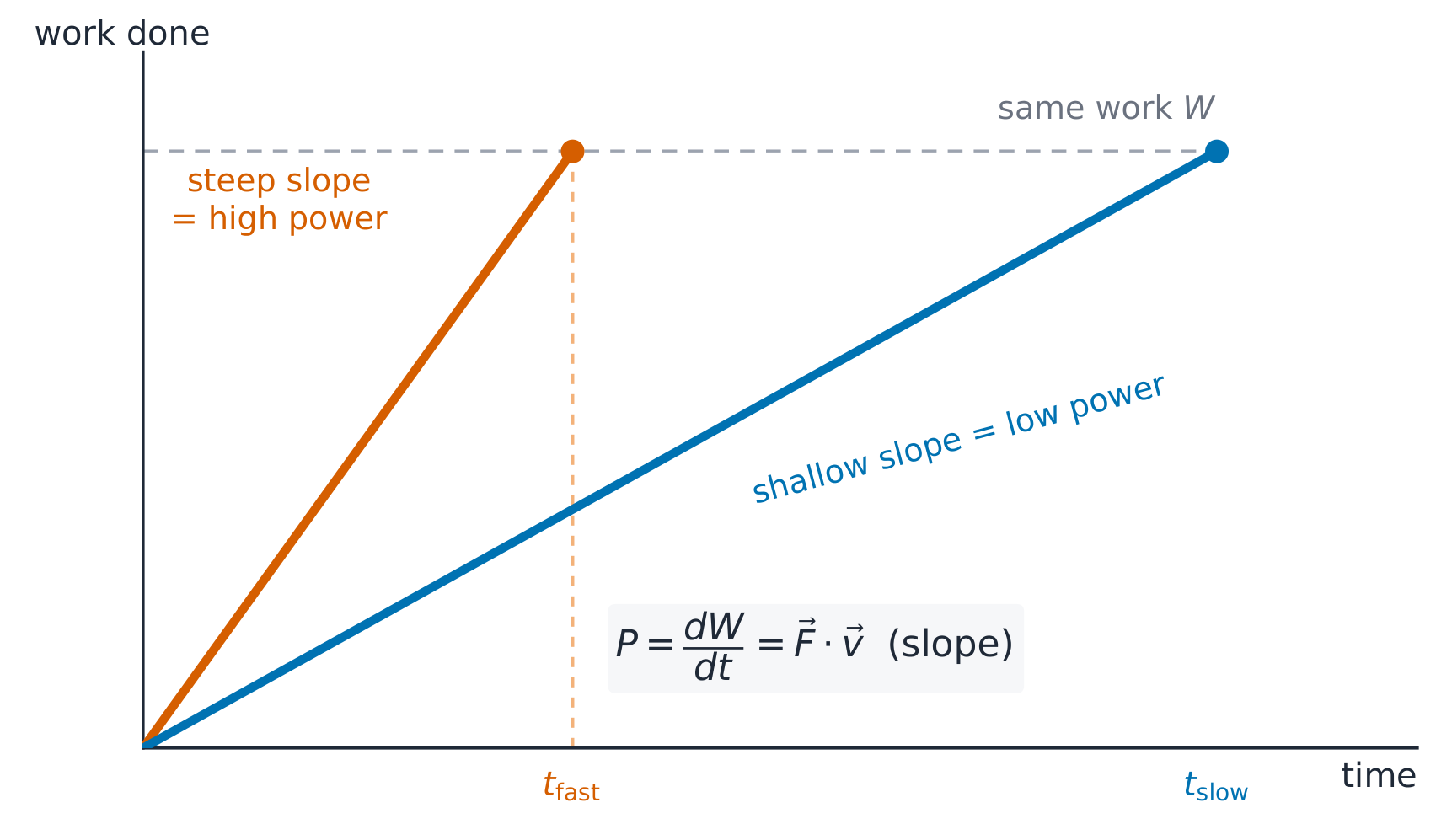
它测量功被做得多,不是多少。点积重要:只有沿速度的力分量传递功率。

功率是功-时间图的斜率:同样的功在更少时间里意味着更多功率

Worked example. 一个木块从一个无摩擦的 $3.0\ \text{m}$ 高坡道的顶部从静止释放,以 $v=\sqrt{2gh}=7.7\ \text{m/s}$ 到达底部(从 $mgh=\tfrac12mv^2$)。一个然后以稳定的 $7.7\ \text{m/s}$ 逆着一个 $20\ \text{N}$ 阻力驱动它的马达传递 $P=Fv=20(7.7)\approx150\ \text{W}$

Worked example. 一辆 $1200\ \text{kg}$ 的车以稳定的 $15\ \text{m/s}$ 爬一个每 $20\ \text{m}$ 道路上升 $1.0\ \text{m}$ 的山。引擎必须供应重力的功率消耗:$P=mg\,v\sin\theta=1200(9.8)(15)\big(\tfrac{1}{20}\big)\approx8.8\ \text{kW}$ ——在加空气阻力之前。

Exam skill. 能量 FRQ 奖励核算句子:命名你的系统、陈述哪些力对它做功,并在代入数字之前写平衡($W_{\text{ext}}=\Delta K+\Delta U+\Delta E_{\text{thermal}}$)。"摩擦存在,所以机械能不守恒"是一个评分的陈述。

词汇表 训练
英文 中文 拼音
Power 功率 gōng lǜ
watts 瓦特 wǎ tè
3.5

考试技巧

  • 动能定理 $W_{net}=\Delta KE$ 并对一个变力把功计算为 $W=\int \vec F\cdot d\vec r$
  • 从一个力-位置图把功读作曲线下的面积。
  • 功率是 $P=\tfrac{dW}{dt}=\vec F\cdot\vec v$;注意瞬时 vs 平均。
  • 把力分成保守的(定义一个势能)和非保守的(耗散能量)。
  • 当力变化或路径复杂时选择能量方法而不是运动学。

本主题的互动课程

逐步学习,并即时检测练习。

AP 物理 C:力学历年真题

AP 物理 C:力学的更多主题

登录或创建账号

IGCSE, A-Level & AP