跳到主要内容

力与平动动力学

AP 物理 C:力学 · 第 2 主题

训练
讲义 词汇表
2.1

系统与质心

大纲
Learning ObjectiveEssential Knowledge

2.1.A
Describe the properties and interactions of a system.

  • 2.1.A.1 System properties are determined by the interactions between objects within the system.
  • 2.1.A.2 If the properties or interactions of the constituent objects within a system are not important in modeling the behavior of the macroscopic system, the system can itself be treated as a single object.
  • 2.1.A.3 Systems may allow interactions between constituent parts of the system and the environment, which may result in the transfer of energy or mass.
  • 2.1.A.4 Individual objects within a chosen system may behave differently from each other as well as from the system as a whole.
  • 2.1.A.5 The internal structure of a system affects the analysis of that system.
  • 2.1.A.6 As variables external to a system are changed, the system's substructure may change.

2.1.B
Describe the location of a system's center of mass with respect to the system's constituent parts.

  • 2.1.B.1 For objects or systems with symmetrical mass distributions, the center of mass is located on lines of symmetry.
  • 2.1.B.2 The location of a system's center of mass along a given axis can be calculated using the equation
    • Equation: $\vec{x}_{\text{cm}} = \dfrac{\sum m_i \vec{x}_i}{\sum m_i}$
  • 2.1.B.3 For a nonuniform solid that can be considered as a collection of differential masses, $dm$, the solid's center of mass can be calculated using the equation
    • Equation: $\vec{r}_{\text{cm}} = \dfrac{\int \vec{r}\, dm}{\int dm}$
    • 2.1.B.3.i The linear mass density of a rod or other linear rigid body is the derivative of the rod's mass with respect to the position of the differential mass element on the rigid body.
      • Equation: $\lambda = \dfrac{d}{d\ell} m(\ell)$
    • 2.1.B.3.ii If a function of mass density is given for a solid, the total mass can be determined by integrating the mass density over the length (one dimension), area (two dimensions), or volume (three dimensions) of the solid. For example:
      • Equation: $M_{\text{total}} = \int \rho(r)\, dV$
  • 2.1.B.4 A system can be modeled as a singular object that is located at the system's center of mass.

来源:美国大学理事会 AP 课程与考试说明

一个系统(system)是你分析的物体,当作它质心(center of mass)处的一个点。对于一组质量,$x_{\text{cm}}=\dfrac{\sum m_i x_i}{\sum m_i}$;对于一个连续物体,$x_{\text{cm}}=\dfrac{1}{M}\int x\,dm$。只有力移动质心。

词汇表 训练
英文 中文 拼音
system 系统 xì tǒng
center of mass 质心 zhì xīn
2.2

力与受力图

大纲
Learning ObjectiveEssential Knowledge

2.2.A
Describe a force as an interaction between two objects or systems

  • 2.2.A.1 Forces are vector quantities that describe the interactions between objects or systems.
    • 2.2.A.1.i A force exerted on an object or system is always due to the interaction of that object or system with another object or system.
    • 2.2.A.1.ii An object or system cannot exert a net force on itself.
  • 2.2.A.2 Contact forces describe the interaction of an object or system touching another object or system and are macroscopic effects of interatomic electric forces.

2.2.B
Describe the forces exerted on an object or system using a free-body diagram.

  • 2.2.B.1 Free-body diagrams are useful tools for visualizing forces being exerted on a single object or system and for determining the equations that represent a physical situation.
  • 2.2.B.2 The free-body diagram of an object or system shows each of the forces exerted on the object or system by the environment.
  • 2.2.B.3 Forces exerted on an object or system are represented as vectors originating from the representation of the center of mass, such as a dot. A system is treated as though all of its mass is located at the center of mass.
  • 2.2.B.4 A coordinate system with one axis parallel to the direction of acceleration of the object or system simplifies the translation from free-body diagram to algebraic representation. For example, in a free-body diagram of an object on an inclined plane, it is useful to set one axis parallel to the surface of the incline.

Boundary statement: AP Physics C: Mechanics and AP Physics C: Electricity and Magnetism only expect students to depict the forces exerted on objects, not the force components on free-body diagrams. On the AP Physics exams, individual forces represented on a free-body diagram must be drawn as individual straight arrows, originating on the dot and pointing in the direction of the force. Individual forces that are in the same direction must be drawn side by side, not overlapping.

来源:美国大学理事会 AP 课程与考试说明

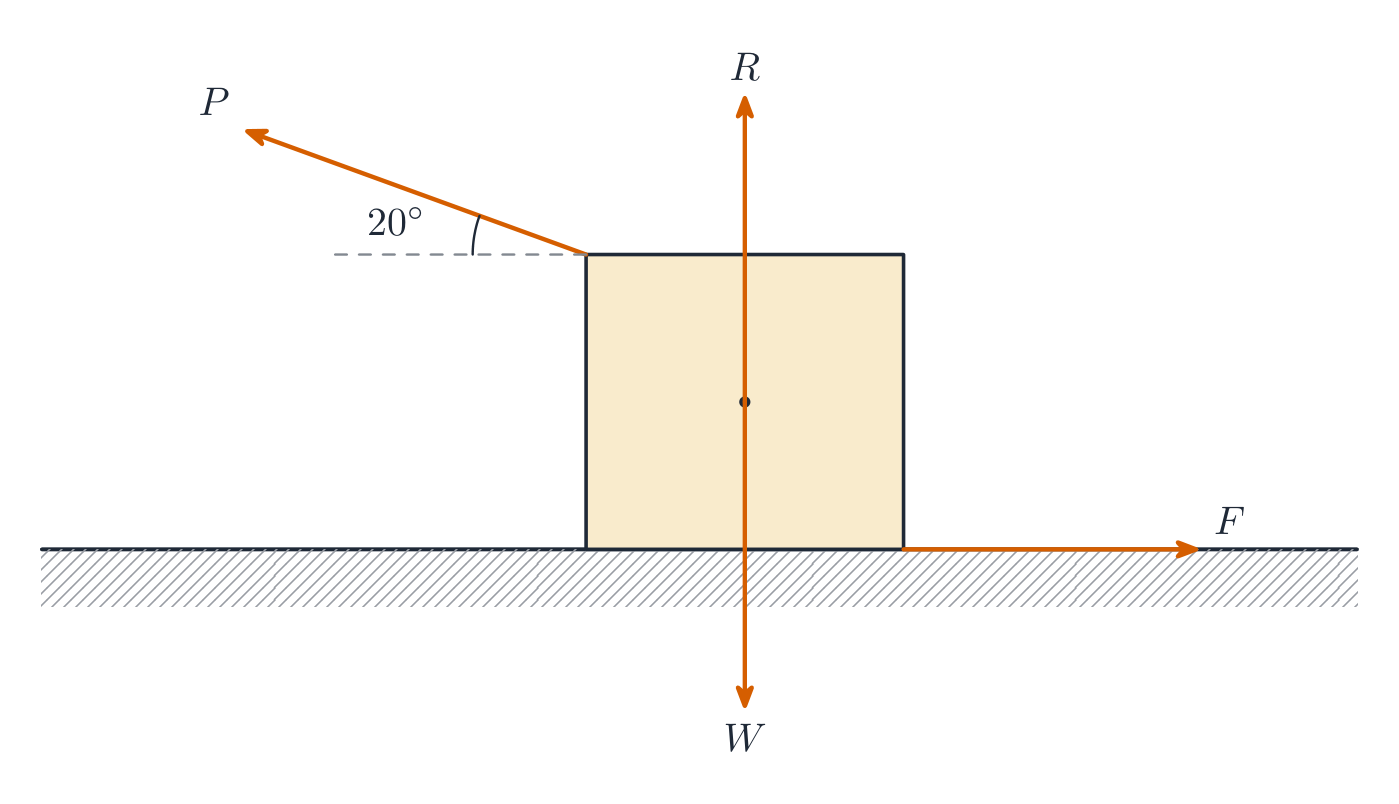
一个(force)是一个推或拉(一个矢量,以牛顿)。一个受力图(free-body diagram)画一个物体,带它上每个力的一个箭头——重力、法向、张力、摩擦、施加、阻力。先画它;它设置每个动力学方程。

一个受力图显示作用在一个物体上的每个力
一个受力图显示作用在一个物体上的每个力
探索

Balance the forces on a free-body diagram

A free-body diagram shows every force on one object as an arrow. The object accelerates only if the forces don't cancel — the net force sets $a=F/m$.

词汇表 训练
英文 中文 拼音
force
free-body diagram 受力图 shòu lì tú
2.3

牛顿第三定律

大纲
Learning ObjectiveEssential Knowledge

2.3.A
Describe the interaction of two objects or systems using Newton's third law and a representation of paired forces exerted on each object or system.

  • 2.3.A.1 Newton's third law describes the interaction of two objects or systems in terms of the paired forces that each exerts on the other.
    • Equation: $\vec{F}_{\text{A on B}} = -\vec{F}_{\text{B on A}}$
  • 2.3.A.2 Interactions between objects within a system (internal forces) do not influence the motion of a system's center of mass.
  • 2.3.A.3 Tension is the macroscopic net result of forces that infinitesimal segments of a string, cable, chain, or similar system exert on each other in response to an external force.
    • 2.3.A.3.i An ideal string has negligible mass and does not stretch when under tension.
    • 2.3.A.3.ii The tension in an ideal string is the same at all points within the string.
    • 2.3.A.3.iii In a string with nonnegligible mass, tension may not be the same at all points within the string.
    • 2.3.A.3.iv An ideal pulley is a pulley that has negligible mass and rotates about an axle through its center of mass with negligible friction.

来源:美国大学理事会 AP 课程与考试说明

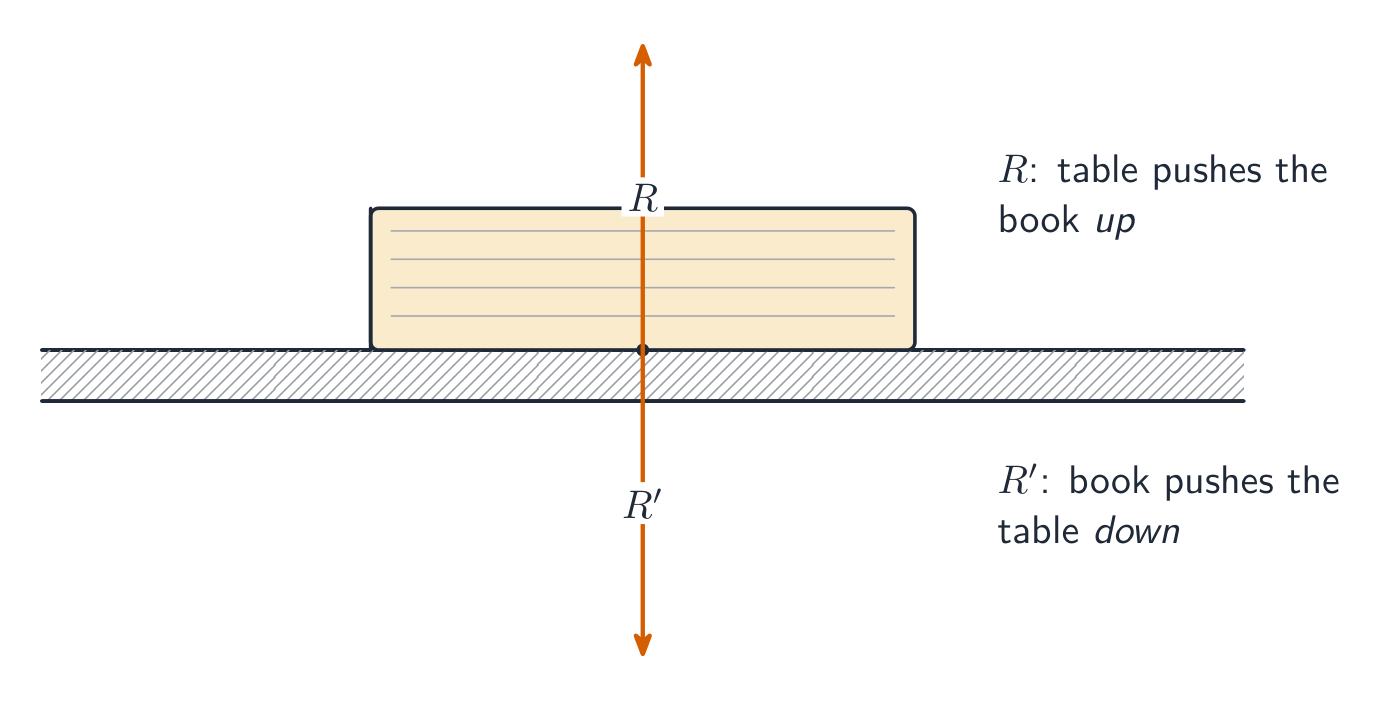
牛顿第三定律(Newton's third law):A 推 B,B 相等且相反地推回。这一对作用在不同的物体上,所以它在一个受力图内从不抵消。

一个牛顿第三定律对:两个不同物体上大小相等、方向相反的力
词汇表 训练
英文 中文 拼音
Newton's third law 牛顿第三定律 niú dùn dì sān dìng lǜ
2.4

牛顿第一定律

大纲
Learning ObjectiveEssential Knowledge

2.4.A
Describe the conditions under which a system's velocity remains constant.

  • 2.4.A.1 The net force on a system is the vector sum of all forces exerted on the system.
  • 2.4.A.2 Translational equilibrium is the configuration of forces such that the net force exerted on a system is zero.
    • Derived equation: $\sum \vec{F}_i = 0$
  • 2.4.A.3 Newton's first law states that if the net force exerted on a system is zero, the velocity of that system will remain constant.
  • 2.4.A.4 Forces may be balanced in one dimension but unbalanced in another. The system's velocity will change only in the direction of the unbalanced force.
  • 2.4.A.5 An inertial reference frame is one from which an observer would verify Newton's first law of motion.

来源:美国大学理事会 AP 课程与考试说明

牛顿第一定律(惯性(inertia)):以零合力(net force),速度保持恒定——物体处于平动平衡(translational equilibrium)。

词汇表 训练
英文 中文 拼音
inertia 惯性 guàn xìng
net force 合力 hé lì
translational equilibrium 平动平衡 píng dòng píng héng
2.5

牛顿第二定律

大纲
Learning ObjectiveEssential Knowledge

2.5.A
Describe the conditions under which a system's velocity changes.

  • 2.5.A.1 Unbalanced forces are a configuration of forces such that the net force exerted on a system is not equal to zero.
  • 2.5.A.2 Newton's second law of motion states that the acceleration of a system's center of mass has a magnitude proportional to the magnitude of the net force exerted on the system and is in the same direction as that net force.
    • Equation: $\vec{a}_{\text{sys}} = \dfrac{\sum \vec{F}}{m_{\text{sys}}} = \dfrac{\vec{F}_{\text{net}}}{m_{\text{sys}}}$
  • 2.5.A.3 The velocity of a system's center of mass will only change if a nonzero net external force is exerted on that system.

来源:美国大学理事会 AP 课程与考试说明

一般形式用动量:

$$\sum\vec{F}=\frac{d\vec{p}}{dt}=m\vec{a}\ \ (\text{for constant mass}).$$
一次一个轴地应用它。当力取决于速度或位置时,这变成一个要解的微分方程(differential equation)。

Worked example. 一个 $2.0\ \text{kg}$ 的木块沿一个 $30^{\circ}$ 的无摩擦斜面(incline)滑下。只有重力的沿坡道分量驱动它,所以 $a=g\sin30^{\circ}=9.8(0.5)=4.9\ \text{m/s}^2$,与质量无关。

Worked example (two bodies). 一个无摩擦桌子上的 $6.0\ \text{kg}$ 小车被一根越过一个轻滑轮的绳子拉向一个悬挂的 $2.0\ \text{kg}$ 质量。把这一对当作一个系统:只有悬挂的重量驱动它,所以 $a=\dfrac{2.0(9.8)}{8.0}=2.45\ \text{m/s}^2$。然后单独隔离小车以求绳子张力(tension):$T=6.0(2.45)\approx15\ \text{N}$。先系统求 $a$、单个物体求内力——那两步是标准的模式。

A rocket launch: net force changes momentum — F_net = ma for translational dynamics
词汇表 训练
英文 中文 拼音
differential equation 微分方程 wēi fēn fāng chéng
incline 斜面 xié miàn
tension 张力 zhāng lì
2.6

万有引力

大纲
Learning ObjectiveEssential Knowledge

2.6.A
Describe the gravitational interaction between two objects or systems with mass.

  • 2.6.A.1 Newton's law of universal gravitation describes the gravitational force between two objects or systems as directly proportional to each of their masses and inversely proportional to the square of the distance between the systems' centers of mass.
    • Equation: $\left| \vec{F}_g \right| = G \dfrac{m_1 m_2}{r^2}$
    • 2.6.A.1.i The gravitational force is attractive.
    • 2.6.A.1.ii The gravitational force is always exerted along the line connecting the center of mass of the two interacting systems.
    • 2.6.A.1.iii The gravitational force on a system can be considered to be exerted on the system's center of mass.
  • 2.6.A.2 A field models the effects of a noncontact force exerted on an object at various positions in space.
    • 2.6.A.2.i The magnitude of the gravitational field created by a system of mass $M$ at a point in space is equal to the ratio of the gravitational force exerted by the system on a test object of mass $m$ to the mass of the test object.
      • Derived equation: $\left| \vec{g} \right| = \dfrac{\left| \vec{F}_g \right|}{m} = G \dfrac{M}{r^2}$
    • 2.6.A.2.ii If the gravitational force is the only force exerted on an object, the observed acceleration of the object (in $\text{m/s}^2$) is numerically equal to the magnitude of the gravitational field strength (in $\text{N/kg}$) at that location.
  • 2.6.A.3 The gravitational force exerted by an astronomical body on a relatively small nearby object is called weight.
    • Derived equation: $\text{Weight} = F_g = mg$

2.6.B
Describe situations in which the gravitational force can be considered constant.

  • 2.6.B.1 If the gravitational force between two systems' centers of mass has a negligible change as the relative position of the two systems changes, the gravitational force can be considered constant at all points between the initial and final positions of the systems.
  • 2.6.B.2 Near the surface of Earth, the strength of the gravitational field is
    • Equation: $g \approx 10\ \text{N/kg}$

2.6.C
Describe the conditions under which the magnitude of a system's apparent weight is different from the magnitude of the gravitational force exerted on that system.

  • 2.6.C.1 The magnitude of the apparent weight of a system is the magnitude of the normal force exerted on the system.
  • 2.6.C.2 If the system is accelerating, the apparent weight of the system is not equal to the magnitude of the gravitational force exerted on the system.
  • 2.6.C.3 A system appears weightless when there are no forces exerted on the system or when the force of gravity is the only force exerted on the system.
  • 2.6.C.4 The equivalence principle states that an observer in a noninertial reference frame is unable to distinguish between an object's apparent weight and the gravitational force exerted on the object by a gravitational field.

2.6.D
Describe inertial and gravitational mass.

  • 2.6.D.1 Objects have inertial mass, or inertia, a property that determines how much an object's motion resists changes when interacting with another object.
  • 2.6.D.2 Gravitational mass is related to the force of attraction between two systems with mass.
  • 2.6.D.3 Inertial mass and gravitational mass have been experimentally verified to be equivalent.

2.6.E
Describe the gravitational force exerted on an object by a uniform spherical distribution of mass.

  • 2.6.E.1 The net gravitational force exerted on an object by a uniform spherical distribution of mass is the sum of the individual forces from small differential masses that comprise the distribution.
  • 2.6.E.2 Newton's shell theorem describes the net gravitational force exerted on an object by a uniform spherical shell of mass.
    • 2.6.E.2.i The net gravitational force exerted on an object inside a thin spherical shell is zero.
    • 2.6.E.2.ii The net gravitational force exerted on an object outside a thin spherical shell can be determined by treating the shell as a single massive object located at the center of the shell.
    • 2.6.E.2.iii An object inside a sphere of uniform density experiences a net gravitational force from only a partial mass of the sphere.
    • 2.6.E.2.iv The partial mass of a sphere that contributes to the net gravitational force exerted on an object within that sphere is the portion of the sphere's mass located a distance less than or equal to the object's distance from the center of the sphere and can be calculated using the density of the sphere.
      • Derived equation: $m_{\text{partial}} = \rho \dfrac{4}{3} \pi \left( r_{\text{partial}} \right)^3$
  • 2.6.E.3 The gravitational force exerted on an object within a uniform sphere can be shown to be proportional to the object's distance from the sphere's center.
    • Derived equation: $F_{g,\text{partial}} = -k r_{\text{partial}}$

Boundary statement: AP Physics C: Mechanics does not expect students to mathematically prove or derive Newton's shell theorem.

来源:美国大学理事会 AP 课程与考试说明

轨道运动(开普勒第二定律)

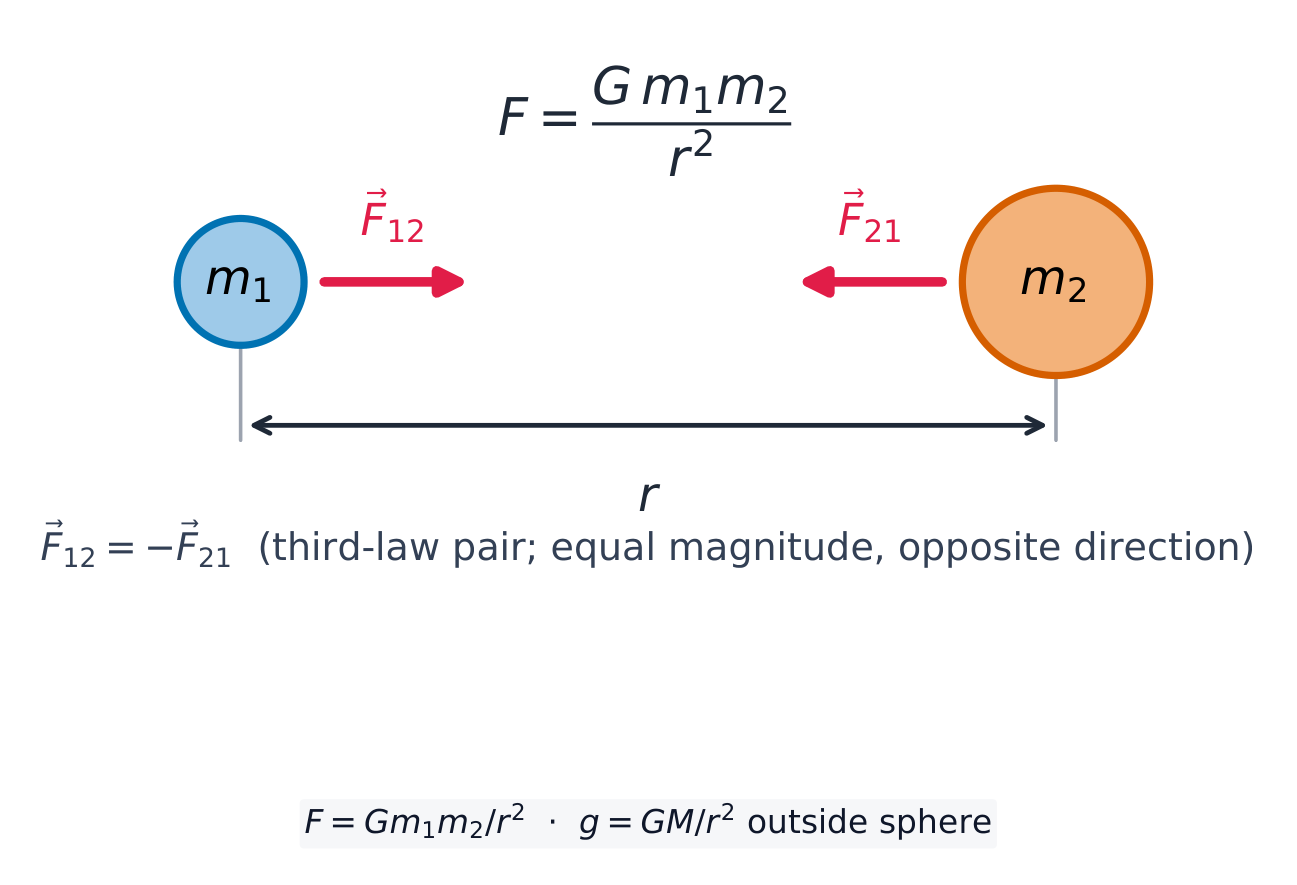
在一个表面附近,重量是 $F_g=mg$。一般地,万有引力定律(Newton's law of gravitation):

$$F_g=\frac{Gm_1m_2}{r^2},$$
吸引的且平方反比。引力场是 $g=\dfrac{GM}{r^2}$

两个质量沿连接它们的线以大小相等、方向相反、平方反比的力互相吸引
词汇表 训练
英文 中文 拼音
Newton's law of gravitation 万有引力定律 wàn yǒu yǐn lì dìng lǜ
练习卷
2.7

动摩擦与静摩擦

大纲
Learning ObjectiveEssential Knowledge

2.7.A
Describe kinetic friction between two surfaces.

  • 2.7.A.1 Kinetic friction occurs when two surfaces in contact move relative to each other.
    • 2.7.A.1.i The kinetic friction force is exerted in a direction opposite the motion of each surface relative to the other surface.
    • 2.7.A.1.ii The force of friction between two surfaces does not depend on the size of the surface area of contact.
  • 2.7.A.2 The magnitude of the kinetic friction force exerted on an object is the product of the normal force the surface exerts on the object and the coefficient of kinetic friction.
    • Equation: $\left| \vec{F}_{f,k} \right| = \left| \mu_k \vec{F}_N \right|$
    • 2.7.A.2.i The coefficient of kinetic friction depends on the material properties of the surfaces that are in contact.
    • 2.7.A.2.ii Normal force is the perpendicular component of the force exerted on an object by the surface with which it is in contact; it is directed away from the surface.

2.7.B
Describe static friction between two surfaces.

  • 2.7.B.1 Static friction may occur between the contacting surfaces of two objects that are not moving relative to each other.
  • 2.7.B.2 Static friction adopts the value and direction required to prevent an object from slipping or sliding on a surface.
    • Equation: $\left| \vec{F}_{f,s} \right| \leq \left| \mu_s \vec{F}_n \right|$
    • 2.7.B.2.i Slipping and sliding refer to situations in which two surfaces are moving relative to each other.
    • 2.7.B.2.ii There exists a maximum value for which static friction will prevent an object from slipping on a given surface.
      • Derived equation: $F_{f,s,\text{max}} = \mu_s F_N$
  • 2.7.B.3 The coefficient of static friction is typically greater than the coefficient of kinetic friction for a given pair of surfaces.

来源:美国大学理事会 AP 课程与考试说明

摩擦力(friction)沿一个表面反对滑动:滑动时动摩擦(kinetic)$f_k=\mu_k N$,而滑动之前静摩擦(static)$f_s\le\mu_s N$ 到一个最大值。$N$法向力(normal force)。注意不等式:静摩擦只大到它需要的那么大,而 $\mu_s N$ 是它的上限,不是它的值。

Worked example. 同一个木块在同一个 $30^{\circ}$ 的斜面上,现在带 $\mu_k=0.20$。垂直于坡道:$N=mg\cos30^{\circ}$。沿坡道:$ma=mg\sin30^{\circ}-\mu_k mg\cos30^{\circ}$,所以 $a=g(\sin30^{\circ}-0.20\cos30^{\circ})=9.8(0.500-0.173)=3.2\ \text{m/s}^2$ ——质量又约去。

探索

Slide a block down a slope with friction

Friction opposes motion up to a maximum $\mu N$. Tilt the slope until gravity's pull along it beats static friction and the block starts to slide.

词汇表 训练
英文 中文 拼音
Friction 摩擦力 mó cā lì
kinetic 动摩擦 dòng mó cā
static 静摩擦 jìng mó cā
normal force 法向力 fǎ xiàng lì
2.8

弹簧力

大纲
Learning ObjectiveEssential Knowledge

2.8.A
Describe the force exerted on an object by an ideal spring.

  • 2.8.A.1 An ideal spring has negligible mass and exerts a force that is proportional to the change in its length as measured from its relaxed length. A nonideal spring either has nonnegligible mass or exerts a force that is not proportional to the change in its length as measured from its relaxed length.
  • 2.8.A.2 The magnitude of the force exerted by an ideal spring on an object is given by Hooke's law:
    • Equation: $\vec{F}_s = -k \Delta \vec{x}$
  • 2.8.A.3 The force exerted on an object by a spring is always directed toward the equilibrium position of the object–spring system.

2.8.B
Describe the equivalent spring constant of a combination of springs exerting forces on an object.

  • 2.8.B.1 A collection of springs that exert forces on an object may behave as though they were a single spring with an equivalent spring constant $k_{\text{eq}}$.
    • 2.8.B.1.i The inverse of the equivalent spring constant of a set of springs in series is equal to the sum of the inverses of the individual spring constants.
      • Derived equation: $\dfrac{1}{k_{\text{eq, series}}} = \sum_i \dfrac{1}{k_i} = \dfrac{1}{k_1} + \dfrac{1}{k_2} + \dots$
    • 2.8.B.1.ii The equivalent spring constant of a set of springs arranged in series is smaller than the smallest constituent spring constant.
    • 2.8.B.1.iii The equivalent spring constant of a set of springs arranged in parallel is the sum of the individual spring constants.
      • Derived equation: $k_{\text{eq, parallel}} = \sum_i k_i = k_1 + k_2 + \dots$

Boundary statement: AP Physics C: Mechanics only expects students to find the effective spring constant of systems of springs that are arranged either in series or in parallel and does not expect students to find the effective spring constant of a system in which springs are arranged in both series and parallel.

来源:美国大学理事会 AP 课程与考试说明

胡克定律与弹性极限

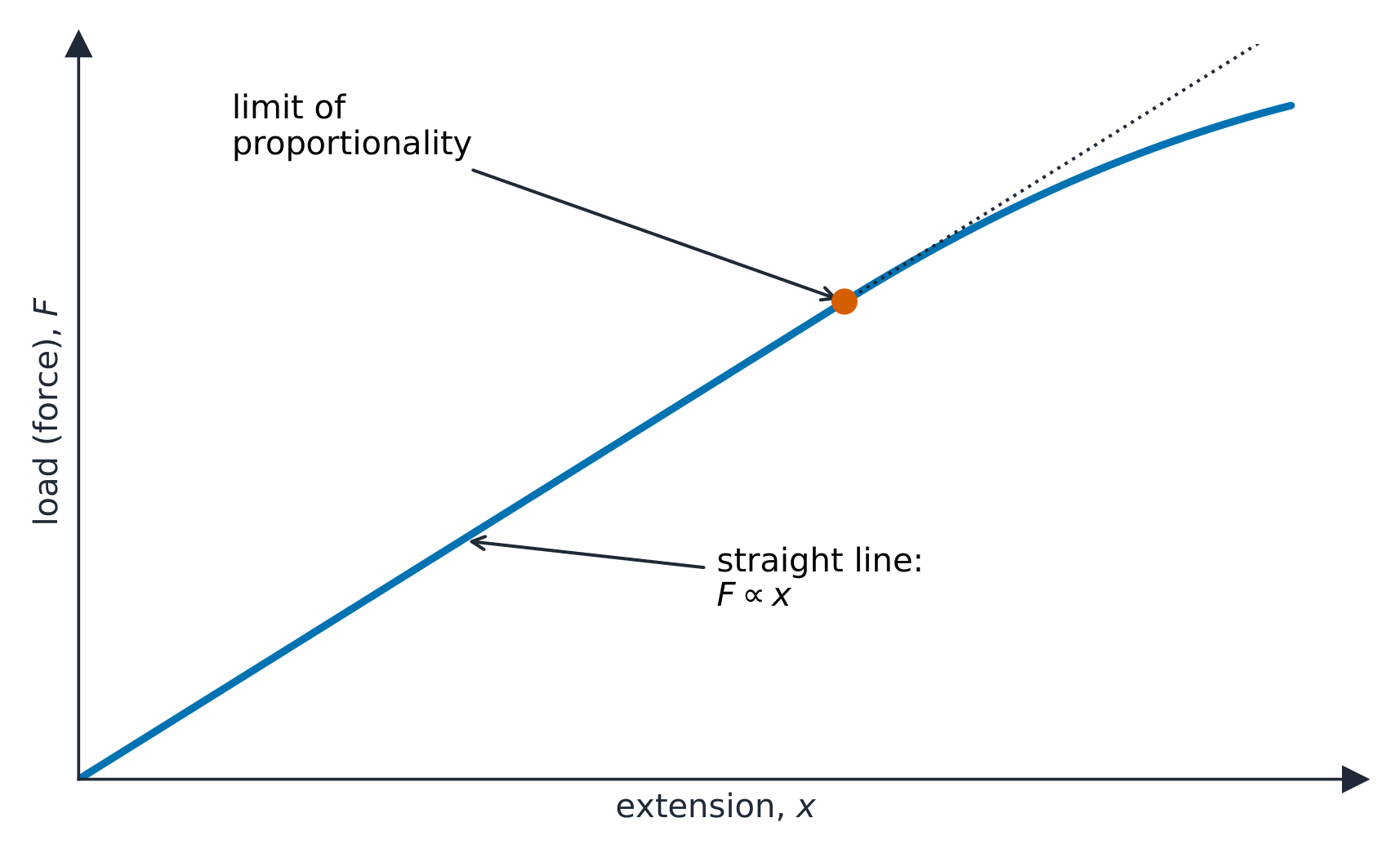
一个理想弹簧遵循胡克定律(Hooke's law)$F_s=-kx$,一个由弹簧劲度系数(spring constant)$k$ 设定的回复力。它储存的能量是 $U=\tfrac12 kx^2$

胡克定律:伸长与负载成比例,直到比例极限

组合的弹簧作为一个劲度系数为 $k_{\text{eq}}$等效弹簧并联(并排、共同分担负载)时劲度系数相加,$k_{\text{eq}}=k_1+k_2$ ——比任一个都更硬。串联(首尾相接)时它们按 $\dfrac{1}{k_{\text{eq}}}=\dfrac{1}{k_1}+\dfrac{1}{k_2}$ 组合——比最软的还软。两根从相反两侧拉一个质量的弹簧也作为并联,给出恢复劲度系数 $k_1+k_2$。无论哪种,简谐运动周期都用 $k_{\text{eq}}$:$T=2\pi\sqrt{m/k_{\text{eq}}}$

探索

Stretch a spring (Hooke's law)

A spring's force is proportional to its extension, $F=kx$ (Hooke's law). Pull harder and the extension grows in step — until the spring's limit.

词汇表 训练
英文 中文 拼音
Hooke's law 胡克定律 hú kè dìng lǜ
spring constant 弹簧劲度系数 tán huáng jìn dù xì shù
练习卷
2.9

阻力

大纲
Learning ObjectiveEssential Knowledge

2.9.A
Describe the motion of an object subject to a resistive force.

  • 2.9.A.1 A resistive force is defined as a velocity-dependent force in the opposite direction of an object's velocity, for example:
    • Equation: $\vec{F}_r = -k\vec{v}$
  • 2.9.A.2 Applying Newton's second law to an object upon which a resistive force is exerted results in a differential equation for velocity.
    • 2.9.A.2.i Using the method of separation of variables, the velocity can be determined by integrating over the proper limits of integration.
    • 2.9.A.2.ii The acceleration or position of a moving object that is subject to a velocity-dependent force may be determined using initial conditions of the object and methods of calculus, once a function for velocity is determined.
    • 2.9.A.2.iii The position, velocity, and acceleration as functions of time of an object under the influence of a resistive force of the form $\vec{F}_r = -k\vec{v}$ are exponential and have asymptotes that are determined by the initial conditions of the object and the forces exerted on the object.
  • 2.9.A.3 Terminal velocity is defined as the maximum speed achieved by an object moving under the influence of a constant force and a resistive force that are exerted on the object in opposite directions. The terminal condition is reached when the net force exerted on the object is zero.

来源:美国大学理事会 AP 课程与考试说明

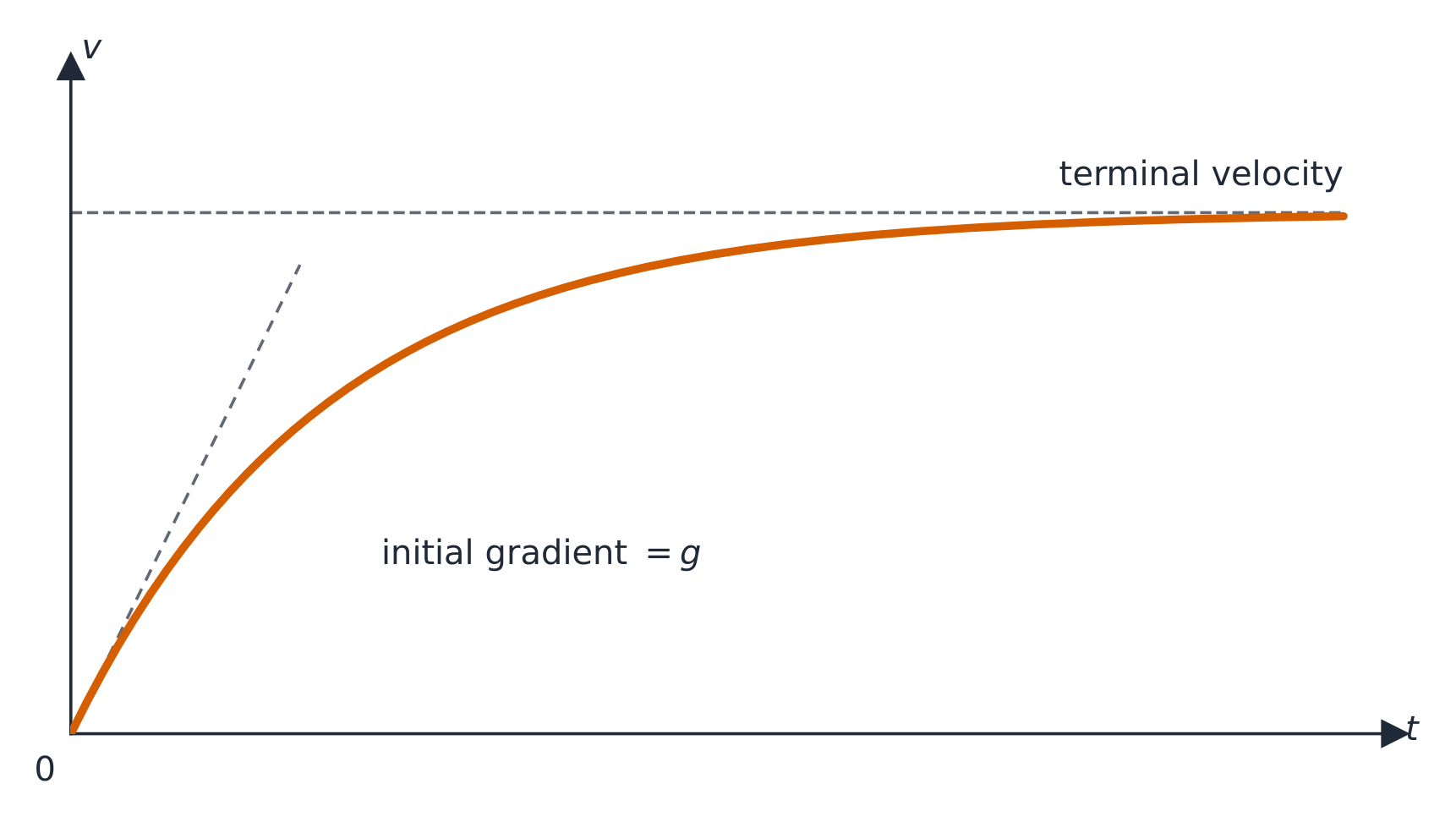
一个阻力(resistive force)(drag)反对通过一个流体的运动并随速率增长,常常建模为 $F=-bv$$F=-cv^2$。牛顿第二定律然后给出一个微分方程,例如对一个落下的物体 $m\dfrac{dv}{dt}=mg-bv$。随着速率上升,阻力增强直到它平衡驱动力;物体然后停止加速并以一个恒定的终极速度(terminal velocity)移动,通过把合力(和 $dv/dt$)设为零求出。

Worked example. 对于一个落下的物体,$m\dfrac{dv}{dt}=mg-bv$,终极速度是 $\dfrac{dv}{dt}=0$ 的地方:$mg=bv_T$,所以 $v_T=\dfrac{mg}{b}$。以 $m=0.10\ \text{kg}$$b=0.50\ \text{kg/s}$,$v_T=\dfrac{0.10(9.8)}{0.50}=2.0\ \text{m/s}$

要得到完整的运动 $v(t)$,分离变量(separate the variables)并从静止积分:

$$\int_0^{v}\frac{dv'}{mg-bv'}=\int_0^{t}\frac{dt'}{m}\;\Rightarrow\;-\frac{1}{b}\ln\!\frac{mg-bv}{mg}=\frac{t}{m},$$
它重排为 $v(t)=v_T\left(1-e^{-bt/m}\right)$ ——速率指数地向 $v_T$ 上升。展示这个积分正是 Physics C 自由回答所奖励的微积分技能,而不只是引用最终公式。

一个通过一个流体落下的物体加速到一个终极速度
Skydivers in freefall: drag grows with speed until it balances weight at terminal velocity
词汇表 训练
英文 中文 拼音
resistive force 阻力 zǔ lì
terminal velocity 终极速度 zhōng jí sù dù
separate the variables 分离变量 fēn lí biàn liàng
2.10

圆周运动

大纲
Learning ObjectiveEssential Knowledge

2.10.A
Describe the motion of an object traveling in a circular path.

  • 2.10.A.1 Centripetal acceleration is the component of an object's acceleration directed toward the center of the object's circular path.
    • 2.10.A.1.i The magnitude of centripetal acceleration for an object moving in a circular path is the ratio of the object's tangential speed squared to the radius of the circular path.
      • Equation: $a_c = \dfrac{v^2}{r}$
    • 2.10.A.1.ii Centripetal acceleration is directed toward the center of an object's circular path.
  • 2.10.A.2 Centripetal acceleration can result from a single force, more than one force, or components of forces that are exerted on an object in circular motion.
    • 2.10.A.2.i At the top of a vertical, circular loop, an object requires a minimum speed to maintain circular motion. At this point, and with this minimum velocity, the gravitational force is the only force that causes the centripetal acceleration.
      • Derived equation: $v = \sqrt{gr}$
    • 2.10.A.2.ii Components of the static friction force and the normal force can contribute to the net force producing centripetal acceleration of an object traveling in a circle on a banked surface.
    • 2.10.A.2.iii A component of tension contributes to the net force producing centripetal acceleration experienced by a conical pendulum.
  • 2.10.A.3 Tangential acceleration is the rate at which an object's speed changes and is directed tangent to the object's circular path.
  • 2.10.A.4 The net acceleration of an object moving in a circle is the vector sum of the centripetal acceleration and tangential acceleration.
  • 2.10.A.5 The revolution of an object traveling in a circular path at a constant speed (uniform circular motion) can be described using period and frequency.
    • 2.10.A.5.i The time to complete one full circular path, one full rotation, or a full cycle of oscillatory motion is defined as period, $T$.
    • 2.10.A.5.ii The rate at which an object is completing revolutions is defined as frequency, $f$.
      • Equation: $T = \dfrac{1}{f}$
    • 2.10.A.5.iii For an object traveling at a constant speed in a circular path, the period is given by the derived equation
      • Derived equation: $T = \dfrac{2\pi r}{v}$

2.10.B
Describe circular orbits using Kepler's third law.

  • 2.10.B.1 For a satellite in circular orbit around a central body, the satellite's centripetal acceleration is caused only by gravitational attraction. The period and radius of the circular orbit are related to the mass of the central body.
    • Derived equation: $T^2 = \dfrac{4\pi^2}{GM} R^3$

Boundary statement: AP Physics C: Mechanics does not expect students to know Kepler's first or second laws of planetary motion.

来源:美国大学理事会 AP 课程与考试说明

匀速圆周运动

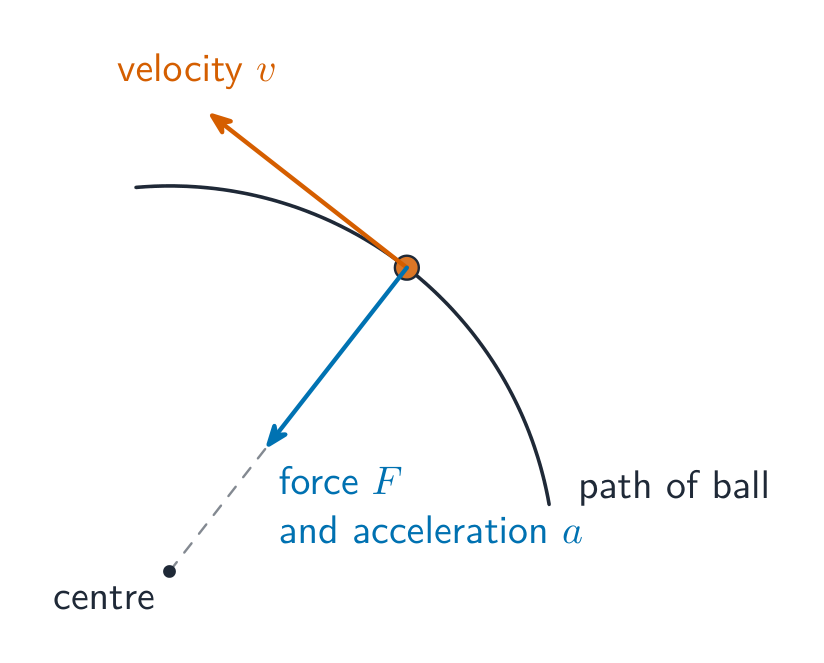
匀速圆周运动有一个指向中心的向心加速度(centripetal acceleration)$a_c=\dfrac{v^2}{r}$,需要一个由一个真实力(张力、重力、摩擦、法向)供应的合向内力 $F_c=\dfrac{mv^2}{r}$。没有向外的力。对于竖直圆和倾斜的弯道,分解真实的力以求哪个提供向心要求。

Worked example. 一个 $0.50\ \text{kg}$ 的球在一根 $1.0\ \text{m}$ 的绳上以 $3.0\ \text{m/s}$ 在一个水平圆里被甩。绳子张力供应整个向心力:$T=\dfrac{mv^2}{r}=\dfrac{0.50(3.0)^2}{1.0}=4.5\ \text{N}$

Worked example (vertical circle). 在一个半径 $r$ 的竖直环的顶部,重力和法向力指向中心:$N+mg=\dfrac{mv^2}{r}$。顶部最慢可能的速率是轨道什么都不推($N=0$)的地方:$v_{\min}=\sqrt{gr}$。对于 $r=2.5\ \text{m}$:$v_{\min}=\sqrt{9.8(2.5)}=4.9\ \text{m/s}$。再慢一点小车就在顶部之前离开轨道。

速度沿切线指向;向心力指向中心
速度沿切线指向;向心力指向中心
词汇表 训练
英文 中文 拼音
centripetal acceleration 向心加速度 xiàng xīn jiā sù dù
2.10

考试技巧

  • $x_{cm}=\tfrac{1}{M}\int x\,dm$(或对点质量 $\tfrac{\sum m_i x_i}{\sum m_i}$)定位质心并对质量元素用 $\lambda,\sigma,\rho$
  • 合外力移动质心,仿佛所有质量都坐在那里:$\vec F_{net}=M\vec a_{cm}$
  • 清晰地定义你的系统——内力抵消,所以只有外力改变它的动量。
  • 利用对称来简化一个质心积分。
  • 把质心与重心区分开(在一个均匀场里相同)。

本主题的互动课程

逐步学习,并即时检测练习。

AP 物理 C:力学历年真题

AP 物理 C:力学的更多主题

登录或创建账号

IGCSE, A-Level & AP