跳到主要内容

运动学

AP 物理 C:力学 · 第 1 主题

训练
讲义 词汇表
1.1

标量与矢量

大纲
Learning ObjectiveEssential Knowledge

1.1.A
Describe a scalar or vector quantity using magnitude and direction, as appropriate.

  • 1.1.A.1 Scalars are quantities described by magnitude only; vectors are quantities described by both magnitude and direction.
  • 1.1.A.2 Vectors can be visually modeled as arrows with appropriate direction and lengths proportional to their magnitude.
  • 1.1.A.3 Distance and speed are examples of scalar quantities, while position, displacement, velocity, and acceleration are examples of vector quantities.
  • 1.1.A.4 Vectors can be expressed in unit vector notation or as a magnitude and a direction.
    • 1.1.A.4.i Unit vector notation can be used to represent vectors as the sum of their constituent components in the $x$-, $y$-, and $z$-directions, denoted by $\hat{i}$, $\hat{j}$, and $\hat{k}$, respectively.
      • Equation: $\vec{r} = \left( A\hat{i} + B\hat{j} + C\hat{k} \right)$
    • 1.1.A.4.ii The position vector of a point is given by $\vec{r}$, and the unit vector in the direction of the position vector is denoted $\hat{r}$.
    • 1.1.A.4.iii A resultant vector is the vector sum of the addend vectors' components.
      • Equation: $\vec{C} = \vec{A} + \vec{B}$
      • Equation: $\vec{C} = \left( A_x + B_x \right)\hat{i} + \left( A_y + B_y \right)\hat{j}$
  • 1.1.A.5 In a given one-dimensional coordinate system, opposite directions are denoted by opposite signs.

来源:美国大学理事会 AP 课程与考试说明

运动学(kinematics)描述运动。两种量:

  • 一个标量(scalar)只有大小(大小(magnitude)):距离、速率、质量、时间。
  • 一个矢量(vector)有大小方向:位移、速度、加速度、力。

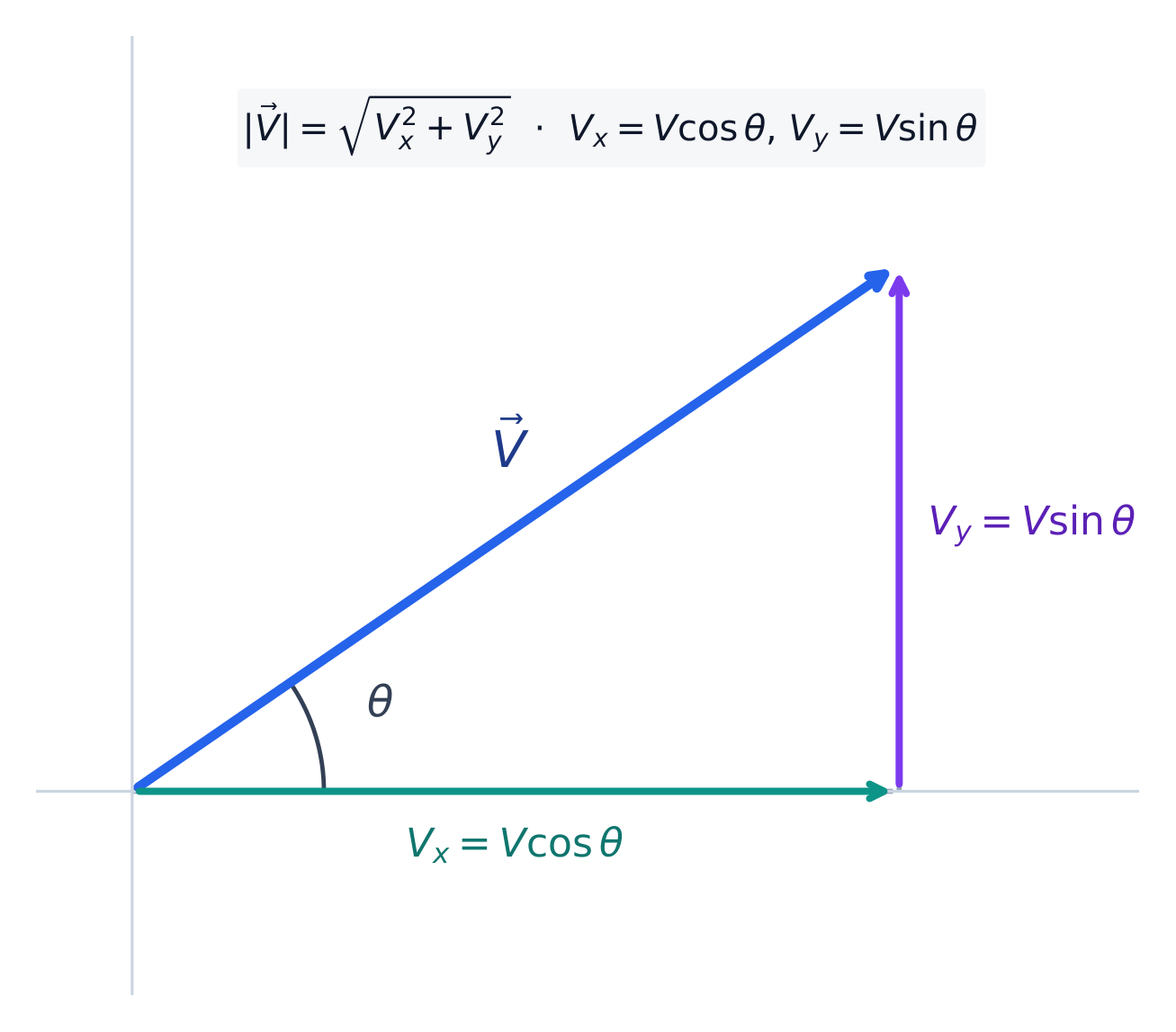
在这门基于微积分的课程里你把矢量分解成分量(components)并逐分量地把它们相加;一个矢量的大小是 $\sqrt{v_x^2+v_y^2+\cdots}$。物理 C 也用单位矢量(unit vectors)写矢量:$\vec{v}=v_x\hat{i}+v_y\hat{j}$,其中 $\hat{i}$$\hat{j}$ 是沿 $x$$y$ 的长度为一的方向——方便,因为微积分然后能分别作用于每个分量。

把一个矢量分解成它的 x 和 y 分量
把一个矢量分解成它的 x 和 y 分量
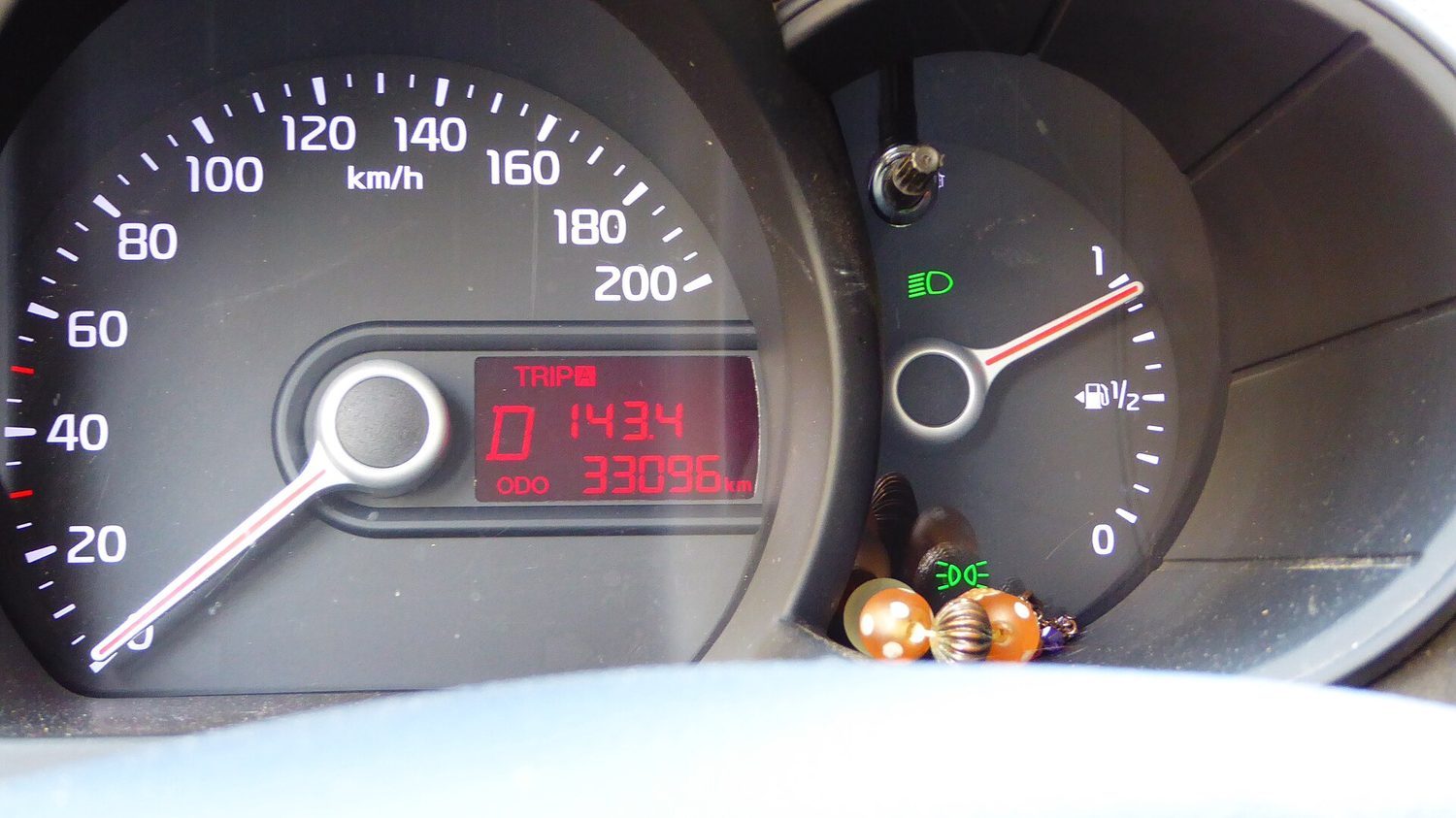
A car speedometer: speed is the magnitude of velocity — a scalar rate of motion
探索

Explore the dot product

Drag the components of $\vec{A}$ and $\vec{B}$. The dot product $\vec{A}\cdot\vec{B}=A_xB_x+A_yB_y$ reaches zero exactly when the two vectors are perpendicular — the geometry behind $\cos\theta$.

词汇表 训练
英文 中文 拼音
Kinematics 运动学 yùn dòng xué
scalar 标量 biāo liàng
magnitude 大小 dà xiǎo
vector 矢量 shǐ liàng
components 分量 fèn liàng
unit vectors 单位矢量 dān wèi shǐ liàng
1.2

位移、速度与加速度

大纲
Learning ObjectiveEssential Knowledge

1.2.A
Describe a change in an object's position.

  • 1.2.A.1 When using the object model, the size, shape, and internal configuration are ignored. The object may be treated as a single point with extensive properties such as mass and charge.
  • 1.2.A.2 Displacement is the change in an object's position.
    • Equation: $\Delta x = x - x_0$

1.2.B
Describe the average velocity and acceleration of an object.

  • 1.2.B.1 Averages of velocity and acceleration are calculated considering the initial and final states of an object over an interval of time.
  • 1.2.B.2 Average velocity is the displacement of an object divided by the interval of time in which that displacement occurs.
    • Equation: $\vec{v}_{\text{avg}} = \dfrac{\Delta \vec{x}}{\Delta t}$
  • 1.2.B.3 Average acceleration is the change in velocity divided by the interval of time in which that change in velocity occurs.
    • Equation: $\vec{a}_{\text{avg}} = \dfrac{\Delta \vec{v}}{\Delta t}$
  • 1.2.B.4 An object is accelerating if either the magnitude and/or direction of the object's velocity are changing.
  • 1.2.B.5 Calculating average velocity or average acceleration over a very small time interval yields a value that is very close to the instantaneous velocity or instantaneous acceleration.

1.2.C
Describe the instantaneous position, velocity, and acceleration of an object as a function of time.

  • 1.2.C.1 As the time interval used to calculate the average value of a quantity approaches zero, the average value of that quantity approaches the value of the quantity at that instant, called the instantaneous value.
    • 1.2.C.1.i Instantaneous velocity is the rate of change of the object's position, which is equal to the derivative of position with respect to time.
      • Equation: $\vec{v} = \dfrac{d\vec{r}}{dt}$
      • Equation: $v_x = \dfrac{dx}{dt}$
    • 1.2.C.1.ii Instantaneous acceleration is the rate of change of the object's velocity, which is equal to the derivative of velocity with respect to time.
      • Equation: $\vec{a} = \dfrac{d\vec{v}}{dt}$
      • Equation: $a_x = \dfrac{dv_x}{dt}$
  • 1.2.C.2 Time-dependent functions and instantaneous values of position, velocity, and acceleration can be determined using differentiation and integration.

来源:美国大学理事会 AP 课程与考试说明

抛体运动:两个独立方向

因为运动能连续地变化,把速率定义为导数(derivatives):

$$v=\frac{dx}{dt},\qquad a=\frac{dv}{dt}=\frac{d^2x}{dt^2}.$$
反转这个,积分以恢复速度和位置:
$$v(t)=v_0+\int_0^t a\,dt,\qquad x(t)=x_0+\int_0^t v\,dt.$$
平均瞬时区分开:平均速度(average velocity)是一个区间上的 $\Delta x/\Delta t$,而瞬时速度(instantaneous velocity)是一个时刻的导数——切线的斜率,以及一个速度表所显示的。

对于恒定加速度这些给出熟悉的运动学方程($v=v_0+at$$x=x_0+v_0t+\tfrac12at^2$$v^2=v_0^2+2a\,\Delta x$)。最重要的恒定 $a$ 情况是自由落体(free fall):在地球表面附近每个物体,重的或轻的,一旦空气阻力可忽略就以 $g=9.8\ \text{m/s}^2$ 向下加速。当 $a$$v$ 随时间变化时,直接用积分。

Worked example. 一个质点以 $x(t)=2t^3-3t^2$(米)移动。求导得速度和加速度:

$$v=\frac{dx}{dt}=6t^2-6t,\qquad a=\frac{dv}{dt}=12t-6.$$
$t=2\ \text{s}$,$v=24-12=12\ \text{m/s}$$a=24-6=18\ \text{m/s}^2$。这个微积分联系——不只是恒定 $a$ 公式——是区别物理 C 的东西。

Worked example. 一个质点从原点静止开始,$a(t)=6t$。积分:$v=\int 6t\,dt=3t^2$$x=\int 3t^2\,dt=t^3$。在 $t=2\ \text{s}$,$v=12\ \text{m/s}$$x=8\ \text{m}$

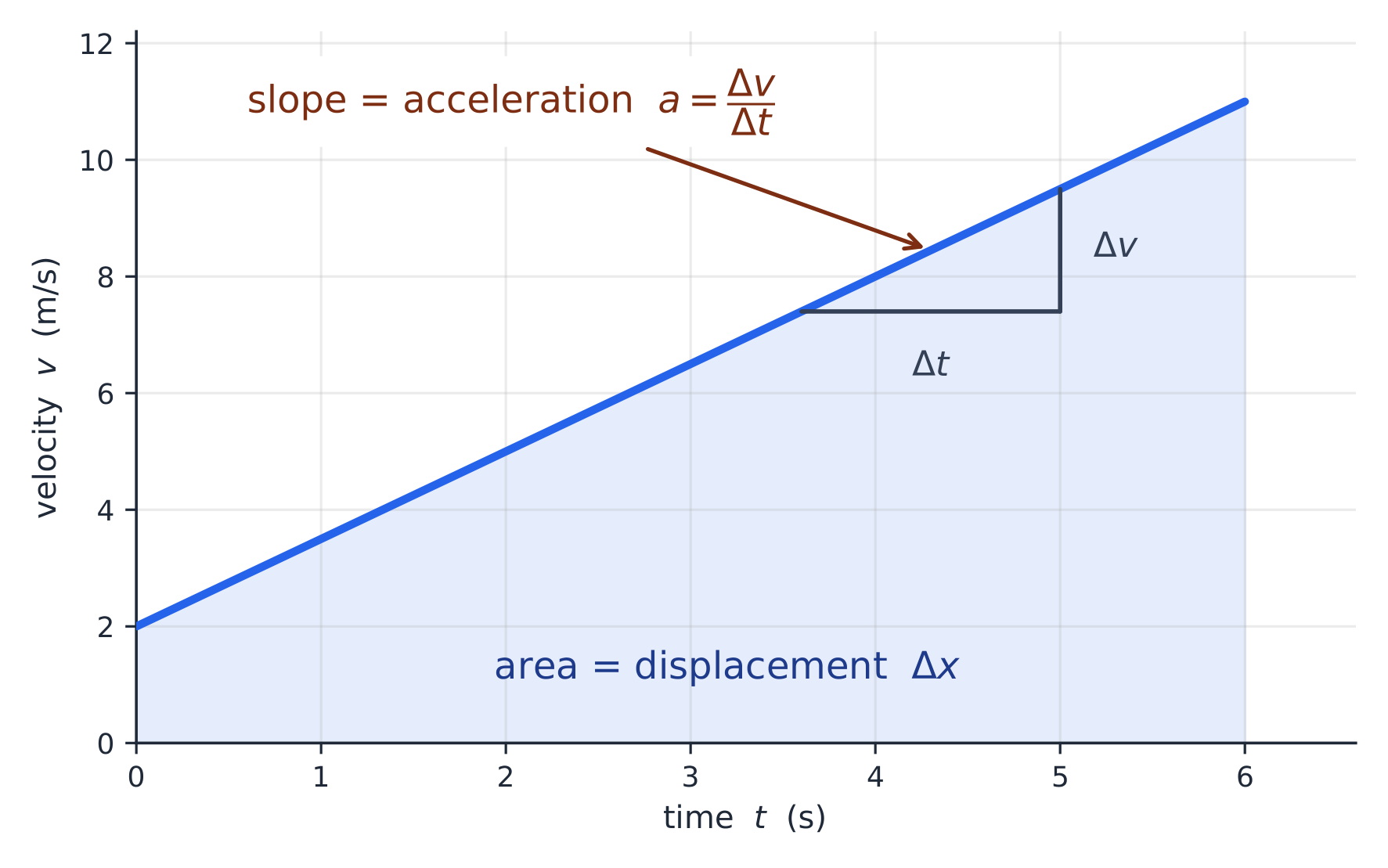
在一个速度-时间图上斜率是加速度而面积是位移
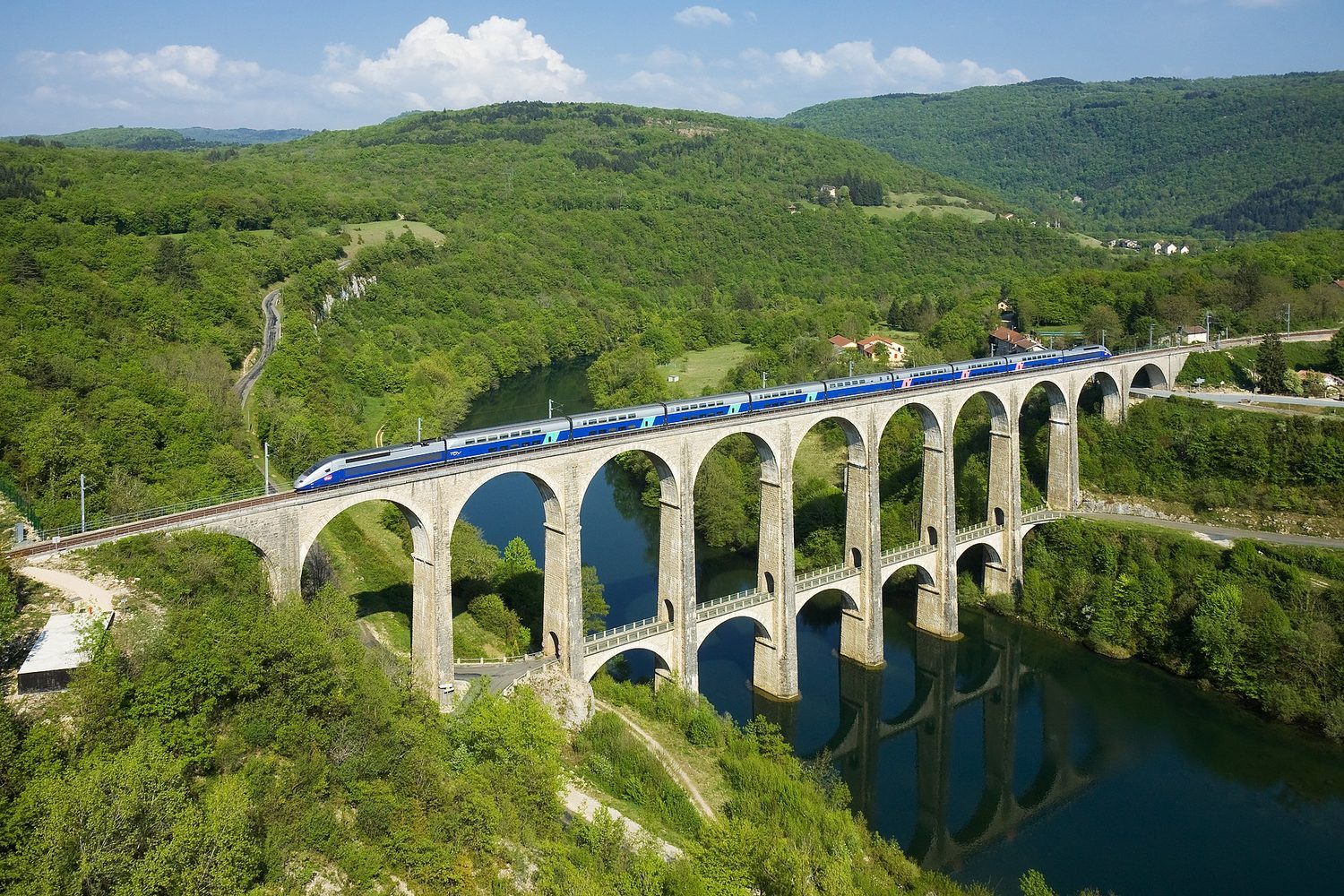
A high-speed train: kinematics describes displacement, velocity and acceleration over time
词汇表 训练
英文 中文 拼音
derivatives 导数 dǎo shù
average velocity 平均速度 píng jūn sù dù
instantaneous velocity 瞬时速度 shùn shí sù dù
free fall 自由落体 zì yóu luò tǐ
1.3

运动的表示

大纲
Learning ObjectiveEssential Knowledge

1.3.A
Describe the position, velocity, and acceleration of an object using representations of that object's motion.

  • 1.3.A.1 Motion can be represented by motion diagrams, figures, graphs, equations, and narrative descriptions.
  • 1.3.A.2 For constant acceleration, three kinematic equations can be used to describe instantaneous linear motion in one dimension:
    • Equation: $v_x = v_{x0} + a_x t$
    • Equation: $x = x_0 + v_{x0} t + \dfrac{1}{2} a_x t^2$
    • Equation: $v_x^2 = v_{x0}^2 + 2a_x \left( x - x_0 \right)$
    • Note: The equations above are written to indicate motion in the $x$-direction, but these equations can be used in any single dimension as appropriate.
  • 1.3.A.3 Near the surface of Earth, the vertical acceleration caused by the force of gravity is downward, constant, and has a measured value approximately equal to
    • Equation: $a_g = g \approx 10 \ \text{m/s}^2$.
  • 1.3.A.4 Graphs of position, velocity, and acceleration as functions of time can be used to find the relationships between those quantities.
    • 1.3.A.4.i An object's instantaneous velocity is the rate of change of the object's position, which is equal to the slope of a line tangent to a point on a graph of the object's position as a function of time.
      • Equation: $v_x = \dfrac{dx}{dt}$
    • 1.3.A.4.ii An object's instantaneous acceleration is the rate of change of the object's velocity, which is equal to the slope of a line tangent to a point on a graph of the object's velocity as a function of time.
      • Equation: $a_x = \dfrac{dv_x}{dt}$
    • 1.3.A.4.iii The displacement of an object during a time interval is equal to the area under the curve of a graph of the object's velocity as a function of time (i.e., the area bounded by the function and the horizontal axis for the appropriate interval).
      • Equation: $\Delta x = \displaystyle\int_{t_1}^{t_2} v_x(t) \ dt$
    • 1.3.A.4.iv The change in velocity of an object during a time interval is equal to the area under the curve of a graph of the acceleration of the object as a function of time.
      • Equation: $\Delta v_x = \displaystyle\int_{t_1}^{t_2} a_x(t) \ dt$

Boundary statement: AP Physics C: Mechanics and AP Physics C: Electricity and Magnetism expects that for all situations in which a numerical quantity is required for g, the value $g \approx 10 \ \text{m/s}^2$ will be used. However, students will not be penalized for correctly using the more precise commonly accepted values of $g = 9.81 \ \text{m/s}^2$ or $g = 9.8 \ \text{m/s}^2$.

来源:美国大学理事会 AP 课程与考试说明

在描述、图、表和方程之间流畅地移动:

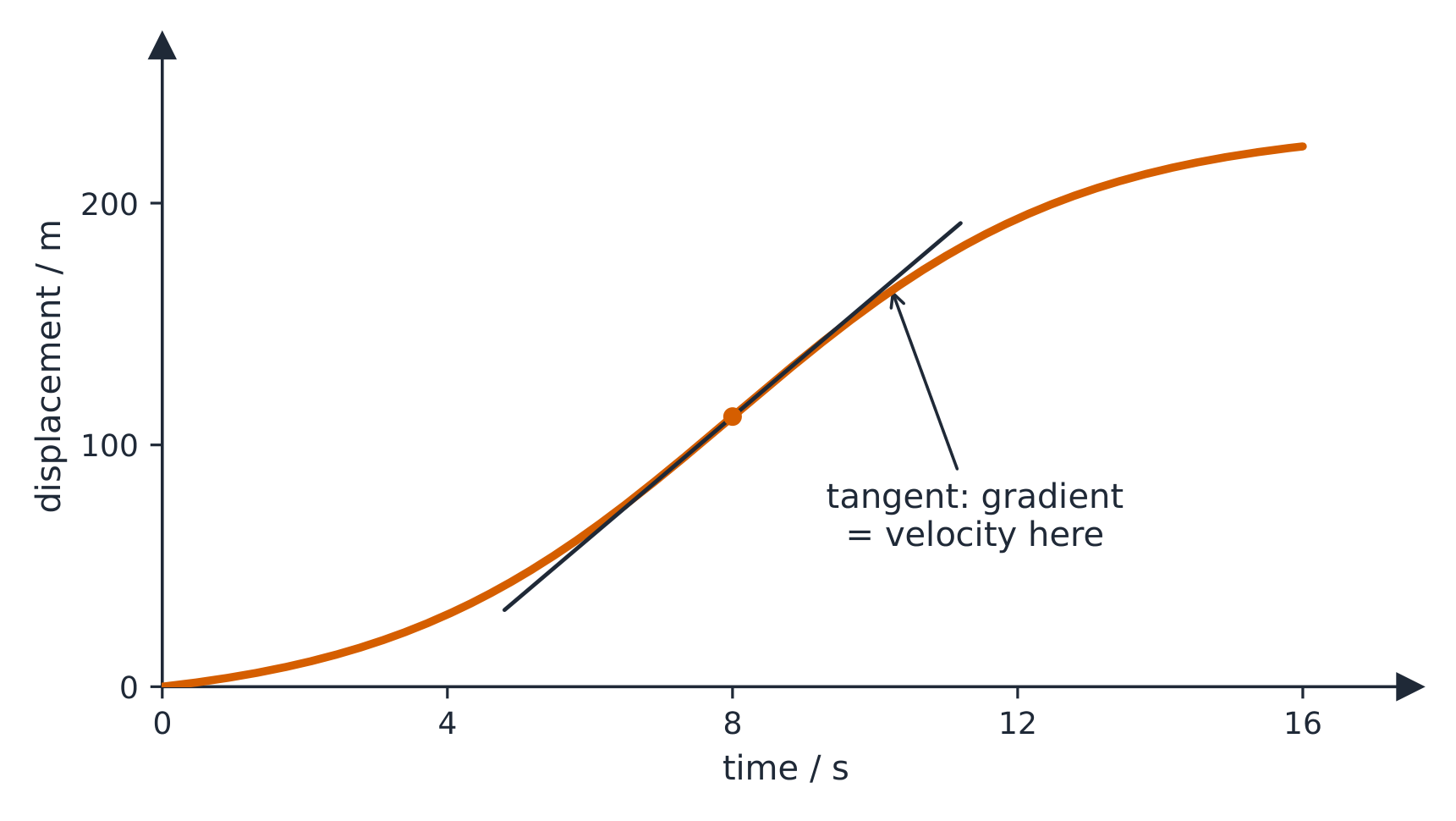
一个位移-时间图:任何时刻的斜率是速度
一个位移-时间图:任何时刻的斜率是速度
  • 在一个位置-时间图上,斜率($dx/dt$)是速度。
  • 在一个速度-时间图上,斜率是加速度而面积($\int v\,dt$)是位移。
  • 在一个加速度-时间图上,面积($\int a\,dt$)是速度的变化。

斜率是导数;面积是积分——这两者在这里是逆运算。
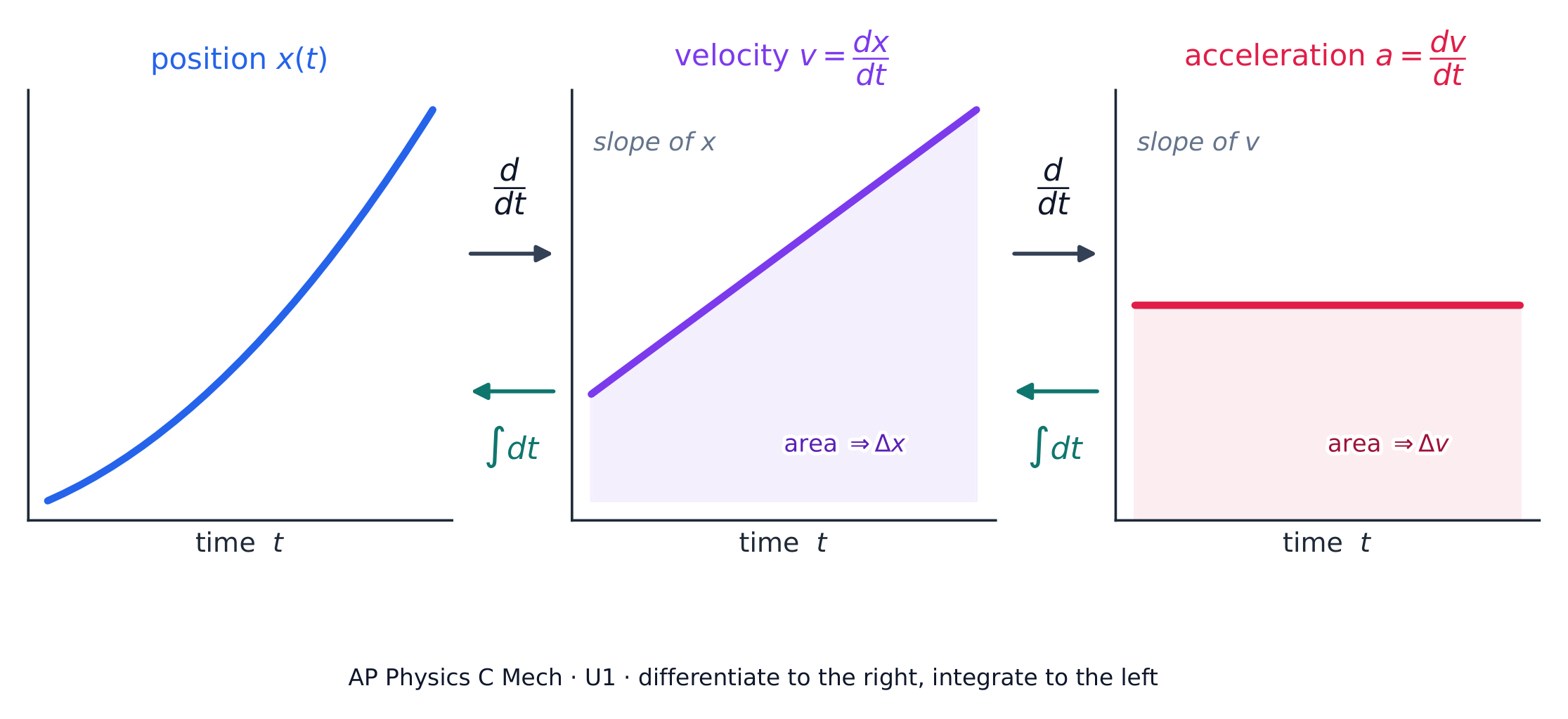
位置、速度和加速度由求导联系
位置、速度和加速度由求导联系
探索

Explore the velocity–time graph

Change the start velocity and acceleration. The slope of a $v$$t$ line is the acceleration $a=\tfrac{dv}{dt}$, and the area underneath is the displacement $\Delta x=\int v\,dt$ — slope and area are the graphical faces of the derivative and the integral.

1.4

参考系与相对运动

大纲
Learning ObjectiveEssential Knowledge

1.4.A
Describe the reference frame of a given observer.

  • 1.4.A.1 The choice of reference frame will determine the direction and magnitude of quantities measured by an observer in that reference frame.

1.4.B
Describe the motion of objects as measured by observers in different inertial reference frames.

  • 1.4.B.1 Measurements from a given reference frame may be converted to measurements from another reference frame.
  • 1.4.B.2 The observed velocity of an object results from the combination of the object's velocity and the velocity of the observer's reference frame.
    • 1.4.B.2.i Combining the motion of an object and the motion of an observer in a given reference frame involves the addition or subtraction of vectors.
    • 1.4.B.2.ii The acceleration of any object is the same as measured from all inertial reference frames.

Boundary statement: Unless otherwise stated, the frame of reference of any problem may be assumed to be inertial.

来源:美国大学理事会 AP 课程与考试说明

所有运动都相对于一个参考系(reference frame)。通过矢量加法组合速度:$\vec{v}_{A/C}=\vec{v}_{A/B}+\vec{v}_{B/C}$。这处理横穿河流的船和移动车辆上的乘客——相对运动(relative motion)问题。把下标读作一个链:"A 相对于 B"加"B 相对于 C"给出"A 相对于 C"。

Worked example. 一艘在静水里以 $4.0\ \text{m/s}$ 移动的船直向横穿一条以 $3.0\ \text{m/s}$ 流动的河。相对于地面这艘船以 $\sqrt{4.0^2+3.0^2}=5.0\ \text{m/s}$ 移动,朝下游成角。若河宽 $80\ \text{m}$,穿越仍取 $t=\dfrac{80}{4.0}=20\ \text{s}$ ——只有横流分量穿过河;水流只把船带 $60\ \text{m}$ 下游。

词汇表 训练
英文 中文 拼音
reference frame 参考系 cān kǎo xì
relative motion 相对运动 xiāng duì yùn dòng
1.5

二维或三维运动

大纲
Learning ObjectiveEssential Knowledge

1.5.A
Describe the motion of an object moving in two or three dimensions.

  • 1.5.A.1 Motion in two or three dimensions can be analyzed using one-dimensional kinematic relationships if the motion is separated into components.
  • 1.5.A.2 Velocity and acceleration may be different in each dimension and may be nonuniform.
  • 1.5.A.3 Motion in one dimension may be changed without causing a change in a perpendicular dimension.
  • 1.5.A.4 Projectile motion is a special case of two-dimensional motion that has zero acceleration in one dimension and constant, nonzero acceleration in the second dimension.

Boundary statement: AP Physics C: Mechanics only expects students to quantitatively analyze the motion of an object in two dimensions. AP Physics C: Electricity and Magnetism expects students to also qualitatively describe the motion of a particle in three dimensions.

来源:美国大学理事会 AP 课程与考试说明

在二维或三维里,位置是一个矢量 $\vec{r}(t)=\langle x(t),y(t),z(t)\rangle$,而速度和加速度是它的连续导数——每个分量独立处理。

Worked example. $\vec{r}(t)=\big(2t^2\big)\hat{i}+\big(4t-t^3\big)\hat{j}$(米)。对每个分量求导:$\vec{v}=4t\,\hat{i}+(4-3t^2)\,\hat{j}$$\vec{a}=4\,\hat{i}-6t\,\hat{j}$。在 $t=1\ \text{s}$:$\vec{v}=4\hat{i}+1\hat{j}$,所以速率是 $\sqrt{17}\approx4.1\ \text{m/s}$ ——没有新物理,只是每分量一个导数。

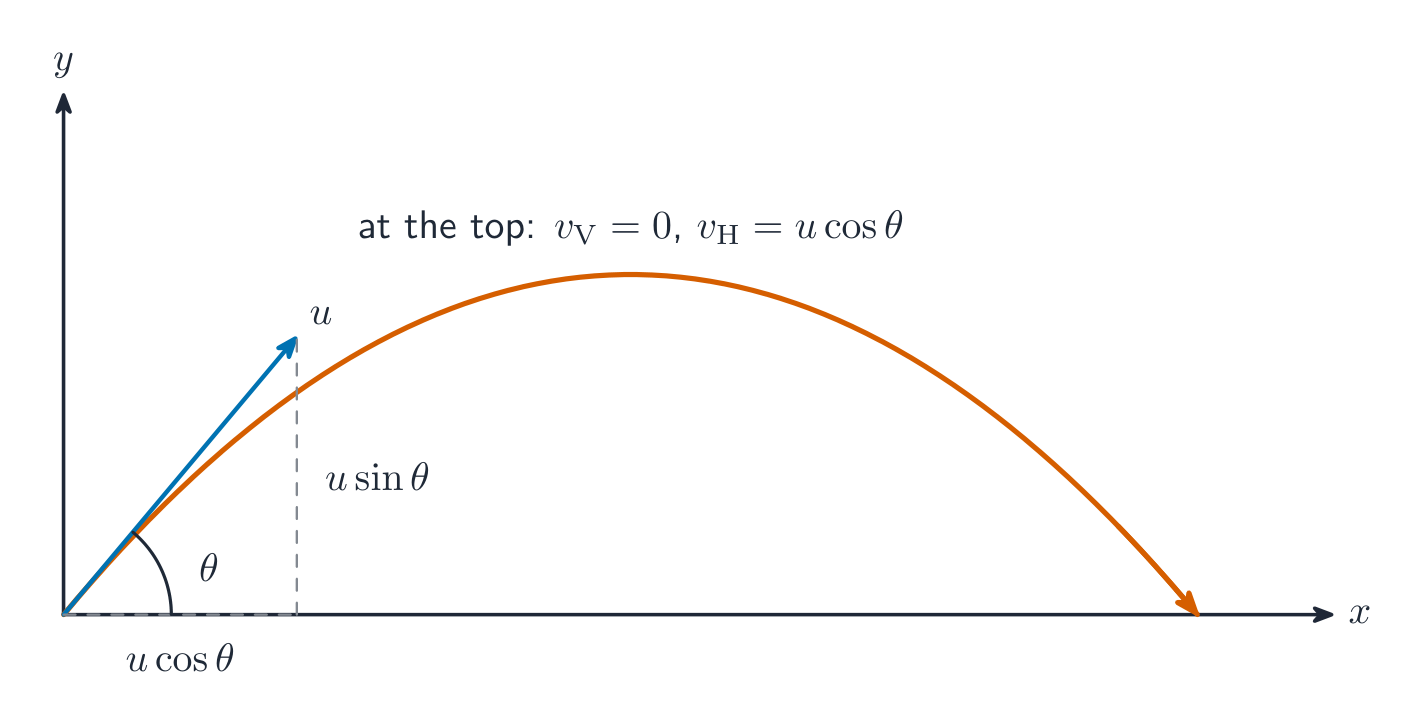
一个以一个角度发射的抛体:水平和竖直运动是独立的

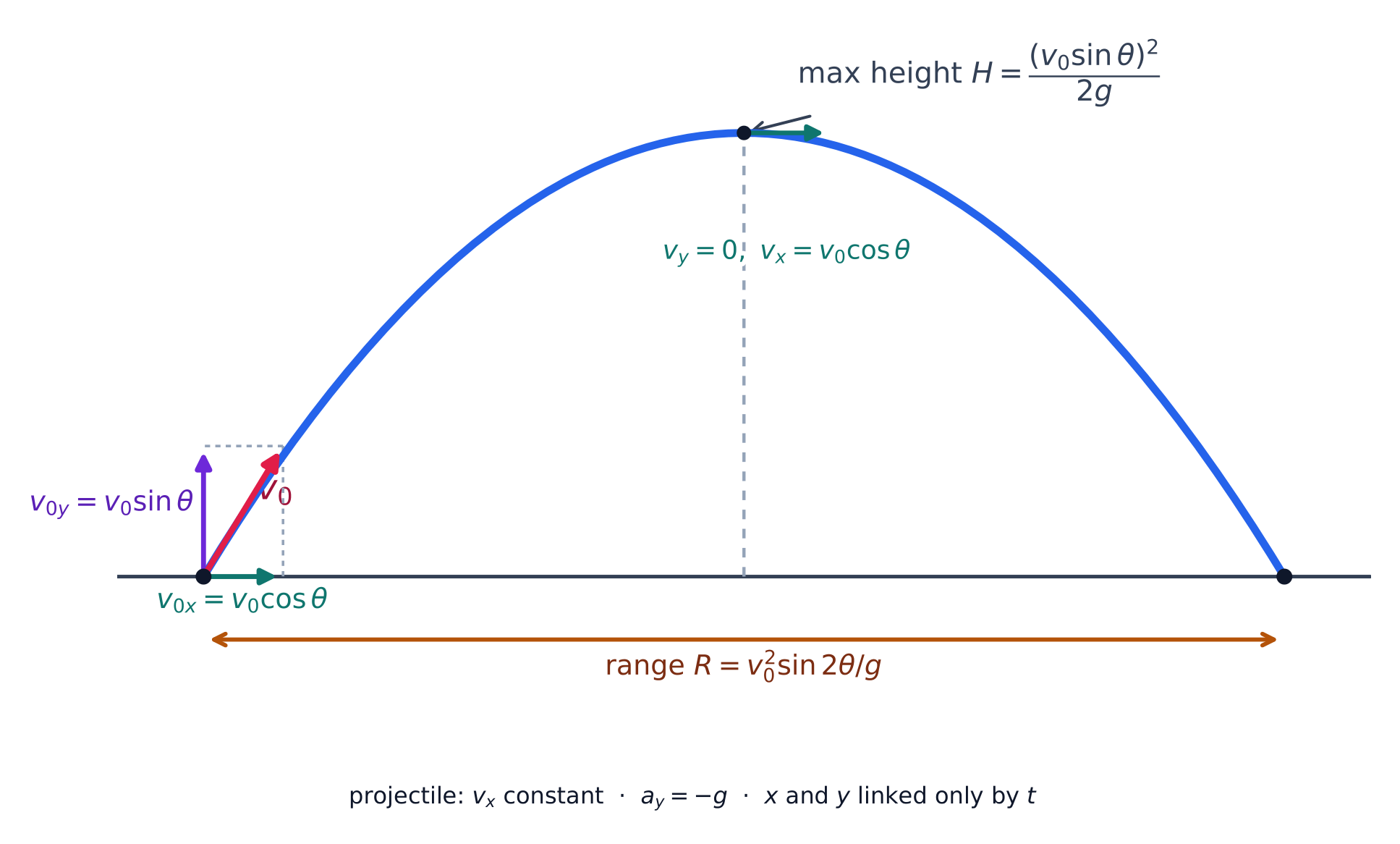
对于抛体运动(projectile motion),水平和竖直运动是独立的,只由时间 $t$ 联系:水平地 $a_x=0$(恒定速度)、竖直地 $a_y=-g$。路径是一条抛物线。这个分量方法延伸到任何沿每个轴的加速度已知的二维运动。

Worked example. 一个球以 $20\ \text{m/s}$、水平之上 $30^{\circ}$ 发射($g=9.8\ \text{m/s}^2$)。分量是 $v_{0x}=20\cos30^{\circ}=17.3\ \text{m/s}$$v_{0y}=20\sin30^{\circ}=10\ \text{m/s}$。竖直运动设定时间:总飞行 $=\dfrac{2v_{0y}}{g}=\dfrac{20}{9.8}=2.0\ \text{s}$、最大高度 $=\dfrac{v_{0y}^2}{2g}=5.1\ \text{m}$,而射程 $=v_{0x}\times2.0=35\ \text{m}$

一个以一个角度发射的抛体:速度分量、最大高度和射程
探索

Explore projectile motion

Fire the projectile, then vary the angle and speed. The horizontal motion is steady while gravity acts only downward — together they trace a parabola. Find the angle that gives the greatest range (it peaks near $45^\circ$), and try the Moon.

词汇表 训练
英文 中文 拼音
projectile motion 抛体运动 pāo tǐ yùn dòng
1.5

考试技巧

  • 在相加之前把每个矢量分解成分量——绝不直接相加成角度的大小。
  • 在物理 C 上你被期望用微积分:速度是 $\vec v=\tfrac{d\vec r}{dt}$ 而加速度 $\vec a=\tfrac{d\vec v}{dt}$;用积分反转。
  • 携带并检查单位,并用符号处理方向(选择一个正轴并坚持它)。
  • 对功类型的量用点积,对力矩和角动量用叉积。
  • 草绘矢量——一个图捕捉代数隐藏的符号和方向错误。

本主题的互动课程

逐步学习,并即时检测练习。

AP 物理 C:力学历年真题

AP 物理 C:力学的更多主题

登录或创建账号

IGCSE, A-Level & AP