这份讲义涵盖主题 1:进阶纯数学(Further Pure Mathematics)1。它增加新的代数、矩阵、极坐标、更多的向量,以及归纳证明。
进阶纯数学1
A-Level 进阶数学 · 第 1 主题
 14:28
14:28
Further Pure Mathematics 1
Here is a cubic equation, crossing the axis at three roots. Finding those roots exactly can be hard — or even impossible by hand. But here is a beautiful…
英文讲解 · 内嵌中英文字幕
1.1
多项式方程的根
大纲
| Candidates should be able to: | Notes and examples |
|---|---|
| • recall and use the relations between the roots and coefficients of polynomial equations | e.g. to evaluate symmetric functions of the roots or to solve problems involving unknown coefficients in equations; restricted to equations of degree 2, 3 or 4 only. |
| • use a substitution to obtain an equation whose roots are related in a simple way to those of the original equation | Substitutions will not be given for the easiest cases, e.g. where the new roots are reciprocals or squares or a simple linear function of the old roots. |
来源:剑桥国际大纲
对一个多项式方程,根(roots)与系数(coefficients)联系。对于有根 $\alpha, \beta$ 的 $ax^2 + bx + c = 0$:
$$\alpha + \beta = -\frac{b}{a}, \qquad \alpha\beta = \frac{c}{a}.$$
对于有根 $\alpha, \beta, \gamma$ 的一个三次式 $ax^3 + bx^2 + cx + d = 0$:
$$\sum\alpha = -\frac{b}{a}, \qquad \sum\alpha\beta = \frac{c}{a}, \qquad \alpha\beta\gamma = -\frac{d}{a}.$$
像 $\sum\alpha$ 和 $\sum\alpha\beta$ 的和是根的对称函数(symmetric functions,若根被交换则不变)。要找到一个根以一种简单方式被改变的方程,用一个代换(substitution,例如令 $w = \alpha + 1$)。
例题。 方程 $x^2 - 5x + 6 = 0$ 有根 $\alpha, \beta$。求以 $\alpha + 1, \beta + 1$ 为根的方程。
这里 $\alpha + \beta = 5$ 且 $\alpha\beta = 6$。新的和是 $(\alpha + 1) + (\beta + 1) = 7$,而新的积是 $(\alpha + 1)(\beta + 1) = \alpha\beta + \alpha + \beta + 1 = 6 + 5 + 1 = 12$。所以新方程是
$$x^2 - 7x + 12 = 0.$$
探索
Roots of a polynomial
y = ax³ + bx² + cx + d
The roots are where the curve meets the x-axis — their sum and product link to the coefficients.
词汇表
训练
| 英文 | 中文 | 拼音 |
|---|---|---|
| Further Pure Mathematics/ˈfɜːðə pjʊə ˌmæθɪˈmætɪks/ | 进阶纯数学 | jìn jiē chún shù xué |
| roots/ruːts/ | 根 | gēn |
| coefficients/ˌkəʊɪˈfɪʃənts/ | 系数 | xì shù |
| substitution/ˌsʌbstɪˈtjuːʃn/ | 代换 | dài huàn |
| symmetric functions/sɪˈmetrɪk ˈfʌŋkʃnz/ | 对称函数 | duì chèn hán shù |
1.2
有理函数与图像
大纲
| Candidates should be able to: | Notes and examples |
|---|---|
| • sketch graphs of simple rational functions, including the determination of oblique asymptotes, in cases where the degree of the numerator and the denominator are at most 2 | Including determination of the set of values taken by the function, e.g. by the use of a discriminant. Detailed plotting of curves will not be required, but sketches will generally be expected to show significant features, such as turning points, asymptotes and intersections with the axes. |
| • understand and use relationships between the graphs of $y = f(x)$, $y^2 = f(x)$, $y = \frac{1}{f(x)}$, $y = |f(x)|$ and $y = f(|x|)$ | Including use of such sketch graphs in the course of solving equations or inequalities. |
来源:剑桥国际大纲
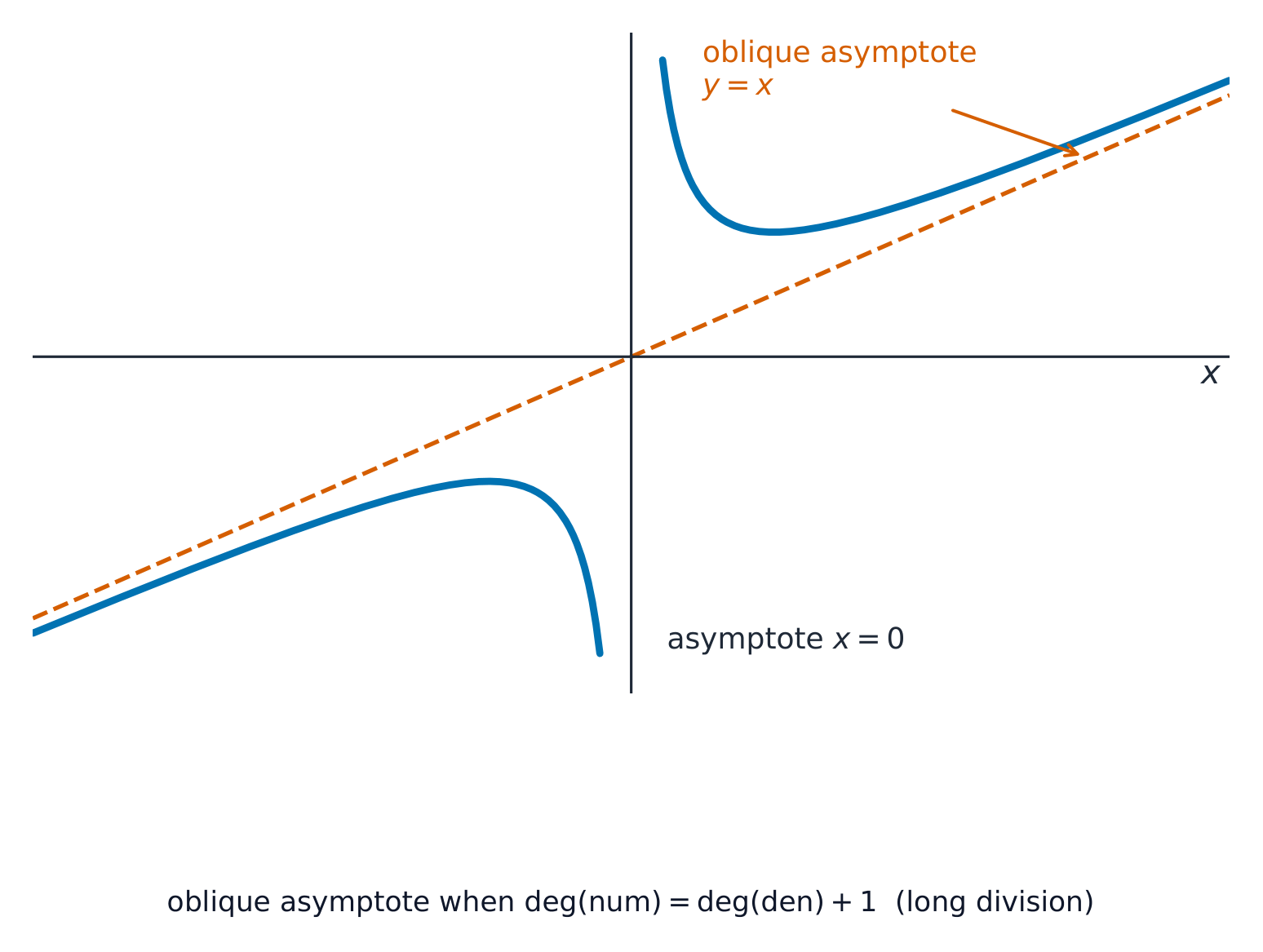
一个有理函数(rational function)是两个多项式的一个分数。当上面的次数恰好比下面的高一次时,图形有一条斜渐近线(oblique asymptote,曲线逼近的一条斜线);通过除出来找到它。你也应当能够把 $y = f(x)$ 的图形与 $y^2 = f(x)$、$y = \dfrac{1}{f(x)}$、$y = |f(x)|$ 和 $y = f(|x|)$ 的联系起来。用判别式(discriminant)求函数能取的值的集合,并定位它的驻点(turning points)。
例题。 求 $y = \dfrac{x^2 + x + 1}{x + 1}$ 的斜渐近线。
除出这个分数:$\dfrac{x^2 + x + 1}{x + 1} = x + \dfrac{1}{x + 1}$。当 $x \to \pm\infty$ 时余数 $\dfrac{1}{x+1} \to 0$,所以曲线逼近直线 $y = x$——斜渐近线。
探索
Rational functions
y = a/(x − b) + c
A rational function has asymptotes the curve approaches but never touches.
词汇表
训练
| 英文 | 中文 | 拼音 |
|---|---|---|
| rational function/ˈræʃənl ˈfʌŋkʃn/ | 有理函数 | yǒu lǐ hán shù |
| oblique asymptote/əˈbliːk ˈæsɪmptəʊt/ | 斜渐近线 | xié jiàn jìn xiàn |
| discriminant/dɪˈskrɪmɪnənt/ | 判别式 | pàn bié shì |
| turning points/ˈtɜːnɪŋ pɔɪnts/ | 驻点 | zhù diǎn |
1.3
级数求和
大纲
| Candidates should be able to: | Notes and examples |
|---|---|
| • use the standard results for $\sum r$, $\sum r^2$, $\sum r^3$ to find related sums | |
| • use the method of differences to obtain the sum of a finite series | Use of partial fractions to express a general term in a suitable form may be required. |
| • recognise, by direct consideration of a sum to $n$ terms, when a series is convergent, and find the sum to infinity in such cases |
来源:剑桥国际大纲
学习这些标准结果:
$$\sum_{r=1}^{n} r = \tfrac12 n(n+1), \qquad \sum_{r=1}^{n} r^2 = \tfrac16 n(n+1)(2n+1), \qquad \sum_{r=1}^{n} r^3 = \tfrac14 n^2(n+1)^2.$$
差分法(method of differences)通过抵消中间项来求一个级数的和:若部分分式(partial fractions)把每一项写成 $f(r) - f(r+1)$,几乎所有的都抵消。从到 $n$ 项的和你能看出一个级数是否收敛(convergent),若是,求它的无穷和(sum to infinity)。
例题。 求 $\displaystyle\sum_{r=1}^{n} (2r + 1)$。
$$\sum_{r=1}^{n}(2r + 1) = 2\sum_{r=1}^{n} r + \sum_{r=1}^{n} 1 = 2\cdot\tfrac12 n(n+1) + n = n(n+1) + n = n(n+2).$$
探索
Sequences and their sums
Step through the terms and the running total — the idea behind a series and its sum to n terms.
词汇表
训练
| 英文 | 中文 | 拼音 |
|---|---|---|
| method of differences/ˈmeθəd ɒv ˈdɪfrənsɪz/ | 差分法 | chā fēn fǎ |
| convergent/kənˈvɜːdʒənt/ | 收敛 | shōu liǎn |
| sum to infinity/sʌm tʊ ɪnˈfɪnɪti/ | 无穷和 | wú qióng hé |
| partial fractions/ˈpɑːʃl ˈfrækʃnz/ | 部分分式 | bù fèn fēn shì |
1.4
矩阵

大纲
| Candidates should be able to: | Notes and examples |
|---|---|
| carry out operations of matrix addition, subtraction and multiplication, and recognise the terms zero matrix and identity (or unit) matrix | Including non-square matrices. Matrices will have at most 3 rows and columns. |
| recall the meaning of the terms singular and non-singular as applied to square matrices and, for $2 \times 2$ and $3 \times 3$ matrices, evaluate determinants and find inverses of non-singular matrices | The notations $\det \mathbf{M}$ for the determinant of a matrix $\mathbf{M}$, and $\mathbf{I}$ for the identity matrix, will be used. |
| understand and use the result, for non-singular matrices, $(\mathbf{AB})^{-1} = \mathbf{B}^{-1}\mathbf{A}^{-1}$ | Extension to the product of more than two matrices may be required. |
| understand the use of $2 \times 2$ matrices to represent certain geometric transformations in the $x$-$y$ plane, in particular: – understand the relationship between the transformations represented by $\mathbf{A}$ and $\mathbf{A}^{-1}$ – recognise that the matrix product $\mathbf{AB}$ represents the transformation that results from the transformation represented by $\mathbf{B}$ followed by the transformation represented by $\mathbf{A}$ – recall how the area scale factor of a transformation is related to the determinant of the corresponding matrix – find the matrix that represents a given transformation or sequence of transformations | Understanding of the terms rotation, reflection, enlargement, stretch and shear for 2D transformations will be required. Other 2D transformations may be included, but no particular knowledge of them is expected. |
| understand the meaning of invariant as applied to points and lines in the context of transformations represented by matrices, and solve simple problems involving invariant points and invariant lines. | e.g. to locate the invariant points of the transformation represented by $\begin{pmatrix} 6 & 5 \\ 2 & 3 \end{pmatrix}$, or to find the invariant lines through the origin for $\begin{pmatrix} 4 & -1 \\ 2 & 1 \end{pmatrix}$, or to show that any line with gradient 1 is invariant for $\begin{pmatrix} 2 & 0 \\ 1 & 1 \end{pmatrix}$. |
来源:剑桥国际大纲
一个矩阵(matrix)是一个矩形的数块。矩阵加法把匹配位置的元素相加;你也能减和乘矩阵(乘法是行 $\times$ 列)。零矩阵(zero matrix)每个元素都是 $0$,而单位矩阵(identity matrix,或 unit matrix)$I$ 在乘法下使任何矩阵不变。
对一个 $2\times 2$ 矩阵 $A = \begin{pmatrix} a & b \\ c & d \end{pmatrix}$,行列式(determinant)是 $\det A = ad - bc$。若 $\det A \neq 0$ 矩阵是非奇异的(否则它是一个奇异矩阵(singular matrix)),而逆矩阵(inverse matrix)是
$$A^{-1} = \frac{1}{ad - bc}\begin{pmatrix} d & -b \\ -c & a \end{pmatrix}.$$
对一个乘积,$(AB)^{-1} = B^{-1}A^{-1}$。一个 $2\times 2$ 矩阵能表示平面的一个几何变换(geometric transformation)——一个旋转(rotation)、反射(reflection)、放大(enlargement)、拉伸(stretch)或切变(shear):行列式给出面积比例因子,而一个乘积 $AB$ 意味着"做 $B$,然后 $A$"。不移动的点或直线叫不变点(invariant points)和不变直线(invariant lines)。
例题。 求 $A = \begin{pmatrix} 3 & 1 \\ 2 & 4 \end{pmatrix}$ 的逆。
$\det A = 3\times 4 - 1\times 2 = 10$,所以
$$A^{-1} = \frac{1}{10}\begin{pmatrix} 4 & -1 \\ -2 & 3 \end{pmatrix}.$$
探索
Matrices as transformations
Change the four entries and watch the unit square map to a new shape. The determinant is the area scale factor.
词汇表
训练
| 英文 | 中文 | 拼音 |
|---|---|---|
| matrix/ˈmeɪtrɪks/ | 矩阵 | jǔ zhèn |
| zero matrix/ˈzɪərəʊ ˈmeɪtrɪks/ | 零矩阵 | líng jǔ zhèn |
| identity matrix/aɪˈdentɪti ˈmeɪtrɪks/ | 单位矩阵 | dān wèi jǔ zhèn |
| determinant/dɪˈtɜːmɪnənt/ | 行列式 | háng liè shì |
| singular matrix/ˈsɪŋɡjʊlə ˈmeɪtrɪks/ | 奇异矩阵 | qí yì jǔ zhèn |
| inverse matrix/ɪnˈvɜːs ˈmeɪtrɪks/ | 逆矩阵 | nì jǔ zhèn |
| geometric transformation/ˌdʒiːəʊˈmetrɪk trænsfɔːˈmeɪʃn/ | 几何变换 | jǐ hé biàn huàn |
| invariant points/ɪnˈveərɪənt pɔɪnts/ | 不变点 | bù biàn diǎn |
| invariant lines/ɪnˈveərɪənt laɪnz/ | 不变直线 | bù biàn zhí xiàn |
| rotation/rəʊˈteɪʃn/ | 旋转 | xuán zhuǎn |
| reflection/rɪˈflekʃn/ | 反射 | fǎn shè |
| enlargement/enˈlɑːdʒmənt/ | 放大 | fàng dà |
| stretch/stretʃ/ | 拉伸 | lā shēn |
| shear/ʃɪə/ | 切变 | qiē biàn |
1.5
极坐标

大纲
| Candidates should be able to: | Notes and examples |
|---|---|
| understand the relations between Cartesian and polar coordinates, and convert equations of curves from Cartesian to polar form and vice versa | The convention $r \geqslant 0$ will be used. |
| sketch simple polar curves, for $0 \leqslant \theta < 2\pi$ or $-\pi < \theta \leqslant \pi$ or a subset of either of these intervals | Detailed plotting of curves will not be required, but sketches will generally be expected to show significant features, such as symmetry, coordinates of intersections with the initial line, the form of the curve at the pole and least/greatest values of $r$. |
| recall the formula $\frac{1}{2} \int r^2 \mathrm{d}\theta$ for the area of a sector, and use this formula in simple cases. |
来源:剑桥国际大纲
极坐标(polar coordinates)用一个点从原点的距离 $r$ 和它的角 $\theta$ 给出它。它们通过以下与直角坐标(Cartesian coordinates)联系
$$x = r\cos\theta, \qquad y = r\sin\theta, \qquad r^2 = x^2 + y^2.$$

你应当作简单的极坐标曲线(polar curves)的草图,并用以下求一个扇形的面积
$$\text{area} = \tfrac12\int r^2\,d\theta.$$

例题。 把极坐标方程 $r = 4\cos\theta$ 转换成直角坐标形式。
两边乘以 $r$:$r^2 = 4r\cos\theta$,所以 $x^2 + y^2 = 4x$。配方给出 $(x - 2)^2 + y^2 = 4$,一个以 $(2, 0)$ 为圆心、半径 $2$ 的圆。
探索
Polar curves
Pick a curve and change a. In polar form a point is set by its distance r and angle θ — that draws roses, cardioids and spirals.
词汇表
训练
| 英文 | 中文 | 拼音 |
|---|---|---|
| polar coordinates/ˈpəʊlə kəʊˈɔːdɪnəts/ | 极坐标 | jí zuò biāo |
| Cartesian coordinates/kɑːˈtiːzɪən kəʊˈɔːdɪnəts/ | 直角坐标 | zhí jiǎo zuò biāo |
| polar curves/ˈpəʊlə kɜːvz/ | 极坐标曲线 | jí zuò biāo qū xiàn |
1.6
向量

大纲
| Candidates should be able to: | Notes and examples |
|---|---|
| use the equation of a plane in any of the forms $ax + by + cz = d$ or $\mathbf{r.n} = p$ or $\mathbf{r} = \mathbf{a} + \lambda\mathbf{b} + \mu\mathbf{c}$ and convert equations of planes from one form to another as necessary in solving problems | |
| recall that the vector product $\mathbf{a} \times \mathbf{b}$ of two vectors can be expressed either as $|\mathbf{a}||\mathbf{b}|\sin\theta\hat{\mathbf{n}}$, where $\hat{\mathbf{n}}$ is a unit vector, or in component form as $(a_2b_3 - a_3b_2)\mathbf{i} + (a_3b_1 - a_1b_3)\mathbf{j} + (a_1b_2 - a_2b_1)\mathbf{k}$ | |
| use equations of lines and planes, together with scalar and vector products where appropriate, to solve problems concerning distances, angles and intersections, including: – determining whether a line lies in a plane, is parallel to a plane or intersects a plane, and finding the point of intersection of a line and a plane when it exists – finding the foot of the perpendicular from a point to a plane – finding the angle between a line and a plane, and the angle between two planes – finding an equation for the line of intersection of two planes – calculating the shortest distance between two skew lines – finding an equation for the common perpendicular to two skew lines. |
来源:剑桥国际大纲
在三维中一个平面(plane)能被写成 $ax + by + cz = d$,或 $\mathbf{r}\cdot\mathbf{n} = p$,或 $\mathbf{r} = \mathbf{a} + \lambda\mathbf{b} + \mu\mathbf{c}$。除了数量积,还有两个向量(vectors)的向量积(vector product):
$$\mathbf{a}\times\mathbf{b} = |\mathbf{a}|\,|\mathbf{b}|\sin\theta\;\hat{\mathbf{n}},$$
它给出一个与两者都成直角的向量。用数量积和向量积你能求距离、角,以及直线和平面相遇的地方——包括异面直线(skew lines)之间的最短距离。

例题。 对 $\mathbf{a} = \mathbf{i} + \mathbf{j}$ 和 $\mathbf{b} = \mathbf{j} + \mathbf{k}$ 求 $\mathbf{a}\times\mathbf{b}$。
$$\mathbf{a}\times\mathbf{b} = \begin{vmatrix} \mathbf{i} & \mathbf{j} & \mathbf{k} \\ 1 & 1 & 0 \\ 0 & 1 & 1 \end{vmatrix} = \mathbf{i}(1) - \mathbf{j}(1) + \mathbf{k}(1) = \mathbf{i} - \mathbf{j} + \mathbf{k}.$$
探索
Vectors
a · b = |a||b|cos θ
The dot product is zero exactly when two vectors are perpendicular.
词汇表
训练
| 英文 | 中文 | 拼音 |
|---|---|---|
| plane/pleɪn/ | 平面 | píng miàn |
| vector product/ˈvektə ˈprɒdʌkt/ | 向量积 | xiàng liàng jī |
| vectors/ˈvektəz/ | 向量 | xiàng liàng |
| skew lines/skjuː laɪnz/ | 异面直线 | yì miàn zhí xiàn |
1.7
数学归纳法证明

大纲
| Candidates should be able to: | Notes and examples |
|---|---|
| use the method of mathematical induction to establish a given result | e.g. $\sum_{r=1}^{n} r^4 = \frac{1}{4}n^2(n+1)^2$, $u_n = \frac{1}{2}(1 + 3^{n-1})$ for the sequence given by $u_{n+1} = 3u_n - 1$ and $u_1 = 1$, $\begin{pmatrix} 4 & -1 \\ 6 & -1 \end{pmatrix}^n = \begin{pmatrix} 3 \times 2^n - 2 & 1 - 2^n \\ 3 \times 2^{n+1} - 6 & 3 - 2^{n+1} \end{pmatrix}$, $3^{2n} + 2 \times 5^n - 3$ is divisible by 8. |
| recognise situations where conjecture based on a limited trial followed by inductive proof is a useful strategy, and carry this out in simple cases. | e.g. find the $n$th derivative of $x e^x$, find $\sum_{r=1}^{n} r \times r!$. |
来源:剑桥国际大纲
数学归纳法(mathematical induction)分两步对每个正整数 $n$ 证明一个结果:
- 基本情形:证明结果对 $n = 1$ 为真。
- 归纳步骤:假设它对 $n = k$ 为真,然后对 $n = k + 1$ 证明它。
若两步都有效,结果对所有 $n$ 为真。往往你先从几个情形做一个猜想(conjecture,一个合理的猜),然后用归纳证明(inductive proof)确认它。
例题。 证明 $\displaystyle\sum_{r=1}^{n} r = \tfrac12 n(n+1)$。
基本情形 $n = 1$:左边是 $1$,右边是 $\tfrac12(1)(2) = 1$。为真。 归纳步骤:假设 $\displaystyle\sum_{r=1}^{k} r = \tfrac12 k(k+1)$。那么
$$\sum_{r=1}^{k+1} r = \tfrac12 k(k+1) + (k+1) = (k+1)\left(\tfrac{k}{2} + 1\right) = \tfrac12 (k+1)(k+2).$$
这是 $n = k + 1$ 的公式,所以由归纳法它对所有 $n$ 成立。
探索
Proof by induction route
See induction as a first domino plus a rule that pushes every next case.
词汇表
训练
| 英文 | 中文 | 拼音 |
|---|---|---|
| mathematical induction/ˌmæθɪˈmætɪkl ɪnˈdʌkʃn/ | 数学归纳法 | shù xué guī nà fǎ |
| conjecture/kənˈdʒektʃə/ | 猜想 | cāi xiǎng |
| inductive proof/ɪnˈdʌktɪv pruːf/ | 归纳证明 | guī nà zhèng míng |
1.7
考试技巧
- 用根和系数之间的关系(和、成对的和、积)而不是解多项式。
- 对于归纳证明,布置基本情形、假设结果对 $n = k$、对 $n = k+1$ 证明它,并写一个清晰的结束陈述。
- 作有理函数图形的草图,带它们的渐近线和驻点;对一个求和用差分法。
- 对于矩阵,知道行列式、逆和不变直线,并从几何上解释每个变换。
本主题的互动课程
逐步学习,并即时检测练习。