| English | 释义 | 拼音 |
|---|---|---|
| polynomial/ˌpɒlɪˈnəʊmɪəl/ | 多项式 | duō xiàng shì |
| rational function/ˈræʃənl ˈfʌŋkʃn/ | 有理函数 | yǒu lǐ hán shù |
| denominator/dɪˈnɒmɪneɪtə/ | 分母 | fēn mǔ |
| vertical asymptote/ˈvɜːtɪkl ˈæsɪmptəʊt/ | 垂直渐近线 | chuí zhí jiàn jìn xiàn |
| oblique asymptote/əˈbliːk ˈæsɪmptəʊt/ | 斜渐近线 | xié jiàn jìn xiàn |
| quotient/ˈkwəʊʃənt/ | 商 | shāng |
| remainder/rɪˈmeɪndə/ | 余数 | yú shù |
| turning points/ˈtɜːnɪŋ pɔɪnts/ | 极值点 | jí zhí diǎn |
| discriminant/dɪˈskrɪmɪnənt/ | 判别式 | pàn bié shì |
信任拟合曲线前先进行检查
- 程序可能对数据拟合两个多项式的比。其图像在屏幕上看起来平滑,却可能隐藏了被排除的输入或独立的分支。
- 对于有理函数 $f(x)=P(x)/Q(x)$,首先分析原始分母:确定 $Q(x)\ne0$。然后找出草图必须显示的特征。
被排除的输入可能表现为可去间断点(空心点)
- 当剩余表达式在该处趋于无界时,分母为零才会产生垂直渐近线。先进行因式分解;若发生约分,则可能仅留下一个缺失的点。
- 对于 $f(x)=(x^2-1)/(x-1)=x+1$,原始限制条件 $x\ne1$ 仍然适用。画出该直线,并在 $(1,2)$ 处标记为空心点,而非垂直渐近线。只有当原始分母在该点不为零时,分子的零点才构成截距。
A rational function is a fraction of two polynomials.
难度 1/5 · 今日首次完成可获 100 金币及少量额外奖励
That is the definition — one polynomial over another.
Sketch $(x^2-4)/(x-2)$ with its original domain. State whether x=2 is a vertical asymptote, and list its actual axis intersections.
The expression simplifies to x+2 only for x≠2. Draw that line with a hole at (2,4). The function is bounded near 2, so there is no vertical asymptote there. The actual intersections are (−2,0) and (0,2).
由次数和除法确定的渐近线
- 约分后比较次数:分子次数较低时,水平极限为 0;次数相等时,极限为最高次项系数之比。斜渐近线是一条倾斜直线,因此分子次数必须恰好比一次高。
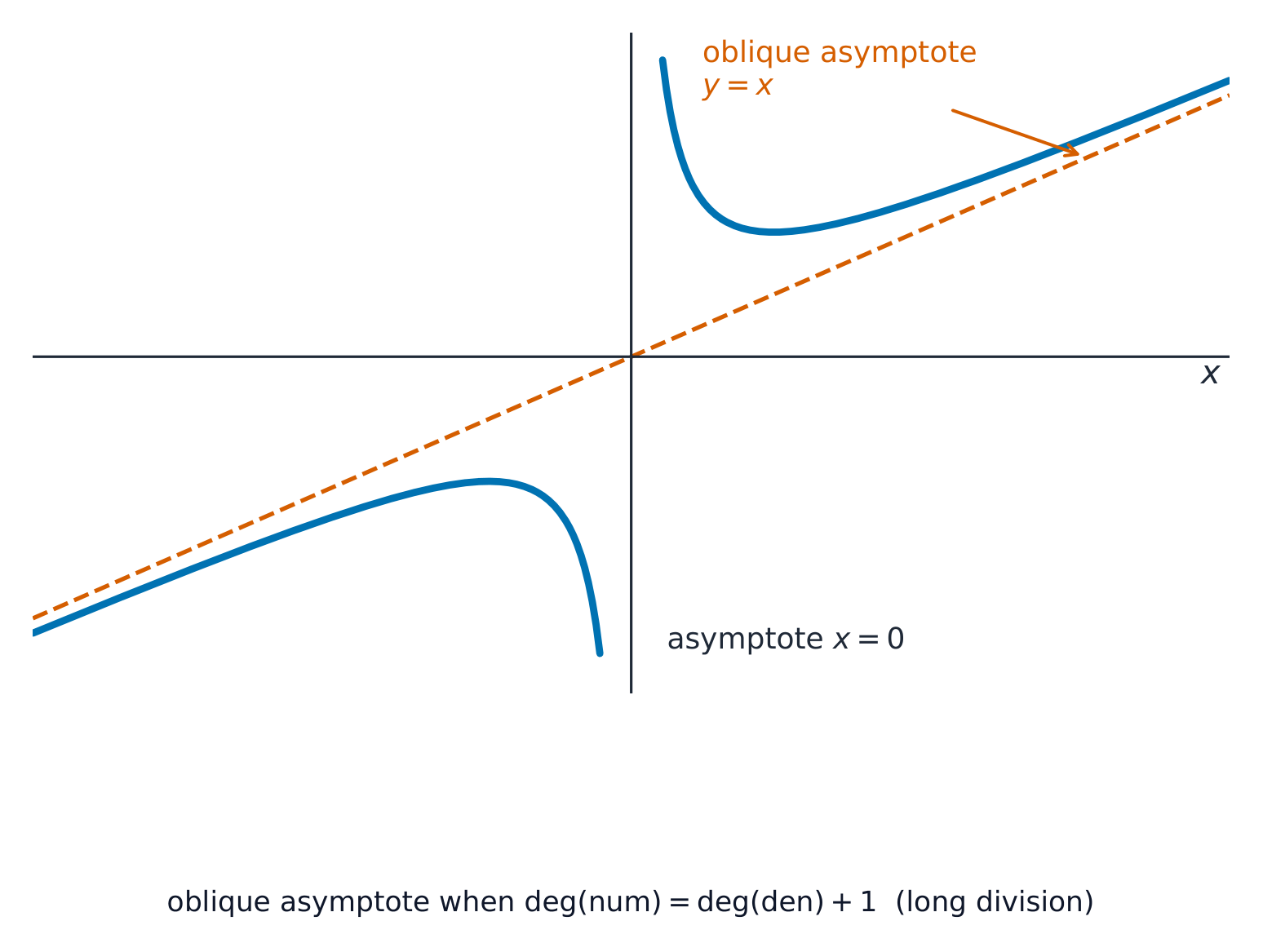
- 通过多项式除法得到商加上分母上的余数。对于 $(x^2-1)/(x-2)$,结果为 $x+2+3/(x-2)$。因此 $y=x+2$ 是 $x\to\pm\infty$ 时的斜渐近线;$x=2$ 是垂直渐近线。

水平或斜渐近线描述的是远处的行为,曲线可能在有限输入处穿过渐近线。对于 $f(x)=(x^2+x)/(x^2+1)$,水平渐近线为 $y=1$,且满足 $f(1)=1$。
For a reduced rational function with a non-zero remainder, a sloping straight-line asymptote occurs when the numerator degree is:
难度 1/5 · 今日首次完成可获 100 金币及少量额外奖励
When the numerator's degree exceeds the denominator's, dividing out leaves a slant line the curve approaches.
You find an oblique asymptote by:
难度 1/5 · 今日首次完成可获 100 金币及少量额外奖励
Polynomial division gives the straight-line part the curve approaches far from the origin.
For f(x) = (x²−1)/(x−2), divide to get f(x) = x + 2 + 3/(x−2). The oblique asymptote is y = x + ?
难度 2/5 · 今日首次完成可获 140 金币及少量额外奖励
The quotient is x + 2, so the oblique asymptote is y = x + 2.
极值点与完整草图
- 对于 $f(x)=x+1/x$,对应 $x\ne0$ 和 $f'(x)=1-1/x^2$。极值点包括 $(-1,-2)$(局部最大值)和 $(1,2)$(局部最小值),因为导数发生了变号。
- 该函数没有坐标轴交点。画出两条分支,包含垂直渐近线 $x=0$ 和斜渐近线 $y=x$。左支位于斜线下方,右支位于斜线上方。在原点附近,左支下降至 $-\infty$,右支上升至 $+\infty$。
并非所有有理曲线都有驻点。例如对于 $h(x)=(x+1)/(x^2+2x-2)$,
在其定义域的每个允许输入处均成立。由于分子不可能为零,故无驻点,且在定义域的每一区间上单调递减。不要跨越极点连接递减的分支。
支持 $f(x)=(x^2+4)/(x-2)$, find the asymptotes, stationary coordinates, axis intersections and range, and draw a labelled sketch.
$f=x+2+8/(x-2)$, x≠2. Asymptotes x=2 and y=x+2. $f\prime=1-8/(x-2)^2$ gives x=2±2√2 and y=4±4√2; the left point is a maximum, the right a minimum. There are no real x-intercepts; the y-intercept is (0,−2). Range $(-\infty,4-4\sqrt2]\cup[4+4\sqrt2,\infty)$. Left branch lies below the slant line, right above.
支持 $h(x)=(2x+1)/(x^2+x-3)$, prove that there are no stationary points. State the separate intervals on which it decreases.
The original exclusions are $l=(-1-\sqrt{13})/2$ and $r=(-1+\sqrt{13})/2$. The derivative is $-(2x^2+2x+7)/(x^2+x-3)^2$. Its numerator before the minus sign is $2(x+1/2)^2+13/2>0$, while the denominator is positive on the domain. Thus the derivative is always negative and never zero. The function decreases separately on $(-\infty,l)$, $(l,r)$ and $(r,\infty)$.
使用判别式证明值域
- 将 $y=x+1/x$ 整理为 $x^2-yx+1=0$。存在实数输入当且仅当其判别式满足 $y^2-4\ge0$。值域为 $y\le-2$ 或 $y\ge2$,包含两个极值点的取值。
- 检查被排除的值以及方程不再为二次方程的情况。对于 $y=x/(x^2+1)$,整理后得到 $yx^2-x+y=0$。在 $y=0$ 处,这是有效的线性方程 $x=0$;切勿舍去该值域值。
对于第二个函数,$1-4y^2\ge0$给出$-1/2\le y\le1/2$。其分母对实数$x$永不为零,因此所有这些值都会出现,包括$0$和两个端点。
Sketch $f(x)=(x^2-4)/(x^2-1)$ and find its range. Label poles, intercepts and its stationary point.
Domain x≠±1, vertical asymptotes x=±1, horizontal asymptote y=1. Intercepts (±2,0),(0,4). $f\prime=6x/(x^2-1)^2$, so (0,4) is a minimum on the middle branch. Put z=x²≥0, z≠1: $y=1-3/(z-1)$. For 0≤z<1, y≥4; for z>1, y<1. Range $(-\infty,1)\cup[4,\infty)$. All three branches must be shown.
Use a discriminant to find the range of $f(x)=(2x+1)/(x^2+1)$. Handle y=0 separately and identify the x-values where the range endpoints occur.
Rearrange to $yx^2-2x+(y-1)=0$. For y≠0, discriminant $4-4y(y-1)\ge0$ gives $(1-\sqrt5)/2\le y\le(1+\sqrt5)/2$. At y=0, x=−1/2 is valid. The denominator never vanishes. Equality gives a double input root x=1/y, so endpoint inputs are (−1−√5)/2 and (−1+√5)/2 respectively.
For a>0, sketch the features of $f_a(x)=(x^2+a^2)/(x-a)$: asymptotes, stationary coordinates and range. Explain what changes when a=0 in the original expression.
$f_a=x+a+2a^2/(x-a)$. Asymptotes x=a,y=x+a. Stationary points $(a\pm\sqrt2a,2a\pm2\sqrt2a)$; the minus point is a maximum and plus a minimum. Range $y\le2a-2\sqrt2a$ 或 $y\ge2a+2\sqrt2a$. At a=0 the expression is x²/x=x for x≠0: a line with a hole at (0,0), no vertical asymptote and no stationary points. Its range is R without {0}.
改变输出:绝对值和倒数
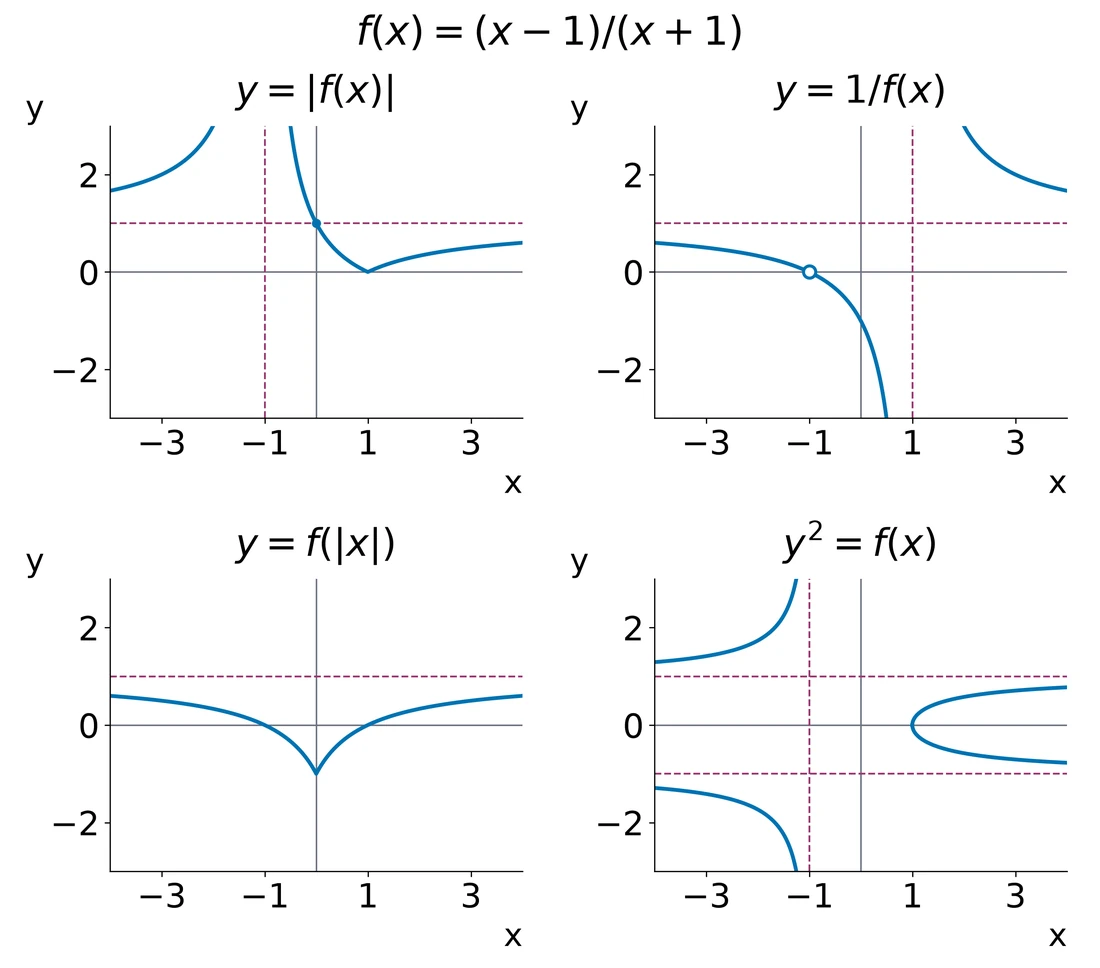
- 取$f(x)=(x-1)/(x+1)$。对于$y=|f(x)|$,保留非负部分并将负部分关于$x$轴反射。排除点$x=-1$保持不变。它唯一的零点是$x=1$。
- 对于$y=1/f(x)=(x+1)/(x-1)$,同时排除$x=-1$和$x=1$:前者从未在原定义域中,后者使倒数无意义。在$(-1,0)$处有一个空心点,在$x=1$处有一条垂直渐近线;空心点不是零点。
支持 $f(x)=(x-2)/(x+3)$, sketch y=1/f(x) with the domain inherited from f. Give its poles, holes, zeros and range.
$1/f=(x+3)/(x-2)$ for x≠−3,2. There is a vertical asymptote at x=2, a hole at (−3,0), and horizontal asymptote y=1. There are no actual zeros. Since $y=1+5/(x-2)$ omits 1, and the only input giving y=0 is excluded, its range is R without {0,1}.
改变输入,或平方输出
- 对于$f(|x|)$,保留原始右半部分并将其关于$y$轴反射。此处分母$|x|+1$永不消失;值域为$[-1,1)$,零点位于$x=\pm1$,且在$(0,-1)$处有一个尖角。这种尖角并非自动产生:如果原始右侧在零点的斜率为零,连接处可以是平滑的。
- 对于$y^2=f(x)$,仅保留满足$f(x)\ge0$条件的原始输入,然后绘制$y=\sqrt{f(x)}$和$y=-\sqrt{f(x)}$。此处$x<-1$或$x\ge1$;两条分支在$(1,0)$处相交,且不存在对应于$-1<x<1$的图像。
平滑连接是可能的:对于$h(x)=(x^2+4x+8)/(x+2)$,$h(0)=4$和$h'(0)=0$。将其右半部分反射后,两侧斜率均为0,因此$h(|x|)$在$(0,4)$处是平滑的。
Explore a reciprocal curve
y = a/(x − b) + c
For a non-zero a, x=b is excluded and the curve approaches y=c at large |x|. Track the domain as well as the visible branches.
For y = 1/f(x), the zeros of f(x) become the zeros of y.
难度 1/5 · 今日首次完成可获 100 金币及少量额外奖励
A zero of f becomes an excluded input and usually a vertical asymptote of 1/f. Original domain exclusions remain; do not turn an original pole into a filled zero.
The graph of y = |f(x)| is obtained from y = f(x) by:
难度 1/5 · 今日首次完成可获 100 金币及少量额外奖励
The modulus reflects any part of the graph below the x-axis to above it.
支持 $f(x)=(x^2-4)/(x^2-1)$, sketch $y^2=f(x)$. State its real x-domain, axis intersections, vertical and horizontal limiting lines.
Require f≥0 in the original domain. This gives $x\le-2$ 或 $-1<x<1$ 或 $x\ge2$. Draw both signs of √f, symmetric about the x-axis (also even in x). Intersections (±2,0),(0,±2). Vertical asymptotes x=±1 approached from the central interval. As |x|→∞, the outer branches tend to y=±1. No points exist on (−2,−1) or (1,2).
支持 $g(x)=(x-2)/(x+1)$, sketch y=|g(x)| and y=g(|x|) separately. Compare domains, zeros, y-intercepts and the join at x=0. Would $h(|x|)$, for $h(x)=(x^2+4x+8)/(x+2)$, have the same type of join at zero?
For |g|, x≠−1, pole x=−1, sole zero x=2, y-intercept2; reflect original negative outputs upward. For g(|x|), the denominator |x|+1 is positive for every real x, zeros are ±2 and y-intercept−2. Copy only the right half of g and reflect left; the slopes at zero are −3 and +3, so there is a corner minimum there. Its range is [−2,1). For h, division gives $h=x+2+4/(x+2)$, so $h(0)=4$ and $h\prime(0)=1-4/4=0$. The reflected slopes both equal zero; its join at (0,4) is smooth, unlike the corner for g.
利用边界和分支求解不等式
- 为求解$|(x-1)/(x+1)|<2$,找出$f=2$和$f=-2$的位置:边界输入为$-3$和$-1/3$。将极点$-1$包含在符号或分支图中。
- 测试由这些值分隔的区间。答案为$x<-3$或$x>-1/3$,端点不包含在内。在决定$x+1$符号之前不要乘不等式;排除$x=-1$后乘$(x+1)^2$才是安全的。
Solve $|(x-2)/(x+1)|<1/2$ exactly, showing boundaries and the excluded input.
Exclude x=−1. The boundaries f=−1/2 and f=1/2 occur at x=1 and x=5. On x<−1, f>1, so there is no solution there. On x>−1, f increases from −∞ to1, giving 1<x<5. An equivalent safe algebra route squares and multiplies by the positive (x+1)² after excluding −1.
利用对称性求解输入绝对值不等式
- 对于$f(|x|)<1/2$,令$t=|x|\ge0$。此时$(t-1)/(t+1)<1/2$具有正分母并给出$t<3$。
- 转换回$-3<x<3$。零值是包含在内的。如果二次计算产生了$t$的负边界,则它不可能是$|x|$的值;应在反射结果之前检查允许的半直线。
Solve $((|x|)^2+4)/(|x|+2)<3$ exactly. Explain how the restriction on |x| affects the two quadratic boundary roots.
Put t=|x|≥0. Since t+2>0, the inequality becomes t²−3t−2<0. Its roots are (3±√17)/2, but the lower one is negative. Thus 0≤t<(3+√17)/2 and $-(3+\sqrt{17})/2<x<(3+\sqrt{17})/2$. Zero is included.
根据证据构建草图
- 记录定义域、截距、渐近线、驻点坐标及单侧行为。使用值域计算来确认哪些垂直间隙是真实的;水平渐近线不一定是被排除的输出值。
- 对于相关图像,在绘图前先声明新的定义域。对于不等式,标记所有边界和极点,测试分支,并保持端点的严格或包含性质。
For (x squared plus 1) divided by (x minus 1), what is the oblique asymptote, and why is the remainder not that line?
Polynomial division writes the function as quotient plus remainder over divisor. Only the quotient survives as the oblique asymptote.
For (x²+1)/(x−1), what constant is added to x in its slant asymptote?
难度 1/5 · 今日首次完成可获 100 金币及少量额外奖励
The quotient is x plus 1, so the constant is 1. The remainder is 2.
Solve $|(x^2-4)/(x^2-1)|<1/2$ exactly. Give the intervals and show why multiplying by the denominator itself would require care.
Exclude x=±1. Squaring and multiplying by (x²−1)² gives $4(x^2-4)^2<(x^2-1)^2$, hence $3(x^2-3)(x^2-7)<0$. Thus 3<x²<7, so $-\sqrt7<x<-\sqrt3$ 或 $\sqrt3<x<\sqrt7$. The excluded poles lie outside these intervals. Multiplication by x²−1 without a sign split is unsafe.