| Candidates should be able to: | Notes and guidance |
|---|---|
| Show understanding of linear search and binary search methods | Write an algorithm to implement a linear search Write an algorithm to implement a binary search The conditions necessary for the use of a binary search How the performance of a binary search varies according to the number of data items |
| Show understanding of insertion sort and bubble sort methods | Write an algorithm to implement an insertion sort Write an algorithm to implement a bubble sort Performance of a sorting routine may depend on the initial order of the data and the number of data items |
| Show understanding of and use Abstract Data Types (ADT) | Write algorithms to find an item in each of the following: linked list, binary tree Write algorithms to insert an item into each of the following: stack, queue, linked list, binary tree Write algorithms to delete an item from each of the following: stack, queue, linked list Show understanding that a graph is an example of an ADT. Describe the key features of a graph and justify its use for a given situation. Candidates will not be required to write code for a graph structure |
| Show how it is possible for ADTs to be implemented from another ADT | Describe the following ADTs and demonstrate how they can be implemented from appropriate built-in types or other ADTs: stack, queue, linked list, dictionary, binary tree |
| Show understanding that different algorithms which perform the same task can be compared by using criteria (e.g. time taken to complete the task and memory used) | Including use of Big O notation to specify time and space complexity |
计算思维与问题求解
A-Level 计算机科学 · 第 19 主题
 15:33
15:33
Searching & Sorting
A phone book with a million names. If you check them one at a time, you might make a million comparisons. But you already know the trick: open it in the…
英文讲解 · 内嵌中英文字幕
19.1
算法

大纲
来源:剑桥国际大纲
一个搜索(search)在一个集合(常常是一个数组(array))中找一个目标值并返回它的位置,或"未找到"。
Linear search
一个线性查找(linear search)从头走到尾,把每个元素与目标比较:
FOR i ← 1 TO n
    IF A[i] = target THEN RETURN i
NEXT i
RETURN -1   // not found
不需要准备,所以它在任何列表上都能用。最坏情况 O($n$)(目标在末端或不存在);最好情况 1 次比较。在未排序的数据或小列表上用它。(返回的 -1 是一个哨兵值——一个表示"未找到"的不可能位置;调用者测试 IF result = -1。)
考试的版本。 试卷 3 要你补全用标志和 WHILE 循环写的线性查找,试卷 4 要你写一个返回下标或计数的函数。两者都像这样:
FUNCTION LinearSearch(Data : ARRAY OF INTEGER, Target : INTEGER) RETURNS INTEGER
    DECLARE Index, Count : INTEGER
    Count ← 0
    FOR Index ← 1 TO 100
        IF Data[Index] = Target THEN
            Count ← Count + 1
        ENDIF
    NEXT Index
    RETURN Count          // Target 出现的次数;0 表示未找到
ENDFUNCTION
要在第一个匹配处停止,改用 WHILE Index <= 100 AND NOT Found 循环,设置 Found ← TRUE 并记住下标。分数在于遍历每个元素的循环、比较,以及值不存在时返回什么。

Binary search
一个二分查找(binary search)需要数据已排序。看中间元素;若它是目标,完成;若目标更小,搜索左半,否则右半——每次把范围折半:
low ← 1
high ← n
WHILE low <= high DO
    mid ← (low + high) DIV 2
    IF A[mid] = target THEN RETURN mid
    IF A[mid] < target THEN
        low ← mid + 1
    ELSE
        high ← mid - 1
    ENDIF
ENDWHILE
RETURN -1
最坏情况 O($\log_{2} n$)——对一百万项,约 20 次比较。在大的已排序数组上比线性查找快得多,但你必须先排序(一个一次性的 O($n \log n$) 代价),若你搜索许多次就值得。
"说明二分查找的必要条件。" 数据必须有序(按所查找的键升序或降序排列)。"描述如何进行二分查找"(三分):(1) 找到列表(或当前范围)的中间项并与目标比较;(2) 若匹配则查找结束;若目标更小,对下半部分重复,若更大则对上半部分重复;(3) 不断折半范围,直到找到该项或范围为空,即它不存在。
带边界和标志的考试版本,是被要求补全算法时要复现的:
DECLARE Lower, Upper, Mid : INTEGER
DECLARE Found : BOOLEAN
Lower ← 0
Upper ← 99
Found ← FALSE
WHILE Lower <= Upper AND NOT Found
    Mid ← (Lower + Upper) DIV 2
    IF Names[Mid] = Target THEN
        Found ← TRUE
    ELSE
        IF Names[Mid] < Target THEN
            Lower ← Mid + 1
        ELSE
            Upper ← Mid - 1
        ENDIF
    ENDIF
ENDWHILE
IF Found THEN OUTPUT Mid ELSE OUTPUT "Not found" ENDIF
"解释性能如何随项数变化。" 每次比较把剩余项数折半,所以最大比较次数约为 $\log_{2} n$:列表规模加倍只多一次比较。这是 O($\log n$)。"比较线性查找和二分查找":线性查找最多需要 $n$ 次比较(O($n$)),平均为其一半,但对未排序数据也能用;二分查找最多需要 $\log_{2} n$ 次(O($\log n$)),对大列表快得多,但数据必须先排序,并且必须能直接访问中间项(数组,而不是链表)。对 $1000$ 项:$1000$ 次对 $10$ 次比较。

探索
Linear vs binary search
Search for a value. Binary search halves the list each step (only on sorted data); linear search checks one by one.
词汇表
训练
| 英文 | 中文 | 拼音 |
|---|---|---|
| binary search/ˈbaɪnəri sɜːtʃ/ | 二分查找 | èr fēn chá zhǎo |
| array/əˈreɪ/ | 数组 | shù zǔ |
| linear search/ˈlɪnɪə sɜːtʃ/ | 线性查找 | xiàn xìng chá zhǎo |
19.1
排序算法

Bubble sort
一个冒泡排序(bubble sort)反复走过数组,交换顺序错误的相邻对,所以最大的每趟"冒泡"到末端:
FOR pass ← 1 TO n - 1
    swapped ← FALSE
    FOR i ← 1 TO n - pass
        IF A[i] > A[i + 1] THEN
            temp ← A[i]
            A[i] ← A[i + 1]
            A[i + 1] ← temp
            swapped ← TRUE
        ENDIF
    NEXT i
    IF swapped = FALSE THEN EXIT FOR   // already sorted
NEXT pass
最好情况 O($n$)(已排序,带早退);平均/最坏 O($n^{2}$)。简单但对大的 $n$ 慢。
Insertion sort
一个插入排序(insertion sort)从左边构建一个已排序的前缀,通过把较大的向右移把每个新元素插入位置:
FOR i ← 2 TO n
    key ← A[i]
    j ← i - 1
    WHILE j >= 1 AND A[j] > key DO
        A[j + 1] ← A[j]
        j ← j - 1
    ENDWHILE
    A[j + 1] ← key
NEXT i
最好情况 O($n$)(已排序);最坏 O($n^{2}$)。适合小或近乎已排序的数组。它原地(in place)排序并且是稳定的(stable,保持相等元素的顺序)。
Tracing a sort
一个常见的任务是显示每一次外趟之后的数组。对 [D, T, H, R] 用插入排序:趟 1(key T)无变化;趟 2(key H)→ [D, H, T, R];趟 3(key R)→ [D, H, R, T]。
从头写一个排序。 "写出把 DataArray[1:1000] 升序排序的伪代码"用带提前退出标志的完整冒泡排序或插入排序作答,带声明和缩进;只要对每种输入都正确,两者都得满分:
DECLARE Pass, Index, Temp : INTEGER
DECLARE Swapped : BOOLEAN
Pass ← 1
REPEAT
    Swapped ← FALSE
    FOR Index ← 1 TO 1000 - Pass
        IF DataArray[Index] > DataArray[Index + 1] THEN
            Temp ← DataArray[Index]
            DataArray[Index] ← DataArray[Index + 1]
            DataArray[Index + 1] ← Temp
            Swapped ← TRUE
        ENDIF
    NEXT Index
    Pass ← Pass + 1
UNTIL Swapped = FALSE OR Pass = 1000
要降序就把 > 改成 <;要按某个字段排序记录或二维数组,比较该字段但交换整条记录(或每一列)。被要求写一个"完成与给定冒泡排序相同任务"的插入排序时,保持同样的数组名和方向,复现上面的插入排序,若为降序则把比较反过来。
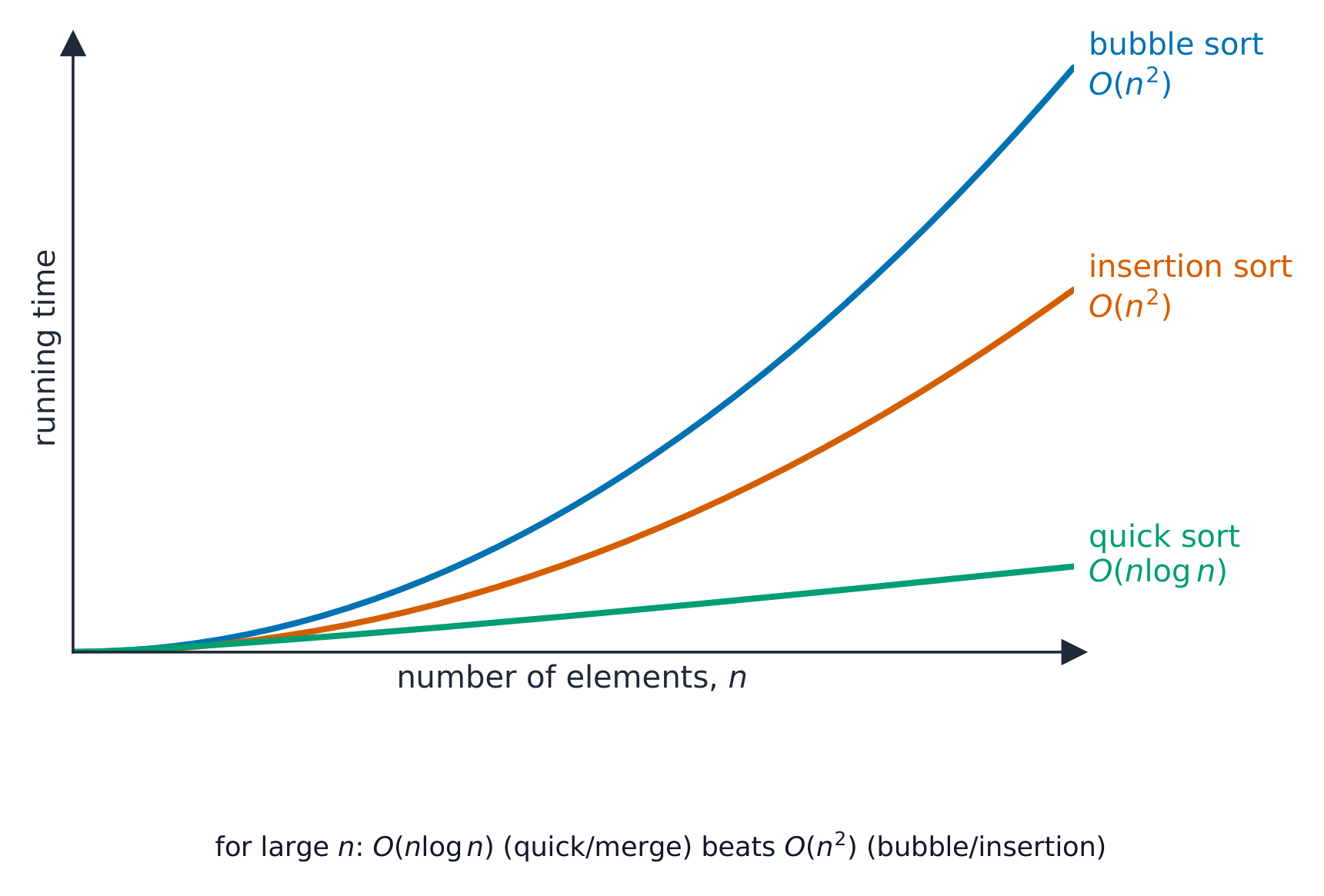
"描述排序性能受数据影响的两种方式"(两分)。 (1) 项目的数量:$O(n^{2})$ 的排序对两倍的项目要花四倍的时间。(2) 数据已经有序到什么程度:带标志的冒泡排序或插入排序对已排序的数据一趟就结束($O(n)$),对逆序数据做的工作最多;交换次数取决于有多少对是乱序的。(也可接受:取值范围或重复值的数量,以及项目是否是移动代价高的大记录。)冒泡排序和插入排序在最坏和平均情况下都是 O($n^{2}$),最好情况 O($n$);快速排序和归并排序是 O($n \log n$),这就是它们用于大数据的原因。
[D, T, H, R] 的一个插入排序,一趟接一趟把每个 key 移入它的位置
探索
Watch a sort run
Step through a sort and watch the bars settle into order — how a sorting algorithm works pass by pass.
词汇表
训练
| 英文 | 中文 | 拼音 |
|---|---|---|
| insertion sort/ɪnˈsɜːʃn sɔːt/ | 插入排序 | chā rù pái xù |
| bubble sort/ˈbʌbl sɔːt/ | 冒泡排序 | mào pào pái xù |
| in place/ɪn pleɪs/ | 原地 | yuán dì |
| stable/ˈsteɪbl/ | 稳定 | wěn dìng |
19.1
算法中的抽象数据类型
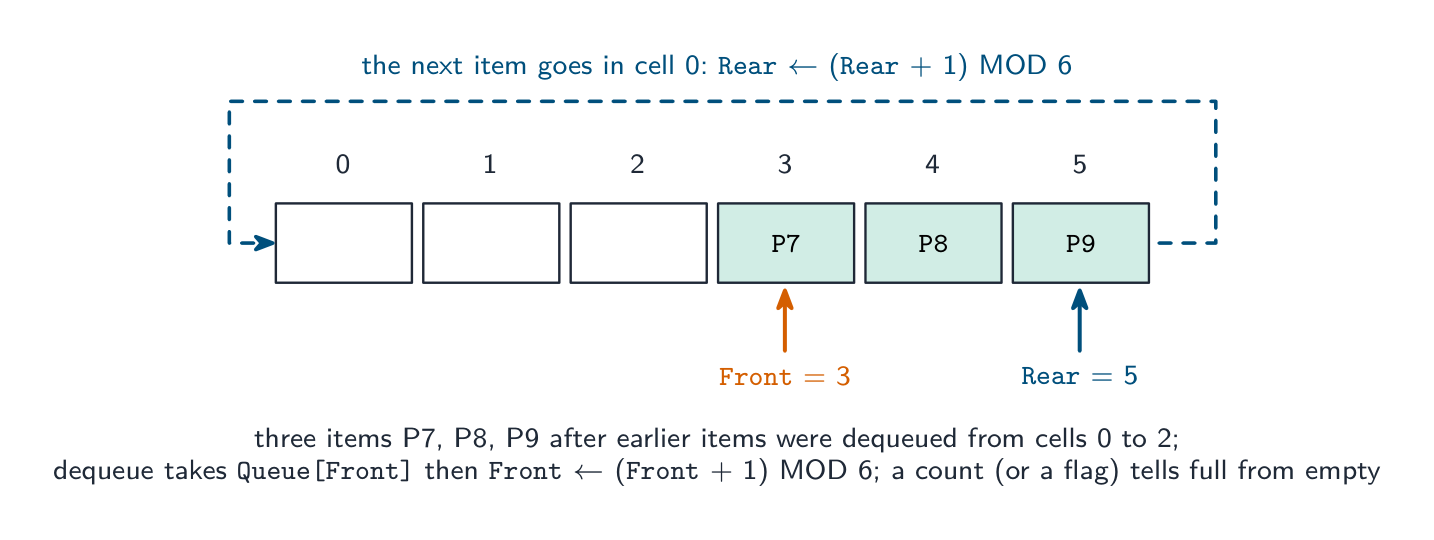
主题 10 的抽象数据类型(ADT)出现在许多算法内部:一个栈(stack)驱动深度优先遍历和撤销;一个队列(queue)驱动广度优先遍历和打印排序;一个链表(linked list)让数据增长和收缩。
ADT 可以从其他 ADT 构建,而不只是从数组:一个队列从两个栈;一个栈从一个链表(push = 在头部前置一个节点(node));一个队列从一个带头和尾指针(pointers)的链表;一棵二叉树(binary tree)从带两个孩子指针的节点;一个字典(dictionary)存储键→值对(常在一个哈希表上)。这样分层分离关注点——使用该 ADT 的算法不必知道它如何构建。
考试要你描述和实现的 ADT
栈(后进先出):项目在同一端即栈顶加入(压入)和移除(弹出);指针 TopOfStack 保存栈顶项的下标。用一个数组和这一个指针实现:压入检查栈未满、递增指针并存入项目;弹出检查栈非空、返回栈顶项并递减指针。
FUNCTION Push(Item : INTEGER) RETURNS BOOLEAN
    IF TopOfStack = 9 THEN RETURN FALSE ENDIF      // 已满(数组 0 到 9)
    TopOfStack ← TopOfStack + 1
    StackData[TopOfStack] ← Item
    RETURN TRUE
ENDFUNCTION
FUNCTION Pop() RETURNS INTEGER
    IF TopOfStack = -1 THEN RETURN -1 ENDIF        // 已空
    TopOfStack ← TopOfStack - 1
    RETURN StackData[TopOfStack + 1]
ENDFUNCTION
队列(先进先出):项目在队尾加入(入队)、从队首离开(出队);两个指针和一个计数。在线性队列中队首指针沿数组前移,开头的空间被浪费;循环队列(circular queue)用 MOD 让两个指针绕回,使每个单元都被重用。
FUNCTION Enqueue(Item : STRING) RETURNS BOOLEAN
    IF Count = 6 THEN RETURN FALSE ENDIF            // 已满
    Rear ← (Rear + 1) MOD 6
    QueueArray[Rear] ← Item
    Count ← Count + 1
    RETURN TRUE
ENDFUNCTION
FUNCTION Dequeue() RETURNS STRING
    IF Count = 0 THEN RETURN "" ENDIF               // 已空
    DECLARE Item : STRING
    Item ← QueueArray[Front]
    Front ← (Front + 1) MOD 6
    Count ← Count - 1
    RETURN Item
ENDFUNCTION
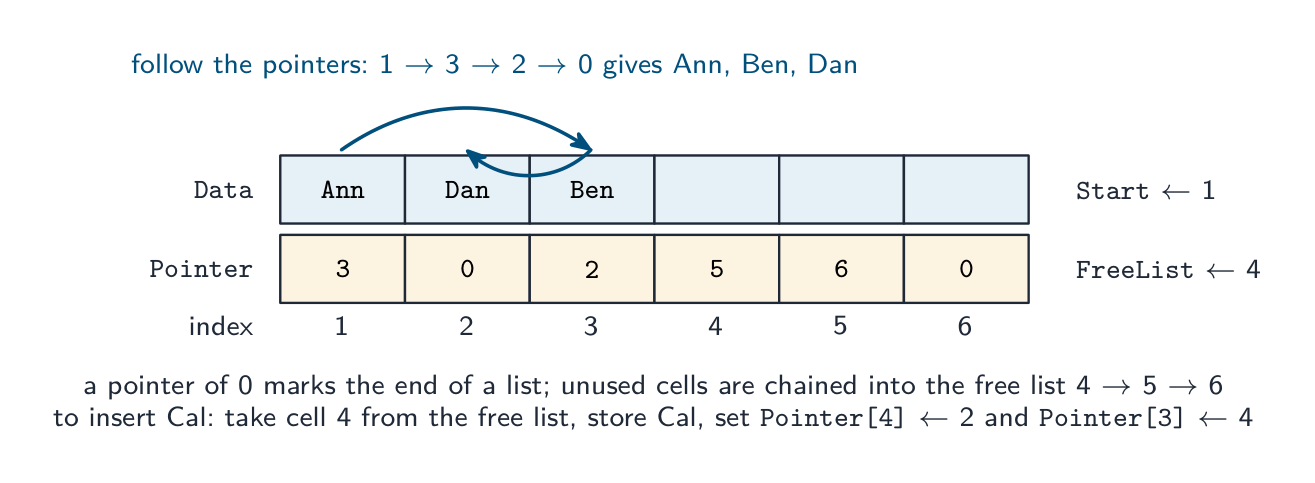
链表:一串节点,每个保存一个数据项和指向下一个节点的指针;起始指针给出第一个节点,空指针(0 或 $-1$)结束链表。用数组实现时,两个平行数组保存数据和指针,未用的单元串成空闲列表(free list),使插入时知道把新节点放在哪里。
FUNCTION FindInList(Target : STRING) RETURNS INTEGER   // 下标,不存在则为 0
    DECLARE Current : INTEGER
    Current ← Start
    WHILE Current <> 0
        IF Data[Current] = Target THEN RETURN Current ENDIF
        Current ← Pointer[Current]
    ENDWHILE
    RETURN 0
ENDFUNCTION
要插入有序链表:取第一个空闲单元(NewNode ← FreeList,FreeList ← Pointer[FreeList]),存入项目,然后用 Previous 和 Current 指针遍历链表直到 Data[Current] > Item 或到末尾;设 Pointer[NewNode] ← Current 和 Pointer[Previous] ← NewNode(若排在最前则 Start ← NewNode)。要删除,把前一个节点重新链接到被删节点之后,并把该单元归还空闲列表。
二叉树:一个根节点,每个节点保存数据、一个指向较小值子树的左指针和一个指向较大值子树的右指针。实现为二维数组(或三个一维数组)Tree[Index, 0..2],存左指针、数据、右指针,加一个根指针和一个下一空闲指针。
FUNCTION FindInTree(Target : INTEGER) RETURNS INTEGER   // 下标,不存在则为 -1
    DECLARE Current : INTEGER
    Current ← Root
    WHILE Current <> -1
        IF Tree[Current, 1] = Target THEN RETURN Current ENDIF
        IF Target < Tree[Current, 1] THEN
            Current ← Tree[Current, 0]      // 向左
        ELSE
            Current ← Tree[Current, 2]      // 向右
        ENDIF
    ENDWHILE
    RETURN -1
ENDFUNCTION
要插入:把项目存入下一个空闲节点,两个指针都设为 $-1$;若树为空则令它为根;否则从根向下,按比较向左或向右,直到要跟随的指针为 $-1$,把该指针设为新节点。用一个 ADT 构建另一个 ADT:栈是压入和弹出都在起始端进行的链表;队列是带起始和末尾指针的链表;队列可以用两个栈构成(压入一个,从另一个弹出,第二个为空时把全部搬过去);二叉树的节点是由指针链接的记录或对象,所以它由节点的链式结构构成。要说明新 ADT 的哪些操作对应旧 ADT 的哪些操作。


词汇表
训练
| 英文 | 中文 | 拼音 |
|---|---|---|
| linked list/lɪŋkt lɪst/ | 链表 | liàn biǎo |
| stack/stæk/ | 栈 | zhàn |
| queue/kjuː/ | 队列 | duì liè |
| node/nəʊd/ | 节点 | jié diǎn |
| pointers/ˈpɔɪntəz/ | 指针 | zhǐ zhēn |
| binary tree/ˈbaɪnəri triː/ | 二叉树 | èr chā shù |
| dictionary/ˈdɪkʃənəri/ | 字典 | zì diǎn |
| circular queue/ˈsɜːkjʊlə kjuː/ | 循环队列 | xún huán duì liè |
| free list/friː lɪst/ | 空闲列表 | kòng xián liè biǎo |
19.1
比较算法
Time complexity
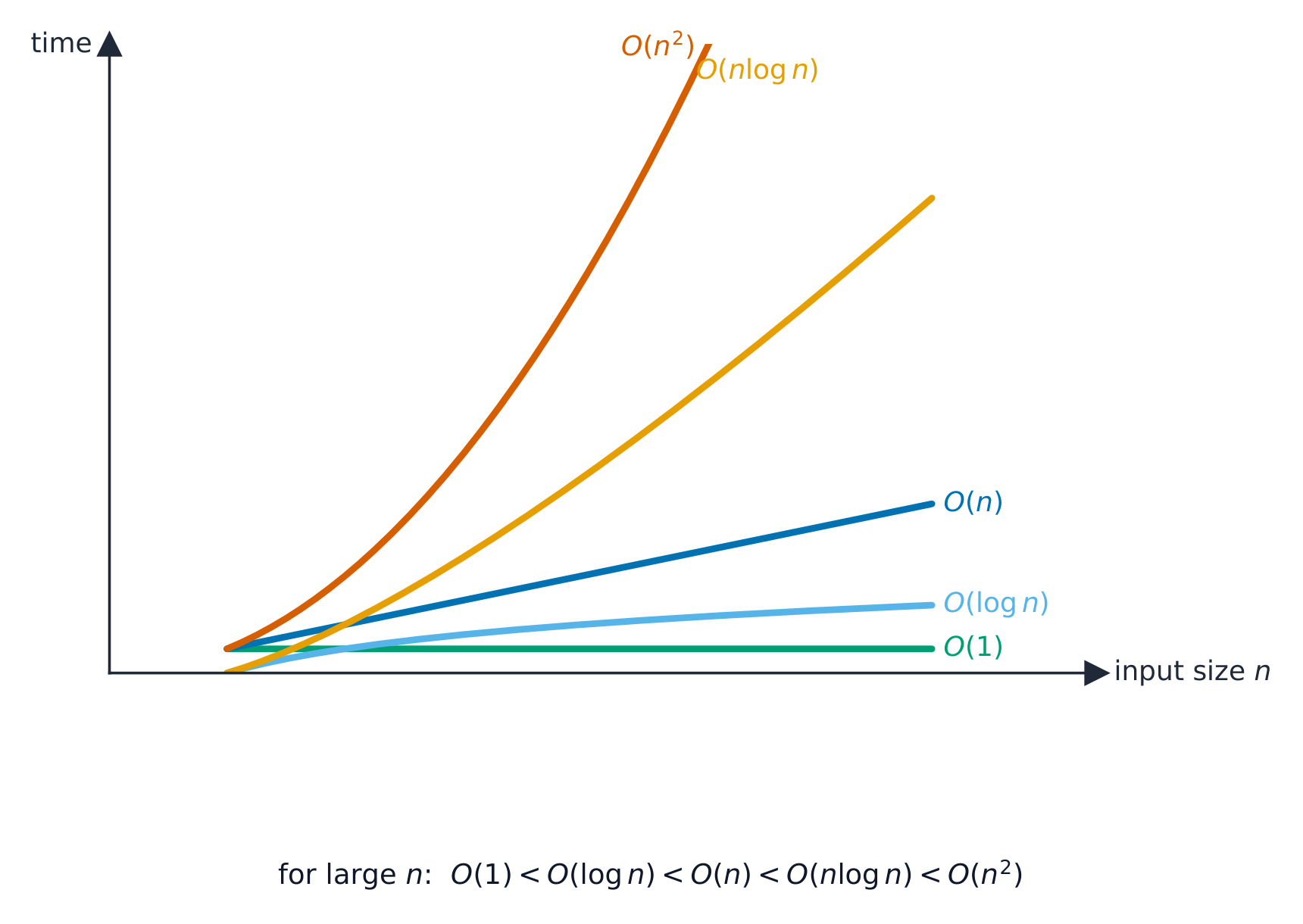
时间复杂度(time complexity)是运行时间如何随输入大小 $n$ 增长,写成大O表示法(Big-O notation,主导项):O(1) 常数、O($\log n$) 二分查找、O($n$) 线性查找、O($n \log n$) 好的排序、O($n^{2}$) 冒泡/插入排序。较小的阶在规模上更好,即使另一个算法对小 $n$ 更快。
具体地说:要排序一百万项,一个 $O(n \log n)$ 排序在不到一秒内完成,而一个 $O(n^{2})$ 排序可能花几分钟。
例题。 一个已排序的列表容纳 $1000$ 项。每个搜索在最坏情况下需要多少次比较?
一个线性查找一次检查一项,所以它可能需要多达 $1000$ 次比较——这是 $O(n)$。一个二分查找每步把列表折半,所以它最多需要 $\lceil \log_2 1000 \rceil = 10$ 次比较——这是 $O(\log n)$。把列表翻倍到 $2000$ 项只给二分查找加一次比较,但给线性查找加多达另外 $1000$ 次——这就是为什么增长的阶,而不是原始速度,决定规模上的赢家。
描述一个阶。 *O(1):*时间恒定,与项数无关(压栈、读数组元素)。*O($\log n$):*时间随项数的对数增长,所以数据加倍只多一个固定的步骤(二分查找)。*O($n$):*时间与项数成比例增长(线性查找,遍历一遍列表)。*O($n \log n$):*比线性稍差(高效排序)。*O($n^{2}$):*时间随项数的平方增长,所以数据加倍时间变为四倍(冒泡和插入排序)。"说出对 Names[0:99] 二分查找的大 O"答 $O(\log n)$,"描述其含义"如上;大 O 度量时间或内存如何伸缩,而不是实际时间。
Space complexity
空间复杂度(space complexity)是需要的额外内存。冒泡和插入排序用 O(1) 额外(原地);归并排序用 O($n$);递归用与它的深度成正比的栈内存。常常有一个时间–内存权衡。
Other criteria
简单性(更容易编码和维护)、稳定性,以及自适应性(在近乎已排序的数据上更快)。正确的算法取决于数据和约束。
探索
How running time grows with n
Slide n upward and compare the curves: O(1) and O(log n) stay almost flat, O(n) rises steadily, O(n²) explodes. This is why Big-O — not a stopwatch — is how we compare algorithms on large inputs.
探索
Big-O growth
Change the input size n and compare how fast each algorithm's work grows — the idea behind time complexity.
词汇表
训练
| 英文 | 中文 | 拼音 |
|---|---|---|
| time complexity/taɪm kəmˈpleksɪti/ | 时间复杂度 | shí jiān fù zá dù |
| Big-O notation/bɪɡ əʊ nəʊˈteɪʃn/ | 大O表示法 | dà O biǎo shì fǎ |
| space complexity/speɪs kəmˈpleksɪti/ | 空间复杂度 | kōng jiān fù zá dù |
19.2
递归

大纲
| Candidates should be able to: | Notes and guidance |
|---|---|
| Show understanding of recursion | Essential features of recursion How recursion is expressed in a programming language Write and trace recursive algorithms When the use of recursion is beneficial |
| Show awareness of what a compiler has to do to translate recursive programming code | Use of stacks and unwinding |
来源:剑桥国际大纲
递归算法用递归(recursion):例程用同一问题的一个更小的版本调用它自己,直到一个基本情形(base case)结束这条链。它有两部分:基本情形(小到能直接解决——没有它递归永不停止)和递归情形(recursive case,减小输入并调用它自己)。
阶乘(factorial):
FUNCTION Factorial(n : INTEGER) RETURNS INTEGER
    IF n = 0 OR n = 1 THEN
        RETURN 1
    ELSE
        RETURN n * Factorial(n - 1)
    ENDIF
ENDFUNCTION
递归对自相似的问题是自然的:树、分治(divide-and-conquer,二分查找、归并排序)和嵌套数据。当它不合适时,一个循环通常更清爽。
"描述递归是什么意思"(两分)。 用自身定义的函数或过程:它在自己的函数体内调用自己,每次处理一个更小的问题版本,直到到达基本情形。 "说出递归的三个基本特征":(1) 一个基本情形(停止条件),不再调用而直接返回一个值;(2) 一个一般情形(general case),其中例程调用自身;(3) 每次调用使问题更接近基本情形(参数减小),从而递归终止。有些评分方案还加上:值在调用解退时返回。
"描述递归何时有益,并举例。" 当问题天然地由其更小版本定义,使得递归解比循环更短、更清晰、更接近数学定义时:阶乘或斐波那契数、二分查找、遍历二叉树、归并排序或快速排序,以及处理文件夹套文件夹这样的嵌套结构。当深度很大(栈可能溢出)或同一子问题被计算多次(朴素的斐波那契)时,它是糟糕的选择。
Tracing a recursive call
对 Factorial(4):调用往下走到 Factorial(1)=1,然后展开往上乘回来:2*1=2、3*2=6、4*6=24。最终结果 24。在一个栈上跟踪每个待处理的调用。
例题。 下面的函数没有说明。追踪 Unknown(3, 5),说出它的输出和返回值。
FUNCTION Unknown(BYVAL X, BYVAL Y : INTEGER) RETURNS INTEGER
    IF X < Y THEN
        OUTPUT X + Y
        RETURN Unknown(X + 1, Y - 1) + 1
    ELSE
        RETURN 0
    ENDIF
ENDFUNCTION
调用 1:$X = 3, Y = 5$:$3 < 5$,输出 8,调用 Unknown(4, 4)。调用 2:$4 < 4$ 为假,返回 0。解退:调用 1 返回 $0 + 1 = 1$。输出 8,返回值 1。把追踪写成每次调用一行的表(参数、条件、输出、返回什么),并从最深的调用向上做返回:那就是评分方案要找的解退。
例题(斐波那契)。 Fib(n) 在 n < 2 时返回 n,否则返回 Fib(n - 1) + Fib(n - 2)。求 Fib(5)。
Fib(5) = Fib(4) + Fib(3);Fib(4) = Fib(3) + Fib(2);Fib(3) = Fib(2) + Fib(1);Fib(2) = Fib(1) + Fib(0) = 1 + 0 = 1。所以 Fib(3) = 1 + 1 = 2,Fib(4) = 2 + 1 = 3,Fib(5) = 3 + 2 = 5。基本情形被到达许多次(Fib(2) 被计算三次),这就是这个版本慢的原因:对 $n = 5$ 它做 15 次调用,$n$ 每增加 1 调用数大约翻倍。
把递归改成迭代。 每个递归例程都可以用循环改写,占用更少内存且更快:保存一个累积结果,从基本情形向上循环。循环版的阶乘:
FUNCTION Factorial(N : INTEGER) RETURNS INTEGER
    DECLARE Result, Count : INTEGER
    Result ← 1
    FOR Count ← 2 TO N
        Result ← Result * Count
    NEXT Count
    RETURN Result
ENDFUNCTION
被要求把递归的插入排序或查找改成迭代版本时,用一个对递归所步进的下标的循环取代自调用,并把基本情形变成循环的退出条件。
Risks
- 若错过基本情形则无限递归——用一个栈溢出(stack overflow)崩溃。
- 深度递归的高内存使用。
- 若它重复工作则慢(朴素的斐波那契是指数的——用一个循环或记忆化(memoisation))。
探索
Recursion unwinds from the leaves up
Step through fib(4) in the order the calls actually finish: the leaves (base cases) resolve first, then each parent combines its children. Notice fib(2) is computed twice — that repeated work is why naive recursion is slow.
词汇表
训练
| 英文 | 中文 | 拼音 |
|---|---|---|
| recursion/rɪˈkɜːʃn/ | 递归 | dì guī |
| base case/beɪs keɪs/ | 基本情形 | jī běn qíng xíng |
| recursive case/rɪˈkɜːsɪv keɪs/ | 递归情形 | dì guī qíng xíng |
| factorial/fækˈtɔːrɪəl/ | 阶乘 | jiē chéng |
| divide-and-conquer/dɪˈvaɪd ænd ˈkɒŋkə/ | 分治 | fēn zhì |
| general case/ˈdʒenərəl keɪs/ | 一般情形 | yì bān qíng xíng |
| stack overflow/stæk ˌəʊvəˈfləʊ/ | 栈溢出 | zhàn yì chū |
| memoisation/ˌmeməʊaɪˈzeɪʃn/ | 记忆化 | jì yì huà |
19.2
编译器如何处理递归代码
递归需要每个调用有它自己的副本,包括它的参数(parameters)和局部变量(local variables)。编译器把这些保存在调用栈(call stack)上。对每个调用它压入一个栈帧(stack frame),容纳参数、局部变量和返回地址(return address,在调用者中在哪里恢复)。当函数返回时,返回值被交回、帧被弹出,而控制在返回地址恢复。
因为每个调用有它自己的帧,递归调用不会践踏彼此的变量。栈对深度递归可能变得很大,这就是为什么非常深的递归可能使它溢出。这是用于普通(非递归)调用的同一个调用-返回机制——没有特殊的"递归机制"。
"解释为什么栈适合实现递归"(三分)。 每次递归调用必须保存它的返回地址(return address)、参数和局部变量,而各调用以与发起相反的顺序完成(最后发起的调用最先结束),这正是栈的后进先出行为:每个新调用压入一个帧,每次返回弹出最近的帧,恢复调用者的状态并告诉它从哪里继续。这就是编译器翻译递归代码时的工作:它在每次调用时生成压入栈帧、每次返回时生成弹出,帧随着结果的返回而解退。
词汇表
训练
| 英文 | 中文 | 拼音 |
|---|---|---|
| call stack/kɔːl stæk/ | 调用栈 | diào yòng zhàn |
| parameters/pəˈræmɪtəz/ | 参数 | cān shù |
| local variables/ˈləʊkl ˈveərɪəblz/ | 局部变量 | jú bù biàn liàng |
| stack frame/stæk freɪm/ | 栈帧 | zhàn zhēn |
| return address/rɪˈtɜːn əˈdres/ | 返回地址 | fǎn huí dì zhǐ |
19.2
考官认可的定义
定义题按固定措辞评分。准确学会这些,只给一个答案。
| 术语 | 定义 |
|---|---|
| 线性查找 | 从开头依次检查每一项,直到找到目标或到达末尾 |
| 二分查找 | 反复把目标与已排序列表的中间项比较,丢弃不可能包含它的那一半 |
| 冒泡排序 | 反复遍历列表,交换顺序错误的相邻项,直到某一趟没有交换 |
| 插入排序 | 依次取每一项,把它插入到已排序项中的正确位置 |
| 抽象数据类型 | 一组数据及可对其执行的操作,其定义独立于存储方式 |
| 栈 | 在栈顶压入和弹出的后进先出结构 |
| 队列 | 项目在队尾加入、从队首移除的先进先出结构 |
| 链表 | 一串节点,每个保存数据和指向下一节点的指针,带一个起始指针 |
| 二叉树 | 每个节点保存数据以及指向较小值左子树和较大值右子树的指针 |
| 大 O 表示法 | 按算法所需时间(或内存)随输入规模的增长方式对其分类的方法 |
| 递归 | 用问题的更小版本调用自身、直到基本情形停止调用的例程 |
| 基本情形 | 递归例程不再调用自身而直接返回的条件 |
| 解退 | 一串递归调用从最深的调用回到第一个的返回过程,栈帧被逐个弹出 |
19.2
考试技巧
- 查找:线性查找不需要顺序,O($n$);二分查找需要已排序数组,每次折半,O($\log n$)。两个算法都要熟记,包括边界和标志。
- 排序:带交换标志的冒泡排序,用一个键把较大项右移的插入排序;两者最坏都是 O($n^{2}$),对已排序数据是 O($n$)。性能取决于项数和有序程度。
- ADT 实现就是指针簿记:一个栈顶指针;带 MOD 的队首、队尾和计数;起始指针、指针和空闲列表;带左右指针的根。总要检查满和空。
- 大 O 关乎伸缩:常数、对数、线性、平方。对二分查找要说"数据加倍多一次比较"。
- 递归:基本情形、一般情形、向基本情形推进;当问题用自身定义时有益;栈保存返回地址和变量,因为调用以相反顺序返回。用表格追踪,从最深的调用解退。
常见错误
- 对未排序数据或链表用二分查找;以及把
Lower ← Mid而不是Mid + 1,导致死循环。 - 冒泡排序的内循环每趟都跑到数组末尾,或不用临时变量就交换。
- 压入或入队不检测满,弹出或出队不检测空。
- 在循环队列中移动队首指针不用 MOD,或把队首 = 队尾一律当作空。
- 通过移动数组内容来插入链表;只有指针改变。
- 递归函数没有基本情形,或其递归调用没有让问题变小。
- 追踪递归调用但忘记在返回途中加上待做的工作。
- 用"因为它快"回答"为什么用栈";理由是返回的后进先出顺序。
本主题的互动课程
逐步学习,并即时检测练习。