| Candidates should be able to: | Notes and guidance |
|---|---|
| Show understanding of how an OS can maximise the use of resources | |
| Describe the ways in which the user interface hides the complexities of the hardware from the user | |
| Show understanding of process management | The concept of multi-tasking and a process The process states: running, ready and blocked The need for scheduling and the function and benefits of different scheduling routines (including round robin, shortest job first, first come first served, shortest remaining time) How the kernel of the OS acts as an interrupt handler and how interrupt handling is used to manage low-level scheduling |
| Show understanding of virtual memory, paging and segmentation for memory management | The concepts of paging, virtual memory and segmentation The difference between paging and segmentation How pages can be replaced How disk thrashing can occur |
系统软件
A-Level 计算机科学 · 第 16 主题
 14:07
14:07
Resources, Compilers & RPN
Open a browser, a music player, and a game. You have one processor — maybe a few cores — yet all of them seem to run at once. And together they want more…
英文讲解 · 内嵌中英文字幕
16.1
操作系统(OS)的功能

大纲
来源:剑桥国际大纲
一台计算机有许多资源(CPU 时间、内存、磁盘、I/O)和许多程序争夺它们。OS 公平且高效地共享它们,使每个都被好好利用,系统保持响应:
- 多任务(multi-tasking)——在进程之间快速切换 CPU,使几个看起来一次运行。
- 内存管理(memory management)——给每个进程它需要的内存;当 RAM 用尽时用磁盘分页(paging)。
- 假脱机(spooling)和缓冲——打印作业在磁盘上排队,所以 CPU 从不等打印机。
- 缓存(caching)——把最近用过的磁盘数据保存在高速缓存(cache)/ RAM 中。


词汇表
训练
| 英文 | 中文 | 拼音 |
|---|---|---|
| multi-tasking/ˈmʌlti ˈtæskɪŋ/ | 多任务 | duō rèn wù |
| paging/ˈpeɪdʒɪŋ/ | 分页 | fēn yè |
| spooling/ˈspuːlɪŋ/ | 假脱机 | jiǎ tuō jī |
| cache/kæʃ/ | 高速缓存 | gāo sù huǎn cún |
16.1
用户界面
用户界面把硬件隐藏在友好的抽象之后:用户看到窗口、菜单和文件夹,而不是地址或扇区。在一个图标上点一下,使 OS 在磁盘上找到程序、分配内存、加载它并启动它。一个 CLI(命令行)对专家强大且可脚本化;一个 GUI(图形)更容易学。大多数系统两者都提供。
"描述硬件的复杂性对用户隐藏的两种方式。" (1) 用户用名字操作文件和文件夹,由 OS 把它们翻译成磁盘的磁道、扇区和块;(2) 用户用一次点击或一条命令运行程序,由 OS 装载它、分配内存并调度它,用户不需要知道任何地址;(3) 设备驱动程序让用户打印或保存而不必知道打印机或磁盘如何控制;(4) 图形界面用图标、窗口和菜单取代机器级命令。对学生的好处及例子:OS 使硬件无需技术知识即可使用,例如把文档的图标拖过去就能保存到 U 盘。
"说明 OS 如何最大化资源的利用。" 它调度处理器,使有进程就绪时处理器决不空闲;它管理内存,把内存分配给进程、回收并用虚拟内存扩展它;它管理输入和输出,用缓冲和假脱机使快慢设备的工作重叠;它管理存储,记录空闲空间和文件。每一点都要点名一种资源以及 OS 对它做什么。
16.1
进程管理
一个进程(process)是执行中的一个程序——它的代码、当前状态、内存和打开的文件。
Scheduling
调度器(scheduler)选择哪个就绪进程接下来运行,以及运行多久:
- 轮转(round robin)——每个进程得到一个固定的时间片(time slice),然后去到队列的后面。
- 先来先服务;最短作业优先;最短剩余时间(shortest remaining time,运行剩余工作最少的作业);优先级;多级反馈队列。
权衡是响应性对吞吐量对公平性。
"描述多任务是什么意思以及它如何有益于进程管理。" 几个进程同时保存在内存中,处理器在它们之间切换得如此之快,以至于它们看起来在同时运行,每个轮流得到一份处理器时间。好处:当一个进程等待输入或输出时处理器决不闲置,所以吞吐量更高,用户可以同时在几个程序上工作。"解释调度的必要性。" 进程多于处理器,所以必须决定哪个进程接下来运行以及运行多久;调度确保每个进程都取得进展、处理器被充分利用、响应时间可接受,并且优先级得到尊重。
调度例程,按考试要求的描述方式。
| 例程 | 功能 | 优点 | 缺点 |
|---|---|---|---|
| 先来先服务(FCFS) | 进程按到达就绪队列的顺序运行,各运行到结束 | 简单;每个进程都轮到,没有饥饿 | 一个长进程拖住它后面所有的短进程;响应差 |
| 最短作业优先(SJF) | 估计运行时间最短的就绪进程下一个运行,直到结束 | 平均等待时间最小;许多短作业很快完成 | 运行时间必须预先知道;长作业可能永远不运行(饥饿) |
| 最短剩余时间(SRT) | SJF 的抢占式(pre-emptive)版本:若新到的进程剩余时间少于正在运行的,它就接管 | 短进程得到更快的服务;吞吐量好 | 更多上下文切换;长作业可能被反复打断而饥饿 |
| 轮转(RR) | 每个就绪进程轮流得到固定的时间片;到期后进程回到队尾 | 公平;每个进程在有限时间内响应,适合交互使用 | 上下文切换开销;时间片太短浪费时间,太长则延误其他进程 |
| 优先级 | 优先级最高的就绪进程先运行 | 重要或时间紧迫的工作先做 | 除非优先级随时间提升,低优先级进程可能饥饿 |
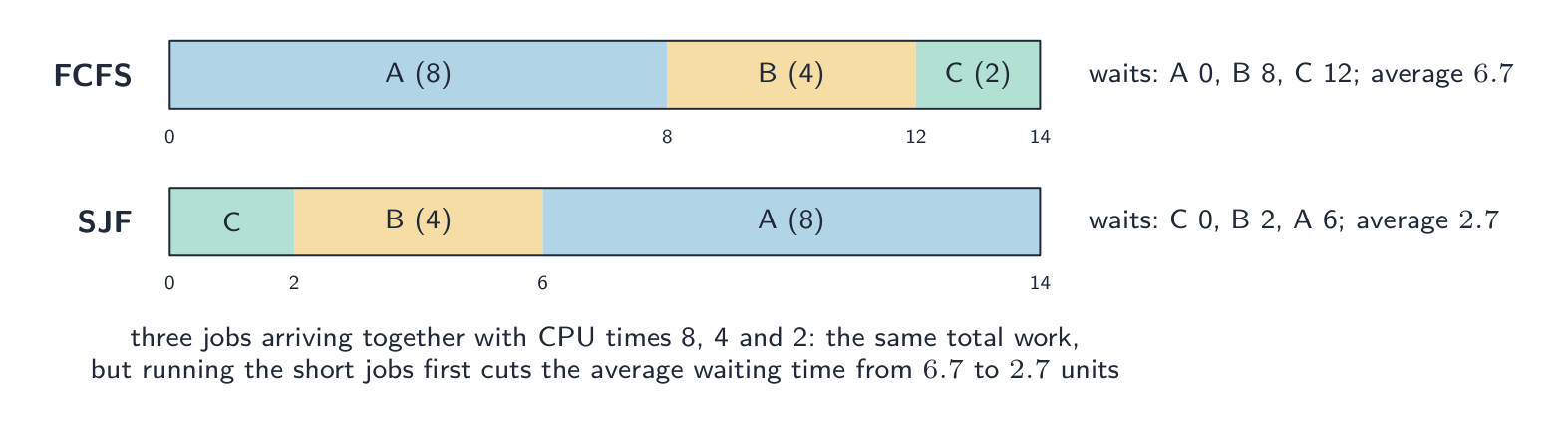
例题。 三个进程同时到达,CPU 时间分别为 8、4 和 2 ms。比较 FCFS(按到达顺序 A、B、C)和最短作业优先下的平均等待时间。
FCFS:A 等 0,B 等 8,C 等 12;平均 $(0 + 8 + 12)/3 = 6.7\ \text{ms}$。SJF 运行 C、B、A:C 等 0,B 等 2,A 等 6;平均 $2.7\ \text{ms}$。两种方式总工作量都是 14 ms;顺序决定谁等待。时间片 2 ms 的轮转让 A、B、C 在前 6 ms 内各得一轮,所以 C 在 6 ms 完成,B 在 12 ms,A 在 14 ms:响应最好,但平均不是最快。


Process states
一个进程是新建(new)、就绪(ready,等待 CPU)、运行(running)、阻塞(blocked,等待 I/O 或一个锁),或终止(terminated)。当它的时间片结束时它从运行 → 就绪;当它请求 I/O 时它从运行 → 阻塞;当 I/O 完成时它从阻塞 → 就绪。

三个状态以及进程为什么转移。 *运行:*进程占有处理器。*就绪:*它可以运行但在等待处理器。*阻塞:*在其他事件发生之前它不能运行。每种转移的原因,考试会逐个问:运行到就绪,当它的时间片用完,或当一个更高优先级的进程变为就绪并抢占它(一次中断);运行到阻塞,当它请求输入或输出,或等待某个资源或另一个进程;阻塞到就绪,当它等待的 I/O 完成(由中断通知);就绪到运行,当调度器派遣它。阻塞的进程决不能直接进入运行:它必须先变为就绪。
Process control block and context switch
对每个进程,OS 保存一个进程控制块(process control block,PCB)——保存的程序计数器、寄存器、状态和内存信息。

- 一次上下文切换(context switch)挂起一个进程并启动另一个:它把状态保存进一个 PCB 并从另一个恢复它。这个小代价在每次切换时付出。
- 内核(kernel,OS 的核心)充当一个中断处理程序(interrupt handler)。当一个设备或定时器发起一个中断时,中断处理(interrupt handling)保存运行中的进程并运行正确的例程——这就是驱动底层调度的东西。
"概述内核如何充当中断处理程序"(两分)。 中断发生时,内核保存正在运行进程的状态(它的寄存器和程序计数器,存入进程控制块),识别中断的来源和优先级,运行相应的中断服务例程,然后恢复被中断的进程(或一个更高优先级的进程),使执行继续。定时器就是这样结束时间片的,完成的 I/O 操作也是这样解除进程阻塞的。
Inter-process communication
进程是隔离的,所以 OS 提供进程间通信(inter-process communication):管道(pipes,一个程序的输出馈入另一个的输入)、共享内存(shared memory,几个进程可以用的一个区域),以及消息传递。
探索
The life of a process
Tap round the loop a process travels. It only runs when the scheduler picks it; needing I/O sends it to blocked, and finishing its time slice sends it back to ready — round and round until it's done.
词汇表
训练
| 英文 | 中文 | 拼音 |
|---|---|---|
| process/ˈprəʊses/ | 进程 | jìn chéng |
| scheduler/ˈʃedjʊlə/ | 调度器 | diào dù qì |
| round robin/raʊnd ˈrɒbɪn/ | 轮转 | lún zhuàn |
| time slice/taɪm slaɪs/ | 时间片 | shí jiān piàn |
| pre-emptive/priː ˈemptɪv/ | 抢占式 | qiǎng zhàn shì |
| blocked/blɒkt/ | 阻塞 | zǔ sè |
| process control block/ˈprəʊses kənˈtrəʊl blɒk/ | 进程控制块 | jìn chéng kòng zhì kuài |
| context switch/ˈkɒntekst swɪtʃ/ | 上下文切换 | shàng xià wén qiè huàn |
| kernel/ˈkɜːnl/ | 内核 | nèi hé |
| interrupt handler/ˈɪntərʌpt ˈhændlə/ | 中断处理程序 | zhōng duàn chǔ lǐ chéng xù |
| interrupt handling/ˈɪntərʌpt ˈhændlɪŋ/ | 中断处理 | zhōng duàn chǔ lǐ |
| inter-process communication/ˈɪntə ˈprəʊses kəˌmjuːnɪˈkeɪʃn/ | 进程间通信 | jìn chéng jiān tōng xìn |
| pipes/paɪps/ | 管道 | guǎn dào |
| shared memory/ʃeəd ˈmeməri/ | 共享内存 | gòng xiǎng nèi cún |
16.1
虚拟内存、分页与分段

每个进程得到它自己的虚拟地址空间(virtual address space)——OS 映射到物理内存的一个干净、连续的地址范围。这给每个进程一个简单的空间,保护进程彼此隔离,并让总内存超过物理 RAM。
在分页中,虚拟空间被拆成固定大小的页(pages),物理内存被拆成同样大小的页框(frames)。一个页表把每个页映射到一个页框。若一个被访问的页不在 RAM 中——一个缺页(page fault)——OS 从交换文件(swap file)把它读进一个页框,若 RAM 满了就逐出另一个页。频繁的缺页导致抖动(thrashing,磁盘抖动),那里 OS 把它的大部分时间花在交换页而不是做有用的工作。
在分段(segmentation)中,内存被拆成可变大小的逻辑段(代码、栈、堆),每个有它自己的权限。许多系统在段内使用分页。

"解释虚拟内存是什么意思"(三分)。 用辅助存储器(磁盘)扩展 RAM,使可用内存显得比物理内存大;进程的地址空间被分成页,只有当前需要的页保存在 RAM 中,其余在磁盘上等待;页按需要在 RAM 和磁盘之间交换,OS 把每个虚拟地址翻译成物理地址。OS 为什么需要它:正在运行的程序可能需要比安装的 RAM 更多的内存;它让更多(或更大)的程序同时运行;程序可以比物理内存大;内存得到高效利用,因为只有程序的活动部分占据 RAM。
分页对分段:考试要的区别。 分页把内存分成由硬件决定的固定大小的块(页和页框),不考虑程序的结构,映射对程序员不可见;分段把程序分成大小可变的逻辑单元(一个过程、一个数组、栈),其大小和边界跟随程序,所以一个段可以作为整体被保护或共享。"描述分段的过程":程序被拆成大小不同的段,每段给一个段号;段表记录每段在内存中从哪里开始、有多长;逻辑地址是段号加偏移量,OS 把偏移量加到该段的基地址上得到物理位置。
"解释磁盘抖动是什么意思"以及它何时发生。 磁盘抖动(disk thrashing)是页在 RAM 中换入换出如此频繁,以至于处理器花在搬页上的时间多于执行指令、系统几乎停顿的状态。它发生在 RAM 对正在运行的进程所需的页(它们的工作集)来说太小时:刚换出的页几乎立刻又被需要,于是被取回,又挤出另一个很快就要用的页,如此往复。进程太多,或程序以不可预测的方式访问内存,都会引起它;更多 RAM 或更少进程能治愈它。
探索
What happens on a page fault
Step through a page fault. When the program touches a page that isn't in RAM, the OS quietly fetches it from disk and updates the page table — so the program sees more memory than physically exists.
词汇表
训练
| 英文 | 中文 | 拼音 |
|---|---|---|
| virtual address space/ˈvɜːtʃuːəl əˈdres speɪs/ | 虚拟地址空间 | xū nǐ dì zhǐ kōng jiān |
| pages/ˈpeɪdʒɪz/ | 页 | yè |
| frames/freɪmz/ | 页框 | yè kuāng |
| page fault/peɪdʒ fɒlt/ | 缺页 | quē yè |
| swap file/swɒp faɪl/ | 交换文件 | jiāo huàn wén jiàn |
| thrashing/ˈθræʃɪŋ/ | 抖动 | dǒu dòng |
| segmentation/ˌseɡmənˈteɪʃn/ | 分段 | fēn duàn |
| disk thrashing/dɪsk ˈθræʃɪŋ/ | 磁盘抖动 | cí pán dǒu dòng |
16.2
翻译软件
大纲
| Candidates should be able to: | Notes and guidance |
|---|---|
| Show understanding of how an interpreter can execute programs without producing a translated version | |
| Show understanding of the various stages in the compilation of a program | Including lexical analysis, syntax analysis, code generation and optimisation |
| Show understanding of how the grammar of a language can be expressed using syntax diagrams or Backus-Naur Form (BNF) notation | |
| Show understanding of how Reverse Polish Notation (RPN) can be used to carry out the evaluation of expressions |
来源:剑桥国际大纲
一个解释器(interpreter)同时翻译并运行源代码。对每条语句它读这行、做词法和语法分析、检查类型,然后执行该动作,并继续。错误被立即报告,它通常停止;不产生可执行文件。翻译每次运行都重做(更慢),但它给出快速的开发反馈并且是可移植的。
"解释解释器如何在不产生翻译版本的情况下执行程序"(三分)。 解释器一次取一条语句(一行),翻译(分析)它,并立即执行,然后再处理下一条;不创建或存储整个程序的翻译版本,所以每条语句每次执行都要翻译,包括循环的每一趟;若某条语句有错误,执行在那里停止并报告错误。这就是解释器适合开发和测试(错误在到达时被发现,修改可以立即试验)但运行成品程序较慢的原因。
词汇表
训练
| 英文 | 中文 | 拼音 |
|---|---|---|
| interpreter/ɪnˈtɜːprɪtə/ | 解释器 | jiě shì qì |
16.2
编译的各阶段

一个编译器(compiler)分阶段把源代码变成机器码(machine code):
- 词法分析(lexical analysis)——词法分析器把字符分组成词法单元(tokens,关键字、标识符、运算符、字面量),丢弃空白和注释。
- 语法分析(解析)(syntax analysis / parsing)——检查词法单元符合文法并构建一棵抽象语法树(abstract syntax tree)。一个遗漏的括号给出一个语法错误(syntax error)。
- 语义分析(semantic analysis)——检查程序说得通(变量已声明、类型匹配)。
- 代码生成(code generation)——遍历树并发出目标代码,选择寄存器和布局。
- 代码优化(code optimisation)——去除冗余的工作、折叠常量、为流水线重排。
输出是一个可执行文件。
各阶段的目的,用得分的措辞。 *词法分析:*去掉空白和注释;把源代码的字符转换成词法单元(关键字、标识符、运算符、常量),检查每一个在该语言中是否有效;把标识符登记到符号表(symbol table)中。*语法分析:*检查词法单元序列是否符合语言的文法(语法规则);构建解析树(抽象语法树);报告语法错误;类型检查和变量声明的检查有时归入语义分析。*代码生成:*把检查过的树转换成目标代码或机器码(可能经由中间代码),分配内存和寄存器。*优化:*使代码运行更快或占用更少内存,通过去除冗余指令、合并或简化计算、重组循环,而不改变程序的功能。配对题把每个阶段与这些描述之一配对。
探索
The phases of compilation
Step through what a compiler does to your source. Each phase hands its output to the next — characters become tokens, tokens become a tree, the tree becomes optimised machine code.
词汇表
训练
| 英文 | 中文 | 拼音 |
|---|---|---|
| compiler/kəmˈpaɪlə/ | 编译器 | biān yì qì |
| machine code/məˈʃiːn kəʊd/ | 机器码 | jī qì mǎ |
| lexical analysis/ˈleksɪkl əˈnæləsɪs/ | 词法分析 | cí fǎ fēn xī |
| tokens/ˈtəʊkənz/ | 词法单元 | cí fǎ dān yuán |
| syntax analysis (parsing)/ˈsɪntæks əˈnæləsɪs/ | 语法分析 | yǔ fǎ fēn xī |
| abstract syntax tree/ˈæbstrækt ˈsɪntæks triː/ | 抽象语法树 | chōu xiàng yǔ fǎ shù |
| syntax error/ˈsɪntæks ˈerə/ | 语法错误 | yǔ fǎ cuò wù |
| semantic analysis/səˈmæntɪk əˈnæləsɪs/ | 语义分析 | yǔ yì fēn xī |
| code generation/kəʊd ˌdʒenəˈreɪʃn/ | 代码生成 | dài mǎ shēng chéng |
| code optimisation/kəʊd ˌɒptɪmaɪˈzeɪʃn/ | 代码优化 | dài mǎ yōu huà |
| symbol table/ˈsɪmbl ˈteɪbl/ | 符号表 | fú hào biǎo |
16.2
文法:BNF 与语法图

一个文法(grammar)说明哪些词法单元序列是有效的程序。
巴科斯-诺尔范式(Backus-Naur Form,BNF)是文本的。一个产生式(production rule)有这样的形式:
<symbol> ::= alternative1 | alternative2 | ...
每个候选是一个终结符(terminal)符号(字面文本)和非终结符(non-terminal)符号(其他规则名)的序列:
<digit>      ::= 0 | 1 | 2 | 3 | 4 | 5 | 6 | 7 | 8 | 9
<identifier> ::= <letter> | <identifier> <letter> | <identifier> <digit>
递归的第三条规则表达"一个字母后跟任意数目的字母或数字"。一个 IF 语句:
<if-statement> ::= IF <condition> THEN <statement> ENDIF
                 | IF <condition> THEN <statement> ELSE <statement> ENDIF
一个语法图(syntax diagram,铁路图)以图形显示同样的东西:非终结符用方框、终结符用圆角框、有效路径用箭头、重复用循环。两种记法是等价的。解析器用文法来判定一个程序是否有效。
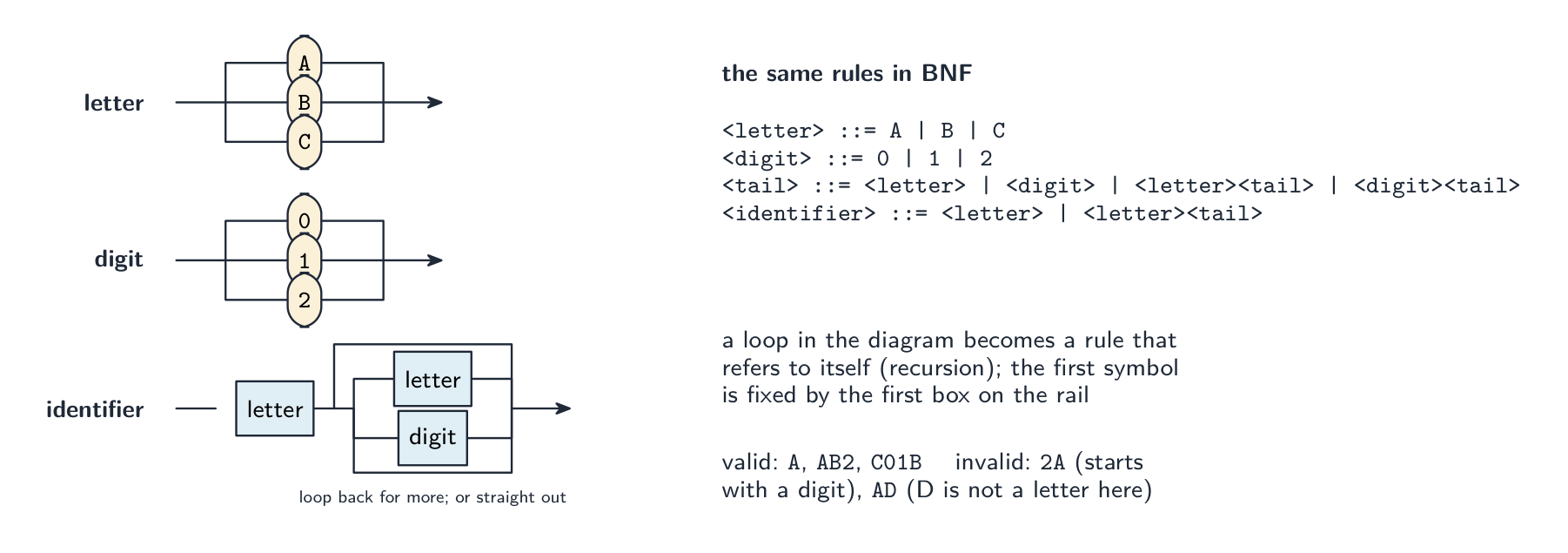
读考试的图。 每张图定义一个非终结符;沿箭头从入口走到出口,能走通的每条路径都是一个有效字符串。并排的选择框是一组候选;回头的循环是"想重复多少次都行";另一个非终结符的框表示"插入那条规则允许的任何东西"。"说明该字符串为什么无效"要的是它违反的规则,用文字表述:9K 作为变量无效,因为第一个字符必须是字母而不是数字;若规则只允许数字前有一个字母,或 J 不在列出的字母集合中,JJ90 就是无效的口令。总是对照图实际允许的字符集合检查字符串,而不是对照真实语言会接受什么。
由图写 BNF。 每张图变成一条规则 <名称> ::= ...;候选用 | 分隔;序列一个符号接一个符号地写;而重复用递归来写,因为 BNF 没有循环符号:"一个或多个字母"是 <word> ::= <letter> | <letter><word>,"一个字母后接零个或多个数字"是 <variable> ::= <letter> | <letter><digits>,其中 <digits> ::= <digit> | <digit><digits>。
例题。 补全车辆登记号的 BNF:必须以两个字母(取自 A B C)开头,后接一位、两位或三位数字(取自 0 1 2)。
<letter>       ::= A | B | C
<digit>        ::= 0 | 1 | 2
<digits>       ::= <digit> | <digit><digit> | <digit><digit><digit>
<registration> ::= <letter><letter><digits>
AB12 有效;A12 无效(只有一个字母);AB1234 无效(四位数字);AD1 无效(D 不是列出的字母)。被要求加约束如"第三个字符也可以是符号"时,只给那个位置的规则加额外候选,并用单独的规则定义 <symbol>。
例题。 写出表达式的 BNF:表达式是一个变量,后接一个运算符,再接一个变量或一个数,其中变量是取自 a b c 的单个小写字母,运算符是 + 或 -。
<variable>   ::= a | b | c
<operator>   ::= + | -
<number>     ::= <digit> | <digit><number>
<expression> ::= <variable><operator><variable> | <variable><operator><number>
递归的 <number> 规则允许任意多位数字;<expression> 的两个候选覆盖定义中提到的两种情况。每个非终结符都放在尖括号里,每个终结符都不加。
词汇表
训练
| 英文 | 中文 | 拼音 |
|---|---|---|
| grammar/ˈɡræmə/ | 文法 | wén fǎ |
| Backus-Naur Form/ˈbækəs nɔː fɔːm/ | 巴科斯-诺尔范式 | bā kē sī - nuò ěr fàn shì |
| production rule/prəˈdʌkʃn ruːl/ | 产生式 | chǎn shēng shì |
| terminal/ˈtɜːmɪnl/ | 终结符 | zhōng jié fú |
| non-terminal/nɒn ˈtɜːmɪnl/ | 非终结符 | fēi zhōng jié fú |
| syntax diagram/ˈsɪntæks ˈdaɪəɡræm/ | 语法图 | yǔ fǎ tú |
16.2
逆波兰表示法(RPN)
在中缀(infix)记法中,运算符坐在它的操作数之间(3 + 4 * 2),需要括号和优先级规则。在逆波兰表示法(Reverse Polish Notation,RPN,后缀(postfix))中,运算符跟在它的操作数之后(3 4 2 * +),不需要括号。
Converting infix to RPN
用一个运算符栈(stack)。从左到右扫描:输出一个操作数;对一个运算符,先把任何更高或相等****优先级(precedence)的已入栈运算符弹到输出,然后把它压栈;把 ( 压栈;遇到 ) 弹出到输出直到匹配的 (。在最后,弹出所有运算符。例子:(3 + 4) * 2 → 3 4 + 2 *。
Evaluating RPN
用一个操作数栈。从左到右扫描:把每个操作数压栈;遇到一个运算符,弹出顶上两个、应用它,并把结果压栈。求值 3 4 2 * +:
| 词法单元 | 栈 |
|---|---|
3 |
3 |
4 |
3, 4 |
2 |
3, 4, 2 |
* |
3, 8 |
+ |
11 |
结果:11。RPN 在求值时不需要括号并适合一个栈机器——这就是 JVM 和许多字节码(bytecode)解释器工作的方式。
"解释为什么用 RPN 求表达式的值"(两分)。 在 RPN 中运算符按它们被应用的顺序出现,所以表达式可以从左到右一趟求值,不需要括号,也不需要优先级规则;因此编译器或解释器处理起来更简单、更快。"指出一种合适的数据结构并说明理由":**栈,因为求值需要先用最近**压入的操作数(后进先出):每个操作数被压入,每个运算符弹出顶部两个,应用自身,再压入结果。被要求时要写出每个词法单元之后的栈内容。
手工把中缀转成 RPN。 (1) 按优先级规则给表达式完全加括号;(2) 把每个运算符移到它自己那对括号的右括号之后;(3) 去掉括号。于是 $(a - b) * (a + c) / 7$ 变成 $((a - b) * (a + c)) / 7$,再变成 a b - a c + * 7 /。注意 * 和 / 从左到右应用,所以除法是最后一个运算符,而不是乘法。更多转换:$((7 + 3) - (2 * 8)) / 6$ 是 7 3 + 2 8 * - 6 /;$(7 - 2 + 8) / (9 - 5)$ 是 7 2 - 8 + 9 5 - /;$a * b + b - d + 15$ 是 a b * b + d - 15 +;$(2 - 6) * (13 + 7) / 5$ 是 2 6 - 13 7 + * 5 /。
把 RPN 转回中缀。 用一个表达式栈处理 RPN:压入每个操作数;对每个运算符弹出两个,加括号写在它两侧,再压入结果。于是 a b / 4 * a b + - 是 $((a / b) * 4) - (a + b)$;5 2 + 9 3 - / 3 * 是 $((5 + 2) / (9 - 3)) * 3$;b a c - + d b + * c / 是 $((b + (a - c)) * (d + b)) / c$;a b - c + c a - * d / 是 $(((a - b) + c) * (c - a)) / d$。保留括号:去掉它们可能改变含义。
例题。 当 $a = 17$、$b = 5$、$c = 7$、$d = 3$、$e = 10$ 时求 a b - c d + * e / 的值,写出栈。
| 词法单元 | 动作 | 栈(栈顶在右) |
|---|---|---|
a |
压入 17 | 17 |
b |
压入 5 | 17, 5 |
- |
弹出 5 和 17,压入 $17 - 5$ | 12 |
c |
压入 7 | 12, 7 |
d |
压入 3 | 12, 7, 3 |
+ |
弹出 3 和 7,压入 $7 + 3$ | 12, 10 |
* |
弹出 10 和 12,压入 $12 \times 10$ | 120 |
e |
压入 10 | 120, 10 |
/ |
弹出 10 和 120,压入 $120 / 10$ | 12 |
结果 12。对 - 和 / 弹出的顺序很重要:第二个弹出的值是左操作数,所以 a b - 是 $a - b$,不是 $b - a$。再来两个,方法相同:d a b + * c a - / 在 $a = 6, b = 12, c = 15, d = 5$ 时给出 $5 \times (6 + 12) / (15 - 6) = 90 / 9 = 10$;c a - b d + * b c + / 在 $a = 4, b = 12, c = 24, d = 6$ 时给出 $(24 - 4) \times (12 + 6) / (12 + 24) = 360 / 36 = 10$。
例题。 把 $(A + B) \times (C - D)$ 转换成逆波兰式,然后计算 $(3 + 4) \times (5 - 2)$。用一个运算符栈从左向右扫描。压入 (;输出 A;压入 +;输出 B;遇到 ) 时弹出直到匹配的 (,此时已输出 A B +。压入 ×,第二个括号同样处理,得到 C D -。最后弹出 ×。结果是:A B + C D - ×。要计算数值,则用一个操作数栈:压入 3,压入 4;+ 弹出两者并压入 7;压入 5,压入 2;- 弹出两者并压入 3;× 弹出 7 和 3 并压入 21。有两点能让这类题做得稳:转换过程中操作数保持原来的顺序(只有运算符在移动),而且每个运算符作用于栈中紧挨着它下面的两个值。
探索
Operator precedence — what RPN removes
In ordinary infix maths × and ÷ bind tighter than + and −, so you must apply rules in the right order. Reverse Polish Notation writes the operands first (3 4 2 × + 1 −), fixing the order so no precedence rules are needed.
词汇表
训练
| 英文 | 中文 | 拼音 |
|---|---|---|
| infix/ˈɪnfɪks/ | 中缀 | zhōng zhuì |
| Reverse Polish Notation/rɪˈvɜːs ˈpəʊlɪʃ nəʊˈteɪʃn/ | 逆波兰表示法 | nì bō lán biǎo shì fǎ |
| postfix/ˈpəʊstfɪks/ | 后缀 | hòu zhuì |
| stack/stæk/ | 栈 | zhàn |
| precedence/ˈpresɪdəns/ | 优先级 | yōu xiān jí |
| bytecode/ˈbaɪtkəʊd/ | 字节码 | zì jié mǎ |
16.2
考官认可的定义
定义题按固定措辞评分。准确学会这些,只给一个答案。
| 术语 | 定义 |
|---|---|
| 多任务 | 几个进程同时保存在内存中,处理器在它们之间切换,使它们看起来在同时运行 |
| 进程 | 已装入内存并正在执行(或准备执行)的程序 |
| 运行 / 就绪 / 阻塞 | 占有处理器 / 等待处理器 / 在 I/O 完成等事件发生之前不能继续 |
| 调度 | 决定哪个就绪进程接下来得到处理器,以及得到多久 |
| 抢占式调度 | 正在运行的进程可以被中断并移到就绪,让另一个进程运行 |
| 虚拟内存 | 用辅助存储器扩展 RAM,只把当前需要的页保存在物理内存中 |
| 分页 | 把内存和程序分成固定大小的页,按需要在磁盘和 RAM 之间移动 |
| 分段 | 把程序分成大小可变的逻辑段,每段由段表映射到内存 |
| 磁盘抖动 | 页在 RAM 和磁盘之间交换得如此频繁,以至于几乎没有有用的处理 |
| 解释器 | 一次一条语句地翻译并执行程序,不产生翻译版本 |
| 编译器 | 在运行之前把整个高级语言程序翻译成机器(目标)代码 |
| 词法分析 | 把源代码转换成词法单元,去掉空白和注释,并建立符号表 |
| 语法分析 | 检查词法单元是否符合语言的文法并构建解析树 |
| 巴科斯-诺尔范式 | 语言文法的一种记法:由终结符和非终结符构成的 <名称> ::= 候选 形式的规则 |
| 逆波兰表示法 | 把每个运算符写在其操作数之后的表达式写法,使表达式能用栈、不用括号求值 |
16.2
考试技巧
- OS 题按点名的机制评分:调度、内存管理、I/O 缓冲和假脱机、文件管理;对界面,文件名而非地址、点击而非命令、驱动程序、GUI。
- 进程状态及其转移和每种转移的原因;调度例程按功能加优点加缺点;内核保存状态、识别中断、处理、恢复。
- 虚拟内存:磁盘扩展 RAM、页交换、地址翻译;分页是固定大小且不可见,分段是可变大小且逻辑的;抖动是交换而不是工作。
- 解释器:一次一条语句,先翻译再执行,不存储任何东西。编译阶段:词法单元和符号表、文法和解析树、代码、优化。
- BNF:每张图一条规则,
|表示选择,递归表示重复,终结符不加括号而非终结符加尖括号。要说出字符串违反了哪条规则。 - RPN:运算符在操作数之后,用栈求值,写出每一步;转换时完全加括号;转回时保留括号。
常见错误
- 把多任务描述成"同时运行几个程序"而不说处理器在它们之间切换。
- 让阻塞的进程直接进入运行,或把"时间片用完"当作运行到阻塞的原因。
- 混淆最短作业优先(非抢占)与最短剩余时间(抢占),或混淆轮转与优先级。
- 把虚拟内存定义为"把硬盘当 RAM 用"而不提页的交换。
- 说解释器"把程序转换成机器码然后运行";那是编译器。
- 把语法检查放进词法分析,或在配对题中把优化放在代码生成之前。
- 把 BNF 的重复写成
<letter>*或用省略号;要用递归。非终结符漏掉尖括号。 - 求 RPN 值时把
-或/的操作数弄反,或把 $a * b + c$ 的 RPN 写成a b c + *。
本主题的互动课程
逐步学习,并即时检测练习。