| Candidates should be able to: | Notes and guidance |
|---|---|
| Show understanding of Reduced Instruction Set Computers (RISC) and Complex Instruction Set Computers (CISC) processors | Differences between RISC and CISC Understand interrupt handling on CISC and RISC processors |
| Show understanding of the importance/use of pipelining and registers in RISC processors | |
| Show understanding of the four basic computer architectures | SISD, SIMD, MISD, MIMD |
| Show understanding of the characteristics of massively parallel computers | |
| Show understanding of the concept of a virtual machine | Give examples of the role of virtual machines Understand the benefits and limitations of virtual machines |
Hardware and Virtual Machines
A-Level Computer Science · Topic 15
 15:02
15:02
RISC, Pipelines & Logic
Two chip designers face the same problem: make programs run fast. One says — build powerful instructions, so each one does a lot of work. The other says — keep…
English narration · English + 中文 subtitles burned in
15.1
RISC vs CISC processors

Syllabus
Source: Cambridge International syllabus
Two styles of CPU design. The CPU itself plugs into the motherboard 主板, the main board that links the processor, the memory and every other part of the computer together.

CISC
A CISC 复杂指令集 (Complex Instruction Set Computers) has many, often complex instructions (one may do several memory accesses and operations), of variable length, so decoding is intricate. It does more per instruction in hardware. Examples: Intel x86.
RISC
A RISC 精简指令集 (Reduced Instruction Set Computers) has a small set of simple instructions, each doing one basic operation, all of fixed length (fast to decode). Only load and store touch memory; everything else is register 寄存器 to register. Programs are longer but each instruction is quick and predictable, which suits pipelining. Examples: ARM, RISC-V.
| Feature | CISC | RISC |
|---|---|---|
| Instruction set | many | few |
| Instruction length | variable | fixed |
| Memory access | many instructions | only load/store |
| Pipeline-friendly | harder | naturally |
| Per-instruction cycles | varies | usually 1 |
The trade-off is doing more per instruction (CISC) vs doing each instruction faster and more predictably (RISC). Modern Intel chips translate CISC instructions into simpler RISC-like micro-ops internally.
"Identify four features of a RISC processor." Any four of: a small set of simple instructions; instructions of fixed length (one word); most instructions complete in one clock cycle; many general-purpose registers; only load and store instructions access memory (all arithmetic is register to register); hard-wired control (no microcode); designed for pipelining; the compiler does more of the work, so programs contain more instructions and need more memory. "Identify four features of a CISC processor." Any four of: a large set of instructions, many of them complex (one instruction may do several operations); instructions of variable length; instructions that take several clock cycles; fewer registers; instructions that can access memory directly; microprogrammed control; less suited to pipelining; shorter programs, so a simpler compiler and less memory. "Describe what is meant by RISC and CISC" (two marks each): name the expansion and give the defining idea (few simple single-cycle instructions; many complex multi-cycle instructions).
Interrupt handling on the two designs. On a CISC processor the current instruction, however complex, is completed before the interrupt is serviced; the processor then saves the contents of its registers (including the program counter) on the stack, jumps to the interrupt service routine, and restores the registers afterwards. On a RISC processor with a pipeline, several instructions are part-way through at the moment the interrupt 中断 arrives, so the processor must either let every instruction in the pipeline finish, or discard (flush) the partly executed instructions and restart them after the interrupt; either way the pipeline is emptied, the registers are saved, and the service routine runs. The exam phrasing: "pipelining makes interrupt handling more complex, because the contents of the pipeline must be dealt with before the interrupt can be serviced".
Vocabulary
Train
| English |
|---|
| motherboard/ˈmʌðəbɔːd/ |
| CISC/sɪsk/ |
| RISC/rɪsk/ |
| register/ˈredʒɪstə/ |
| interrupt/ˈɪntərʌpt/ |
15.1
Pipelining
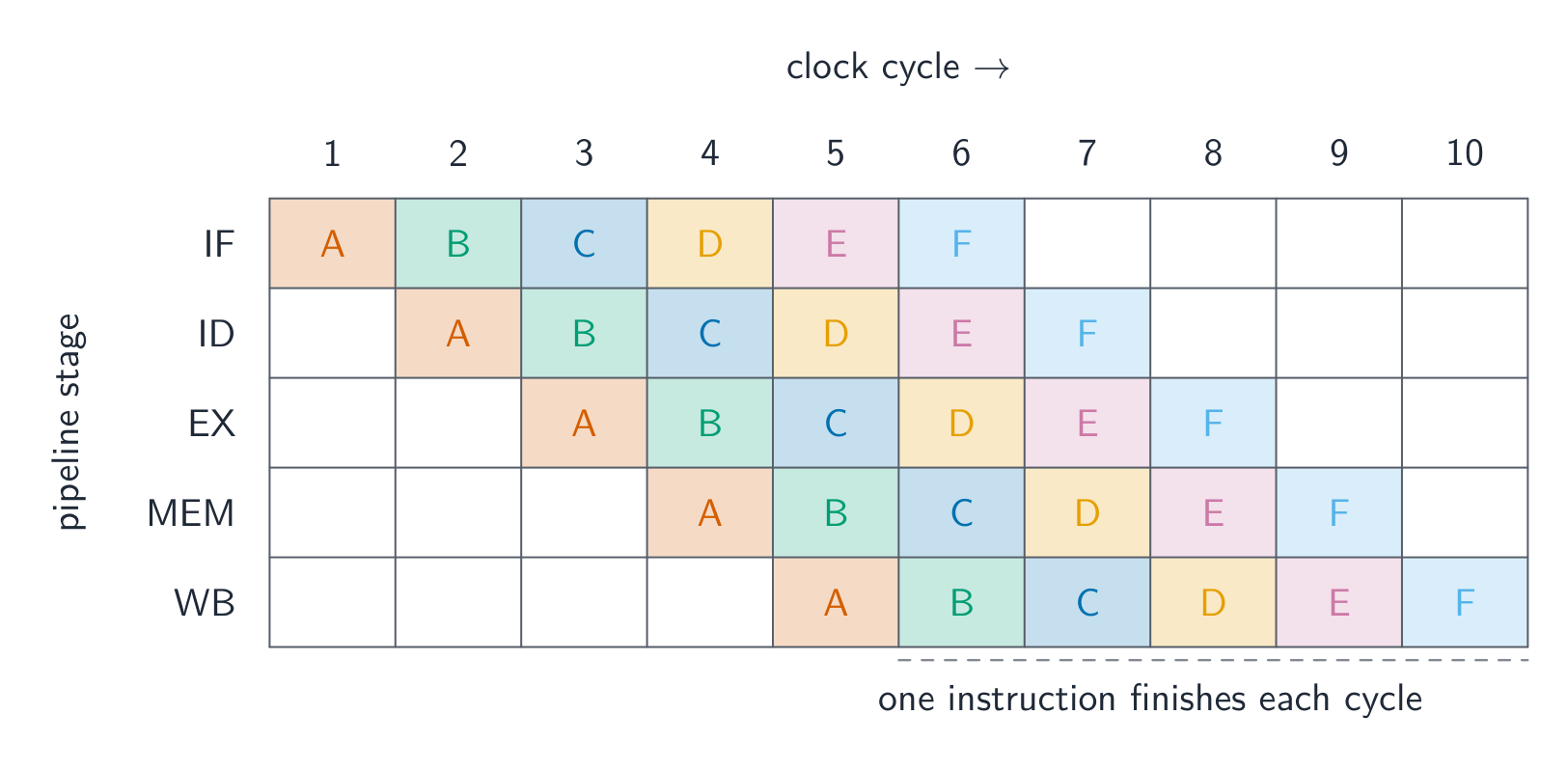
A pipeline 流水线 processes instructions in overlapping stages, like an assembly line: Fetch → Decode → Execute (in the ALU 算术逻辑单元) → Memory access → Write back. Each stage works on a different instruction at once, so once the pipeline is full, one instruction completes per cycle. RISC's fixed-length, simple instructions make every stage take the same time. A pipeline can stall on a hazard 冒险 — a data hazard (an instruction needs a result not ready yet) or a control hazard (a branch makes the next address unknown).
RISC chips keep data in many registers because memory is slow and registers are fast; the compiler allocates values to registers wisely.
"Describe the use of pipelining in RISC processors" (three marks). (1) The fetch–execute cycle is divided into stages (fetch, decode, execute, memory access, write back); (2) several instructions are in the pipeline at once, each at a different stage, so while one is being executed the next is being decoded and the one after fetched; (3) a new instruction is started, and one completed, in every clock cycle once the pipeline is full, which increases throughput 吞吐量 (the number of instructions completed per second), although each instruction still takes the same time on its own. Fixed-length single-cycle RISC instructions are what make the stages equal and the pipeline possible.
Worked example. A processor uses five pipeline stages (IF, ID, OF, EX, WB). Four instructions enter the pipeline one after another. In which cycle does the last instruction complete, and how many cycles would the four take without pipelining?
Instruction 1 occupies IF in cycle 1, ID in 2, OF in 3, EX in 4 and WB in 5; instruction 2 starts one cycle later and finishes in cycle 6; instruction 3 in cycle 7; instruction 4 in cycle 8. In general $n$ instructions through $k$ stages take $n + k - 1$ cycles, here $4 + 5 - 1 = 8$. Without pipelining each instruction takes all five cycles before the next starts: $4 \times 5 = 20$ cycles. The exam's table is filled by writing each instruction's stages diagonally, one column to the right of the previous instruction.
A processor running this fast gives off a lot of heat, so a heat-sink 散热器 and fan sit on top of it. The metal fins spread the heat and the fan blows it away, keeping the CPU cool enough to work.

Explore
How pipelining fills up
Step through the clock cycles. Once the pipeline is full, a new instruction finishes every cycle — even though each one still takes several stages — because the stages of different instructions overlap.
Vocabulary
Train
| English |
|---|
| pipeline/ˈpaɪplaɪn/ |
| ALU/ˌeɪ el ˈjuː/ |
| hazard/ˈhæzəd/ |
| throughput/ˈθruːpʊt/ |
| heat-sink/hiːt sɪŋk/ |
15.1
Flynn's taxonomy
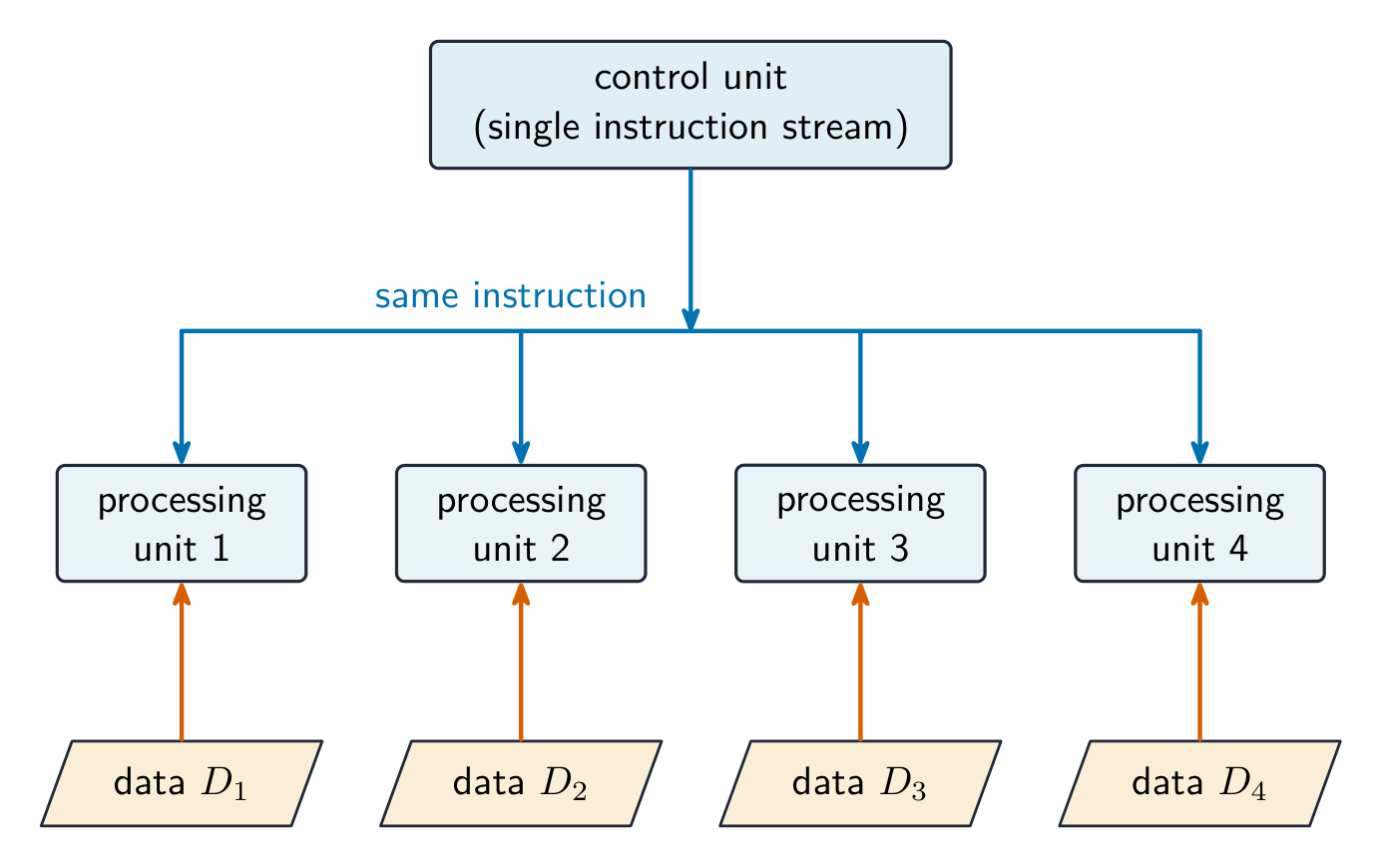
Flynn's taxonomy 弗林分类 sorts computers by the number of instruction and data streams:
- SISD — one instruction, one data stream (a traditional single core).
- SIMD 单指令多数据 — one instruction works on many data items at once (GPUs, CPU vector extensions). Great for images, video, scientific arrays.
- MISD — several operations on the same data; rare, mostly theoretical.
- MIMD 多指令多数据 — many processors run different instructions on different data (multi-core CPUs, clusters). The most general.
Describing the four architectures (two marks each). SISD: a single processor executes one instruction at a time on one item of data; no parallelism, the traditional von Neumann machine. SIMD: one instruction is applied simultaneously to many data items, by many processing elements acting in step; used for array and graphics processing. MISD: several processors apply different instructions to the same data; rarely used, for example a fault-tolerant system where several processors check one stream. MIMD: many processors, each executing its own instructions on its own data, independently; the multi-core computer and the cluster.
A graphics card 显卡 (with its GPU) is a real example of SIMD hardware: it has thousands of small cores that run the same instruction on many pixels or numbers at once, which is why GPUs are so fast for images, video and machine learning.


Vocabulary
Train
| English |
|---|
| Flynn's taxonomy/flɪnz tækˈsɒnəmi/ |
| SIMD/ˈsɪmdiː/ |
| MIMD/ˈmɪmdiː/ |
| graphics card/ˈɡræfɪks kɑːd/ |
15.1
Massively parallel computers

A massively parallel 大规模并行 system uses thousands of processors on a fast network, each with its own memory (distributed memory 分布式内存), exchanging data by messages. It is MIMD, needs specially-written software (MPI, CUDA), and suits climate simulation, large machine learning 机器学习 training, and astrophysics. The largest supercomputers 超级计算机 are massively parallel.
"Outline the characteristics of massively parallel computers" (three marks). A very large number of processors (thousands), each with its own memory, connected by a network (a high-speed interconnect or bus) so that they can pass messages to one another; they work simultaneously on parts of the same problem, so the problem must be written as a program that can be split into parts that run in parallel and combine their results. It is an MIMD arrangement.
The processors live in tall server 服务器 racks, often filling a whole room (a data centre 数据中心), wired together so they can work on one big problem at the same time.
Vocabulary
Train
| English |
|---|
| massively parallel/ˈmæsɪvli ˈpærəlel/ |
| distributed memory/ˈdɪstrɪbjuːtɪd ˈmeməri/ |
| machine learning/məˈʃiːn ˈlɜːnɪŋ/ |
| supercomputers/ˌsuːpəkəmˈpjuːtəz/ |
| server/ˈsɜːvə/ |
| data centre/ˈdeɪtə ˈsentə/ |
15.1
Virtual machines
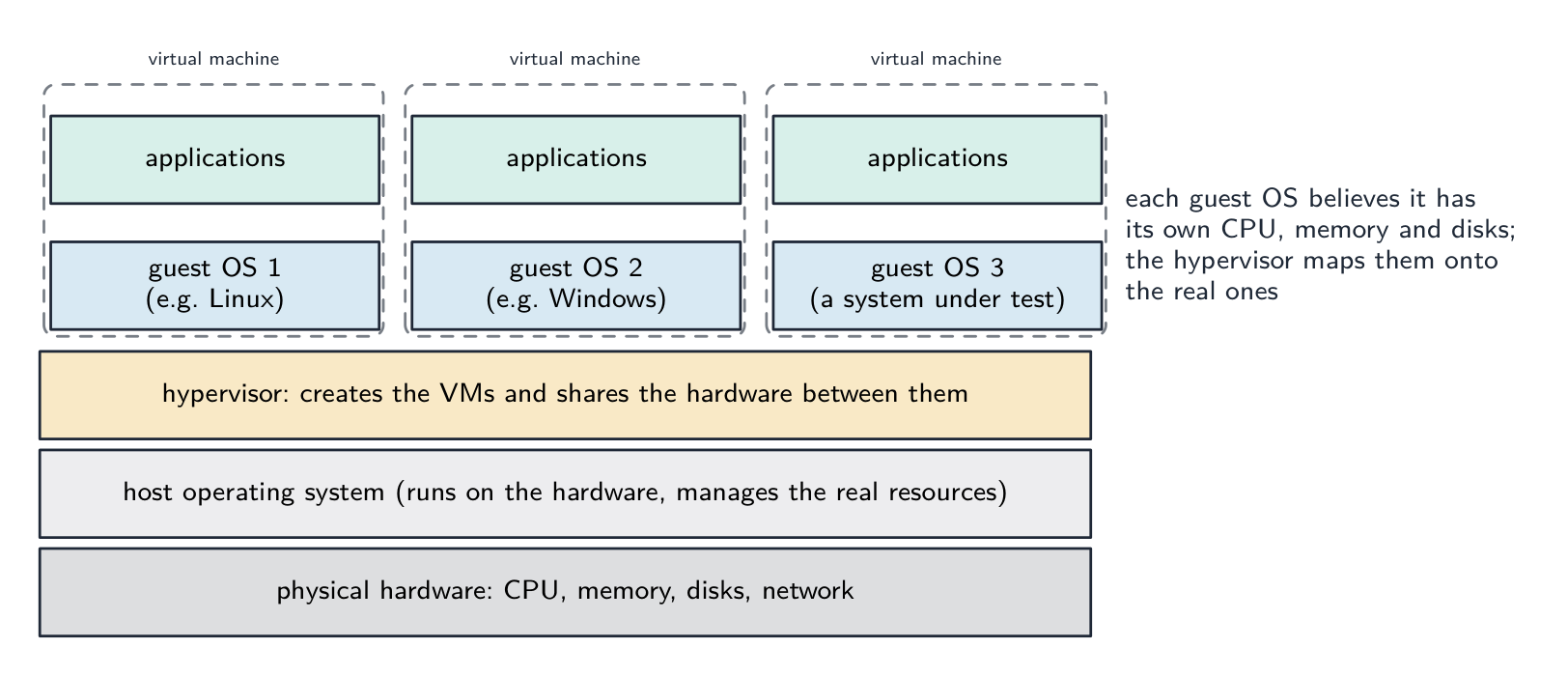
A virtual machine 虚拟机 (VM) is a software emulation of a whole computer — the software inside sees a CPU, memory and disks that look real but are managed by host software.
- a system VM runs a complete OS. A hypervisor 虚拟机监控器 creates and manages VMs, each booting its own guest OS. Uses: run different OSes on one machine; server consolidation; sandboxing 沙箱 (risky software runs isolated); snapshots.
- a process (language) VM runs one program in portable bytecode 字节码 — the JVM (Java), the CLR (.NET), CPython. Benefits: portability ("write once, run anywhere"), runtime safety checks, and just-in-time compilation 即时编译 for near-native speed. The cost is an extra layer and needing the VM installed.
"Describe what is meant by a virtual machine" (two marks). A software emulation (implementation) of a computer system that runs on a host computer and behaves, to the programs running inside it, like a separate physical computer with its own processor, memory and storage. The host operating system 宿主操作系统 runs on the actual hardware, manages the real resources and (through the hypervisor) creates and controls the virtual machines; each guest operating system 客户操作系统 runs inside a virtual machine, manages the applications in it, and is unaware that its hardware is virtual.
Benefits (give two). Several different operating systems can run on one machine at the same time; software can be tested on many systems without buying the hardware; a new computer system can be emulated and tried before it is built; each VM is isolated, so a crash or malware in one does not affect the host or the others; VMs can be copied, moved and backed up as files, and a server can be shared between many users, reducing hardware cost. Limitations (give two). A VM runs more slowly than the real hardware because every instruction passes through the emulation layer; it consumes the host's memory and processing power, so the host must be powerful; some hardware features or devices are not emulated exactly, so the tested software may behave differently on the real machine; licences are needed for each guest OS, and setting the system up needs expertise.
Explore
Computing concept lab
Classify concrete examples by the computing idea they demonstrate.
Vocabulary
Train
| English |
|---|
| virtual machine/ˈvɜːtʃuːəl məˈʃiːn/ |
| hypervisor/ˌhaɪpəˈvaɪzə/ |
| sandboxing/ˈsændbɒksɪŋ/ |
| bytecode/ˈbaɪtkəʊd/ |
| just-in-time compilation/dʒʌst ɪn taɪm ˌkɒmpɪˈleɪʃn/ |
| host operating system/həʊst ˈɒpəreɪtɪŋ ˈsɪstəm/ |
| guest operating system/ɡest ˈɒpəreɪtɪŋ ˈsɪstəm/ |
15.2
Boolean algebra
Syllabus
| Candidates should be able to: | Notes and guidance |
|---|---|
| Produce truth tables for logic circuits including half adders and full adders | May include logic gates with more than two inputs |
| Show understanding of a flip-flop (SR, JK) | Draw a logic circuit and derive a truth table for a flip-flop Understand of the role of flip-flops as data storage elements |
| Show understanding of Boolean algebra | Understand De Morgan’s laws Perform Boolean algebra using De Morgan’s laws Simplify a logic circuit/expression using Boolean algebra |
| Show understanding of Karnaugh maps (K-map) | Understand of the benefits of using Karnaugh maps Solve logic problems using Karnaugh maps |
Source: Cambridge International syllabus
Boolean algebra 布尔代数 simplifies Boolean 布尔 expressions, which can equally be described by truth tables 真值表. Symbols: + for OR, · for AND (often omitted), an overbar for NOT.
Key laws include commutative, associative and distributive (as in ordinary algebra), plus:
- identity $A + 0 = A$, $A \cdot 1 = A$; null $A + 1 = 1$, $A \cdot 0 = 0$.
- idempotent $A + A = A$; inverse $A + \overline{A} = 1$, $A \cdot \overline{A} = 0$.
- De Morgan's laws 德摩根定律: $(A + B)' = A' \cdot B'$; $(A \cdot B)' = A' + B'$ — negate the whole, swap AND/OR, negate each operand.
- absorption 吸收律: $A + AB = A$.
Simplifying reduces the number of terms, so the resulting logic circuit has fewer gates. Example: $Z = AB + A\overline{B} = A(B + \overline{B}) = A$.
The laws with their names (quote the name at each step when "show all working" is asked).
| Law | OR form | AND form |
|---|---|---|
| identity | $A + 0 = A$ | $A \cdot 1 = A$ |
| null (annulment) | $A + 1 = 1$ | $A \cdot 0 = 0$ |
| idempotent | $A + A = A$ | $A \cdot A = A$ |
| complement (inverse) | $A + \overline{A} = 1$ | $A \cdot \overline{A} = 0$ |
| commutative | $A + B = B + A$ | $A \cdot B = B \cdot A$ |
| associative | $A + (B + C) = (A + B) + C$ | $A(BC) = (AB)C$ |
| distributive | $A + BC$ $= (A + B)(A + C)$ |
$A(B + C)$ $= AB + AC$ |
| absorption | $A + AB = A$ | $A(A + B) = A$ |
| De Morgan | $\overline{A + B} = \overline{A} \cdot \overline{B}$ | $\overline{A \cdot B} = \overline{A} + \overline{B}$ |
| double negation | $\overline{\overline{A}} = A$ |
Worked example. Simplify $X = \overline{\overline{(A \cdot B)} \cdot \overline{(A + B)}}$, showing all working.
$X = \overline{\overline{(A \cdot B)}} + \overline{\overline{(A + B)}}$ (De Morgan on the outer bar) $= A \cdot B + A + B$ (double negation) $= A + B$ (absorption, $A + AB = A$, applied with $A + B$ absorbing $AB$).
Worked example. Simplify $(\overline{A + B}) \cdot (\overline{A} + B)$.
$= \overline{A} \cdot \overline{B} \cdot (\overline{A} + B)$ (De Morgan) $= \overline{A}\,\overline{B}\,\overline{A} + \overline{A}\,\overline{B}\,B$ (distributive) $= \overline{A}\,\overline{B} + 0$ (idempotent, complement) $= \overline{A}\,\overline{B}$.
Worked example. Simplify $Y = \overline{A}\,\overline{B}\,\overline{C} + \overline{A}\,\overline{B}\,C + A\,\overline{B}\,C$.
$= \overline{A}\,\overline{B}(\overline{C} + C) + A\,\overline{B}\,C$ (distributive) $= \overline{A}\,\overline{B} + A\,\overline{B}\,C$ (complement, identity) $= \overline{B}(\overline{A} + AC)$ (distributive) $= \overline{B}(\overline{A} + C)$, using $\overline{A} + AC = (\overline{A} + A)(\overline{A} + C) = \overline{A} + C$. Applying De Morgan to a three-input term works the same way: $\overline{A + B + C} = \overline{A} \cdot \overline{B} \cdot \overline{C}$.
Sum-of-products from a truth table. Take every row whose output is 1, write the AND of its inputs (a variable barred where it is 0), and OR the terms: a row with $A = 1, B = 0, C = 1$ gives $A\,\overline{B}\,C$. This is the sum-of-products 积之和 form the exam asks for, and it is the starting point for both algebraic simplification and the Karnaugh map.
Explore
Boolean algebra
A·B, A+B, Ā …
Boolean algebra is just these gates written as expressions — compare the truth tables.
Explore
Boolean truth tables
Pick an operator and the inputs to build its truth table — the algebra behind logic circuits.
Vocabulary
Train
| English |
|---|
| Boolean algebra/ˈbuːlɪən ˈældʒɪbrə/ |
| Boolean/ˈbuːlɪən/ |
| truth tables/truːθ ˈteɪblz/ |
| De Morgan's laws/də ˈmɔːɡənz lɔːz/ |
| absorption/əbˈsɔːpʃn/ |
| sum-of-products/sʌm ɒv ˈprɒdʌkts/ |
15.2
Karnaugh maps
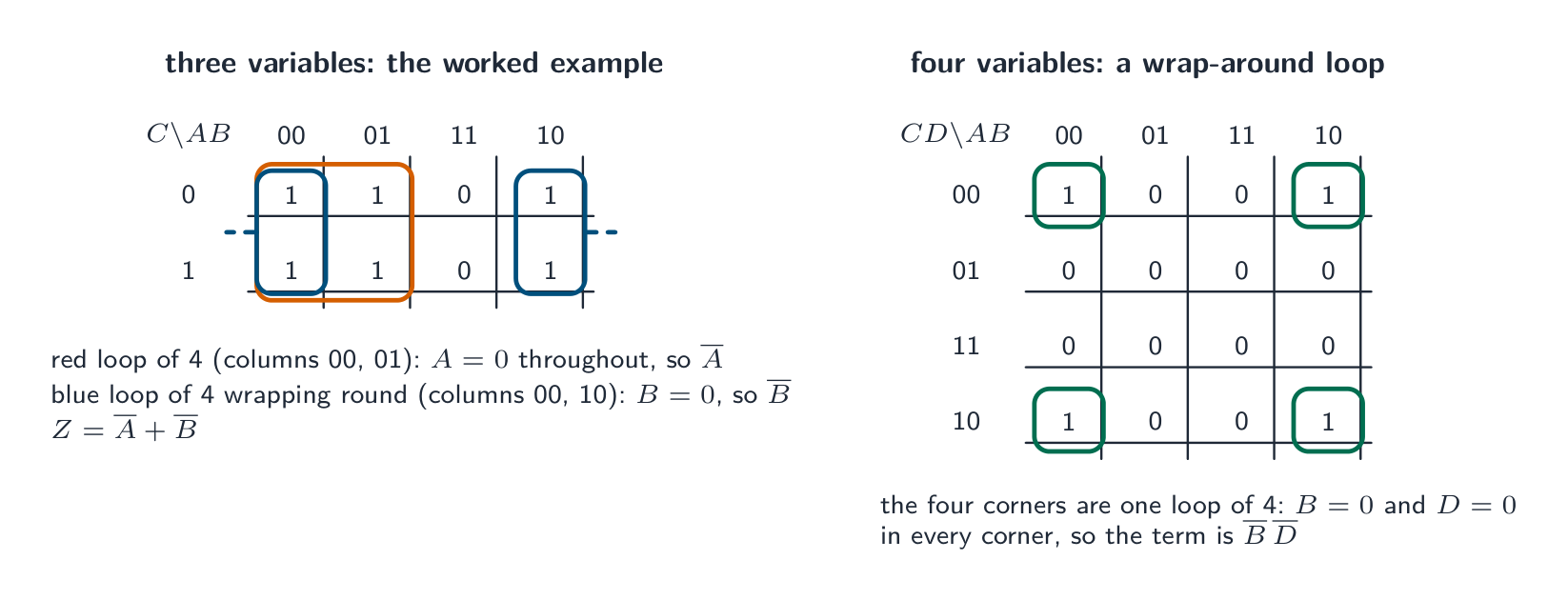
A Karnaugh map 卡诺图 (K-map) simplifies a Boolean expression by grouping adjacent 1s from a truth table. Columns and rows use Gray code 格雷码 order (00, 01, 11, 10) so adjacent cells differ in one variable.
Place a 1 in each cell where the output is 1. Find rectangular groups of 1s whose sides are powers of 2 (1, 2, 4, 8), wrapping around edges if it makes a bigger group. The larger the group, the simpler the term: a group of 2 drops one variable, a group of 4 drops two, and so on — variables that change within the group disappear. OR the group terms together for the simplified expression. Cover every 1 using as few, as large, groups as possible.
Worked example. A Karnaugh map for $A$ and $B$ has 1s in the cells $\overline{A}B$ and $AB$. Simplify. The two 1s are adjacent - they share the $B=1$ column - so group them as a rectangle of 2. Inside that group $B$ stays 1 throughout while $A$ changes from 0 to 1, and any variable that changes within a group disappears. So the group leaves simply $X = B$. Compare that with the sum of products read straight off the table, $\overline{A}B + AB$: the same circuit, two gates fewer. Two rules do most of the work - make each group as large as possible (a group of 2 drops one variable, 4 drops two, 8 drops three), and remember the map wraps around its edges, so the leftmost and rightmost columns are adjacent. That wrap is the grouping most candidates miss.
Building and reading a K-map. Label the columns $AB$ and the rows $C$ (or $CD$) in Gray-code order 00 01 11 10, so that neighbouring cells differ in one variable only. Put a 1 in every cell whose minterm appears in the expression (or whose truth-table row outputs 1). Then draw the fewest, largest loops that cover every 1: each loop must be a rectangle of $1, 2, 4$ or $8$ cells, loops may overlap, may wrap across the left–right and top–bottom edges, and the four corners together make a loop. For each loop write the variables that are constant inside it (barred if 0), and OR the loop terms: that is the optimal sum-of-products. Why use one? It gives the simplest expression without algebra, in a few steps, with less chance of error, and the same map suits three or four variables.
Worked example. $Z = \overline{A}\,\overline{B}\,\overline{C} + \overline{A}\,\overline{B}\,C + \overline{A}\,B\,\overline{C} + \overline{A}\,B\,C + A\,\overline{B}\,\overline{C} + A\,\overline{B}\,C$.
On the three-variable map the 1s fill columns 00, 01 and 10 in both rows. The loop of four over columns 00 and 01 has $A = 0$ throughout and $B$, $C$ both varying: term $\overline{A}$. The loop of four over columns 00 and 10 (wrapping round) has $B = 0$ throughout: term $\overline{B}$. So $Z = \overline{A} + \overline{B}$, which Boolean algebra confirms: $\overline{A}(\overline{B} + B) + \ldots = \overline{A} + \overline{B}$. Two loops of two would also be correct but not optimal; a loop is as large as the 1s allow.
Worked example (four variables). A map has 1s only in its four corners: $\overline{A}\,\overline{B}\,\overline{C}\,\overline{D}$, $A\,\overline{B}\,\overline{C}\,\overline{D}$, $\overline{A}\,\overline{B}\,C\,\overline{D}$ and $A\,\overline{B}\,C\,\overline{D}$. Because the top and bottom rows are adjacent and so are the outer columns, the corners are one loop of four; $B = 0$ and $D = 0$ in all of them while $A$ and $C$ vary, so $Z = \overline{B}\,\overline{D}$.
Vocabulary
Train
| English |
|---|
| Karnaugh map/ˈkɑːnɔː mæp/ |
| Gray code/ɡreɪ kəʊd/ |
15.2
Half adder and full adder

A half adder 半加器 adds two single bits $A$ and $B$, giving a sum $S$ and a carry 进位 $C$:
| A | B | S | C |
|---|---|---|---|
| 0 | 0 | 0 | 0 |
| 0 | 1 | 1 | 0 |
| 1 | 0 | 1 | 0 |
| 1 | 1 | 0 | 1 |
So $S = A \text{ XOR } B$ and $C = A \text{ AND } B$. It ignores any carry-in — hence "half".
A full adder 全加器 adds three bits ($A$, $B$, carry-in), giving a sum and a carry-out: $S = A \text{ XOR } B \text{ XOR } C_{\text{in}}$. It can be built from two half adders plus an OR gate. Chaining full adders (each carry-out feeding the next carry-in) makes a multi-bit "ripple-carry" adder.

The full-adder truth table. With inputs $A$, $B$ and the carry-in $C_{\text{in}}$: the sum $S$ is 1 when an odd number of inputs is 1, and the carry-out is 1 when two or more inputs are 1.
| $A$ | $B$ | $C_{\text{in}}$ | $S$ | $C_{\text{out}}$ |
|---|---|---|---|---|
| 0 | 0 | 0 | 0 | 0 |
| 0 | 0 | 1 | 1 | 0 |
| 0 | 1 | 0 | 1 | 0 |
| 0 | 1 | 1 | 0 | 1 |
| 1 | 0 | 0 | 1 | 0 |
| 1 | 0 | 1 | 0 | 1 |
| 1 | 1 | 0 | 0 | 1 |
| 1 | 1 | 1 | 1 | 1 |
The circuit questions the exam sets. Given a circuit of an XOR and an AND gate sharing two inputs, or two half adders and an OR gate, "complete the truth table (show your working)" means adding a column for every intermediate gate output and filling the rows in order; "state the name of the circuit" is half adder or full adder; "state the purpose of each output" is the sum of the bits and the carry to the next column. Sum-of-products for the half adder: $S = \overline{A}B + A\overline{B}$, $C = AB$. A chain of full adders, each passing its carry-out to the next carry-in, adds two multi-bit numbers.
Explore
The gates inside an adder
A half-adder's sum bit is an XOR gate and its carry is an AND gate — toggle A and B and watch the truth-table row light up.
Vocabulary
Train
| English |
|---|
| half adder/hɑːf ˈædə/ |
| carry/ˈkæri/ |
| full adder/fʊl ˈædə/ |
15.2
Flip-flops
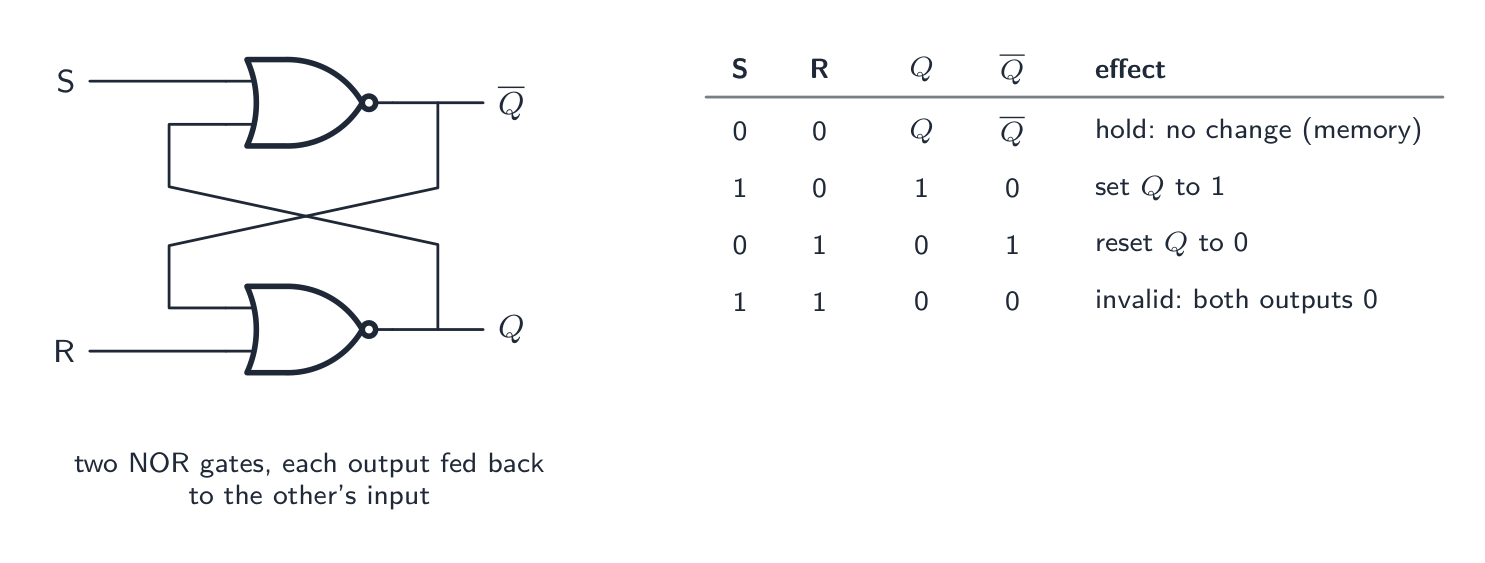
A flip-flop 触发器 is a bistable 双稳态 circuit — two stable states (0 and 1) — that remembers its state. It stores one bit and is the basic element of registers and SRAM.
SR flip-flop
An SR flip-flop SR触发器 has inputs S (set) and R (reset) and outputs Q and $\overline{Q}$. S=1,R=0 sets Q to 1; S=0,R=1 resets it to 0; S=0,R=0 holds; S=1,R=1 is invalid. Built from two cross-coupled NOR gates.
"Draw a logic circuit for an SR flip-flop and label the inputs." Two NOR gates (or two NAND gates), the output of each connected back to one input of the other; the free input of one gate is S, of the other R; the outputs are $Q$ and $\overline{Q}$. The feedback is what the marks are for: without it there is no memory. "State the purpose of a flip-flop." To store one bit of data; it is the basic memory element from which registers and static RAM are built, and it holds its value until it is deliberately changed. The invalid input $S = R = 1$ makes both outputs 0, so that $\overline{Q}$ is no longer the complement of $Q$, and the state after both inputs return to 0 is unpredictable, which is the SR flip-flop's weakness.
JK flip-flop
A JK flip-flop JK触发器 improves on it by using the previously-invalid 1,1 input as a toggle 翻转 (the output flips). This makes it ideal for building counters 计数器 (a chain of toggling flip-flops). It is usually clocked — inputs act only on a clock edge, keeping flip-flops synchronised.

Flip-flops are the building blocks of registers (n bits = n flip-flops), counters, and SRAM 静态RAM cells.
JK flip-flop truth table. The clock 时钟 input decides when the J and K inputs are read, so the output changes only on a clock pulse: with $J = K = 0$ the output is held; $J = 1, K = 0$ sets $Q$ to 1; $J = 0, K = 1$ resets it to 0; $J = K = 1$ toggles it (Q becomes $\overline{Q}$). The last row is exactly the SR flip-flop's forbidden input turned into a useful one, which is why the JK is preferred: every input combination is valid, and the clocked operation makes it the building block of counters and shift registers.
Vocabulary
Train
| English |
|---|
| flip-flop/flɪp flɒp/ |
| bistable/baɪˈsteɪbl/ |
| toggle/ˈtɒɡl/ |
| counters/ˈkaʊntəz/ |
| SRAM/ˈesræm/ |
| clock/klɒk/ |
| SR flip-flop/ˌes ˈɑː flɪp flɒp/ |
| JK flip-flop/ˌdʒeɪ ˈkeɪ flɪp flɒp/ |
15.2
Definitions the examiner accepts
A definition question is marked against fixed wording. Learn these exactly, and give one answer only.
| Term | Definition |
|---|---|
| RISC | a processor with a small set of simple, fixed-length instructions, most executed in one clock cycle, using many registers and pipelining |
| CISC | a processor with a large set of complex, variable-length instructions, many taking several clock cycles and accessing memory directly |
| pipelining | dividing the fetch–execute cycle into stages so that several instructions are processed at once, each at a different stage |
| SISD / SIMD / MISD / MIMD | one instruction on one data item; one instruction on many data items; many instructions on one data item; many instructions on many data items |
| massively parallel computer | thousands of processors, each with its own memory, connected by a network and working simultaneously on one problem |
| virtual machine | a software emulation of a computer system running on a host computer and behaving like a separate physical computer |
| hypervisor | the software that creates virtual machines and shares the host's hardware between them |
| truth table | a table listing every combination of inputs to a logic circuit with the resulting output(s) |
| sum-of-products | a Boolean expression written as the OR of AND terms, one term for each input combination giving 1 |
| Karnaugh map | a grid of the truth-table outputs, arranged in Gray-code order, in which loops of adjacent 1s give the simplified expression |
| half adder | a circuit that adds two bits, producing a sum and a carry |
| full adder | a circuit that adds two bits and a carry-in, producing a sum and a carry-out |
| flip-flop | a bistable circuit that stores one bit, holding its output until its inputs change it |
15.2
Exam tips
- RISC and CISC are answered as lists of features: simple, fixed, one cycle, many registers, load/store, pipelined against complex, variable, multi-cycle, fewer registers, direct memory access, microcode. Four of each.
- Pipelining: stages, several instructions at once, one completed per cycle, higher throughput; $n + k - 1$ cycles for $n$ instructions through $k$ stages; interrupts must empty the pipeline.
- Flynn's four categories are "how many instruction streams" by "how many data streams"; say what runs on what. Massively parallel: many processors, own memory, network, same problem.
- Virtual machine: emulation of a computer on a host; host OS on the hardware, hypervisor sharing it, guest OS inside. Two benefits and two limitations, each a full sentence.
- Boolean algebra: name each law as you use it; De Morgan swaps the operator and negates each term; check with a truth table if in doubt.
- K-map: Gray-code order, largest loops of 1/2/4/8, wrapping allowed, one term per loop with the unchanging variables. State why: simplest expression with no algebra.
- Half adder gives sum and carry; full adder also takes a carry-in; SR flip-flop is two cross-coupled NOR/NAND gates and stores one bit; JK's 1,1 input toggles.
Common mistakes
- Swapping the RISC and CISC feature lists, or offering "faster" as a feature; give the design features, not a verdict.
- Describing pipelining as "running instructions in parallel on several cores"; it is stages of one processor overlapping.
- Confusing SIMD (one instruction, many data) with MIMD (many of both), or describing MISD as the common case.
- Defining a virtual machine as "a copy of a computer" without the word emulation or the host and guest.
- Applying De Morgan to only part of an expression under a long bar, or dropping the bar without swapping AND for OR.
- Looping a group of three, or a non-rectangular group, in a K-map; ordering the columns 00, 01, 10, 11 instead of Gray code.
- Writing the carry of a half adder as XOR and the sum as AND.
- Drawing an SR flip-flop as two gates with no feedback, or leaving out the invalid state from its truth table.
Interactive lessons on this topic
Work through it step by step, with instant-check exercises.