พลังงาน, งาน และกำลัง
แนะนำใหม่| English | ความหมาย |
|---|---|
| power/ˈpaʊə/ | กำลัง |
| potential energy/pəˈtenʃl ˈenədʒi/ | พลังงานศักย์ |
| kinetic energy/kɪˈnetɪk ˈenədʒi/ | พลังงานจลน์ |
| conservation of energy/ˌkɒnsəˈveɪʃn ɒv ˈenədʒi/ | การอนุรักษ์พลังงาน |
| work done/wɜːk dʌn/ | งานที่ทำ |
| joule/dʒuːl/ | จูล |
| gravitational potential energy/ˌɡrævɪˈteɪʃənl pəˈtenʃl ˈenədʒi/ | พลังงานศักย์โน้มถ่วง |
| watt/wɒt/ | วัตต์ |
The energy that powers 功率 everything
- A roller coaster at the top of its first hill has maximum potential energy 势能. As it plunges down, that energy converts to kinetic energy 动能 — speed.
- Conservation of energy 能量守恒 lets you predict the speed at any point without knowing the path in between.
Work done 功
- Work done by a constant force: $W = Fd\cos\theta$ (measured in joules 焦耳).
- Work is the energy transferred by a force acting through a distance.
Worked example. A 50 N force pulls a box 4 m along the floor at $30^{\circ}$ to the horizontal. $W = 50 \times 4 \times \cos 30^{\circ} = 200 \times 0.866 = 173.2\text{ J}$.
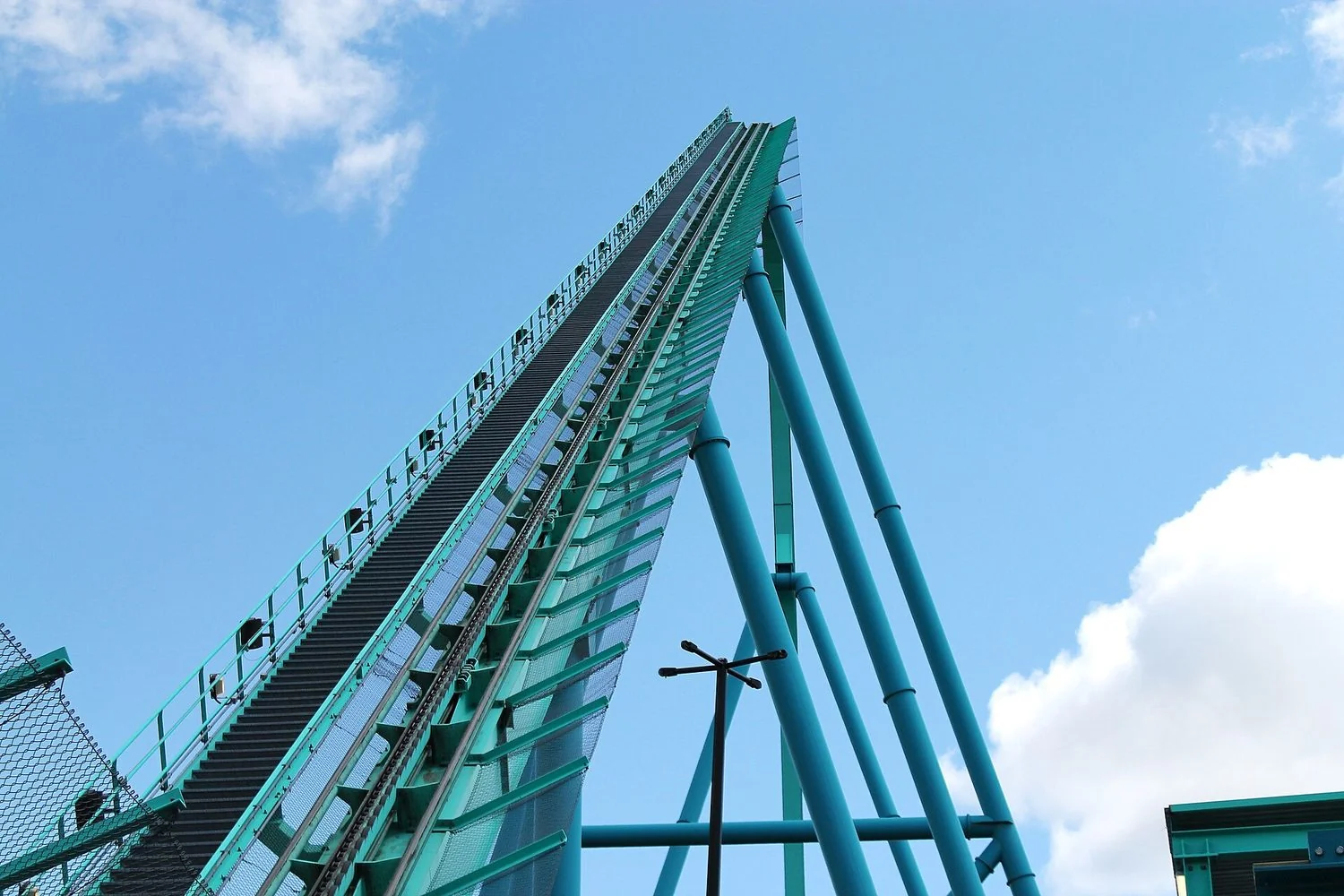
A roller coaster trades potential energy for kinetic energy
มีแรง 50 นิวตัน ดึงกล่อง 4 เมตร ตามพื้น (θ = 0°) งานที่ทำ = Fd cos θ. หาค่า (J)
ความยาก 2/5 · 140 เหรียญ + บอนัสน้อยๆ เมื่อทำสำเร็จครั้งแรกในวันนี้
W = 50 × 4 × cos 0° = 50 × 4 × 1 = 200 J.
จับคู่แต่ละปริมาณกับสูตรหรือความหมายของมัน
ความยาก 2/5 · 140 เหรียญ + บอนัสน้อยๆ เมื่อทำสำเร็จครั้งแรกในวันนี้
พลังงานถูกอนุรักษ์: KE และ PE เปลี่ยนแปลงกัน ในขณะที่กำลังคืออัตราของการทำงาน
Kinetic and potential energy
- Kinetic energy (movement): $\text{KE} = \tfrac12 mv^2$.
- Gravitational potential energy 重力势能 (height): $\text{PE} = mgh$.
KE depends on $v^2$, not $v$. Doubling the speed quadruples the kinetic energy. A car at 60 mph has four times the KE of one at 30 mph — and needs four times the braking distance.
การอนุรักษ์พลังงาน
PE + KE = ค่าคงที่
เมื่อลูกบอลตก พลังงานศักย์เปลี่ยนเป็น พลังงานจลน์ — แต่ รวมไม่เปลี่ยนแปลง
พลังงานจลน์ของวัตถุที่มีมวล 2 kg เคลื่อนที่ด้วยความเร็ว 3 m/s คือเท่าใด (KE = ½mv²), ในหน่วย J?
ความยาก 2/5 · 140 เหรียญ + บอนัสน้อยๆ เมื่อทำสำเร็จครั้งแรกในวันนี้
KE = ½ × 2 × 3² = ½ × 2 × 9 = 9 J.
ถ้า g = 10, พลังงานศักย์ของวัตถุที่มีมวล 2 kg ที่ยกขึ้นสูง 5 m คือเท่าใด (PE = mgh), ในหน่วย J?
ความยาก 2/5 · 140 เหรียญ + บอนัสน้อยๆ เมื่อทำสำเร็จครั้งแรกในวันนี้
PE = mgh = 2 × 10 × 5 = 100 J.
การเพิ่มความเร็วของวัตถุเป็นสองเท่าจะทำให้พลังงานจลน์เพิ่มขึ้นสองเท่า
ความยาก 1/5 · 100 เหรียญ + บอนัสน้อยๆ เมื่อทำสำเร็จครั้งแรกในวันนี้
KE = ½mv², ดังนั้นการเพิ่ม v เป็นสองเท่าจะทำให้ KE เพิ่มขึ้นสี่เท่า (2² = 4 เท่า)
Conservation of energy
- With no friction, total energy is conserved (conservation of energy).
- Loss in PE = gain in KE (for a falling object): $mgh = \tfrac{1}{2}mv^2$.
ลูกบอลที่มีมวล 1 kg หลุดจากสูง 5 m (g = 10). ใช้ mgh = ½mv², จงหาความเร็วที่ด้านล่าง (m/s).
ความยาก 2/5 · 140 เหรียญ + บอนัสน้อยๆ เมื่อทำสำเร็จครั้งแรกในวันนี้
mgh = ½mv² → v² = 2gh = 2(10)(5) = 100 → v = 10 m/s.
Power
- Power is the rate of doing work (in watts 瓦特): $P = \dfrac{W}{t}$.
- For a force pulling along the motion: $P = Fv$.
- Work is the scalar product of force and displacement; differentiating velocity gives the instantaneous acceleration.
รถยนต์ทำงานที่ 12 kW ด้วยความเร็ว 20 m/s. ใช้ P = Fv, แรงขับเคลื่อนคือเท่าใด, ในหน่วย N?
ความยาก 2/5 · 140 เหรียญ + บอนัสน้อยๆ เมื่อทำสำเร็จครั้งแรกในวันนี้
F = P/v = 12000/20 = 600 N.
You've got it
- work $W = Fd\cos\theta$; KE $= \tfrac12 mv^2$; PE $= mgh$
- with no friction, total energy is conserved
- power = rate of work; $P = Fv$
Write from the data: find the kinetic energy
- A 2 kg body moves at 4 metres per second. A 3 kg body is raised 4 m with g = 10.
- Find the kinetic energy and the gain in potential energy.
หาพลังงานจลน์ของวัตถุ 2 กก. ที่ความเร็ว 4 เมตรต่อวินาที, และการเพิ่มขึ้นของพลังงานศักย์ของวัตถุ 3 กก. ที่ยกขึ้น 4 เมตร ใช้ g = 10
ครึ่งหนึ่งของ 32 คือ 16 3 คูณกับ 40 ได้ 120
พลังงานจลน์คืออะไร?
ความยาก 1/5 · 100 เหรียญ + บอนัสน้อยๆ เมื่อทำสำเร็จครั้งแรกในวันนี้
ครึ่งหนึ่งของ 2 คูณกับ 16 ได้ 16 จูล