Skip to content · ⁨ข้ามไปยังเนื้อหา⁩

Understanding business activity · ⁨ความเข้าใจกิจกรรมทางธุรกิจ⁩

IGCSE Business Studies · ⁨Business Studies IGCSE⁩ · Topic 1 · ⁨หัวข้อ 1⁩

Video lesson for this topic · ⁨บทเรียนวิดีโอสำหรับหัวข้อนี้⁩ Open the video page · ⁨เปิดหน้าวิดีโอ⁩
17:55

ความเข้าใจกิจกรรมทางธุรกิจ

มองไปบนถนนหลัก ร้านค้าเรียงรายกัน ขายสินค้าทุกอย่าง ล้วนไล่ล่าลูกค้าคนเดียวกัน ทั้งหมดคือธุรกิจ แต่ธุรกิจแท้จริงแล้วคือ…

English narration · English + 中文 subtitles burned in · ⁨การบรรยายภาษาอังกฤษ · คำบรรยายภาษาอังกฤษ + 中文 ลอยตัวบนภาพ⁩

1.1

What business activity is for · ⁨ธุรกิจมีไว้เพื่ออะไร⁩

Syllabus · ⁨หลักสูตร⁩
English
  1. understand the purpose of business activity: combining factors of production (land, labour, capital, enterprise) to make goods and services that satisfy people's needs and wants
  2. understand the economic problem: needs and wants are unlimited but resources are scarce, so choices must be made
  3. understand opportunity cost: the next best alternative given up when a choice is made
  4. explain the concept of added value (selling price minus cost of bought-in materials) and how a business can increase added value
  5. understand why businesses succeed or fail (e.g. management skill, finance, competition)
ไทย
  1. เข้าใจวัตถุประสงค์ของกิจกรรมธุรกิจ: การรวมปัจจัยการผลิต (ที่ดิน, แรงงาน, ทุน,Entrepreneurship) เพื่อผลิตสินค้าและบริการเพื่อตอบสนองความต้องการและความต้องการของผู้คน
  2. เข้าใจปัญหาเศรษฐกิจ: ความต้องการและความต้องการไม่มีที่สิ้นสุดแต่ทรัพยากรมีจำกัด ดังนั้นต้องมีการตัดสินใจเลือก
  3. เข้าใจ opportunity cost: ทางเลือกที่ดีที่สุดถัดไปที่ถูกทิ้งไว้เมื่อมีการตัดสินใจเลือก
  4. อธิบายแนวคิดของ added value (ราคาขายลบด้วยต้นทุนวัสดุนำเข้า) และวิธีที่ธุรกิจ可以增加 added value
  5. เข้าใจว่าทำไมธุรกิจถึงประสบความสำเร็จหรือล้มเหลว (เช่น ทักษะการจัดการ, เงินทุน, การแข่งขัน)

Source: Cambridge International syllabus · ⁨แหล่งที่มา: หลักสูตร Cambridge International⁩

English

A business 企业 is an organisation that makes goods 商品 or provides services 服务 for customers 顾客.

  • Goods are physical things you can touch — bread, phones, cars.
  • Services are useful actions done for you — a haircut, a bus ride, a doctor's visit.

The purpose of business activity is to use resources 资源 to make goods and services, so that people's needs 需要 and wants 欲望 are met.

  • Needs are things you must have to live: food, water, shelter, clothes.
  • Wants are things you would like but can live without: a holiday, a games console.

Factors of production

To produce anything, a business brings together four factors of production 生产要素 — the resources needed to make goods and services.

Factor What it means Example
land 土地 natural resources farmland, water, oil, minerals
labour 劳动力 the work of people workers, managers
capital 资本 money and the man-made tools bought with it machines, factories, vehicles
enterprise 企业家才能 the skill to bring the other three together and take risks the owner's idea and effort

The economic problem

People's needs and wants are unlimited. But resources are scarce 稀缺 — there are not enough of them for everything. This is the economic problem 经济问题.

Because resources are scarce, you must always choose. You cannot have everything.

Opportunity cost

When you choose one thing, you give up the next best thing. The opportunity cost 机会成本 is the next best choice you give up.

Example: a business has some money and spends it on a new machine. Now it cannot also spend that money on a bigger shop. The bigger shop is the opportunity cost.

Added value

Added value 增值 is the difference between the price a business sells a product for and the cost of the raw materials 原材料 bought in to make it.

$$\text{added value} = \text{selling price} - \text{cost of bought-in materials}$$

A business can increase added value by:

  • raising the price, often through a strong brand 品牌 or better design,
  • lowering the cost of materials, for example by finding cheaper suppliers,
  • improving the product so customers will pay more.

Worked example. A furniture maker buys the wood and fabric for a chair for £40 and sells the chair for £110. The factory rent is £6,000 a month. Find the added value per chair.

$$\text{added value} = \text{\pounds} 110 - \text{\pounds} 40 = \text{\pounds} 70$$

The rent is a deliberate distractor. Added value counts only the cost of the bought-in materials, so rent, wages and other running costs stay out of it - they matter for profit, not for added value. Subtract only what was bought in to make the product, and never treat added value as if it were profit.

Why businesses succeed or fail

A business is more likely to succeed when it has:

  • good management 管理 — skilled leaders who plan well,
  • enough finance 资金 — money to pay bills while it grows,
  • a product customers want, and an edge over the competition 竞争 (the other businesses selling similar things).

A business may fail and close down when it runs out of cash, manages money badly, or cannot compete. Weak management and poor cash control are the most common causes.

ไทย
ร้านค้าแข่งขันกันบนถนนหลัก
ร้านค้าที่แข่งขันกันในถนนหลัก: ธุรกิจผลิตสินค้าและบริการเพื่อตอบสนองความต้องการของผู้บริโภค
ความต้องการและความต้องการของผู้บริโภคนำไปสู่ธุรกิจซึ่งให้บริการสินค้าและบริการ
ธุรกิจผลิตสินค้าและบริการเพื่อตอบสนองความต้องการและความต้องการของผู้คน

ธุรกิจ คือองค์กรที่ผลิต สินค้า หรือให้บริการ บริการ ให้กับ ลูกค้า

  • สินค้าคือวัตถุที่จับสัมผัสได้ — ขนมปัง โทรศัพท์ รถยนต์
  • บริการคือการทำงานที่มีประโยชน์ที่ทำให้คุณ — การตัดผม การนั่งรถบัส การไปพบแพทย์

วัตถุประสงค์ของกิจกรรมทางธุรกิจคือการนำ ทรัพยากร มาผลิตสินค้าและบริการ เพื่อให้ ความต้องการ และ ความต้องการ ของผู้คนได้รับการตอบสนอง

  • ความต้องการคือสิ่งที่ต้องมีเพื่อดำรงชีวิต: อาหาร น้ำ ที่อยู่อาศัย เสื้อผ้า
  • ความต้องการคือสิ่งที่อยากได้แต่ใช้ชีวิตได้โดยไม่ต้องมี: การท่องเที่ยว-consoleเกม

ปัจจัยการผลิต

ในการผลิตสิ่งใดสิ่งหนึ่ง ธุรกิจจะรวบรวม ปัจจัยการผลิต ทั้งสี่อย่าง — وهوทรัพยากรที่ต้องการในการผลิตสินค้าและบริการ

ปัจจัย ความหมาย ตัวอย่าง
ที่ดิน ทรัพยากรธรรมชาติ ที่ทำเกษตรกรรม น้ำ น้ำมันแร่
แรงงาน งานของมนุษย์ พนักงาน ผู้จัดการ
ทุน เงินและเครื่องมือที่สร้างขึ้นเองที่ซื้อได้ด้วยเงินนั้น เครื่องจักร โรงงานยานพาหนะ
ผู้ประกอบการ ทักษะในการรวมสามอย่างที่เหลือเข้าด้วยกันและรับความเสี่ยง ความคิดและความพยายามของเจ้าของ
ที่ดิน แรงทุน และผู้ประกอบการแสดงเป็น inputs สี่อย่างที่ถูกcombineโดยธุรกิจเพื่อผลิตสินค้าและบริการ
ปัจจัยการผลิตทั้งสี่อย่างถูกcombinedเพื่อผลิตสินค้าและบริการ

ปัญหาทางเศรษฐกิจ

ความต้องการและความต้องการของผู้บริโภคมีไม่จำกัด แต่ทรัพยากรมี ขาดแคลน — มีไม่เพียงพอสำหรับทุกสิ่ง นี่คือ ปัญหาทางเศรษฐกิจ

เนื่องจากทรัพยากรมีจำกัด คุณจึงต้องเลือกเสมอ ไม่สามารถมีทุกอย่างได้

Opportunity cost

When you choose one thing, you give up the next best thing. The opportunity cost is the next best choice you give up.

Example: a business has some money and spends it on a new machine. Now it cannot also spend that money on a bigger shop. The bigger shop is the opportunity cost.

The money can go one way only: the new machine is chosen, the bigger shop is given up - the bigger shop is the opportunity cost
The opportunity cost is the next best choice you give up

Added value

Added value is the difference between the price a business sells a product for and the cost of the raw materials bought in to make it.

$$\text{added value} = \text{selling price} - \text{cost of bought-in materials}$$
Stacked bar with the cost of bought-in materials at the bottom and added value on top, together making the selling price
Added value is the selling price minus the cost of bought-in materials

A business can increase added value by:

  • raising the price, often through a strong brand or better design,
  • lowering the cost of materials, for example by finding cheaper suppliers,
  • improving the product so customers will pay more.

Worked example. A furniture maker buys the wood and fabric for a chair for £40 and sells the chair for £110. The factory rent is £6,000 a month. Find the added value per chair.

$$\text{added value} = \text{\pounds} 110 - \text{\pounds} 40 = \text{\pounds} 70$$

The rent is a deliberate distractor. Added value counts only the cost of the bought-in materials, so rent, wages and other running costs stay out of it - they matter for profit, not for added value. Subtract only what was bought in to make the product, and never treat added value as if it were profit.

Why businesses succeed or fail

A business is more likely to succeed when it has:

  • good management — skilled leaders who plan well,
  • enough finance — money to pay bills while it grows,
  • a product customers want, and an edge over the competition (the other businesses selling similar things).

A business may fail and close down when it runs out of cash, manages money badly, or cannot compete. Weak management and poor cash control are the most common causes.

Explore · ⁨สำรวจ⁩

Value added lab · ⁨ห้องปฏิบัติการเพิ่มมูลค่า⁩

Change the bought-in cost, the selling price and other costs to see how business activity creates value added. · ⁨เปลี่ยนต้นทุนวัตถุดิบ ราคาขาย และค่าใช้จ่ายอื่นๆ เพื่อดูว่ากิจกรรมทางธุรกิจสร้างมูลค่าเพิ่มได้อย่างไร⁩

Vocabulary · ⁨คำศัพท์⁩ Train · ⁨ฝึกฝน⁩
English ไทย
business/ˈbɪznəs/ ธุรกิจ
customers/ˈkʌstəməz/ ลูกค้า
factors of production/ˈfæktəz ɒv prəˈdʌkʃn/ ปัจจัยการผลิต
land/lænd/ ที่ดิน
labour/ˈleɪbə/ แรงงาน
capital/ˈkæpɪtl/ ทุน (capital)
opportunity cost/ɒpəˈtjuːnɪti kɒst/ ต้นทุนโอกาส
added value/ˈædɪd ˈvæljuː/ มูลค่าเพิ่ม
raw materials/rɔː məˈtɪərɪəlz/ วัตถุดิบ
brand/brænd/ แบรนด์
management/ˈmænɪdʒmənt/ การบริหารจัดการ
finance/ˈfaɪnæns/ finance
competition/ˌkɒmpəˈtɪʃn/ การแข่งขัน
profit/ˈprɒfɪt/ profit
suppliers/səˈplaɪəz/ ผู้ขาย
tax/tæks/ tax
local community/ˈləʊkl kəˈmjuːnɪti/ ชุมชนท้องถิ่น
conflict/ˈkɒnflɪkt/ ความขัดแย้ง
pollution/pəˈluːʃn/ มลพิษ
1.2

Classifying businesses

Syllabus · ⁨หลักสูตร⁩
English
  1. classify business activity into primary, secondary and tertiary sectors with examples
  2. understand the changing importance of business sectors (de-industrialisation) in developed and developing economies
  3. distinguish the private sector and the public sector and give the features of each
ไทย
  1. จำแนกกิจกรรมธุรกิจเป็นภาค primary, secondary และ tertiary พร้อมตัวอย่าง
  2. เข้าใจถึงความสำคัญที่เปลี่ยนแปลงไปของภาคธุรกิจ (de-industrialisation) ในเศรษฐกิจพัฒนาแล้วและกำลังพัฒนา
  3. แยกแยะภาคเอกชนและภาคสาธารณะและระบุลักษณะของแต่ละภาค

Source: Cambridge International syllabus · ⁨แหล่งที่มา: หลักสูตร Cambridge International⁩

English

The three sectors

We sort all business activity into three groups, by how far the work is from the final customer.

Sector What it does Examples
primary sector 第一产业 takes natural resources from the earth farming, fishing, mining, oil drilling
secondary sector 第二产业 makes goods from raw materials building, manufacturing 制造业, food processing
tertiary sector 第三产业 provides services shops, banks, transport, tourism

How the sectors change

The importance of each sector changes as a country grows richer.

  • In a developing economy 发展中经济体 (a poorer country building up its industry), the primary sector is often large — many people farm.
  • As the country grows, the secondary sector grows too.
  • In a developed economy 发达经济体 (a rich, industrialised country), most people work in the tertiary sector.

De-industrialisation 去工业化 is when the secondary sector shrinks and the tertiary sector grows. This has happened in many developed economies as factories move abroad.

Private sector and public sector

The private sector 私营部门 is made up of businesses owned by private people and groups. Most aim to make a profit 利润. The public sector 公共部门 is made up of organisations owned by the government, which aim to provide a service to the public.

Private sector Public sector
Owner private people and companies the government
Main aim usually profit provide services to everyone
Examples shops, factories, private firms state schools, public hospitals, the army
ไทย

The three sectors

We sort all business activity into three groups, by how far the work is from the final customer.

Sector What it does Examples
primary sector takes natural resources from the earth farming, fishing, mining, oil drilling
secondary sector makes goods from raw materials building, manufacturing, food processing
tertiary sector provides services shops, banks, transport, tourism
Three boxes in a row — primary, secondary, tertiary — linked by arrows, with an example under each
Business activity runs from the primary sector through to the tertiary sector

How the sectors change

The importance of each sector changes as a country grows richer.

  • In a developing economy (a poorer country building up its industry), the primary sector is often large — many people farm.
  • As the country grows, the secondary sector grows too.
  • In a developed economy (a rich, industrialised country), most people work in the tertiary sector.

De-industrialisation is when the secondary sector shrinks and the tertiary sector grows. This has happened in many developed economies as factories move abroad.

Private sector and public sector

The private sector is made up of businesses owned by private people and groups. Most aim to make a profit. The public sector is made up of organisations owned by the government, which aim to provide a service to the public.

Private sector Public sector
Owner private people and companies the government
Main aim usually profit provide services to everyone
Examples shops, factories, private firms state schools, public hospitals, the army
Explore · ⁨สำรวจ⁩

Classify business activity · ⁨จัดประเภทกิจกรรมทางธุรกิจ⁩

Sort real firms by the sector they mainly belong to. · ⁨จำแนกบริษัทจริงตามภาคที่ส่วนใหญ่อยู่ใน⁩

Vocabulary · ⁨คำศัพท์⁩ Train · ⁨ฝึกฝน⁩
English ไทย
goods/ɡʊdz/ สินค้า
services/ˈsɜːvɪsɪz/ บริการ
resources/rɪˈzɔːsɪz/ ทรัพยากร
needs/niːdz/ ต้องการ
wants/wɒnts/ ความต้องการ
primary sector/ˈpraɪməri ˈsektə/ sector primary
manufacturing/ˌmænjuːˈfæktʃərɪŋ/ ภาคการผลิต
secondary sector/ˈsekəndəri ˈsektə/ sector secondary
tertiary sector/ˈtɜːʃjəri ˈsektə/ sector tertiary
developing economy/dɪˈveləpɪŋ ɪˈkɒnəmi/ เศรษฐกิจกำลังพัฒนา
developed economy/dɪˈveləpt ɪˈkɒnəmi/ เศรษฐกิจพัฒนาแล้ว
de-industrialisation/də ɪnˌdʌstrɪəlaɪˈzeɪʃn/ การลดอุตสาหกรรม
private sector/ˈpraɪvət ˈsektə/ ภาคเอกชน
public sector/ˈpʌblɪk ˈsektə/ ภาคสาธารณะ
1.3

Enterprise, business growth and size

Syllabus · ⁨หลักสูตร⁩
English
  1. describe the characteristics of a successful entrepreneur (risk-taker, hard-working, innovative, confident, organised)
  2. explain the contents and purpose of a business plan and how it helps a business raise finance
  3. explain why and how governments support business start-ups (grants, loans, training, advice)
  4. measure the size of a business (number of employees, revenue/sales, capital employed) and the limitations of each measure
  5. explain why some businesses remain small and why/how businesses grow (internal/organic growth and external growth: mergers and takeovers, horizontal, vertical and conglomerate integration)
  6. explain economies and diseconomies of scale (purchasing, financial, managerial, technical, marketing)
ไทย
  1. อธิบายลักษณะของ entrepreneur ที่ประสบความสำเร็จ (ผู้รับความเสี่ยง, ขยัน, มีนวัตกรรม, มั่นใจ, จัดระเบียบ)
  2. อธิบายเนื้อหาและวัตถุประสงค์ของ business plan และวิธีที่มันช่วยธุรกิจในการระดมทุน
  3. อธิบายว่าทำไมและรัฐบาล چگونهสนับสนุนการเริ่มต้นธุรกิจ (grants, Loans, การฝึกอบรม, คำแนะนำ)
  4. วัดขนาดของธุรกิจ (จำนวนพนักงาน, รายได้/ยอดขาย, ทุนที่ใช้) และข้อจำกัดของแต่ละการวัด
  5. อธิบายว่าทำไมบางธุรกิจยังคงเล็กและทำไม/ چگونه ธุรกิจโตขึ้น (การเติบโตภายใน/organic และการเติบโตภายนอก: Mergers และ takeovers, horizontal, vertical และ conglomerate integration)
  6. อธิบาย economies และ diseconomies of scale (purchasing, financial, managerial, technical, marketing)

Source: Cambridge International syllabus · ⁨แหล่งที่มา: หลักสูตร Cambridge International⁩

English

The entrepreneur

An entrepreneur 企业家 is a person who sets up a business and takes the risk of running it. Successful entrepreneurs usually:

  • are willing to take risk 风险 — to risk their own money on a new idea,
  • work hard and do not give up,
  • are innovative 创新 — full of new ideas,
  • are confident and good at making decisions,
  • are well organised, able to manage time, money and people.

The business plan

A business plan 商业计划书 is a document that describes the business and its future. It usually contains the business idea and objectives, the product, the market 市场 it will sell to, who will run it, and a plan for the money.

A business plan has two main uses:

  • it makes the owner think carefully and plan ahead,
  • it helps the business raise finance 筹集资金 — banks and investors want to see a plan before they lend or invest.

Government support for start-ups

A start-up 初创企业 is a brand-new business. New businesses create jobs and help the economy grow, so governments often support them with:

  • grants 补助金 — money given that does not have to be paid back,
  • low-interest loans 贷款 — money lent on easy terms,
  • training and advice for new owners,
  • lower taxes in the first years.

Measuring the size of a business

You can measure how big a business is in several ways. Each one has a weakness.

Measure How it works Limitation
number of employees 员工 count the staff a high-tech firm can have few staff but large output 产量
revenue 收入 (sales) the value of everything sold a firm selling cheap goods may sell a lot yet be small
capital employed 所用资本 the total money invested in the business hard to compare between different industries

Staying small or growing

Some businesses stay small on purpose: the owner wants to keep control, the market is small, or the product is specialised.

Businesses that want to grow bigger — to achieve growth 增长 — can do it in two ways.

  • Internal growth 内部增长 (also called organic growth): the business grows by itself, by selling more, opening new branches, or adding new products. It is slower but lower-risk.
  • External growth 外部增长: the business joins with another business. This is faster. It happens through a merger 合并 (two businesses agree to join into one) or a takeover 收购 (one business buys control of another).

External growth is classified by the kind of business that is joined.

Type What joins Example
horizontal integration 横向一体化 two firms at the same stage of the same business two car makers join
vertical integration 纵向一体化 two firms at different stages of the same business a car maker buys a tyre maker
conglomerate integration 混合一体化 two firms in completely different businesses a car maker buys a food company

Economies and diseconomies of scale

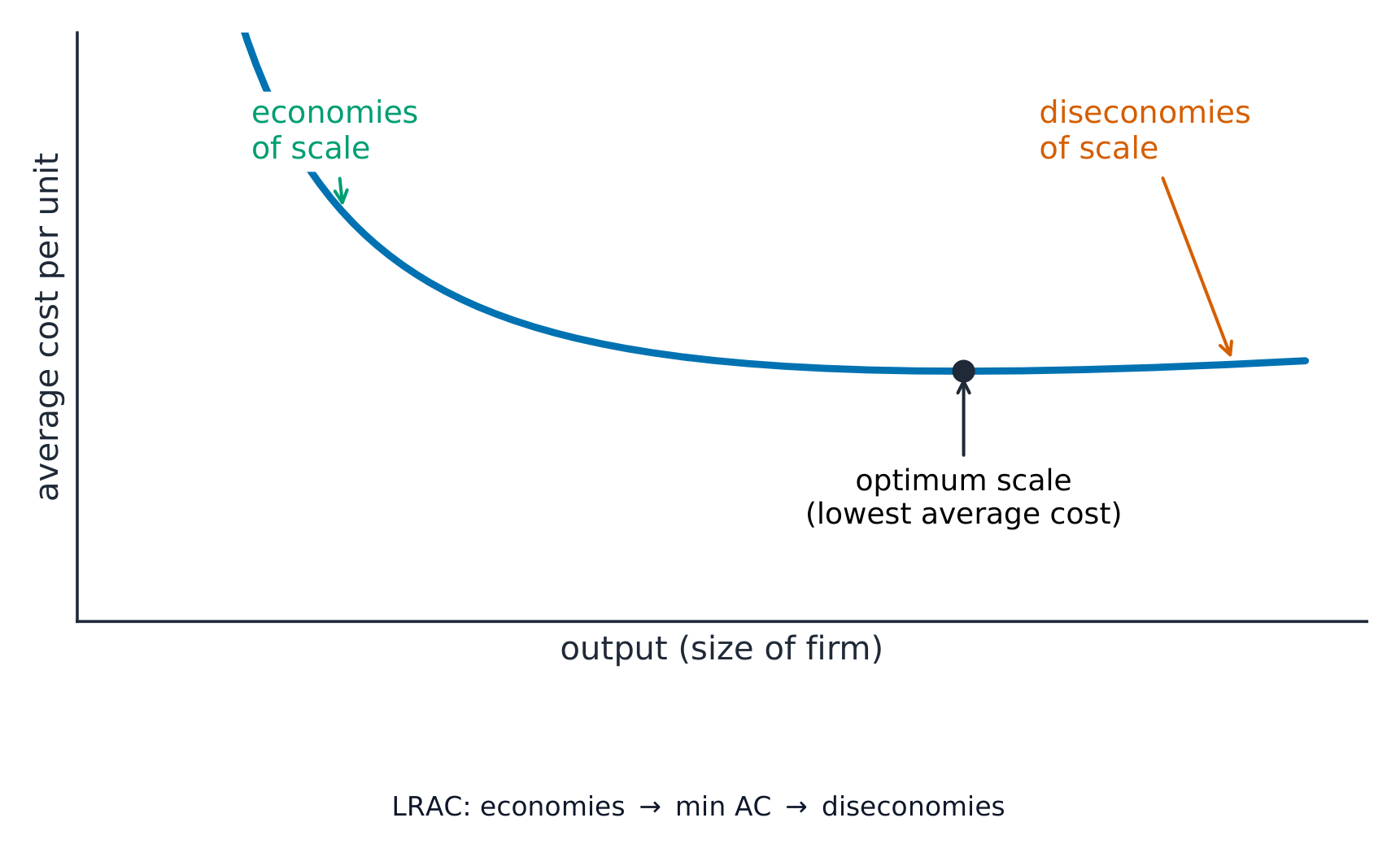
As a business grows, its cost per unit can fall. These savings are called economies of scale 规模经济.

Type How the cost per unit falls
purchasing buying large amounts of materials brings a lower price
financial large firms can borrow money more cheaply
managerial the firm can afford expert managers
technical the firm can use large, efficient machines
marketing 营销 the cost of advertising 广告 is spread over more goods

If a business grows too big, the cost per unit can start to rise again. These are diseconomies of scale 规模不经济. They happen because communication 沟通 in a huge firm gets worse, workers feel less important and work less hard, and managers find the firm hard to control.

ไทย

The entrepreneur

An entrepreneur is a person who sets up a business and takes the risk of running it. Successful entrepreneurs usually:

  • are willing to take risk — to risk their own money on a new idea,
  • work hard and do not give up,
  • are innovative — full of new ideas,
  • are confident and good at making decisions,
  • are well organised, able to manage time, money and people.
The entrepreneur in the centre with five traits around them: takes risks, hard-working, innovative, confident, well organised
What successful entrepreneurs are usually like

The business plan

A business plan is a document that describes the business and its future. It usually contains the business idea and objectives, the product, the market it will sell to, who will run it, and a plan for the money.

A business plan has two main uses:

  • it makes the owner think carefully and plan ahead,
  • it helps the business raise finance — banks and investors want to see a plan before they lend or invest.

Government support for start-ups

A start-up is a brand-new business. New businesses create jobs and help the economy grow, so governments often support them with:

  • grants — money given that does not have to be paid back,
  • low-interest loans — money lent on easy terms
  • การอบรมและคำแนะนำสำหรับผู้ประกอบการใหม่,
  • ลดภาษีในช่วงปีแรกๆ

การวัดขนาดของธุรกิจ

คุณสามารถวัดขนาดของธุรกิจได้หลายวิธี แต่ละวิธีมีจุดอ่อนของตัวเอง

ตัวชี้วัด วิธีการใช้ ข้อจำกัด
จำนวน พนักงาน นับจำนวนเจ้าหน้าที่ บริษัทเทคโนโลยีสูงอาจมีพนักงานน้อยแต่มี ผลผลิต สูง
รายได้ (ยอดขาย) มูลค่าของสินค้าทั้งหมดที่ขายได้ บริษัทที่ขายสินค้าราคาถูกอาจขายได้มากแต่ยังเล็กอยู่
สินทรัพย์ที่ใช้ในการดำเนินงาน เงินลงทุนรวมในธุรกิจ ยากต่อการเปรียบเทียบระหว่างอุตสาหกรรมที่แตกต่างกัน

การคงความเป็นธุรกิจขนาดเล็กหรือการขยายตัว

บางธุรกิจเลือกที่จะเป็นธุรกิจขนาดเล็กโดยตั้งใจ: เจ้าของต้องการควบคุมตลาด มีตลาดขนาดเล็ก หรือสินค้ามีความจำเพาะ

ธุรกิจที่ต้องการขยายใหญ่ขึ้นเพื่อให้เกิด การเติบโต สามารถทำได้สองวิธี

  • การเติบโตภายใน (หรือเรียกว่า การเติบโตแบบอินทรีย์): ธุรกิจเติบโตด้วยตนเอง bằngการขายมากขึ้น เปิดสาขาใหม่ หรือเพิ่มสินค้าใหม่ จะช้ากว่าแต่เสี่ยงน้อยกว่า
  • การเติบโตภายนอก: ธุรกิจรวมกับอีกธุรกิจหนึ่ง会发生จะเร็วกว่า会发生 occurs through a merger (two businesses agree to join into one) or a takeover (one business buys control of another).

การเติบโตภายนอกถูกจัดประเภทตามชนิดของธุรกิจที่ถูกควบรวมเข้าด้วยกัน

ประเภท สิ่งที่ควบรวมเข้าด้วยกัน ตัวอย่าง
การควบรวมแนวนอน Two firms at the same stage of the same business Two car makers join
การควบรวมแนวตั้ง Two firms at different stages of the same business A car maker buys a tyre maker
การควบรวมกลุ่ม Two firms in completely different businesses A car maker buys a food company

ประโยชน์จากขนาดและการขาดประโยชน์จากขนาด

เมื่อธุรกิจขยายตัว ต้นทุนต่อหน่วยอาจลดลง Savings these are called economies of scale.

ประเภท วิธีที่ต้นทุนต่อหน่วยลดลง
การซื้อ การซื้อวัตถุดิบจำนวนมากทำให้ราคาถูกลง
การเงิน บริษัทขนาดใหญ่สามารถกู้ยืมเงินได้ถูกกว่า
การบริหาร บริษัทสามารถจ้างผู้บริหารผู้เชี่ยวชาญได้
เทคนิค บริษัทสามารถใช้เครื่องจักรขนาดใหญ่ที่มีประสิทธิภาพได้
การตลาด ค่าใช้จ่ายด้าน โฆษณา ถูกกระจายไปบนสินค้ามากขึ้น

หากธุรกิจใหญ่เกินไป ต้นทุนต่อหน่วยอาจเริ่มเพิ่มขึ้นอีกครั้ง These are diseconomies of scale. They happen because communication in a huge firm gets worse, workers feel less important and work less hard, and managers find the firm hard to control.

U-shaped average cost curve falling on the left (economies of scale), reaching a lowest point, then rising on the right (diseconomies of scale)
ต้นทุนต่อหน่วยลดลง (ประหยัดจากขนาด) แล้วเพิ่มขึ้น (ความไม่ประหยัดจากขนาด) เมื่อบริษัทขยายขนาด
Explore · ⁨สำรวจ⁩

Business case lab

Classify real decisions so the main business concept becomes concrete. · ⁨จำแนกการตัดสินใจจริงเพื่อให้แนวคิดธุรกิจหลักเป็นรูปธรรมขึ้น⁩

Vocabulary · ⁨คำศัพท์⁩ Train · ⁨ฝึกฝน⁩
English ไทย
entrepreneur/ˌɒntrɪprəˈnjʊə/ ผู้ประกอบการ
risk/rɪsk/ ความเสี่ยง (Risk)
innovative/ˈɪnəveɪtɪv/ สร้างสรรค์นวัตกรรม
business plan/ˈbɪznəs plæn/ แผนธุรกิจ
market/ˈmɑːkɪt/ ตลาด
raise finance/reɪz ˈfaɪnæns/ ระดมทุน
start-up/stɑːt ʌp/ สตาร์ทอัพ
grants/ɡrænts/ เงินอุดหนุน
loans/ləʊnz/ สินเชื่อ
employees/emˈplɔɪiːz/ พนักงาน
output/ˈaʊtpʊt/ ผลผลิต
revenue/ˈrevənjuː/ รายได้
capital employed/ˈkæpɪtl emˈplɔɪd/ capital employed
growth/ɡrəʊθ/ การเติบโต
internal growth/ɪnˈtɜːnl ɡrəʊθ/ การเติบโตภายใน
external growth/ekˈstɜːnl ɡrəʊθ/ การเติบโตภายนอก
merger/ˈmɜːdʒə/ การควบรวมกิจการ
takeover/ˈteɪkəʊvə/ การควบรวมกิจการ
horizontal integration/ˌhɒrɪˈzɒntl ˌɪntɪˈɡreɪʃn/ การบูรณาการแนวนอน
vertical integration/ˈvɜːtɪkl ˌɪntɪˈɡreɪʃn/ การบูรณาการแนวตั้ง
conglomerate integration/kənˈɡlɒməreɪt ˌɪntɪˈɡreɪʃn/ การบูรณาการกลุ่มธุรกิจ
economies of scale/ɪˈkɒnəmiz ɒv skeɪl/ ประหยัดขนาด
marketing/ˈmɑːkɪtɪŋ/ การตลาด
advertising/ˈædvətaɪzɪŋ/ การโฆษณา
diseconomies of scale/ˌdɪsɪˈkɒnəmiz ɒv skeɪl/ diseconomies of scale
communication/kəˌmjuːnɪˈkeɪʃn/ การสื่อสาร
objective/ɒbˈdʒektɪv/ วัตถุประสงค์
1.4

Types of business organisation · ⁨รูปแบบการจัดตั้งองค์กรทางธุรกิจ⁩

Syllabus · ⁨หลักสูตร⁩
English
  1. describe the features, advantages and disadvantages of sole traders, partnerships, private limited companies and public limited companies
  2. explain the difference between unlimited and limited liability and between incorporated and unincorporated businesses
  3. describe franchises, joint ventures and social enterprises and their advantages and disadvantages
  4. explain the features of public sector business organisations (public corporations)
ไทย
  1. อธิบายลักษณะ, ข้อดีและข้อเสียของ sole traders, partnerships, private limited companies และ public limited companies
  2. อธิบายความแตกต่างระหว่าง unlimited และ limited liability และระหว่าง incorporated และ unincorporated businesses
  3. อธิบาย franchises, joint ventures และ social enterprises และข้อดีและข้อเสียของพวกเขา
  4. อธิบายลักษณะขององค์กรธุรกิจภาคสาธารณะ (public corporations)

Source: Cambridge International syllabus · ⁨แหล่งที่มา: หลักสูตร Cambridge International⁩

English

Liability

Liability 责任 means who must pay the debts 债务 if a business cannot pay them itself.

  • With unlimited liability 无限责任, the owner is personally responsible for all the debts. If the business fails, the owner may lose personal things, like a house or car, to pay them.
  • With limited liability 有限责任, the owner can only lose the money they put into the business. Their personal things are safe.

Incorporated and unincorporated

  • An incorporated 法人 business has a separate legal identity from its owners. The business itself can own things and be taken to court. Its owners get limited liability. Companies are incorporated.
  • An unincorporated 非法人 business is not separate from its owner in law. Sole traders and partnerships are unincorporated.

The four main types

A sole trader 独资企业 is a business owned by one person.

Advantages Disadvantages
easy and cheap to set up unlimited liability
the owner keeps all the profit hard to raise finance
the owner makes all decisions long hours, no one to share the work
private (accounts stay secret) the business ends if the owner stops

A partnership 合伙企业 is owned by two or more people who share the work, the decisions and the profit. They usually sign a written agreement.

Advantages Disadvantages
more owners bring more capital unlimited liability (in most cases)
work and ideas are shared the profit is shared
easy to set up partners can disagree
one partner's mistake affects everyone

A private limited company 私人有限公司 (often "Ltd") is owned by shareholders 股东, but its shares cannot be sold to the public. The owners are often family and friends.

Advantages Disadvantages
limited liability more legal rules and paperwork
easier to raise capital than a sole trader shares cannot be sold to the public
control stays in a small group accounts must be shared with the government

A public limited company 公众有限公司 (often "plc") is a large company whose shares 股份 can be bought by the public on the stock exchange 证券交易所.

Advantages Disadvantages
can raise very large amounts of capital expensive and complex to set up
limited liability accounts are fully public
well known, so easy to borrow anyone can buy shares, so there is a risk of takeover
the original owners may lose control

Shareholders may receive a share of the profit, called a dividend 股息.

Other forms of organisation

  • Franchise 特许经营: a person (the franchisee 加盟商) pays to use the name, products and methods of an existing successful business (the franchisor 授权商). The franchisee gets a known brand, training and lower risk, but must pay fees and a share of the profit and has less freedom. Many fast-food chains work this way.
  • Joint venture 合资企业: two businesses agree to share the cost, risk and profit of one project, while staying separate companies.
  • Social enterprise 社会企业: a business that trades to help society or the environment, not only to make profit. Most of its profit is put back into its social aims.

Public sector organisation

A public corporation 国有企业 is a business owned and run by the government, such as a national rail or postal service. Its aims include giving an important service to everyone, not only making a profit.

ไทย
A modern corporate headquarters tower
A company headquarters: businesses ranging from sole traders to giant public limited companies.

ความรับผิดชอบ

ความรับผิดชอบ หมายความว่าใครต้องชำระ หนี้สิน หากธุรกิจไม่สามารถชำระเองได้

  • ด้วย ความรับผิดชอบไม่จำกัด เจ้าของมีหน้าที่รับผิดชอบหนี้สินทั้งหมด หากธุรกิจล้มเหลว เจ้าของอาจสูญเสียทรัพย์สินส่วนตัว เช่น บ้านหรือรถยนต์ เพื่อชำระหนี้
  • ด้วย ความรับผิดชอบจำกัด เจ้าของสามารถสูญเสียเพียงเงินที่ลงทุนในธุรกิจเท่านั้น ทรัพย์สินส่วนตัวจะปลอดภัย

องค์กรจดทะเบียนและไม่จดทะเบียน

  • ธุรกิจ จดทะเบียน มีตัวตนทางกฎหมายแยกต่างหากจากเจ้าของ ธุรกิจสามารถเป็นเจ้าของสิ่งของและถูกฟ้องร้องได้ เจ้าของได้รับความรับผิดชอบจำกัด บริษัทจดทะเบียนเป็นธุรกิจจดทะเบียน
  • ธุรกิจ ไม่จดทะเบียน ไม่แยกออกจากเจ้าของในทางกฎหมาย ผู้ประกอบการรายเดียวและนิติบุคคลร่วมเป็นธุรกิจไม่จดทะเบียน

สี่ประเภทหลัก

ผู้ประกอบการรายเดียว เป็นธุรกิจที่_filename by one person.

ข้อดี ข้อเสีย
ตั้ง้งง่ายและประหยัด ความรับผิดชอบไม่จำกัด
เจ้าของรับกำไรทั้งหมด กู้เงินทุนยาก
เจ้าของตัดสินใจทั้งหมด ทำงานนาน ไม่มีใครแบ่งเบาภาระงาน
ส่วนตัว (บัญชีเป็นความลับ) ธุรกิจสิ้นสุดเมื่อเจ้าของหยุดทำงาน

นิติบุคคลร่วม เป็นธุรกิจ_filename by two or more people who share the work, the decisions and the profit. They usually sign a written agreement.

ข้อดี ข้อเสีย
เจ้าของมากขึ้นนำเงินทุนเข้ามา ความรับผิดชอบไม่จำกัด (ในกรณีส่วนใหญ่)
งานและความคิดถูกแบ่งปัน กำไรถูกแบ่งปัน
ตั้ง้งง่าย หุ้นส่วนอาจเห็นไม่ตรงกัน
ความผิดพลาดของหุ้นส่วนคนหนึ่งส่งผลกระทบต่อทุกคน

บริษัทจำกัด (มักเขียนว่า "Ltd")_filename by shareholders, but its shares cannot be sold to the public. The owners are often family and friends.

ข้อดี ข้อเสีย
ความรับผิดชอบจำกัด กฎหมายและเอกสารราชการมากขึ้น
กู้เงินทุนได้ง่ายกว่าผู้ประกอบการรายเดียว ขายหุ้นให้ประชาชนทั่วไปไม่ได้
控制权อยู่ในกลุ่มเล็กๆ ต้องเปิดเผยบัญชีให้รัฐบาลทราบ

บริษัทมหาชนจำกัด (มักเขียนว่า "plc") เป็นบริษัทขนาดใหญ่ whose shares can be bought by the public on the stock exchange.

ข้อดี ข้อเสีย
กู้เงินทุนได้ในปริมาณมาก ตั้ง้งแพงและซับซ้อน
ความรับผิดชอบจำกัด บัญชีเป็นสาธารณะทั้งหมด
มีชื่อเสียงดี จึงกู้เงินได้ง่าย ใครก็ซื้อหุ้นได้ ดังนั้นจึงมีความเสี่ยงของการถูกควบรวม
เจ้าของดั้งเดิมอาจสูญเสียอำนาจควบคุม

ผู้ถือหุ้นอาจได้รับส่วนแบ่งของกำไร ซึ่งเรียกว่า เงินปันผล

Tree classifying business types into unincorporated (sole trader, partnership) with unlimited liability and incorporated (private Ltd, public plc) with limited liability
Business types split by liability: unincorporated (unlimited) and incorporated (limited)

รูปแบบการจัดตั้งอื่นๆ

  • แฟรนไชส์: บุคคล (ผู้รับแฟรนไชส์) จ่ายเงินเพื่อใช้ชื่อ ผลิตภัณฑ์ และวิธีการของธุรกิจที่มีอยู่และประสบความสำเร็จ (ผู้ให้แฟรนไชส์) ผู้รับแฟรนไชส์จะได้รับแบรนด์ที่รู้จัก การอบรม และความเสี่ยงที่ต่ำกว่า แต่ต้องจ่ายค่าธรรมเนียมและแบ่งส่วนแบ่งกำไร พร้อมมีความเป็นอิสระน้อยกว่า ธุรกิจอาหารจานด่วนหลายแห่งใช้รูปแบบนี้
  • กิจการร่วมค้า (Joint venture): ธุรกิจสองแห่งตกลงแบ่งปันต้นทุน ความเสี่ยง และกำไรจากโครงการเดียวกัน โดยยังคงเป็นบริษัทแยกต่างหาก
  • องค์กรธุรกิจเพื่อสังคม (Social enterprise): ธุรกิจที่ทำการค้าเพื่อช่วยเหลือสังคมหรือสิ่งแวดล้อม ไม่ใช่เพียงการทำกำไร ส่วนใหญ่ของกำไรจะถูกนำกลับไปสู่เป้าหมายทางสังคม

องค์กรภาคสาธารณะ

รัฐวิสาหกิจ เป็นธุรกิจที่รัฐบาลเป็นเจ้าของและดำเนินการ เช่น การรถไฟแห่งชาติหรือบริการไปรษณีย์ เป้าหมายรวมถึงการให้บริการสำคัญแก่ทุกคน ไม่ใช่เพียงการทำกำไรเท่านั้น

Explore · ⁨สำรวจ⁩

Choose the ownership form · ⁨เลือกรูปแบบความเป็นเจ้าของ⁩

Compare ownership, control and liability in real business types. · ⁨เปรียบเทียบความเป็น ownership, control และความรับผิดชอบในรูปแบบธุรกิจจริง⁩

Vocabulary · ⁨คำศัพท์⁩ Train · ⁨ฝึกฝน⁩
English ไทย
enterprise/ˈentəpraɪz/ ผู้ประกอบการ (enterprise)
scarce/skeəs/ หายาก
economic problem/ˌiːkəˈnɒmɪk ˈprɒbləm/ ปัญหาทางเศรษฐศาสตร์
liability/ˌlaɪəˈbɪlɪti/ หนี้สิน
debts/dets/ หนี้สิน
unlimited liability/ʌnˈlɪmɪtɪd ˌlaɪəˈbɪlɪti/ ความรับผิดไม่จำกัด
limited liability/ˈlɪmɪtɪd ˌlaɪəˈbɪlɪti/ ความรับผิดจำกัด
incorporated/ɪnˈkɔːpəreɪtɪd/ จดทะเบียน
unincorporated/ˌʌnɪnˈkɔːpəreɪtɪd/ นิติบุคคลไม่จดทะเบียน
sole trader/səʊl ˈtreɪdə/ เจ้าของกิจการคนเดียว
partnership/ˈpɑːtnəʃɪp/ นิติบุคคล
private limited company/ˈpraɪvət ˈlɪmɪtɪd ˈkʌmpəni/ บริษัทจำกัด
shareholders/ˈʃeəhəʊldəz/ ผู้ถือหุ้น
public limited company/ˈpʌblɪk ˈlɪmɪtɪd ˈkʌmpəni/ บริษัทมหาชนจำกัด
shares/ʃeəz/ หุ้น
stock exchange/stɒk eksˈtʃeɪndʒ/ ตลาดหลักทรัพย์
dividend/ˈdɪvɪdend/ เงินปันผล
franchise/ˈfræntʃaɪz/ แฟรนไชส์
franchisee/ˈfræntʃɪsiː/ ผู้รับแฟรนไชส์ (franchisee)
franchisor/ˈfræntʃaɪzə/ ผู้ให้แฟรนไชส์ (franchisor)
joint venture/dʒɔɪnt ˈventʃə/ กิจการร่วมค้า
social enterprise/ˈsəʊʃl ˈentəpraɪz/ องค์กรเพื่อสังคม
public corporation/ˈpʌblɪk ˌkɔːpəˈreɪʃn/ รัฐวิสาหกิจ
1.5

Business objectives and stakeholder objectives · ⁨เป้าหมายทางธุรกิจและเป้าหมายของผู้มีส่วนได้ส่วนเสีย⁩

Syllabus · ⁨หลักสูตร⁩
English
  1. explain the objectives a business might have: survival, profit, growth, market share, customer service, social objectives
  2. explain the objectives of a social enterprise (economic, social and environmental)
  3. identify the main stakeholder groups (owners/shareholders, employees, customers, suppliers, government, local community, banks) and their objectives
  4. explain how and why stakeholder objectives may conflict
ไทย
  1. อธิบายวัตถุประสงค์ที่ธุรกิจอาจมี: การดำรงอยู่, กำไร, การเติบโต, ส่วนแบ่งตลาด, บริการลูกค้า, วัตถุประสงค์ทางสังคม
  2. อธิบายวัตถุประสงค์ของ social enterprise (เศรษฐกิจ, สังคมและสิ่งแวดล้อม)
  3. ชี้认出กลุ่ม stakeholder หลัก (เจ้าของ/ผู้ถือหุ้น, พนักงาน, ลูกค้า, ผู้จัดจำหน่าย, รัฐบาล, ชุมชนท้องถิ่น, ธนาคาร) และวัตถุประสงค์ שלה
  4. อธิบายว่าและทำไมวัตถุประสงค์ของ stakeholder อาจขัดแย้งกัน

Source: Cambridge International syllabus · ⁨แหล่งที่มา: หลักสูตร Cambridge International⁩

English

Business objectives

An objective 目标 is a goal that a business aims for. Common objectives are:

  • survival 生存 — staying in business, especially when new or in hard times,
  • profit — earning more than it spends; the main aim of most private firms,
  • growth — getting bigger, to be safer and earn more,
  • market share 市场份额 — the share of total sales in a market that one business holds,
  • customer service 顾客服务 — keeping customers happy so they come back,
  • social objectives — helping society or the environment 环境.

Objectives of a social enterprise

A social enterprise aims for three kinds of objective together:

  • economic — earn enough money to survive and grow,
  • social — help people, for example by giving jobs to those who find work hard to get,
  • environmental — protect the planet, for example by cutting waste.

Stakeholders

A stakeholder 利益相关者 is any person or group that is affected by a business or has an interest in it.

Stakeholder What they usually want
owners / shareholders good profit and a rising dividend
employees fair pay, safe work, secure jobs
customers good quality at a fair price
suppliers 供应商 to be paid on time, and regular orders
government businesses to obey laws and pay tax 税收
local community 当地社区 jobs, but no pollution or noise
banks to be repaid the money they lent

Why stakeholder objectives conflict

Stakeholders often want different things, so their objectives can conflict 冲突. A business cannot fully please everyone at once.

  • Owners want higher profit, but employees want higher pay. Higher pay lowers profit.
  • Owners want to cut costs, but the local community wants less pollution 污染. Cutting costs may create more pollution.
  • Customers want low prices, but suppliers want to be paid more.

Good managers try to balance these different objectives.

ไทย

เป้าหมายทางธุรกิจ

เป้าหมาย คือวัตถุประสงค์ที่ธุรกิจมุ่งหวัง เป้าหมายทั่วไปมีดังนี้:

  • การดำรงชีวิต (Survival) — การดำเนินธุรกิจต่อไป โดยเฉพาะเมื่อเพิ่งเริ่ม性或อยู่ในช่วงยากลำบาก,
  • กำไร — สร้างรายได้มากกว่าค่าใช้จ่าย; เป้าหมายหลักของบริษัทส่วนใหญ่ในภาคเอกชน,
  • การเติบโต — การขยายขนาด เพื่อให้ปลอดภัยขึ้นและสร้างรายได้มากขึ้น,
  • ส่วนแบ่งตลาด — สัดส่วนยอดขายรวมในตลาดที่ธุรกิจหนึ่งครอบครอง,
  • บริการลูกค้า — ทำให้ลูกค้าพอใจเพื่อให้กลับมาใช้บริการอีกครั้ง,
  • เป้าหมายทางสังคม — การช่วยเหลือสังคมหรือ สิ่งแวดล้อม

เป้าหมายขององค์กรธุรกิจเพื่อสังคม

องค์กรธุรกิจเพื่อสังคมมุ่งเป้าไปที่เป้าหมายสามประเภทพร้อมกัน:

  • เศรษฐกิจ — สร้างเงินให้เพียงพอต่อการดำรงชีวิตและการเติบโต,
  • สังคม — ช่วยเหลือคน เช่น การมอบงานให้กับผู้ที่หาcwd ยาก,
  • สิ่งแวดล้อม — ปกป้องโลก เช่น การลดขยะ

ผู้มีส่วนได้ส่วนเสีย (Stakeholders)

ผู้มีส่วนได้ส่วนเสีย คือบุคคลหรือกลุ่มใด ๆ ที่ได้รับผลกระทบจากธุรกิจหรือมีความสนใจในธุรกิจนั้น

ผู้มีส่วนได้ส่วนเสีย สิ่งที่พวกเขามักต้องการ
เจ้าของ / ผู้ถือหุ้น กำไรที่ดีและเงินปันผลที่เพิ่มขึ้น
พนักงาน เงินเดือนที่เหมาะสม สภาพการทำงานที่ปลอดภัย และตำแหน่งงานที่มั่นคง
ลูกค้า คุณภาพดีในราคาที่สมเหตุสมผล
ผู้จัดจำหน่าย การชำระเงินตรงเวลา และการสั่งซื้อที่สม่ำเสมอ
รัฐบาล ธุรกิจต้องปฏิบัติตามกฎหมายและชำระ ภาษี
ชุมชนท้องถิ่น งาน แต่ไม่มีการปนเปื้อนหรือเสียงดัง
ธนาคาร การคืนเงินกู้ที่พวกเขาให้ยืม
แผนภูมิผู้มีส่วนได้ส่วนเสีย โดยมีธุรกิจอยู่ตรงกลาง ล้อมรอบด้วยผู้มีส่วนได้ส่วนเสียภายใน (เจ้าของ, พนักงาน) และภายนอก (ลูกค้า, ผู้จัดจำหน่าย, ธนาคาร, รัฐบาล, ชุมชน)
ผู้มีส่วนได้เสียภายในและภายนอกทุกคนล้วนมีความสนใจในธุรกิจ

เหตุผลที่วัตถุประสงค์ของผู้มีส่วนได้เสียขัดแย้งกัน

ผู้มีส่วนได้ส่วนเสียมักต้องการสิ่งที่ไม่เหมือนกัน ดังนั้นเป้าหมายของพวกเขาจึงอาจ ขัดแย้งกัน ธุรกิจไม่สามารถทำให้ทุกคนพอใจได้อย่างสมบูรณ์ในขณะเดียวกัน

  • เจ้าของต้องการกำไรสูงขึ้น แต่พนักงานต้องการเงินเดือนสูงขึ้น เงินเดือนที่สูงขึ้นจะทำให้กำไรลดลง
  • เจ้าของต้องการลดต้นทุน แต่ชุมชนท้องถิ่นต้องการการปนเปื้อนที่น้อยลง การลดต้นทุนอาจทำให้เกิดการปนเปื้อนมากขึ้น
  • ลูกค้าต้องการราคาต่ำ แต่ผู้จัดจำหน่ายต้องการได้รับเงินมากขึ้น

ผู้จัดการที่ดีพยายามปรับสมดุลเป้าหมายที่แตกต่างกันเหล่านี้

Explore · ⁨สำรวจ⁩

Stakeholder interest lab · ⁨ห้องปฏิบัติการความสนใจของผู้มีส่วนได้ส่วนเสีย⁩

See how different stakeholders judge the same business decision. · ⁨ดูว่าผู้มีส่วนได้ส่วนเสียแต่ละกลุ่มตัดสินการตัดสินใจทางธุรกิจเดียวกันอย่างไร⁩

Vocabulary · ⁨คำศัพท์⁩ Train · ⁨ฝึกฝน⁩
English ไทย
survival/səˈvaɪvl/ การอยู่รอด
market share/ˈmɑːkɪt ʃeə/ ส่วนแบ่งตลาด
customer service/ˈkʌstəmə ˈsɜːvɪs/ บริการลูกค้า
environment/enˈvaɪrənmənt/ สิ่งแวดล้อม
stakeholder/ˈsteɪkhəʊldə/ ผู้มีส่วนได้เสีย
1.5

Exam tips · ⁨ข้อแนะนำสำหรับการสอบ⁩

English
  • Added value = selling price − cost of bought-in materials. A business raises it with a strong brand, better design, or cheaper materials.
  • Know the three sectors: primary (extracts raw materials), secondary (makes goods), tertiary (services). As a country develops, employment shifts from primary towards tertiary.
  • Unlimited liability (sole traders, partnerships) puts the owner's personal things at risk; limited liability (Ltd, plc) limits any loss to the money invested.
  • A stakeholder is anyone affected by the business, and their objectives often conflict — owners want profit, workers want higher pay, the community wants less pollution.
  • Economies of scale cut the cost per unit as a firm grows; growing too big brings diseconomies of scale (cost per unit rises).
ไทย
  • มูลค่าเพิ่ม = ราคาขาย − ต้นทุนวัตถุดิบที่ซื้อเข้ามา ธุรกิจสามารถเพิ่มค่านี้ได้โดยมีแบรนด์ที่แข็งแกร่ง การออกแบบที่ดีขึ้น หรือวัตถุดิบที่ถูกกว่า
  • รู้จักสามภาค: ภาคต้นน้ำ (Primary) ( extraction วัตถุดิบ), ภาคกลางน้ำ (Secondary) (ผลิตสินค้า), ภาคบริการ (Tertiary) (บริการ) เมื่อประเทศพัฒนาขึ้น การจ้างงานจะเคลื่อนย้ายจากภาคต้นน้ำไปสู่ภาคบริการ
  • ความรับผิดชอบที่ไม่จำกัด (Unlimited liability) (ผู้ประกอบการรายเดียว, กิจ zajedная) ทำให้ทรัพย์สินส่วนตัวของเจ้าของมีความเสี่ยง; ความรับผิดชอบที่จำกัด (Limited liability) (Ltd, plc) จำกัดความเสียหายไว้แค่จำนวนเงินที่ลงทุนเท่านั้น
  • ผู้มีส่วนได้ส่วนเสีย คือใครก็ตามที่ได้รับผลกระทบจากธุรกิจ และเป้าหมายของพวกเขา اغلب ขัดแย้งกัน — เจ้าของต้องการกำไร คนงานต้องการเงินเดือนสูงขึ้น ชุมชนต้องการการปนเปื้อนที่น้อยลง
  • เศรษฐกิจจากขนาด (Economies of scale) ลดต้นทุนต่อหน่วยเมื่อธุรกิจเติบโต; การเติบโต มากเกินไป นำไปสู่ ภาวะเศรษฐกิจจากขนาดที่ไม่เอื้ออำนวย (Diseconomies of scale) (ต้นทุนต่อหน่วยเพิ่มขึ้น)

Interactive lessons on this topic · ⁨บทเรียนเชิงโต้ตอบสำหรับหัวข้อนี้⁩

Work through it step by step, with instant-check exercises. · ⁨ทำทีละขั้นตอน พร้อมแบบฝึกหัดตรวจสอบผลทันที⁩

Past Papers · ⁨ข้อสอบย้อนหลัง⁩

More topics in IGCSE Business Studies · ⁨Business Studies IGCSE⁩ · ⁨หัวข้อเพิ่มเติมใน IGCSE Business Studies · ⁨Business Studies IGCSE⁩⁩

Log in or create account · ⁨เข้าสู่ระบบหรือสร้างบัญชี⁩

IGCSE, A-Level & AP