Classification of businesses
Introduced| English | Meaning |
|---|---|
| sector/ˈsektə/ | A distinct part of an economy, industry or organisation grouped by its activities or ownership. |
| primary/ˈpraɪməri/ | The economic sector concerned with obtaining natural resources, such as farming, fishing and mining. |
| raw materials/rɔː məˈtɪərɪəlz/ | Basic substances used as inputs in making products. |
| secondary/ˈsekəndəri/ | The economic sector concerned with manufacturing, processing and construction. |
| manufacturing/ˌmænjuːˈfæktʃərɪŋ/ | The production of physical goods by processing materials or assembling components. |
| tertiary/ˈtɜːʃjəri/ | The economic sector that provides services to consumers or other organisations. |
| public sector/ˈpʌblɪk ˈsektə/ | The part of the economy owned or controlled by government. |
| private sector/ˈpraɪvət ˈsektə/ | The part of the economy owned and operated by private individuals or organisations rather than government. |
| shareholders/ˈʃeəhəʊldəz/ | People or organisations that own shares in a company. |
Sorting the business world
- A farm, a car factory and a bank are all businesses — but they do very different kinds of work.
- We sort them by the sector 部门 they work in and by who owns them.
Classify business activity
Sort real firms by the sector they mainly belong to.
Match each sector to an example.
Difficulty 2/5 · 140 coins + a small bonus on first completion today
Primary extracts, secondary makes, tertiary serves.
A car factory operates in the:
Difficulty 1/5 · 100 coins + a small bonus on first completion today
Manufacturing is the secondary sector.
Mining and farming belong to the ______ sector.
Difficulty 1/5 · 100 coins + a small bonus on first completion today
The primary sector extracts raw materials.
The three sectors
- Primary 第一产业: extracting raw materials 原材料 (farming, mining, fishing).
- Secondary 第二产业: making and building (manufacturing 制造业, construction).
- Tertiary 第三产业: providing services (shops, banks, transport).
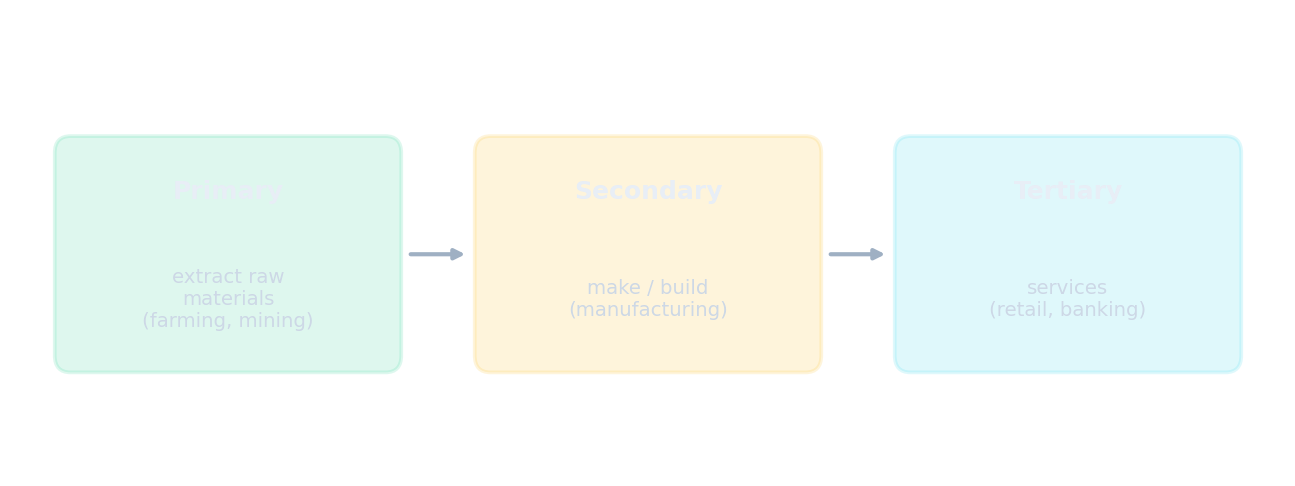
Raw materials (primary) are turned into goods (secondary) and sold as services (tertiary).
As a country develops, employment usually shifts towards the:
Difficulty 1/5 · 100 coins + a small bonus on first completion today
Developed economies are service-led.
The changing balance
- As a country develops, jobs shift from primary to secondary to tertiary.
- Rich economies are dominated by the tertiary (service) sector.

A company headquarters: businesses range from sole traders to public limited companies
The public sector is made up of organisations owned by:
Difficulty 1/5 · 100 coins + a small bonus on first completion today
Public sector = government-owned.
Private and public sector 公共部门
- Private sector 私营部门: businesses owned by individuals, aiming mainly for profit.
- Public sector: organisations owned by the government (e.g. state schools, hospitals).
Don't confuse "public sector" with "public limited company". The public sector is government-owned. A public limited company is privately owned by shareholders 股东 — it just sells shares to the public.
You've got it
- three sectors: primary (extract), secondary (make), tertiary (services)
- development shifts activity toward the tertiary sector
- private sector = privately owned (profit); public sector = government-owned