Skip to content · ⁨ข้ามไปยังเนื้อหา⁩

Development and Learning · ⁨การพัฒนาและการเรียนรู้⁩

AP Psychology · ⁨AP จิตวิทยา⁩ · Topic 3 · ⁨หัวข้อ 3⁩

Video lesson for this topic · ⁨บทเรียนวิดีโอสำหรับหัวข้อนี้⁩ Open the video page · ⁨เปิดหน้าวิดีโอ⁩
12:18

การพัฒนาและการเรียนรู้

เด็กอายุสี่ปียกแก้วลูกบอลหนักขึ้นมาแล้วพยายามกระแทกกับพื้น เขาไม่ได้ทำอย่างไร้สาระ เขาเคยมีกฎสำหรับของทรงกลม: ของทรงกลมต้องเด้ง...

English narration · English + 中文 subtitles burned in · ⁨การบรรยายภาษาอังกฤษ · คำบรรยายภาษาอังกฤษ + 中文 ลอยตัวบนภาพ⁩

3.1

Studying Development · ⁨การศึกษาพัฒนาการ⁩

Syllabus · ⁨หลักสูตร⁩
English

Learning Objective 3.1.A: Explain how enduring themes inform developmental psychology.

  • 3.1.A.1 Developmental psychology is concerned with both chronological order of development and/ or thematic issues in development across the lifespan. Thematic issues of interest to developmental psychologists include stability and change, nature and nurture, and continuous and discontinuous stages of development.

Learning Objective 3.1.B: Describe ways cross-sectional and longitudinal research design methods used in developmental psychology inform understanding about behavior and mental processes.

ไทย

จุดประสงค์การเรียนรู้ 3.1.A: อธิบายว่าแนวคิดที่ยั่งยืน informs จิตวิทยาพัฒนาการอย่างไร

  • 3.1.A.1 จิตวิทยาพัฒนาการสนใจทั้งลำดับเวลาของการพัฒนาและ/หรือประเด็นเชิงแนวคิดในการพัฒนาตลอดช่วงชีวิต ประเด็นเชิงแนวคิดที่น่าสนใจสำหรับนักจิตวิทยาพัฒนาการรวมถึงความมั่นคงและการเปลี่ยนแปลง ธรรมชาติและการเลี้ยงดู และขั้นตอนการพัฒนาอย่างต่อเนื่องและไม่ต่อเนื่อง

จุดประสงค์การเรียนรู้ 3.1.B: อธิบายวิธีการวิจัยแบบ cross-sectional และ longitudinal ที่ใช้ในจิตวิทยาพัฒนาการ ช่วยให้ความเข้าใจเกี่ยวกับพฤติกรรมและกระบวนการทางจิตใจ

Source: College Board AP Course and Exam Description · ⁨แหล่งที่มา: คำอธิบายหลักสูตรและข้อสอบ College Board AP⁩

English

Developmental psychology 发展心理学 studies how people change across the lifespan. Two questions run through the whole unit.

  • Is change continuous 连续的 (gradual and smooth) or discontinuous 不连续的 (in stages)?
  • Is a trait stable 稳定的 across life, or does it change?

Researchers answer these with two designs. A cross-sectional study 横断研究 compares different age groups at one time - fast, but differences may come from the groups' different generations. A longitudinal study 纵向研究 follows the same people over years - slower, but it shows real change within a person.

ไทย

จิตวิทยาพัฒนาการ ศึกษาว่าผู้คนเปลี่ยนแปลงอย่างไรตลอดชีวิต มีสองคำถามที่贯穿ทั้งหน่วย

  • การเปลี่ยนแปลงเป็น ต่อเนื่อง (ค่อยเป็นค่อยไปและราบรื่น) หรือ ไม่ต่อเนื่อง (เป็นขั้น)?
  • สัมภาระเป็น มั่นคง ตลอดชีวิต หรือไม่?

นักวิจัยตอบคำถามเหล่านี้ด้วยการออกแบบสองแบบ การศึกษาแบบข้ามระยะ เปรียบเทียบกลุ่มอายุต่างกันในเวลาเดียว - เร็ว แต่ความแตกต่างอาจมาจาก generación ที่ต่างกันของกลุ่ม การศึกษาแบบตามตัว ติดตามคนกลุ่มเดียวกันเป็นเวลานาน - ช้ากว่า แต่แสดงการเปลี่ยนแปลงจริงภายในบุคคล

3.2

Physical Development · ⁨การพัฒนาทางกายภาพ⁩

Syllabus · ⁨หลักสูตร⁩
English

Learning Objective 3.2.A: Explain how physical development before birth applies to behavior and mental processes.

  • 3.2.A.1 Teratogens, maternal illness, genetic mutations, hormonal, and environmental factors can influence the major physical and psychological milestones that occur during prenatal development.
    • Exclusion Statement: The stages of prenatal development (zygote, embryo, and fetus) are outside the scope of the AP Psychology Exam.

Learning Objective 3.2.B: Explain how physical development in infancy and childhood apply to behavior and mental processes.

  • 3.2.B.1 Physical development in infancy and childhood happens in generally the same order, but the timing of the development can vary. The development of fine and gross motor coordination is among the major physical and psychological milestones that define infancy and childhood. These physical skills develop as children mature, allowing children to develop critical skills needed to become more independent.
  • 3.2.B.2 Infants possess reflexes, like the rooting reflex, that indicate on-track physical and psychological milestone development.
  • 3.2.B.3 Research using the visual cliff apparatus demonstrates an early ability in infants to perceive depth and an innovative way to assess infant responses.
  • 3.2.B.4 Research suggests that critical or sensitive periods in infancy and childhood have strong developmental effects, especially for skills such as language. Some non-human animals will imprint on the first object they encounter as a means of survival.

Learning Objective 3.2.C: Explain how physical development in adolescence applies to behavior and mental processes.

  • 3.2.C.1 The main physical and psychological milestones that occur in adolescence are the adolescent growth spurt and puberty, in which reproductive ability develops. Adolescents develop primary and secondary sex characteristics during this time, such as menarche and spermarche.

Learning Objective 3.2.D: Explain how physical development in adulthood applies to behavior and mental processes.

  • 3.2.D.1 Adulthood spans most of the lifespan and is characterized by a general leveling off and then a varying decline in reproductive ability (i.e., menopause), mobility, flexibility, reaction time, and visual and auditory sensory acuity.
ไทย

จุดประสงค์การเรียนรู้ 3.2.A: อธิบายว่าการพัฒนาทางกายภาพก่อนเกิดมีผลต่อพฤติกรรมและกระบวนการทางจิตใจอย่างไร

  • 3.2.A.1 Teratogens, โรคของแม่, การกลายพันธุ์ทางพันธุกรรม,ฮอร์โมน และปัจจัยสิ่งแวดล้อมสามารถส่งผลต่อäge development ทางกายภาพและจิตวิทยาหลักที่เกิดขึ้นระหว่างการพัฒนาก่อนเกิด
    • ข้อความยกเว้น: ขั้นตอนของการพัฒนาก่อนเกิด (zygote, embryo และ fetus) อยู่นอกขอบเขตของการสอบ AP Psychology

จุดประสงค์การเรียนรู้ 3.2.B: อธิบายว่าการพัฒนาทางกายภาพในวัยทารกและเด็กมีผลต่อพฤติกรรมและกระบวนการทางจิตใจอย่างไร

  • 3.2.B.1 การพัฒนาทางกายภาพในวัยทารกและเด็กเกิดขึ้นโดยทั่วไปตามลำดับเดียวกัน แต่ช่วงเวลาของการพัฒนาอาจแตกต่างกัน การพัฒนาการประสานงานของกล้ามเนื้อละเอียดและกล้ามเนื้อใหญ่เป็นหนึ่งในäge development ทางกายภาพและจิตวิทยาหลักที่กำหนดวัยทารกและเด็ก ทักษะทางกายเหล่านี้พัฒนาขึ้นเมื่อเด็กเติบโต ทำให้เด็กสามารถพัฒนาทักษะสำคัญที่ต้องการเพื่อให้เป็นอิสระมากขึ้น
  • 3.2.B.2 ทารกมี refleks เช่น rooting reflex ซึ่งบ่งชี้ว่าäge development ทางกายภาพและจิตวิทยาดำเนินไปตามปกติ
  • 3.2.B.3 การวิจัยโดยใช้ visual cliff apparatus แสดงให้เห็นถึงความสามารถเบื้องต้นในทารกในการรับรู้ความลึกและวิธีการนวัตกรรมในการประเมินการตอบสนองของทารก
  • 3.2.B.4 การวิจัยชี้ให้เห็นว่าช่วงเวลาสำคัญหรือช่วงเวลาไว (critical or sensitive periods) ในวัยทารกและเด็กมีผลต่อการพัฒนาอย่างรุนแรง โดยเฉพาะสำหรับทักษะเช่นภาษา สัตว์ที่ไม่ใช่มนุษย์จะมี imprinting กับวัตถุแรกที่ได้พบเห็นในฐานะ Means of Survival

จุดประสงค์การเรียนรู้ 3.2.C: อธิบายว่าการพัฒนาทางกายภาพในวัยรุ่นมีผลต่อพฤติกรรมและกระบวนการทางจิตใจอย่างไร

  • 3.2.C.1 äge development ทางกายภาพและจิตวิทยาหลักที่เกิดขึ้นในวัยรุ่นคือการเพิ่มสูงขึ้นอย่างรวดเร็วของวัยรุ่น (adolescent growth spurt) และ青春期 (puberty) ซึ่งความสามารถในการสืบพันธุ์พัฒนาขึ้น วัยรุ่นพัฒนาลักษณะเพศหลักและลักษณะเพศรองในช่วงเวลานี้ เช่น menarche และ spermarche

จุดประสงค์การเรียนรู้ 3.2.D: อธิบายว่าการพัฒนาทางกายภาพในวัยผู้ใหญ่มีผลต่อพฤติกรรมและกระบวนการทางจิตใจอย่างไร

  • 3.2.D.1 วัยผู้ใหญ่ครอบคลุมส่วนใหญ่ของช่วงชีวิต และมีลักษณะเป็นการชะลอตัวลงโดยทั่วไปแล้วตามด้วยการลดลงที่แตกต่างกันในความสามารถในการสืบพันธุ์ (เช่น ภาวะหมดประจำเดือน), การเคลื่อนไหว, ความยืดหยุ่น, เวลาตอบสนอง, และความไวของประสาทสัมผัสทางสายตาและเสียง

Source: College Board AP Course and Exam Description · ⁨แหล่งที่มา: คำอธิบายหลักสูตรและข้อสอบ College Board AP⁩

English

Development before birth can be disrupted by teratogens 致畸物 (harmful agents such as alcohol), maternal illness, genetic mutations, and hormonal or environmental factors.

Infant physical development follows the same general order everywhere, though the rate varies. Newborns show reflexes 反射 that indicate healthy development, such as the rooting reflex 觅食反射 (turning towards a touch on the cheek). The visual cliff 视崖 experiment shows that infants perceive depth early.

A critical period 关键期 is a window in which a particular experience has an unusually strong effect; a sensitive period 敏感期 is a softer version of the same idea.

Adolescence 青春期 brings the adolescent growth spurt 青春期发育突增 and puberty 青春发育期, including primary sex characteristics 第一性征 and secondary sex characteristics 第二性征. Adulthood spans most of life and is marked by a gradual levelling off, then decline - including menopause 更年期 in women.

ไทย

การพัฒนาก่อนเกิดสามารถถูกรบกวนโดย สารก่อความผิดปกติ (ปัจจัยอันตรายเช่นแอลกอฮอล์), โรคของแม่, การกลายพันธุ์ทางพันธุกรรม, และปัจจัยทางฮอร์โมนหรือสิ่งแวดล้อม

การพัฒนาทางกายภาพของทารก遵循相同的顺序 everywhere, แม้速度的 varies. ทารกแสดง ปฏิกิริยาสะท้อนกลับ ที่บ่งบอกการพัฒนาที่ดี เช่น ปฏิกิริยาระบุตำแหน่ง (หันไปหาสัมผัสที่แก้ม) การทดลอง บันไดสายตา แสดงว่าทารกรับรู้ความลึกตั้งแต่ต้น

ช่วงเวลาวิกฤต เป็นช่วงเวลาที่มีประสบการณ์เฉพาะมีผลอย่างน่าประหลาด; ช่วงไวต่อการตอบสนอง เป็นเวอร์ชันที่อ่อนโยนกว่าของแนวคิดเดียวกัน

วัยรุ่น นำมาซึ่ง ช่วงการเติบโตอย่างรวดเร็วของวัยรุ่น และ วัยเจริญพันธุ์ รวมถึง ลักษณะเพศปฐมภูมิ และ ลักษณะเพศทุติยภูมิ วัยผู้ใหญ่ครอบคลุมส่วนหนึ่งของชีวิตและมีลักษณะการชะลอตัวลง gradual แล้วลดลง - بما包括 วัยหมดประจำเดือน ในผู้หญิง

3.3

Gender and Sexual Orientation · ⁨เพศและ Orientation ทางเพศ⁩

Syllabus · ⁨หลักสูตร⁩
English

Learning Objective 3.3.A: Describe how sex and gender influence socialization and other aspects of development.

ไทย

จุดประสงค์การเรียนรู้ 3.3.A: อธิบายว่าเพศและ Gender ส่งผลต่อ socialization และด้านอื่นๆ ของการพัฒนาอย่างไร

Source: College Board AP Course and Exam Description · ⁨แหล่งที่มา: คำอธิบายหลักสูตรและข้อสอบ College Board AP⁩

English

Sex 生理性别 refers to biological characteristics, while gender 社会性别 refers to the roles and expectations a society attaches to them. Gender roles 性别角色 are learned through socialization 社会化: family, school, peers, and media all teach what behaviour is expected. Sexual orientation 性取向 describes a person's enduring pattern of attraction. The exam asks how sex and gender influence socialization and development, not for any evaluation of individuals.

ไทย

เพศ (Sex) หมายถึงลักษณะทางชีวภาพ ในขณะที่ เพศสภาพ (Gender) หมายถึงบทบาทและความคาดหวังที่สังคมมอบให้ บทบาททางเพศ ถูกเรียนรู้ผ่านกระบวนการ สังคมวิทยา: ครอบครัว โรงเรียน เพื่อนร่วมวัย และสื่อต่าง ๆ都在สอนว่าพฤติกรรมใดเป็นที่คาดหวัง แนวโน้มทางเพศ อธิบายรูปแบบความดึงดูดใจที่ยั่งยืนของบุคคล การสอบถามถึงวิธีที่เพศและเพศสภาพมีอิทธิพลต่อการสังคมวิทยาและการพัฒนา ไม่ใช่การประเมินบุคคล

Vocabulary · ⁨คำศัพท์⁩ Train · ⁨ฝึกฝน⁩
English ไทย
Sex/seks/ Sex
gender/ˈdʒendə/ เพศสภาพ
Gender roles/ˈdʒendə rəʊlz/ บทบาททางเพศ
socialization/ˌsəʊʃəlaɪˈzeɪʃn/ การสร้าง社会化 (Socialization)
Sexual orientation/ˈsekʃuːəl ˌɔːrɪənˈteɪʃn/ แนวโน้มทางเพศ
3.4

Cognitive Development · ⁨การพัฒนาทางปัญญา⁩

Syllabus · ⁨หลักสูตร⁩
English

Learning Objective 3.4.A: Explain how theories of cognitive development apply to behavior and mental processes.

  • 3.4.A.1 According to Piaget, children develop schemas via continuous and discontinuous processes such as assimilation and accommodation.
    • 3.4.A.1.i The sensorimotor stage occurs from infancy through toddlerhood. Object permanence develops during this stage.
    • 3.4.A.1.ii The preoperational stage occurs from toddlerhood through early childhood. Children become proficient in using mental symbols and engage in pretend play. The preoperational stage is identified more by cognitive tasks children cannot perform such as conservation and reversibility, or by those they exhibit, such as animism and egocentrism. Children begin to develop a theory of mind during this stage.
    • 3.4.A.1.iii The concrete operational stage occurs from early through late childhood. Children in this stage can generally correct the cognitive errors made in the preoperational stage and understand the world in logical, realistic, and straightforward ways, but struggle to think systematically.
    • 3.4.A.1.iv The formal operational stage occurs from late childhood through adulthood. People in this stage gain the ability to think abstractly and hypothetically. Piaget proposed that not all people achieve formal operational thinking.
  • 3.4.A.2 According to Vygotsky, children are social learners who learn through interacting with and scaffolding by other people within sociocultural contexts. Ideally, learning occurs while the person is in their zone of proximal development.
  • 3.4.A.3 Adults experience changes in cognitive capabilities as they progress through the lifespan. Crystallized intelligence remains relatively stable through adulthood while fluid intelligence tends to wane as people age. Cognitive disorders that affect adults include dementia.
ไทย

จุดประสงค์การเรียนรู้ 3.4.A: อธิบายว่าทฤษฎีการพัฒนาทางปัญญาประยุกต์ใช้กับพฤติกรรมและกระบวนการทางจิตใจได้อย่างไร

  • 3.4.A.1 ตามที่Piaget กล่าวว่า เด็กพัฒนา schemas ผ่านกระบวนการต่อเนื่องและไม่ต่อเนื่อง เช่น assimilation และ accommodation
    • 3.4.A.1.i ระยะ sensorimotor เกิดขึ้นตั้งแต่วัยทารกจนถึงวัยเด็กเล็ก Object permanence พัฒนาขึ้นในระยะนี้
    • 3.4.A.1.ii ระยะก่อนการดำเนินการ (preoperational stage) เกิดขึ้นตั้งแต่วัยเด็กเล็กจนถึงวัยเด็กต้นๆ เด็กๆ จะมีความสามารถในการใช้สัญลักษณ์ทางความคิดและมีการเล่นสมมติ. ระยะก่อนการดำเนินการถูกจำแนกมากกว่าจากงานทางปัญญาที่เด็กๆ ทำไม่ได้ เช่น conservation and reversibility, หรือสิ่งที่พวกเขาแสดงออก เช่น animism and egocentrism. เด็กเริ่มพัฒนา theory of mind ในช่วงนี้
    • 3.4.A.1.iii ระยะการดำเนินการแบบรูปธรรม (concrete operational stage) เกิดขึ้นตั้งแต่วัยเด็กต้นถึงวัยเด็กปลาย. เด็กในระยะนี้โดยทั่วไปสามารถแก้ไขข้อผิดพลาดทางปัญญาที่ทำในระยะ preoperational และเข้าใจโลกในวิธีที่เป็นตรรกะ สมจริง และตรงไปตรงมา, แต่ยังคิดอย่างเป็นระบบไม่เก่ง
    • 3.4.A.1.iv ระยะการดำเนินการแบบรูปธรรม (formal operational stage) เกิดขึ้นตั้งแต่วัยเด็กปลายจนถึงวัยผู้ใหญ่. คนในระยะนี้ได้รับความสามารถในการคิดแบบนามธรรมและสมมติ. Piaget เสนอว่าไม่ใช่ทุกคนที่จะบรรลุการคิดแบบ formal operational
  • 3.4.A.2 ตามแนวคิดของ Vygotsky เด็กๆ เป็นผู้เรียนทางสังคมที่เรียนรู้ผ่านการมีปฏิสัมพันธ์และการสนับสนุนจากผู้อื่นภายในบริบททางสังคมและวัฒนธรรม โดย理想แล้ว การเรียนรู้จะเกิดขึ้นขณะที่บุคคลอยู่ใน "เขตพัฒนาการระหว่าง" (zone of proximal development)
  • 3.4.A.3 ผู้ใหญ่จะเกิดการเปลี่ยนแปลงในศักยภาพทางปัญญาเมื่อผ่านช่วงชีวิตไป ความฉลาดแบบผลึก (crystallized intelligence) จะคงที่ relatif ตลอดวัยผู้ใหญ่ ในขณะที่ความฉลาดแบบไหล (fluid intelligence) มักจะลดลงเมื่อคนอายุมากขึ้น Disorders ทางปัญญาที่มีผลต่อผู้ใหญ่อีกด้วย ได้แก่ โรคอัลไซเมอร์ (dementia)

Source: College Board AP Course and Exam Description · ⁨แหล่งที่มา: คำอธิบายหลักสูตรและข้อสอบ College Board AP⁩

English

Piaget 皮亚杰 proposed that children build schemas and pass through four stages:

  • Sensorimotor stage 感知运动阶段 (infancy to toddlerhood): the child learns through senses and action, and develops object permanence 客体永久性 - knowing an object still exists when hidden.
  • Preoperational stage 前运算阶段 (toddlerhood to early childhood): the child uses symbols and pretend play but shows egocentrism 自我中心 (difficulty taking another view) and lacks conservation 守恒 (knowing quantity stays the same when shape changes).
  • Concrete operational stage 具体运算阶段 (early to late childhood): the child reasons logically about concrete things and gains conservation.
  • Formal operational stage 形式运算阶段 (late childhood onward): abstract and hypothetical reasoning becomes possible.

Vygotsky 维果茨基 saw children as social learners. The zone of proximal development 最近发展区 is the gap between what a child can do alone and what they can do with help; scaffolding 支架 is the support that closes it.

Adult cognition changes too, and here the fluid/crystallised split from Unit 2 returns: reasoning speed declines while accumulated knowledge does not. Dementia 痴呆 is a decline beyond normal ageing.

ไทย
สี่ขั้นตอนของ Piaget ในรูปบันได แต่ละขั้นมีช่วงอายุและความสำเร็จที่กำหนดไว้
สี่ขั้นตอนของ Piaget แต่ละขั้นกำหนดโดยสิ่งที่เด็กสามารถทำได้ใหม่

Piaget เสนอว่าเด็กสร้าง สคีมา (schemas) และผ่านสี่ขั้นตอน:

  • ขั้นตอน sensori-motor (ทารกแรกเกิดถึงเด็กเล็ก): เด็กเรียนรู้ผ่านประสาทสัมผัสและการกระทำ และพัฒนา ความเป็นอยู่ของวัตถุ (object permanence) - คือการรู้ว่าวัตถุยังคงมีอยู่แม้จะถูกซ่อน
  • ขั้นตอนก่อนการคิดเชิงสัญลักษณ์ (Preoperational stage) (เด็กเล็กถึงวัยเด็กต้น): เด็กใช้สัญลักษณ์และการเล่นสมมติ แต่แสดง ความยึดติดกับตนเอง (egocentrism) (ยากที่จะมองจากมุมมองคนอื่น) และขาด การอนุรักษ์ (conservation) (การรู้ว่าปริมาณคงเดิมเมื่อรูปร่างเปลี่ยน)
  • ขั้นตอนการคิดเชิงประจักษ์ (Concrete operational stage) (วัยเด็กต้นถึงปลาย): เด็กใช้เหตุผลเกี่ยวกับสิ่งที่เป็นรูปธรรมและได้มาซึ่งการอนุรักษ์
  • ขั้นตอนการคิดเชิงนามธรรม (Formal operational stage) (ตั้งแต่วัยเด็กปลายขึ้นไป): การคิดเชิงนามธรรมและสมมติเป็นไปได้อีกต่อไป

Vygotsky มองเด็กเป็นผู้เรียนทางสังคม เขตการพัฒนาแบบ毗邻 (zone of proximal development) คือช่องว่างระหว่างสิ่งที่เด็กทำได้เองกับสิ่งที่ทำได้ด้วยความช่วยเหลือ; โครงร่างรองรับ (scaffolding) คือการสนับสนุนที่ใช้ปิดช่องว่างนี้

ความคิดของผู้ใหญ่ก็เปลี่ยนแปลงเช่นกัน และในที่นี้การแบ่งแยกด้านไหล/ผลึก (fluid/crystallised split) จากยูนิตที่ 2 กลับมา: ความเร็วในการคิดลดลงในขณะที่ความรู้ที่สะสมไม่ลดลง โรคสมองเสื่อม (Dementia) คือการลดลงที่เกินกว่าการแก่ตามวัย

Vocabulary · ⁨คำศัพท์⁩ Train · ⁨ฝึกฝน⁩
English ไทย
Piaget/ˈpaɪəɡɪt/ 皮亚杰
Sensorimotor stage/ˈsensɔːrɪməʊtə steɪdʒ/ ระยะ sensori-motor
object permanence/ˈɒbdʒekt ˈpɜːmənəns/ object permanence
Preoperational stage/prɪəʊˈpreɪʃənl steɪdʒ/ ระยะก่อนการดำเนินการ
egocentrism/ˈiːɡəʊsentrɪzəm/ egocentrism
conservation/ˌkɒnsəˈveɪʃn/ conservation
Concrete operational stage/ˈkɒŋkriːt ˌɒpəˈreɪʃənl steɪdʒ/ ระยะดำเนินการเชิงรูปธรรม
Formal operational stage/ˈfɔːml ˌɒpəˈreɪʃənl steɪdʒ/ ระยะดำเนินการเชิงนามธรรม
Vygotsky/vaɪˈɡɒtski/ 维果茨基
zone of proximal development/zəʊn ɒv ˈprɒksɪml dɪˈveləpmənt/ เขตพัฒนาการโดยรอบ
scaffolding/ˈskæfəʊldɪŋ/ โครงรองรับ (Scaffolding)
Dementia/dɪˈmenʃə/ ภาวะสมองเสื่อม
Language/ˈlæŋɡwɪdʒ/ ภาษา
gestures/ˈdʒestʃəz/ ท่าทาง
3.5

Language Development · ⁨การพัฒนาภาษา⁩

Syllabus · ⁨หลักสูตร⁩
English

Learning Objective 3.5.A: Explain how key components of language and communication apply to behavior and mental processes.

  • 3.5.A.1 Language is a shared (mutually agreed upon) system of arbitrary symbols (often expressed as and combined into phonemes, morphemes, and semantics) that are rule-governed (via grammar and syntax) and generative to produce an infinity of ideas.
    • Exclusion Statement: Pragmatics of language are outside the scope of the AP Psychology Exam.

Learning Objective 3.5.B: Explain how language develops in humans.

  • 3.5.B.1 In language development across all cultures, people use nonverbal manual gestures (e.g., pointing) to communicate and develop formal language through specific stages (cooing, babbling, one-word stage, and telegraphic speech). People learning a language often make errors such as overgeneralization of language rules as they learn.
ไทย

วัตถุประสงค์การเรียนรู้ 3.5.A: อธิบายว่าองค์ประกอบหลักของภาษาและการสื่อสารมีผลต่อพฤติกรรมและกระบวนการทางจิตใจอย่างไร

  • 3.5.A.1 ภาษาคือระบบสัญลักษณ์ที่ตกลงร่วมกัน (arbitrary symbols) ซึ่งมักแสดงออกหรือรวมกันเป็น phonemes, morphemes และ semantics ที่ถูกกำหนดโดยกฎเกณฑ์ (ผ่านไวยากรณ์และ_syntax) และมีคุณสมบัติในการสร้าง (generative) เพื่อผลิตไอเดียที่ไม่จำกัดจำนวน
    • ข้อยกเว้น: Pragmatics ของภาษานอกเหนือขอบเขตของการสอบ AP Psychology

วัตถุประสงค์การเรียนรู้ 3.5.B: อธิบายการพัฒนาภาษาในมนุษย์

  • 3.5.B.1 ในการพัฒนาภาษาAcross ทุกวัฒนธรรม มนุษย์ใช้ท่าทางไม่ใช้คำพูด (เช่น การชี้) เพื่อสื่อสารและพัฒนาภาษาที่เป็นทางการผ่านขั้นตอนเฉพาะ (cooing, babbling, one-word stage, และ telegraphic speech) ผู้ที่กำลังเรียนรู้ภาษาอาจทำข้อผิดพลาดได้ เช่น การ generalize กฎภาษาเกินจำเป็นขณะเรียนรู้

Source: College Board AP Course and Exam Description · ⁨แหล่งที่มา: คำอธิบายหลักสูตรและข้อสอบ College Board AP⁩

English

Language 语言 is a shared system of arbitrary symbols used to communicate. Development follows a common sequence: nonverbal gestures 手势, then cooing 咕咕声, babbling 咿呀语, the one-word stage 单词阶段, and telegraphic speech 电报式语言 (two-word combinations).

Children generalise rules before they master exceptions, which produces overgeneralization 过度规则化 - saying "goed" instead of "went". This is evidence that they are learning rules, not just copying.

ไทย

ภาษา เป็นระบบสัญลักษณ์ตามสุ่มที่ร่วมกันใช้เพื่อสื่อสาร การพัฒนาเป็นไปตามลำดับทั่วไป: กายภาษารูป是非 verbal ท่าทาง, แล้วเป็น เสียงคราง (cooing), เสียงบอกลำลอง (babbling), ระยะคำเดียว, และ ภาษาแบบโทรกราฟ (telegraphic speech) (การรวมสองคำ)

เด็กนำกฎไปใช้กว้างก่อนจะเข้าใจข้อยกเว้น ซึ่งทำให้เกิด การนำไปใช้กว้างเกินไป (overgeneralization) - เช่น บอกว่า "goed" แทน "went" นี่คือหลักฐานว่าพวกเขากำลังเรียนรู้กฎ ไม่ใช่แค่ลอกเลียนแบบ

Vocabulary · ⁨คำศัพท์⁩ Train · ⁨ฝึกฝน⁩
English ไทย
cooing/ˈkuːɪŋ/ เสียงคราง (cooing)
babbling/ˈbæblɪŋ/ เสียงอู้อู (babbling)
one-word stage/wʌn wɜːd steɪdʒ/ ระยะคำเดียว
telegraphic speech/ˌtelɪˈɡræfɪk spiːtʃ/ ภาษาแบบโทรกราฟิก
overgeneralization/ˌəʊvəˌdʒenərəlaɪˈzeɪʃn/ การขยายความหมายเกินจริง
Generalization/ˌdʒenərəlaɪˈzeɪʃn/ การ generalize
3.6

Social and Emotional Development · ⁨การพัฒนาทางสังคมและอารมณ์⁩

Syllabus · ⁨หลักสูตร⁩
English

Learning Objective 3.6.A: Explain how social development relates to behavior and mental processes.

  • 3.6.A.1 The ecological systems theory explores how the social environment influences development. The five systems in this theory are as follows: Bullet Microsystem (groups that have direct contact with the individual) Bullet Mesosystem (the relationships between groups in the microsystem) Bullet Exosystem (indirect factors in an individual’s life) Bullet Macrosystem (cultural events that affect the individuals and others around them) Bullet Chronosystem (the individual’s current stage of life).
  • 3.6.A.2 Research has identified different parenting styles of caregivers, including authoritarian, authoritative, and permissive. Cultural differences exist in the ways these parenting styles affect outcomes in caregivers and children.
  • 3.6.A.3 Research has identified different attachment styles demonstrated by infants and children, which vary by culture. The types of attachment infants and children display include secure and insecure (avoidant, anxious, and disorganized). Temperament is related to how children attach to caregivers.
    • 3.6.A.3.i Separation anxiety occurs when children express heightened anxiety or fear when away from a caregiver or in the presence of a stranger.
    • 3.6.A.3.ii Studies with monkeys demonstrate the importance of comfort over food in attachment.
  • 3.6.A.4 Developmental psychologists study how peer relationships develop over time.
    • 3.6.A.4.i Children engage with peers via play (parallel and pretend).
    • 3.6.A.4.ii Adolescents gradually rely more on peer relationships as they age. As adolescents interact with peers, they demonstrate a type of egocentrism that is often demonstrated via the imaginary audience and the personal fable.
  • 3.6.A.5 Developmental psychologists study how adults develop socially over time.
    • 3.6.A.5.i Culture plays a role in determining when adulthood begins and when major life events occur (social clock). Some cultures allow for a time of emerging adulthood as a transition from adolescence to adulthood.
    • 3.6.A.5.ii Relationships with other adults result in adults forming families or family-like relationships that should provide mutual support and care. Childhood attachment styles can affect how adults form attachments to other adults.
  • 3.6.A.6 The stage theory of psychosocial development, which was a reconceptualization of the psychosexual theory, proposes that people must resolve psychosocial conflicts at each stage of the lifespan. The stages are as follows: Bullet Trust and mistrust Bullet Autonomy and shame and doubt Bullet Initiative and guilt Bullet Industry and inferiority Bullet Identity and role confusion Bullet Intimacy and isolation Bullet Generativity and stagnation Bullet Integrity and despair
    • Exclusion Statement: The psychosexual stage theory of development is outside of the scope of the AP Psychology Exam.
  • 3.6.A.7 The experience of adverse childhood experiences (ACEs) has effects on relationships people form throughout the lifespan. Sociocultural differences exist in what is considered an ACE and how ACEs affect outcomes people may experience.
  • 3.6.A.8 Adolescents develop a sense of identity for who they will be as an adult through the processes of achievement, diffusion, foreclosure, and moratorium. Identity development also includes processes for developing identities such as racial/ethnic identity, gender identity, sexual orientation, religious identity, occupational identity, and familial identity, often through considering possible selves.
ไทย

วัตถุประสงค์การเรียนรู้ 3.6.A: อธิบายว่าพัฒนาการทางสังคมเกี่ยวข้องกับพฤติกรรมและกระบวนการทางจิตใจอย่างไร

  • 3.6.A.1 ทฤษฎีระบบนิเวศ (ecological systems theory) สำรวจว่าสภาพแวดล้อมทางสังคมมีผลต่อการพัฒนาอย่างไร ระบบทั้งห้าในทฤษฎีนี้นั้นประกอบด้วย: Bullet Microsystem (กลุ่มที่มีปฏิสัมพันธ์โดยตรงกับบุคคล) Bullet Mesosystem (ความสัมพันธ์ระหว่างกลุ่มภายใน microsystem) Bullet Exosystem (ปัจจัยทางอ้อมในชีวิตของบุคคล) Bullet Macrosystem (เหตุการณ์ทางวัฒนธรรมที่มีผลต่อบุคคลและคนรอบข้าง) Bullet Chronosystem (ช่วงวัยปัจจุบันของบุคคล)
  • 3.6.A.2 งานวิจัยได้ระบุรูปแบบการเลี้ยงดู的不同ของ caregivers รวมถึง authoritarian, authoritative และ permissive มีความแตกต่างทางวัฒนธรรมในวิธีที่รูปแบบการเลี้ยงดูเหล่านี้ส่งผลต่อผลลัพธ์ของทั้ง caregiver และเด็ก
  • 3.6.A.3 งานวิจัยได้ระบุรูปแบบการยึดติด (attachment styles) ที่เด็กทารกและเด็กแสดงออก ซึ่งแตกต่างกันไปตามวัฒนธรรม ประเภทของการยึดติดที่เด็กทารกและเด็กแสดงออก ได้แก่ secure และ insecure (avoidant, anxious, และ disorganized) Temperament มีความสัมพันธ์กับวิธีการที่เด็กยึดติดกับ caregivers
    • 3.6.A.3.i ความกังวลจากการแยกจาก (separation anxiety) เกิดขึ้นเมื่อเด็กแสดงความกังวลหรือกลัวอย่างรุนแรงเมื่อห่างจาก caregiver หรือเมื่ออยู่หน้าแปลกหน้า
    • 3.6.A.3.ii การศึกษาบนลิงค์แสดงถึงความสำคัญของความสะดวกสบายมากกว่าอาหารในการยึดติด
  • 3.6.A.4 นักจิตวิทยาพัฒนาการศึกษาว่าความสัมพันธ์กับเพื่อนร่วมวัยพัฒนาขึ้นตามเวลาอย่างไร
    • 3.6.A.4.i เด็กๆ มีปฏิสัมพันธ์กับเพื่อนผ่านการเล่น (parallel play และ pretend play)
    • 3.6.A.4.ii วัยรุ่นค่อยๆ พึ่งพาความสัมพันธ์กับเพื่อนมากขึ้นเมื่ออายุเพิ่มขึ้น เมื่อวัยรุ่นมีปฏิสัมพันธ์กับเพื่อน พวกเขาแสดงออกถึง egocentrism แบบหนึ่งซึ่งมักปรากฏผ่าน imaginary audience และ personal fable
  • 3.6.A.5 นักจิตวิทยาพัฒนาการศึกษาว่าผู้ใหญ่มักพัฒนาการทางสังคมตามเวลาอย่างไร
    • 3.6.A.5.i วัฒนธรรมมีบทบาทในการกำหนดเมื่อวัยผู้ใหญ่เริ่มต้นขึ้นและเมื่อเหตุการณ์สำคัญในชีวิตเกิดขึ้น (social clock) บางวัฒนธรรมอนุญาตให้มีช่วง emerging adulthood เป็นการเปลี่ยนผ่านจากวัยรุ่นสู่วัยผู้ใหญ่
    • 3.6.A.5.ii ความสัมพันธ์กับผู้ใหญ่คนอื่นๆ นำไปสู่การสร้างครอบครัวหรือความสัมพันธ์คล้ายครอบครัวซึ่งควรให้การสนับสนุนและดูแลซึ่งกันและ Childhood attachment styles สามารถส่งผลต่อวิธีการที่ผู้ใหญ่อารมณ์สร้างการยึดติดกับผู้ใหญ่คนอื่น
  • 3.6.A.6 ทฤษฎีสเตจของการพัฒนา psychosocial ซึ่งเป็นการ reconceptualization ของ psychosexual theory เสนอว่าบุคคลต้องแก้ปัญหาขัดแย้ง psychosocial ในแต่ละสเตจของช่วงชีวิต สเตจต่างๆ ดังนี้: Bullet Trust and mistrust Bullet Autonomy and shame and doubt Bullet Initiative and guilt Bullet Industry and inferiority Bullet Identity and role confusion Bullet Intimacy and isolation Bullet Generativity and stagnation Bullet Integrity and despair
    • ข้อยกเว้น: ทฤษฎีสเตจ psychosexual ของการพัฒนาอยู่นอกขอบเขตของการสอบ AP Psychology
  • 3.6.A.7 ประสบการณ์童年ที่ยากลำบาก (ACEs) มีผลต่อความสัมพันธ์ที่บุคคลสร้างตลอดช่วงชีวิต มีความแตกต่างทางสังคมและวัฒนธรรมในเรื่องใด被视为 ACEs และผลของ ACEs ที่มีต่อผลลัพธ์ที่บุคคลอาจประสบ
  • 3.6.A.8 วัยรุ่นพัฒนาความรู้สึกถึงตัวตนว่าพวกเขาจะเป็นใครในฐานะผู้ใหญ่ ผ่านกระบวนการแห่งความสำเร็จ การกระจายตัว การตัดสินใจล่วงหน้า และการหยุดชะงัก การพัฒนาตัวตนยังรวมถึงกระบวนการในการสร้างตัวตนต่างๆ เช่น อัตลักษณ์ทางเชื้อชาติ/ชาติพันธุ์ อัตลักษณ์ทางเพศ ทิศทางทางเพศ อัตลักษณ์ทางศาสนา อัตลักษณ์ทางอาชีพ และอัตลักษณ์ทางครอบครัว มักจะเกิดจากการพิจารณาถึง "ตัวเองที่เป็นไปได้" (possible selves)

Source: College Board AP Course and Exam Description · ⁨แหล่งที่มา: คำอธิบายหลักสูตรและข้อสอบ College Board AP⁩

English

Ecological systems theory 生态系统理论 describes development as nested environments, from the immediate family outwards to culture.

Research identifies parenting styles 教养方式: authoritarian 专制型 (high demands, low warmth), authoritative 权威型 (high demands, high warmth), and permissive 放任型 (low demands, high warmth).

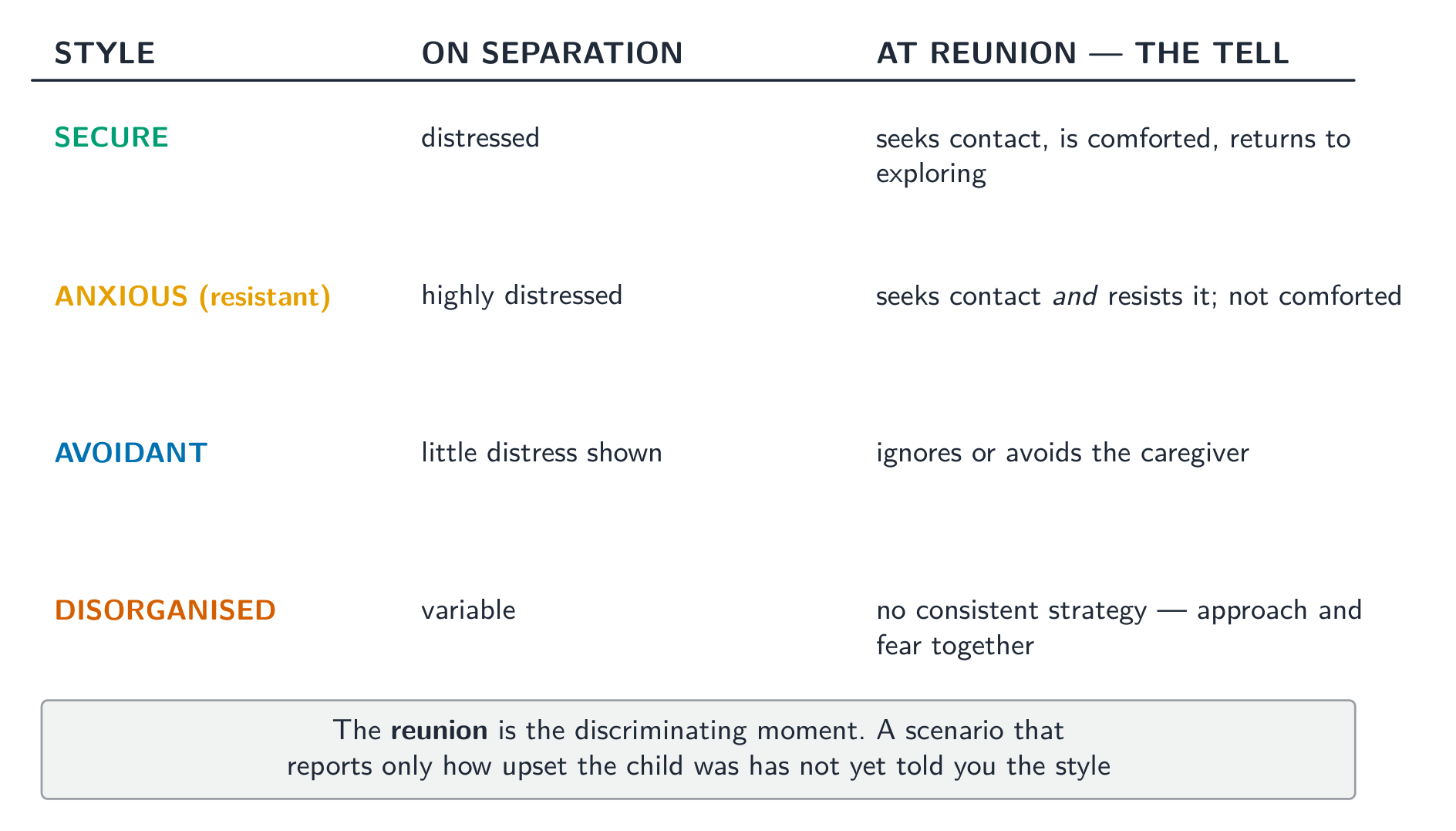
Attachment 依恋 is the emotional bond between infant and caregiver, studied with the strange situation 陌生情境 procedure. Styles include secure attachment 安全型依恋 and insecure forms (avoidant 回避型, anxious 焦虑型, disorganized 混乱型). Separation anxiety 分离焦虑 is heightened distress when away from a caregiver. Studies with monkeys showed that infants prefer contact comfort 接触安慰 over food, which changed how attachment was understood.

Peer relationships develop through parallel play 平行游戏 and pretend play 假装游戏 in childhood, and adolescents rely on peers more as they age.

Erikson 埃里克森 proposed a stage theory of psychosocial development 心理社会发展, in which each stage poses a conflict to resolve - the adolescent stage being identity versus role confusion 同一性与角色混乱. Adverse childhood experiences (ACEs) 童年不良经历 affect later relationships and health.

ไทย

ทฤษฎีระบบนิเวศ (Ecological systems theory) อธิบายการพัฒนาว่าเป็นสิ่งแวดล้อมที่ซ้อนกัน เริ่มจากครอบครัว terdekat ไปจนถึงวัฒนธรรม

งานวิจัยระบุ รูปแบบการเลี้ยงดู: แบบอำนาจนิยม (authoritarian) (ความต้องการสูง ความอบอุ่นต่ำ), แบบมีอำนาจแต่ให้ความรัก (authoritative) (ความต้องการสูง ความอบอุ่นสูง), และ แบบ宽松的 (permissive) (ความต้องการต่ำ ความอบอุ่นสูง)

การยึดติด (Attachment) คือความผูกพันทางอารมณ์ระหว่างเด็กทารกและผู้ดูแล ซึ่งศึกษาโดยใช้วิธีการ สถานการณ์แปลกใหม่ (strange situation) รูปแบบการยึดติดประกอบด้วย การยึดติดอย่างปลอดภัย (secure attachment) และรูปแบบที่ไม่ปลอดภัย ได้แก่ หลีกเลี่ยง (avoidant), กังวล (anxious), และ ไร้ระเบียบ (disorganized) ความวิตกกังวลจากการแยกจาก (Separation anxiety) คือความทุกข์ใจที่เพิ่มขึ้นเมื่อห่างจากผู้ดูแล การทดลองกับลิงแสดงให้เห็นว่าเด็กทารกให้ความสำคัญกับ ความสะดวกสบายจากการสัมผัส (contact comfort) มากกว่าอาหาร ซึ่งทำให้ความเข้าใจเรื่องการยึดติดเปลี่ยนแปลงไป

ความสัมพันธ์กับเพื่อนพัฒนาผ่าน การเล่นขนาน (parallel play) และ การเล่นสมมติ (pretend play) ในวัยเด็ก และวัยรุ่นพึ่งพาคู่同龄มากขึ้นเมื่อโตขึ้น

Erikson เสนอทฤษฎีขั้นตอนของการ พัฒนาทางจิตสังคม (psychosocial development) ซึ่งแต่ละขั้นตอนมีข้อขัดแย้งที่ต้องแก้ - ขั้นวัยรุ่นคือ อัตลักษณ์ vs ความสับสนในบทบาท (identity versus role confusion). ประสบการณ์ childhood ที่รุนแรง (ACEs) มีผลต่อความสัมพันธ์และสุขภาพในอนาคต

การกลับมารวมกันคือจุดสังเกตการณ์ที่สำคัญ ไม่ใช่การจากลา
Vocabulary · ⁨คำศัพท์⁩ Train · ⁨ฝึกฝน⁩
English ไทย
Ecological systems theory/ˌekəˈlɒdʒɪkl ˈsɪstəmz ˈθɪəri/ ทฤษฎีระบบนิเวศ
parenting styles/ˈpeərəntɪŋ staɪlz/ สไตล์การเลี้ยงดู
authoritarian/ˌɔːθɔːrɪˈteərɪən/ อำนาจนิยม
authoritative/ɔːˈθɒrɪtətɪv/ มีอำนาจและอบอุ่น (authoritative)
permissive/pəˈmɪsɪv/ 放行 (permissive)
Attachment/əˈtætʃmənt/ การยึดติด
strange situation/streɪndʒ ˌsɪtʃuːˈeɪʃn/ สถานการณ์แปลก
secure attachment/sɪˈkjʊə əˈtætʃmənt/ การยึดเหนี่ยวที่ปลอดภัย
avoidant/əˈvɔɪdənt/ หลีกเลี่ยง
anxious/ˈæŋʃəs/ กังวล
disorganized/dɪˈsɔːɡənaɪzd/ ไม่มีการจัดระเบียบ
Separation anxiety/ˌsepəˈreɪʃn æŋˈzaɪəti/ ความวิตกกังวลจากการแยกจาก
contact comfort/ˈkɒntækt ˈkʌmfət/ ความสะดวกสบายจากการสัมผัส
parallel play/ˈpærəlel pleɪ/ การเล่นแบบขนาน
pretend play/prɪˈtend pleɪ/ การเล่นสมมติ
Erikson/ˈerɪksn/ เอริกสัน
psychosocial development/ˈsaɪkəʊsəʊʃl dɪˈveləpmənt/ พัฒนาการทางจิตสังคม
identity versus role confusion/aɪˈdentɪti ˈvɜːsɪz rəʊl kənˈfjuːʒn/ อัตลักษณ์เทียบเท่ากับความสับสนในบทบาท
Adverse childhood experiences (ACEs)/ædˈvɜːs ˈtʃaɪldhʊd ekˈspɪərɪənsɪz/ ประสบการณ์วัยเด็กที่เลวร้าย (ACEs)
3.7

Classical Conditioning · ⁨การเงื่อนไขแบบคลาสสิก⁩

Syllabus · ⁨หลักสูตร⁩
English

Learning Objective 3.7.A: Explain how classical conditioning applies to behavior and mental processes.

  • 3.7.A.1 The behavioral perspective evolved from theories about learning via conditioning. Behaviorists have traditionally focused on observable behavior to the exclusion of mental processes.
  • 3.7.A.2 Classical conditioning focuses on the association of one stimulus with another stimulus to elicit a response. Learning the association (also known as acquisition) involves a series of steps that demonstrate principles of associative learning.
    • 3.7.A.2.i The unconditioned stimulus (UCS) elicits an unconditioned response (UCR). This response becomes the conditioned response (CR) when it is performed in response to the conditioned stimulus (CS).
    • 3.7.A.2.ii The order of presentation of the CS with the UCS is important to successful acquisition.
    • 3.7.A.2.iii A CR can become extinct when the CS is no longer paired with the UCS. A formerly extinct CR can be spontaneously recovered when the CS is again presented after extinction.
    • 3.7.A.2.iv Stimulus discrimination and generalization have been demonstrated in studies of classical conditioning.
    • 3.7.A.2.v A CS can be used as a UCS in higher-order conditioning.
      • Exclusion Statement: Delayed conditioning, trace conditioning, simultaneous conditioning, and backward conditioning are outside the scope of the AP Psychology Exam.
  • 3.7.A.3 Research has demonstrated that emotional responses can be classically conditioned. These findings form the basis of therapeutic interventions for many mental disorders, such as counterconditioning.
    • Exclusion Statement: The expectancy theory is outside the scope of the AP Psychology Exam.
  • 3.7.A.4 Research on taste aversions, which are acquired through classical conditioning, demonstrates one-trial conditioning and biological preparedness. One-trial learning occurs when the association is acquired through one pairing of the stimulus and response and is not strengthened by further pairings. Biological preparedness refers to how animals are biologically predisposed to learning certain stimulus-response pairings more quickly than others.
  • 3.7.A.5 Habituation occurs when organisms grow accustomed to and exhibit a diminished response to a repeated or enduring stimulus.
ไทย

วัตถุประสงค์การเรียนรู้ 3.7.A: อธิบายว่าการเงื่อนไขแบบคลาสสิกมีผลต่อพฤติกรรมและกระบวนการทางจิตใจอย่างไร

  • 3.7.A.1 มุมมองด้านพฤติกรรมวิวัฒนาการมาจากทฤษฎีเกี่ยวกับการเรียนรู้ผ่านการ以下条件条件 Behaviorists มีแนวโน้มที่จะมุ่งเน้นที่พฤติกรรมที่สังเกตได้ โดยละเลยกระบวนการทางจิตใจ
  • 3.7.A.2 การเงื่อนไขแบบคลาสสิกมุ่งเน้นไปที่การเชื่อมโยงระหว่างสิ่งเร้าหนึ่งกับอีกสิ่งเร้าหนึ่งเพื่อกระตุ้นให้เกิดการตอบสนอง การเรียนรู้การเชื่อมโยงนี้ (หรือที่เรียกว่า Acquisition) ประกอบด้วยขั้นตอนต่างๆ ที่แสดงถึงหลักการของการเรียนรู้แบบเชื่อมโยง
    • 3.7.A.2.i สิ่งเร้าที่ไม่ได้ถูกเงื่อนไข (UCS) กระตุ้นให้เกิดการตอบสนองที่ไม่ได้ถูกเงื่อนไข (UCR) การตอบสนองนี้จะกลายเป็นการตอบสนองที่ถูกเงื่อนไข (CR) เมื่อเกิดขึ้นจากการตอบสนองต่อสิ่งเร้าที่ถูกเงื่อนไข (CS)
    • 3.7.A.2.ii ลำดับในการนำเสนอ CS ร่วมกับ UCS มีความสำคัญต่อการ Achieving การเรียนรู้ที่สำเร็จ
    • 3.7.A.2.iii CR สามารถหายไปเมื่อ CS不再ถูกจับคู่กับ UCS CR ที่เคยหายไปนั้นสามารถกลับมาได้อย่างฉับพลันเมื่อ CS ถูกนำเสนออีกครั้งหลังจากที่การ Extinction เกิดขึ้นแล้ว
    • 3.7.A.2.iv การแยกแยะสิ่งเร้าและการขยายความของสิ่งเร้า (Stimulus discrimination and generalization) ได้ถูกพิสูจน์ในงานวิจัยเกี่ยวกับการเงื่อนไขแบบคลาสสิก
    • 3.7.A.2.v CS สามารถทำหน้าที่เป็น UCS ในการ以下条件条件ระดับสูง (Higher-order conditioning)
      • ข้อจำกัด: Delayed conditioning, trace conditioning, simultaneous conditioning และ backward Conditioning ไม่อยู่ในขอบเขตของข้อสอบ AP Psychology
  • 3.7.A.3 งานวิจัยได้พิสูจน์ว่าปฏิกิริยาทางอารมณ์สามารถ被以下条件条件ได้ ผลลัพธ์เหล่านี้เป็นพื้นฐานของการรักษาด้วยวิธีบำบัดสำหรับโรคทางจิตหลายชนิด เช่น Counterconditioning
    • ข้อจำกัด: ทฤษฎีความคาดหวัง (Expectancy theory) ไม่อยู่ในขอบเขตของข้อสอบ AP Psychology
  • 3.7.A.4 งานวิจัยเกี่ยวกับ taste aversions ซึ่งถูก acquire ผ่านการ以下条件条件แบบคลาสสิก แสดงให้เห็นถึงการ以下条件条件ครั้งเดียวเดียว (One-trial conditioning) และความพร้อมทางชีวภาพ (Biological preparedness) การเรียนรู้แบบ One-trial เกิดขึ้นเมื่อการเชื่อมโยงถูก acquire ผ่านการจับคู่เพียงครั้งเดียวระหว่างสิ่งเร้าและการตอบสนอง และไม่เสริมแรงด้วยการจับคู่เพิ่มเติม ความพร้อมทางชีวภาพหมายถึงลักษณะที่สัตว์มีแนวโน้มทางชีวภาพที่จะเรียนรู้การจับคู่ระหว่างสิ่งเร้าและการตอบสนองบางประเภทได้เร็วกว่าประเภทอื่น
  • 3.7.A.5 Habituation เกิดขึ้นเมื่อสิ่งมีชีวิตปรับตัวให้คุ้นเคยกับสิ่งเร้าที่ซ้ำซ้อนหรือคงอยู่ และแสดงการตอบสนองที่ลดลง

Source: College Board AP Course and Exam Description · ⁨แหล่งที่มา: คำอธิบายหลักสูตรและข้อสอบ College Board AP⁩

English

The behavioral perspective 行为主义视角 explains behaviour through learning rather than thought.

Classical conditioning 经典条件作用 associates one stimulus with another:

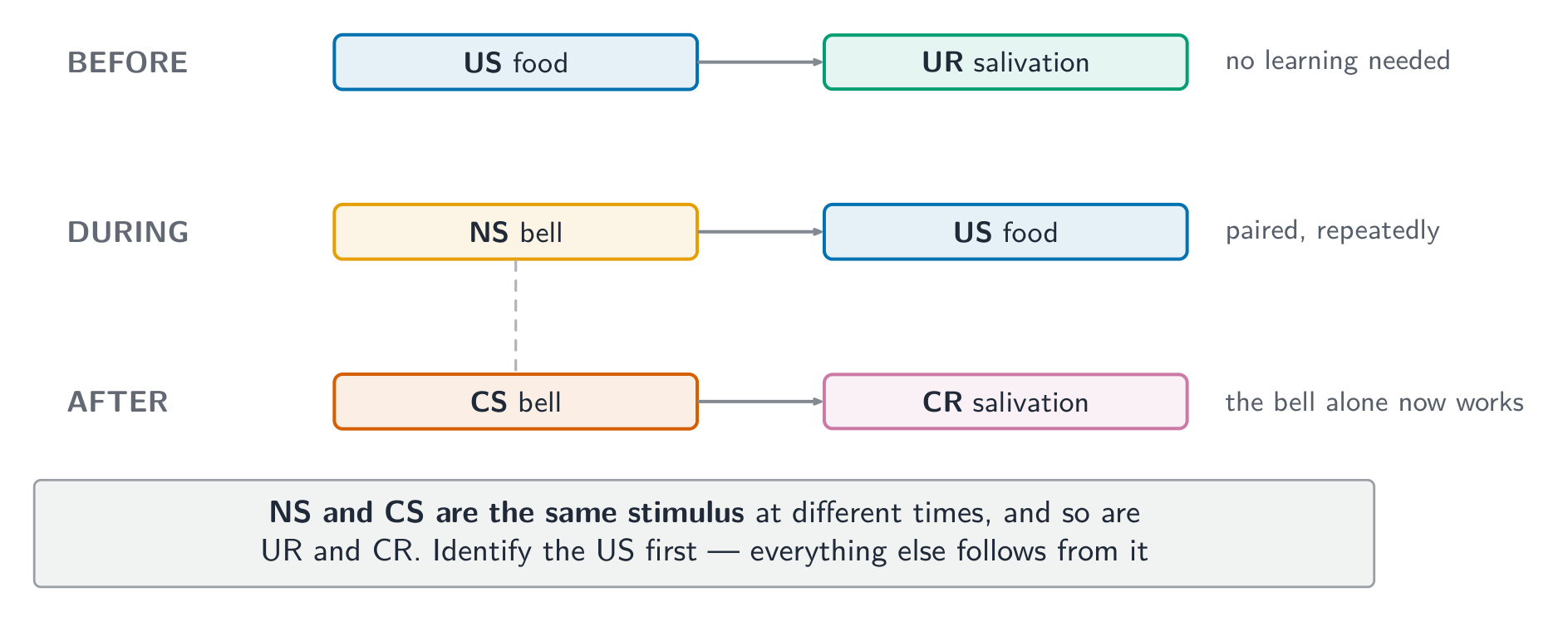
  • An unconditioned stimulus (UCS) 无条件刺激 naturally produces an unconditioned response (UCR) 无条件反应 - food causes salivation.
  • A neutral stimulus 中性刺激 paired with the UCS becomes a conditioned stimulus (CS) 条件刺激, producing a conditioned response (CR) 条件反应.
  • Acquisition 习得 depends on the order and timing of the pairing.
  • Extinction 消退 occurs when the CS is no longer paired with the UCS; spontaneous recovery 自发恢复 is the reappearance of an extinguished CR.
  • Generalization 泛化 is responding to similar stimuli; stimulus discrimination 刺激辨别 is responding only to the exact CS.
  • In higher-order conditioning 高级条件作用 an established CS acts as a UCS for a new one.

Emotional responses can be conditioned, and taste aversion 味觉厌恶 shows that some associations are learned in a single trial because they aided survival. Habituation 习惯化 is a diminished response to a repeated stimulus.

ไทย

มุมมองทางพฤติกรรม (behavioral perspective) อธิบายพฤติกรรมผ่านการเรียนรู้มากกว่าความคิด

การเงื่อนไขแบบคลาสสิก (Classical conditioning) เชื่อมโยงสิ่งเร้าหนึ่งเข้ากับอีกสิ่งหนึ่ง:

  • สิ่งเร้าที่ไม่ได้ถูกเงื่อนไข (unconditioned stimulus, UCS) ผลิต การตอบสนองที่ไม่ได้ถูกเงื่อนไข (unconditioned response, UCR) ตามธรรมชาติ - อาหารทำให้น้ำลายไหล
  • สิ่งเร้าที่เป็นกลาง (neutral stimulus) ที่จับคู่กับ UCS จะกลายเป็น สิ่งเร้าที่ถูกเงื่อนไข (conditioned stimulus, CS) ผลิต การตอบสนองที่ถูกเงื่อนไข (conditioned response, CR)
  • การได้มา (Acquisition) ขึ้นอยู่กับลำดับและเวลาของการจับคู่
  • การดับ消失 (Extinction) เกิดขึ้นเมื่อ CS不再จับคู่กับ UCS; การฟื้นตัวโดยธรรมชาติ (spontaneous recovery) คือการปรากฏกลับของ CR ที่ดับ消失แล้ว
  • การ generalize (Generalization) คือการตอบสนองต่อสิ่งเร้าคล้ายคลึงกัน; การแยกแยะสิ่งเร้า (stimulus discrimination) คือการตอบสนองเฉพาะต่อ CS ที่แท้จริงเท่านั้น
  • ใน การเงื่อนไขระดับสูง (higher-order conditioning) CS ที่ได้รับรู้แล้วทำหน้าที่เป็น UCS สำหรับ一个新的 CS

การตอบสนองทางอารมณ์สามารถถูก)))), และ ความเกลียดชังรสชาติ (taste aversion) แสดงให้เห็นว่าบางการเชื่อมโยงถูกเรียนรู้ในครั้งเดียวเพราะช่วยในการรอดชีวิต การปรับตัว (Habituation) คือการตอบสนองที่ลดลงต่อสิ่งเร้าซ้ำซาก

NS และ CS คือสิ่งเร้าเดียวกันในเวลาต่างกัน - ระบุ US ก่อน
Explore · ⁨สำรวจ⁩

Condition a response in three stages · ⁨ شرطcondition ปฏิกิริยาในสามขั้นตอน⁩

NS and CS are the same stimulus at different times, and so are UR and CR. Identify the US first and the rest follows. · ⁨NS และ CS เป็นสิ่งเร้าเดียวกันในเวลาต่างกัน และ UR กับ CR ก็เช่นกัน ระบุ US ก่อนแล้วส่วนที่เหลือจะตามมา⁩

Vocabulary · ⁨คำศัพท์⁩ Train · ⁨ฝึกฝน⁩
English ไทย
behavioral perspective/bɪˈheɪvjərəl pəˈspektɪv/ มุมมองด้านพฤติกรรม
Classical conditioning/ˈklæsɪkl kənˈdɪʃənɪŋ/ การเงื่อนไขแบบคลาสสิก (Classical conditioning)
unconditioned stimulus (UCS)/ʌŋkənˈdɪʃnd ˈstɪmjʊləs/ สิ่งเร้าที่ไม่ได้ถูกทำให้เป็นเงื่อนไข (UCS)
unconditioned response (UCR)/ʌŋkənˈdɪʃnd rɪˈspɒns/ การตอบสนองที่ไม่ได้ถูกทำให้เป็นเงื่อนไข (UCR)
neutral stimulus/ˈnjuːtrəl ˈstɪmjʊləs/ สิ่งเร้าที่เป็นกลาง
conditioned stimulus (CS)/kənˈdɪʃnd ˈstɪmjʊləs/ สิ่งเร้าที่ถูกทำให้เป็นเงื่อนไข (CS)
conditioned response (CR)/kənˈdɪʃnd rɪˈspɒns/ การตอบสนองที่ถูกทำให้เป็นเงื่อนไข (CR)
Acquisition/əkwɪˈsɪʃn/ การได้มาซึ่งพฤติกรรม
Extinction/ekˈstɪŋkʃn/ การสูญสิ้น
spontaneous recovery/spɒnˈteɪnɪəs rɪˈkʌvəri/ การฟื้นตัวตามธรรมชาติ
stimulus discrimination/ˈstɪmjʊləs dɪˌskrɪmɪˈneɪʃn/ การจำแนกสิ่งเร้า
higher-order conditioning/ˈhaɪə ˈɔːdə kənˈdɪʃənɪŋ/ การทำให้เป็นเงื่อนไขระดับสูง
taste aversion/teɪst əˈvɜːʃn/ การหลีกเลี่ยงรสชาติ
Habituation/ˌhæbɪtʃuːˈeɪʃn/ การเคยชิน
3.8

Operant Conditioning · ⁨การเงื่อนไขแบบเครื่องมือ⁩

Syllabus · ⁨หลักสูตร⁩
English

Learning Objective 3.8.A: Explain how operant conditioning applies to behavior and mental processes.

  • 3.8.A.1 Operant conditioning focuses on associating consequences (reinforcement and punishment) with behaviors. The Law of Effect states that behaviors with reinforcing consequences are more likely to be repeated while behaviors with punishing consequences are not as likely to be repeated.
  • 3.8.A.2 Reinforcement and punishment can be positive or negative. Reinforcers can be primary or secondary. Reinforcement discrimination and generalization have been demonstrated in studies of operant conditioning.
  • 3.8.A.3 Reinforcement can be used to shape behavior (“shaping”) gradually through rewarding successive approximations of the desired behavior. Research with animals shows that only certain behaviors can be shaped through reinforcement (known as instinctive drift).
  • 3.8.A.4 Superstitious behavior occurs when consequences reinforce unrelated behaviors. Learned helplessness occurs when organisms learn that they have no control over their experience of aversive consequences in a given situation.
  • 3.8.A.5 The schedule with which reinforcement is delivered can determine the strength of the association between the consequence and the response. The two main types of reinforcement schedules are continuous and partial. Each type of reinforcement behavior can be graphed, resulting in a distinctive pattern on the graph (e.g., fixed-interval schedule produces a scalloped graph).
    • 3.8.A.5.i Continuous reinforcement schedules deliver reinforcement for each and every correct behavior.
    • 3.8.A.5.ii The partial reinforcement schedules focus on whether reinforcement is delivered on a time-based schedule (fixed- or variable-interval) or for the number of behaviors performed (fixed- or variable-ratio).
ไทย

วัตถุประสงค์การเรียนรู้ 3.8.A: อธิบายว่าการ以下条件条件เชิงปฏิบัติมีผลต่อพฤติกรรมและกระบวนการทางจิตใจอย่างไร

  • 3.8.A.1 การ以下条件条件เชิงปฏิบัติมุ่งเน้นไปที่การเชื่อมโยงผลลัพธ์ (Reinforcement และ Punishment) กับพฤติกรรม กฎแห่งผลลัพธ์ (Law of Effect) ระบุว่าพฤติกรรมที่มีผลลัพธ์แบบ Reinforce จะมีแนวโน้มจะถูกทำซ้ำ ในขณะที่พฤติกรรมที่มีผลลัพธ์แบบ Punish จะมีแนวโน้มที่จะไม่ถูกทำซ้ำ
  • 3.8.A.2 Reinforcement และ Punishment อาจเป็น Positive หรือ Negative Reinforcers อาจเป็น Primary หรือ Secondary การแยกแยะและการขยายความของ Reinforcement ได้ถูกพิสูจน์ในงานวิจัยเกี่ยวกับการ以下条件条件เชิงปฏิบัติ
  • 3.8.A.3 Reinforcement สามารถถูกใช้เพื่อ shaped พฤติกรรม (“Shaping”) อย่างค่อยเป็นค่อยไป通过对 reinforcing successive approximations ของพฤติกรรมที่ต้องการ งานวิจัยกับสัตว์แสดงให้เห็นว่าเฉพาะพฤติกรรมบางอย่างเท่านั้นที่สามารถ被 shaped ผ่าน Reinforcement (ซึ่งเรียกว่า Instinctive drift)
  • 3.8.A.4 พฤติกรรมแบบ Superstitious เกิดขึ้นเมื่อผลลัพธ์ Reinforce พฤติกรรมที่ไม่เกี่ยวข้องกัน Learned helplessness เกิดขึ้นเมื่อสิ่งมีชีวิตเรียนรู้ว่าตนเองไม่มีอำนาจควบคุมต่อประสบการณ์ของผลลัพธ์ที่เป็นลบ (Aversive consequences) ในสถานการณ์ที่กำหนด
  • 3.8.A.5 ตารางเวลาที่ Reinforcement ถูก deliver สามารถกำหนดความแข็งแกร่งของการเชื่อมโยงระหว่างผลลัพธ์กับการตอบสนอง ประเภทหลักของตาราง Reinforcement คือ Continuous และ Partial พฤติกรรม Reinforcement แต่ละประเภทสามารถถูก graph ได้ ทำให้เกิดรูปแบบเฉพาะบนกราฟ (เช่น Fixed-interval schedule จะสร้างกราฟรูปทรง shellfish/scalloped)
    • 3.8.A.5.i ตาราง Reinforcement แบบ Continuous deliver Reinforcement สำหรับทุกพฤติกรรมที่ถูกต้อง
    • 3.8.A.5.ii ตาราง Reinforcement แบบ Partial มุ่งเน้นไปที่ whether Reinforcement ถูก deliver ตามตารางเวลาที่เกี่ยวข้องกับเวลา (Fixed- หรือ Variable-interval) หรือตามจำนวนพฤติกรรมที่ทำ (Fixed- หรือ Variable-ratio)

Source: College Board AP Course and Exam Description · ⁨แหล่งที่มา: คำอธิบายหลักสูตรและข้อสอบ College Board AP⁩

English

Operant conditioning 操作性条件作用 associates a behaviour with its consequence.

  • Reinforcement 强化 increases a behaviour; punishment 惩罚 decreases it.
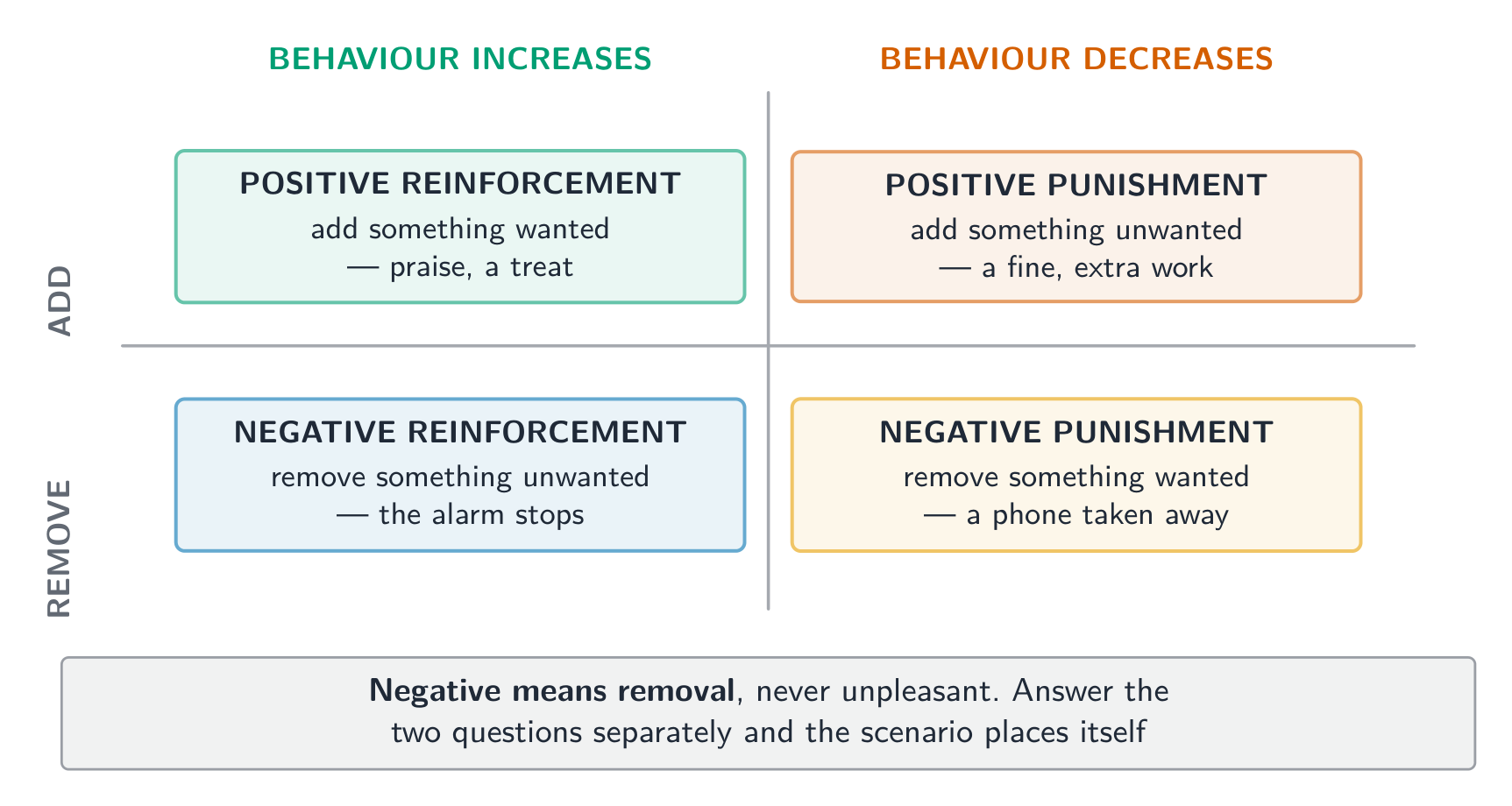
  • Positive 正 means something is added; negative 负 means something is removed. So negative reinforcement 负强化 increases behaviour by removing something unpleasant - it is not punishment.
  • A primary reinforcer 原级强化物 satisfies a biological need; a secondary reinforcer 次级强化物 (money) is learned.
  • Shaping 塑造 rewards successive approximations 逐步接近 of a target behaviour.

Reinforcement schedules 强化程式 change how strong and persistent learning is. Continuous reinforcement 连续强化 rewards every response and produces fast learning but fast extinction. Partial reinforcement 部分强化 comes in four kinds - fixed-ratio 固定比率, variable-ratio 变动比率, fixed-interval 固定时距, and variable-interval 变动时距 - and variable-ratio produces the highest, most extinction-resistant rate.

Superstitious behavior 迷信行为 arises when a consequence reinforces an unrelated action. Learned helplessness 习得性无助 develops when an organism repeatedly cannot escape an aversive event and stops trying.

ไทย

การเงื่อนไขแบบเครื่องมือ (Operant conditioning) เชื่อมโยงพฤติกรรมกับผลลัพธ์ของมัน

  • Reinforcement เพิ่มพฤติกรรม; punishment ลดมันลง
  • บวก (Positive) หมายถึงมีการเพิ่มเข้ามา; ลบ (Negative) หมายถึงมีการกำจัดออก ดังนั้น การเสริมแรงลบ (negative reinforcement) เพิ่มพฤติกรรมโดยการกำจัดสิ่งไม่พึงประสงค์ - มันไม่ใช่การลงโทษ
  • ผู้เสริมแรงเบื้องต้น (primary reinforcer) ตอบสนองความต้องการทางชีวภาพ; ผู้เสริมแรง ثان級 (secondary reinforcer) (เงิน) ถูกเรียนรู้มา
  • การจัดรูป (Shaping) ให้รางวัลกับการ ประมาณค่าต่อเนื่อง (successive approximations) ของพฤติกรรมเป้าหมาย

ตารางการเสริมแรง (Reinforcement schedules) เปลี่ยนแปลงความแข็งแกร่งและความยั่งยืนของการเรียนรู้ การเสริมแรงต่อเนื่อง (Continuous reinforcement) ให้รางวัลทุกการตอบสนองและสร้างการเรียนรู้ที่รวดเร็วแต่การดับ消失也快 การเสริมแรงบางส่วน (Partial reinforcement) มีสี่ประเภท - อัตราคงที่ (fixed-ratio), อัตราแปรผัน (variable-ratio), ช่วงเวลาคงที่ (fixed-interval), และ ช่วงเวลาแปรผัน (variable-interval) - และอัตราแปรผันสร้างอัตราการสูงสุดและทนต่อการดับ消失มากที่สุด

พฤติกรรมความเชื่อ เกิดขึ้นเมื่อผลที่เกิดขึ้นเสริมสร้างพฤติกรรมที่ไม่เกี่ยวข้องกัน ความไร้แรงจูงใจที่เรียนรู้ได้ (Learned helplessness) พัฒนาขึ้นเมื่อสิ่งมีชีวิตไม่สามารถหลบหลีกเหตุการณ์ไม่พึงประสงค์ซ้ำแล้วซ้ำเล่าและหยุดพยายาม

ความหมายของลบคือการกำจัด ไม่ใช่เรื่องน่าอึดอัด - ตอบคำถามทั้งสองข้อแยกต่างหาก
Explore · ⁨สำรวจ⁩

Place each scenario in the operant grid · ⁨วางแต่ละสถานการณ์ในตารางการเสริมแรง⁩

Negative means removal, never unpleasant. Answer two questions separately: add or remove, and does the behaviour go up or down? · ⁨ลบหมายถึงการกำจัด ไม่ใช่เรื่องน่าเกลียด ตอบสองคำถามแยกกัน: เพิ่มหรือลบ และพฤติกรรมเพิ่มหรือลด?⁩

Vocabulary · ⁨คำศัพท์⁩ Train · ⁨ฝึกฝน⁩
English ไทย
Developmental psychology/dɪˈveləpmentl saɪˈkɒlədʒi/ จิตวิทยาพัฒนาการ
continuous/kənˈtɪnjuːəs/ 连续的
discontinuous/dɪskənˈtɪnjuːəs/ ไม่ต่อเนื่อง
stable/ˈsteɪbl/ เสถียร
cross-sectional study/krɒs ˈsekʃənl ˈstʌdi/ การศึกษาระดับภาค
longitudinal study/ˌlɒŋɡɪˈtjuːdɪnl ˈstʌdi/ การศึกษายาวนาน
teratogens/ˈterətədʒnz/ สารก่อความผิดปกติ
reflexes/ˈriːfleksɪz/ การตอบสนองสะท้อน
rooting reflex/ˈruːtɪŋ ˈriːfleks/ การตอบสนองสะท้อนการค้นหา
visual cliff/ˈvɪʒuːəl klɪf/ หน้าผาทางสายตา
Operant conditioning/ˈɒpərənt kənˈdɪʃənɪŋ/ การเงื่อนไขแบบ operasional (Operant conditioning)
Reinforcement/ˌriːɪnˈfɔːsmənt/ การเรียนรู้ด้วยการเสริมแรง
punishment/ˈpʌnɪʃmənt/ การลงโทษ
Positive/ˈpɒzɪtɪv/ บวก
negative/ˈneɡətɪv/ ลบ
negative reinforcement/ˈneɡətɪv ˌriːɪnˈfɔːsmənt/ การเสริมแรงเชิงลบ
primary reinforcer/ˈpraɪməri ˌriːɪnˈfɔːsə/ สิ่งเสริมพื้นฐาน
secondary reinforcer/ˈsekəndəri ˌriːɪnˈfɔːsə/ สิ่งเสริมรอง
Shaping/ˈʃeɪpɪŋ/ การจัดรูปทรง
successive approximations/səkˈsesɪv əˌprɒksɪˈmeɪʃnz/ การประมาณค่าต่อเนื่อง
Reinforcement schedules/ˌriːɪnˈfɔːsmənt ˈʃedjuːlz/ ตารางการเสริมแรง
Continuous reinforcement/kənˈtɪnjuːəs ˌriːɪnˈfɔːsmənt/ การเสริมแรงต่อเนื่อง
Partial reinforcement/ˈpɑːʃl ˌriːɪnˈfɔːsmənt/ การเสริมแรงแบบไม่ต่อเนื่อง
fixed-ratio/fɪkst ˈreɪʃɪəʊ/ อัตราส่วนคงที่ (fixed-ratio)
variable-ratio/ˈveərɪəbl ˈreɪʃɪəʊ/ อัตราส่วนแปรผัน (variable-ratio)
fixed-interval/fɪkst ˈɪntəvl/ ช่วงเวลาคงที่ (fixed-interval)
variable-interval/ˈveərɪəbl ˈɪntəvl/ ช่วงเวลาแปรผัน (variable-interval)
Superstitious behavior/ˌsuːpəˈstɪʃəs bɪˈheɪvjə/ พฤติกรรมความเชื่อผิดๆ
Learned helplessness/lɜːnd ˈhelpləsnəs/ ความไร้กำลังที่เรียนรู้
Social learning theory/ˈsəʊʃl ˈlɜːnɪŋ ˈθɪəri/ ทฤษฎีการเรียนรู้ทางสังคม
observation/ɒbzəˈveɪʃn/ observation
modeling/ˈmɒdəlɪŋ/ การสร้างแบบจำลอง
3.9

Observational and Cognitive Learning · ⁨การเรียนรู้จากการสังเกตและการเรียนรู้แบบรู้คิด⁩

Syllabus · ⁨หลักสูตร⁩
English

Learning Objective 3.9.A: Explain how social learning applies to behavior and mental processes.

  • 3.9.A.1 Social learning theory proposes that learning can occur by observation and does not have to involve personal experience with a consequence (vicarious conditioning). Learning can occur by copying the behavior of models. The more similar a model is, the more likely the behavior is to be learned.

Learning Objective 3.9.B: Explain how cognitive factors in learning apply to behavior and mental processes.

  • 3.9.B.1 Insight learning occurs when the solution to a problem occurs without any association, consequence, or model being present.
  • 3.9.B.2 Latent learning occurs when information is learned without reinforcement but is not immediately evident. Latent learning is often demonstrated by cognitive maps.
ไทย

วัตถุประสงค์การเรียนรู้ 3.9.A: อธิบายว่าการเรียนรู้ทางสังคมมีผลต่อพฤติกรรมและกระบวนการทางจิตใจอย่างไร

  • 3.9.A.1 ทฤษฎีการเรียนรู้ทางสังคมเสนอว่าการเรียนรู้สามารถเกิดขึ้นได้จากการสังเกตและไม่จำเป็นต้อง involvement กับประสบการณ์ส่วนตัวกับผลลัพธ์ (Vicarious conditioning) Learning สามารถเกิดขึ้นได้โดยการCopying พฤติกรรมของ Models ยิ่ง Model มีลักษณะคล้ายคลึงกันมากเท่าไร พฤติกรรมนั้นก็ยิ่งมีแนวโน้ม就会被 learn มากเท่านั้น

วัตถุประสงค์การเรียนรู้ 3.9.B: อธิบายว่าปัจจัยทางสติปัญญาในกระบวนการเรียนรู้มีผลต่อพฤติกรรมและกระบวนการทางจิตใจอย่างไร

  • 3.9.B.1 Insight learning เกิดขึ้นเมื่อการแก้ปัญหาเกิดขึ้นโดยไม่มี association, consequence หรือ model อยู่
  • 3.9.B.2 Latent learning เกิดขึ้นเมื่อข้อมูลถูก learnโดยไม่ reinforcement แต่ไม่ได้ปรากฏออกมาทันที Latent learning มักถูก demonstrate โดย cognitive maps

Source: College Board AP Course and Exam Description · ⁨แหล่งที่มา: คำอธิบายหลักสูตรและข้อสอบ College Board AP⁩

English

Not all learning needs direct experience. Social learning theory 社会学习理论 shows that behaviour can be learned by observation 观察 and modeling 榜样示范 - the basis of the Bobo doll findings on imitated aggression.

Insight learning 顿悟学习 is a sudden solution with no gradual conditioning. Latent learning 潜伏学习 is learning that occurs without reinforcement and stays hidden until there is a reason to show it, demonstrated by rats forming a cognitive map 认知地图 of a maze.

Worked example (a real AP exam question). The 2024 exam described Gavin, a preschooler at a science museum: he grabbed a large glass marble and tried to bounce it, he was briefly separated from his parents, and the next day he told his grandmother about a picture he had drawn. Students had to "Explain how Jean Piaget's concept of assimilation could relate to Gavin's experience with the glass marble" and "Explain how egocentrism could relate to how Gavin interacted with his grandmother in the car". A full-mark answer defines the term and ties it to the specific detail: "Gavin already had a schema for balls, which bounce. He assimilated the marble into that schema by treating it as a ball and trying to bounce it." Notice the shape: the definition alone earns nothing, and so does retelling the story. The mark is for the join between them.

ไทย

ไม่จำเป็นต้องมีประสบการณ์ตรงในการเรียนรู้ทั้งหมด ทฤษฎีการเรียนรู้ทางสังคม แสดงให้เห็นว่าพฤติกรรมสามารถเรียนรู้ได้จากการ สังเกต และการเป็น แบบอย่าง ซึ่งเป็นพื้นฐานของการค้นพบ关于การเลียนแบบความรุนแรงในตุ๊กตาโบโบ

การเรียนรู้ด้วยการเข้าใจฉับพลัน (Insight learning) คือการแก้ปัญหาอย่างฉับพลันโดยไม่มีการปรับสภาพแบบค่อยเป็นค่อยไป การเรียนรู้แฝง (Latent learning) คือการเรียนรู้ที่เกิดขึ้นโดยไม่มีการเสริมแรงและยังคงซ่อนอยู่จนกว่าจะมีเหตุผลที่จะแสดงออก ซึ่งสาธิตโดยหนูที่สร้าง แผนที่ทางปัญญา (cognitive map) ของเขาวงกต

ตัวอย่างวิธีทำ (โจทย์จริงจากสอบ AP). การสอบปี 2024 อธิบายถึง━━วีน เด็กวัยก่อนเรียนในพิพิธภัณฑ์วิทยาศาสตร์: เขาจับลูกแก้วแก้วขนาดใหญ่และพยายามกระโดดมัน他被短暂地与父母分开,第二天他告诉祖母一张画。学生们需要解释让·皮亚杰的“同化”概念如何与━━vín对玻璃球的经历相关,以及“自我中心主义”如何与━━vín在车里与祖母的互动相关。满分答案定义术语并联系具体细节:“━━vín已经有关于球会弹跳图式,他将玻璃球同化进该图式,将其视为球并尝试让它弹跳。”注意结构:仅定义或仅复述故事均不得分,分数在于二者的结合。

Vocabulary · ⁨คำศัพท์⁩ Train · ⁨ฝึกฝน⁩
English ไทย
Insight learning/ˈɪnsaɪt ˈlɜːnɪŋ/ การเรียนรู้ด้วยการเข้าใจ
Latent learning/ˈleɪtənt ˈlɜːnɪŋ/ การเรียนรู้แบบซ่อนเร้น
cognitive map/ˈkɒɡnɪtɪv mæp/ แผนที่ทางปัญญา (cognitive map)
3.9

Exam tips · ⁨ข้อแนะนำสำหรับการสอบ⁩

English
  • Negative reinforcement increases behaviour. If you can say what was removed, and the behaviour went up, it is not punishment.
  • Match a Piaget stage to its achievement - object permanence, conservation, abstract reasoning - rather than to an age.
  • Classical conditioning links two stimuli and produces an involuntary response; operant conditioning links behaviour to consequence.
  • Variable-ratio schedules resist extinction best. Use it whenever a question describes gambling-like persistence.
  • Keep critical period for the narrow window and sensitive period for the softer one.
  • On scenario questions, name the term and then point at the detail in the scenario that proves it. The detail is what earns the mark.
ไทย
  • การเสริมแรงเชิงลบ เพิ่มพฤติกรรม หากคุณระบุได้ว่าอะไร被移除且行为上升,则不是惩罚。
  • จับคู่ระดับ皮亚杰与其成就(客体永久性、守恒、抽象推理),而非年龄。
  • 条件反射将两个刺激联系起来产生非自愿反应;操作性条件反射将行为与后果联系起来。
  • 变比强化程序最抗消退。当题目描述类似赌博般的坚持时使用它。
  • 保留critical period指狭窄窗口,sensitive period指较宽松的窗口。
  • 在情境题中,先说出术语,再指出情境中的具体细节以证明其适用性。得分点在于细节部分。
Vocabulary · ⁨คำศัพท์⁩ Train · ⁨ฝึกฝน⁩
English ไทย
critical period/ˈkrɪtɪkl ˈpɪərɪəd/ ช่วงเวลาแห่งความวิกฤต critical period
sensitive period/ˈsensɪtɪv ˈpɪərɪəd/ ช่วงเวลาแห่งความไว sensitive period
Adolescence/ˌædəˈlesəns/ วัยรุ่น (Adolescence)
adolescent growth spurt/ˌædəˈlesənt ɡrəʊθ spɜːt/ ช่วงการเจริญเติบโตของวัยรุ่น
puberty/ˈpjuːbəti/ 青春期 (Puberty)
primary sex characteristics/ˈpraɪməri seks ˌkærɪktəˈrɪstɪks/ ลักษณะทางเพศหลัก
secondary sex characteristics/ˈsekəndəri seks ˌkærɪktəˈrɪstɪks/ ลักษณะทางเพศรอง
menopause/ˈmenəpɔːz/ วัยหมดประจำเดือน

Interactive lessons on this topic · ⁨บทเรียนเชิงโต้ตอบสำหรับหัวข้อนี้⁩

Work through it step by step, with instant-check exercises. · ⁨ทำทีละขั้นตอน พร้อมแบบฝึกหัดตรวจสอบผลทันที⁩

Past Papers · ⁨ข้อสอบย้อนหลัง⁩

More topics in AP Psychology · ⁨AP จิตวิทยา⁩ · ⁨หัวข้อเพิ่มเติมใน AP Psychology · ⁨AP จิตวิทยา⁩⁩

Log in or create account · ⁨เข้าสู่ระบบหรือสร้างบัญชี⁩

IGCSE, A-Level & AP