Skip to content · ⁨ข้ามไปยังเนื้อหา⁩

Trigonometric and Polar Functions · ⁨ฟังก์ชันตรีโกณมิติและฟังก์ชันเชิงขั้ว⁩

AP Precalculus · Topic 3 · ⁨หัวข้อ 3⁩

Video lesson for this topic · ⁨บทเรียนวิดีโอสำหรับหัวข้อนี้⁩ Open the video page · ⁨เปิดหน้าวิดีโอ⁩
8:08

ฟังก์ตรีโกณมิติและฟังก์ชันเชิงขั้ว

สังเกตจุดเคลื่อนที่ไปรอบวงกลมด้วยความเร็วคงที่ ความสูงจะเพิ่มขึ้น ลดลง และเพิ่มขึ้นอีกครั้ง ซ้ำแล้วซ้ำเล่า เมื่อคุณวาดกราฟความสูงเทียบกับเวลา คุณจะได้...

English narration · English + 中文 subtitles burned in · ⁨การบรรยายภาษาอังกฤษ · คำบรรยายภาษาอังกฤษ + 中文 ลอยตัวบนภาพ⁩

3.1

Periodic Phenomena · ⁨ปรากฏการณ์เป็นรอบ⁩

Syllabus · ⁨หลักสูตร⁩
English

Learning Objective 3.1.A: Construct graphs of periodic relationships based on verbal representations.

  • 3.1.A.1 A periodic relationship can be identified between two aspects of a context if, as the input values increase, the output values demonstrate a repeating pattern over successive equal-length intervals.
  • 3.1.A.2 The graph of a periodic relationship can be constructed from the graph of a single cycle of the relationship.

Learning Objective 3.1.B: Describe key characteristics of a periodic function based on a verbal representation.

  • 3.1.B.1 The period of the function is the smallest positive value $k$ such that $f(x + k) = f(x)$ for all $x$ in the domain. Consequently, the behavior of a periodic function is completely determined by any interval of width $k$.
  • 3.1.B.2 The period can be estimated by investigating successive equal-length output values and finding where the pattern begins to repeat.
  • 3.1.B.3 Periodic functions take on characteristics of other functions, such as intervals of increase and decrease, different concavities, and various rates of change. However, with periodic functions, all characteristics found in one period of the function will be in every period of the function.
ไทย

จุดประสงค์การเรียนรู้ 3.1.A: สร้างกราฟความสัมพันธ์ที่เป็นรอบจากคำบรรยาย

  • 3.1.A.1 สามารถระบุความสัมพันธ์ที่เป็นรอบได้ระหว่างสองด้านของบริบท หากเมื่อค่าอินพุตเพิ่มขึ้น ค่าเอาต์พุตแสดงรูปแบบซ้ำในช่วงที่มีความยาวเท่ากันต่อเนื่องกัน
  • 3.1.A.2 กราฟของความสัมพันธ์ที่เป็นรอบสามารถสร้างได้จากกราฟของรอบเดียวของความสัมพันธ์นั้น

จุดประสงค์การเรียนรู้ 3.1.B: อธิบายคุณลักษณะสำคัญของฟังก์ชันเป็นรอบจากคำบรรยาย

  • 3.1.B.1 ช่วงรอบ (period) ของฟังก์ชันคือค่าบวกที่เล็กที่สุด $k$ ที่ทำให้ $f(x + k) = f(x)$ สำหรับทุก $x$ ในโดเมน ดังนั้น พฤติกรรมของฟังก์ชันเป็นรอบจึงถูกกำหนดโดยช่วงใดหนึ่งที่มีความกว้าง $k$ อย่างสมบูรณ์
  • 3.1.B.2 ช่วงรอบสามารถประมาณได้โดยการตรวจสอบค่าเอาต์พุตที่มีความยาวเท่ากันต่อเนื่องกันและหาจุดที่รูปแบบเริ่มซ้ำ
  • 3.1.B.3 ฟังก์ชันเป็นรอบมีคุณลักษณะคล้ายกับฟังก์ชันอื่น ๆ เช่น ช่วงที่เพิ่มขึ้นและลดลง ความโค้ง Concavity ต่างๆ และอัตราการเปลี่ยนแปลงหลากหลาย อย่างไรก็ตาม对于ฟังก์ชันเป็นรอบ คุณลักษณะทั้งหมดที่พบในรอบเดียวของฟังก์ชันจะอยู่ในทุก ๆ รอบของฟังก์ชัน

Source: College Board AP Course and Exam Description · ⁨แหล่งที่มา: คำอธิบายหลักสูตรและข้อสอบ College Board AP⁩

English

A relationship is periodic 周期性 if its output pattern repeats at regular input steps. The period 周期 is the smallest positive $k$ with $f(x+k)=f(x)$ for all $x$. You can build the whole graph by copying a single cycle 周期段, and estimate the period by finding how far apart the pattern repeats. Within each cycle a periodic function still has intervals of increase/decrease and maxima/minima.

ไทย
ISS正在轨道上运行:三角函数和极坐标函数描述周期性和圆周运动

ความสัมพันธ์จะเป็น เป็นรอบ若其输出模式重复在规则的输入步长. ช่วง คือค่า $k$ บวกที่มีค่าน้อยที่สุดที่ $f(x+k)=f(x)$ สำหรับทุก $x$. คุณสามารถสร้างกราฟทั้งหมดโดยการคัดลอก รอบ เดียว, และประมาณค่าช่วงโดยการหาว่ารูปแบบซ้ำกันห่างกัน多远. ภายในแต่ละรอบ ฟังก์ชันที่เป็นรอบยังมีช่วงที่เพิ่มขึ้น/ลดลง และค่าสูงสุด/ต่ำสุด

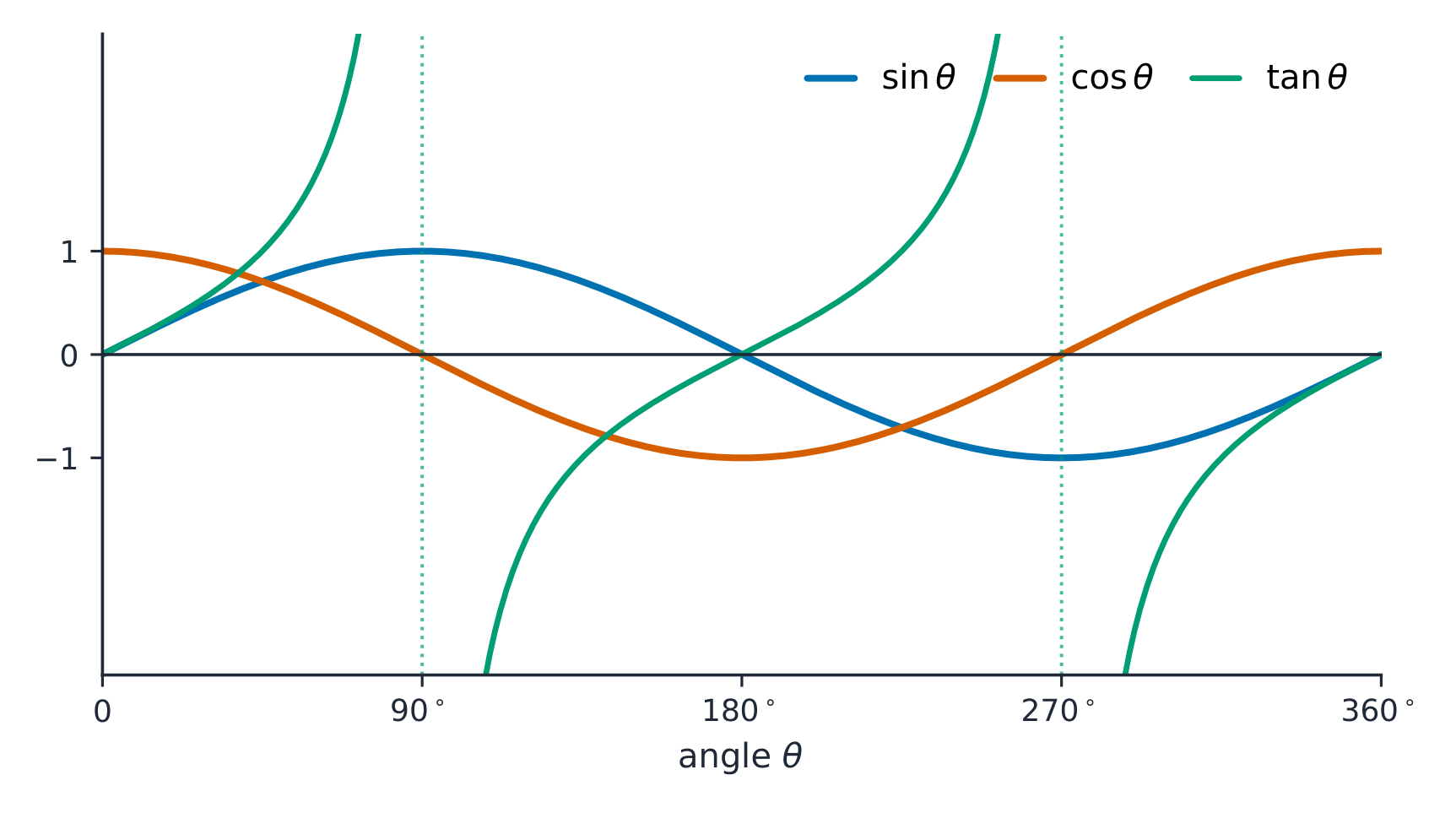
sin และ cos ลู่ระหว่าง -1 ถึง 1; tan หักที่ 90 และ 270 องศา
维也纳巨型摩天轮在蓝天背景下
当摩天轮平稳转动时,你的高度反复上升和下降——时间上的真实正弦波
3.2

Sine, Cosine, and Tangent · ⁨Сine, Cosine, และ Tangent⁩

Syllabus · ⁨หลักสูตร⁩
English

Learning Objective 3.2.A: Determine the sine, cosine, and tangent of an angle using the unit circle.

  • 3.2.A.1 In the coordinate plane, an angle is in standard position when the vertex coincides with the origin and one ray coincides with the positive $x$-axis. The other ray is called the terminal ray. Positive and negative angle measures indicate rotations from the positive $x$-axis in the counterclockwise and clockwise direction, respectively. Angles in standard position that share a terminal ray differ by an integer number of revolutions.
  • 3.2.A.2 The radian measure of an angle in standard position is the ratio of the length of the arc of a circle centered at the origin subtended by the angle to the radius of that same circle. For a unit circle, which has radius $1$, the radian measure is the same as the length of the subtended arc.
  • 3.2.A.3 Given an angle in standard position and a circle centered at the origin, there is a point, $P$, where the terminal ray intersects the circle. The sine of the angle is the ratio of the vertical displacement of $P$ from the $x$-axis to the distance between the origin and point $P$. Therefore, for a unit circle, the sine of the angle is the $y$-coordinate of point $P$.
  • 3.2.A.4 Given an angle in standard position and a circle centered at the origin, there is a point, $P$, where the terminal ray intersects the circle. The cosine of the angle is the ratio of the horizontal displacement of $P$ from the $y$-axis to the distance between the origin and point $P$. Therefore, for a unit circle, the cosine of the angle is the $x$-coordinate of point $P$.
  • 3.2.A.5 Given an angle in standard position, the tangent of the angle is the slope, if it exists, of the terminal ray. Because the slope of the terminal ray is the ratio of the vertical displacement to the horizontal displacement over any interval, the tangent of the angle is the ratio of the $y$-coordinate to the $x$-coordinate of the point at which the terminal ray intersects the unit circle; alternately, it is the ratio of the angle's sine to its cosine.
ไทย

วัตถุประสงค์การเรียนรู้ 3.2.A: หาค่าเสน์ คอสinus และแทนเจนต์ของมุมโดยใช้วงกลมหน่วย

  • 3.2.A.1 ในระนาบพิกัด มุมจะอยู่ใน ตำแหน่งมาตรฐาน เมื่อจุดยอดมุมทับกับจุดกำเนิด และรังสีด้านหนึ่งทับกับแกน $x$ บวก รังสีอีกด้านเรียกว่า รังสีปลาย ค่ามุมบวกและลบบ่งบอกถึงการหมุนจากแกน $x$ บวกทวนและตามเข็มนาฬิกาตามลำดับ มุมที่อยู่ในตำแหน่งมาตรฐานที่มีรังสีปลายเดียวกันจะแตกต่างกันด้วยจำนวนเต็มรอบ
  • 3.2.A.2 ขนาดเรเดียนของมุมในตำแหน่งมาตรฐานคืออัตราส่วนของความยาวส่วนโค้งของวงกลมที่มีจุดศูนย์กลางอยู่ที่จุดกำเนิดซึ่งถูกมุมนั้นตัดต่อ กับรัศมีของวงกลมนั้น สำหรับวงกลมหน่วยซึ่งมีรัศมี $1$ ขนาดเรเดียนจะมีค่าเท่ากับความยาวของส่วนโค้งที่ถูกตัดต่อ
  • 3.2.A.3 กำหนดให้มุมอยู่ในตำแหน่งมาตรฐานและมีวงกลมที่มีจุดศูนย์กลางอยู่ที่จุดกำเนิด จะมีจุด $P$ ที่รังสีปลายตัดกับวงกลม เสน์ ของมูมนั้นคืออัตราส่วนของความกระจัดแนวตั้งของ $P$ จาก $x$ ต่อระยะระหว่างจุดกำเนิดกับจุด $P$ ดังนั้นสำหรับวงกลมหน่วย เสน์ของมูมนั้นคือ $y$-พิกัดของจุด $P$
  • 3.2.A.4 กำหนดให้มุมอยู่ในตำแหน่งมาตรฐานและมีวงกลมที่มีจุดศูนย์กลางอยู่ที่จุดกำเนิด จะมีจุด $P$ ที่รังสีปลายตัดกับวงกลม คอสinus ของมูมนั้นคืออัตราของความกระจัดแนวนอนของ $P$ จาก $y$ ต่อระยะระหว่างจุดกำเนิดกับจุด $P$ ดังนั้นสำหรับวงกลมหน่วย คอสinusของมูมนั้นคือ $x$-พิกัดของจุด $P$
  • 3.2.A.5 กำหนดให้มุมอยู่ในตำแหน่งมาตรฐาน แทนเจนต์ ของมูมนั้นคือความชัน (หากมี) ของรังสีปลาย เนื่องจากความชันของรังสีปลายคืออัตราของความกระจัดแนวตั้งต่อความกระจัดแนวนอนในช่วงใด ๆ แทนเจนต์ของมูมนั้นจึงเป็นอัตราของ $y$-พิกัดต่อ $x$-พิกัดของจุดที่รังสีปลายตัดกับวงกลมหน่วย หรือ alternatively เป็นอัตราของเสน์ของมูมนั้นต่อคอสinus

Source: College Board AP Course and Exam Description · ⁨แหล่งที่มา: คำอธิบายหลักสูตรและข้อสอบ College Board AP⁩

English

An angle is in standard position 标准位置 when its vertex is at the origin and its initial ray lies on the positive $x$-axis. Its radian 弧度 measure is the arc length on a unit circle. For the point $P$ where the terminal ray meets a circle of radius $r$:

$$\cos\theta = \frac{x}{r},\qquad \sin\theta = \frac{y}{r},\qquad \tan\theta = \frac{y}{x}\ (\text{the slope of the terminal ray}).$$

ไทย

มุมอยู่ใน ตำแหน่งมาตรฐาน เมื่อจุดยอดอยู่ที่จุดกำเนิดและรังสีเริ่มต้นอยู่บนแกน $x$ บวก. การวัดเป็น เรเดียน คือความยาวส่วนโค้งบนวงกลมหน่วย. สำหรับจุด $P$ ที่รังสีปลายตัดกับวงกลมรัศมี $r$:

$$\cos\theta = \frac{x}{r},\qquad \sin\theta = \frac{y}{r},\qquad \tan\theta = \frac{y}{x}\ (\text{the slope of the terminal ray}).$$

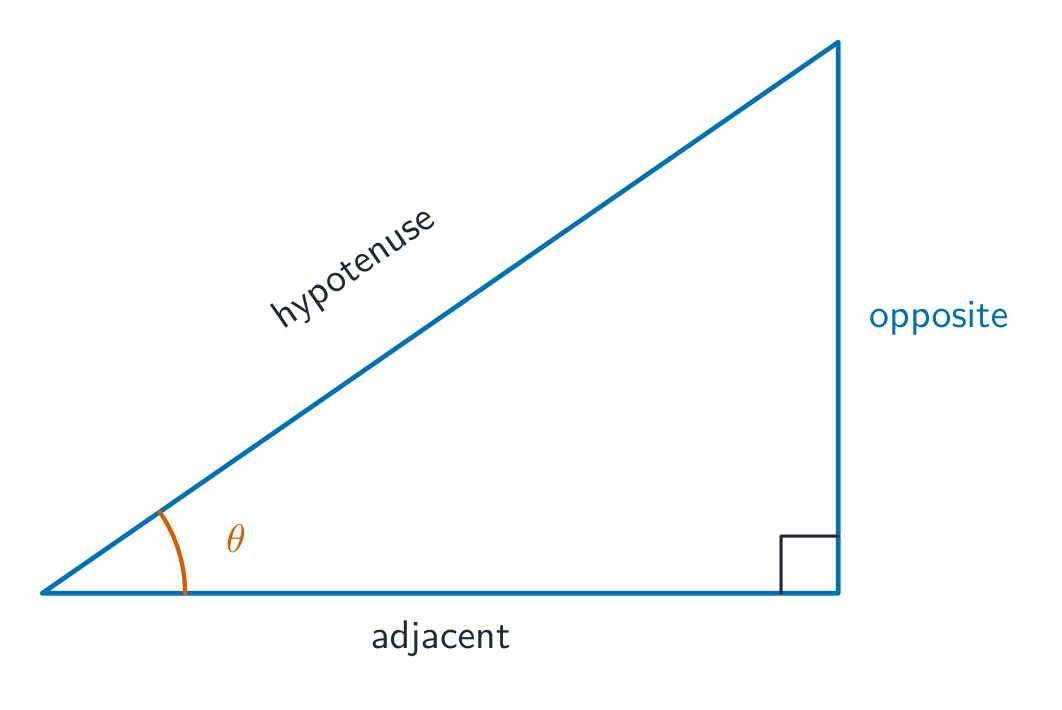
命名直角三角形的边从角
命名直角三角形的边从角
Explore · ⁨สำรวจ⁩

Read sine and cosine off the unit circle · ⁨อ่านค่าไซน์และโคไซน์จากวงกลมหน่วย⁩

On the unit circle a point at angle $\theta$ has coordinates $(\cos\theta,\ \sin\theta)$. Spin the angle to watch sine and cosine trace out as the height and width. · ⁨บน วงกลมหน่วย จุดที่มุม $\theta$ มีพิกัด $(\cos\theta,\ \sin\theta)$ หมุนมุมเพื่อดูว่าไซน์และโคไซน์วาดเป็นเส้นสูงและกว้างอย่างไร⁩

3.3

Sine and Cosine Function Values · ⁨ค่าฟังก์ชัน Sine และ Cosine⁩

Syllabus · ⁨หลักสูตร⁩
English

Learning Objective 3.3.A: Determine coordinates of points on a circle centered at the origin.

  • 3.3.A.1 Given an angle of measure $\theta$ in standard position and a circle with radius $r$ centered at the origin, there is a point, $P$, where the terminal ray intersects the circle. The coordinates of point $P$ are $(r\cos\theta, r\sin\theta)$.
  • 3.3.A.2 The geometry of isosceles right and equilateral triangles, while attending to the signs of the values based on the quadrant of the angle, can be used to find exact values for the cosine and sine of angles that are multiples of $\dfrac{\pi}{4}$ and $\dfrac{\pi}{6}$ radians and whose terminal rays do not lie on an axis.
ไทย

วัตถุประสงค์การเรียนรู้ 3.3.A: หาพิกัดของจุดบนวงกลมที่มีจุดศูนย์กลางอยู่ที่จุดกำเนิด

  • 3.3.A.1 กำหนดให้มุมมีขนาด $\theta$ ในตำแหน่งมาตรฐานและมีวงกลมที่มีรัศมี $r$ และมีจุดศูนย์กลางอยู่ที่จุดกำเนิด จะมีจุด $P$ ที่รังสีปลายตัดกับวงกลม พิกัดของจุด $P$ คือ $(r\cos\theta, r\sin\theta)$
  • 3.3.A.2 Hìnhทรงสามเหลี่ยมหน้าจั่วและสามเหลี่ยมด้านเท่า สามารถใช้หาค่าที่แน่นอนของคอสinusและเสน์ของมุมที่เป็นพหุคูณของ $\dfrac{\pi}{4}$ และ $\dfrac{\pi}{6}$ เรเดียน โดยต้องคำนึงถึงเครื่องหมายของค่าตามจตุภาคที่รังสีปลายไม่อยู่บนแกน

Source: College Board AP Course and Exam Description · ⁨แหล่งที่มา: คำอธิบายหลักสูตรและข้อสอบ College Board AP⁩

English

On a circle of radius $r$, $x=r\cos\theta$ and $y=r\sin\theta$. Exact values at the special angles ($0,\tfrac{\pi}{6},\tfrac{\pi}{4},\tfrac{\pi}{3},\tfrac{\pi}{2},\dots$) come from isosceles right and equilateral triangle 等边三角形 geometry, with signs set by the quadrant 象限 of the angle.

ไทย

บนวงกลมรัศมี $r$, $x=r\cos\theta$ และ $y=r\sin\theta$. ค่าที่แม่นยำที่มุมพิเศษ ($0,\tfrac{\pi}{6},\tfrac{\pi}{4},\tfrac{\pi}{3},\tfrac{\pi}{2},\dots$) มาจากเรขาคณิตของ สามเหลี่ยมหน้าจั่วฉาก และ สามเหลี่ยมด้านเท่า, โดยเครื่องหมายกำหนดโดย ควอดรันต์ ของมุม

3.4

Sine and Cosine Function Graphs · ⁨กราฟฟังก์ชัน Sine และ Cosine⁩

Syllabus · ⁨หลักสูตร⁩
English

Learning Objective 3.4.A: Construct representations of the sine and cosine functions using the unit circle.

  • 3.4.A.1 Given an angle of measure $\theta$ in standard position and a unit circle centered at the origin, there is a point, $P$, where the terminal ray intersects the circle. The sine function, $f(\theta) = \sin\theta$, gives the $y$-coordinate, or vertical displacement from the $x$-axis, of point $P$. The domain of the sine function is all real numbers.
  • 3.4.A.2 As the input values, or angle measures, of the sine function increase, the output values oscillate between $-1$ and $1$, taking every value in between and tracking the vertical distance of points on the unit circle from the $x$-axis.
  • 3.4.A.3 Given an angle of measure $\theta$ in standard position and a unit circle centered at the origin, there is a point, $P$, where the terminal ray intersects the circle. The cosine function, $f(\theta) = \cos\theta$, gives the $x$-coordinate, or horizontal displacement from the $y$-axis, of point $P$. The domain of the cosine function is all real numbers.
  • 3.4.A.4 As the input values, or angle measures, of the cosine function increase, the output values oscillate between $-1$ and $1$, taking every value in between and tracking the horizontal distance of points on the unit circle from the $y$-axis.
ไทย

วัตถุประสงค์การเรียนรู้ 3.4.A: สร้างภาพแทนของฟังก์ชันเสน์และคอสinusโดยใช้วงกลมหน่วย

  • 3.4.A.1 กำหนดให้มุมมีขนาด $\theta$ ในตำแหน่งมาตรฐานและมีวงกลมหน่วยที่มีจุดศูนย์กลางอยู่ที่จุดกำเนิด จะมีจุด $P$ ที่รังสีปลายตัดกับวงกลม ฟังก์ชันเสน์ $f(\theta) = \sin\theta$ ให้ค่า $y$-พิกัด หรือความกระจัดแนวตั้งจาก $x$-axis ของจุด $P$ โดเมนของฟังก์ชันเสน์คือจำนวนจริงทั้งหมด
  • 3.4.A.2 เมื่อค่าอินพุต หรือขนาดมุมของฟังก์ชันไซน์เพิ่มขึ้น ค่าเอาต์พุตจะสั่นสะเทือนระหว่าง $-1$ และ $1$ โดยรับทุกค่าในระหว่างนั้นและติดตามระยะทางแนวตั้งของจุดบนวงกลมหน่วยจาก $x$-แกน
  • 3.4.A.3 กำหนดให้มุมขนาด $\theta$ ในตำแหน่งมาตรฐาน และมีวงกลมหน่วยที่มีศูนย์กลางอยู่ที่จุดกำเนิด จะมีจุดหนึ่ง คือ $P$ ที่รังปลายตัดกับวงกลม ฟังก์ชันโคไซน์, $f(\theta) = \cos\theta$, ให้ค่าพิกัด $x$ หรือการกระจัดแนวนอนจาก $y$-แกน ของจุด $P$ ขอบเขตของฟังก์ชันโคซีนคือจำนวนจริงทั้งหมด
  • 3.4.A.4 เมื่อค่าอินพุต หรือขนาดมุมของฟังก์ชันโคซีนเพิ่มขึ้น ค่าเอาต์พุตจะสั่นสะเทือนระหว่าง $-1$ และ $1$ โดยรับทุกค่าในระหว่างนั้นและติดตามระยะทางแนวนอนของจุดบนวงกลมหน่วยจาก $y$-แกน

Source: College Board AP Course and Exam Description · ⁨แหล่งที่มา: คำอธิบายหลักสูตรและข้อสอบ College Board AP⁩

English
The unit circle draws the sine curve

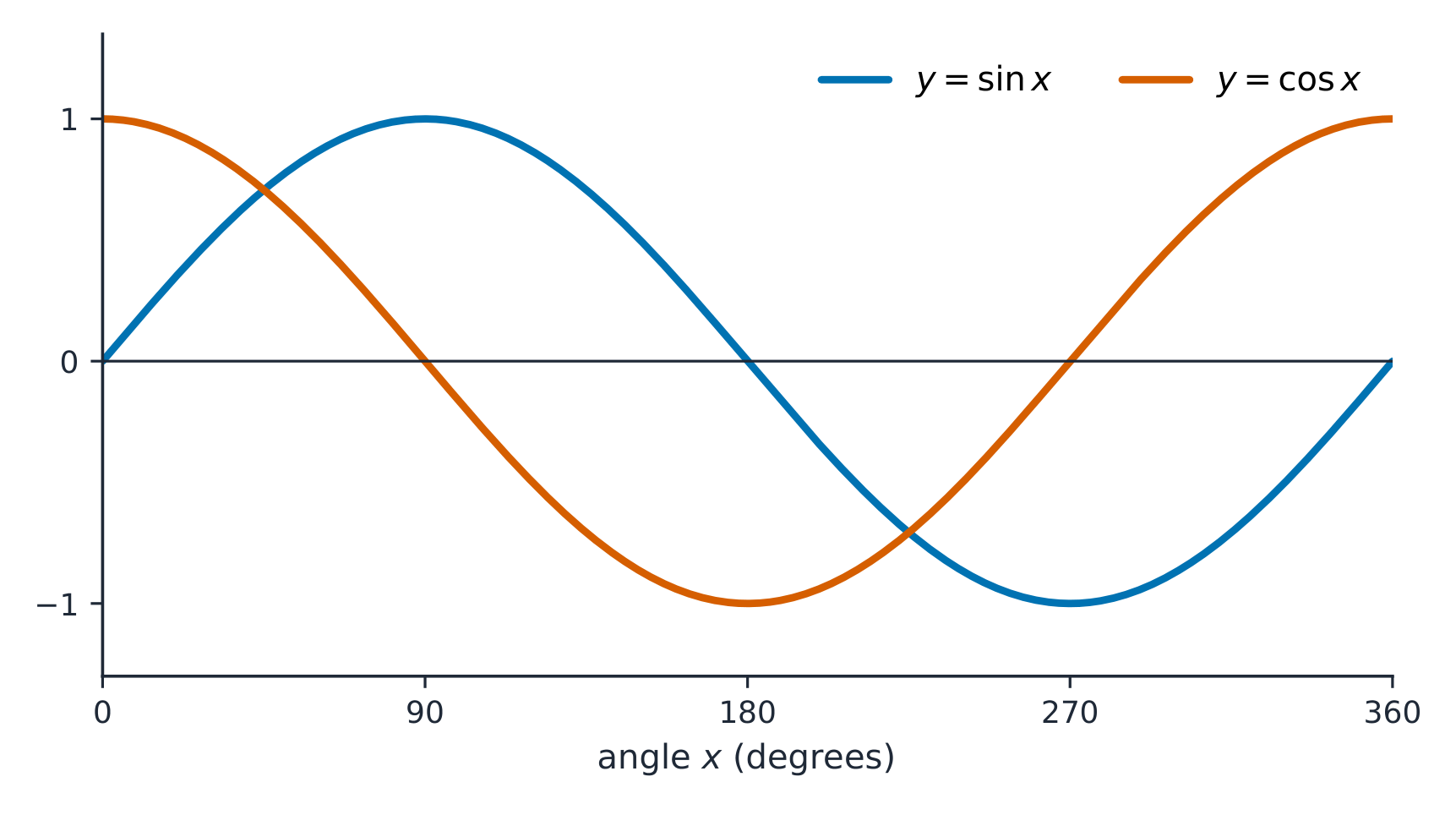
On the unit circle 单位圆 ($r=1$), $\sin\theta$ is the $y$-coordinate and $\cos\theta$ is the $x$-coordinate. As $\theta$ increases, both oscillate 振荡 smoothly between $-1$ and $1$ with period $2\pi$. Sine starts at $0$ (rising); cosine starts at $1$. They are the same wave shifted by $\tfrac{\pi}{2}$.

ไทย
Unit circle วาด curve สีนوس

บน วงกลมหน่วย ($r=1$), $\sin\theta$ คือพิกัด $y$ และ $\cos\theta$ คือพิกัด $x$. เมื่อ $\theta$ เพิ่มขึ้น ทั้งสอง สั่น ลื่นไหลระหว่าง $-1$ และ $1$ ด้วยช่วง $2\pi$. Sine เริ่มต้นที่ $0$ (เพิ่มขึ้น); cosine เริ่มต้นที่ $1$. พวกมันคือคลื่นเดียวกันที่เลื่อนไป $\tfrac{\pi}{2}$

y = sin x และ y = cos x are smooth waves between -1 and 1
Explore · ⁨สำรวจ⁩

Graph a sine wave · ⁨วาดกราฟคลื่นไซน์⁩

Unrolling the circle gives the wave $y=\sin x$: it repeats every $2\pi$ (its period) and swings between $-1$ and $1$ (its amplitude). · ⁨การคลี่วงกลมออกจะได้คลื่น $y=\sin x$: ซ้ำทุก $2\pi$ (คาบ) และแกว่งระหว่าง $-1$ ถึง $1$ (แอมพลิจูด) ⁩

Vocabulary · ⁨คำศัพท์⁩ Train · ⁨ฝึกฝน⁩
English ไทย
unit circle/ˈjuːnɪt ˈsɜːkl/ วงกลมหน่วย
oscillate/ˈɒsɪleɪt/ การสั่นสะเทือน
sinusoidal function/ˌsaɪnəˈsɔɪdl ˈfʌŋkʃn/ ฟังก์ชันไซน์
3.5

Sinusoidal Functions · ⁨ฟังก์ชันไซน์ลูइด์⁩

Syllabus · ⁨หลักสูตร⁩
English

Learning Objective 3.5.A: Identify key characteristics of the sine and cosine functions.

  • 3.5.A.1 A sinusoidal function is any function that involves additive and multiplicative transformations of $f(\theta) = \sin\theta$. The sine and cosine functions are both sinusoidal functions, with $\cos\theta = \sin\left(\theta + \dfrac{\pi}{2}\right)$.
  • 3.5.A.2 The period and frequency of a sinusoidal function are reciprocals. The period of $f(\theta) = \sin\theta$ and $g(\theta) = \cos\theta$ is $2\pi$, and the frequency is $\dfrac{1}{2\pi}$.
  • 3.5.A.3 The amplitude of a sinusoidal function is half the difference between its maximum and minimum values. The amplitude of $f(\theta) = \sin\theta$ and $g(\theta) = \cos\theta$ is $1$.
  • 3.5.A.4 The midline of the graph of a sinusoidal function is determined by the average, or arithmetic mean, of the maximum and minimum values of the function. The midline of the graphs of $y = \sin\theta$ and $y = \cos\theta$ is $y = 0$.
  • 3.5.A.5 As input values increase, the graphs of sinusoidal functions oscillate between concave down and concave up.
  • 3.5.A.6 The graph of $y = \sin\theta$ has rotational symmetry about the origin and is therefore an odd function. The graph of $y = \cos\theta$ has reflective symmetry over the $y$-axis and is therefore an even function.
ไทย

วัตถุประสงค์การเรียนรู้ 3.5.A: ระบุลักษณะสำคัญของฟังก์ชันไซน์และโคไซน์

  • 3.5.A.1 ฟังก์ชันซினูโซइดัล คือฟังก์ชันใดๆ ที่มีการแปลงแบบบวกและคูณของ $f(\theta) = \sin\theta$ ฟังก์ชันไซน์และโคซีนเป็นฟังก์ชันซินูโซइดัลทั้งคู่ โดยมี $\cos\theta = \sin\left(\theta + \dfrac{\pi}{2}\right)$
  • 3.5.A.2 ช่วงคาบและความถี่ของฟังก์ชันซินูโซइดัลเป็นผลกลับต่อกัน ช่วงคาบของ $f(\theta) = \sin\theta$ และ $g(\theta) = \cos\theta$ คือ $2\pi$ และความถี่คือ $\dfrac{1}{2\pi}$
  • 3.5.A.3 แอมพลิจูดของฟังก์ชันซินูโซइดัลคือครึ่งหนึ่งของผลต่างระหว่างค่าสูงสุดและค่าต่ำสุด แอมพลิจูดของ $f(\theta) = \sin\theta$ และ $g(\theta) = \cos\theta$ คือ $1$
  • 3.5.A.4 เส้นกลางของกราฟฟังก์ชันซินูโซइดัลกำหนดโดยค่าเฉลี่ยหรือค่าเฉลี่ยเลขคณิตของค่าสูงสุดและค่าต่ำสุดของฟังก์ชัน เส้นกลางของกราฟของ $y = \sin\theta$ และ $y = \cos\theta$ คือ $y = 0$
  • 3.5.A.5 เมื่อค่าอินพุตเพิ่มขึ้น กราฟของฟังก์ชันซินูโซइดัลจะสั่นสะเทือนระหว่างความโค้งลง (concave down) และความโค้งขึ้น (concave up)
  • 3.5.A.6 กราฟของ $y = \sin\theta$ มีความสมมาตรรอบจุดหมุนที่จุดกำเนิด ดังนั้นจึงเป็นฟังก์ชันคี่ กราฟของ $y = \cos\theta$ มีความสมมาตรสะท้อนผ่าน $y$-แกน ดังนั้นจึงเป็นฟังก์ชันคู่

Source: College Board AP Course and Exam Description · ⁨แหล่งที่มา: คำอธิบายหลักสูตรและข้อสอบ College Board AP⁩

English

A sinusoidal function 正弦型函数 is any transformation of sine (or cosine). Its key features:

  • Period and frequency 频率 are reciprocals; $\sin\theta$ has period $2\pi$.
  • Amplitude 振幅 = half the distance between the maximum and minimum output.
  • Midline 中线 $y=d$ = the average of the maximum and minimum (the horizontal center line).

The graph alternates concave up and concave down each half-cycle.

Worked example. For $f(\theta)=3\sin(2\theta)+1$: the amplitude is $3$, the period is $\dfrac{2\pi}{2}=\pi$, and the midline is $y=1$. So the maximum output is $1+3=4$ and the minimum is $1-3=-2$.

ไทย

ฟังก์ชันไซน์ลูइด์ คือการแปลงของ sine (หรือ cosine) ใดๆ. คุณสมบัติสำคัญของมัน:

  • ช่วง (Period) และ ความถี่ (Frequency) เป็นค่าผกผันกัน; $\sin\theta$ มีช่วง $2\pi$.
  • แอมพลิจูด (Amplitude) = กึ่งหนึ่งของระยะห่างระหว่างค่าสูงสุดและค่าต่ำสุดของผลลัพธ์
  • เส้นกลาง (Midline) $y=d$ = ค่าเฉลี่ยของค่าสูงสุดและค่าต่ำสุด (เส้นศูนย์กลางแนวนอน)

กราฟจะเปลี่ยนจากนูนขึ้นเป็นนูนลงสลับกันไปทุกครึ่งรอบ

ตัวอย่างที่แสดงวิธีทำ สำหรับ $f(\theta)=3\sin(2\theta)+1$: แอมพลิจูดคือ $3$, ช่วงคือ $\dfrac{2\pi}{2}=\pi$, และเส้นกลางคือ $y=1$ ดังนั้นค่าสูงสุดของผลลัพธ์คือ $1+3=4$ และค่าต่ำสุดคือ $1-3=-2$

Vocabulary · ⁨คำศัพท์⁩ Train · ⁨ฝึกฝน⁩
English ไทย
periodic/ˌpɪərɪˈɒdɪk/ ฟังก์ชันที่มีคาบ
period/ˈpɪərɪəd/ รอบ
cycle/ˈsaɪkl/ วัฏจักร
standard position/ˈstændəd pəˈzɪʃn/ ตำแหน่งมาตรฐาน standard position
radian/ˈreɪdɪən/ เรเดียน
equilateral triangle/ˌiːkwɪˈlætərəl ˈtraɪæŋɡl/ สามเหลี่ยมด้านเท่า equilateral triangle
quadrant/ˈkwɒdrənt/ ควอดแรนต์ quadrant
frequency/ˈfriːkwənsi/ ความถี่
Amplitude/ˈæmplɪtjuːd/ แอมพลิจูด
Midline/ˈmɪdlaɪn/ เส้นกลาง Midline
3.6

Sinusoidal Function Transformations · ⁨การแปลงฟังก์ชันไซน์เวค⁩

Syllabus · ⁨หลักสูตร⁩
English

Learning Objective 3.6.A: Identify the amplitude, vertical shift, period, and phase shift of a sinusoidal function.

  • 3.6.A.1 Functions that can be written in the form $f(\theta) = a\sin(b(\theta + c)) + d$ or $g(\theta) = a\cos(b(\theta + c)) + d$, where $a, b, c,$ and $d$ are real numbers and $a \neq 0$, are sinusoidal functions and are transformations of the sine and cosine functions. Additive and multiplicative transformations are the same for both sine and cosine because the cosine function is a phase shift of the sine function by $-\dfrac{\pi}{2}$ units.
  • 3.6.A.2 The graph of the additive transformation $g(\theta) = \sin\theta + d$ of the sine function $f(\theta) = \sin\theta$ is a vertical translation of the graph of $f$, including its midline, by $d$ units. The same transformation of the cosine function yields the same result.
  • 3.6.A.3 The graph of the additive transformation $g(\theta) = \sin(\theta + c)$ of the sine function $f(\theta) = \sin\theta$ is a horizontal translation, or phase shift, of the graph of $f$ by $-c$ units. The same transformation of the cosine function yields the same result.
  • 3.6.A.4 The graph of the multiplicative transformation $g(\theta) = a\sin\theta$ of the sine function $f(\theta) = \sin\theta$ is a vertical dilation of the graph of $f$ and differs in amplitude by a factor of $|a|$. The same transformation of the cosine function yields the same result.
  • 3.6.A.5 The graph of the multiplicative transformation $g(\theta) = \sin(b\theta)$ of the sine function $f(\theta) = \sin\theta$ is a horizontal dilation of the graph of $f$ and differs in period by a factor of $\left|\dfrac{1}{b}\right|$. The same transformation of the cosine function yields the same result.
  • 3.6.A.6 The graph of $y = f(\theta) = a\sin(b(\theta + c)) + d$ has an amplitude of $|a|$ units, a period of $\left|\dfrac{1}{b}\right|2\pi$ units, a midline vertical shift of $d$ units from $y = 0$, and a phase shift of $-c$ units. The same transformations of the cosine function yield the same results.
ไทย

วัตถุประสงค์การเรียนรู้ 3.6.A: ระบุแอมพลิจูด การเลื่อนแนวตั้ง ช่วงคาบ และการเลื่อนเฟสของฟังก์ชันซินูโซइดัล

  • 3.6.A.1 ฟังก์ชันที่เขียนอยู่ในรูป $f(\theta) = a\sin(b(\theta + c)) + d$ หรือ $g(\theta) = a\cos(b(\theta + c)) + d$ ซึ่ง $a, b, c,$ และ $d$ เป็นจำนวนจริงและ $a \neq 0$ เป็นฟังก์ชันซินูโซइดัลและการแปลงของฟังก์ชันไซน์และโคซีน การแปลงแบบบวกและคูณมีเหมือนกันสำหรับทั้งไซน์และโคซีนเนื่องจากฟังก์ชันโคซีนเป็นการเลื่อนเฟสของฟังก์ชันไซน์ไป $-\dfrac{\pi}{2}$ หน่วย
  • 3.6.A.2 กราฟของการแปลงแบบบวก $g(\theta) = \sin\theta + d$ ของฟังก์ชันไซน์ $f(\theta) = \sin\theta$ เป็นการเลื่อนแนวตั้งของกราฟของ $f$ รวมถึงเส้นกลาง由其 โดย $d$ หน่วย การแปลงเดียวกันของฟังก์ชันโคซีนให้ผลลัพธ์เดียวกัน
  • 3.6.A.3 กราฟของการแปลงแบบบวก $g(\theta) = \sin(\theta + c)$ ของฟังก์ชันไซน์ $f(\theta) = \sin\theta$ เป็นการเลื่อนแนวนอน หรือการเลื่อนเฟส, ของกราฟของ $f$ ไป $-c$ หน่วย การแปลงเดียวกันของฟังก์ชันโคซีนให้ผลลัพธ์เดียวกัน
  • 3.6.A.4 กราฟของการแปลงแบบคูณ $g(\theta) = a\sin\theta$ ของฟังก์ชันไซน์ $f(\theta) = \sin\theta$ เป็นการขยายแนวตั้งของกราฟของ $f$ และแตกต่างกันในแอมพลิจูดด้วยปัจจัย $|a|$ การแปลงเดียวกันของฟังก์ชันโคซีนให้ผลลัพธ์เดียวกัน
  • 3.6.A.5 กราฟของการแปลงแบบคูณ $g(\theta) = \sin(b\theta)$ ของฟังก์ชันไซน์ $f(\theta) = \sin\theta$ เป็นการขยายแนวนอนของกราฟของ $f$ และแตกต่างกันในช่วงคาบด้วยปัจจัย $\left|\dfrac{1}{b}\right|$ การแปลงเดียวกันของฟังก์ชันโคซีนให้ผลลัพธ์เดียวกัน
  • 3.6.A.6 กราฟของ $y = f(\theta) = a\sin(b(\theta + c)) + d$ มีแอมพลิจูด $|a|$ หน่วย, ช่วงคาบ $\left|\dfrac{1}{b}\right|2\pi$ หน่วย, การเลื่อนแนวตั้งของเส้นกลาง $d$ หน่วย จาก $y = 0$, และการเลื่อนเฟส $-c$ หน่วย การแปลงเดียวกันของฟังก์ชันโคซีนให้ผลลัพธ์เดียวกัน

Source: College Board AP Course and Exam Description · ⁨แหล่งที่มา: คำอธิบายหลักสูตรและข้อสอบ College Board AP⁩

English
Amplitude, period & phase of a sinusoid

The general sinusoid is

$$f(\theta)=a\sin\big(b(\theta+c)\big)+d \quad\text{or}\quad a\cos\big(b(\theta+c)\big)+d,$$
where $|a|$ is the amplitude, $\dfrac{2\pi}{|b|}$ is the period, $-c$ is the horizontal phase shift 相移 (a $+c$ inside the bracket shifts the graph left by $c$), and $d$ is the vertical shift (midline). A negative $a$ reflects the wave.

ไทย
แอมพลิจูด, ช่วง และเฟสของไซน์เวค

ฟังก์ชันไซน์เวคทั่วไปคือ

$$f(\theta)=a\sin\big(b(\theta+c)\big)+d \quad\text{or}\quad a\cos\big(b(\theta+c)\big)+d,$$
โดยที่ $|a|$ คือ แอมพลิจูด, $\dfrac{2\pi}{|b|}$ คือ ช่วง, $-c$ คือการเลื่อนเฟสในแนวราบ (phase shift) (ค่า $+c$ ภายในวงเล็บจะเลื่อนกราฟไปทาง ซ้าย จำนวน $c$), และ $d$ คือการเลื่อนในแนวตั้ง (vertical shift) (ซึ่งคือเส้นกลาง) ค่า $a$ ที่เป็นลบจะทำให้คลื่นสะท้อนกลับ

Explore · ⁨สำรวจ⁩

Stretch and shift a sinusoid · ⁨ยืดและเลื่อนฟังก์ชันซинуสอยด์⁩

In $y=a\sin(bx+c)+d$: $a$ sets the amplitude, $b$ the period, $c$ a horizontal phase shift, and $d$ a vertical shift. Change each and watch the wave respond. · ⁨ใน $y=a\sin(bx+c)+d$ : $a$ กำหนด แอมพลิจูด, $b$ กำหนด คาบ, $c$ การเลื่อนเฟสแนวนอน, และ $d$ การเลื่อนแนวตั้ง เปลี่ยนแต่ละค่าแล้วดูปฏิกิริยาของคลื่น⁩

Vocabulary · ⁨คำศัพท์⁩ Train · ⁨ฝึกฝน⁩
English ไทย
phase shift/feɪz ʃɪft/ การเลื่อนเฟส
inverse trigonometric functions/ɪnˈvɜːs ˌtrɪɡənəʊˈmetrɪk ˈfʌŋkʃnz/ ฟังก์ชันตรีโกณมิติผกผัน
3.7

Sinusoidal Function Context and Data Modeling · ⁨บริบทของฟังก์ชันไซน์เวคและการสร้างแบบจำลองข้อมูล⁩

Syllabus · ⁨หลักสูตร⁩
English

Learning Objective 3.7.A: Construct sinusoidal function models of periodic phenomena.

  • 3.7.A.1 The smallest interval of input values over which the maximum or minimum output values start to repeat, that is, the input-value interval between consecutive maxima or consecutive minima, can be used to determine or estimate the period and frequency for a sinusoidal function model.
  • 3.7.A.2 The maximum and minimum output values can be used to determine or estimate the amplitude and vertical shift for a sinusoidal function model.
  • 3.7.A.3 An actual pair of input-output values can be compared to pairs of input-output values produced by a sinusoidal function model to determine or estimate a phase shift for the model.
  • 3.7.A.4 Sinusoidal function models can be constructed for a data set with technology by estimating key values or using sinusoidal regressions.
  • 3.7.A.5 Sinusoidal functions that model a data set are frequently only useful over their contextual domain and can be used to predict values of the dependent variable from values of the independent variable.
ไทย

วัตถุประสงค์การเรียนรู้ 3.7.A: สร้างโมเดลฟังก์ชันซินูโซइดัลของปรากฏการณ์ที่เป็นช่วง

  • 3.7.A.1 ช่วง的最小值ของค่าอินพุตที่ค่าเอาต์พุตสูงสุดหรือต่ำสุดเริ่มซ้ำกัน นั่นคือ ช่วงค่าอินพุตระหว่างค่าสูงสุดต่อเนื่องกันหรือค่าต่ำสุดต่อเนื่องกัน สามารถใช้เพื่อกำหนดหรือประมาณค่าช่วงคาบและความถี่สำหรับโมเดลฟังก์ชันซินูโซइดัลได้
  • 3.7.A.2 ค่าเอาต์พุตสูงสุดและต่ำสุดสามารถใช้เพื่อกำหนดหรือประมาณค่าแอมพลิจูดและการเลื่อนแนวตั้งสำหรับโมเดลฟังก์ชันซินูโซइดัลได้
  • 3.7.A.3 คู่ค่าอินพุต-เอาต์พุตจริงสามารถเปรียบเทียบกับคู่ค่าอินพุต-เอาต์พุตที่ผลิตโดยโมเดลฟังก์ชันซินูโซइดัลเพื่อกำหนดหรือประมาณค่าการเลื่อนเฟสสำหรับโมเดลได้
  • 3.7.A.4 โมเดลฟังก์ชันซินูโซइดัลสามารถสร้างสำหรับชุดข้อมูลได้ด้วยเทคโนโลยีโดยการประมาณค่าสำคัญหรือใช้การถดถอยแบบซินูโซइดัล
  • 3.7.A.5 ฟังก์ชันซินูโซइดัลที่โมเดลชุดข้อมูลมักจะมีประโยชน์เฉพาะในช่วงบริบทเท่านั้นและสามารถใช้ทำนายค่าของตัวแปรตามจากค่าของตัวแปรอิสระได้

Source: College Board AP Course and Exam Description · ⁨แหล่งที่มา: คำอธิบายหลักสูตรและข้อสอบ College Board AP⁩

English

To model periodic data (tides, daylight, temperature): read the period from where the pattern repeats, get the amplitude and midline from the max and min, and set the phase shift so a peak lands at the right input. Technology fits a sinusoidal regression. Such a model is only trustworthy over its contextual domain.

ไทย

เพื่อสร้างแบบจำลองข้อมูลที่เป็นคาบ (น้ำขึ้นน้ำลด,时长แสงแดด, อุณหภูมิ): อ่าน ช่วง จากจุดที่รูปแบบซ้ำ, ได้ แอมพลิจูด และ เส้นกลาง จากค่าสูงสุดและต่ำสุด, และตั้งค่าเฟสให้ยอดกราฟอยู่ตำแหน่งอินพุตที่ถูกต้อง เทคโนโลยีช่วย-fit แบบจำลองการถดถอยเชิงไซน์เวค แบบจำลองนี้เชื่อถือได้เฉพาะในช่วง บริบท (contextual domain) เท่านั้น

3.8

The Tangent Function · ⁨ฟังก์ชันแทนเจนต์⁩

Syllabus · ⁨หลักสูตร⁩
English

Learning Objective 3.8.A: Construct representations of the tangent function using the unit circle.

  • 3.8.A.1 Given an angle of measure $\theta$ in standard position and a unit circle centered at the origin, there is a point, $P$, where the terminal ray intersects the circle. The tangent function, $f(\theta) = \tan\theta$, gives the slope of the terminal ray.
  • 3.8.A.2 Because the slope of the terminal ray is the ratio of the change in the $y$-values to the change in the $x$-values between any two points on the ray, the tangent function is also the ratio of the sine function to the cosine function. Therefore, $\tan\theta = \dfrac{\sin\theta}{\cos\theta}$, where $\cos\theta \neq 0$.

Learning Objective 3.8.B: Describe key characteristics of the tangent function.

  • 3.8.B.1 Because the slope values of the terminal ray repeat every one-half revolution of the circle, the tangent function has a period of $\pi$.
  • 3.8.B.2 The tangent function demonstrates periodic asymptotic behavior at input values $\theta = \dfrac{\pi}{2} + k\pi$, for integer values of $k$, because $\cos\theta = 0$ at those values.
  • 3.8.B.3 The tangent function increases and its graph changes from concave down to concave up between consecutive asymptotes.
ไทย

วัตถุประสงค์การเรียนรู้ 3.8.A: สร้างการแสดงฟังก์ชันแทนเจนต์โดยใช้วงกลมหน่วย

  • 3.8.A.1 เมื่อให้มุมที่มีขนาด $\theta$ ในตำแหน่งมาตรฐาน และมีวงกลมหน่วยที่จุดกำเนิด จะมีจุดหนึ่ง, $P$, ซึ่งรังสีปลายตัดกับวงกลม ฟังก์ชันแทนเจนท์, $f(\theta) = \tan\theta$, ให้ค่าความชันของรังสีปลาย
  • 3.8.A.2 เนื่องจากความชันของรังสีปลายเป็นอัตราส่วนของการเปลี่ยนแปลงค่า $y$ ต่อการเปลี่ยนแปลงค่า $x$ ระหว่างจุดใดๆ บนรังสี ฟังก์ชันแทนเจนต์จึงเป็นอัตราส่วนของฟังก์ชันไซน์ต่อฟังก์ชันโคไซน์ ดังนั้น $\tan\theta = \dfrac{\sin\theta}{\cos\theta}$ เมื่อ $\cos\theta \neq 0$

วัตถุประสงค์การเรียนรู้ 3.8.B: อธิบายคุณลักษณะสำคัญของฟังก์ชันแทนเจนต์

  • 3.8.B.1 เนื่องจากค่าความชันของรังสีปลายซ้ำทุกครึ่งรอบของวงกลม ฟังก์ชันแทนเจนต์จึงมีคาบเท่ากับ $\pi$
  • 3.8.B.2 ฟังก์ชันแทนเจนต์แสดงพฤติกรรมแบบอสมการที่มีคาบที่ค่าอินพุต $\theta = \dfrac{\pi}{2} + k\pi$ สำหรับค่าจำนวนเต็มของ $k$ เนื่องจาก $\cos\theta = 0$ ที่ค่าเหล่านั้น
  • 3.8.B.3 ฟังก์ชันแทนเจนต์เพิ่มขึ้นและกราฟเปลี่ยนจากนูนลงเป็นนูนขึ้นระหว่างเส้นอสมการติดกัน

Source: College Board AP Course and Exam Description · ⁨แหล่งที่มา: คำอธิบายหลักสูตรและข้อสอบ College Board AP⁩

English

$\tan\theta=\dfrac{\sin\theta}{\cos\theta}$ is the slope of the terminal ray. Its slope values repeat every half-revolution, so its period is $\pi$. It has vertical asymptotes where $\cos\theta=0$ (at $\theta=\tfrac{\pi}{2}+k\pi$), and it is always increasing between consecutive asymptotes, switching concavity at each zero.

ไทย

$\tan\theta=\dfrac{\sin\theta}{\cos\theta}$ คือ ความชัน ของรังสีปลาย ค่าความชันของฟังก์ชันนี้ซ้ำกันทุกครึ่งรอบหมุน ดังนั้นช่วง周期 (period) จึงเป็น $\pi$. ฟังก์ชันนี้มี เส้นประแนวตั้ง ที่ $\cos\theta=0$ (ที่ $\theta=\tfrac{\pi}{2}+k\pi$), และจะเพิ่มขึ้นตลอดระหว่างเส้นประแนวตั้งที่ติดกัน โดยเปลี่ยนความโค้ง (concavity) ที่จุดตัดแกน x ทุกจุด

3.9

Inverse Trigonometric Functions · ⁨ฟังก์ชันตรีโกณมิติผกผัน⁩

Syllabus · ⁨หลักสูตร⁩
English

Learning Objective 3.9.A: Construct analytical and graphical representations of the inverse of the sine, cosine, and tangent functions over a restricted domain.

  • 3.9.A.1 For inverse trigonometric functions, the input and output values are switched from their corresponding trigonometric functions, so the output value of an inverse trigonometric function is often interpreted as an angle measure and the input is a value in the range of the corresponding trigonometric function.
  • 3.9.A.2 The inverse trigonometric functions are called arcsine, arccosine, and arctangent (also represented as $\sin^{-1}x, \cos^{-1}x,$ and $\tan^{-1}x$). Because the corresponding trigonometric functions are periodic, they are only invertible if they have restricted domains.
  • 3.9.A.3 In order to define their respective inverse functions, the domain of the sine function is restricted to $\left[-\dfrac{\pi}{2}, \dfrac{\pi}{2}\right]$, the cosine function to $[0, \pi]$, and the tangent function to $\left(-\dfrac{\pi}{2}, \dfrac{\pi}{2}\right)$.
ไทย

วัตถุประสงค์การเรียนรู้ 3.9.A: สร้างแบบจำลองเชิงวิเคราะห์และกราฟิกของฟังก์ชันตรีโกณมิติกลับด้านของไซน์ โคไซน์ และแทนเจนต์บนโดเมนที่จำกัด

  • 3.9.A.1 สำหรับฟังก์ชันตรีโกณมิติกลับด้าน ค่าอินพุตและเอาต์พุตจะสลับกับฟังก์ชันตรีโกณมิติที่เกี่ยวข้อง ดังนั้นค่าเอาต์พุตของฟังก์ชันตรีโกณมิติกลับด้านจึงมักถูกตีความว่าเป็นขนาดมุม และค่าอินพุตคือค่าอยู่ในช่วงของฟังก์ชันตรีโกณมิติที่เกี่ยวข้อง
  • 3.9.A.2 ฟังก์ชันตรีโกณมิติกลับด้านเรียกว่า อาร์กไซน์, อาร์กโคไซน์ และ อาร์กแทนเจนต์ (แสดงด้วย $\sin^{-1}x, \cos^{-1}x,$ และ $\tan^{-1}x$) เนื่องจากฟังก์ชันตรีโกณมิติที่เกี่ยวข้องมีคาบ จึงสามารถหาฟังก์ชันกลับด้านได้ก็ต่อเมื่อมีโดเมนที่จำกัดเท่านั้น
  • 3.9.A.3 เพื่อกำหนดฟังก์ชันกลับด้านของแต่ละฟังก์ชัน โดเมนของฟังก์ชันไซน์ถูกจำกัดให้เหลือ $\left[-\dfrac{\pi}{2}, \dfrac{\pi}{2}\right]$ ฟังก์ชันโคไซน์เหลือ $[0, \pi]$ และฟังก์ชันแทนเจนต์เหลือ $\left(-\dfrac{\pi}{2}, \dfrac{\pi}{2}\right)$

Source: College Board AP Course and Exam Description · ⁨แหล่งที่มา: คำอธิบายหลักสูตรและข้อสอบ College Board AP⁩

English

The inverse trigonometric functions 反三角函数 – arcsine 反正弦, arccosine, arctangent – reverse the trig functions, so they take a ratio and return an angle. Because sine, cosine, and tangent repeat, their domains must be restricted (e.g. sine to $[-\tfrac{\pi}{2},\tfrac{\pi}{2}]$) before an inverse can exist.

ไทย

ฟังก์ชันตรีโกณมิติผกผัน – อาร์西斯าย (arcsine), อาร์โคไซน (arccosine), อาร์ควันเทนต์ (arctangent) – ทำหน้าที่ย้อนกลับฟังก์ชันตรีโกณมิติ ดังนั้นจึงรับค่าอัตราส่วนเข้าไปและส่งมุมออกมา เนื่องจากไซน์, โคไซน และแทนเจนต์ซ้ำซ้อนโดเมนของมันต้องถูก จำกัด (restricted) (เช่น ไซน์อยู่ที่ $[-\tfrac{\pi}{2},\tfrac{\pi}{2}]$) ก่อนที่จะมีฟังก์ชันผกผันได้

Vocabulary · ⁨คำศัพท์⁩ Train · ⁨ฝึกฝน⁩
English ไทย
arcsine/ˈɑːksaɪn/ Screening arcsine
reciprocals/rɪˈsɪprəklz/ ส่วนกลับ (reciprocals)
Pythagorean identity/ˈpaɪθəɡɔːrɪən aɪˈdentɪti/ เอกลักษณ์พีทาโกรัส
3.10

Trigonometric Equations and Inequalities · ⁨สมการอสมการตรีโกณมิติ⁩

Syllabus · ⁨หลักสูตร⁩
English

Learning Objective 3.10.A: Solve equations and inequalities involving trigonometric functions.

  • 3.10.A.1 Inverse trigonometric functions are useful in solving equations and inequalities involving trigonometric functions, but solutions may need to be modified due to domain restrictions.
  • 3.10.A.2 Because trigonometric functions are periodic, there are often infinitely many solutions to trigonometric equations.
  • 3.10.A.3 In trigonometric equations and inequalities arising from a contextual scenario, there is often a domain restriction that can be implied from the context, which limits the number of solutions.
ไทย

จุดประสงค์การเรียนรู้ 3.10.A: แก้สมการและอสมการที่เกี่ยวข้องกับฟังก์ชันตรีโกณมิติ

  • 3.10.A.1 ฟังก์ชันตรีโกณมิติผกผันมีประโยชน์ในการแก้สมการและอสมการที่เกี่ยวข้องกับฟังก์ชันตรีโกณมิติ แต่คำตอบอาจต้องปรับเนื่องจากข้อจำกัดของโดเมน
  • 3.10.A.2 เนื่องจากฟังก์ชันตรีโกณมิติเป็นรอบ มักจะมีคำตอบจำนวนนับไม่ถ้วนสำหรับสมการตรีโกณมิติ
  • 3.10.A.3 ในสมการและอสมการตรีโกณมิติที่เกิดจากสถานการณ์จริง มักจะมีข้อจำกัดของโดเมนที่สื่อจากบริบท ซึ่งจำกัดจำนวนคำตอบ

Source: College Board AP Course and Exam Description · ⁨แหล่งที่มา: คำอธิบายหลักสูตรและข้อสอบ College Board AP⁩

English

Use inverse trig functions to solve trig equations. Because the functions are periodic, there are usually infinitely many solutions – write the general solution by adding multiples of the period, then keep those in the required (often contextual) domain.

Worked example. Solve $2\sin\theta=1$ on $[0,2\pi)$. Then $\sin\theta=\tfrac12$, and on the unit circle sine is positive in the first and second quadrants, so $\theta=\dfrac{\pi}{6}$ or $\dfrac{5\pi}{6}$. Over all reals you would add $2\pi k$ to each.

ไทย

ใช้ฟังก์ชันตรีโกณมิติผกผันเพื่อแก้สมการตรีโกณมิติ เนื่องจากฟังก์ชันเหล่านี้เป็น คาบ มักจะมีคำตอบเป็น จำนวนไม่จำกัด – เขียนคำตอบทั่วไปโดยการบวกพหุคูณของช่วง แล้วเลือกคำตอบที่อยู่ในโดเมนที่ต้องการ (ซึ่งมักจะเป็นโดเมนตามบริบท)

ตัวอย่างที่แสดงวิธีทำ แก้ $2\sin\theta=1$ บน $[0,2\pi)$ จากนั้น $\sin\theta=\tfrac12$, และบนวงกลมหน่วย ไซน์เป็นบวกในจตุภาคที่หนึ่งและสอง ดังนั้น $\theta=\dfrac{\pi}{6}$ หรือ $\dfrac{5\pi}{6}$ ในจำนวนจริงทั้งหมดคุณสามารถเพิ่ม $2\pi k$ เข้าไปในแต่ละค่าได้

3.11

The Secant, Cosecant, and Cotangent Functions · ⁨ฟังก์ชันเซคันต์, คอสีcant, และโคแทนเจนท์⁩

Syllabus · ⁨หลักสูตร⁩
English

Learning Objective 3.11.A: Identify key characteristics of functions that involve quotients of the sine and cosine functions.

  • 3.11.A.1 The secant function, $f(\theta) = \sec\theta$, is the reciprocal of the cosine function, where $\cos\theta \neq 0$.
  • 3.11.A.2 The cosecant function, $f(\theta) = \csc\theta$, is the reciprocal of the sine function, where $\sin\theta \neq 0$.
  • 3.11.A.3 The graphs of the secant and cosecant functions have vertical asymptotes where cosine and sine are zero, respectively, and have a range of $(-\infty, -1] \cup [1, \infty)$.
  • 3.11.A.4 The cotangent function, $f(\theta) = \cot\theta$, is the reciprocal of the tangent function, where $\tan\theta \neq 0$. Equivalently, $\cot\theta = \dfrac{\cos\theta}{\sin\theta}$, where $\sin\theta \neq 0$.
  • 3.11.A.5 The graph of the cotangent function has vertical asymptotes for domain values where $\tan\theta = 0$ and is decreasing between consecutive asymptotes.
ไทย

จุดประสงค์การเรียนรู้ 3.11.A: ระบุคุณลักษณะสำคัญของฟังก์ชันที่เกี่ยวข้องกับการหารของฟังก์ชันไซน์และ cosine

  • 3.11.A.1 ฟังก์ชันเซคันต์, $f(\theta) = \sec\theta$, เป็นผลกลับของฟังก์ชัน cosinus, โดยที่ $\cos\theta \neq 0$
  • 3.11.A.2 ฟังก์ชัน cosecant, $f(\theta) = \csc\theta$, เป็นผลกลับของฟังก์ชัน sine, โดยที่ $\sin\theta \neq 0$
  • 3.11.A.3 กราฟของฟังก์ชัน secant และ cosecant มีเส้นประแนวนอนเมื่อ cosinus และ sine เป็นศูนย์ตามลำดับ และมีช่วงค่า (range) เป็น $(-\infty, -1] \cup [1, \infty)$
  • 3.11.A.4 ฟังก์ชันโคแทนเจนท์, $f(\theta) = \cot\theta$, เป็นค่าผกผันของฟังก์ชันแทนเจนท์, โดยที่ $\tan\theta \neq 0$. ในทางเทียบเท่า, $\cot\theta = \dfrac{\cos\theta}{\sin\theta}$, โดยที่ $\sin\theta \neq 0$
  • 3.11.A.5 กราฟของฟังก์ชัน cotangent มีเส้นประแนวตั้งสำหรับค่าโดเมนที่ทำให้ $\tan\theta = 0$ และเป็นฟังก์ชันลดระหว่างเส้นประแนวตั้งที่ติดกัน

Source: College Board AP Course and Exam Description · ⁨แหล่งที่มา: คำอธิบายหลักสูตรและข้อสอบ College Board AP⁩

English

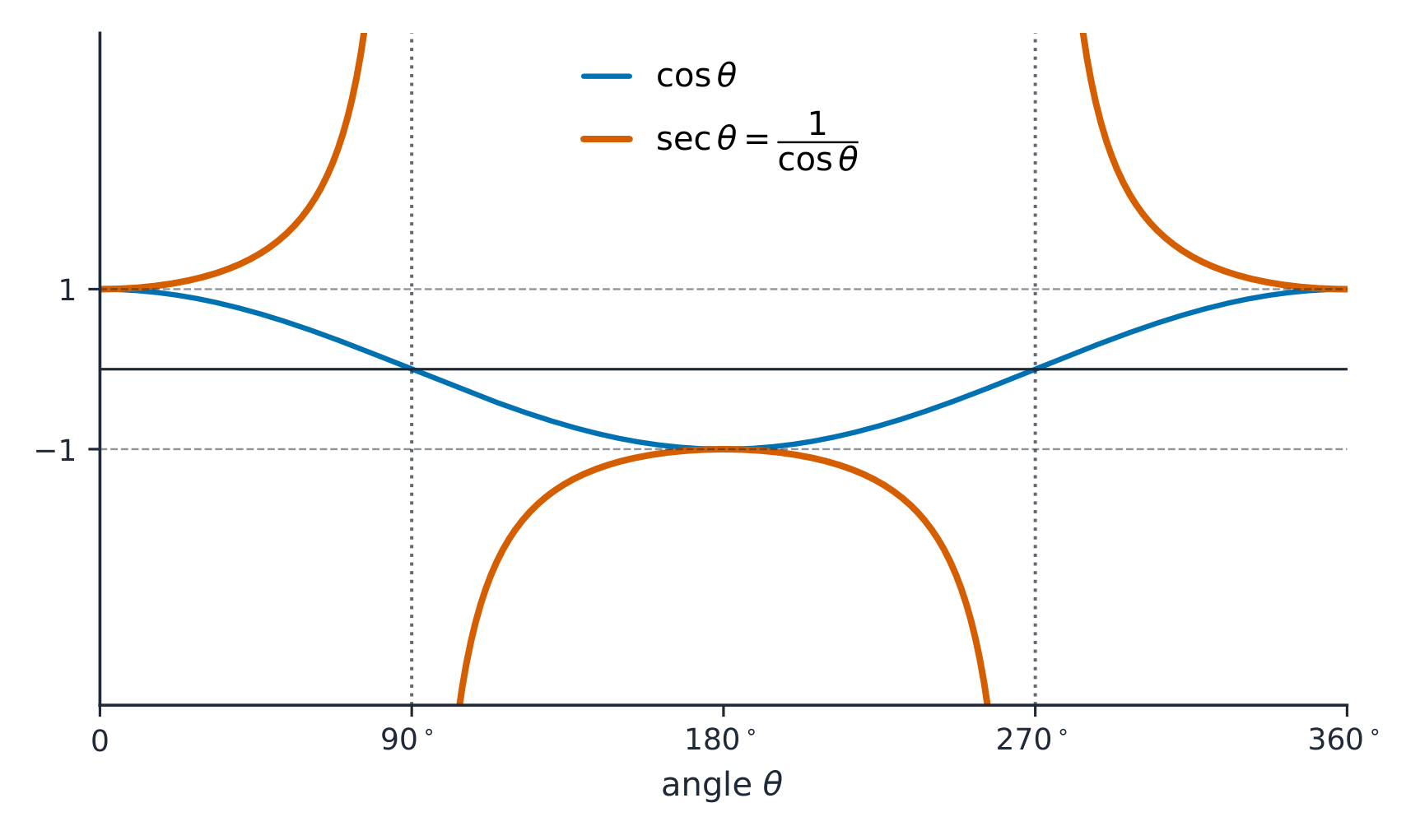
These are the reciprocals 倒数 of the main three:

$$\sec\theta=\frac{1}{\cos\theta},\qquad \csc\theta=\frac{1}{\sin\theta},\qquad \cot\theta=\frac{1}{\tan\theta}.$$
Secant and cosecant have vertical asymptotes where cosine and sine are zero; cotangent has them where tangent is zero (where sine is zero).

ไทย

这些都是主要สามฟังก์ชัน的第一倒数:

$$\sec\theta=\frac{1}{\cos\theta},\qquad \csc\theta=\frac{1}{\sin\theta},\qquad \cot\theta=\frac{1}{\tan\theta}.$$
เซคันต์และคอสีcantมีเส้นประขนานแกน Y ที่โคไซนและไซน์เป็นศูนย์; โคแทนเจนท์มีที่แทนเจนต์เป็นศูนย์ (ซึ่งคือที่ไซน์เป็นศูนย์)

sec เป็น reciprocal ของ cos, มี asymptotes ที่ cos เป็นศูนย์
3.12

Equivalent Representations of Trigonometric Functions · ⁨รูปแบบการแสดงตรีโกณมิติที่เทียบเท่ากัน⁩

Syllabus · ⁨หลักสูตร⁩
English

Learning Objective 3.12.A: Rewrite trigonometric expressions in equivalent forms with the Pythagorean identity.

  • 3.12.A.1 The Pythagorean Theorem can be applied to right triangles with points on the unit circle at coordinates $(\cos\theta, \sin\theta)$, resulting in the Pythagorean identity: $\sin^2\theta + \cos^2\theta = 1$.
  • 3.12.A.2 The Pythagorean identity can be algebraically manipulated into other forms involving trigonometric functions, such as $\tan^2\theta = \sec^2\theta - 1$, and can be used to establish other trigonometric relationships, such as $\arcsin x = \arccos\left(\sqrt{1 - x^2}\right)$, with appropriate domain restrictions.

Learning Objective 3.12.B: Rewrite trigonometric expressions in equivalent forms with sine and cosine sum identities.

  • 3.12.B.1 The sum identity for sine is $\sin(\alpha + \beta) = \sin\alpha\cos\beta + \cos\alpha\sin\beta$.
  • 3.12.B.2 The sum identity for cosine is $\cos(\alpha + \beta) = \cos\alpha\cos\beta - \sin\alpha\sin\beta$.
  • 3.12.B.3 The sum identities for sine and cosine can also be used as difference and double-angle identities.
  • 3.12.B.4 Properties of trigonometric functions, known trigonometric identities, and other algebraic properties can be used to verify additional trigonometric identities.

Learning Objective 3.12.C: Solve equations using equivalent analytic representations of trigonometric functions.

  • 3.12.C.1 A specific equivalent form involving trigonometric expressions can make information more accessible.
  • 3.12.C.2 Equivalent trigonometric forms may be useful in solving trigonometric equations and inequalities.
ไทย

จุดประสงค์การเรียนรู้ 3.12.A: เขียนนิพจน์ตรีโกณมิติในรูปที่เทียบเท่ากันโดยใช้เอกลักษณ์ Pythagorean

  • 3.12.A.1 ทฤษฎีบท Pythagorean สามารถใช้กับสามเหลี่ยมมุมฉากที่มีจุดอยู่บนวงกลมหน่วยที่พิกัด $(\cos\theta, \sin\theta)$ ทำให้เกิดเอกลักษณ์ Pythagorean: $\sin^2\theta + \cos^2\theta = 1$
  • 3.12.A.2 เอกลักษณ์ Pythagorean สามารถจัดรูปทางพีชคณิตเป็นรูปอื่น ๆ ที่เกี่ยวข้องกับฟังก์ชันตรีโกณมิติ เช่น $\tan^2\theta = \sec^2\theta - 1$ และสามารถใช้ในการพิสูจน์ความสัมพันธ์ตรีโกณมิติอื่น ๆ เช่น $\arcsin x = \arccos\left(\sqrt{1 - x^2}\right)$ พร้อมข้อจำกัดโดเมนที่เหมาะสม

จุดประสงค์การเรียนรู้ 3.12.B: เขียนนิพจน์ตรีโกณมิติในรูปที่เทียบเท่ากันโดยใช้เอกลักษณ์ผลรวมของไซน์และ cosine

  • 3.12.B.1 เอกลักษณ์ผลรวมของ sine คือ $\sin(\alpha + \beta) = \sin\alpha\cos\beta + \cos\alpha\sin\beta$
  • 3.12.B.2 เอกลักษณ์ผลรวมของ cosine คือ $\cos(\alpha + \beta) = \cos\alpha\cos\beta - \sin\alpha\sin\beta$
  • 3.12.B.3 เอกลักษณ์ผลรวมของ sine และ cosine ยังสามารถใช้เป็นเอกลักษณ์ผลต่างและมุมสองเท่าได้ด้วย
  • 3.12.B.4 คุณสมบัติของฟังก์ชันตรีโกณมิติ เอกลักษณ์ตรีโกณมิติKnown และคุณสมบัติทางพีชคณิตอื่น ๆ สามารถใช้เพื่อยืนยันเอกลักษณ์ตรีโกณมิติเพิ่มเติมได้

จุดประสงค์การเรียนรู้ 3.12.C: แก้สมการโดยใช้表现形式วิเคราะห์ที่เทียบเท่ากันของฟังก์ชันตรีโกณมิติ

  • 3.12.C.1 รูปแบบที่เทียบเท่ากันเฉพาะบางรูปแบบที่เกี่ยวข้องกับนิพจน์ตรีโกณมิติสามารถทำให้ข้อมูลเข้าถึงได้ง่ายขึ้น
  • 3.12.C.2 รูปแบบตรีโกณมิติที่เทียบเท่ากันอาจมีประโยชน์ในการแก้สมการและอสมการตรีโกณมิติ

Source: College Board AP Course and Exam Description · ⁨แหล่งที่มา: คำอธิบายหลักสูตรและข้อสอบ College Board AP⁩

English

The Pythagorean identity 毕达哥拉斯恒等式 comes from $x^2+y^2=1$ on the unit circle:

$$\sin^2\theta+\cos^2\theta=1,$$
which rearranges into forms with $\sec$ and $\tan$. The sum identities 和角公式:
$$\sin(\alpha+\beta)=\sin\alpha\cos\beta+\cos\alpha\sin\beta,\qquad \cos(\alpha+\beta)=\cos\alpha\cos\beta-\sin\alpha\sin\beta,$$
also give the difference and double-angle 二倍角 identities (set $\beta=\alpha$).

ไทย

เอกลักษณ์ Pythagorean มาจาก $x^2+y^2=1$ บนวงกลมหน่วย:

$$\sin^2\theta+\cos^2\theta=1,$$
ซึ่งจัดรูปใหม่เป็นรูปแบบที่มี $\sec$ และ $\tan$ เอกลักษณ์ผลบวก (sum identities):
$$\sin(\alpha+\beta)=\sin\alpha\cos\beta+\cos\alpha\sin\beta,\qquad \cos(\alpha+\beta)=\cos\alpha\cos\beta-\sin\alpha\sin\beta,$$
ยังให้เอกลักษณ์ผลต่างและ มุมสองเท่า (double-angle) (ตั้งค่า $\beta=\alpha$)

Vocabulary · ⁨คำศัพท์⁩ Train · ⁨ฝึกฝน⁩
English ไทย
sum identities/sʌm aɪˈdentɪtiz/ เอกลักษณ์ผลบวก sum identities
double-angle/ˈdʌbl ˈæŋɡl/ มุมสองเท่า double-angle
3.13

Trigonometry and Polar Coordinates · ⁨ตรีโกณมิติและพิกัดขั้ว⁩

Syllabus · ⁨หลักสูตร⁩
English

Learning Objective 3.13.A: Determine the location of a point in the plane using both rectangular and polar coordinates.

  • 3.13.A.1 The polar coordinate system is based on a grid of circles centered at the origin and on lines through the origin. Polar coordinates are defined as an ordered pair, $(r, \theta)$, such that $|r|$ represents the radius of the circle on which the point lies, and $\theta$ represents the measure of an angle in standard position whose terminal ray includes the point. In the polar coordinate system, the same point can be represented many ways.
  • 3.13.A.2 The coordinates of a point in the polar coordinate system, $(r, \theta)$, can be converted to coordinates in the rectangular coordinate system, $(x, y)$, using $x = r\cos\theta$ and $y = r\sin\theta$.
  • 3.13.A.3 The coordinates of a point in the rectangular coordinate system, $(x, y)$, can be converted to coordinates in the polar coordinate system, $(r, \theta)$, using $r = \sqrt{x^2 + y^2}$ and $\theta = \arctan\left(\dfrac{y}{x}\right)$ for $x > 0$ or $\theta = \arctan\left(\dfrac{y}{x}\right) + \pi$ for $x < 0$.
  • 3.13.A.4 A complex number can be understood as a point in the complex plane and can be determined by its corresponding rectangular or polar coordinates. When the complex number has the rectangular coordinates $(a, b)$, it can be expressed as $a + bi$. When the complex number has polar coordinates $(r, \theta)$, it can be expressed as $(r\cos\theta) + i(r\sin\theta)$.
ไทย

จุดประสงค์การเรียนรู้ 3.13.A: หาตำแหน่งของจุดบนระนาบโดยใช้ทั้งพิกัดสี่เหลี่ยมและพิกัดขั้ว

  • 3.13.A.1 ระบบพิกัดขั้วอาศัยตารางกริดของวงกลมที่มีจุดศูนย์กลางที่จุดกำเนิดและเส้นตรงผ่านจุดกำเนิด พิกัดขั้วถูกกำหนดเป็นคู่เรียง $(r, \theta)$ โดยที่ $|r|$ แทนรัศมีของวงกลมที่จุดนั้นอยู่ และ $\theta$ แทนขนาดของมุมในตำแหน่งมาตรฐานซึ่งรังสีปลายมีจุดนั้นอยู่ ในระบบพิกัดขั้ว จุดเดียวกันสามารถแทนได้หลายวิธี
  • 3.13.A.2 พิกัดของจุดในระบบพิกัดขั้ว, $(r, \theta)$, สามารถแปลงเป็นพิกัดในระบบพิกัดสี่เหลี่ยม, $(x, y)$, โดยใช้ $x = r\cos\theta$ และ $y = r\sin\theta$
  • 3.13.A.3 พิกัดของจุดในระบบพิกัดสี่เหลี่ยม, $(x, y)$, สามารถแปลงเป็นพิกัดในระบบพิกัดขั้ว, $(r, \theta)$, โดยใช้ $r = \sqrt{x^2 + y^2}$ และ $\theta = \arctan\left(\dfrac{y}{x}\right)$ สำหรับ $x > 0$ หรือ $\theta = \arctan\left(\dfrac{y}{x}\right) + \pi$ สำหรับ $x < 0$
  • 3.13.A.4 จำนวนเชิงซ้อนสามารถพิจารณาได้เป็นจุดในระนาบเชิงซ้อนและกำหนดค่าได้ด้วยพิกัดแบบสี่เหลี่ยมหรือพิกัดแบบขั้ว เมื่อจำนวนเชิงซ้อนมีพิกัดแบบสี่เหลี่ยม $(a, b)$ สามารถเขียนได้ในรูป $a + bi$ เมื่อจำนวนเชิงซ้อนมีพิกัดแบบขั้ว $(r, \theta)$ สามารถเขียนได้ในรูป $(r\cos\theta) + i(r\sin\theta)$

Source: College Board AP Course and Exam Description · ⁨แหล่งที่มา: คำอธิบายหลักสูตรและข้อสอบ College Board AP⁩

English

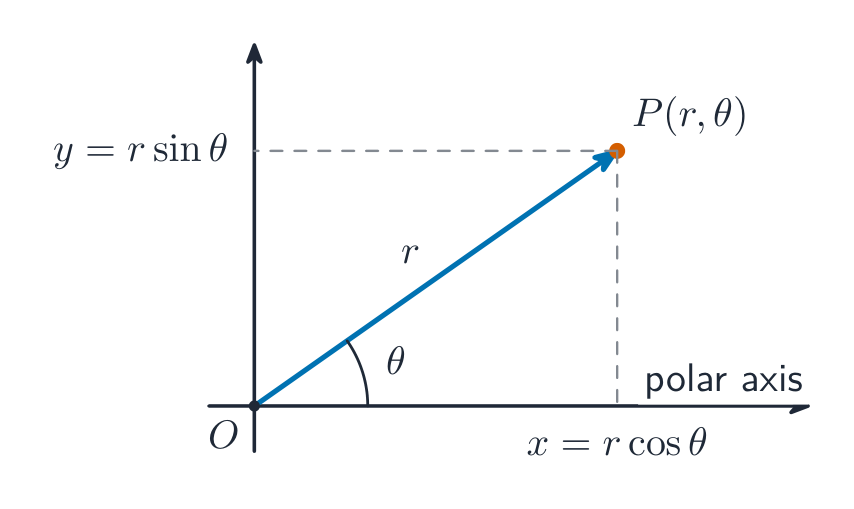
Polar coordinates 极坐标 locate a point by $(r,\theta)$ – distance $r$ from the origin at angle $\theta$. Convert with

$$x=r\cos\theta,\quad y=r\sin\theta,\qquad r=\sqrt{x^2+y^2},\quad \tan\theta=\frac{y}{x}.$$
A complex number 复数 is the point $(x,y)=x+yi$ and can likewise be written with $r$ and $\theta$.

ไทย

พิกัดขั้ว (Polar coordinates) ใช้ระบุตำแหน่งจุดด้วย $(r,\theta)$ – ระยะ $r$ จากจุดกำเนิดที่มุม $\theta$ แปลงด้วย

$$x=r\cos\theta,\quad y=r\sin\theta,\qquad r=\sqrt{x^2+y^2},\quad \tan\theta=\frac{y}{x}.$$
จำนวนเชิงซ้อน (Complex number) คือจุด $(x,y)=x+yi$ และสามารถเขียนได้ด้วย $r$ และ $\theta$ เช่นกัน

พิกัดขั้วให้จุดโดยระยะ r และมุม theta
Vocabulary · ⁨คำศัพท์⁩ Train · ⁨ฝึกฝน⁩
English ไทย
Polar coordinates/ˈpəʊlə kəʊˈɔːdɪnəts/ พิกัดขั้ว
complex number/ˈkɒmpleks ˈnʌmbə/ จำนวนเชิงซ้อน
3.14

Polar Function Graphs · ⁨กราฟฟังก์ชันขั้ว⁩

Syllabus · ⁨หลักสูตร⁩
English

Learning Objective 3.14.A: Construct graphs of polar functions.

  • 3.14.A.1 The graph of the function $r = f(\theta)$ in polar coordinates consists of input-output pairs of values where the input values are angle measures and the output values are radii.
  • 3.14.A.2 The domain of the polar function $r = f(\theta)$, given graphically, can be restricted to a desired portion of the function by selecting endpoints corresponding to the desired angle and radius.
  • 3.14.A.3 When graphing polar functions in the form of $r = f(\theta)$, changes in input values correspond to changes in angle measure from the positive $x$-axis, and changes in output values correspond to changes in distance from the origin.
ไทย

วัตถุประสงค์การเรียนรู้ 3.14.A: สร้างกราฟของฟังก์ชันแบบขั้ว

  • 3.14.A.1 กราฟของฟังก์ชัน $r = f(\theta)$ ในพิกัดแบบขั้ว ประกอบด้วยคู่ค่าอินพุต-เอาต์พุต โดยค่าอินพุตคือขนาดของมุม และค่าเอาต์พุตคือรัศมี
  • 3.14.A.2 โดเมนของฟังก์ชันแบบขั้ว $r = f(\theta)$ ที่แสดงด้วยกราฟ สามารถจำกัดให้เหลือเพียงส่วนที่ต้องการของฟังก์ชันได้ด้วยการเลือกจุดปลายที่สอดคล้องกับมุมและรัศมีที่ต้องการ
  • 3.14.A.3 ในการวาดกราฟฟังก์ชันแบบขั้วในรูปแบบ $r = f(\theta)$ การเปลี่ยนแปลงของค่าอินพุตจะสอดคล้องกับการเปลี่ยนแปลงของขนาดมุมจากแกน $x$ บวก และการเปลี่ยนแปลงของค่าเอาต์พุตจะสอดคล้องกับการเปลี่ยนแปลงของระยะห่างจากจุดกำเนิด

Source: College Board AP Course and Exam Description · ⁨แหล่งที่มา: คำอธิบายหลักสูตรและข้อสอบ College Board AP⁩

English
Tracing a polar curve

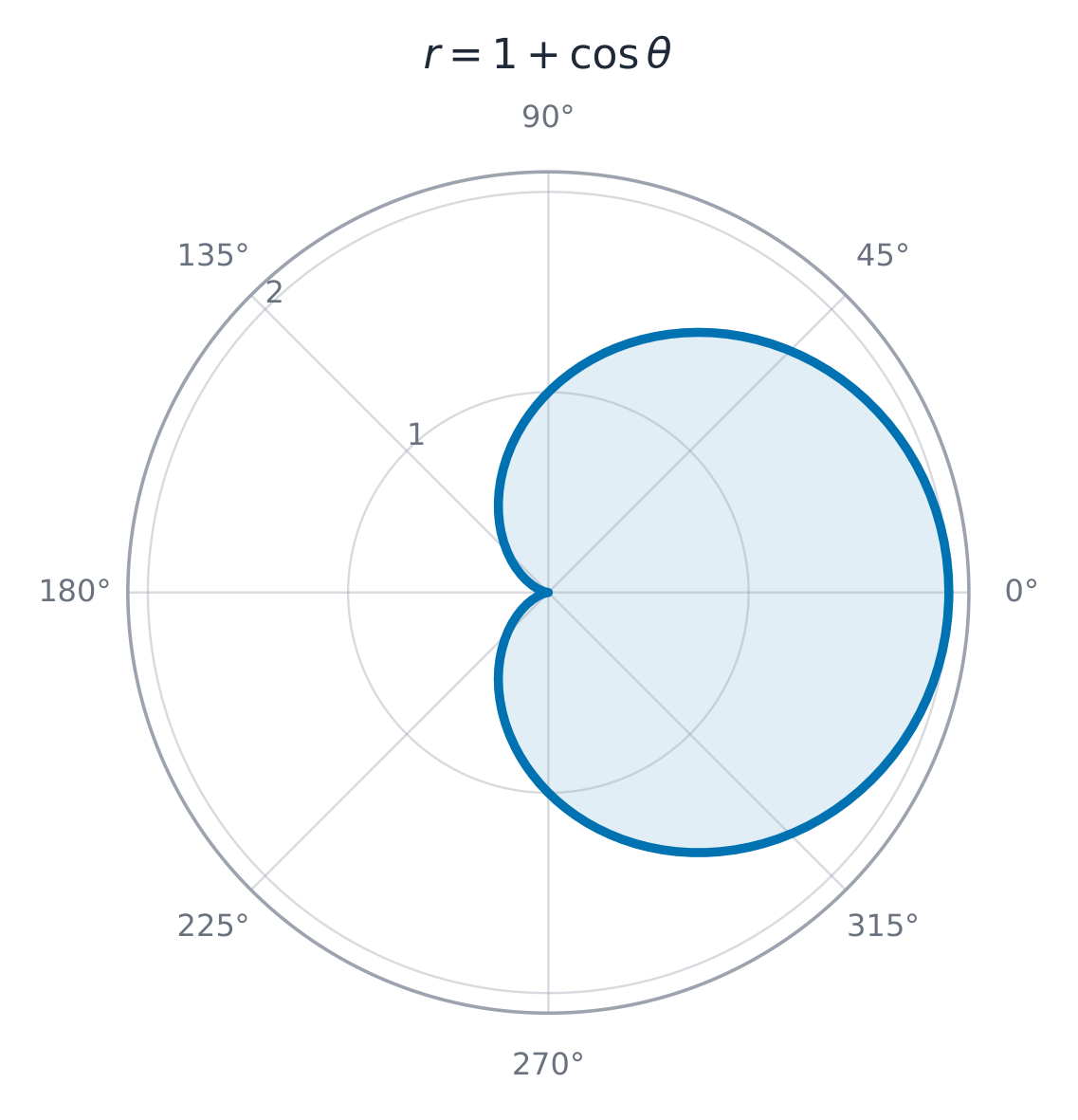
The graph of $r=f(\theta)$ is all points $(r,\theta)$ as $\theta$ sweeps around. Restricting the domain of $\theta$ draws only part of the curve. As $\theta$ increases, $r$ grows or shrinks, tracing spirals, circles, roses, and limaçons.

ไทย
การติดตาม curve ขั้ว

กราฟของ $r=f(\theta)$ คือจุดทั้งหมด $(r,\theta)$ เมื่อ $\theta$ sweeping รอบ Restricting โดเมนของ $\theta$ จะวาดเพียงส่วนของเส้นโค้ง เมื่อ $\theta$ เพิ่มขึ้น $r$ เติบโตหรือหดตัว วาด spiral, วงกลม, rose, และ limaçon

รูปหัวใจ cardioid r = 1 + cos theta, วาดโดยตรงในรูปแบบขั้ว
Explore · ⁨สำรวจ⁩

Plot a curve in polar coordinates · ⁨วาดเส้นโค้งในระบบพิกัดขั้ว⁩

In polar form a point is a distance $r$ at angle $\theta$. Letting $r$ depend on $\theta$ traces shapes a rule in $x,y$ can't — like this cardioid. · ⁨ในรูปแบบ ขั้ว จุดคือระยะ $r$ ที่มุม $\theta$ ให้ $r$ ขึ้นอยู่กับ $\theta$ เพื่อวาดรูปทรงที่กฎใน $x,y$ ทำไม่ได้ — เช่น คาร์ดิอยด์นี้⁩

3.15

Rates of Change in Polar Functions · ⁨อัตราการเปลี่ยนแปลงในฟังก์ชันขั้ว⁩

Syllabus · ⁨หลักสูตร⁩
English

Learning Objective 3.15.A: Describe characteristics of the graph of a polar function.

  • 3.15.A.1 If a polar function, $r = f(\theta)$, is positive and increasing or negative and decreasing, then the distance between $f(\theta)$ and the origin is increasing.
  • 3.15.A.2 If a polar function, $r = f(\theta)$, is positive and decreasing or negative and increasing, then the distance between $f(\theta)$ and the origin is decreasing.
  • 3.15.A.3 For a polar function, $r = f(\theta)$, if the function changes from increasing to decreasing or decreasing to increasing on an interval, then the function has a relative extremum on the interval corresponding to a point relatively closest to or farthest from the origin.
  • 3.15.A.4 The average rate of change of $r$ with respect to $\theta$ over an interval of $\theta$ is the ratio of the change in the radius values to the change in $\theta$ over an interval of $\theta$. Graphically, the average rate of change indicates the rate at which the radius is changing per radian.
  • 3.15.A.5 The average rate of change of $r$ with respect to $\theta$ over an interval of $\theta$ can be used to estimate values of the function within the interval.
ไทย

วัตถุประสงค์การเรียนรู้ 3.15.A: อธิบายลักษณะของกราฟของฟังก์ชันแบบขั้ว

  • 3.15.A.1 หากฟังก์ชันแบบขั้ว $r = f(\theta)$ มีค่าบวกและเพิ่มขึ้น หรือมีค่าลบและลดลง แล้วระยะระหว่าง $f(\theta)$ กับจุดกำเนิดจะเพิ่มขึ้น
  • 3.15.A.2 หากฟังก์ชันแบบขั้ว $r = f(\theta)$ มีค่าบวกและลดลง หรือมีค่าลบและเพิ่มขึ้น แล้วระยะระหว่าง $f(\theta)$ กับจุดกำเนิดจะลดลง
  • 3.15.A.3 สำหรับฟังก์ชันแบบขั้ว $r = f(\theta)$ หากฟังก์ชันมีการเปลี่ยนจากเพิ่มเป็นลด หรือลดเป็นเพิ่มในช่วงหนึ่ง จะทำให้ฟังก์ชันมีค่าสัมพัทธ์สูงสุดหรือต่ำสุดในช่วงนั้น ซึ่งสอดคล้องกับจุดที่อยู่ใกล้หรือไกลจากจุดกำเนิดมากที่สุด
  • 3.15.A.4 อัตราการเปลี่ยนแปลงเฉลี่ยของ $r$ เทียบกับ $\theta$ ในช่วง $\theta$ คืออัตราส่วนของความเปลี่ยนแปลงของค่ารัศมีต่อความเปลี่ยนแปลงของ $\theta$ ในช่วง $\theta$ ในทางกราฟ อัตราการเปลี่ยนแปลงเฉลี่ยบ่งบอกถึงอัตราการเปลี่ยนแปลงของรัศมีต่อเรเดียน
  • 3.15.A.5 อัตราการเปลี่ยนแปลงเฉลี่ยของ $r$ เทียบกับ $\theta$ ในช่วง $\theta$ สามารถใช้เพื่อประมาณค่าฟังก์ชันในช่วงนั้นได้

Source: College Board AP Course and Exam Description · ⁨แหล่งที่มา: คำอธิบายหลักสูตรและข้อสอบ College Board AP⁩

English

As $\theta$ increases, the distance from the origin $r$ changes:

  • $r$ positive and increasing (or negative and decreasing) $\Rightarrow$ moving away from the origin;
  • $r$ positive and decreasing (or negative and increasing) $\Rightarrow$ moving toward the origin.

Where $r$ switches between increasing and decreasing, the distance reaches a relative extreme. The average rate of change of $r$ with respect to $\theta$, $\dfrac{\Delta r}{\Delta \theta}$, estimates how fast the curve moves in or out over an interval.

ไทย

เมื่อ $\theta$ เพิ่มขึ้น ระยะจากจุดกำเนิด $r$ เปลี่ยนแปลง:

  • $r$ เป็นบวกและเพิ่มขึ้น (หรือเป็นลบและลดลง) $\Rightarrow$ เคลื่อนที่ ออก จากจุดกำเนิด;
  • $r$ เป็นบวกและลดลง (หรือเป็นลบและเพิ่มขึ้น) $\Rightarrow$ เคลื่อนที่ เข้าหา จุดกำเนิด

ที่ $r$ เปลี่ยนจากการเพิ่มขึ้นเป็นการลดลง ระยะถึงจุดสุดสัมพัทธ์ อัตราการเปลี่ยนแปลงเฉลี่ย ของ $r$ เทียบกับ $\theta$, $\dfrac{\Delta r}{\Delta \theta}$, ประมาณความเร็วที่เส้นโค้งเคลื่อนที่เข้าหรือออกในช่วงเวลาใดช่วงเวลาหนึ่ง

3.15

Exam tips · ⁨ข้อแนะนำสำหรับการสอบ⁩

English
  • Use radians and the unit circle: $\cos\theta$ and $\sin\theta$ are the coordinates, always between $-1$ and $1$.
  • For a sinusoid $a\sin(b(\theta+c))+d$: $|a|$ is the amplitude, $\tfrac{2\pi}{|b|}$ the period, $d$ the midline, and the phase shift is $-c$ (a $+c$ shifts left).
  • Model periodic data by reading period, amplitude, and midline from the max and min.
  • Inverse trig functions need a restricted domain and return an angle; trig equations have infinitely many solutions (add the period).
  • Convert polar↔rectangular with $x=r\cos\theta$, $y=r\sin\theta$.
ไทย
  • ใช้เรเดียนและ วงกลมหน่วย: $\cos\theta$ และ $\sin\theta$ คือพิกัด, อยู่ระหว่าง $-1$ และ $1$ เสมอ
  • สำหรับ sinusoid $a\sin(b(\theta+c))+d$: $|a|$ คือแอมพลิจูด, $\tfrac{2\pi}{|b|}$ คือช่วง, $d$ คือเส้นกลาง, และการเลื่อนเฟสคือ $-c$ (ค่า $+c$ เลื่อนซ้าย)
  • สร้างแบบจำลองข้อมูลที่เป็นคาบด้วยการอ่านช่วง, แอมพลิจูด, และเส้นกลางจากค่าสูงสุดและต่ำสุด
  • ฟังก์ชันตรีโกณมิติผกผันต้องการโดเมนที่จำกัดและส่งมุมออกมา; สมการตรีโกณมิติมีคำตอบเป็นจำนวนไม่จำกัด (บวกช่วง)
  • แปลงขั้ว↔สี่เหลี่ยมด้วย $x=r\cos\theta$, $y=r\sin\theta$

Interactive lessons on this topic · ⁨บทเรียนเชิงโต้ตอบสำหรับหัวข้อนี้⁩

Work through it step by step, with instant-check exercises. · ⁨ทำทีละขั้นตอน พร้อมแบบฝึกหัดตรวจสอบผลทันที⁩

Past Papers · ⁨ข้อสอบย้อนหลัง⁩

More topics in AP Precalculus · ⁨หัวข้อเพิ่มเติมใน AP Precalculus⁩

Log in or create account · ⁨เข้าสู่ระบบหรือสร้างบัญชี⁩

IGCSE, A-Level & AP