Graphs of Polar Functions
Introduced| English |
|---|
| polar function/ˈpəʊlə ˈfʌŋkʃn/ |
| rose/rəʊz/ |
| cardioid/ˈkɑːdɪəʊɪd/ |
| polar coordinates/ˈpəʊlə kəʊˈɔːdɪnəts/ |
Curves that bloom
- In rectangular graphs, $y$ depends on $x$. In polar graphs, the radius depends on the angle.
- As the angle sweeps around, the radius grows and shrinks, tracing surprising shapes.
- Flowers, hearts, and spirals all appear from simple polar rules.
- These curves are hard to write with $x$ and $y$, but easy with $r$ and $\theta$.
What a polar function is
- A polar function 极坐标函数 has the form $r = f(\theta)$: a radius for each angle.
- To plot it, sweep $\theta$ around and mark the point at distance $r$ in that direction.
- Where $r$ is large the curve reaches far out; where $r = 0$ it touches the origin.
- The whole graph is built one angle at a time.
A polar function $r = f(\theta)$ gives, for each angle, the…
A polar function outputs a radius for each input angle; plotting $(f(\theta), \theta)$ traces the curve.
The simple polar equation $r = 3$ (constant) is a circle.
A constant radius at every angle traces a circle of that radius around the origin.
Roses and other shapes
- $r = a\sin(k\theta)$ or $a\cos(k\theta)$ traces a rose 玫瑰线 — a flower of petals.
- With $k$ odd there are $k$ petals; with $k$ even there are $2k$.
- $r = a(1 + \sin\theta)$ traces a heart-shaped cardioid 心形线.
- A constant $r = a$ is simply a circle of radius $a$.
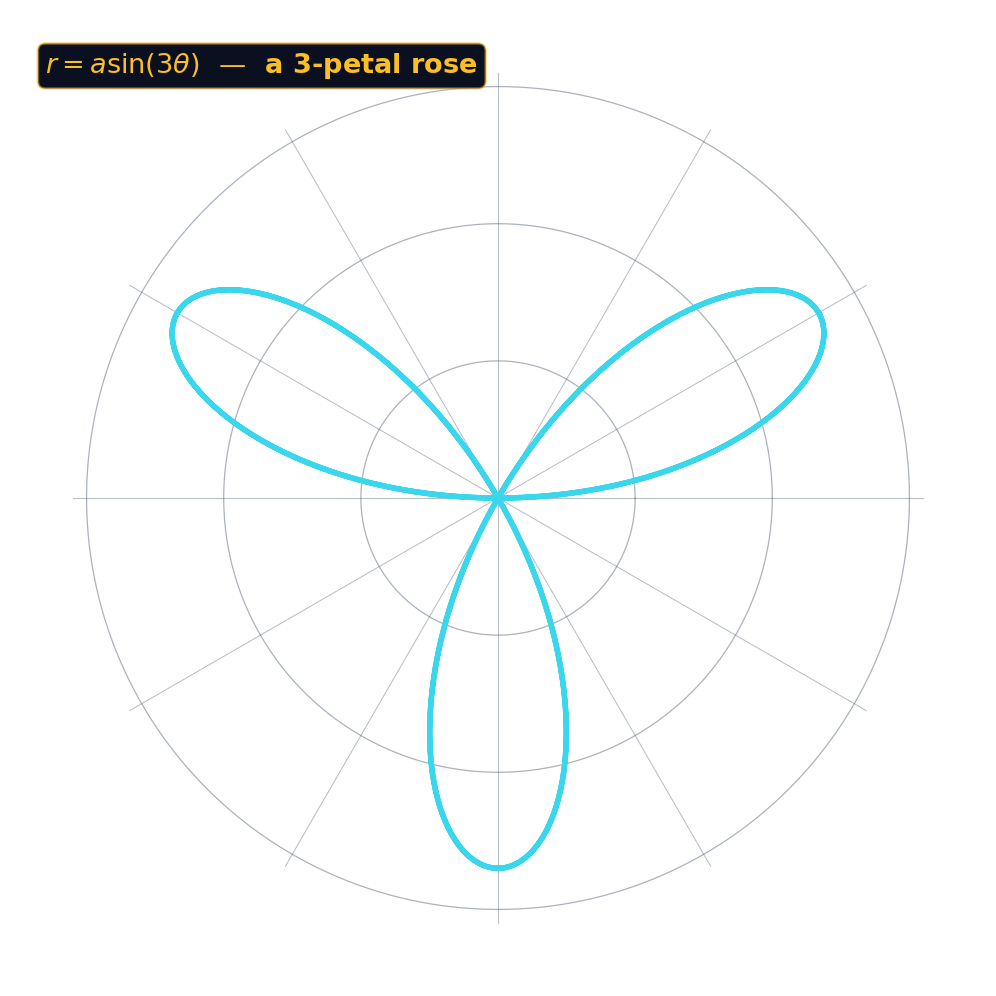
Draw a polar curve petal by petal
A polar function sets r for each angle theta. Sweep theta around and the radius traces a rose, circle, or spiral.
The curve $r = a\sin(3\theta)$ is a rose with how many petals?
For $r = a\sin(k\theta)$ with $k$ odd, the rose has exactly $k$ petals — here $3$.
The heart-shaped polar curve $r = 1 + \sin\theta$ is called a ____.
A cardioid ("heart-shaped") is a classic polar curve of the form $r = a(1 + \sin\theta)$.
Select all true statements about polar graphs.
Polar graphs include circles, roses, cardioids, and spirals — rarely straight lines. The other three are correct.
Plotting point by point
- Make a table: choose angles, compute $r$ at each, and mark the points.
- Watch for where $r = 0$ (the curve passes through the origin) and where $r$ peaks.
- Join the points smoothly in order of increasing $\theta$.
- The pattern usually repeats after one full turn (or half, for even roses).
Symmetry helps
- Many polar curves are symmetric about an axis, which halves the plotting work.
- A $\sin$ curve is often symmetric about the vertical axis; a $\cos$ curve about the horizontal.
- Spotting the symmetry lets you sketch one part and mirror the rest.
- Converting back to polar coordinates 极坐标 confirms exactly where each feature sits.
Do not read a polar graph like a rectangular one. A "loop" back to the origin means $r$ passed through $0$, not that the function is undefined. And a single point can be reached at several different angles, so the same curve may be traced more than once.
Sketch $r = 2\cos\theta$ over $0 \le \theta \le \pi$.
- At $\theta = 0$: $r = 2$ (a point $2$ units right).
- At $\theta = \tfrac{\pi}{2}$: $r = 0$ (the origin).
- The points trace a circle of diameter $2$ sitting to the right of the origin.
A polar function $r = f(\theta)$ gives a radius for each angle. Sweeping $\theta$ traces circles, roses ($r = a\sin k\theta$), cardioids ($r = a(1+\sin\theta)$), and spirals. Plot point by point using polar coordinates, and use symmetry to speed up the sketch.