Skip to content · ⁨ข้ามไปยังเนื้อหา⁩

Exponential and Logarithmic Functions · ⁨ฟังก์ชันเลขยกกำลังและลอการิทึม⁩

AP Precalculus · Topic 2 · ⁨หัวข้อ 2⁩

Video lesson for this topic · ⁨บทเรียนวิดีโอสำหรับหัวข้อนี้⁩ Open the video page · ⁨เปิดหน้าวิดีโอ⁩
14:05

ฟังก์ชันเลขชี้กำลังและลอการิทึม

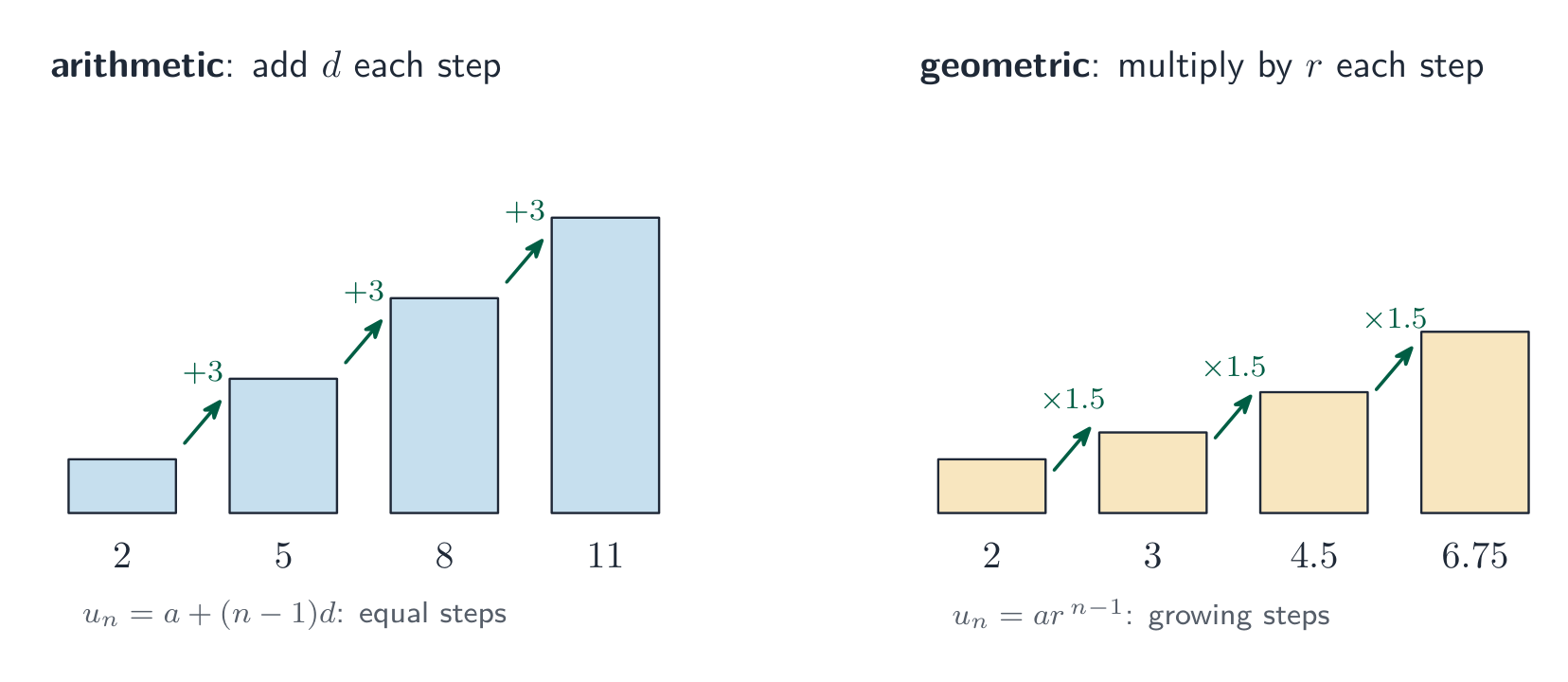
นี่คือสองวิธีที่ปริมาณหนึ่งจะเติบโต เส้นสีฟ้าเติบโตอย่างสม่ำเสมอ เพิ่มจำนวนเท่าเดิมทุกขั้นตอน อีกแบบคือการคูณสอง — คูณด้วยค่าเดิม...

English narration · English + 中文 subtitles burned in · ⁨การบรรยายภาษาอังกฤษ · คำบรรยายภาษาอังกฤษ + 中文 ลอยตัวบนภาพ⁩

2.1

Change in Arithmetic and Geometric Sequences · ⁨การเปลี่ยนแปลงในอนุกรมเลขคณิตและเรขาคณิต⁩

Syllabus · ⁨หลักสูตร⁩
English

Learning Objective 2.1.A: Express arithmetic sequences found in mathematical and contextual scenarios as functions of the whole numbers.

  • 2.1.A.1 A sequence is a function from the whole numbers to the real numbers. Consequently, the graph of a sequence consists of discrete points instead of a curve.
  • 2.1.A.2 Successive terms in an arithmetic sequence have a common difference, or constant rate of change.
  • 2.1.A.3 The general term of an arithmetic sequence with a common difference $d$ is denoted by $a_n$ and is given by $a_n = a_0 + dn$, where $a_0$ is the initial value, or by $a_n = a_k + d(n - k)$, where $a_k$ is the $k$th term of the sequence.

Learning Objective 2.1.B: Express geometric sequences found in mathematical and contextual scenarios as functions of the whole numbers.

  • 2.1.B.1 Successive terms in a geometric sequence have a common ratio, or constant proportional change.
  • 2.1.B.2 The general term of a geometric sequence with a common ratio $r$ is denoted by $g_n$ and is given by $g_n = g_0 r^n$, where $g_0$ is the initial value, or by $g_n = g_k r^{(n-k)}$, where $g_k$ is the $k$th term of the sequence.
  • 2.1.B.3 Increasing arithmetic sequences increase equally with each step, whereas increasing geometric sequences increase by a larger amount with each successive step.
ไทย

วัตถุประสงค์การเรียนรู้ 2.1.A: แสดงอนุกรมเลขคณิตที่พบในสถานการณ์ทางคณิตศาสตร์และบริบทต่างๆ ในรูปแบบฟังก์ชันของจำนวนเต็มบวก

  • 2.1.A.1 อนุกรม คือฟังก์ชันจากจำนวนเต็มบวกไปยังจำนวนจริง ดังนั้น กราฟของอนุกรมจึงประกอบด้วยจุดแยกต่างหากแทนที่จะเป็นเส้นโค้ง
  • 2.1.A.2 พจน์ติดกันในอนุกรมเลขคณิตมีผลต่างร่วม หรืออัตราการเปลี่ยนแปลงคงที่
  • 2.1.A.3 พจน์ทั่วไปของอนุกรมเลขคณิตที่มีผลต่าง $d$ แทนด้วย $a_n$ และกำหนดโดย $a_n = a_0 + dn$ โดยที่ $a_0$ เป็นค่าเริ่มต้น หรือโดย $a_n = a_k + d(n - k)$ โดยที่ $a_k$ เป็น $k$-พจน์ของอนุกรม

วัตถุประสงค์การเรียนรู้ 2.1.B: แสดงอนุกรมเรขาคณิตที่พบในสถานการณ์ทางคณิตศาสตร์และบริบทต่างๆ ในรูปแบบฟังก์ชันของจำนวนเต็มบวก

  • 2.1.B.1 พจน์ติดกันในอนุกรมเรขาคณิตมีอัตราส่วนร่วม หรือการเปลี่ยนแปลงแบบสัดส่วนคงที่
  • 2.1.B.2 พจน์ทั่วไปของอนุกรมเรขาคณิตที่มีอัตราส่วน $r$ แทนด้วย $g_n$ และกำหนดโดย $g_n = g_0 r^n$ โดยที่ $g_0$ เป็นค่าเริ่มต้น หรือโดย $g_n = g_k r^{(n-k)}$ โดยที่ $g_k$ เป็น $k$-พจน์ของอนุกรม
  • 2.1.B.3 อนุกรมเลขคณิตที่เพิ่มขึ้นจะเพิ่มขึ้นเท่าๆ กันในแต่ละขั้นตอน ในขณะที่อนุกรมเรขาคณิตที่เพิ่มขึ้นจะเพิ่มขึ้นด้วยปริมาณที่มากขึ้นในแต่ละพจน์ถัดไป

Source: College Board AP Course and Exam Description · ⁨แหล่งที่มา: คำอธิบายหลักสูตรและข้อสอบ College Board AP⁩

English
Geometric series & convergence

A sequence 数列 is a function from the whole numbers to the real numbers, so its graph is discrete points, not a curve.

  • An arithmetic sequence 等差数列 has a common difference 公差 $d$ (a constant rate of change): $a_n = a_0 + dn$, or from a known term, $a_n = a_k + d(n-k)$.
  • A geometric sequence 等比数列 has a common ratio 公比 $r$ (a constant proportional change): $g_n = g_0\,r^{\,n}$, or $g_n = g_k\,r^{\,(n-k)}$.

An increasing arithmetic sequence grows by the same amount each step; an increasing geometric sequence grows by a larger amount each step.

Worked example. An arithmetic sequence with $a_0=3$ and $d=5$ has $a_4=3+5(4)=23$. A geometric sequence with $g_0=2$ and $r=3$ has $g_4=2\cdot3^4=162$ – addition versus multiplication makes the geometric one pull far ahead.

ไทย
อนุกรมเรขาคณิต & การลู่เข้า

อนุกรมคือฟังก์ชันจากจำนวนเต็มบวกไปยังจำนวนจริง ดังนั้นกราฟของมันจึงเป็น จุดแยก ไม่ใช่เส้นโค้ง

อนุกรมเลขคณิตเพิ่มขึ้นทีละเท่ากัน; อนุกรมเรขาคณิตคูณด้วยอัตรา
  • อนุกรมเลขคณิตมี ผลต่างร่วม $d$ (อัตราการเปลี่ยนแปลงคงที่): $a_n = a_0 + dn$, หรือจากพจน์ที่ทราบมา, $a_n = a_k + d(n-k)$.
  • อนุกรมเรขาคณิตมี อัตราส่วนร่วม $r$ (การเปลี่ยนแปลงตามสัดส่วนคงที่): $g_n = g_0\,r^{\,n}$, หรือ $g_n = g_k\,r^{\,(n-k)}$.

อนุกรมเลขคณิตที่เพิ่มขึ้นเพิ่มใน ปริมาณเท่าเดิมทุกขั้นตอน; อนุกรมเรขาคณิตที่เพิ่มขึ้นเพิ่มใน ปริมาณมากขึ้นทุกขั้นตอน

ตัวอย่างวิธีทำ. อนุกรมเลขคณิตที่มี $a_0=3$ และ $d=5$ มี $a_4=3+5(4)=23$. อนุกรมเรขาคณิตที่มี $g_0=2$ และ $r=3$ มี $g_4=2\cdot3^4=162$ – การบวกและการคูณทำให้แบบเรขาคณิตพุ่งไปข้างหน้าไกลกว่ามาก

Explore · ⁨สำรวจ⁩

Compare arithmetic and geometric growth · ⁨เปรียบเทียบการเติบโตแบบเลขคณิตและเรขาคณิต⁩

An arithmetic sequence adds a fixed step each term (linear); a geometric sequence multiplies by a fixed ratio (exponential). Change the ratio and watch the terms explode or decay. · ⁨ลำดับเลขคณิต เพิ่มขั้นคงที่ในแต่ละพจน์ (เชิงเส้น); ลำดับเรขาคณิต คูณด้วยอัตราส่วนคงที่ (เอกซ์โพเนนเชียล) เปลี่ยนอัตราส่วนและดูพจน์ระเบิดหรือสลายตัว⁩

2.2

Change in Linear and Exponential Functions · ⁨การเปลี่ยนแปลงในฟังก์ชันเชิงเส้นและเอ็กซ์โพเนนเชียล⁩

Syllabus · ⁨หลักสูตร⁩
English

Learning Objective 2.2.A: Construct functions of the real numbers that are comparable to arithmetic and geometric sequences.

  • 2.2.A.1 Linear functions of the form $f(x) = b + mx$ are similar to arithmetic sequences of the form $a_n = a_0 + dn$, as both can be expressed as an initial value ($b$ or $a_0$) plus repeated addition of a constant rate of change, the slope ($m$ or $d$).
  • 2.2.A.2 Similar to arithmetic sequences of the form $a_n = a_k + d(n - k)$, which are based on a known difference, $d$, and a $k$th term, linear functions can be expressed in the form $f(x) = y_i + m(x - x_i)$ based on a known slope, $m$, and a point, $(x_i, y_i)$.
  • 2.2.A.3 Exponential functions of the form $f(x) = ab^x$ are similar to geometric sequences of the form $g_n = g_0 r^n$, as both can be expressed as an initial value ($a$ or $g_0$) times repeated multiplication by a constant proportion ($b$ or $r$).
  • 2.2.A.4 Similar to geometric sequences of the form $g_n = g_k r^{(n-k)}$, which are based on a known ratio, $r$, and a $k$th term, exponential functions can be expressed in the form $f(x) = y_i r^{(x - x_i)}$ based on a known ratio, $r$, and a point, $(x_i, y_i)$.
  • 2.2.A.5 Sequences and their corresponding functions may have different domains.
ไทย

จุดประสงค์การเรียนรู้ 2.2.A: สร้างฟังก์ชันของจำนวนจริงที่เทียบเคียงได้กับอนุกรมเลขคณิตและอนุกรมเรขาคณิต

  • 2.2.A.1 ฟังก์ชันเชิงเส้นในรูป $f(x) = b + mx$ มีลักษณะคล้ายกับอนุกรมเลขคณิตในรูป $a_n = a_0 + dn$ เนื่องจากทั้งสองสามารถเขียนแทนค่าเป็นค่าเริ่มต้น ($b$ หรือ $a_0$) บวกด้วยการเพิ่มค่าคงที่ซ้ำๆ ซึ่งคืออัตราการเปลี่ยนแปลง, ความชัน ($m$ หรือ $d$)
  • 2.2.A.2 คล้ายกับอนุกรมเลขคณิตในรูป $a_n = a_k + d(n - k)$ ที่ตั้งอยู่บนผลต่าง Known, $d$, และ $k$ พจน์, ฟังก์ชันเชิงเส้นสามารถเขียนในรูป $f(x) = y_i + m(x - x_i)$ โดยอ้างอิงจากความชัน Known, $m$, และจุดหนึ่ง, $(x_i, y_i)$
  • 2.2.A.3 ฟังก์ชันเอกซ์โพเนนเชียลในรูป $f(x) = ab^x$ มีลักษณะคล้ายกับอนุกรมเรขาคณิตในรูป $g_n = g_0 r^n$ เนื่องจากทั้งสองสามารถเขียนแทนค่าเป็นค่าเริ่มต้น ($a$ หรือ $g_0$) คูณด้วยการคูณด้วยอัตราส่วนคงที่ซ้ำๆ ($b$ หรือ $r$)
  • 2.2.A.4 คล้ายกับอนุกรมเรขาคณิตในรูป $g_n = g_k r^{(n-k)}$ ที่ตั้งอยู่บนอัตราส่วน Known, $r$, และ $k$ พจน์, ฟังก์ชันเอกซ์โพเนนเชียลสามารถเขียนในรูป $f(x) = y_i r^{(x - x_i)}$ โดยอ้างอิงจากอัตราKnown, $r$, และจุดหนึ่ง, $(x_i, y_i)$
  • 2.2.A.5 อนุกรมและฟังก์ชันที่เกี่ยวข้องอาจมีโดเมนที่แตกต่างกัน

Source: College Board AP Course and Exam Description · ⁨แหล่งที่มา: คำอธิบายหลักสูตรและข้อสอบ College Board AP⁩

English

Sequences have continuous cousins:

  • Linear functions $f(x)=b+mx$ mirror arithmetic sequences – an initial value plus repeated addition of the slope $m$. Point form: $f(x)=y_i+m(x-x_i)$.
  • Exponential functions $f(x)=ab^x$ mirror geometric sequences – an initial value times repeated multiplication by the base $b$. Point form: $f(x)=y_i\,r^{\,(x-x_i)}$.

The difference: linear = repeated addition, exponential = repeated multiplication. (A sequence and its function may have different domains.)

ไทย
นักวิ่ง sprinter: โมเดลเอ็กซ์โพเนนเชียลและลอการิทึมจับอัตราการเติบโตและการลดลงในบริบท

อนุกรมมีคู่Continuous:

  • ฟังก์ชันเชิงเส้น $f(x)=b+mx$ คล้ายกับอนุกรมเลขคณิต – ค่าเริ่มต้นบวกกับการเพิ่มซ้ำของความชัน $m$. รูปแบบจุด: $f(x)=y_i+m(x-x_i)$.
  • ฟังก์ชันเอ็กซ์โพเนนเชียล $f(x)=ab^x$ คล้ายกับอนุกรมเรขาคณิต – ค่าเริ่มต้นคูณด้วยการคูณซ้ำด้วยฐาน $b$. รูปแบบจุด: $f(x)=y_i\,r^{\,(x-x_i)}$.

ความแตกต่าง: เชิงเส้น = การบวกซ้ำ, เอ็กซ์โพเนนเชียล = การคูณซ้ำ. (อนุกรมและฟังก์ชันอาจมีโดเมนต่างกัน)

2.3

Exponential Functions · ⁨ฟังก์ชันเอ็กซ์โพเนนเชียล⁩

Syllabus · ⁨หลักสูตร⁩
English

Learning Objective 2.3.A: Identify key characteristics of exponential functions.

  • 2.3.A.1 The general form of an exponential function is $f(x) = ab^x$, with the initial value $a$, where $a \neq 0$, and the base $b$, where $b > 0$, and $b \neq 1$. When $a > 0$ and $b > 1$, the exponential function is said to demonstrate exponential growth. When $a > 0$ and $0 < b < 1$, the exponential function is said to demonstrate exponential decay.
  • 2.3.A.2 When the natural numbers are input values in an exponential function, the input value specifies the number of factors of the base to be applied to the function's initial value. The domain of an exponential function is all real numbers.
  • 2.3.A.3 Because the output values of exponential functions in general form are proportional over equal-length input-value intervals, exponential functions are always increasing or always decreasing, and their graphs are always concave up or always concave down. Consequently, exponential functions do not have extrema except on a closed interval, and their graphs do not have points of inflection.
  • 2.3.A.4 If the values of the additive transformation function $g(x) = f(x) + k$ of any function $f$ are proportional over equal-length input-value intervals, then $f$ is exponential.
ไทย

จุดประสงค์การเรียนรู้ 2.3.A: ระบุลักษณะสำคัญของฟังก์ชันเอกซ์โพเนนเชียล

  • 2.3.A.1 รูปแบบทั่วไปของฟังก์ชันเอกซ์โพเนนเชียลคือ $f(x) = ab^x$, โดยมี ค่าเริ่มต้น $a$, โดยที่ $a \neq 0$, และ ฐาน $b$, โดยที่ $b > 0$, และ $b \neq 1$ เมื่อ $a > 0$ และ $b > 1$, ฟังก์ชันเอกซ์โพเนนเชียลจะแสดงถึง การเติบโตแบบเอกซ์โพเนนเชียล เมื่อ $a > 0$ และ $0 < b < 1$, ฟังก์ชันเอกซ์โพเนนเชียลจะแสดงถึง การลดลงแบบเอกซ์โพเนนเชียล
  • 2.3.A.2 เมื่อจำนวนเต็มบวกเป็นค่าอินพุตในฟังก์ชันเอกซ์โพเนนเชียล ค่าอินพุตจะบ่งบอกจำนวนครั้งของการนำฐานไปคูณกับค่าเริ่มต้นของฟังก์ชัน โดเมนของฟังก์ชันเอกซ์โพเนนเชียลคือจำนวนจริงทั้งหมด
  • 2.3.A.3 เนื่องจากค่าเอาต์พุตของฟังก์ชันเอกซ์โพเนนเชียลในรูปแบบทั่วไปมีความสัมพันธ์กันในช่วงค่าอินพุตที่มีความยาวเท่ากัน ฟังก์ชันเอกซ์โพเนนเชียลจึงเพิ่มขึ้นหรือลดลงอย่างสม่ำเสมอเสมอ, และกราฟของมันจะโค้งขึ้นหรือโค้งลงอย่างสม่ำเสมอเสมอ ดังนั้น ฟังก์ชันเอกซ์โพเนนเชียลจึงไม่มีจุดสูงสุดหรือต่ำสุดยกเว้นบนช่วงปิด, และกราฟของมันไม่มีจุดเปลี่ยนเว้า
  • 2.3.A.4 หากค่าของฟังก์ชันการแปลงแบบบวก $g(x) = f(x) + k$ ของฟังก์ชันใดๆ $f$ มีความสัมพันธ์กันในช่วงค่าอินพุตที่มีความยาวเท่ากัน, แล้ว $f$ เป็นฟังก์ชันเอกซ์โพเนนเชียล

Source: College Board AP Course and Exam Description · ⁨แหล่งที่มา: คำอธิบายหลักสูตรและข้อสอบ College Board AP⁩

English

The general exponential function 指数函数 is $f(x)=ab^x$ with initial value 初始值 $a\neq 0$ and base 底数 $b>0,\ b\neq 1$. Domain: all real numbers.

  • $a>0,\ b>1$ gives exponential growth 指数增长; $a>0,\ 0 gives exponential decay 指数衰减.
  • Outputs are proportional over equal-length input intervals. So an exponential is always increasing or always decreasing, and always concave up or always concave down – it has no extrema (except on a closed interval) and no points of inflection.
ไทย

ฟังก์ชันเอ็กซ์โพเนนเชียลทั่วไปคือ $f(x)=ab^x$ ที่มี ค่าเริ่มต้น $a\neq 0$ และ ฐาน $b>0,\ b\neq 1$. โดเมน: จำนวนจริงทั้งหมด

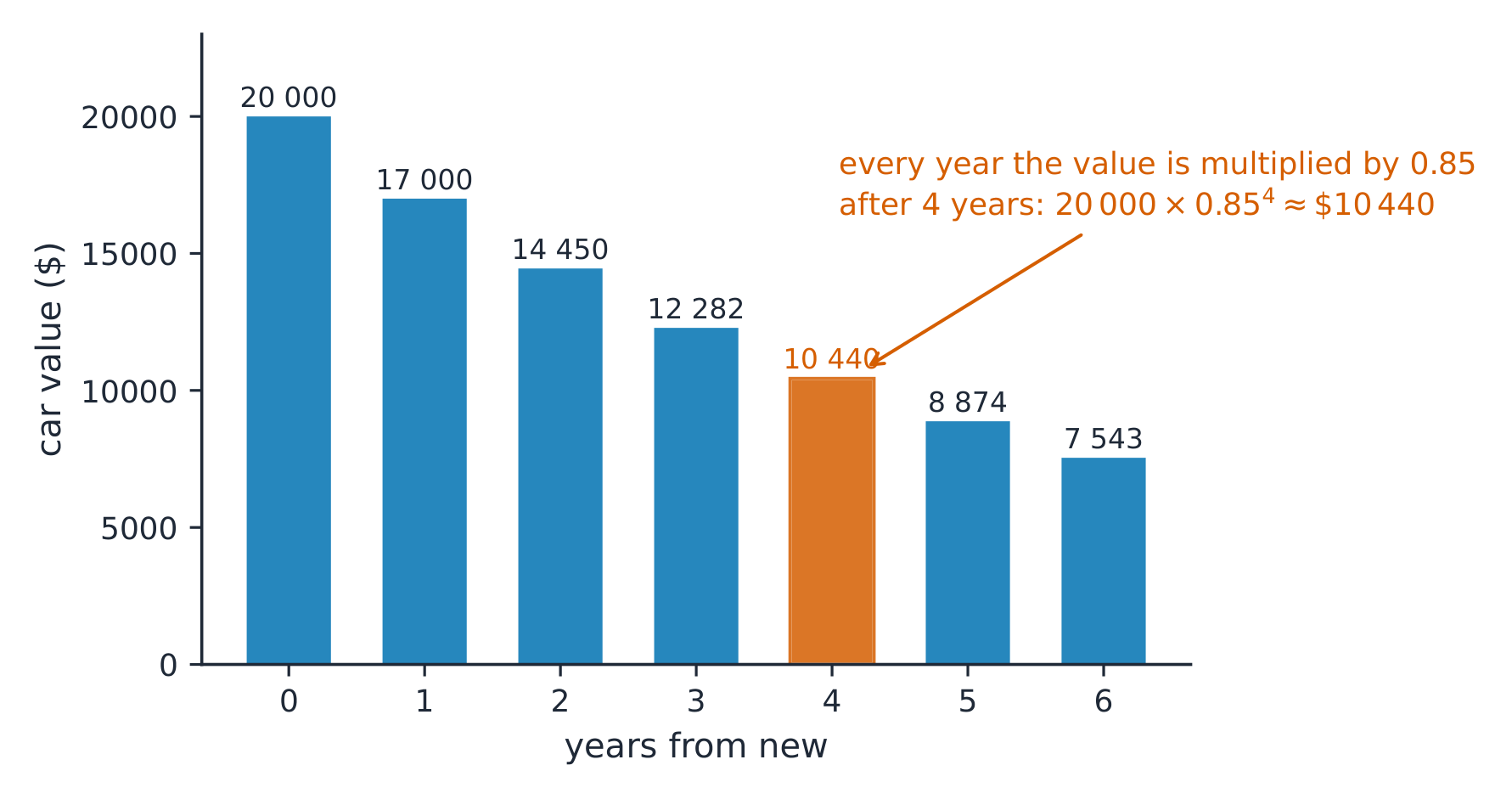
การสลายตัวของเอ็กซ์โพเนนเชียล: เสียเปอร์เซ็นต์คงที่แต่ละรอบ
  • $a>0,\ b>1$ ให้ การเติบโตแบบเอ็กซ์โพเนนเชียล; $a>0,\ 0 ให้ การสลายตัวแบบเอ็กซ์โพเนนเชียล
  • ผลลัพธ์เป็น สัดส่วนในช่วงอินพุตที่มีความยาวเท่ากัน ดังนั้นเอ็กซ์โพเนนเชียลจึงเพิ่มขึ้นหรือลดลงตลอด และเว้าขึ้นหรือเว้าลงตลอด – ไม่มี จุดสุดขั้ว (ยกเว้นบนช่วงปิด) และไม่มี จุดเปลี่ยนเว้า
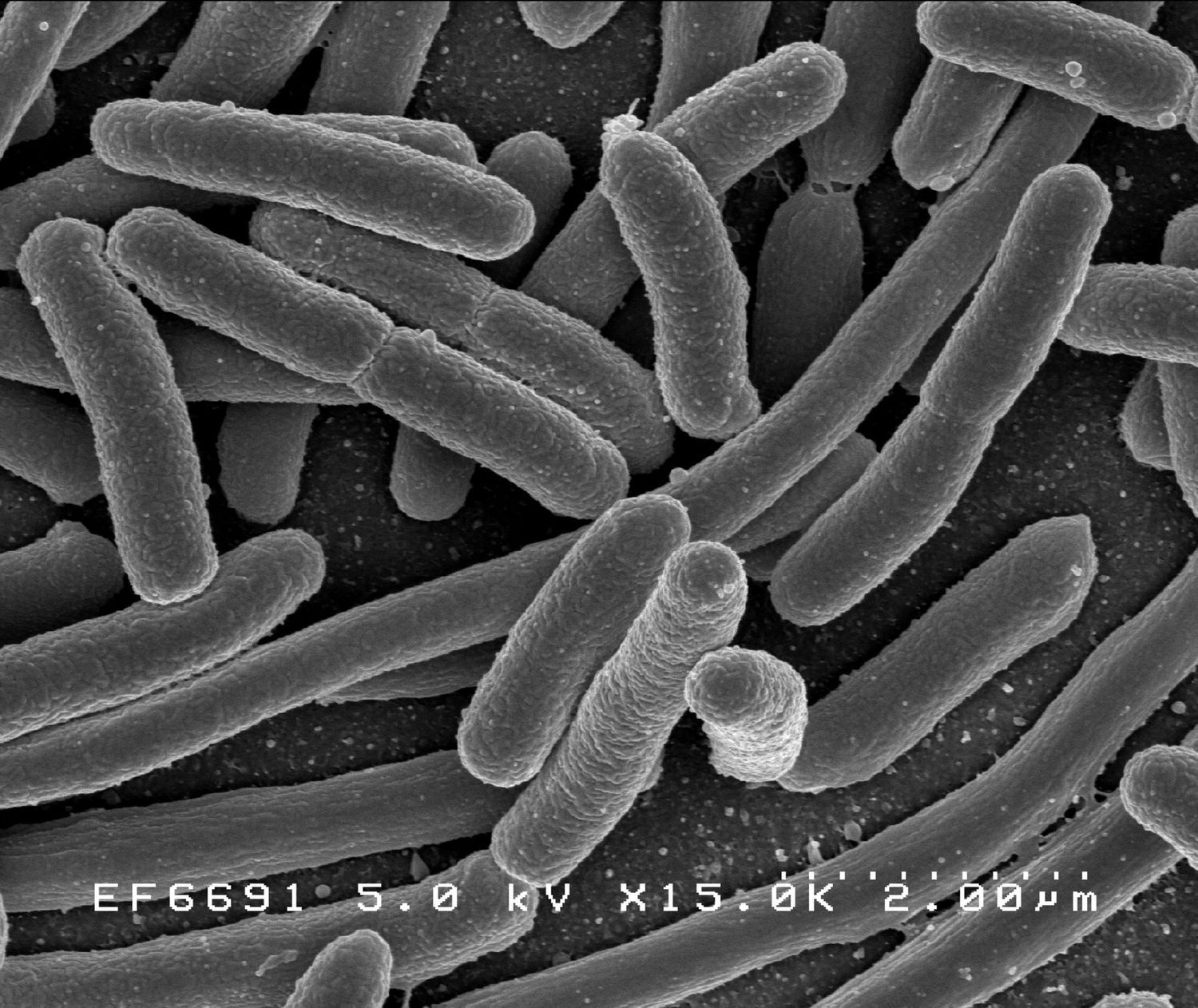
แบคทีเรียภายใต้กล้องจุลทรรศน์: โมเดลเอ็กซ์โพเนนเชียลอธิบายประชากรที่เพิ่มขึ้นด้วยปัจจัยคงที่แต่ละขั้นตอนเวลา
Explore · ⁨สำรวจ⁩

Explore an exponential curve · ⁨สำรวจเส้นโค้งเอกซ์โพเนนเชียล⁩

y = a·e^(bx) + c

An exponential function changes by a constant factor over equal steps, so it rises (or decays) ever faster. The constant $c$ sets the horizontal asymptote it hugs. · ⁨ฟังก์ชันเอกซ์โพเนนเชียล เปลี่ยนแปลงด้วย ตัวคูณ คงที่ในช่วงเท่ากัน จึงเพิ่มขึ้น (หรือลดลง) เร็วขึ้นเรื่อยๆ ค่าคงที่ $c$ กำหนดเส้น asymptote แนวนอนที่มันโอบอ้อม⁩

Vocabulary · ⁨คำศัพท์⁩ Train · ⁨ฝึกฝน⁩
English ไทย
sequence/ˈsiːkwəns/ ลำดับขั้นตอน (sequence)
arithmetic sequence/əˈrɪθmətɪk ˈsiːkwəns/ ลำดับเลขคณิต
common difference/ˈkɒmən ˈdɪfrəns/ ผลต่างร่วม
geometric sequence/ˌdʒiːəʊˈmetrɪk ˈsiːkwəns/ ลำดับเรขาคณิต
common ratio/ˈkɒmən ˈreɪʃɪəʊ/ อัตราส่วนร่วม
exponential function/ˌekspəˈnenʃl ˈfʌŋkʃn/ ฟังก์ชันเอ็กซ์โพเนนเชียล
initial value/ɪˈnɪʃl ˈvæljuː/ ค่าเริ่มต้น
base/beɪs/ ฐาน
exponential growth/ˌekspəˈnenʃl ɡrəʊθ/ การเติบโตแบบเอกซ์โพเนนเชียล
exponential decay/ˌekspəˈnenʃl dɪˈkeɪ/ การลดลงแบบเอกซ์โพเนนเชียล
root/ruːt/ ราก
exponential regression/ˌekspəˈnenʃl rɪˈɡreʃn/ การถดถอยเอ็กซ์โพเนนเชียล
natural base/ˈnætʃərəl beɪs/ ฐานธรรมชาติ natural base
residual plot/rɪˈsɪdʒuːəl plɒt/ แผนภูมิเศษเหลือ (residual plot)
residual/rɪˈsɪdʒuːəl/ ค่าคงเหลือ
composite function/ˈkɒmpəzɪt ˈfʌŋkʃn/ ฟังก์ชันประกอบ
identity function/aɪˈdentɪti ˈfʌŋkʃn/ ฟังก์ชันเอกลักษณ์ identity function
2.4

Exponential Function Manipulation · ⁨การจัดการฟังก์ชันเอ็กซ์โพเนนเชียล⁩

Syllabus · ⁨หลักสูตร⁩
English

Learning Objective 2.4.A: Rewrite exponential expressions in equivalent forms.

  • 2.4.A.1 The product property for exponents states that $b^m b^n = b^{(m+n)}$. Graphically, this property implies that every horizontal translation of an exponential function, $f(x) = b^{(x+k)}$, is equivalent to a vertical dilation, $f(x) = b^{(x+k)} = b^x b^k = ab^x$, where $a = b^k$.
  • 2.4.A.2 The power property for exponents states that $\left(b^m\right)^n = b^{(mn)}$. Graphically, this property implies that every horizontal dilation of an exponential function, $f(x) = b^{(cx)}$, is equivalent to a change of the base of an exponential function, $f(x) = \left(b^c\right)^x$, where $b^c$ is a constant and $c \neq 0$.
  • 2.4.A.3 The negative exponent property states that $b^{-n} = \dfrac{1}{b^n}$.
  • 2.4.A.4 The value of an exponential expression involving an exponential unit fraction, such as $b^{(1/k)}$ where $k$ is a natural number, is the $k$th root of $b$, when it exists.
ไทย

จุดประสงค์การเรียนรู้ 2.4.A: เขียนนิพจน์เอกซ์โพเนนเชียลใหม่ให้อยู่ในรูปที่เทียบเท่ากัน

  • 2.4.A.1 คุณสมบัติการคูณของเลขชี้กำลังระบุว่า $b^m b^n = b^{(m+n)}$ ในทางกราฟ, คุณสมบัตินี้บ่งบอกว่าทุกการเลื่อนแนวนอนของฟังก์ชันเอกซ์โพเนนเชียล, $f(x) = b^{(x+k)}$, เทียบเท่ากับ การขยายแนวตั้ง, $f(x) = b^{(x+k)} = b^x b^k = ab^x$, โดยที่ $a = b^k$
  • 2.4.A.2 คุณสมบัติการยกกำลังของเลขชี้กำลังระบุว่า $\left(b^m\right)^n = b^{(mn)}$ ในทางกราฟ, คุณสมบัตินี้บ่งบอกว่าทุกการขยายแนวนอนของฟังก์ชันเอกซ์โพเนนเชียล, $f(x) = b^{(cx)}$, เทียบเท่ากับการเปลี่ยนฐานของฟังก์ชันเอกซ์โพเนนเชียล, $f(x) = \left(b^c\right)^x$, โดยที่ $b^c$ เป็นค่าคงที่ และ $c \neq 0$
  • 2.4.A.3 คุณสมบัติเลขชี้กำลังลบระบุว่า $b^{-n} = \dfrac{1}{b^n}$
  • 2.4.A.4 ค่าของนิพจน์เอกซ์โพเนนเชียลที่ประกอบด้วยเศษส่วนเอกซ์โพเนนเชียล, เช่น $b^{(1/k)}$ โดยที่ $k$ เป็นจำนวนเต็มบวก, คือ รากที่ $k$ ของ $b$, เมื่อมันมีอยู่จริง

Source: College Board AP Course and Exam Description · ⁨แหล่งที่มา: คำอธิบายหลักสูตรและข้อสอบ College Board AP⁩

English

The exponent rules reshape exponential expressions and connect to graph transformations:

  • Product: $b^m b^n = b^{m+n}$. A horizontal shift $b^{x+k}$ equals a vertical stretch $ab^x$ with $a=b^k$.
  • Power: $(b^m)^n = b^{mn}$. A horizontal stretch $b^{cx}$ equals a base change $(b^c)^x$.
  • Negative exponent: $b^{-n}=\dfrac{1}{b^n}$.
  • Unit-fraction exponent: $b^{1/k}=\sqrt[k]{b}$ (the $k$th root 方根).
ไทย

กฎเลขชี้กำลังปรับรูปนิพจน์เอ็กซ์โพเนนเชียลและเชื่อมต่อกับการแปลงกราฟ:

  • ผลคูณ: $b^m b^n = b^{m+n}$. การเลื่อนแนวนอน $b^{x+k}$ เท่ากับการดึงแนวตั้ง $ab^x$ ด้วย $a=b^k$.
  • กำลัง: $(b^m)^n = b^{mn}$. การดึงแนวนอน $b^{cx}$ เท่ากับการเปลี่ยนฐาน $(b^c)^x$.
  • เลขชี้กำลังลบ: $b^{-n}=\dfrac{1}{b^n}$.
  • เลขชี้กำลังเศษหน่วย: $b^{1/k}=\sqrt[k]{b}$ (รากที่ $k$).
2.5

Exponential Function Context and Data Modeling · ⁨บริบทและการสร้างโมเดลข้อมูลของฟังก์ชันเอ็กซ์โพเนนเชียล⁩

Syllabus · ⁨หลักสูตร⁩
English

Learning Objective 2.5.A: Construct a model for situations involving proportional output values over equal-length input-value intervals.

  • 2.5.A.1 Exponential functions model growth patterns where successive output values over equal-length input-value intervals are proportional. When the input values are whole numbers, exponential functions model situations of repeated multiplication of a constant to an initial value.
  • 2.5.A.2 A constant may need to be added to the dependent variable values of a data set to reveal a proportional growth pattern.
  • 2.5.A.3 An exponential function model can be constructed from an appropriate ratio and initial value or from two input-output pairs. The initial value and the base can be found by solving a system of equations resulting from the two input-output pairs.
  • 2.5.A.4 Exponential function models can be constructed by applying transformations to $f(x) = ab^x$ based on characteristics of a contextual scenario or data set.
  • 2.5.A.5 Exponential function models can be constructed for a data set with technology using exponential regressions.
  • 2.5.A.6 The natural base $e$, which is approximately $2.718$, is often used as the base in exponential functions that model contextual scenarios.
ไทย

จุดประสงค์การเรียนรู้ 2.5.A: สร้างแบบจำลองสำหรับสถานการณ์ที่มีค่าเอาต์พุตแปรผันตามในช่วงค่าอินพุตที่มีความยาวเท่ากัน

  • 2.5.A.1 ฟังก์ชันเอกซ์โพเนนเชียลใช้สร้างแบบจำลองรูปแบบการเติบโตซึ่งค่าเอาต์พุตที่ต่อเนื่องกันในช่วงค่าอินพุตที่มีความยาวเท่ากันมีความสัมพันธ์กัน เมื่อค่าอินพุตเป็นจำนวนเต็ม ฟังก์ชันเอกซ์โพเนนเชียลใช้สร้างแบบจำลองสถานการณ์ของการคูณซ้ำๆ ของค่าคงที่กับค่าเริ่มต้น
  • 2.5.A.2 อาจจำเป็นต้องเพิ่มค่าคงที่ลงในค่าตัวแปรตามของชุดข้อมูลเพื่อเผยให้เห็นรูปแบบการเติบโตแบบแปรผัน
  • 2.5.A.3 สามารถสร้างแบบจำลองฟังก์ชันเอกซ์โพเนนเชียลได้จากอัตราส่วนที่เหมาะสมและค่าเริ่มต้น หรือจากคู่ค่าอินพุต-เอาต์พุตสองคู่ ค่าเริ่มต้นและฐานสามารถหาได้โดยการแก้ระบบสมการที่เกิดจากคู่ค่าอินพุต-เอาต์พุตสองคู่นั้น
  • 2.5.A.4 สามารถสร้างแบบจำลองฟังก์ชันเอกซ์โพเนนเชียลได้โดยนำการแปลงไปใช้กับ $f(x) = ab^x$ โดยอ้างอิงจากลักษณะของบริบทหรือชุดข้อมูล
  • 2.5.A.5 สามารถสร้างแบบจำลองฟังก์ชันเอกซ์โพเนนเชียลสำหรับชุดข้อมูลโดยใช้เทคโนโลยีผ่านการทำ Regression แบบเอกซ์โพเนนเชียล
  • 2.5.A.6 ฐานธรรมชาติ $e$ ซึ่งมีค่าประมาณ $2.718$ มักถูกใช้เป็นฐานในฟังก์ชันเอกซ์โพเนนเชียลที่สร้างแบบจำลองสถานการณ์ในบริบทต่างๆ

Source: College Board AP Course and Exam Description · ⁨แหล่งที่มา: คำอธิบายหลักสูตรและข้อสอบ College Board AP⁩

English

Exponentials model quantities that grow by a constant proportion over equal intervals (repeated multiplication).

  • Build a model from a ratio and an initial value, or from two points (solve the system for $a$ and $b$).
  • Sometimes a constant must be added to the data to reveal the proportional pattern.
  • Use exponential regression 指数回归 on technology to fit a data set.
  • The natural base 自然底数 $e\approx 2.718$ is the standard base for real-world models.
ไทย

เอ็กซ์โพเนนเชียลสร้างโมเดลสำหรับปริมาณที่เพิ่มขึ้นด้วย สัดส่วนคงที่ในช่วงเท่ากัน (การคูณซ้ำ)

  • สร้างโมเดลจากอัตราและค่าเริ่มต้น, หรือจาก สองจุด (แก้ระบบสมการสำหรับ $a$ และ $b$).
  • บางครั้งต้อง เพิ่มค่าคงที่เข้ากับข้อมูลเพื่อเผยให้เห็นรูปแบบสัดส่วน
  • ใช้ การถดถอยเอ็กซ์โพเนนเชียลบนเทคโนโลยีเพื่อจับชุดข้อมูล
  • ฐานธรรมชาติ $e\approx 2.718$ เป็นฐานมาตรฐานสำหรับโมเดลในโลกจริง
2.6

Competing Function Model Validation · ⁨การตรวจสอบโมเดลฟังก์ชันที่แข่งขันกัน⁩

Syllabus · ⁨หลักสูตร⁩
English

Learning Objective 2.6.A: Construct linear, quadratic, and exponential models based on a data set.

  • 2.6.A.1 Two variables in a data set that demonstrate a slightly changing rate of change can be modeled by linear, quadratic, and exponential function models.
  • 2.6.A.2 Models can be compared based on contextual clues and applicability to determine which model is most appropriate.

Learning Objective 2.6.B: Validate a model constructed from a data set.

  • 2.6.B.1 A model is justified as appropriate for a data set if the graph of the residuals of a regression, the residual plot, appear without pattern.
  • 2.6.B.2 The difference between the predicted and actual values is the error in the model. Depending on the data set and context, it may be more appropriate to have an underestimate or overestimate for any given interval.
ไทย

จุดประสงค์การเรียนรู้ 2.6.A: สร้างแบบจำลองเชิงเส้น, สี่เหลี่ยมจตุรัส, และเอกซ์โพเนนเชียลโดยอ้างอิงจากชุดข้อมูล

  • 2.6.A.1 ตัวแปรสองตัวในชุดข้อมูลที่แสดงอัตราการเปลี่ยนแปลงที่เปลี่ยนแปลงเล็กน้อยสามารถสร้างแบบจำลองได้ด้วยฟังก์ชันเชิงเส้น, สี่เหลี่ยมจตุรัส, และเอกซ์โพเนนเชียล
  • 2.6.A.2 สามารถเปรียบเทียบแบบจำลองได้โดยอ้างอิงจากข้อบ่งชี้ในบริบทและความเหมาะสมเพื่อกำหนดว่าแบบจำลองใดเหมาะสมที่สุด

จุดประสงค์การเรียนรู้ 2.6.B: ตรวจสอบความถูกต้องของแบบจำลองที่สร้างขึ้นจากชุดข้อมูล

  • 2.6.B.1 โมเดลจะถือว่า เหมาะสม กับชุดข้อมูลหากกราฟของค่าคงเหลือจากการถดถอย (residual plot) ปรากฏโดยไม่มีการจัดเรียงรูปแบบ
  • 2.6.B.2 ความแตกต่างระหว่างค่าที่คาดหมายและค่าจริงคือ ความคลาดเคลื่อน ในโมเดล ขึ้นอยู่กับชุดข้อมูลและบริบท อาจเหมาะสมกว่าที่จะมีค่าประมาณต่ำกว่าหรือสูงกว่าสำหรับช่วงใดช่วงหนึ่ง

Source: College Board AP Course and Exam Description · ⁨แหล่งที่มา: คำอธิบายหลักสูตรและข้อสอบ College Board AP⁩

English

When a rate of change shifts only slightly, linear, quadratic, and exponential models may all seem to fit. Choose using context and fit quality:

  • A model is appropriate if its residual plot 残差图 shows no pattern (a residual 残差 is actual minus predicted).
  • The error is the gap between predicted and actual; context decides whether an over- or under-estimate is safer.
ไทย

เมื่ออัตราการเปลี่ยนแปลงเปลี่ยนเพียงเล็กน้อย โมเดลเชิงเส้น กำลังสอง และเอ็กซ์โพเนนเชียลอาจดูว่าเข้ากันทั้งนั้น เลือกโดยใช้บริบทและคุณภาพของการเข้ากัน:

  • โมเดล เหมาะสมหาก แผนภาพค่าตกค้างแสดง ไม่มีรูปแบบ (ค่าตกค้างคือค่าจริงลบด้วยค่าคาดหมาย)
  • ความผิดพลาดคือช่องว่างระหว่างค่าคาดหมายกับค่าจริง; บริบทตัดสินใจว่าค่าประมาณเกินหรือต่ำกว่า哪个ปลอดภัยกว่า
2.7

Composition of Functions · ⁨การประกอบฟังก์ชัน⁩

Syllabus · ⁨หลักสูตร⁩
English

Learning Objective 2.7.A: Evaluate the composition of two or more functions for given values.

  • 2.7.A.1 If $f$ and $g$ are functions, the composite function $f \circ g$ maps a set of input values to a set of output values such that the output values of $g$ are used as input values of $f$. For this reason, the domain of the composite function is restricted to those input values of $g$ for which the corresponding output value is in the domain of $f$. $(f \circ g)(x)$ can also be represented as $f(g(x))$.
  • 2.7.A.2 Values for the composite function $f \circ g$ can be calculated or estimated from the graphical, numerical, analytical, or verbal representations of $f$ and $g$ by using output values from $g$ as input values for $f$.
  • 2.7.A.3 The composition of functions is not commutative; that is, $f \circ g$ and $g \circ f$ are typically different functions; therefore, $f(g(x))$ and $g(f(x))$ are typically different values.
  • 2.7.A.4 If the function $f(x) = x$ is composed with any function $g$, the resulting composite function is the same as $g$; that is, $g(f(x)) = f(g(x)) = g(x)$. The function $f(x) = x$ is called the identity function. When composing two functions, the identify function acts in the same way as $0$, the additive identity, when adding two numbers and $1$, the multiplicative identity, when multiplying two numbers.

Learning Objective 2.7.B: Construct a representation of the composition of two or more functions.

  • 2.7.B.1 Function composition is useful for relating two quantities that are not directly related by an existing formula.
  • 2.7.B.2 When analytic representations of the functions $f$ and $g$ are available, an analytic representation of $f(g(x))$ can be constructed by substituting $g(x)$ for every instance of $x$ in $f$.
  • 2.7.B.3 A numerical or graphical representation of $f \circ g$ can often be constructed by calculating or estimating values for $(x, f(g(x)))$.

Learning Objective 2.7.C: Rewrite a given function as a composition of two or more functions.

  • 2.7.C.1 Functions given analytically can often be decomposed into less complicated functions. When properly decomposed, the variable in one function should replace each instance of the function with which it was composed.
  • 2.7.C.2 An additive transformation of a function, $f$, that results in vertical and horizontal translations can be understood as the composition of $g(x) = x + k$ with $f$.
  • 2.7.C.3 A multiplicative transformation of a function, $f$, that results in vertical and horizontal dilations can be understood as the composition of $g(x) = kx$ with $f$.
ไทย

จุดประสงค์การเรียนรู้ 2.7.A: ประเมินการประกอบของสองหรือมากกว่าฟังก์ชันสำหรับค่าที่กำหนดให้

  • 2.7.A.1 หาก $f$ และ $g$ เป็นฟังก์ชัน ฟังก์ชันประกอบ $f \circ g$ จะจับคู่เซตของค่าอินพุตเข้ากับเซตของค่าเอาต์พุต โดยที่ค่าเอาต์พุตของ $g$ จะถูกใช้เป็นค่าอินพุตของ $f$ ด้วยเหตุนี้โดเมนของฟังก์ชันประกอบจึงถูกจำกัดไว้เฉพาะค่าอินพุตของ $g$ ที่ค่าเอาต์พุตที่เกี่ยวข้องอยู่ในโดเมนของ $f$ $(f \circ g)(x)$ ยังสามารถแสดงในรูปแบบ $f(g(x))$ ได้
  • 2.7.A.2 ค่าของฟังก์ชันประกอบ $f \circ g$ สามารถคำนวณหรือประมาณได้จากการแทนค่ากราฟ ตัวเลข สมการ หรือคำอธิบายของ $f$ และ $g$ โดยใช้ค่าเอาต์พุตจาก $g$ เป็นค่าอินพุตสำหรับ $f$
  • 2.7.A.3 การประกอบฟังก์ชันไม่เป็นแบบสลับที่ได้ (non-commutative) นั่นคือ $f \circ g$ และ $g \circ f$ มักจะเป็นฟังก์ชันที่แตกต่างกัน ดังนั้น $f(g(x))$ และ $g(f(x))$ จึงมักเป็นค่าที่แตกต่างกัน
  • 2.7.A.4 หากฟังก์ชัน $f(x) = x$ ถูกประกอบกับฟังก์ชันใดๆ $g$ ฟังก์ชันประกอบที่เกิดขึ้นจะมีค่าเท่ากับ $g$ เสมอ นั่นคือ $g(f(x)) = f(g(x)) = g(x)$ ฟังก์ชัน $f(x) = x$ เรียกว่า ฟังก์ชันเอกลักษณ์ (identity function) เมื่อประกอบฟังก์ชันสองตัว ฟังก์ชันเอกลักษณ์จะทำหน้าที่เหมือน $0$ ซึ่งเป็นเอกลักษณ์ของการบวกเมื่อเพิ่มจำนวนสองจำนวน และ $1$ ซึ่งเป็นเอกลักษณ์ของการคูณเมื่อคูณจำนวนสองจำนวน

จุดประสงค์การเรียนรู้ 2.7.B: สร้างการแสดงผลของการประกอบของสองหรือมากกว่าฟังก์ชัน

  • 2.7.B.1 การประกอบฟังก์ชันมีประโยชน์สำหรับการเชื่อมโยงปริมาณสองอย่างที่ไม่ได้สัมพันธ์กันโดยตรงผ่านสูตรที่มีอยู่เดิม
  • 2.7.B.2 เมื่อมีรูปแบบสมการของฟังก์ชัน $f$ และ $g$ อยู่แล้ว สามารถสร้างรูปแบบสมการของ $f(g(x))$ ได้โดยการแทนค่า $g(x)$ เข้าไปในทุกตำแหน่งของ $x$ ใน $f$
  • 2.7.B.3 การแสดงค่าตัวเลขหรือกราฟของ $f \circ g$ มักสามารถสร้างได้ด้วยการคำนวณหรือประมาณค่าของ $(x, f(g(x)))$

จุดประสงค์การเรียนรู้ 2.7.C: เขียนฟังก์ชันที่กำหนดให้ใหม่ในรูปของการประกอบของสองหรือมากกว่าฟังก์ชัน

  • 2.7.C.1 ฟังก์ชันที่กำหนดด้วยสมการมักสามารถแยกองค์ประกอบออกเป็นฟังก์ชันที่ซับซ้อนน้อยลง เมื่อแยกองค์ประกอบได้อย่างถูกต้อง ตัวแปรในฟังก์ชันหนึ่งควรไปแทนที่ทุกตำแหน่งของฟังก์ชันที่ถูกประกอบเข้าด้วยกัน
  • 2.7.C.2 การแปลงเชิงบวกของฟังก์ชัน $f$ ซึ่งส่งผลให้เกิดการเลื่อนแนวตั้งและแนวนอน สามารถเข้าใจได้ว่าเป็นการประกอบของ $g(x) = x + k$ กับ $f$
  • 2.7.C.3 การแปลงคูณของฟังก์ชัน $f$ ที่ทำให้เกิดการขยายแนวตั้งและแนวนอน สามารถอธิบายได้ว่าเป็นการประกอบกันของ $g(x) = kx$ กับ $f$

Source: College Board AP Course and Exam Description · ⁨แหล่งที่มา: คำอธิบายหลักสูตรและข้อสอบ College Board AP⁩

English

The composite function 复合函数 $(f\circ g)(x)=f(g(x))$ feeds $g$'s output into $f$. Its domain is the inputs of $g$ whose outputs lie in $f$'s domain.

  • Composition is not commutative: $f(g(x))$ and $g(f(x))$ usually differ.
  • To build $f(g(x))$ analytically, substitute $g(x)$ for every $x$ in $f$.
  • The identity function 恒等函数 $f(x)=x$ leaves any function unchanged under composition.
  • A function can also be decomposed into simpler pieces – useful for seeing an additive shift as composing with $x+k$, or a dilation as composing with $kx$.
ไทย

ฟังก์ชันประกอบ $(f\circ g)(x)=f(g(x))$ นำผลลัพธ์ของ $g$ ไปใส่ใน $f$. โดเมนของมันคืออินพุตของ $g$ ที่ผลลัพธ์อยู่ในโดเมนของ $f$

ฟังก์ชันเป็นเครื่องจักร; ฟังก์ชันผกผัน运行的เครื่องกลับ backwards
ฟังก์ชันเป็นเครื่องจักร; ฟังก์ชันผกผัน运行的เครื่อง backwards
  • การประกอบ ไม่มีการแลกเปลี่ยน: $f(g(x))$ และ $g(f(x))$ โดยทั่วไปจะต่างกัน
  • เพื่อสร้าง $f(g(x))$ แบบวิเคราะห์, แทนที่ $g(x)$ แทน $x$ ทุกตัวใน $f$
  • ฟังก์ชันเอกลักษณ์ $f(x)=x$ ทำให้ฟังก์ชันใดๆ ไม่เปลี่ยนภายใต้การประกอบ
  • ฟังก์ชันยังสามารถ แยกส่วนออกเป็นชิ้นส่วนที่ง่ายขึ้น – มีประโยชน์สำหรับการเห็นการเลื่อนเชิงบวกเป็นการประกอบกับ $x+k$, หรือการขยายเป็นการประกอบกับ $kx$
ตุ๊กตา Matryoshka: การประกอบฟังก์ชันซ้อนชั้น – คำนวณด้านในก่อน
2.8

Inverse Functions · ⁨ฟังก์ชันผกผัน⁩

Syllabus · ⁨หลักสูตร⁩
Learning ObjectiveEssential Knowledge

2.8.A
Determine the input-output pairs of the inverse of a function.

  • 2.8.A.1 On a specified domain, a function, $f$, has an inverse function, or is invertible, if each output value of $f$ is mapped from a unique input value. The domain of a function may be restricted in many ways to make the function invertible.
  • 2.8.A.2 An inverse function can be thought of as a reverse mapping of the function. An inverse function, $f^{-1}$, maps the output values of a function, $f$, on its invertible domain to their corresponding input values; that is, if $f(a) = b$, then $f^{-1}(b) = a$. Alternately, on its invertible domain, if a function consists of input-output pairs $(a, b)$, then the inverse function consists of input-output pairs $(b, a)$.

2.8.B
Determine the inverse of a function on an invertible domain.

  • 2.8.B.1 The composition of a function, $f$, and its inverse function, $f^{-1}$, is the identity function; that is, $f\left(f^{-1}(x)\right) = f^{-1}(f(x)) = x$.
  • 2.8.B.2 On a function's invertible domain, the function's range and domain are the inverse function's domain and range, respectively. The inverse of the table of values of $y = f(x)$ can be found by reversing the input-output pairs; that is, $(a, b)$ corresponds to $(b, a)$.
  • 2.8.B.3 The inverse of the graph of the function $y = f(x)$ can be found by reversing the roles of the $x$- and $y$-axes; that is, by reflecting the graph of the function over the graph of the identity function $h(x) = x$.
  • 2.8.B.4 The inverse of the function can be found by determining the inverse operations to reverse the mapping. One method for finding the inverse of the function $f$ is reversing the roles of $x$ and $y$ in the equation $y = f(x)$, then solving for $y = f^{-1}(x)$.
  • 2.8.B.5 In addition to limiting the domain of a function to obtain an inverse function, contextual restrictions may also limit the applicability of an inverse function.

Source: College Board AP Course and Exam Description · ⁨แหล่งที่มา: คำอธิบายหลักสูตรและข้อสอบ College Board AP⁩

English
Inverse functions are a reflection
Exponential & logarithm are inverses

A function is invertible 可逆 on a domain where each output comes from a unique input (you may restrict the domain to force this). The inverse function 反函数 $f^{-1}$ reverses the mapping: if $f(a)=b$ then $f^{-1}(b)=a$.

  • $f\big(f^{-1}(x)\big)=f^{-1}\big(f(x)\big)=x$ (composition gives the identity).
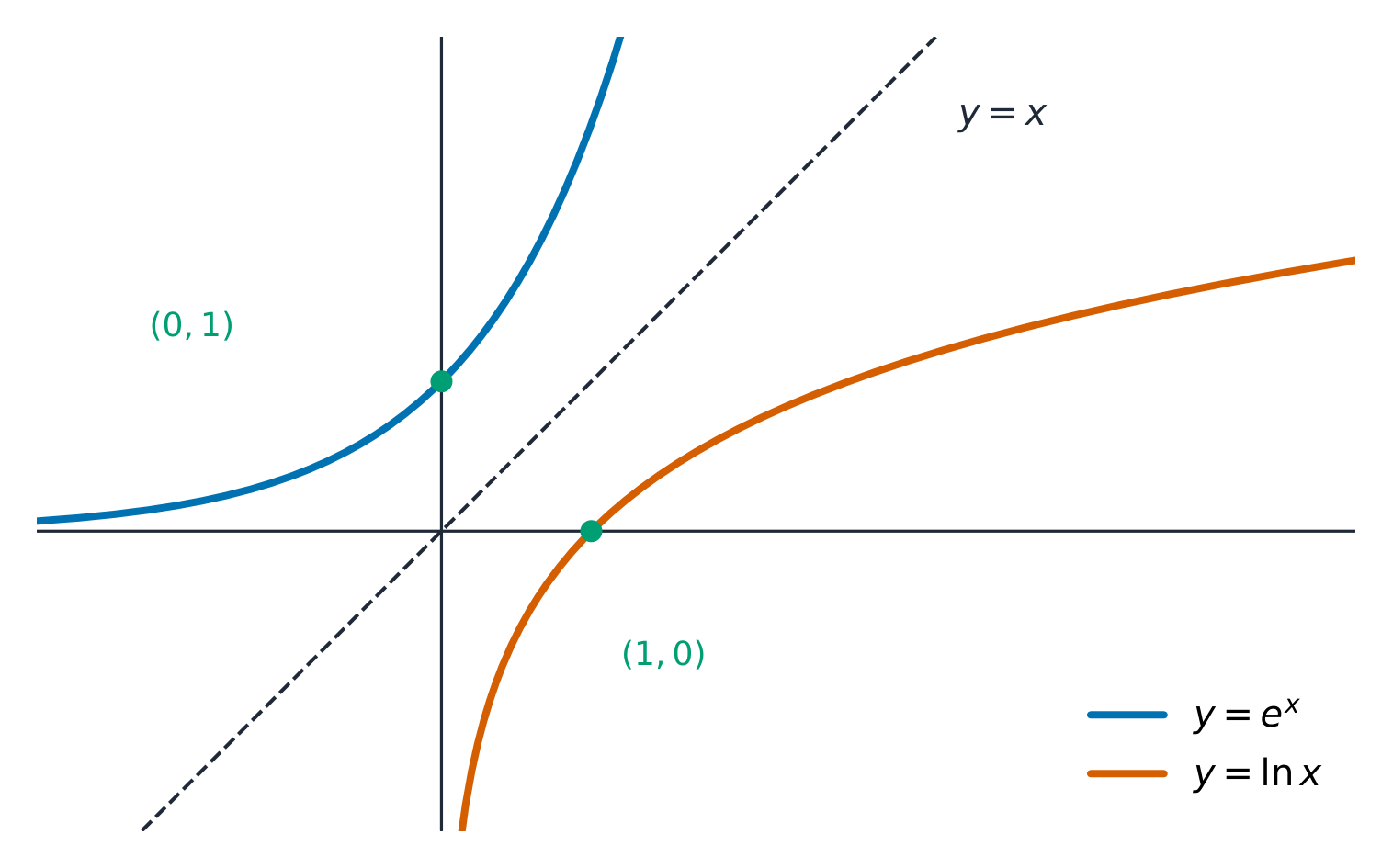
  • Domain and range swap: reverse each $(a,b)$ to $(b,a)$ in a table; reflect the graph over the line $y=x$.
  • To find a formula: swap $x$ and $y$ in $y=f(x)$, then solve for $y$. Context may further limit where the inverse applies.
ไทย
ฟังก์ชันผกผันเป็นการสะท้อน
Exponential & logarithm are inverses

ฟังก์ชันหนึ่งๆ จะ ผกผันได้ (invertible) ในโดเมนที่แต่ละค่าผลลัพธ์มาจาก ตัวแปรเข้าที่เฉพาะเจาะจง (คุณสามารถจำกัดโดเมนเพื่อบังคับให้เป็นเช่นนั้น) ฟังก์ชันผกผัน $f^{-1}$ ทำการย้อนกลับการจับคู่: หาก $f(a)=b$ แล้ว $f^{-1}(b)=a$

  • $f\big(f^{-1}(x)\big)=f^{-1}\big(f(x)\big)=x$ (การประกอบให้ผลลัพธ์เป็นเอกลักษณ์)
  • โดเมนและเรนจ์ สลับกัน: ย้อนกลับ $(a,b)$ เป็น $(b,a)$ ในตาราง; สะท้อนกราฟผ่านเส้นตรง $y=x$
  • การหาคำอธิบายทางคณิตศาสตร์: สลับ $x$ และ $y$ ใน $y=f(x)$ จากนั้นแก้สมการหา $y$. บริบทอาจจำกัดเพิ่มเติมว่าฟังก์ชันผกผันใช้ได้ในช่วงใดบ้าง
Vocabulary · ⁨คำศัพท์⁩ Train · ⁨ฝึกฝน⁩
English ไทย
invertible/ɪnˈvɜːtɪbl/ สามารถกลับด้านได้ invertible
inverse function/ɪnˈvɜːs ˈfʌŋkʃn/ ฟังก์ชันผกผัน
logarithm/ˈlɒɡərɪθəm/ ลอการิทึม
common logarithm/ˈkɒmən ˈlɒɡərɪθəm/ ลอการิทึมฐานสิบ common logarithm
natural logarithm/ˈnætʃərəl ˈlɒɡərɪθəm/ ลอการิทึมธรรมชาติ
logarithmic function/ˌlɒɡəˈrɪθmɪk ˈfʌŋkʃn/ ฟังก์ชันลอการิทึม
change-of-base/tʃeɪndʒ ɒv beɪs/ change-of-base (换底公式)
semi-log plot/ˈsemi lɒɡ plɒt/ กราฟ semi-log
2.9

Logarithmic Expressions · ⁨นิพจน์ลอการิทึม⁩

Syllabus · ⁨หลักสูตร⁩
English

Learning Objective 2.9.A: Evaluate logarithmic expressions.

  • 2.9.A.1 The logarithmic expression $\log_b c$ is equal to, or represents, the value that the base $b$ must be exponentially raised to in order to obtain the value $c$. That is, $\log_b c = a$ if and only if $b^a = c$, where $a$ and $c$ are constants, $b > 0$, and $b \neq 1$. (when the base of a logarithmic expression is not specified, it is understood as the common logarithm with a base of $10$)
  • 2.9.A.2 The values of some logarithmic expressions are readily accessible through basic arithmetic while other values can be estimated through the use of technology.
  • 2.9.A.3 On a logarithmic scale, each unit represents a multiplicative change of the base of the logarithm. For example, on a standard scale, the units might be $0, \; 1, \; 2, \; \ldots$, while on a logarithmic scale, using logarithm base $10$, the units might be $10^0, \; 10^1, \; 10^2, \; \ldots$.
ไทย

จุดประสงค์การเรียนรู้ 2.9.A: ประเมินนิพจน์ลอการิทึม

  • 2.9.A.1 นิพจน์ลอการิทึม $\log_b c$ เท่ากับ หรือแทนค่าของเลขชี้กำลังที่ฐาน $b$ ต้องถูกยกกำลังเพื่อให้ได้ค่า $c$ นั่นคือ $\log_b c = a$ ก็ต่อเมื่อ $b^a = c$ โดยที่ $a$ และ $c$ เป็นค่าคงที่, $b > 0$, และ $b \neq 1$ (เมื่อไม่ระบุฐานของนิพจน์ลอการิทึม จะ理解为เป็นลอการิทึมทั่วไปที่มีฐาน $10$)
  • 2.9.A.2 ค่าของนิพจน์ลอการิทึมบางชนิดสามารถหาได้จาก arithmetic พื้นฐาน ในขณะที่ค่าอื่นๆ สามารถประมาณได้โดยใช้ technology
  • 2.9.A.3 บนสเกลลอการิทึม แต่ละหน่วยจะแสดงถึงการเปลี่ยนแปลงแบบคูณด้วยฐานของลอการิทึม เช่น บนสเกลมาตรฐาน หน่วยอาจเป็น $0, \; 1, \; 2, \; \ldots$ แต่บนสเกลลอการิทึม โดยใช้ฐานลอการิทึม $10$ หน่วยอาจเป็น $10^0, \; 10^1, \; 10^2, \; \ldots$

Source: College Board AP Course and Exam Description · ⁨แหล่งที่มา: คำอธิบายหลักสูตรและข้อสอบ College Board AP⁩

English

The logarithm 对数 answers "what exponent?": $\log_b c = a$ means exactly $b^a = c$ (with $b>0,\ b\neq 1$). An unwritten base means the common logarithm 常用对数 (base $10$). On a logarithmic scale, each unit is a multiplicative step of the base (…, $10^0,10^1,10^2,$ …).

ไทย

ลอการิทึมตอบคำถาม "เลขชี้กำลังคืออะไร?": $\log_b c = a$ หมายความว่า $b^a = c$ พอดี (โดยมี $b>0,\ b\neq 1$). การไม่เขียนฐานไว้แสดงว่าเป็น ลอการิทึมทั่วไป (ฐาน $10$). บน สเกลลอการิทึม แต่ละหน่วยคือขั้นตอนการคูณด้วยฐาน (... $10^0,10^1,10^2,$ ...)

2.10

Inverses of Exponential Functions · ⁨ฟังก์ชันผกผันของฟังก์ชันเอ็กซ์โพเนนเชียล⁩

Syllabus · ⁨หลักสูตร⁩
English

Learning Objective 2.10.A: Construct representations of the inverse of an exponential function with an initial value of 1.

  • 2.10.A.1 The general form of a logarithmic function is $f(x) = a\log_b x$, with base $b$, where $b > 0$, $b \neq 1$, and $a \neq 0$.
  • 2.10.A.2 The way in which input and output values vary together have an inverse relationship in exponential and logarithmic functions. Output values of general-form exponential functions change proportionately as input values increase in equal-length intervals. However, input values of general-form logarithmic functions change proportionately as output values increase in equal-length intervals. Alternately, exponential growth is characterized by output values changing multiplicatively as input values change additively, whereas logarithmic growth is characterized by output values changing additively as input values change multiplicatively.
  • 2.10.A.3 $f(x) = \log_b x$ and $g(x) = b^x$, where $b > 0$ and $b \neq 1$, are inverse functions. That is, $g(f(x)) = f(g(x)) = x$.
  • 2.10.A.4 The graph of the logarithmic function $f(x) = \log_b x$, where $b > 0$ and $b \neq 1$, is a reflection of the graph of the exponential function $g(x) = b^x$, where $b > 0$ and $b \neq 1$, over the graph of the identity function $h(x) = x$.
  • 2.10.A.5 If $(s, \; t)$ is an ordered pair of the exponential function $g(x) = b^x$, where $b > 0$ and $b \neq 1$, then $(t, \; s)$ is an ordered pair of the logarithmic function $f(x) = \log_b x$, where $b > 0$ and $b \neq 1$.
ไทย

วัตถุประสงค์การเรียนรู้ 2.10.A: สร้างการแสดงภาพของฟังก์ชันผกผันของฟังก์ชันเอ็กซ์โพเนนเชียลที่มีค่าเริ่มต้นเป็น 1

  • 2.10.A.1 รูปแบบทั่วไปของฟังก์ชันลอการิทึมคือ $f(x) = a\log_b x$ โดยมีฐาน $b$ โดยที่ $b > 0$, $b \neq 1$ และ $a \neq 0$
  • 2.10.A.2 วิธีการที่ค่าอินพุตและเอาต์พุตแปรผันร่วมกันมีความสัมพันธ์ผกผันในฟังก์ชันเอ็กซ์โพเนนเชียลและลอการิทึม ค่าเอาต์พุตของฟังก์ชันเอ็กซ์โพเนนเชียลรูปแบบทั่วไปเปลี่ยนแบบสัดส่วนเมื่อค่าอินพุตเพิ่มขึ้นในช่วงความยาวเท่ากัน อย่างไรก็ตาม ค่าอินพุตของฟังก์ชันลอการิทึมรูปแบบทั่วไปเปลี่ยนแบบสัดส่วนเมื่อค่าเอาต์พุตเพิ่มขึ้นในช่วงความยาวเท่ากัน ทางเลือกอื่น การเติบโตแบบเอ็กซ์โพเนนเชียลมีลักษณะเฉพาะโดยค่าเอาต์พุตที่เปลี่ยนแบบคูณเมื่อค่าอินพุตเปลี่ยนแบบบวก ในขณะที่การเติบโตแบบลอการิทึมมีลักษณะเฉพาะโดยค่าเอาต์พุตที่เปลี่ยนแบบบวกเมื่อค่าอินพุตเปลี่ยนแบบคูณ
  • 2.10.A.3 $f(x) = \log_b x$ และ $g(x) = b^x$ โดยที่ $b > 0$ และ $b \neq 1$ เป็นฟังก์ชันผกผันกัน นั่นคือ $g(f(x)) = f(g(x)) = x$
  • 2.10.A.4 กราฟของฟังก์ชันลอการิทึม $f(x) = \log_b x$, โดยที่ $b > 0$ และ $b \neq 1$, เป็นภาพสะท้อนของกราฟของฟังก์ชันเอ็กซ์โพเนนเชียล $g(x) = b^x$, โดยที่ $b > 0$ และ $b \neq 1$, เทียบกับกราฟของฟังก์ชันเอกลักษณ์ $h(x) = x$.
  • 2.10.A.5 หาก $(s, \; t)$ เป็นคู่ลำดับของฟังก์ชันเอ็กซ์โพเนนเชียล $g(x) = b^x$ โดยที่ $b > 0$ และ $b \neq 1$ แล้ว $(t, \; s)$ จะเป็นคู่ลำดับของฟังก์ชันลอการิทึม $f(x) = \log_b x$ โดยที่ $b > 0$ และ $b \neq 1$

Source: College Board AP Course and Exam Description · ⁨แหล่งที่มา: คำอธิบายหลักสูตรและข้อสอบ College Board AP⁩

English

The logarithm is the inverse of the exponential: $y=b^x$ and $y=\log_b x$ undo each other, so their graphs are reflections over $y=x$. Hence $\log_b(b^x)=x$ and $b^{\log_b x}=x$. The natural logarithm 自然对数 $\ln x = \log_e x$ is the inverse of $e^x$.

ไทย

ลอการิทึมคือ ฟังก์ชันผกผันของเอ็กซ์โพเนนเชียล: $y=b^x$ และ $y=\log_b x$ ยกเลิกซึ่งกันและกัน ดังนั้นกราฟของทั้งสองจึงเป็นการสะท้อนผ่าน $y=x$. ดังนั้น $\log_b(b^x)=x$ และ $b^{\log_b x}=x$. ลอการิทึมธรรมชาติ $\ln x = \log_e x$ คือฟังก์ชันผกผันของ $e^x$

e^x และ ln x相互反射于直线 y = x
2.11

Logarithmic Functions · ⁨ฟังก์ชันลอการิทึม⁩

Syllabus · ⁨หลักสูตร⁩
English

Learning Objective 2.11.A: Identify key characteristics of logarithmic functions.

  • 2.11.A.1 The domain of a logarithmic function in general form is any real number greater than zero, and its range is all real numbers.
  • 2.11.A.2 Because logarithmic functions are inverses of exponential functions, logarithmic functions are also always increasing or always decreasing, and their graphs are either always concave up or always concave down. Consequently, logarithmic functions do not have extrema except on a closed interval, and their graphs do not have points of inflection.
  • 2.11.A.3 The additive transformation function $g(x) = f(x + k)$, where $k \neq 0$, of a logarithmic function $f$ in general form does not have input values that are proportional over equal-length output-value intervals. However, if the input values of the additive transformation function, $g(x) = f(x + k)$, of any function $f$ are proportional over equal-length output value intervals, then $f$ is logarithmic.
  • 2.11.A.4 With their limited domain, logarithmic functions in general form are vertically asymptotic to $x = 0$, with an end behavior that is unbounded. That is, for a logarithmic function in general form, $\lim\limits_{x \to 0^+} a\log_b x = \pm\infty$ and $\lim\limits_{x \to \infty} a\log_b x = \pm\infty$.
ไทย

จุดประสงค์การเรียนรู้ 2.11.A: ระบุลักษณะสำคัญของฟังก์ชันลอการิทึม

  • 2.11.A.1 เซตกำหนดค่าของฟังก์ชันลอการิทึมในรูปทั่วไปคือจำนวนจริงทุกตัวที่มากกว่าศูนย์ และมีเซตค่าเป็นจำนวนจริงทั้งหมด
  • 2.11.A.2 เนื่องจากฟังก์ชันลอการิทึมเป็นฟังก์ชันผกผันของฟังก์ชันเอ็กซ์โพเนนเชียล ดังนั้นฟังก์ชันลอการิทึมจึงมีแนวโน้มเพิ่มขึ้นหรือลดลงตลอด และกราฟของมันจะมีความโค้งขึ้นหรือลงตลอดเช่นกัน ส่งผลให้ฟังก์ชันลอการิทึมไม่มีค่าสูงสุดหรือต่ำสุดยกเว้นในช่วงปิด และกราฟของมันไม่มีจุดเปลี่ยนเว้า
  • 2.11.A.3 ฟังก์ชันการแปลงเชิงบวก $g(x) = f(x + k)$, เมื่อ $k \neq 0$, ของฟังก์ชันลอการิทึม $f$ ในรูปทั่วไปไม่มีค่าอินพุตที่แปรผันตามกันบนช่วงค่าเอาต์พุตที่มีความยาวเท่ากัน อย่างไรก็ตาม หากค่าอินพุตของฟังก์ชันการแปลงเชิงบวก $g(x) = f(x + k)$ ของฟังก์ชัน $f$ ใด ๆ แปรผันตามกันบนช่วงค่าเอาต์พุตที่มีความยาวเท่ากัน แล้ว $f$ จะเป็นฟังก์ชันลอการิทึม
  • 2.11.A.4 ด้วยโดเมนที่จำกัด ฟังก์ชันลอการิทึมในรูปแบบทั่วไปจะมีแนว asimptotic ในแนวตั้งที่ $x = 0$ โดยมีพฤติกรรมที่ขอบเขตซึ่งไม่มี bounds นั่นคือ สำหรับฟังก์ชันลอการิทึมในรูปแบบทั่วไป $\lim\limits_{x \to 0^+} a\log_b x = \pm\infty$ และ $\lim\limits_{x \to \infty} a\log_b x = \pm\infty$

Source: College Board AP Course and Exam Description · ⁨แหล่งที่มา: คำอธิบายหลักสูตรและข้อสอบ College Board AP⁩

English

The logarithmic function 对数函数 $f(x)=\log_b x$ has domain $x>0$ and range all reals. It is always increasing (for $b>1$) or always decreasing (for $0), always concave one way, with a vertical asymptote at $x=0$ – the mirror image of the exponential's horizontal asymptote. It grows very slowly for large $x$.

ไทย

ฟังก์ชันลอการิทึม $f(x)=\log_b x$ มีโดเมน $x>0$ และเรนจ์เป็นจำนวนจริงทั้งหมด. มันจะเพิ่มขึ้นตลอดเวลา (สำหรับ $b>1$) หรือลดลงตลอดเวลา (สำหรับ $0), นูนไปทางเดียวเสมอ, และมี เส้นประแนวตั้ง ที่ $x=0$ – ซึ่งเป็นภาพสะท้อนของเส้นประแนวนอนของฟังก์ชันเอ็กซ์โพเนนเชียล. มันเติบโตช้ามากเมื่อ $x$ มีค่ามาก

Explore · ⁨สำรวจ⁩

Explore a logarithmic curve · ⁨สำรวจเส้นโค้งลอการิทึม⁩

y = a·ln(x − b) + c

A logarithm is the inverse of an exponential: it grows without bound but ever slower, with a vertical asymptote where its input hits zero. · ⁨ลอการิทึม เป็นผกผันของเอกซ์โพเนนเชียล: เติบโตไม่มีขีดจำกัดแต่ช้าลงเรื่อยๆ มีเส้น asymptote แนวตั้งที่อินพุตเป็นศูนย์⁩

2.12

Logarithmic Function Manipulation · ⁨การจัดการฟังก์ชันลอการิทึม⁩

Syllabus · ⁨หลักสูตร⁩
English

Learning Objective 2.12.A: Rewrite logarithmic expressions in equivalent forms.

  • 2.12.A.1 The product property for logarithms states that $\log_b(xy) = \log_b x + \log_b y$. Graphically, this property implies that every horizontal dilation of a logarithmic function, $f(x) = \log_b(kx)$, is equivalent to a vertical translation, $f(x) = \log_b(kx) = \log_b k + \log_b x = a + \log_b x$, where $a = \log_b k$.
  • 2.12.A.2 The power property for logarithms states that $\log_b x^n = n\log_b x$. Graphically, this property implies that raising the input of a logarithmic function to a power, $f(x) = \log_b x^k$, results in a vertical dilation, $f(x) = \log_b x^k = k\log_b x$.
  • 2.12.A.3 The change of base property for logarithms states that $\log_b x = \dfrac{\log_a x}{\log_a b}$, where $a > 0$ and $a \neq 1$. This implies that all logarithmic functions are vertical dilations of each other.
  • 2.12.A.4 The function $f(x) = \ln x$ is a logarithmic function with the natural base $e$; that is, $\ln x = \log_e x$.
ไทย

จุดประสงค์การเรียนรู้ 2.12.A: เขียนแสดงออกทางลอการิทึมในรูปแบบที่เทียบเท่ากัน

  • 2.12.A.1 สมบัติผลคูณของลอการิทึมระบุว่า $\log_b(xy) = \log_b x + \log_b y$ จากมุมมองกราฟ สมบัตินี้บ่งชี้ว่าการขยายแนวตั้งของฟังก์ชันลอการิทึม $f(x) = \log_b(kx)$ ทุกครั้งนั้นเทียบเท่ากับการเลื่อนแนวตั้ง $f(x) = \log_b(kx) = \log_b k + \log_b x = a + \log_b x$, โดยที่ $a = \log_b k$
  • 2.12.A.2 คุณสมบัติกำลังของลอการิทึมระบุว่า $\log_b x^n = n\log_b x$ ในทางกราฟ คุณสมบัตินี้บ่งบอกว่า การยกค่าอินพุตของฟังก์ชันลอการิทึมขึ้นเป็นกำลัง $f(x) = \log_b x^k$ จะส่งผลให้เกิดการขยายแนวตั้ง $f(x) = \log_b x^k = k\log_b x$
  • 2.12.A.3 คุณสมบัติการเปลี่ยนฐานของลอการิทึมระบุว่า $\log_b x = \dfrac{\log_a x}{\log_a b}$, เมื่อ $a > 0$ และ $a \neq 1$ ซึ่งสิ่งนี้บ่งชี้ว่าฟังก์ชันลอการิทึมทั้งหมดเป็นการขยายแนวตั้งของกันและกัน
  • 2.12.A.4 ฟังก์ชัน $f(x) = \ln x$ เป็นฟังก์ชันลอการิทึมที่มีฐานธรรมชาติ $e$; นั่นคือ $\ln x = \log_e x$

Source: College Board AP Course and Exam Description · ⁨แหล่งที่มา: คำอธิบายหลักสูตรและข้อสอบ College Board AP⁩

English

The log properties reverse the exponent rules:

$$\log_b(xy)=\log_b x+\log_b y,\quad \log_b\!\frac{x}{y}=\log_b x-\log_b y,\quad \log_b(x^n)=n\log_b x.$$
The change-of-base 换底 formula lets you compute any log with technology: $\log_b x = \dfrac{\log x}{\log b}=\dfrac{\ln x}{\ln b}$.

ไทย

คุณสมบัติของลอการิทึมเป็นการย้อนกลับกฎของเลขชี้กำลัง:

$$\log_b(xy)=\log_b x+\log_b y,\quad \log_b\!\frac{x}{y}=\log_b x-\log_b y,\quad \log_b(x^n)=n\log_b x.$$
สูตร เปลี่ยนฐาน ช่วยให้คุณคำนวณลอการิทึมใดๆ ด้วยเทคโนโลยี: $\log_b x = \dfrac{\log x}{\log b}=\dfrac{\ln x}{\ln b}$

2.13

Exponential and Logarithmic Equations and Inequalities · ⁨สมการอสมการเอ็กซ์โพเนนเชียลและลอการิทึม⁩

Syllabus · ⁨หลักสูตร⁩
English

Learning Objective 2.13.A: Solve exponential and logarithmic equations and inequalities.

  • 2.13.A.1 Properties of exponents, properties of logarithms, and the inverse relationship between exponential and logarithmic functions can be used to solve equations and inequalities involving exponents and logarithms.
  • 2.13.A.2 When solving exponential and logarithmic equations found through analytical or graphical methods, the results should be examined for extraneous solutions precluded by the mathematical or contextual limitations.
  • 2.13.A.3 Logarithms can be used to rewrite expressions involving exponential functions in different ways that may reveal helpful information. Specifically, $b^x = c^{(\log_c b)(x)}$.

Learning Objective 2.13.B: Construct the inverse function for exponential and logarithmic functions.

  • 2.13.B.1 The function $f(x) = ab^{(x-h)} + k$ is a combination of additive transformations of an exponential function in general form. The inverse of $y = f(x)$ can be found by determining the inverse operations to reverse the mapping.
  • 2.13.B.2 The function $f(x) = a\log_b(x - h) + k$ is a combination of additive transformations of a logarithmic function in general form. The inverse of $y = f(x)$ can be found by determining the inverse operations to reverse the mapping.
ไทย

จุดประสงค์การเรียนรู้ 2.13.A: แก้สมการและอสมการเอ็กซ์โพเนนเชียลและลอการิทึม

  • 2.13.A.1 สมบัติเลขยกกำลัง สมบัติของลอการิทึม และความสัมพันธ์ผกผันระหว่างฟังก์ชันเอ็กซ์โพเนนเชียลและลอการิทึม สามารถนำไปใช้เพื่อแก้สมการและอสมการที่เกี่ยวข้องกับเลขยกกำลังและลอการิทึม
  • 2.13.A.2 เมื่อแก้สมการเอ็กซ์โพเนนเชียลและลอการิทึมที่พบผ่านวิธีวิเคราะห์หรือวิธีกราฟ ผลลัพธ์ควรตรวจสอบหาคำตอบที่ไม่ใช่คำตอบจริงซึ่งถูกขัดแย้งด้วยข้อจำกัดทางคณิตศาสตร์หรือบริบท
  • 2.13.A.3 ลอการิทึมสามารถใช้เขียนแสดงออกที่เกี่ยวข้องกับฟังก์ชันเอ็กซ์โพเนนเชียลในรูปแบบต่างๆ ที่อาจเปิดเผยข้อมูลที่เป็นประโยชน์ได้ โดยเฉพาะอย่างยิ่ง $b^x = c^{(\log_c b)(x)}$

จุดประสงค์การเรียนรู้ 2.13.B: สร้างฟังก์ชันผกผันสำหรับฟังก์ชันเอ็กซ์โพเนนเชียลและลอการิทึม

  • 2.13.B.1 ฟังก์ชัน $f(x) = ab^{(x-h)} + k$ เป็นการรวมของการแปลงแบบบวกของฟังก์ชันเอ็กซ์โพเนนเชียลในรูปทั่วไป ฟังก์ชันผกผันของ $y = f(x)$ สามารถหาได้โดยการดำเนินการผกผันเพื่อกลับการจับคู่
  • 2.13.B.2 ฟังก์ชัน $f(x) = a\log_b(x - h) + k$ เป็นการรวมของการแปลงแบบบวกของฟังก์ชันลอการิทึมในรูปทั่วไป ฟังก์ชันผกผันของ $y = f(x)$ สามารถหาได้โดยการดำเนินการผกผันเพื่อกลับการจับคู่

Source: College Board AP Course and Exam Description · ⁨แหล่งที่มา: คำอธิบายหลักสูตรและข้อสอบ College Board AP⁩

English

To solve, use the fact that exponentials and logs are inverses:

  • Isolate the exponential, then take a log of both sides (bring the exponent down with the power property).
  • Isolate the log, then exponentiate both sides.
  • Always check for extraneous solutions – the argument of a log must stay positive.

Worked example. Solve $2\cdot3^x=54$. Divide by $2$: $3^x=27=3^3$, so $x=3$. When the sides are not tidy powers, take logs instead: $5^x=20$ gives $x=\dfrac{\ln 20}{\ln 5}\approx1.86$.

ไทย

ในการแก้สมการ ให้ใช้ข้อเท็จจริงที่ว่าเอ็กซ์โพเนนเชียลและลอการิทึมเป็นฟังก์ชันผกผัน:

  • แยกเทอมเอ็กซ์โพเนนเชียลออก แล้วทำลอการิทึมทั้งสองข้าง (ดึงเลขชี้กำลังลงโดยใช้คุณสมบัติกำลัง)
  • แยกเทอมลอการิทึมออก แล้วทำเอ็กซ์โพเนนเชียลทั้งสองข้าง
  • ตรวจสอบเสมอเพื่อหา คำตอบที่ไม่ใช่คำตอบ – ค่าภายในของลอการิทึมต้องคงอยู่เป็น บวก เสมอ

ตัวอย่างวิธีทำ. แก้ $2\cdot3^x=54$. หารด้วย $2$: $3^x=27=3^3$, ดังนั้น $x=3$. เมื่อสองข้างไม่ใช่กำลังที่จัดรูปง่าย ให้ใช้ลอการิทึมแทน: $5^x=20$ ให้ $x=\dfrac{\ln 20}{\ln 5}\approx1.86$

2.14

Logarithmic Function Context and Data Modeling · ⁨บริบทของฟังก์ชันลอการิทึมและการสร้างโมเดลข้อมูล⁩

Syllabus · ⁨หลักสูตร⁩
English

Learning Objective 2.14.A: Construct a logarithmic function model.

  • 2.14.A.1 Logarithmic functions are inverses of exponential functions and can be used to model situations involving proportional growth, or repeated multiplication, where the input values change proportionally over equal-length output-value intervals. Alternately, if the output value is a whole number, it indicates how many times the initial value has been multiplied by the proportion.
  • 2.14.A.2 A logarithmic function model can be constructed from an appropriate proportion and a real zero or from two input-output pairs.
  • 2.14.A.3 Logarithmic function models can be constructed by applying transformations to $f(x) = a\log_b x$ based on characteristics of a context or data set.
  • 2.14.A.4 Logarithmic function models can be constructed for a data set with technology using logarithmic regressions.
  • 2.14.A.5 The natural logarithm function is often useful in modeling real-world phenomena.
  • 2.14.A.6 Logarithmic function models can be used to predict values for the dependent variable.
ไทย

จุดประสงค์การเรียนรู้ 2.14.A: สร้างโมเดลฟังก์ชันลอการิทึม

  • 2.14.A.1 ฟังก์ชันลอการิทึมเป็นฟังก์ชันผกผันของฟังก์ชันเอ็กซ์โพเนนเชียลและสามารถใช้สร้างโมเดลสถานการณ์ที่เกี่ยวข้องกับการเติบโตแบบสัดส่วน หรือการคูณซ้ำ ซึ่งค่าอินพุตจะเปลี่ยนแปลงอย่างสัดส่วนตามช่วงค่าเอาต์พุตที่มีความยาวเท่ากัน ทางเลือกอื่น หากค่าเอาต์พุตเป็นจำนวนเต็ม แสดงถึงจำนวนครั้งที่ค่าเริ่มต้นถูกคูณด้วยอัตราส่วน
  • 2.14.A.2 โมเดลฟังก์ชันลอการิทึมสามารถสร้างจากอัตราส่วนที่เหมาะสมและค่าศูนย์จริง หรือจากคู่ค่าอินพุต-เอาต์พุตสองคู่
  • 2.14.A.3 โมเดลฟังก์ชันลอการิทึมสามารถสร้างได้ด้วยการนำการแปลงไปใช้กับ $f(x) = a\log_b x$ โดยพิจารณาจากลักษณะของบริบทหรือชุดข้อมูล
  • 2.14.A.4 โมเดลฟังก์ชันลอการิทึมสามารถสร้างสำหรับชุดข้อมูลโดยใช้เทคโนโลยีผ่านการถดถอยแบบลอการิทึม
  • 2.14.A.5 ฟังก์ชันลอการิทึมธรรมชาติมักมีประโยชน์ในการสร้างโมเดลปรากฏการณ์ในโลกจริง
  • 2.14.A.6 โมเดลฟังก์ชันลอการิทึมสามารถใช้ทำนายค่าของตัวแปรตาม

Source: College Board AP Course and Exam Description · ⁨แหล่งที่มา: คำอธิบายหลักสูตรและข้อสอบ College Board AP⁩

English

Logarithms model quantities that change over huge multiplicative ranges (sound, acid strength, earthquakes). Build a log model from data, and use logarithmic regression for a data set. Because a log compresses large values, it turns proportional growth into a straight-line pattern – the idea behind semi-log plots.

ไทย

ลอการิทึมใช้จำลองปริมาณที่เปลี่ยนแปลงในช่วงการคูณที่ใหญ่โตมาก (เสียง, ความแรงของกรด, แผ่นดินไหว) สร้างโมเดลลอการิทึมจากข้อมูล และใช้ การถดถอยแบบลอการิทึม สำหรับชุดข้อมูล. เนื่องจากลอการิทึมบีบอัดค่าขนาดใหญ่ มันจึงเปลี่ยนการเติบโตแบบสัดส่วนให้เป็นรูปแบบเส้นตรง – นี่คือแนวคิดเบื้องหลังกราฟแบบเซมิ-ลอค

2.15

Semi-log Plots · ⁨กราฟแบบเซมิ-ลอค⁩

Syllabus · ⁨หลักสูตร⁩
English

Learning Objective 2.15.A: Determine if an exponential model is appropriate by examining a semi-log plot of a data set.

  • 2.15.A.1 In a semi-log plot, one of the axes is logarithmically scaled. When the $y$-axis of a semi-log plot is logarithmically scaled, data or functions that demonstrate exponential characteristics will appear linear.
  • 2.15.A.2 An advantage of semi-log plots is that a constant never needs to be added to the dependent variable values to reveal that an exponential model is appropriate.

Learning Objective 2.15.B: Construct the linearization of exponential data.

  • 2.15.B.1 Techniques used to model linear functions can be applied to a semi-log graph.
  • 2.15.B.2 For an exponential model of the form $y = ab^x$, the corresponding linear model for the semi-log plot is $y = (\log_n b)x + \log_n a$, where $n > 0$ and $n \neq 1$. Specifically, the linear rate of change is $\log_n b$, and the initial linear value is $\log_n a$.
ไทย

จุดประสงค์การเรียนรู้ 2.15.A: ตรวจสอบว่าโมเดลเอ็กซ์โพเนนเชียลเหมาะสมหรือไม่โดยพิจารณาจากแผนภูมิเซมิ-ลอการิทึมของชุดข้อมูล

  • 2.15.A.1 ในแผนภูมิเซมิ-ลอการิทึม แกนหนึ่งจะถูกสเกลด้วยลอการิทึม เมื่อแกน $y$ ของแผนภูมิเซมิ-ลอการิทึมถูกสเกลด้วยลอการิทึม ข้อมูลหรือฟังก์ชันที่แสดงลักษณะเอ็กซ์โพเนนเชียลจะปรากฏเป็นเส้นตรง
  • 2.15.A.2 ข้อดีของแผนภูมิเซมิ-ลอการิทึมคือไม่จำเป็นต้องเพิ่มค่าคงที่ใดๆ กับค่าตัวแปรตามเพื่อแสดงให้เห็นว่าโมเดลเอ็กซ์โพเนนเชียลเหมาะสม

จุดประสงค์การเรียนรู้ 2.15.B: สร้างการทำให้เป็นเส้นตรงของข้อมูลเอ็กซ์โพเนนเชียล

  • 2.15.B.1 เทคนิคที่ใช้สร้างแบบจำลองฟังก์ชันเชิงเส้นสามารถนำไปใช้กับกราฟChunks-log ได้
  • 2.15.B.2 สำหรับแบบจำลองเอกซ์โพเนนเชียลในรูป $y = ab^x$, แบบจำลองเชิงเส้นที่สอดคล้องสำหรับการวาดบนChunks-log plot คือ $y = (\log_n b)x + \log_n a$, โดยที่ $n > 0$ และ $n \neq 1$ โดยเฉพาะแล้ว อัตราการเปลี่ยนแปลงเชิงเส้นคือ $\log_n b$, และค่าเริ่มต้นเชิงเส้นคือ $\log_n a$.

Source: College Board AP Course and Exam Description · ⁨แหล่งที่มา: คำอธิบายหลักสูตรและข้อสอบ College Board AP⁩

English

A semi-log plot 半对数图 puts the output on a logarithmic axis and the input on a normal axis. On these axes, an exponential function $y=ab^x$ becomes a straight line, because $\log y = \log a + (\log b)\,x$ is linear in $x$. So: if data look linear on a semi-log plot, an exponential model fits; the line's slope gives $\log b$ and its intercept gives $\log a$.

ไทย

กราฟแบบเซมิ-ลอค วางค่าเอาต์พุตบนแกน ลอการิทึม และค่าอินพุตบนแกนปกติ. บนแกนนี้อะ ฟังก์ชันเอ็กซ์โพเนนเชียล $y=ab^x$ จะกลายเป็น เส้นตรง, เพราะ $\log y = \log a + (\log b)\,x$ เป็นเชิงเส้นใน $x$. ดังนั้น: ถ้าข้อมูลดูเป็นเส้นตรงบนกราฟแบบเซมิ-ลอค โมเดลเอ็กซ์โพเนนเชียลจะเหมาะสม; ความชันของเส้นบอก $\log b$ และจุดตัดแกนบอก $\log a$

2.15

Exam tips · ⁨ข้อแนะนำสำหรับการสอบ⁩

English
  • Distinguish arithmetic (add a common difference) from geometric (multiply a common ratio) sequences and their linear/exponential function cousins.
  • Exponential = repeated multiplication, so it eventually outgrows any linear or polynomial model.
  • The logarithm is the inverse of the exponential ($\log_b c=a\Leftrightarrow b^a=c$); use it to solve $b^x=k$.
  • Apply the log laws (product, quotient, power) and the change-of-base formula; the argument of a log must be positive.
  • On a semi-log plot an exponential model becomes a straight line.
ไทย
  • แยกแยะระหว่างลำดับ เลขคณิต (บวกด้วยผลต่างร่วม) กับ เรขาคณิต (คูณด้วยอัตราส่วนร่วม) และคู่หูของฟังก์ชันเชิงเส้น/เอ็กซ์โพเนนเชียล
  • เอ็กซ์โพเนนเชียล = การ คูณ ซ้ำซ้อน, ดังนั้นมันจึงเติบโตเร็วกว่าโมเดลเชิงเส้นหรือพหุนามในที่สุด
  • ลอการิทึมคือฟังก์ชันผกผัน ของเอ็กซ์โพเนนเชียล ($\log_b c=a\Leftrightarrow b^a=c$); ใช้มันในการแก้ $b^x=k$
  • ใช้กฎลอการิทึม (ผลคูณ, ผลหาร, กำลัง) และสูตรเปลี่ยนฐาน; ค่าภายในของลอการิทึมต้องเป็น บวก
  • บน กราฟแบบเซมิ-ลอค โมเดลเอ็กซ์โพเนนเชียลจะกลายเป็นเส้นตรง

Interactive lessons on this topic · ⁨บทเรียนเชิงโต้ตอบสำหรับหัวข้อนี้⁩

Work through it step by step, with instant-check exercises. · ⁨ทำทีละขั้นตอน พร้อมแบบฝึกหัดตรวจสอบผลทันที⁩

Past Papers · ⁨ข้อสอบย้อนหลัง⁩

More topics in AP Precalculus · ⁨หัวข้อเพิ่มเติมใน AP Precalculus⁩

Log in or create account · ⁨เข้าสู่ระบบหรือสร้างบัญชี⁩

IGCSE, A-Level & AP