Comparing Competing Models
Introduced| English |
|---|
| linear model/ˈlɪnɪə ˈmɒdl/ |
| quadratic model/kwɒˈdrætɪk ˈmɒdl/ |
| exponential model/ˌekspəˈnenʃl ˈmɒdl/ |
| residuals/rɪˈsɪdʒuːəlz/ |
Three curves, one data set
- The same scatter of points could be fit by a line, a parabola, or an exponential.
- Each will pass near the data, but only one captures its true shape.
- Picking the wrong family gives predictions that drift badly.
- So how do we decide which model actually deserves our trust?
Try each family
- Fit a linear model 线性模型, a quadratic model 二次模型, and an exponential model 指数模型 to the same points.
- Each one produces a formula and a curve through the cloud of data.
- Look at where each curve sits relative to the points.
- A line cannot bend; a parabola bends once; an exponential curves ever upward.
Residuals judge the fit
- A residual 残差 is the gap between a data value and the model's prediction there.
- Small residuals, scattered with no pattern, mean a good fit.
- Large residuals, or residuals that curve, mean the wrong family.
- Comparing residuals is how you rank competing models with evidence.
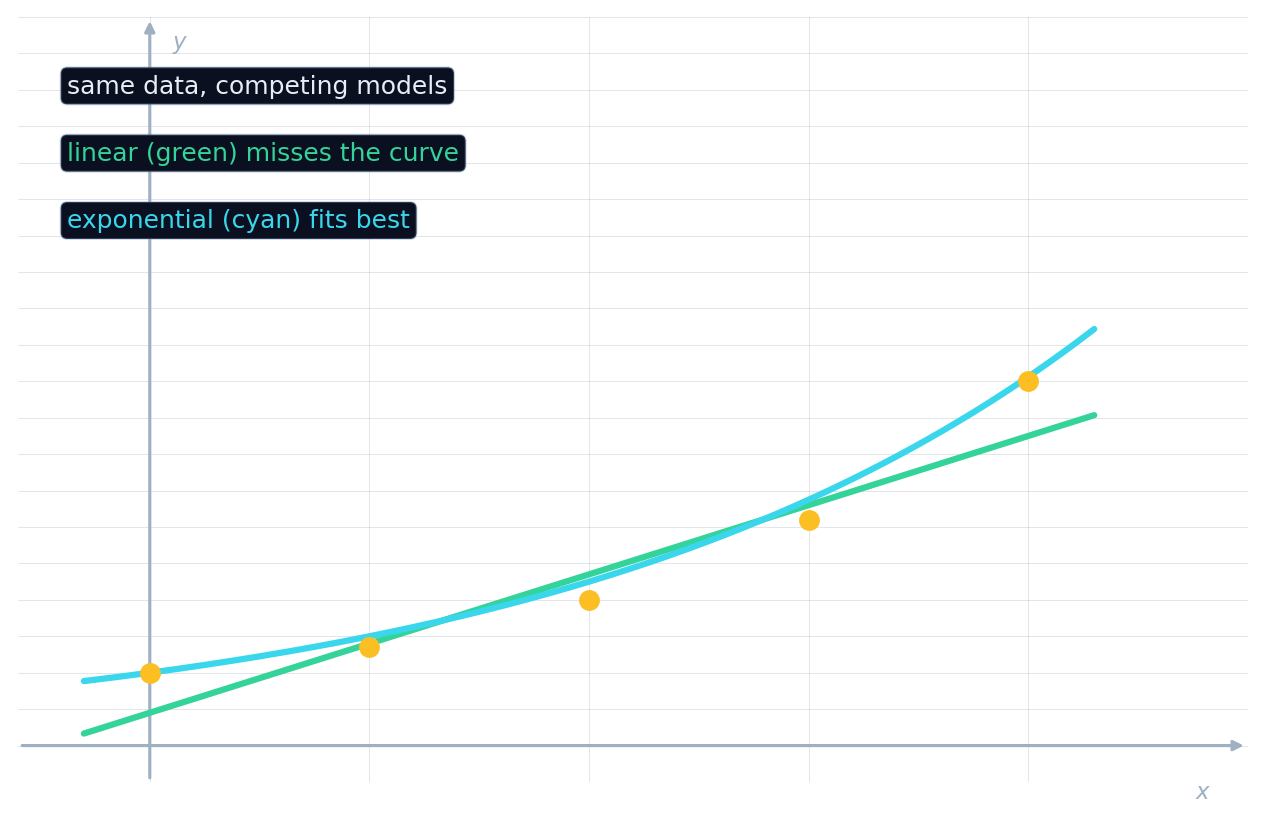
A curve a straight line cannot match
y = a·bˣ
An exponential bends to hug curved data. Try lowering the base toward 1 to see it flatten toward a line.
A residual is the difference between…
A residual = observed − predicted. Small residuals mean the model fits the data closely.
To judge how well a model matches data, examine the size of its ____.
Smaller residuals (and no obvious pattern in them) signal a better-fitting model.
Exponential eventually wins
- Over a long enough range, an exponential outgrows every polynomial.
- Even $x^{100}$ is left behind once $2^x$ gets going.
- So for data that keeps multiplying, the exponential is the natural long-run model.
- Polynomials curve, but they cannot keep up with steady doubling.
Given enough time, an exponential model eventually grows faster than any polynomial model.
Exponential growth outpaces $x^2, x^3,$ even $x^{100}$ in the long run — the exponent always wins.
Select all true statements about comparing models.
The best fit has the smallest residuals, not the biggest. The other three are correct.
Choose with context and evidence
- Use the residuals, but also use what you know about the situation.
- A savings account earns interest → exponential; a falling object → quadratic.
- Prefer the simplest model that fits well and makes physical sense.
- Justify your choice with both the data and the story behind it.
Data doubling at a steady rate is best modeled by a…
Constant-ratio doubling is the hallmark of an exponential model, not a polynomial one.
A wiggly high-degree polynomial can pass through every point and still be a terrible model — it swings wildly between the data and predicts nonsense outside it. A close fit alone is not enough; the family must match the underlying behavior.
Sales over four months: $100, 150, 225, 340$.
- Ratios: $150/100 = 1.5$, $225/150 = 1.5$, $340/225 \approx 1.5$ — nearly constant.
- A constant ratio points to an exponential model, not a line.
- Model: $S \approx 100 \cdot 1.5^{\,m}$, matching the roughly $50\%$ monthly growth.
To compare a linear model, quadratic model, and exponential model on the same data, examine the residuals — smaller is better. Remember an exponential eventually outgrows any polynomial, and let both the evidence and the context guide your final choice.