Skip to content · ⁨ข้ามไปยังเนื้อหา⁩

Line and Mark-Making · ⁨เส้นและการสร้างเครื่องหมาย⁩

AP Drawing · ⁨AP การวาดภาพ⁩ · Topic 1 · ⁨หัวข้อ 1⁩

Video lesson for this topic · ⁨บทเรียนวิดีโอสำหรับหัวข้อนี้⁩ Open the video page · ⁨เปิดหน้าวิดีโอ⁩
7:44

เส้นและการสร้างเครื่องหมาย

ดูภาพวาดสามชิ้นนี้ ไม่มีสี ไม่มีโทน แค่ดินสอ ปากกา เข็มบนแผ่นโลหะ ร่มเงาที่คุณเห็นที่นี่ถูกสร้างขึ้นจากเส้นขีด: เส้น...

English narration · English + 中文 subtitles burned in · ⁨การบรรยายภาษาอังกฤษ · คำบรรยายภาษาอังกฤษ + 中文 ลอยตัวบนภาพ⁩

1.1

Line Quality · ⁨คุณภาพเส้น⁩

Syllabus · ⁨หลักสูตร⁩
English

Focus: Line quality is how a line looks and feels — the first drawing skill the AP rubric names is mark-making.

  • A line can be thick or thin, dark or light, smooth or rough, fast or slow.
  • Weighted line changes thickness along its length: press harder where a form turns away or carries weight.
  • Confident lines are drawn from the shoulder and elbow, not only the fingers.
  • Lost-and-found lines fade out and reappear — the viewer's eye completes the edge.
  • Line direction carries feeling: horizontal is calm, vertical is firm, diagonal is active.
  • Examiners read line quality instantly — scratchy, timid lines and one confident stroke tell different stories.
ไทย

จุดเน้น: คุณภาพเส้น (Line quality) คือลักษณะและความรู้สึกของเส้น — ทักษะการวาดชิ้นแรกที่ AP rubric ระบุคือ การสร้างเครื่องหมาย (mark-making)

  • เส้นสามารถหนาหรือบาง, มืดหรือสว่าง, เรียบหรือหยาบ, รวดเร็วหรือช้า
  • เส้นที่มีน้ำหนัก (Weighted line) เปลี่ยนความหนาตามความยาว: กดหนักขึ้นเมื่อรูปทรงหันออกหรือรับน้ำหนัก
  • เส้นที่มั่นใจจะวาดจากไหล่และศอก ไม่ใช่แค่นิ้วมือเท่านั้น
  • เส้นหายและปรากฏ (Lost-and-found lines) จางหายไปและปรากฏอีกครั้ง — ตาของผู้ชมจะเติมเต็มขอบ
  • ทิศทางของเส้นสื่อความรู้สึก: แนวนอนสงบ, แนวตั้งมั่นคง, แนวเฉียงกระตือรือร้น
  • ผู้ประเมินอ่านคุณภาพเส้นได้ทันที — เส้นที่ขรุขระ ขี้กลัว และ-strokes มั่นใจเพียง stroke เดียว บอกเรื่องราวที่แตกต่างกัน

Source: College Board AP Course and Exam Description · ⁨แหล่งที่มา: คำอธิบายหลักสูตรและข้อสอบ College Board AP⁩

English

Line quality 线条质感 is how a line looks and feels. The AP Drawing rubric names mark-making 笔触 first in its list of drawing skills, and line is the most basic mark.

  • A line can be thick or thin, dark or light, smooth or rough, fast or slow.
  • A weighted line 轻重线条 changes thickness along its length. Press harder where a form turns away from the light or carries weight.
  • Lost-and-found lines 虚实线条 fade out and come back. The viewer's eye completes the missing edge.
  • Confident lines come from the shoulder and elbow, not only the fingers.

Line direction carries feeling: horizontal lines feel calm, vertical lines feel firm, and diagonal lines feel active. Examiners read line quality instantly, so practise until your lines look decided, not timid.

ไทย

Line quality คือลักษณะและความรู้สึกของเส้น AP Drawing rubric ชื่อ mark-making เป็นอันดับแรกในรายการทักษะการวาดภาพ, และเส้นคือ mark ที่พื้นฐานที่สุด

  • เส้นสามารถหนาหรือบาง, มืดหรือสว่าง, เรียบหรือหยาบ, รวดเร็วหรือช้า
  • A weighted line เปลี่ยนความหนาตามความยาว กดแรงขึ้นเมื่อรูปทรงหันหนีจากแสงหรือรับน้ำหนัก
  • Lost-and-found lines จางหายไปและกลับมาตาของผู้ชมจะเติมเต็มขอบที่หายไป
  • เส้นที่มั่นใจเกิดจากไหล่และศอก ไม่ใช่แค่นิ้วมือ
Line qualities: even, weighted, lost-and-found, and expressive lines compared
The same edge drawn four ways: an even line, a weighted line, a lost-and-found line, and a fast expressive line

Line direction carries feeling: horizontal lines feel calm, vertical lines feel firm, and diagonal lines feel active. Examiners read line quality instantly, so practise until your lines look decided, not timid.

Vocabulary · ⁨คำศัพท์⁩ Train · ⁨ฝึกฝน⁩
English ไทย
line quality/laɪn ˈkwɒlɪti/ คุณภาพเส้น
mark-making/mɑːk ˈmeɪkɪŋ/ การทำเครื่องหมาย (mark-making)
weighted line/ˈweɪtɪd laɪn/ เส้นน้ำหนัก
lost-and-found lines/lɒst ænd faʊnd laɪnz/ เส้นหายและพบ
expressive lines/ekˈspresɪv laɪnz/ เส้นแสดงอารมณ์
distortion/dɪˈstɔːʃn/ distortion
voice/vɔɪs/ เสียง/เอกลักษณ์
1.2

Contour Drawing

Syllabus · ⁨หลักสูตร⁩
English

Focus: Contour drawing follows the edges of a form slowly and carefully — it trains eye-hand coordination.

  • A contour line traces the outer edge and the inner edges (folds, creases, overlaps) of a subject.
  • In blind contour you draw without looking at the paper — pure observation practice.
  • Cross-contour lines travel across the surface of a form, like latitude lines on a globe, and describe volume.
  • Draw slowly: match the speed of your eye moving along the edge with the speed of your pencil.
  • Overlapping contours (one edge passing in front of another) create instant depth.
  • Contour studies make strong Sustained Investigation process pages — they show observation skill.
ไทย

จุดเน้น: Contour drawing follows edges ของรูปทรงอย่างช้าๆ และระมัดระวัง — เพื่อฝึก eye-hand coordination

  • เส้นขอบ (Contour line) วิเคราะห์ขอบภายนอกและขอบภายใน (รอยพับ รอยยับ การทับซ้อน) ของวัตถุ
  • ใน blind contour คุณวาดโดยไม่มองกระดาษ — เป็นการฝึกสังเกตการณ์บริสุทธิ์
  • Cross-contour lines เคลื่อนที่ข้ามพื้นผิวของรูปทรง เหมือนเส้นละติจูดบนโลก globe และอธิบาย volume
  • วาดช้า: จับคู่ความเร็วของตาที่เคลื่อนไปตามขอบกับความเร็วของดินสอ
  • Contours ที่ทับซ้อนกัน (ขอบหนึ่งอยู่ข้างหน้าอีกขอบหนึ่ง) สร้างความลึกทันที
  • การศึกษา Contour ทำให้เกิด Sustained Investigation pages ที่มีประสิทธิภาพสูง — แสดงทักษะการสังเกต

Source: College Board AP Course and Exam Description · ⁨แหล่งที่มา: คำอธิบายหลักสูตรและข้อสอบ College Board AP⁩

English

A contour line 轮廓线 traces the edges of a form — the outer edge and the inner edges made by folds, creases, and overlaps. Contour drawing is slow, careful looking.

  • Match the speed of your eye moving along the edge with the speed of your pencil.
  • In blind contour 盲画轮廓 you draw without looking at the paper. It feels strange, but it trains pure observation.
  • Cross-contour lines 横截轮廓线 travel across the surface of a form, like latitude lines on a globe. They describe volume, not edges.
  • Overlapping contours create instant depth: one edge passing in front of another says "this is closer".

Contour studies make strong process pages for the Sustained Investigation because they show real observation skill.

ไทย

A contour line เสนอขอบของรูปทรง - ขอบภายนอกและขอบภายในที่เกิดจากรอยพับ รอยย่น และการซ้อนทับ Contour drawing ช้าและมองอย่างระมัดระวัง

  • Match the speed of your eye moving along the edge with the speed of your pencil.
  • In blind contour you draw without looking at the paper. It feels strange, but it trains pure observation.
  • Cross-contour lines Travel across the surface of a form, like latitude lines on a globe. They describe volume, not edges.
  • Overlapping contours create instant depth: one edge passing in front of another says "this is closer".

Contour studies make strong process pages for the Sustained Investigation เพราะแสดงทักษะการสังเกตที่แท้จริง

Gesture and contour from a master study: line records form in one continuous look
Vocabulary · ⁨คำศัพท์⁩ Train · ⁨ฝึกฝน⁩
English ไทย
contour line/ˈkɒntʊə laɪn/ เส้นขอบ contour line
blind contour/blaɪnd ˈkɒntʊə/ เส้นขอบตาบอด
cross-contour lines/krɒs ˈkɒntʊə laɪnz/ เส้นข้ามพื้นผิวรูปทรง
surface/ˈsɜːfɪs/ ผิว
actual texture/ˈæktʃuːəl ˈtekstʃə/ actual texture
implied texture/ɪmˈplaɪd ˈtekstʃə/ implied texture
frottage/ˈfrɒtɪdʒ/ frottage
1.3

Gesture Drawing

Syllabus · ⁨หลักสูตร⁩
English

Focus: Gesture drawing captures the energy, movement, and weight of a subject in seconds — before any detail.

  • A gesture drawing takes 30 seconds to 3 minutes; it looks for the action line running through the pose.
  • Draw the whole subject at once — big loose lines from the shoulder — never one polished corner.
  • Look for the line of action first: one curve that summarises the pose's movement.
  • Gesture is about what the subject is doing, not what it looks like.
  • Daily gesture pages build speed and confidence, and they photograph well as process evidence.
  • Long drawings usually start as a gesture: energy first, structure second, detail last.
ไทย

จุดเน้น: Gesture drawing ดึงพลังงาน การเคลื่อนไหว และน้ำหนักของวัตถุออกมาในไม่กี่วินาที — ก่อนรายละเอียดใดๆ

  • Gesture drawing ใช้เวลา 30 วินาทีถึง 3 นาที; มองหา action line ที่ไหลผ่านท่าทาง
  • วาดวัตถุทั้งชิ้นพร้อมกัน — เส้นใหญ่ๆ หลวมๆ จากไหล่ — ห้ามวาดมุมเดียวที่ขัดเงา
  • มองหา line of action ก่อน: Curve เดียวที่สรุปการเคลื่อนไหวของท่าทาง
  • Gesture เกี่ยวกับ สิ่งที่วัตถุกำลังทำ ไม่ใช่สิ่งที่มันดูเหมือน
  • หน้า gesture รายวันสร้างความเร็วและความมั่นใจ และถ่ายทำได้ดีในฐานะหลักฐานกระบวนการ
  • ภาพยาวมักเริ่มต้นด้วยการวาดท่าทาง: พลังงานก่อน โครงสร้างทีหลัง รายละเอียดสุดท้าย

Source: College Board AP Course and Exam Description · ⁨แหล่งที่มา: คำอธิบายหลักสูตรและข้อสอบ College Board AP⁩

English

Gesture drawing 动态速写 captures the energy, movement, and weight of a subject in seconds — before any detail.

  • A gesture drawing takes 30 seconds to 3 minutes. Draw the whole subject at once with big, loose lines.
  • Look for the line of action 动势线 first: one curve that summarises the movement of the pose.
  • Gesture asks what the subject is doing, not what it looks like.
  • Long drawings usually start as a gesture: energy first, structure second, detail last.

Daily gesture pages build speed and confidence, and they photograph well as evidence of practice.

ไทย

Gesture drawing จับพลังงาน การเคลื่อนไหว และน้ำหนักของวัตถุภายในไม่กี่วินาที - ก่อนรายละเอียดใดๆ

  • A gesture drawing ใช้เวลา 30 วินาทีถึง 3 นาที วาดวัตถุทั้งชิ้นพร้อมกันด้วยเส้นใหญ่และหลวม
  • Look for the line of action first: one curve that summarises the movement of the pose.
  • Gesture asks what the subject is doing, not what it looks like.
  • ภาพยาวมักเริ่มต้นด้วยการวาดท่าทาง: พลังงานก่อน โครงสร้างทีหลัง รายละเอียดสุดท้าย

Daily gesture pages สร้างความเร็วและความมั่นใจ, และถ่ายทำได้ดีเป็นหลักฐานของการฝึกฝน

Gesture captures action in a few lines before detail begins
Vocabulary · ⁨คำศัพท์⁩ Train · ⁨ฝึกฝน⁩
English ไทย
gesture drawing/ˈdʒestʃə ˈdrɔːɪŋ/ วาดท่าทาง
line of action/laɪn ɒv ˈækʃn/ เส้นของการกระทำ
1.4

Hatching and Cross-Hatching · ⁨Hatching และ Cross-Hatching⁩

Syllabus · ⁨หลักสูตร⁩

Focus: Hatching builds value with parallel lines; cross-hatching layers a second direction on top.

  • Closer, darker lines read as darker value; wider spacing reads as lighter value.
  • Cross-hatching adds layers at new angles — each layer deepens the tone step by step.
  • Curve the hatch lines around the form (cross-contour hatching) so the shading also describes volume.
  • Keep a consistent angle inside one plane; change angle when the plane changes — edges stay crisp.
  • Pen-and-ink drawing depends on hatching because ink has no grey — value comes only from line density.
  • Hatching shows control of mark-making and light and shade, two named AP drawing skills, in one technique.

Source: College Board AP Course and Exam Description · ⁨แหล่งที่มา: คำอธิบายหลักสูตรและข้อสอบ College Board AP⁩

English
Building value with marks

Hatching 排线 builds tone with parallel lines. Cross-hatching 交叉排线 layers a second set of lines at a new angle on top.

  • Closer, darker lines read as darker value 明度; wider spacing reads as lighter value.
  • Each cross-hatched layer deepens the tone step by step — build darkness gradually.
  • Curve the lines around the form (cross-contour hatching) so the shading also describes volume.
  • Keep one angle inside one plane; change the angle when the plane changes, and edges stay crisp.
  • Pen-and-ink drawing depends on hatching, because ink has no grey: value comes only from line density.
ไทย
Building value with marks

Hatching สร้าง tone ด้วยเส้นขนาน Cross-hatching ซ้อนชั้นเส้นชุดที่สองด้วยมุมใหม่ด้านบน

A detailed old-master drawing of a pair of hands pressed together, modelled with dense fine ink lines on blue-grey paper
Dürer สร้างรูปทรงมือเหล่านี้จากการขีดเส้นขนานละเอียดและการขีดไขว้; เมื่อเส้นอยู่ใกล้กันและไขว้กัน โทนสีจะเข้มขึ้น และรอยขีดที่แบนราบจะเปลี่ยนเป็นรูปทรงที่มีมิติ
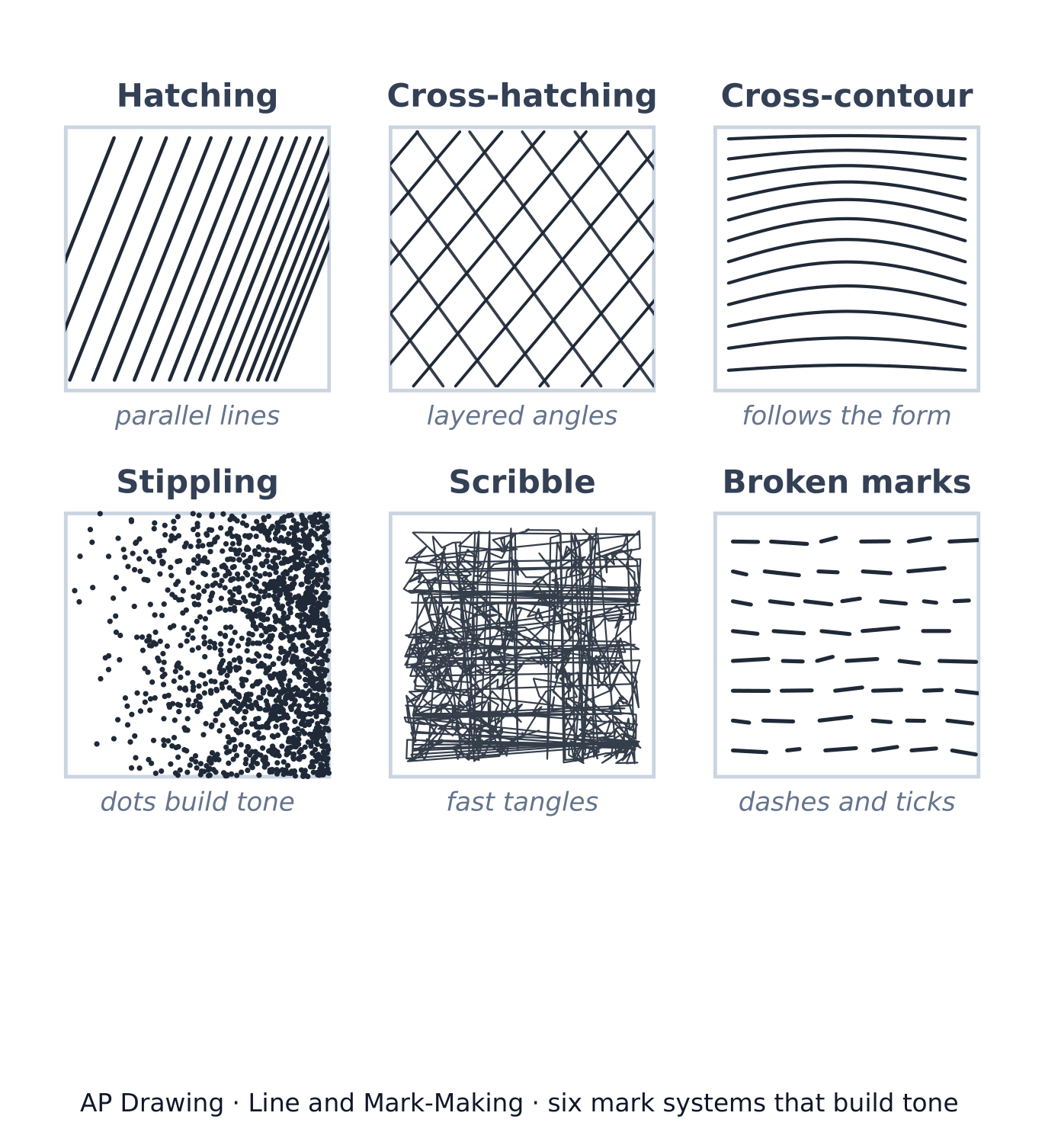
ระบบการทำเครื่องหมาย 6 แบบ: การขีดเส้น, การขีดไขว้, การขีดตามแนวโค้ง, การขีดจุด, การขีดวน, และรอยขีดขาด
6 วิธีในการสร้างโทนสีด้วยเครื่องหมาย: รอยขีดที่ชิด nhauและหนาแน่นกว่า จะถูกอ่านว่ามีความเข้มมากกว่า
  • เส้นที่ชิด nhauและเข้มกว่า ถูกอ่านว่ามีความเข้ม (value) มากกว่า; ระยะห่างที่กว้างกว่าจะถูกอ่านว่ามีความสว่างมากกว่า
  • แต่ละชั้นของการขีดไขว้จะทำให้โทนสีเข้มขึ้นทีละขั้น — สร้างความเข้มอย่างค่อยเป็นค่อยไป
  • ขดเส้นให้ไปตามรูปทรง (การขีดตามแนวโค้ง) เพื่อให้การแรเงาช่วยอธิบายปริมาตรด้วย
  • รักษามุมเดียวภายในระนาบหนึ่ง; เปลี่ยนมุมเมื่อระนาบเปลี่ยนไป และขอบจะยังคงคมชัด
  • การวาดด้วยปากกาหมึกdependence on การขีดเส้น เพราะหมึกไม่มีสีเทา: ความเข้มได้มาจากความหนาแน่นของเส้นเท่านั้น
Explore · ⁨สำรวจ⁩

Which mark system is it? · ⁨นี่คือระบบคะแนนแบบใด?⁩

Hatching uses parallel lines, cross-hatching layers a second angle, stippling builds tone from dots, and scribble uses fast tangles. Naming mark systems helps you choose and describe your own. · ⁨Hatching ใช้เส้นขนาน, cross-hatching ซ้อนชั้นมุมที่สอง, stippling สร้างโทนจากจุด, และ scribble ใช้เส้นพัวพันเร็ว การระบุชื่อระบบเครื่องหมายช่วยให้เลือกและอธิบายงานของคุณเองได้⁩

Vocabulary · ⁨คำศัพท์⁩ Train · ⁨ฝึกฝน⁩
English ไทย
hatching/ˈhætʃɪŋ/ การขีดเส้นทแยงมุม
cross-hatching/krɒs ˈhætʃɪŋ/ การขีดเส้นไขว้
value/ˈvæljuː/ ค่าความเข้มแสง
stippling/ˈstɪplɪŋ/ stippling
scribble/ˈskrɪbl/ scribble
additive/ˈædɪtɪv/ แบบบวก
subtractive/sʌbˈtræktɪv/ ลบ
1.5

Stippling, Scribbling, and Alternative Marks · ⁨การขีดจุด, การขีดวน, และเครื่องหมายทางเลือกอื่นๆ⁩

Syllabus · ⁨หลักสูตร⁩
English

Focus: Beyond hatching there is a whole vocabulary of marks — dots, scribbles, dashes, smears — each with its own texture and speed.

  • Stippling builds tone from dots: dense dots read dark, sparse dots read light — slow but very controllable.
  • Scribble (or scumbled) marks are fast tangles of line — lively, good for fur, foliage, and energy.
  • Dashes, ticks, and broken marks suggest texture without outlining every detail.
  • Marks can be additive (adding material) or subtractive (lifting material out with an eraser).
  • Try one subject rendered in four different mark systems — a classic experimentation page.
  • A personal mark vocabulary is part of your artistic voice — examiners look for it across the portfolio.
ไทย

**เน้น:**Beyond hatching there is a whole vocabulary of marks — dots, scribbles, dashes, smears — each with its own texture and speed.

  • Stippling สร้างโทนสีจากจุด: จุดหนาอ่านเป็นสีเข้ม จุดบางอ่านเป็นสีอ่อน - ช้าแต่ควบคุมได้มาก
  • Scribble (หรือ scumbled) marks are fast tangles of line — lively, good for fur, foliage, and energy.
  • เส้นขีดเส้นจิก และเครื่องหมายแตกหักบ่งบอกถึงพื้นผิวโดยไม่ต้องวาดรายละเอียดทุกส่วน
  • Marks can be additive (adding material) or subtractive (lifting material out with an eraser).
  • Try one subject rendered in four different mark systems — a classic experimentation page.
  • A personal mark vocabulary is part of your artistic voice — examiners look for it across the portfolio.

Source: College Board AP Course and Exam Description · ⁨แหล่งที่มา: คำอธิบายหลักสูตรและข้อสอบ College Board AP⁩

English

Beyond hatching there is a whole vocabulary of marks — dots, tangles, dashes, smears — each with its own texture and speed.

  • Stippling 点画 builds tone from dots: dense dots read dark, sparse dots read light. Slow, but very controllable.
  • Scribble 乱线 marks are fast tangles of line — lively and good for fur, foliage, and energy.
  • Dashes, ticks, and broken marks suggest texture without outlining every detail.
  • Marks can be additive 加法 (putting material on) or subtractive 减法 (lifting material off with an eraser).
  • A classic experimentation page: one subject rendered in four different mark systems.
ไทย

นอกเหนือจากการขีดเส้น ยังมีคำศัพท์ของเครื่องหมายอีกมากมาย — จุด, ลวดลายพันกัน, เส้นประ, รอยปาด — แต่ละแบบมีพื้นผิวและความเร็วของตัวเอง

  • การขีดจุด สร้างโทนสีจากจุด: จุดที่หนาแน่นถูกอ่านว่าเข้ม, จุดที่บางเบาถูกอ่านว่าสว่าง ช้าแต่ควบคุมได้ง่ายมาก
  • เครื่องหมายขีดวน เป็นลวดลายเส้นที่พันกันอย่างรวดเร็ว — มีชีวิตชีวาและเหมาะสำหรับขนสัตว์, ใบไม้, และการสื่อถึงพลังงาน
  • เส้นขีดเส้นจิก และเครื่องหมายแตกหักบ่งบอกถึงพื้นผิวโดยไม่ต้องวาดรายละเอียดทุกส่วน
  • เครื่องหมายสามารถเป็นแบบ เพิ่ม (วางวัสดุลง) หรือแบบ ลบ (ยกวัสดุออกด้วยยางลบ)
  • หน้าทดลองคลาสสิก: วัตถุหนึ่งถูก render ด้วยระบบ marks สี่แบบต่างกัน
1.6

Texture and Surface · ⁨พื้นผิวและลักษณะผิว⁩

Syllabus · ⁨หลักสูตร⁩
English

Focus: Surface is a named AP drawing skill: how the drawing's physical texture and the depicted texture work together.

  • Actual texture is the real surface of the work (rough paper, layered charcoal, collage); implied texture is drawn illusion.
  • Frottage (rubbing over a textured surface) transfers real texture into a drawing.
  • Paper tooth (roughness) changes every mark: the same pencil reads differently on smooth and rough paper.
  • Contrast of textures — smooth skin against rough cloth — makes both read more strongly.
  • Build texture with the logic of the material: short strokes for fur, long strokes for hair, broken marks for stone.
  • Describing texture convincingly is visual evidence of observation and material control.
ไทย

Focus: Surface is a named AP drawing skill: how the drawing's physical texture and the depicted texture work together.

  • Actual texture is the real surface of the work (rough paper, layered charcoal, collage); implied texture is drawn illusion.
  • ฟร็อตตาژ (การถูบนพื้นผิวที่มีลวดลาย) ช่วยถ่ายโอนพื้นผิวจริงเข้าสู่ภาพวาด
  • Paper tooth (roughness) changes every mark: the same pencil reads differently on smooth and rough paper.
  • ความแตกต่างของพื้นผิว — ผิวเรียบเทียบกับผ้าหยาบ — ทำให้ทั้งสองด้านดูเด่นชัดยิ่งขึ้น
  • สร้างพื้นผิวด้วยหลักเหตุผลของวัสดุ: จังหวะสั้นสำหรับขนสัตว์, จังหวะยาวสำหรับเส้นผม, รอยขีดขาดสำหรับหิน
  • Describing texture convincingly is visual evidence of observation and material control.

Source: College Board AP Course and Exam Description · ⁨แหล่งที่มา: คำอธิบายหลักสูตรและข้อสอบ College Board AP⁩

English

Surface 画面质感 is a named AP drawing skill: the physical texture of the drawing and the drawn illusion of texture work together.

  • Actual texture 实际肌理 is the real surface of the work — rough paper, layered charcoal, collage. Implied texture 视觉肌理 is drawn illusion.
  • Frottage 拓印法 (rubbing over a textured surface) transfers real texture into a drawing.
  • Paper tooth 纸纹 changes every mark: the same pencil reads differently on smooth and rough paper.
  • Contrast of textures — smooth skin against rough cloth — makes both read more strongly.
  • Build texture with the logic of the material: short strokes for fur, long strokes for hair, broken marks for stone.
ไทย

พื้นผิว เป็นทักษะการวาดภาพระดับ AP ที่ระบุชื่อไว้: พื้นผิวทางกายภาพของงานศิลปะและภาพลวงตาของพื้นผิวที่วาดขึ้นมาทำงานร่วมกัน

  • พื้นผิวจริง คือพื้นผิวจริงของชิ้นงาน — กระดาษหยาบ, ถ่านที่ซ้อนชั้น, คอลลาจ ภาพลวงตาของพื้นผิว คือการวาดภาพลวงตา
  • ฟร็อตตาژ (การถูบนพื้นผิวที่มีลวดลาย) ช่วยถ่ายโอนพื้นผิวจริงเข้าสู่ภาพวาด
  • Tooth ของกระดาษเปลี่ยนทุก mark:ดินสอตัวเดียวกันอ่านต่างกันบนกระดาษเรียบและหยาบ
  • ความแตกต่างของพื้นผิว — ผิวเรียบเทียบกับผ้าหยาบ — ทำให้ทั้งสองด้านดูเด่นชัดยิ่งขึ้น
  • สร้างพื้นผิวด้วยหลักเหตุผลของวัสดุ: จังหวะสั้นสำหรับขนสัตว์, จังหวะยาวสำหรับเส้นผม, รอยขีดขาดสำหรับหิน
Vocabulary · ⁨คำศัพท์⁩ Train · ⁨ฝึกฝน⁩
English ไทย
tooth/tuːθ/ ความหยาบของพื้นผิว
1.7

Expressive Mark-Making · ⁨การทำเครื่องหมายแบบแสดงอารมณ์⁩

Syllabus · ⁨หลักสูตร⁩
English

Focus: Marks carry emotion: the same subject drawn with angry, calm, or nervous marks tells three different stories.

  • Expressive lines exaggerate speed, pressure, and direction to communicate feeling, not just describe form.
  • Käthe Kollwitz's heavy charcoal and Egon Schiele's tense contours show how marks are the meaning.
  • Choose the mark to match the idea: soft graphite for quiet subjects, aggressive ink for conflict.
  • Distortion and exaggeration are legitimate drawing decisions when they serve intent — 'accurate' is not the only goal.
  • The AP rubric rewards ideas made visual: expressive marks link technique to meaning.
  • Test the same composition in two mark styles and write one sentence on which supports your inquiry better.
ไทย

Focus: Marks carry emotion: the same subject drawn with angry, calm, or nervous marks tells three different stories.

  • Expressive lines exaggerate speed, pressure, and direction to communicate feeling, not just describe form.
  • Käthe Kollwitz's heavy charcoal and Egon Schiele's tense contours show how marks are the meaning.
  • เลือกเส้นพู่กันให้เข้ากับแนวคิด: ดินสอนุ่มสำหรับหัวข้อที่เงียบสงบ, หมึก agresive สำหรับความขัดแย้ง
  • Distortion and exaggeration are legitimate drawing decisions when they serve intent — 'accurate' is not the only goal.
  • The AP rubric rewards ideas made visual: expressive marks link technique to meaning.
  • Test the same composition in two mark styles and write one sentence on which supports your inquiry better.

Source: College Board AP Course and Exam Description · ⁨แหล่งที่มา: คำอธิบายหลักสูตรและข้อสอบ College Board AP⁩

English

Marks carry emotion. The same subject drawn with angry, calm, or nervous marks tells three different stories.

  • Expressive lines 表现性线条 exaggerate speed, pressure, and direction to communicate feeling, not just to describe form.
  • Käthe Kollwitz's heavy charcoal and Egon Schiele's tense contours show how the marks themselves carry the meaning.
  • Choose the mark to match the idea: soft graphite for quiet subjects, aggressive ink for conflict.
  • Distortion 变形 and exaggeration are legitimate drawing decisions when they serve your intent — "accurate" is not the only goal.
  • A personal mark vocabulary is part of your artistic voice 个人风格. Examiners look for it across the whole portfolio.
ไทย

รอยขีดข่วนบ่งบอกอารมณ์ วัตถุเดียวกันที่วาดด้วยรอยขีดข่วนที่โกรธ สงบ หรือหวาดหวั่น บอกเรื่องราวที่แตกต่างกันสามเรื่อง

  • เส้นที่แสดงอารมณ์ มุมมองความเร็ว, แรงกด, และทิศทางเกินจริงเพื่อสื่อสารความรู้สึก ไม่ใช่แค่เพื่ออธิบายรูปทรง
  • เถาถ่านหนักๆ ของ Käthe Kollwitz และเส้นขอบที่ตึงเครียดของ Egon Schiele แสดงให้เห็นว่าตัวเครื่องหมายเองก็พกพาความหมายไปด้วย
  • เลือกเส้นพู่กันให้เข้ากับแนวคิด: ดินสอนุ่มสำหรับหัวข้อที่เงียบสงบ, หมึก agresive สำหรับความขัดแย้ง
  • การบิดเบี้ยว และการมุมมองเกินจริงเป็นการตัดสินใจในการวาดภาพที่ยอมรับได้เมื่อมันสนับสนุนเจตนารมณ์ของคุณ — "ความแม่นยำ" ไม่ใช่เป้าหมายเดียว
  • คำศัพท์เครื่องหมายส่วนตัวเป็นส่วนหนึ่งของ เสียง ทางศิลปะของคุณ ผู้ประเมินมองหาสิ่งนี้ตลอดพอร์ตโฟลิโอทั้งหมด
1.7

Exam tips · ⁨ข้อแนะนำสำหรับการสอบ⁩

English
  • Line quality is judged at a glance — one page of confident, varied strokes tells a scorer more than an hour of timid rendering. Warm up before every serious drawing.
  • Show the systems, not just the results: a portfolio image of hatching, stippling, and cross-contour studies is direct visual evidence of the mark-making skill the rubric names.
  • Photograph marks close up. A detail shot of your best passage of marks proves a skill that a full view only suggests.
  • Blind contour and gesture pages belong in your process images — they show observation and practice, exactly what the Sustained Investigation rubric asks to see.
  • Match marks to meaning in your written evidence: one sentence like "scratchy graphite lines echo the anxiety of exam season" links technique to idea, which is what scorers reward.
ไทย
  • คุณภาพของเส้นถูกตัดสินในทันที — หน้ากระดาษที่เต็มไปด้วยจังหวะมั่นใจหลากหลาย บอกรายละเอียดผู้ประเมินมากกว่าการวาดที่ขี้อายเป็นเวลาหนึ่งชั่วโมงอุ่นเครื่องก่อนการวาดครั้งสำคัญทุกครั้ง
  • แสดงระบบ ไม่ใช่เพียงผลลัพธ์: ภาพพอร์ตโฟลิโอที่แสดงการขีดเส้น, การขีดจุด, และการศึกษาตามแนวโค้ง เป็นหลักฐานทางสายตาโดยตรงของทักษะ การทำเครื่องหมาย ที่เกณฑ์การประเมินระบุ
  • ถ่ายรูปเครื่องหมายแบบระยะใกล้ ภาพรายละเอียดของช่วงเครื่องหมายที่ดีที่สุดของคุณพิสูจน์ทักษะที่ภาพรวมทั้งหมดอาจเพียงบอกลางๆ
  • หน้าเส้นขอบแบบ Blind contour และหน้าท่าทาง ควรอยู่ในภาพกระบวนการ — มันแสดงถึงการสังเกตและการฝึกฝน ซึ่งตรงกับสิ่งที่เกณฑ์ Sustained Investigation ต้องการเห็น
  • จับคู่เครื่องหมายกับความหมายในเอกสารเขียนของคุณ: ประโยคเดียวเช่น "เส้นกราไฟท์ที่ขรุขระสะท้อนถึงความกังวลของฤดูกาลสอบ" เชื่อมโยงเทคนิคเข้ากับแนวคิด ซึ่งเป็นสิ่งที่ผู้ประเมินให้คะแนน

Interactive lessons on this topic · ⁨บทเรียนเชิงโต้ตอบสำหรับหัวข้อนี้⁩

Work through it step by step, with instant-check exercises. · ⁨ทำทีละขั้นตอน พร้อมแบบฝึกหัดตรวจสอบผลทันที⁩

More topics in AP Drawing · ⁨AP การวาดภาพ⁩ · ⁨หัวข้อเพิ่มเติมใน AP Drawing · ⁨AP การวาดภาพ⁩⁩

Log in or create account · ⁨เข้าสู่ระบบหรือสร้างบัญชี⁩

IGCSE, A-Level & AP