Бедность
Введено| English | Значение |
|---|---|
| poverty/ˈpɒvəti/ | бедность |
| absolute poverty/ˈæbsəluːt ˈpɒvəti/ | абсолютная бедность |
| relative poverty/ˈrelətɪv ˈpɒvəti/ | относительная бедность |
| progressive taxation | progressive taxation |
| national minimum wage/ˈnæʃənl ˈmɪnɪməm weɪdʒ/ | national minimum wage |
Two kinds of poor
- A family in rural Malawi cannot buy enough food or clean water. A family in London has a flat and food, but cannot afford a school trip or a phone for their child. Both are called "poor", but they are poor in different ways.
- This lesson covers the two kinds of poverty 贫困, what causes poverty, and the policies that can reduce it.
Absolute and relative poverty
| Absolute poverty 绝对贫困 | Relative poverty 相对贫困 | |
|---|---|---|
| Meaning | people cannot meet their basic needs: food, clean water, shelter, clothing | people can meet basic needs, but have much less than most people in their own country |
| How it is measured | income below a fixed poverty line, for example the World Bank's 2.15 US dollars a day | income below a share of the average income, for example below half of it |
| Can it be ended? | yes, in principle: everyone above the line | it is always there while incomes are unequal |
Exam question. Explain the difference between absolute poverty and relative poverty. [4]
- Model answer: Absolute poverty is when people do not have enough income to buy basic necessities such as food, shelter and clean water (1). It is measured against a fixed poverty line, for example 2.15 US dollars a day (1). Relative poverty is when people are poor compared with others in the same country (1). They can afford the basics, but their income is far below the average, for example less than half of it (1).
- Mark-scheme reasoning: two marks for each kind, a definition plus one more point. Writing only "absolute poverty is worse" gains nothing: you must say what each one compares income with.
Absolute or relative poverty?
Sort each case: are basic needs unmet (absolute), or is the household far below the average in its own country (relative)?
Absolute poverty means:
Сложность 1/5 · 100 монет + небольшой бонус за первое завершение сегодня
Absolute poverty is a lack of basic necessities.
A family that can meet its basic needs but has far less than the national average is in:
Сложность 1/5 · 100 монет + небольшой бонус за первое завершение сегодня
Relative poverty is defined against the average in society.
Poverty measured against the average income in society is ______ poverty.
Сложность 1/5 · 100 монет + небольшой бонус за первое завершение сегодня
Relative poverty compares to the societal average.
In Country Z the average income is 40 000 dollars a year. Using the measure 'below half the average income', which household is in relative poverty?
Сложность 1/5 · 100 монет + небольшой бонус за первое завершение сегодня
Half of 40 000 is 20 000. Only 18 000 is below that line.
Causes of poverty
| Cause | Why it leads to poverty |
|---|---|
| unemployment | no wage, so the household depends on savings or benefits |
| low wages | low skills or low productivity mean low pay, even in full-time work |
| illness or disability | people cannot work, or work less, and may pay for treatment |
| old age | retired people may have only a small pension or none |
| large families | the same income is shared between more dependants |
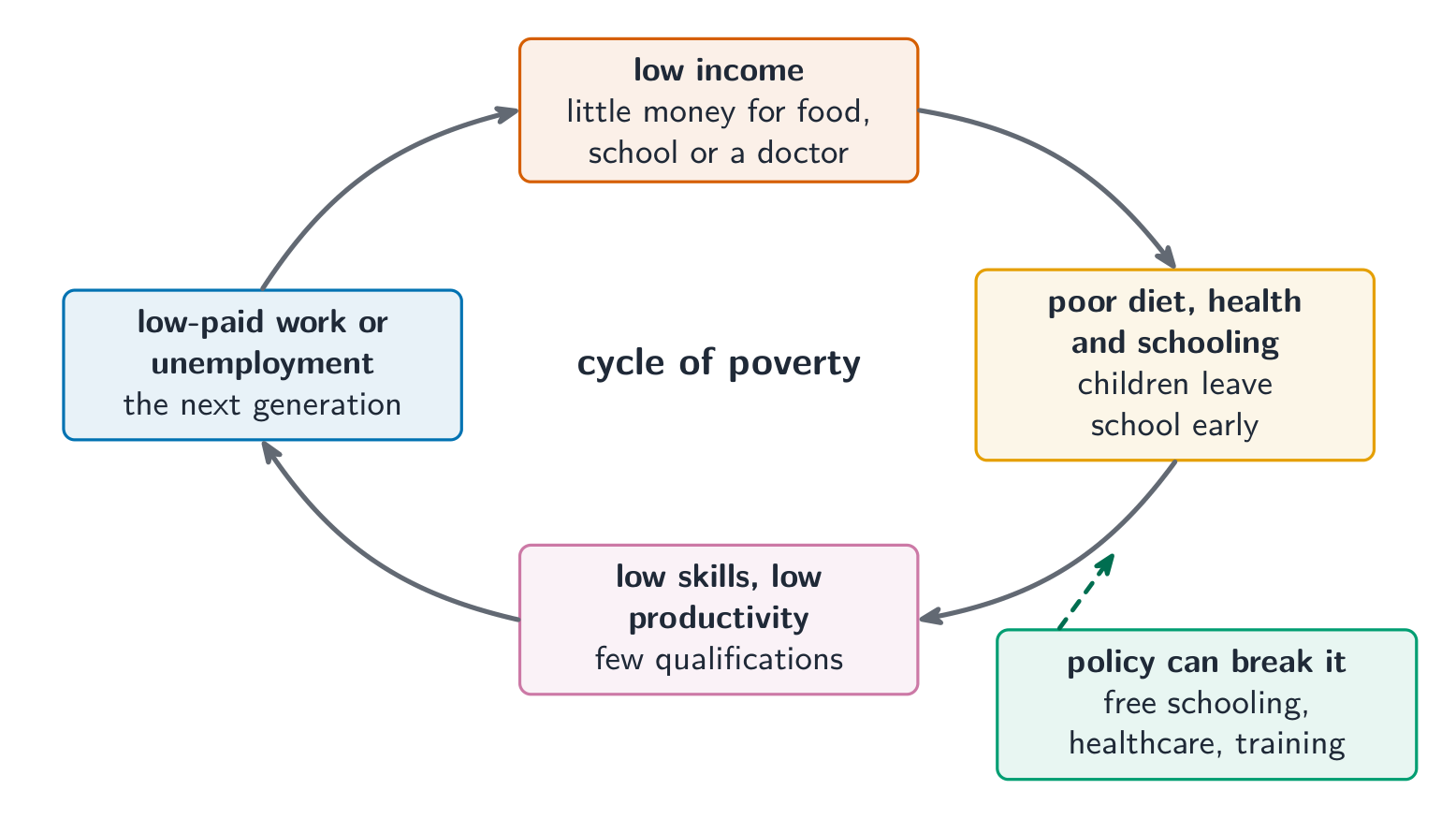
- Poverty often passes from parents to children: this is the cycle of poverty. Breaking it needs action at one of the links, usually education and health.
Why can old age be a cause of poverty?
Сложность 1/5 · 100 монет + небольшой бонус за первое завершение сегодня
After retirement there is no wage. If savings or the pension are small, income falls below what is needed.
Policies to reduce poverty
| Policy | How it helps | A problem |
|---|---|---|
| economic growth | more jobs and higher incomes | the gains may go mainly to the rich |
| better education and training | higher skills → higher productivity and pay | takes many years to work |
| welfare benefits (unemployment pay, pensions) | gives income to those who cannot work | costs tax revenue; may reduce the incentive to work |
| progressive taxation 累进税 | the rich pay a larger share, which can fund benefits | high earners may work less or move abroad |
| national minimum wage 最低工资 | raises the pay of the lowest-paid workers | firms may employ fewer workers |
"Reduce poverty" and "redistribute income" are linked but different. Growth and education can reduce absolute poverty without changing the gap. Progressive taxes and benefits redistribute income from rich to poor, which reduces relative poverty.
Which policies help reduce poverty? (Select all that apply.)
Сложность 2/5 · 140 монет + небольшой бонус за первое завершение сегодня
Cutting the minimum wage would worsen poverty.
A progressive tax takes a higher percentage of income from people with higher incomes.
Сложность 1/5 · 100 монет + небольшой бонус за первое завершение сегодня
Higher earners pay a larger share, which reduces inequality.
Which policy redistributes income from rich to poor?
Сложность 1/5 · 100 монет + небольшой бонус за первое завершение сегодня
A progressive tax takes a larger share from high incomes, and benefits pay it to low-income households. A flat sales tax takes a larger share of a poor person's income, so it does the opposite.
Discuss: will a national minimum wage reduce poverty?
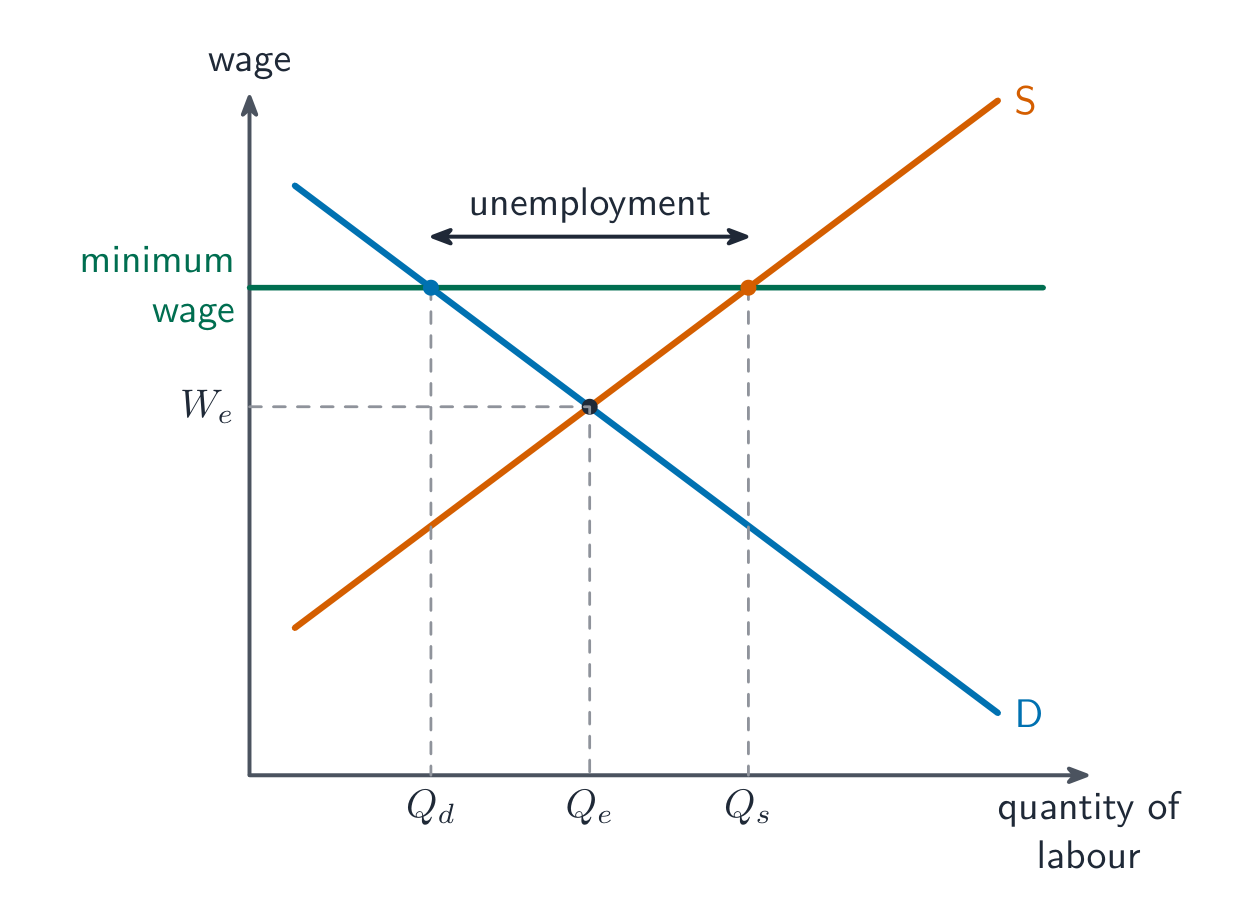
Exam question. Discuss whether or not the introduction of a national minimum wage will reduce poverty. [8]
- Why it may reduce poverty: low-paid workers now earn more, so households on low wages can afford more food, housing and schooling. It can also give people a reason to take a job rather than rely on benefits.
- Why it may not: if the minimum wage is set above the equilibrium wage, firms demand fewer workers (Qd) while more people want work (Qs). Some workers lose their jobs and become poorer. Many of the poorest people are not in work at all (the unemployed, the old, the sick), so a minimum wage does not reach them. In countries with a large informal sector, many workers are not covered.
- Conclusion: it depends on how high it is set compared with the market wage, and on who the poor are. A moderate minimum wage helps the working poor; it should be combined with benefits and education.
- Mark-scheme reasoning: up to 4 marks for "may reduce" and 4 for "may not", each point developed into a chain (cause → effect → poverty). A one-word list ("unemployment, inflation") earns little.
On the diagram, why does a minimum wage above We cause unemployment?
Сложность 1/5 · 100 монет + небольшой бонус за первое завершение сегодня
At the higher wage, labour costs more, so firms move up the demand curve to Qd. More people want work at that wage, so supply rises to Qs. The gap Qs − Qd is unemployment. No curve shifts.
You've got it
- absolute poverty: basic needs not met, measured by a fixed line; relative poverty: far below the average income in your own country
- causes: unemployment, low wages, illness, old age, large families; poverty can pass to the next generation
- policies: growth, education, benefits, progressive taxes, minimum wage, each with a drawback
- a minimum wage above the equilibrium wage can cause unemployment; it helps the working poor, not those without work
- in a "discuss" answer, give both sides as chains, then a conclusion that says what it depends on
Explain one cause of poverty, and explain how one government policy could reduce it. Then give one reason the policy might not work.
Each point needs a chain: cause → effect on income → poverty. A list of words earns little.
A minimum wage is set above the equilibrium wage. Which group of poor people is it least likely to help?
Сложность 1/5 · 100 монет + небольшой бонус за первое завершение сегодня
A minimum wage raises the pay of people in work. People with no job get nothing from it, and some workers may even lose their jobs if firms employ fewer people at the higher wage.