Ваш учебный план · Продолжить · Обзор →
Conditionals — first and second
ВведеноВаше сохранённое положение остаётся в этом браузере. Возобновление не завершает урок и не отвечает на его вопросы.
 5:10
English B1 · Условные предложения
Условные предложения (if-sentences) воображают миры, и в английском их три. Глаголы отступают назад, чтобы показать степень реальности мира: настоящее для фактов, will для реального будущего и …
Озвучивание на английском · переключаемые субтитры на английском и китайском языках
In this lesson
| English |
|---|
| conditional/kənˈdɪʃənl/ |
| remote/rɪˈməʊt/ |
| first conditional/fɜːst kənˈdɪʃənl/ |
| second conditional/ˈsekənd kənˈdɪʃənl/ |
| exception/ekˈsepʃn/ |
If … , then …
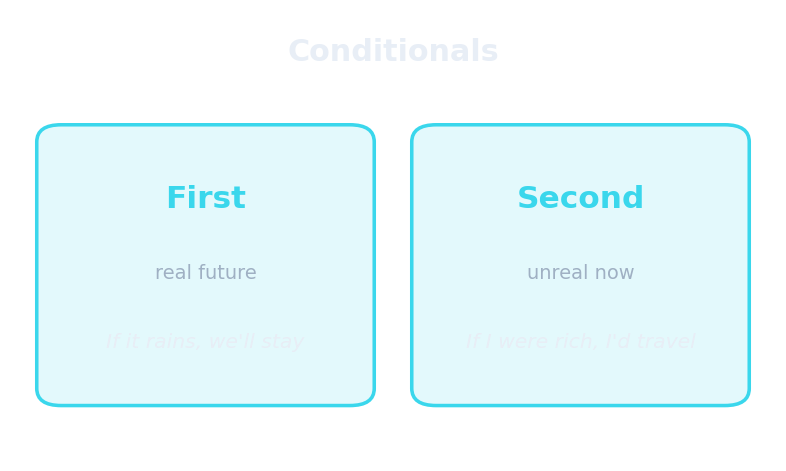
- Условное предложение связывает условие с результатом, решением или предложением. Оно не гарантирует, что условие выполнится.
- Здесь мы практикуем открытую возможность будущего и воображаемую ситуацию, воспринимаемую как более удаленную. «Реальное будущее» на диаграмме — это сокращение для открытой возможности, а не определенности; удаленный паттерн может касаться как будущего, так и настоящего.
- Результат: проанализируйте эти точки зрения и составьте уместное условное предложение. Начните с настоящего простого и ссылки на будущее. Проверка: говорит ли фраза «Если автобус опоздает, я пойду пешком» о том, что автобус обязательно опоздает? Она оставляет это под вопросом.
If it rains tomorrow, my umbrella will choose to stay at home. → Если завтра будет дождь, мой зонт решит остаться дома.
Первое условное — открытая возможность
- Распространенный шаблон:
if + present simple, will + base verb: If it rains, we will stay home. (Если пойдет дождь, мы останемся дома.) Настоящее время здесь указывает на возможное условие в будущем. - В результате также могут использоваться модальные глаголы или указания: If you need help, you can call me. (Если вам нужна помощь, вы можете позвонить мне.) If the door is locked, use the side entrance. (Если дверь заперта, используйте боковой вход.)
- Фраза If you study, you’ll pass (Если ты будешь учиться, ты сдашь) выражает предсказание говорящего; грамматика этого предложения не доказывает, что учеба гарантирует успешную сдачу.
Practise the first-conditional will pattern: “If it rains, we ___ at home.” Choose the result containing “will”.
Сложность 1/5 · 100 монет + небольшой бонус за первое завершение сегодня
Will stay supplies the requested will + base-verb result. Stay can describe a habitual result in another context; it is not the requested will pattern. A conditional prediction is not proof that an outcome is guaranteed.
For an ordinary open future weather condition, is this the standard pattern? “If it will rain tomorrow, we will stay home.” Here “will” is intended only as a future marker.
Сложность 1/5 · 100 монет + небольшой бонус за первое завершение сегодня
For that ordinary future condition use “If it rains tomorrow, we will stay home.” This is not a ban on will after every if: willingness and indirect whether-questions have different patterns.
Translate into English: 如果下雨,我们就待在家里。
Сложность 3/5 · 200 монет + небольшой бонус за первое завершение сегодня
The reference uses a common open-future condition and will result. Preserve the conditional meaning; other natural wording can communicate it too.
Use the present simple of “close” in this ordinary future condition: “If the bridge ___ tomorrow, we’ll use the ferry.”
Сложность 1/5 · 100 монет + небольшой бонус за первое завершение сегодня
Closes fits the ordinary future condition and agrees with the singular bridge. Tomorrow does not require will inside this condition.
A station sign offers an instruction if the ticket machine is broken. Which complete sentence gives that instruction?
Сложность 1/5 · 100 монет + небольшой бонус за первое завершение сегодня
Ask the attendant is a complete imperative result. A conditional result need not contain will; the other options leave the instruction incomplete.
Второе условное — воображаемая или более удаленная от реальности ситуация
- Распространенный шаблон:
if + past form, would + base verb: If I had more time, I would travel. (Если бы у меня было больше времени, я бы отправился в путешествие.) Прошедшее время здесь обозначает дистанцию от реальности, а не прошлую дату. - Может описывать воображаемое настоящее или будущее: If I moved next year, I would need a new job. (Если бы я переехал в следующем году, мне понадобилась бы новая работа.) Не присваивает числовую вероятность.
- If I were you, I’d rest (На твоем месте я бы отдохнул) — это стандартный шаблон для совета. Were используется со всеми подлежащими в данном гипотетическом значении; was также встречается с единственными числами, особенно в неформальной речи.
First or second conditional?
Recognise the open-future and remote-hypothetical patterns in these written examples; they express viewpoints, not guaranteed outcomes or measured probabilities.
Use the past form of “be” in this imagined advice pattern: “If I ___ you, I would rest.”
Сложность 1/5 · 100 монет + небольшой бонус за первое завершение сегодня
Were is conventional in “If I were you” and works with all subjects in this hypothetical use. Singular was also occurs informally and is accepted here. The past form marks an imagined viewpoint, not a past date.
Use the past form of “live” for this imagined future move: “If we ___ nearer the station next year, we would walk there.”
Сложность 1/5 · 100 монет + небольшой бонус за первое завершение сегодня
Lived marks a remote imagined viewpoint here. Next year makes the future reference explicit; the past form does not move the situation into last year.
unless — если только не / при условии, что не
- You’ll be late unless you hurry (Вы опоздаете, если не поторопитесь) означает то же самое, что you’ll be late if you don’t hurry (Вы опоздаете, если не поторопитесь).
- Проверяйте общий смысл, а не механически удаляйте или добавляйте not: I’ll lend it to you unless you don’t want it (Я одолжу тебе это, если ты не хочешь его) имеет значимое отрицательное условие — нежелание получить его является исключением.
- Для обычного условия в будущем после unless используется форма настоящего времени. Это полезный шаблон, а не правило, запрещающее любые отрицательные конструкции.
“The club will lend you a helmet unless you bring your own.” What is the stated exception to the offer?
Сложность 1/5 · 100 монет + небольшой бонус за первое завершение сегодня
Unless introduces the exception: bringing your own helmet. Do not reverse it by treating unless as an instruction to insert not everywhere.
Проверяйте значение перед изменением формы
- Для обычного условия наличия времени пишите If I have time, I’ll help (Если у меня будет время, я помогу), а не добавляйте будущее will внутри условия.
- Но If you will wait here, I’ll find the manager (Если вы будете ждать здесь, я найду менеджера) может использовать will для выражения готовности. I wonder if it will rain (Интересно, пойдет ли дождь) также грамматически верно: его if вводит косвенный вопрос, означая whether (ли).
- Сравните If I knew the answer, I would tell you (Если бы я знал ответ, я бы сказал) с If I know the answer, I’ll tell you (Если я знаю ответ, я скажу). Первое представляет знание как удаленное от реальности; второе оставляет это открытым. Ни одна из форм по отдельности не доказывает, что человек действительно знает ответ.
Match the familiar if-clause/result combinations shown here. These are model patterns, not a claim that a condition can take only one result form.
Сложность 2/5 · 140 монет + небольшой бонус за первое завершение сегодня
The examples pair an open-future prediction with will, hypothetical advice with would and a general fact with present simple. Other coherent modal or imperative results can occur in other messages.
The speaker presents knowing the answer as an imagined, remote situation. Which option uses the standard second-conditional pattern for that meaning?
Сложность 1/5 · 100 монет + небольшой бонус за первое завершение сегодня
If I knew … I would tell … is the requested remote pattern. Knew here marks the imagined viewpoint, not an earlier date. The task does not ban willing/polite would in every other if-clause.
The second-conditional frame itself assigns an exact 10% probability to its imagined condition.
Сложность 1/5 · 100 монет + небольшой бонус за первое завершение сегодня
The frame expresses the speaker’s remote viewpoint, not a numerical probability. A separate forecast or measurement would need its own evidence.
- Прочитайте условие и результат; различайте открытую возможность и воображаемую удаленную ситуацию.
- familiarные структуры первого и второго типа удобны как отправная точка. Также встречаются другие модальные глаголы, инструкции и значения will.
- Держите явные факты, воображаемые условия и предсказанные результаты отдельно. Условное предложение автоматически не устанавливает свое условие и не доказывает обратную связь.
Imagine a remote present or future situation. Write one English sentence using the requested pattern “if + past form, would + base verb”. You may invent a person and ordinary details.
Сложность 3/5 · 200 монет + небольшой бонус за первое завершение сегодня
Example: “If I won the lottery, I would travel the world.”
A workshop message says: “If the projector fails tomorrow, we can use the printed diagrams.” Which reading preserves what the message actually says?
Сложность 1/5 · 100 монет + небольшой бонус за первое завершение сегодня
If leaves the future failure open; can gives an available response. Neither a failure nor diagram accuracy is established. If you read the condition as a fact or guarantee, underline if and can, then rewrite the message as an open possibility before trying a new backup plan.
A friend plans an outdoor lunch, but the weather is uncertain. Write a two-sentence English message: give one possible condition and a practical backup action, then imagine a different location you could choose if you had unlimited space. After comparing, revise one unclear condition or verb frame. Invent ordinary details; no proficiency score is assigned.
Compare the intended meaning and the relevant clause/form choices. Revise one supported issue; this local self-review does not award correctness or proficiency.
Разобранные контрасты: сохранение точки зрения
- Резервирование против отчета: паромная компания говорит: Если переправа будет отменена завтра, мы сможем перевести ваш билет. Отмена остается возможной; can предлагает вариант. The crossing was cancelled (Переправа была отменена) вместо этого сообщает о событии. Использование резервного варианта не доказывает, что отмена была единственной возможной причиной.
- Удаленное будущее против прошлого: If Jo rented a workshop next spring, she would need insurance (Если Джо снимет мастерскую весной следующего года, ей понадобится страховка) воображает будущую ситуацию как удаленную. Jo rented a workshop last spring (Джо сняла мастерскую весной прошлого года) сообщает о прошедшем событии. Прочитайте весь указатель времени; ни форма rented сама по себе, ни метка условного предложения не дают процент вероятности.
- Отрицательное исключение: I’ll reserve you a seat unless you don’t want one (Я забронирую вам место, если только вы не хотите его) оставляет нежелание места в качестве исключения. Удаление don’t меняет предложение на противоположное. В I’ll reserve a seat unless you already have one (Я забронирую место, если только у вас его еще нет) наличие места является исключением: интерпретируйте полное предложение перед изменением отрицания.
Новые решения, полные сообщения
- Попробуйте выполнить двадцать новых независимых письменных решений, не копируя примеры. Некоторые называют конкретную грамматическую рамку; другие спрашивают, что именно устанавливает сообщение. Грамматическая альтернатива может существовать даже тогда, когда задание требует одну конкретную форму.
- Отслеживайте условие и результат отдельно, особенно с отрицаниями и unless. Результат может использовать модальный глагол или инструкцию. Косвенный вопрос с if, означающий whether (то ли... то ли / или), отличается от условия другого действия.
Use the present simple of “need” in this open future condition: “If the printer ___ more paper tomorrow, I’ll refill it.”
Сложность 1/5 · 100 монет + небольшой бонус за первое завершение сегодня
Needs agrees with the singular printer in the ordinary future condition. The proposed refill does not assert that paper will run out.
Use the base verb “keep” after would: “If I owned a greenhouse, I would ___ herbs there.”
Сложность 1/5 · 100 монет + небольшой бонус за первое завершение сегодня
Would keep completes the requested remote result. Keeping or kept would not follow would directly in this frame.
Complete with “doesn’t” or “isn’t” for this open future condition: “If the parcel ___ arrive today, I’ll contact the shop.”
Сложность 1/5 · 100 монет + небольшой бонус за первое завершение сегодня
Doesn’t arrive is the present-simple negative for the singular parcel. Isn’t arrive combines the wrong auxiliary and verb form.
Complete with “unless” or “although” to state that permission is the exception: “We won’t enter the workshop ___ the owner gives permission.”
Сложность 1/5 · 100 монет + небольшой бонус за первое завершение сегодня
Unless supplies the requested exception. Without permission, the proposed entry will not happen; although would express contrast instead.
Use the past form of “have” for the imagined situation: “If Lea ___ a larger desk, she would keep the map open.”
Сложность 1/5 · 100 монет + небольшой бонус за первое завершение сегодня
Had presents the desk situation as imagined and remote. This form does not itself say the desk was larger at a past date.
A host says “If our guest arrives early tomorrow, we’ll offer breakfast.” Which conclusion is supported?
Сложность 1/5 · 100 монет + небольшой бонус за первое завершение сегодня
The condition leaves early arrival open and states the proposed response. It neither reports a completed meal nor guarantees arrival.
Read “If Tessa moved abroad next summer, she would need a new phone plan.” Which viewpoint fits?
Сложность 1/5 · 100 монет + небольшой бонус за первое завершение сегодня
Next summer supplies future time; moved/would marks the remote imagined viewpoint. Past form and past time are not the same thing here.
A visitor imagines renting a bicycle during a possible trip: “If I rented a bike, I could explore the coast.” What does could contribute?
Сложность 1/5 · 100 монет + небольшой бонус за первое завершение сегодня
Could gives a possible option in the imagined situation. The result of a remote conditional need not be would, and no ownership or road guarantee follows.
Choose the reordered sentence that preserves “If the meeting ends early, I’ll catch the six o’clock train.”.
Сложность 1/5 · 100 монет + небольшой бонус за первое завершение сегодня
Putting the result first keeps the same condition. Swapping which event is the condition changes the message; the last option reports past events instead.
A manager says “If the small room is full, we’ll use the hall.” This alone proves that using the hall means the small room must be full.
Сложность 1/5 · 100 монет + небольшой бонус за первое завершение сегодня
The message gives one condition for using the hall, not the only possible reason. Do not reverse if A then B into if B then A without more information.
In “I’m not sure if the ferry will run tomorrow”, what does if introduce?
Сложность 1/5 · 100 монет + небольшой бонус за первое завершение сегодня
If means whether after not sure here. It introduces uncertain information, not the condition of a stated result, so will is grammatical.
A guide says “If you will wait by the desk, I’ll fetch the key.” Here will means be willing to. Which interpretation fits?
Сложность 1/5 · 100 монет + небольшой бонус за первое завершение сегодня
The expressly stated willingness meaning permits will in the if-clause. It differs from mechanically adding a future marker to an ordinary weather condition.
A neighbour says “I’ll bring you soup unless you don’t want any.” What is the exception to bringing soup?
Сложность 1/5 · 100 монет + небольшой бонус за первое завершение сегодня
Not wanting soup is the exception here. The negative has a clear role; removing it would reverse the offer. Read unless together with the whole condition.
A café message says “We’ll sit outside unless the wind gets stronger.” Which paraphrase preserves the ordinary intended meaning?
Сложность 1/5 · 100 монет + небольшой бонус за первое завершение сегодня
Unless gives the stronger-wind exception; the paraphrase keeps the proposed outside seating when that exception does not occur. It does not assert what the wind will do.
Mara tells you that she owns no car. She adds “If I had a car, I would drive to the lake.” Which reading uses both the stated fact and the sentence?
Сложность 1/5 · 100 монет + небольшой бонус за первое завершение сегодня
Her explicit no-car statement supplies the current fact; the conditional imagines a different situation. The past form does not establish yesterday’s ownership.
Use the requested remote pattern for an imagined change of job.
Сложность 1/5 · 100 монет + небольшой бонус за первое завершение сегодня
Changed/would move supplies the requested remote pattern. Move remains the base verb after would; this correction concerns the given target frame, not every possible use of would after if.
The grammar of “If you enter the competition, you’ll win” proves that every entrant will win.
Сложность 1/5 · 100 монет + небольшой бонус за первое завершение сегодня
The speaker predicts a win under a condition. Grammatical form is not independent evidence that the prediction is true.
A shop will keep a repair request open if no reply arrives by Friday. Choose the message preserving that condition and result.
Сложность 1/5 · 100 монет + небольшой бонус за первое завершение сегодня
The first preserves no reply and not closing. The other options change the condition or reverse the result. Track both negatives separately.
Someone asks for imagined advice, using the conventional were pattern. Which reply fits that requested frame?
Сложность 1/5 · 100 монет + небольшой бонус за первое завершение сегодня
Were/would check gives the requested hypothetical advice frame. Singular was is also used informally; that does not make the other incomplete options here valid.
Точная передача плана
- Новые события и обновления студии содержат известные факты и вероятные возможности. Сохраните день, доступное резервное копирование и текущую ситуацию; не изменяйте их ради упрощения написания по знакомому шаблону.
- Составьте черновик на английском языке до того, как покажете образец. Сравните открытые и удаленные точки зрения и устраните несоответствие смысла или глагольной конструкции. Эквивалентная естественная формулировка допустима, если она сохраняет запрошенные факты и рамку изложения.
Facts: the rooftop event is planned for Saturday; rain is uncertain; the downstairs hall is available. Choose a faithful open backup message.
Сложность 1/5 · 100 монет + небольшой бонус за первое завершение сегодня
The first preserves Saturday, uncertain rain and the available hall. The others invent past rain, closure, a changed day or universal cancellation.
A maker has a small studio now and imagines a larger one next year. The actual delivery tomorrow may be delayed. Which pair keeps the two viewpoints distinct?
Сложность 1/5 · 100 монет + небольшой бонус за первое завершение сегодня
Had/would presents the remote studio future. Is delayed/I’ll use gives an open delivery contingency. Neither imagined space nor possible delay is asserted as a completed fact.
Извлеките информацию, не превращая «если» в факт
- Завтра выполните проверку пекарни и обновление статуса поездки перед повторным чтением. Объясните, что является условным или воображаемым, а что известно точно. Сравните, затем исправьте одно несоответствие или объясните, почему ваша формулировка уже соответствует требованиям.
- Далее: косвенная речь, чтобы точно передать измененный план. Время на изучение является предварительным и может меняться от занятия к занятию. Эти письменные проверки не являются оценкой говорения или доказательством владения языком; независимая проверка грамматики/ключей специалистом, а также проверка доступности и мнений учащихся остаются в ожидании.
Проверка использования 21 октябрь 2026: British Council, глаголы во времени и придаточных с if и условные предложения. Новые контексты и образцы являются оригинальными. Проверка локальных источников; независимая проверка языка, ответов и мнений учащихся остается в ожидании.
“If the new bakery opens next week, we’ll try it.” establishes that it will open next week.
Сложность 1/5 · 100 монет + небольшой бонус за первое завершение сегодня
The opening remains an open condition. Explain the possible action without turning the condition into an announced fact.
Later, before rereading, write two English sentences. Facts: a Sunday walking trip may be affected by fog; a local museum is an available backup. Then imagine having your own minibus, which you do not have now, and describe a different trip. Use an open condition with can or will and a remote if + past/would frame. Keep Sunday and the current ownership fact. Compare and revise one mismatch.
Compare the two viewpoints and the supplied facts before copying any wording. The model supports your revision; self-review does not automatically establish correctness or proficiency.