Present simple — habits and facts
IntroducedThings you do again and again
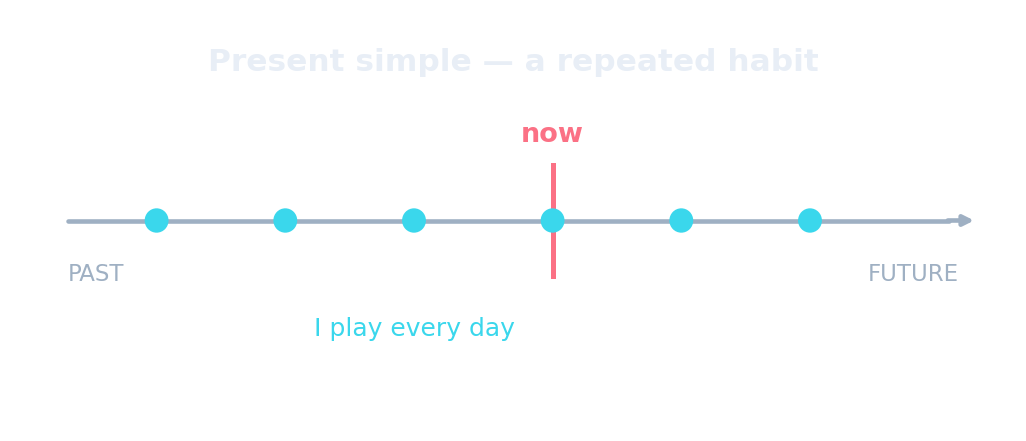
- The present simple is the tense for habits, routines, and facts.
- I wake up at seven. The sun rises in the east.
- It is the most common tense in English — let's master it.
I study every day; my desk has never asked for a holiday.
The basic form
- Subject + base verb: I work, you play, we live, they study.
- Nothing extra — no am / is / are, and no -ing.
- They live in Shanghai.
Which sentence uses the present simple correctly?
Present simple is just the base verb: “I play”. No “am”, no “-ing”.
He / she / it → add -s
- With he, she, it, the verb takes -s: She works. He likes tea.
- Spelling: watch → watches, study → studies, go → goes.
- have is special: he / she / it → has.
He / she / it — how does the verb add -s?
Most verbs add -s, but the spelling changes after -o/-sh/-ch and consonant + y.
Complete with the correct form: He ___ (live) in Beijing.
With he / she / it, add -s: live → lives.
Saying "no": don't / doesn't
- I / you / we / they → don't + base verb.
- he / she / it → doesn't + base verb.
- I don't eat meat. She doesn't like coffee.
- After don't / doesn't, the verb drops the -s.
Is this sentence correct? “She doesn't likes tea.”
After doesn't, use the base verb: “She doesn't like tea.”
Asking questions: Do / Does …?
- Do you …? · Does he …?
- Do you speak English? Does she work here?
- Short answers: Yes, I do. / No, he doesn't.
Put the words in order to make a question.
Yes/No questions start with Do/Does: “Do you like music?”
Translate into English: 我每天早上喝咖啡。
A daily habit → present simple: “I drink coffee every morning.”
Common mistakes
- ❌ She don't like coffee. → ✓ She doesn't like coffee.
- ❌ Does he has a car? → ✓ Does he have a car? — after does, back to the base form.
- ❌ Everyone know the answer. → ✓ Everyone knows the answer. — everyone is singular.
How often? Match the adverb to its meaning.
always > usually > often > sometimes > rarely > never.
Which question is correct?
does already carries the -s, so the verb goes back to have.
- Present simple = habits + facts.
- he / she / it → verb + -s.
- Negatives and questions use do / does with the base verb.
Write one sentence about something a friend or family member does every day. Use he or she and the present simple — remember the -s!
Example: “My mother cooks dinner every evening.” The verb “cooks” takes -s.