Your learning plan · Continue · Review →
Reported speech
IntroducedYour saved position stays in this browser. Resuming does not complete the lesson or answer its questions.
Telling people what others said
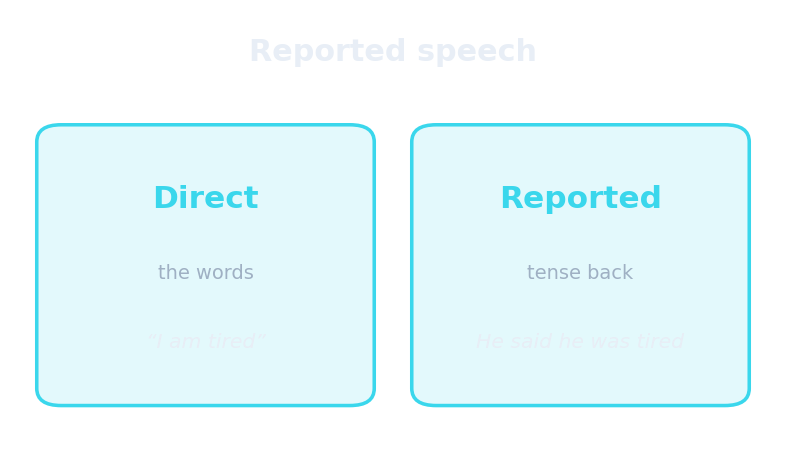
- Indirect speech reports a message without presenting it as an exact quotation: He said he was tired. Direct speech quotes the words: “I am tired,” he said.
- Preserve who said what, to whom and when. A tense substitution by itself cannot do that job.
- Outcome: report a message with clear people and time references. Start with past and present reference. Starting check: if you repeat your own earlier words, does I need to become she? The referent is still you.
He said he was early. The clock reported a different story.
say and tell
- In this statement pattern, use say (that) … or tell someone (that) …: She said she was busy. She told me she was busy. That is often optional.
- A listener can follow say to: She said to me that she was busy. Do not use said me for this meaning.
- These are patterns for reporting statements. Tell a story and tell the truth are also grammatical without a named listener.
Complete with the past-simple form of say or tell: He ___ me that he was busy.
Difficulty 1/5 · 100 coins + a small bonus on first completion today
Told me fits tell + listener. Say can name the listener with to: “He said to me that he was busy.” Do not use said me in this reporting pattern.
Backshift is a viewpoint choice
- After a past reporting verb, a report often uses backshift: is → was, will → would, can → could. Past simple can become past perfect when looking back from that report; past perfect already marks an earlier viewpoint and does not shift again.
- Backshift is not compulsory when the information is still true or relevant: Mina said she works at the museum can report a job she still has. Mina said she worked there is also possible; the past form does not by itself prove she has left.
- A task may ask you to practise a backshifted version. Follow that requested form without calling every unchanged tense ungrammatical.
Direct → reported speech
Practise one backshifted report, preserving speaker and recipient. Backshift and reference changes depend on the reporting context.
She said to me, “I will help you.” Practise reporting this with backshift, from my viewpoint. Which option supplies the requested backshifted form?
Difficulty 1/5 · 100 coins + a small bonus on first completion today
Would supplies the requested backshift of will. She is the original speaker and me is the original recipient reporting it. Will can remain grammatical when the offer is current; this task specifically requests backshift.
Translate into English: 他说他累了。
Difficulty 3/5 · 200 coins + a small bonus on first completion today
He said he was tired is one possible report. An unchanged is can also report a currently relevant state; was does not by itself prove that the tiredness ended.
Track people, place and dates
- Pronouns follow their actual referents. On Monday, Sara tells Ben, “I’ll send you my notes tomorrow.” Ben reports on Wednesday: Sara told me she would send me her notes on Tuesday.
- I → she because Sara is the original speaker; you → me because Ben is reporting the words addressed to him. Another reporter might need him, not me.
- Tomorrow means the day after the original speech, not automatically the day after the report. If the report is still on Monday, tomorrow can remain accurate. Use a named day when the reference might be unclear.
In reported speech, does “tomorrow” often change to “the next day”?
Difficulty 1/5 · 100 coins + a small bonus on first completion today
Yes, often — especially when reporting on a later day. But tomorrow can remain if it still refers to the intended day at the time of reporting. Track dates rather than changing every time word mechanically.
Repair the message, not just its tense
- She asked me where did I live needs statement order in the embedded question: She asked me where I lived. A yes/no report can use if/whether: She asked me if I was busy.
- He said he will come tomorrow can be grammatical if the plan remains relevant and tomorrow still names the intended day. Reporting an old promise later may instead need would and an explicit past date.
- Near miss: Ben’s Wednesday report Sara told me she would send you my notes tomorrow changes the recipient, owner and day. Repair those references first; a correct would cannot rescue a wrong message.
For these examples, match each quotation to the supplied backshifted report, using he for the original speaker. This practises one reporting viewpoint.
Difficulty 2/5 · 140 coins + a small bonus on first completion today
These supplied reports use am → was, will → would and can → could. Unchanged tenses may also be grammatical when information remains current; these matches are not a universal transformation rule.
He asked me, “Are you busy?” Choose the standard indirect yes/no report with backshift.
Difficulty 1/5 · 100 coins + a small bonus on first completion today
If/whether introduces an indirect yes/no question, followed by statement order: “He asked me if I was busy.” If here means whether, not a condition.
- Choose said (to someone) or told someone for this reporting pattern.
- Check whether backshift suits the viewpoint; do not infer that a backshifted state has necessarily ended.
- Later recall: invent a message sent on one named day and report it two days later. Label the speaker, recipient and intended date before writing. Revisit the fresh tasks from memory, then use relative clauses to identify which person or document you mean.
Usage checked 2026-10-20: British Council, reported statements. Local source checks; independent language, answer and learner review pending.
Think of something a friend said. Report it in one sentence using “said” or “told” (with backshift).
Difficulty 3/5 · 200 coins + a small bonus on first completion today
Example: “My friend told me she had passed the exam.”
On Monday, Leila tells Omar, “I’ll email you the map tomorrow.” Omar reports this to a colleague on Thursday. Which report preserves the original speaker, recipient and intended day, without claiming that the email was actually sent?
Difficulty 1/5 · 100 coins + a small bonus on first completion today
The original tomorrow is Tuesday, the day after Monday. Leila remains the sender; Omar, now speaking as I/me, remains the recipient. The wording “told me she would” reports the promise without confirming delivery. If you chose Friday or reversed the people, write the original date/sender/recipient first, then reconstruct the report.
Original message: on Tuesday, Ivo tells you, “I can bring my spare key tomorrow.” On Friday you pass that message to a housemate. Write one or two English sentences preserving the intended day, whose key it is and who offered to bring it. Do not invent whether the key arrived. After comparing, revise one reference that could mislead the housemate.
Compare the intended meaning and the relevant clause/form choices. Revise one supported issue; this local self-review does not award correctness or proficiency.