Индуктивность
Введено 9:11
Электромагнитная индукция
Почти каждый ватт электроэнергии, которую вы когда-либо использовали, начинался одинаково: с магнита и катушки провода, движущихся друг относительно друга. Нет топлива, нет горения: только…
Озвучивание на английском · переключаемые субтитры на английском и китайском языках
In this lesson
| English | Значение |
|---|---|
| inductance/ɪnˈdʌktəns/ | индуктивность |
| henries/ˈhenriz/ | генри |
A coil resists changes to its own current — electrical inertia
- Try to switch a coil's current on suddenly and it fights back.
- Its own changing flux induces an EMF that opposes the change.
- This self-opposition is called inductance 电感.
- Think of it as electrical inertia: current in a coil doesn't like to change quickly.
The self-induced EMF
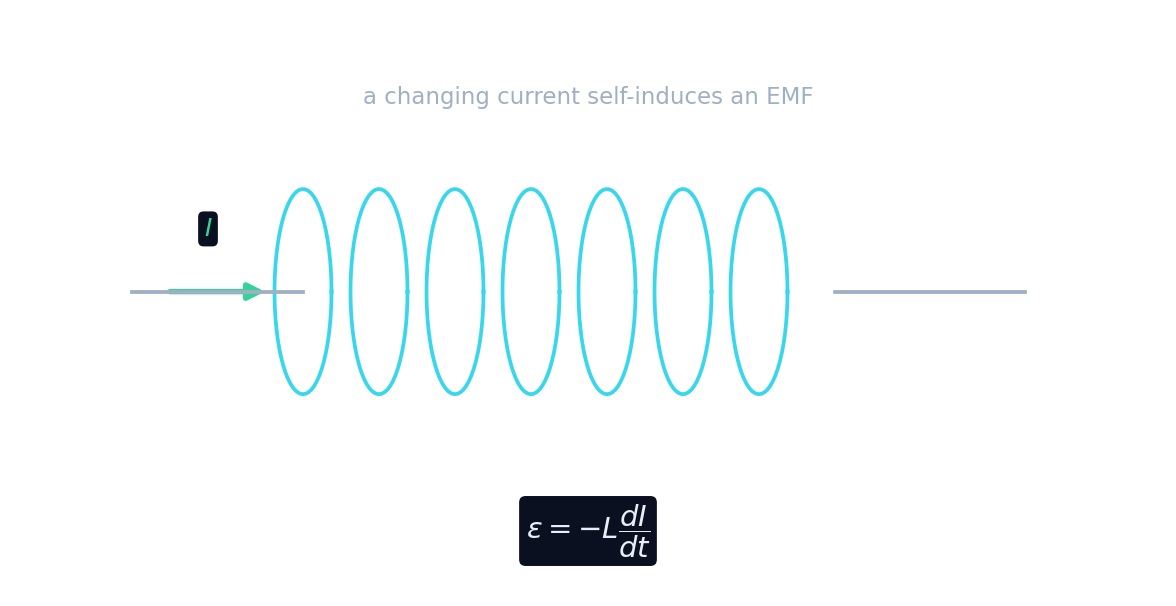
- A changing current makes a changing flux through the coil's own turns.
- By Faraday and Lenz, this induces a back-EMF: $\varepsilon = -L\dfrac{dI}{dt}$.
- $L$ is the inductance, measured in henries 亨利 (H).
- The faster you change the current, the harder the coil pushes back.
The self-induced EMF of an inductor is:
Сложность 1/5 · 100 монет + небольшой бонус за первое завершение сегодня
$\varepsilon = -L\,dI/dt$ — proportional to the rate of current change.
A $4\ \text{H}$ inductor's current changes at $2\ \text{A/s}$. Find the induced EMF magnitude (in V).
Сложность 2/5 · 140 монет + небольшой бонус за первое завершение сегодня
$|\varepsilon| = L\,dI/dt = 4 \times 2 = 8\ \text{V}$.
The SI unit of inductance is the ____.
Сложность 1/5 · 100 монет + небольшой бонус за первое завершение сегодня
Индуктивность $L$ is measured in henries (H).
What sets the inductance
- For a linear inductor, $L$ depends on geometry and core permeability and is approximately independent of current. An iron core can become nonlinear as it saturates.
- More turns, a bigger area, or a longer coil change $L$.
- A tightly wound solenoid with many turns has a large inductance.
- Add an iron core and $L$ grows much larger still.
Energy stored in the field
- Building up a current stores energy in the coil's magnetic field.
- The stored energy is $U = \tfrac12 L I^2$.
- Compare it with a capacitor's $\tfrac12 C V^2$ — the magnetic twin.
- Switch the current off suddenly and this energy has to go somewhere (often a spark).
Inductance opposes change
A changing current in a coil induces a back-EMF proportional to how fast the current changes.
The energy stored in an inductor carrying current $I$ is:
Сложность 1/5 · 100 монет + небольшой бонус за первое завершение сегодня
$U = \tfrac12 LI^2$ — the magnetic twin of $\tfrac12 CV^2$.
The mirror image of a capacitor
- A capacitor opposes sudden changes in voltage.
- An inductor opposes sudden changes in current.
- A capacitor stores energy in an electric field; an inductor in a magnetic field.
- Together they are the two energy-storing circuit elements.
With a steady, unchanging current, an ideal inductor behaves like an ordinary wire.
Сложность 1/5 · 100 монет + небольшой бонус за первое завершение сегодня
$dI/dt = 0$ gives zero back-EMF, so it acts like a plain wire.
Select все true statements about an inductor.
Сложность 2/5 · 140 монет + небольшой бонус за первое завершение сегодня
Opposes current change, stores ½LI², geometric L. Opposing voltage change is a capacitor.
A coil has $L = 2\ \text{H}$ and its current changes at $3\ \text{A/s}$. Find the induced EMF.
- $|\varepsilon| = L\dfrac{dI}{dt} = 2 \times 3$.
- $|\varepsilon| = 6\ \text{V}$, opposing the change.
Worked example: the inductance of a solenoid
- Recipe: assume a current $I$, find $B$ (Ampère), find the flux linkage $N\Phi_B$, then $L=\dfrac{N\Phi_B}{I}$.
- For a long solenoid ($N$ turns, length $\ell$, area $A$), $B=\mu_0\dfrac{N}{\ell}I$ and $N\Phi_B=N\cdot BA=\dfrac{\mu_0N^2AI}{\ell}$, so $L=\dfrac{\mu_0N^2A}{\ell}$.
$N=500$ turns, $\ell=0.25$ m, cross-section $A=2.0\times10^{-4}\ \text{m}^2$.
- $L=\dfrac{(4\pi\times10^{-7})(500)^2(2.0\times10^{-4})}{0.25}=2.5\times10^{-4}$ H $=0.25$ mH.
- Double $N$ in the same length and $L$ grows four times, because both $B$ and the number of linked turns double.
- If the current changes at $200$ A/s, the back-EMF is $L\dfrac{dI}{dt}=0.050$ V.
A solenoid has 1000 turns, length 0.50 m and cross-sectional area 5.0 × 10⁻⁴ m². Find its inductance in mH. Use μ₀ = 4π × 10⁻⁷ T·m/A.
Сложность 2/5 · 140 монет + небольшой бонус за первое завершение сегодня
L = μ₀N²A/ℓ = (4π × 10⁻⁷)(10⁶)(5.0 × 10⁻⁴)/0.50 = 1.26 × 10⁻³ H = 1.26 mH.
A solenoid is rewound with three times as many turns over the same length and area. Its inductance becomes…
Сложность 1/5 · 100 монет + небольшой бонус за первое завершение сегодня
L ∝ N²: three times the turns gives three times the field, linked by three times as many turns, so 9 times the inductance.
An inductor opposes a change in current, not the current itself. A steady current ($dI/dt = 0$) induces no back-EMF at all — the coil then behaves like an ordinary wire. It only fights while the current is changing.
Inductance $L$ (in henries) is a coil's electrical inertia: a changing current self-induces a back-EMF $\varepsilon = -L\,dI/dt$. It depends on geometry and stores energy $U = \tfrac12 LI^2$. An inductor opposes changes in current, the mirror of a capacitor opposing changes in voltage.
Write from the data: find the back EMF
- An inductor of 5 henry has its current falling at 4 amperes per second. At one moment the current is 2 amperes.
- Find the back EMF and the stored energy at that current.
A 5 henry inductor has its current falling at 4 amperes per second. The current is 2 amperes. What are the back-EMF magnitude and the stored energy?
5 times 4 is 20 volts. One half times 5 times 4 is 10 joules.
A linear 5 henry inductor carries 2 amperes while its current falls at 4 amperes per second. What are the induced EMF magnitude and stored energy?
Сложность 1/5 · 100 монет + небольшой бонус за первое завершение сегодня
L dI/dt is 20 volts, and one half L I squared is 10 joules.