Circuits with Resistors and Inductors (LR Circuits)
Введено 9:11
Электромагнитная индукция
Почти каждый ватт электроэнергии, которую вы когда-либо использовали, начинался одинаково: с магнита и катушки провода, движущихся друг относительно друга. Нет топлива, нет горения: только…
Озвучивание на английском · переключаемые субтитры на английском и китайском языках
| English | Значение |
|---|---|
| inductor/ɪnˈdʌktə/ | катушка индуктивности |
Flip the switch and the current takes its time to rise
- In the ideal model with no inductance or capacitance, switching a resistor onto a DC source gives an immediate current; real circuits have finite transients.
- Add an inductor 电感器 and the current climbs gradually instead.
- The inductor's back-EMF fights the sudden change, slowing the rise.
- A resistor and inductor together make an LR circuit — the magnetic cousin of RC.
The current rises exponentially
- For a series LR circuit starting with zero current and constant source EMF, the current climbs: $I(t) = \dfrac{\varepsilon}{R}\left(1 - e^{-t/\tau}\right)$.
- It starts at zero, rises fast, then eases toward its final value $\varepsilon/R$.
- The inductor's opposition is strongest at the start and fades as $I$ steadies.
- The shape is the same exponential curve as an RC charging capacitor.
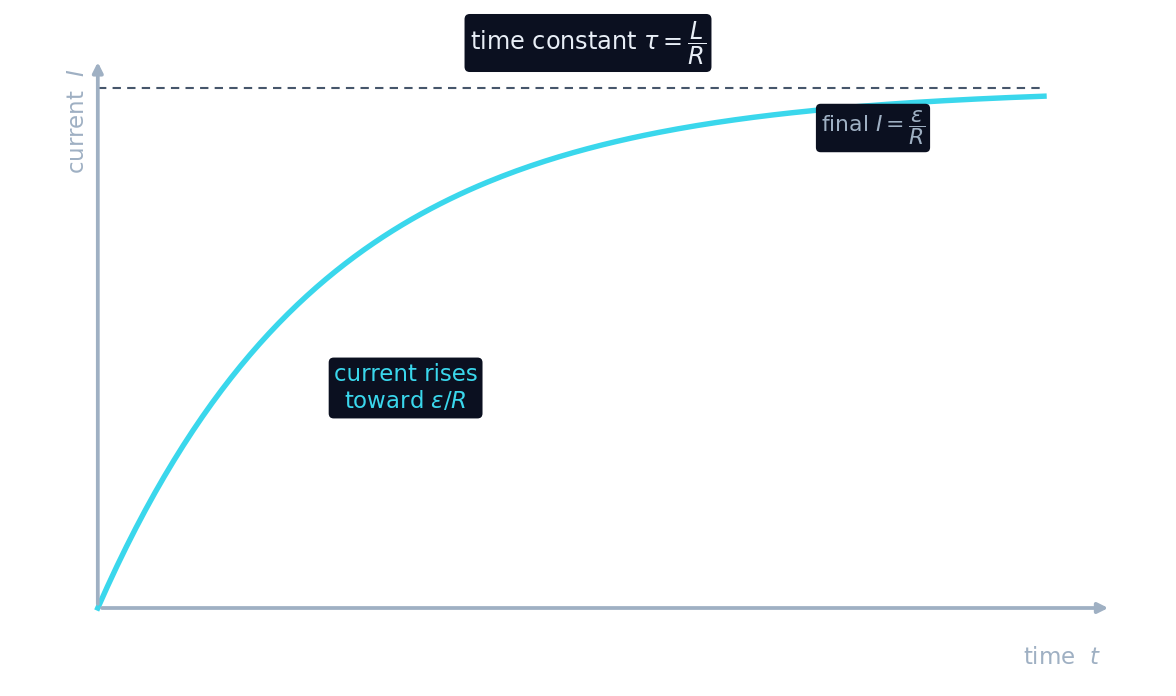
Long after the switch closes, the LR current settles at $\varepsilon/$ ____.
Сложность 1/5 · 100 монет + небольшой бонус за первое завершение сегодня
The final steady current is $\varepsilon/R$ (inductor acts like a wire).
The time constant τ = L/R
- The natural timescale here is $\tau = \dfrac{L}{R}$.
- In one $\tau$, the current reaches about $63\%$ of its final value.
- After about $5\tau$ it is essentially at $\varepsilon/R$.
- A bigger $L$ (more inertia) or smaller $R$ makes the rise slower.
The time constant of an LR circuit is:
Сложность 1/5 · 100 монет + небольшой бонус за первое завершение сегодня
For an LR circuit $\tau = L/R$.
An LR circuit has $L = 10\ \text{H}$ и $R = 5\ \Omega$. Find $\tau$ (in s).
Сложность 2/5 · 140 монет + небольшой бонус за первое завершение сегодня
$\tau = L/R = 10/5 = 2\ \text{s}$.
The inductor's two extremes
- At the first instant ($t = 0$), an initially unenergised ideal inductor keeps current at zero, acting like an open gap. An initial nonzero current cannot jump either.
- After a long time ($t \to \infty$): the current is steady, so the inductor acts like a plain wire.
- Notice this is the opposite of a capacitor's behaviour.
- Those two limits let you check any LR answer quickly.
An LR circuit switching on
An inductor resists sudden change. Sort each fact by the moment it describes.
At the instant a DC source is connected to a series LR circuit with zero initial current, the ideal inductor acts like:
Сложность 1/5 · 100 монет + небольшой бонус за первое завершение сегодня
It blocks the sudden change, so at $t=0$ the current is zero (open gap).
An inductor and a capacitor behave the same way at the start and end of charging.
Сложность 1/5 · 100 монет + небольшой бонус за первое завершение сегодня
For zero initial inductor current and zero initial capacitor voltage, the ideal inductor starts like an open circuit and ends like a wire in steady DC; the capacitor starts like a wire and ends like an open circuit.
Switching off can spark
- Open the switch and the current tries to drop to zero at once.
- The inductor fights that huge $dI/dt$ with a large back-EMF.
- That surge can jump the switch gap as a spark.
- It is why circuits with big coils need protection when switched off.
Select all true statements about a series LR circuit switched onto a constant DC source from zero initial current.
Сложность 2/5 · 140 монет + небольшой бонус за первое завершение сегодня
Exponential rise, τ = L/R, blocked at t = 0. The rise is gradual, not instant.
An LR circuit has $L = 6\ \text{H}$ and $R = 2\ \Omega$. Find its time constant.
- $\tau = \dfrac{L}{R} = \dfrac{6}{2} = 3\ \text{s}$.
- After $3\ \text{s}$ the current is about $63\%$ of $\varepsilon/R$.
Worked example: derive it, then use it
- Loop rule while the current rises: $\varepsilon-IR-L\dfrac{dI}{dt}=0$. Separate: $\dfrac{dI}{\varepsilon/R-I}=\dfrac{R}{L}\,dt$. Integrating from $I=0$ at $t=0$ gives $I=\dfrac{\varepsilon}{R}\left(1-e^{-Rt/L}\right)$.
- The energy stored in the inductor is $U_L=\tfrac12LI^2$.
$\varepsilon=12$ V, $R=4.0\ \Omega$, $L=2.0$ H; the switch closes at $t=0$.
- $\tau=L/R=0.50$ s and the final current is $\varepsilon/R=3.0$ A.
- At $t=0$, $I=0$, so the whole $12$ V is across the inductor: $\dfrac{dI}{dt}=\dfrac{\varepsilon}{L}=6.0$ A/s.
- When is $I=2.0$ A? $2=3\left(1-e^{-t/0.5}\right)$, so $e^{-t/0.5}=\tfrac13$ and $t=0.5\ln3=0.55$ s.
- Final stored energy: $\tfrac12(2.0)(3.0)^2=9.0$ J.
A 24 V battery, a 6.0 Ω resistor and a 3.0 H inductor are connected in series. Find dI/dt at the instant the switch closes.
Сложность 2/5 · 140 монет + небольшой бонус за первое завершение сегодня
At t = 0, I = 0, so there is no voltage across R and ε = L dI/dt. dI/dt = 24/3.0 = 8.0 A/s.
In the same circuit, find the energy stored in the inductor after a long time.
Сложность 2/5 · 140 монет + небольшой бонус за первое завершение сегодня
Final current = 24/6.0 = 4.0 A. U = ½LI² = ½ × 3.0 × 16 = 24 J.
An inductor's limits are the reverse of a capacitor's. At $t = 0$ an initially unenergised ideal inductor acts like an open gap (zero current), and at $t \to \infty$ like a plain wire. Swapping these — or confusing them with the capacitor's — is the classic LR mistake.
In an LR circuit, the current rises as $I = \tfrac{\varepsilon}{R}(1 - e^{-t/\tau})$ with time constant $\tau = L/R$ (about $63\%$ of the final current after the first $\tau$). With zero initial current, at $t=0$ the ideal inductor acts like an open gap, and at $t\to\infty$ like a wire — the reverse of a capacitor.
Write from the data: find the time constant
- An LR circuit has L = 10 henry, R = 2 ohms and a battery EMF of 8 volts.
- Find the time constant and the final current.
A series LR circuit with L = 10 henry and total R = 2 ohms starts with zero current and is switched onto an ideal 8 volt battery. What are its time constant, final current and initial current?
10 divided by 2 is 5 seconds. 8 divided by 2 is 4 amperes. The inductor opposes the initial rise.
A series LR circuit has L = 10 henry, total R = 2 ohms and constant battery EMF 8 volts. It starts with zero current. What are its time constant and final current?
Сложность 1/5 · 100 монет + небольшой бонус за первое завершение сегодня
L over R is 5 seconds and EMF over R is 4 amperes. The start is an open-gap current of 0.