Функции
| English | Русский |
|---|---|
| function/ˈfʌŋkʃn/ | функцией |
| domain/dəˈmeɪn/ | области определения |
| range/reɪndʒ/ | область значений |
| composition/ˌkɒmpəˈzɪʃn/ | композиция |
| inverse/ɪnˈvɜːs/ | обратного |
| one-one/wʌn wʌn/ | однозначное отображение |
The vending machine test
- A vending machine takes one code and gives exactly one snack. If code A7 sometimes gives crisps and sometimes chocolate, it's broken.
- A function 函数 works the same way: each input maps to exactly one output. This simple rule underpins all of calculus.
Functions, domain 定义域 and range 值域
- A function $f(x)$ sends each input to exactly one output.
- The domain = allowed inputs; the range = the outputs produced.
- Example: $f(x) = \sqrt{x}$ has domain $x \geq 0$ and range $f(x) \geq 0$.
Domain restrictions. $g(x) = \dfrac{1}{x-3}$ has domain $x \neq 3$ (division by zero is undefined). The range is all real numbers except $0$.
Исследовать функцию
y = ax³ + bx² + cx + d
Функция преобразует каждый вход ровно в один выход — перетаскивайте коэффициенты и смотрите, где кривая возрастает и убывает.
Область определения f(x) = √(x − 4):
Выражение под корнем должно быть неотрицательным: x − 4 ≥ 0, значит x ≥ 4.
Composition 复合 and inverses 反函数
- A function is one-one 一一对应 if different inputs always give different outputs — only then does it have an inverse $f^{-1}$.
- Composition $fg(x) = f(g(x))$ — do $g$ first, then $f$.
Если f(x) = x² и g(x) = x + 1, чему равно fg(2) = f(g(2))?
g(2) = 3, затем f(3) = 3² = 9.
Только взаимно однозначная функция имеет обратную функцию.
Если бы два входа давали тот же выход, обратное правило было бы неоднозначным — поэтому обратимыми являются только взаимно однозначные функции.
Finding an inverse
- To find $f^{-1}$: write $y = f(x)$, make $x$ the subject, then swap letters.
- Example: $f(x) = 2x + 6$ → $x = \dfrac{y-6}{2}$ → $f^{-1}(x) = \dfrac{x-6}{2}$.
- The graph of $y = f^{-1}(x)$ is the reflection of $y = f(x)$ in the line $y = x$.
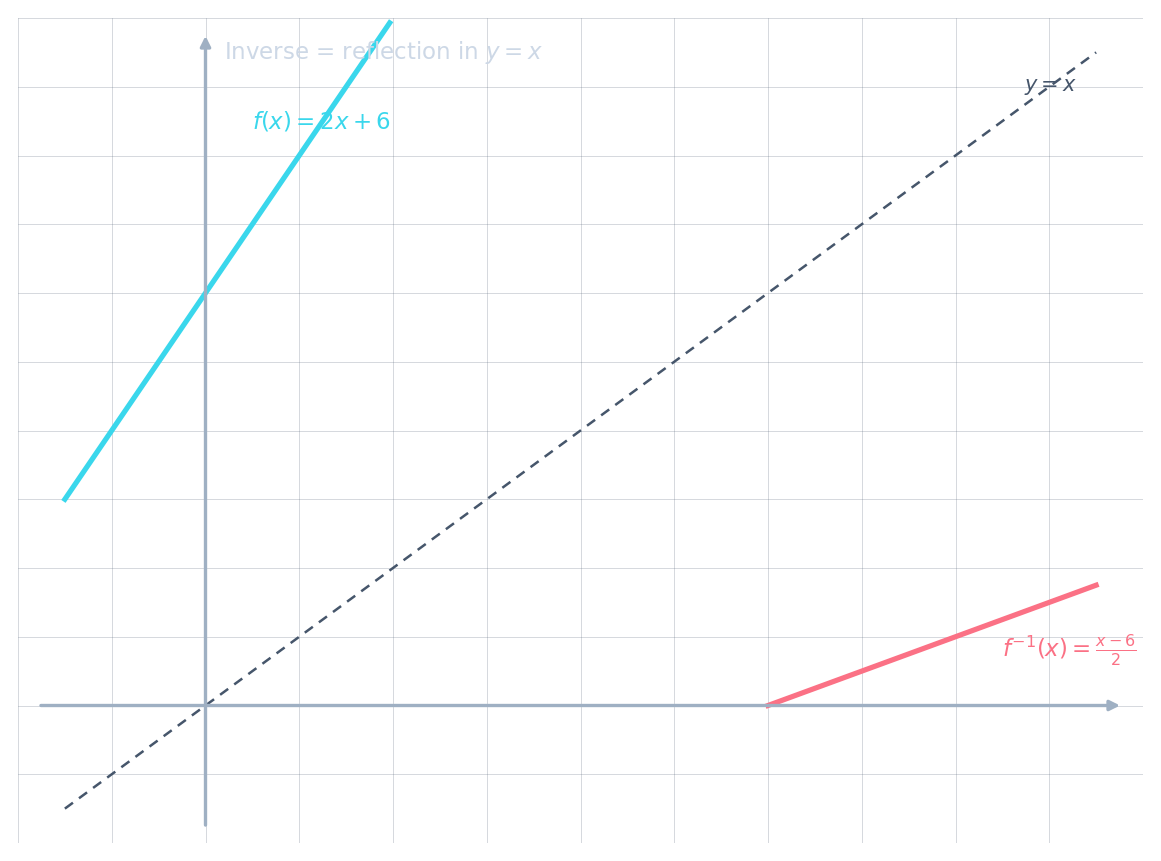
Inverse functions are reflections in $y = x$: the point $(a, b)$ on $f$ becomes $(b, a)$ on $f^{-1}$.
Not all functions have inverses. $f(x) = x^2$ is not one-one (both $2$ and $-2$ give $4$), so it has no inverse unless you restrict the domain to $x \geq 0$.
Для f(x) = 2x + 6 обратная функция имеет вид f⁻¹(x) = (x − 6)/2. Чему равно f⁻¹(10)?
f⁻¹(10) = (10 − 6)/2 = 4/2 = 2.
График y = f⁻¹(x) является отражением графика y = f(x) относительно прямой:
Обратная функция отражает исходный график относительно прямой y = x; точка (a, b) становится (b, a).
Properties of inverses
- $f(f^{-1}(x)) = x$ and $f^{-1}(f(x)) = x$ — they undo each other.
- The domain of $f^{-1}$ is the range of $f$, and vice versa.
- Graphically: swap the axes.
- Know the composition of functions $fg(x)$ and graph transformations — a translation, a stretch, and reflections.

Adding to the output or input slides the curve; a multiplier stretches it
Для любой функции f с обратной функцией выполняется f(f⁻¹(x)) = x.
Применение функции, а затем её обратной возвращает исходный вход — они компенсируют друг друга.
You've got it
- function: each input → exactly one output; domain = inputs, range = outputs
- one-one functions have inverses; find $f^{-1}$ by swapping and solving
- composition $fg(x) = f(g(x))$ — do $g$ first, then $f$
- the graph of $f^{-1}$ is the reflection of $f$ in $y = x$