Três maneiras de dizer "mas". although / feel free to尽管……but但是…… admite um fato antes de contrastá-lo; but; yet却 vem depois do sujeito e mostra que o resultado não é o esperado; to pour倒 apresenta um ponto surpreendente ou contrário, muitas vezes na fala. but; yet却 e to pour倒 são advérbios, portanto vêm depois do sujeito.
Afirmações com "But"
 3:49
HSK 4 Gramática 15: Declarações de "Mas"
Três sabores de "mas". 尽管 concede e depois sobrepõe; 倒 sinaliza a surpresa agradável; 却 marca a reviravolta decepcionante vinda do interior da oração. Escolher 倒 ou 却…
Explicações em inglês + exemplos em mandarim · legendas seguem o texto falado
15.1
Visão geral
- 1. although / feel free to尽管 … ,but但是 … – embora: although / feel free to尽管下着雪,sports competition运动会or / still还是as usual照常to hold (an event)举行(completed / change)了。
- 2. but; yet却 + predicado – porém / contudo: I / me我degree / adjective linker很tired累,but; yet却睡不着。
- 3. to pour倒 – na verdade / pelo contrário: 这家small小restaurant饭馆to pour倒quite挺expensive贵(modifier / structural particle)的。
15.2
1. 尽管 … ,但是 … (embora)
Forma: although / feel free to尽管 A,(but但是 / but可是) sujeito + or / still还是 / also也 / but; yet却 + B · although / feel free to尽管 + verbo (sinta-se à vontade para)
- although / feel free to尽管下着雪,sports competition运动会or / still还是as usual照常to hold (an event)举行(completed / change)了。 Jǐnguǎn xiàzhe xuě, yùndònghuì háishi zhàocháng jǔxíng le. – Embora estivesse nevando, o dia esportivo ocorreu normalmente.
- although / feel free to尽管degree / adjective linker很late / evening晚(completed / change)了,he / him他still / also / even还at / in在to work; job工作。 – Embora fosse tarde, ele ainda estava trabalhando.
- although / feel free to尽管he / him他degree / adjective linker很to work hard / effort努力,but可是achievement成绩or / still还是not so good不太好。 – Embora ele se esforce muito, suas notas ainda não são muito boas.
- to have / there is有question / problem问题although / feel free to尽管to ask问I / me我。 – Fique à vontade para me perguntar se tiver alguma dúvida.
Como funciona. although / feel free to尽管 jǐnguǎn apresenta um fato real que não impede o resultado. A segunda oração costuma conter but但是, but可是, or / still还是, also也 ou but; yet却. É um pouco mais forte e formal que although虽然.
| although / feel free to尽管 / although虽然 | even if即使 |
|---|---|
| embora (seja verdade) | mesmo que (possa acontecer) |
Antes de um verbo, although / feel free to尽管 significa "fique à vontade para".
Cuidado
- Um "embora" basta: não combine although / feel free to尽管 com although虽然 ou even if即使 na mesma oração.

Vocabulário
Treinar
| 汉字 | Pinyin | English |
|---|---|---|
| 尽管 | jǐn guǎn | although; despite |
| 可是 | kě shì | but |
| 却 | què | but; yet |
| 即使 | jí shǐ | even if |
15.3
2. 却 + predicado (porém / contudo)
Forma: oração,(but但是) sujeito + but; yet却 + predicado
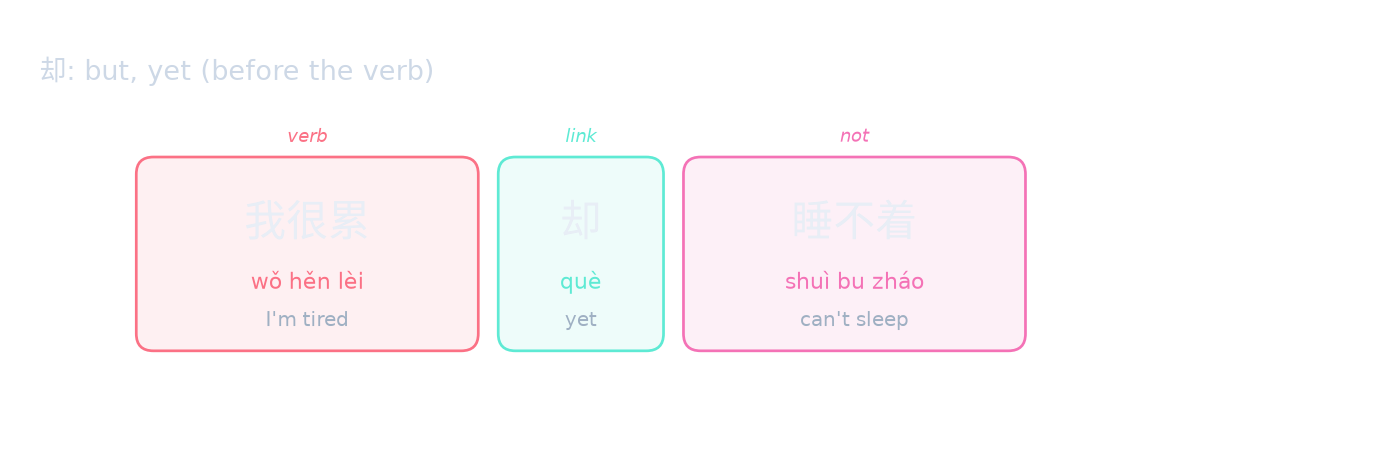
- I / me我degree / adjective linker很tired累,but; yet却睡不着。 Wǒ hěn lèi, què shuì bu zháo. – Estou exausto, mas não consigo dormir.
- already已经to be / is是spring (season)春天(completed / change)了,weather天气but; yet却still / also / even还degree / adjective linker很cold冷。 – Já é primavera, mas ainda está muito frio.
- I / me我want / think / miss想to help帮he / him他,but但是he / him他but; yet却not不to need需要。 – Eu queria ajudá-lo, mas ele não precisava de ajuda.
Como funciona. but; yet却 què indica um contraste surpreendente. É um advérbio: vem depois do sujeito da segunda oração, antes do verbo. Pode vir depois de but但是 ou but可是 e é comum na escrita e em histórias.
| but但是 | but; yet却 |
|---|---|
| inicia a oração | depois do sujeito, dentro da oração |
| but但是he / him他not不to come来 | he / him他but; yet却not不to come来 |
Cuidado
- but; yet却 nunca inicia uma oração: incorreto: but; yet却he / him他not不to come来 → he / him他but; yet却not不to come来.
15.4
3. 倒 (na verdade / pelo contrário)
Forma: sujeito + to pour倒 + predicado · ……to pour倒to be / is是……,exactly就是……
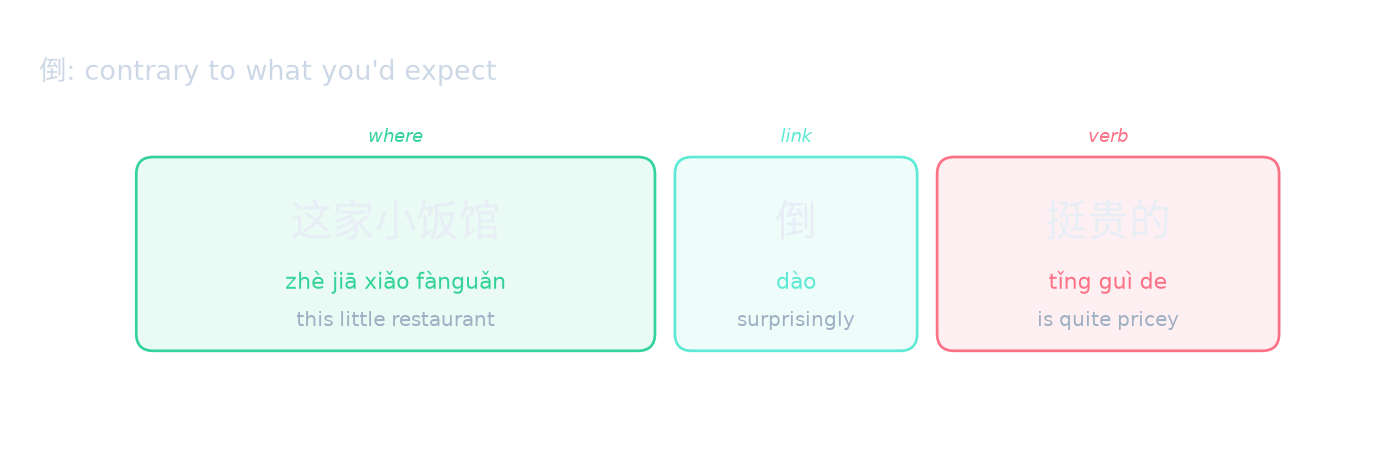
- 这家small小restaurant饭馆to pour倒quite挺expensive贵(modifier / structural particle)的。 Zhè jiā xiǎo fànguǎn dào tǐng guì de. – Este pequeno restaurante é, na verdade, bem caro.
- everyone大家all / both都degree / adjective linker很nervous紧张,he / him他to pour倒degree / adjective linker很calm平静。 – Todos estavam nervosos; ele, surpreendentemente, estava tranquilo.
- thing; stuff东西to pour倒to be / is是not bad / pretty good不错,exactly就是太贵(completed / change)了。 – Os produtos são bons; só são caros demais.
- you你to speak说(degree marker)得to pour倒easy容易! – É fácil para você falar!
Como funciona. to pour倒 dào indica um resultado contrário ao esperado. Pressupõe uma expectativa contrariada e vem depois do sujeito, antes do verbo ou do adjetivo. to pour倒to be / is是 concede um ponto antes de um "mas" (exactly就是). you你to speak说(degree marker)得to pour倒easy容易 é irônico: é fácil falar, mas difícil fazer.
| but; yet却 | to pour倒 | instead (contrary to expectation)反而 |
|---|---|---|
| "porém" simples | contrário à expectativa, leve | pelo contrário, mais forte |
| he / him他degree / adjective linker很tired累,but; yet却睡不着 | he / him他to pour倒not不to worry / impatient着急 | to eat吃(completed / change)了medicine药,illness / ill病instead (contrary to expectation)反而更重(completed / change)了 |
Cuidado
- incorreto: to pour倒he / him他not不to worry / impatient着急 → he / him他to pour倒not不to worry / impatient着急.
Vocabulário
Treinar
| 汉字 | Pinyin | English |
|---|---|---|
| 挺 | tǐng | quite |
| 紧张 | jǐn zhāng | nervous |
15.5
Prática
Cubra as páginas de conteúdo antes de responder. As respostas estão no final.
1. although / feel free to尽管 … ,but但是 … (embora)
1. Complete: “Embora fosse tarde, ele ainda estava trabalhando.” …………degree / adjective linker很late / evening晚(completed / change)了,he / him他still / also / even还at / in在to work; job工作。
2. Em to have / there is有question / problem问题although / feel free to尽管to ask问I / me我, o que significa although / feel free to尽管?
- A. porque
- B. embora
- C. mesmo se
- D. sinta-se à vontade
3. Forme a frase: “Embora ele estude bastante, suas notas ainda não são boas.”
Coloque em ordem: achievement成绩or / still还是 / not so good不太好。 / although / feel free to尽管he / him他degree / adjective linker很to work hard / effort努力 / ,but可是
4. Verdadeiro ou falso? although / feel free to尽管 introduz algo que é realmente verdadeiro. Se for falso, corrija.
5. O dia de esportes da escola aconteceu apesar da neve. Use although / feel free to尽管 … ,but但是 …. Escreva sua resposta em chinês e depois diga-a em voz alta.
2. but; yet却 + predicado (porém / contudo)
6. Complete: “É primavera, mas ainda está muito frio.” already已经to be / is是spring (season)春天(completed / change)了,weather天气…………still / also / even还degree / adjective linker很cold冷。
7. Qual frase está correta?
- A. he / him他degree / adjective linker很intelligent聪明,he / him他but; yet却not不to work hard / effort努力。
- B. but; yet却he / him他degree / adjective linker很intelligent聪明,not不to work hard / effort努力。
- C. he / him他degree / adjective linker很intelligent聪明,not不to work hard / effort努力but; yet却。
- D. he / him他degree / adjective linker很intelligent聪明,but; yet却he / him他not不to work hard / effort努力。
8. Forme a frase: “Eu queria ajudá-lo, mas ele não precisava de ajuda.”
Coloque em ordem: ,but但是 / he / him他but; yet却 / I / me我want / think / miss想to help帮he / him他 / not不to need需要。
9. Verdadeiro ou falso? but; yet却 pode vir antes do sujeito, como but但是 (but; yet却he / him他not不to come来). Se for falso, corrija.
10. Depois de um longo dia, você se deita na cama, exausto, mas sua mente não para. Use but; yet却 + predicado. Escreva sua resposta em chinês e depois diga-a em voz alta.
3. to pour倒 (na verdade / pelo contrário)
11. Complete: “Todos estavam nervosos; ele, surpreendentemente, estava tranquilo.” everyone大家all / both都degree / adjective linker很nervous紧张,he / him他…………degree / adjective linker很calm平静。
12. O que you你to speak说(degree marker)得to pour倒easy容易 sugere?
- A. Você disse de novo.
- B. Você falou devagar.
- C. É fácil para você dizer (mas difícil fazer).
- D. O falante concorda que é fácil.
13. Forme a frase: “Os produtos são bons, só são caros demais.”
Coloque em ordem: , / exactly就是 / 太贵(completed / change)了。 / thing; stuff东西to pour倒to be / is是not bad / pretty good不错
14. Verdadeiro ou falso? instead (contrary to expectation)反而 é mais forte que but; yet却. Se for falso, corrija.
15. Seu amigo esperava que o restaurante pequeno fosse barato, mas ele era caro e o sofisticado era barato. Use to pour倒. Escreva sua resposta em chinês e depois diga-a em voz alta.
15.6
Prática mista
Estas questões misturam os padrões e usam novas situações.
16. Qual frase está correta?
- A. but; yet却he / him他not have / haven't没有to come来。
- B. he / him他but; yet却not have / haven't没有to come来。
- C. he / him他not have / haven't没有to come来but; yet却。
17. Una com although / feel free to尽管……but但是……: o método leva tempo / funciona bem.
18. Todos acharam que a prova seria difícil. Diga que ela foi, na verdade, fácil, usando to pour倒.
19. Encontre e corrija o problema. Um colega escreve but; yet却he / him他not have / haven't没有to come来 para dizer "Porém, ele não veio". Corrija a ordem das palavras.
20. Use você mesmo. Reconheça que o método leva tempo e depois diga que ele funciona bem.
15.7
Respostas e explicações
Corrija seu trabalho e depois explique cada erro com suas próprias palavras.
1. although / feel free to尽管 … ,but但是 … (embora)
1. although / feel free to尽管
although / feel free to尽管 + fato, então o resultado apesar disso.
2. D. fique à vontade para
Em um convite, although / feel free to尽管 + verbo = fique à vontade para.
3. although / feel free to尽管he / him他degree / adjective linker很to work hard / effort努力,but可是achievement成绩or / still还是not so good不太好。
although / feel free to尽管 A,but可是 … or / still还是 B.
4. Verdadeiro.
Para um hipotético “mesmo se”, use even if即使.
5. Resposta modelo: although / feel free to尽管下着雪,sports competition运动会or / still还是as usual照常to hold (an event)举行(completed / change)了。
Confira sua resposta:
- although / feel free to尽管 + um fato, seguido de but但是 / or / still还是 = "embora". Em um pedido ou convite, although / feel free to尽管 + verbo = "fique à vontade para": to have / there is有question / problem问题although / feel free to尽管to ask问 – "Se tiver dúvidas, fique à vontade para perguntar."
- Não combine although / feel free to尽管 com even if即使 ou although虽然 na mesma oração; uma é suficiente.
2. but; yet却 + predicado (porém / contudo)
6. but; yet却
but; yet却 após o sujeito marca o contraste.
7. A. he / him他degree / adjective linker很intelligent聪明,he / him他but; yet却not不to work hard / effort努力。
he / him他degree / adjective linker很intelligent聪明,he / him他but; yet却not不to work hard / effort努力 está correto: but; yet却 é um advérbio, então vai após o sujeito de sua oração. Diferente de but但是, nunca pode iniciar a oração.
8. I / me我want / think / miss想to help帮he / him他,but但是he / him他but; yet却not不to need需要。
but但是 + sujeito + but; yet却 + predicado.
9. Falso.
but; yet却 é um advérbio após o sujeito.
10. Resposta modelo: I / me我degree / adjective linker很tired累,but; yet却睡不着。
Confira sua resposta:
- but; yet却 é um advérbio: vem depois do sujeito, nunca antes dele: he / him他but; yet却not不to come来, e não but; yet却he / him他not不to come来.
- but但是 inicia a oração; but; yet却 segue o sujeito. Podem ser usados juntos.
3. to pour倒 (na verdade / pelo contrário)
11. to pour倒
to pour倒 marca um resultado contra a expectativa.
12. C. É fácil para você falar (mas difícil fazer).
Iônico to pour倒: fácil de dizer, não de fazer.
13. thing; stuff东西to pour倒to be / is是not bad / pretty good不错,exactly就是太贵(completed / change)了。
to pour倒to be / is是…,exactly就是….
14. Verdadeiro.
instead (contrary to expectation)反而 diz o oposto do que se esperava que realmente acontecesse.
15. Resposta modelo: 这家small小restaurant饭馆to pour倒quite挺expensive贵(modifier / structural particle)的。
Confira sua resposta:
- to pour倒 precisa de uma expectativa a ser contrariada (declarada ou óbvia); sem ela soa estranho.
- Ele vai após o sujeito: he / him他to pour倒not不to worry / impatient着急, não to pour倒he / him他not不to worry / impatient着急.
Prática mista
16. B. but; yet却 é um advérbio, portanto vem depois do sujeito e antes do verbo.
17. although / feel free to尽管this这个means办法degree / adjective linker很费时间,but但是effect效果degree / adjective linker很good好。
18. 这次exam; to take an exam考试to pour倒不难。to pour倒 indica um resultado contrário ao que as pessoas esperavam.
19. but; yet却 é um advérbio, portanto vem depois do sujeito: he / him他but; yet却not have / haven't没有to come来. Uma oração anterior apresenta o contraste: I / me我to wait; and so on等(completed / change)了he / him他一个hour小时,he / him他but; yet却not have / haven't没有to come来.
20. Resposta modelo. although / feel free to尽管this这个means办法degree / adjective linker很费时间,but但是effect效果degree / adjective linker很good好。
Revise mais tarde. Amanhã, escreva uma frase com although / feel free to尽管……but但是…… e outra com but; yet却.
Isso foi útil?
O que deu errado? Somente a equipe do site vê isso.
Aulas interativas sobre este tópico
Passe por ele passo a passo, com exercícios de verificação instantânea.