Skip to content · ⁨본문 바로가기⁩

Development and Learning · ⁨발달과 학습⁩

AP Psychology · ⁨AP 심리학⁩ · Topic 3 · ⁨주제 3⁩

Video lesson for this topic · ⁨이 주제용 영상 수업⁩ Open the video page · ⁨영상 페이지 열기⁩
12:18

발달과 학습

네 살 아이는 무거운 유리 공을 집어 바닥에 튀기려 합니다. 그는 바보 같은 짓을 하는 것이 아닙니다. 그는 둥근 것에 대한 규칙을 가지고 있었습니다: 둥근 것은 긴다.…

English narration · English + 中文 subtitles burned in · ⁨영어 내레이션 · 영어 + 중국어 자막 burned-in⁩

3.1

Studying Development · ⁨발달 연구⁩

Syllabus
English

Learning Objective 3.1.A: Explain how enduring themes inform developmental psychology.

  • 3.1.A.1 Developmental psychology is concerned with both chronological order of development and/ or thematic issues in development across the lifespan. Thematic issues of interest to developmental psychologists include stability and change, nature and nurture, and continuous and discontinuous stages of development.

Learning Objective 3.1.B: Describe ways cross-sectional and longitudinal research design methods used in developmental psychology inform understanding about behavior and mental processes.

한국어

학습 목표 3.1.A: 지속되는 주제가 발달 심리학에 어떻게 기여하는지 설명하시오.

  • 3.1.A.1 발달 심리학은 발달의 시간적 순서와/또는 일생 전반에 걸친 주제적 이슈에 모두 관여한다. 발달 심리학자가 관심 있게 여기는 주제적 이슈로는 안정성과 변화, 유전과 환경, 그리고 발달 단계의 연속성과 비연속성이 포함된다.

학습 목표 3.1.B: 발달 심리학에서 사용되는 교차연령(cross-sectional) 및 종단(longitudinal) 연구 설계 방법이 행동 및 정신 과정에 대한 이해를 어떻게 돕는지 설명하시오.

Source: College Board AP Course and Exam Description · ⁨출처: College Board AP Course and Exam Description⁩

English

Developmental psychology 发展心理学 studies how people change across the lifespan. Two questions run through the whole unit.

  • Is change continuous 连续的 (gradual and smooth) or discontinuous 不连续的 (in stages)?
  • Is a trait stable 稳定的 across life, or does it change?

Researchers answer these with two designs. A cross-sectional study 横断研究 compares different age groups at one time - fast, but differences may come from the groups' different generations. A longitudinal study 纵向研究 follows the same people over years - slower, but it shows real change within a person.

한국어

발달 심리학은 사람들이 일생에 걸쳐 어떻게 변화하는지 연구합니다. 전체 단위를 관통하는 두 가지 질문이 있습니다.

  • 변화가 연속적(점진적이고 부드러운)인지 비연속적(단계적인)입니까?
  • 특성이 일생 동안 안정되는지, 아니면 변하는지?

연구자들은 두 가지 설계로 이에 답합니다. **교차 연설(cross-sectional study)**는 한 시점에 다른 연령 집단을 비교합니다 - 빠르지만, 차이는 집단의 다른 세대에 의한 것일 수 있습니다. **종단 연구(longitudinal study)**는 수년간 동일한 사람을 추적합니다 - 느리지만, 개인 내에서의 실제 변화를 보여줍니다.

Vocabulary · ⁨어휘⁩ Train · ⁨연습하기⁩
English 한국어
cross-sectional study/krɒs ˈsekʃənl ˈstʌdi/ 단면 연구
longitudinal study/ˌlɒŋɡɪˈtjuːdɪnl ˈstʌdi/ 종단 연구
3.2

Physical Development · ⁨신체 발달⁩

Syllabus
English

Learning Objective 3.2.A: Explain how physical development before birth applies to behavior and mental processes.

  • 3.2.A.1 Teratogens, maternal illness, genetic mutations, hormonal, and environmental factors can influence the major physical and psychological milestones that occur during prenatal development.
    • Exclusion Statement: The stages of prenatal development (zygote, embryo, and fetus) are outside the scope of the AP Psychology Exam.

Learning Objective 3.2.B: Explain how physical development in infancy and childhood apply to behavior and mental processes.

  • 3.2.B.1 Physical development in infancy and childhood happens in generally the same order, but the timing of the development can vary. The development of fine and gross motor coordination is among the major physical and psychological milestones that define infancy and childhood. These physical skills develop as children mature, allowing children to develop critical skills needed to become more independent.
  • 3.2.B.2 Infants possess reflexes, like the rooting reflex, that indicate on-track physical and psychological milestone development.
  • 3.2.B.3 Research using the visual cliff apparatus demonstrates an early ability in infants to perceive depth and an innovative way to assess infant responses.
  • 3.2.B.4 Research suggests that critical or sensitive periods in infancy and childhood have strong developmental effects, especially for skills such as language. Some non-human animals will imprint on the first object they encounter as a means of survival.

Learning Objective 3.2.C: Explain how physical development in adolescence applies to behavior and mental processes.

  • 3.2.C.1 The main physical and psychological milestones that occur in adolescence are the adolescent growth spurt and puberty, in which reproductive ability develops. Adolescents develop primary and secondary sex characteristics during this time, such as menarche and spermarche.

Learning Objective 3.2.D: Explain how physical development in adulthood applies to behavior and mental processes.

  • 3.2.D.1 Adulthood spans most of the lifespan and is characterized by a general leveling off and then a varying decline in reproductive ability (i.e., menopause), mobility, flexibility, reaction time, and visual and auditory sensory acuity.
한국어

학습 목표 3.2.A: 출생 전 신체적 발달이 행동 및 정신 과정에 어떻게 적용되는지 설명하시오.

  • 3.2.A.1 기형 유발제(teratogens), 모체 질환, 유전자 돌연변이, 호르몬 및 환경적 요인은产前 발달 중 일어나는 주요 신체적 및 심리적 마일스톤에 영향을 미칠 수 있다.
    • *배제 문구:*产前 발달의 단계(정자란, 배아, 태아)는 AP 심리학 시험 범위를 벗어난다.

학습 목표 3.2.B: 유아기 및 아동기의 신체적 발달이 행동 및 정신 과정에 어떻게 적용되는지 설명하시오.

  • 3.2.B.1 유아기 및 아동기의 신체적 발달은 일반적으로 같은 순서로 이루어지지만, 발달 시기는 다양할 수 있다. 세동 coordination(미세 운동 coordination)와 거동 coordination(거대 운동 coordination)의 발달은 유아기와 아동기를 정의하는 주요 신체적 및 심리적 마일스톤에 포함된다. 이러한 신체적 기술은 아이들이 성숙함에 따라 발달하여, 아이들이 더욱 독립적이 되기 위해 필요한 핵심 기술을 습득할 수 있게 한다.
  • 3.2.B.2 영유아는 근원 반사(rooting reflex)와 같은 반사를 가지고 있으며, 이는 정상적인 신체적 및 심리적 마일스톤 발달을 나타낸다.
  • 3.2.B.3 시각 절벽 apparatus를 사용한 연구는 영유아의 깊이 지각 능력에 대한 초기 능력이 있음을 보여주었으며, 영유아 반응을 평가하는 혁신적인 방법을 제시했다.
  • 3.2.B.4 연구에 따르면, 유아기 및 아동기의 kritcal 또는 sensitive periods는 언어와 같은 기술에 특히 강력한 발달적 영향을 미친다. 어떤 비인간 동물들은 생존을 위해 처음 만나는 대상에 대해 imprinting을 할 수 있다.

학습 목표 3.2.C: 사춘기의 신체적 발달이 행동 및 정신 과정에 어떻게 적용되는지 설명하시오.

  • 3.2.C.1 사춘기에 일어나는 주요 신체적 및 심리적 마일스톤은 사춘기 성장 급증과 생식 능력이 발달하는 사춘기(puberty)이다. 사춘기에는 menarche 및 spermarche와 같은 일차 및 이차 성징이 발달한다.

학습 목표 3.2.D: 성인기의 신체적 발달이 행동 및 정신 과정에 어떻게 적용되는지 설명하시오.

  • 3.2.D.1 성人的一生의 대부분을 차지하며, 생식 능력(menopause 등), 이동성, 유연성, 반응 속도, 시각 및 청각 감각 예리함 등에서 전반적인 평탄화 이후 감소하는 특징을 보인다.

Source: College Board AP Course and Exam Description · ⁨출처: College Board AP Course and Exam Description⁩

English

Development before birth can be disrupted by teratogens 致畸物 (harmful agents such as alcohol), maternal illness, genetic mutations, and hormonal or environmental factors.

Infant physical development follows the same general order everywhere, though the rate varies. Newborns show reflexes 反射 that indicate healthy development, such as the rooting reflex 觅食反射 (turning towards a touch on the cheek). The visual cliff 视崖 experiment shows that infants perceive depth early.

A critical period 关键期 is a window in which a particular experience has an unusually strong effect; a sensitive period 敏感期 is a softer version of the same idea.

Adolescence 青春期 brings the adolescent growth spurt 青春期发育突增 and puberty 青春发育期, including primary sex characteristics 第一性征 and secondary sex characteristics 第二性征. Adulthood spans most of life and is marked by a gradual levelling off, then decline - including menopause 更年期 in women.

한국어

태내 발달은 양육인자(teratogens) (알코올 등의 유해 물질), 모체 질환, 유전자 돌연변이, 호르몬 또는 환경 요인에 의해 방해받을 수 있습니다.

영아 신체 발달은 어디나 동일한 일반적인 순서를 따르며, 속도는 다르지만的新生儿显示반사(reflexes), 예를 들어 기원 반사(rooting reflex) (볼에 닿았을 때 Touch towards touch). 시각 절벽(visual cliff) 실험은 영아가 초기에 깊이를 인지함을 보여줍니다.

임계 기간(critical period) 는 특정 경험이 비寻常하게 강한 영향을 미치는 창구이며, 민감 기간(sensitive period) 은 같은 아이디어의 softer 버전입니다.

청소년期는 청소년 성장 급증(adolescent growth spurt) 과 사춘기(puberty) 를 가져오며, 주성별 특성(primary sex characteristics) 과 이성별 특성(secondary sex characteristics) 을 포함합니다. 성인기는 대부분의 일생을 span하며, 점진적인 평형 이후 감소로 특징지어집니다 - 여성에게 폐경(menopause) 을 포함합니다.

Vocabulary · ⁨어휘⁩ Train · ⁨연습하기⁩
English 한국어
teratogens/ˈterətədʒnz/ 기형 유발 물질(teratogens)
reflexes/ˈriːfleksɪz/ 반사
rooting reflex/ˈruːtɪŋ ˈriːfleks/ 수색 반사
visual cliff/ˈvɪʒuːəl klɪf/ 시각 절벽
critical period/ˈkrɪtɪkl ˈpɪərɪəd/ 임계 기
sensitive period/ˈsensɪtɪv ˈpɪərɪəd/ 민감 기
Adolescence/ˌædəˈlesəns/ Adolescence
adolescent growth spurt/ˌædəˈlesənt ɡrəʊθ spɜːt/ 청소년 성장 급증
puberty/ˈpjuːbəti/ puberty
primary sex characteristics/ˈpraɪməri seks ˌkærɪktəˈrɪstɪks/ 일차 성징
secondary sex characteristics/ˈsekəndəri seks ˌkærɪktəˈrɪstɪks/ 이차 성징
menopause/ˈmenəpɔːz/ 폐경(menopause)
Sex/seks/ Sex
3.3

Gender and Sexual Orientation · ⁨성별 및 성적 지향⁩

Syllabus
English

Learning Objective 3.3.A: Describe how sex and gender influence socialization and other aspects of development.

한국어

학습 목표 3.3.A: 성(sex)과 gender가 사회화 및 기타 발달 측면에 어떻게 영향을 미치는지 설명하시오.

Source: College Board AP Course and Exam Description · ⁨출처: College Board AP Course and Exam Description⁩

English

Sex 生理性别 refers to biological characteristics, while gender 社会性别 refers to the roles and expectations a society attaches to them. Gender roles 性别角色 are learned through socialization 社会化: family, school, peers, and media all teach what behaviour is expected. Sexual orientation 性取向 describes a person's enduring pattern of attraction. The exam asks how sex and gender influence socialization and development, not for any evaluation of individuals.

한국어

**성(sex)**은 생물학적 특성을 의미하며, **성별(gender)**은 사회가 그에 부여하는 역할과 기대를 뜻합니다. 성별 역할은 **사회화(socialization)**을 통해 습득됩니다: 가족, 학교, 동료, 매체 등이 어떤 행동이 기대되는지 가르칩니다. **성 지향性(sexual orientation)**은一个人的 enduring pattern of attraction을 설명합니다. 시험에서는 성별이 사회화와 발달에 미치는 영향을 묻는 것이지, 개인의 평가가 아닙니다.

Vocabulary · ⁨어휘⁩ Train · ⁨연습하기⁩
English 한국어
gender/ˈdʒendə/ 성별(gender)
Gender roles/ˈdʒendə rəʊlz/ 성별 역할(Gender roles)
socialization/ˌsəʊʃəlaɪˈzeɪʃn/ socialization
Sexual orientation/ˈsekʃuːəl ˌɔːrɪənˈteɪʃn/ 성적 지향(Sexual orientation)
3.4

Cognitive Development · ⁨인지적 발달⁩

Syllabus
English

Learning Objective 3.4.A: Explain how theories of cognitive development apply to behavior and mental processes.

  • 3.4.A.1 According to Piaget, children develop schemas via continuous and discontinuous processes such as assimilation and accommodation.
    • 3.4.A.1.i The sensorimotor stage occurs from infancy through toddlerhood. Object permanence develops during this stage.
    • 3.4.A.1.ii The preoperational stage occurs from toddlerhood through early childhood. Children become proficient in using mental symbols and engage in pretend play. The preoperational stage is identified more by cognitive tasks children cannot perform such as conservation and reversibility, or by those they exhibit, such as animism and egocentrism. Children begin to develop a theory of mind during this stage.
    • 3.4.A.1.iii The concrete operational stage occurs from early through late childhood. Children in this stage can generally correct the cognitive errors made in the preoperational stage and understand the world in logical, realistic, and straightforward ways, but struggle to think systematically.
    • 3.4.A.1.iv The formal operational stage occurs from late childhood through adulthood. People in this stage gain the ability to think abstractly and hypothetically. Piaget proposed that not all people achieve formal operational thinking.
  • 3.4.A.2 According to Vygotsky, children are social learners who learn through interacting with and scaffolding by other people within sociocultural contexts. Ideally, learning occurs while the person is in their zone of proximal development.
  • 3.4.A.3 Adults experience changes in cognitive capabilities as they progress through the lifespan. Crystallized intelligence remains relatively stable through adulthood while fluid intelligence tends to wane as people age. Cognitive disorders that affect adults include dementia.
한국어

학습 목표 3.4.A: 인지 발달 이론이 행동 및 정신 과정에 어떻게 적용되는지 설명하시오.

  • 3.4.A.1 피아제(Piaget)에 따르면, 아이들은 동화(assimilation)와 조화(accommodation)와 같은 연속적 및 비연속적 과정을 통해 schemas를 발달시킨다.
    • 3.4.A.1.i 감각운동 단계(sensorimotor stage)는 유아기부터幼児期까지 이어진다. 이 단계 동안 물체 영구성(object permanence)이 발달한다.
    • 3.4.A.1.ii 전연산기(Preoperational stage)는 유아기부터 초기 아동기에 걸쳐 발생합니다. 아이들은 mentale 기호를熟练使用하게 되며 상상 놀이를 합니다. 전연산기는 보전(conervation)과 재역성(reversibility)과 같은 아이들이 수행하지 못하는 인지적 과제나, 유물론(animism)과 이기심(egocentrism)과 같이 그들이 보이는 특징으로 더 잘 식별됩니다. 아이들은 이 시기 동안 마음 이론(theory of mind)을 develop하기 시작합니다.
    • 3.4.A.1.iii 구체적 연산기(Concrete operational stage)는 초기부터 후기 아동기에 걸쳐 발생합니다. 이 시기의 아이들은 일반적으로 전연산기에서 발생한 인지적 오류를 수정할 수 있으며, 논리적이고 현실적이며 직관적인 방식으로 세상을 이해하지만, 체계적으로 생각하는 데에는 어려움을 겪습니다.
    • 3.4.A.1.iv 형식적 연산기(Formal operational stage)는 후기 아동기부터 성인기에 걸쳐 발생합니다. 이 단계의 사람들은 추상적이고 가정적 사고 능력을 얻습니다. 피아제(Piaget)는 모든 사람이 형식적 연산적 사고에 도달하지는 않는다고 제안했습니다.
  • 3.4.A.2 비고츠키(Vygotsky)에 따르면, 아이들은 사회 학습자(social learners)이며, 사회문화적 맥락 내에서 다른 사람들과의 상호작용 및 지대(scaffolding)를 통해 배웁니다. 이상적으로는 학습이 개인이 근접발달영역(zone of proximal development)에 있을 때 이루어집니다.
  • 3.4.A.3 성인은 일생(lifespan)을 진행하면서 인지 capabilities의 변화를 경험합니다. 결정지능(crystallized intelligence)은 성인기를 통틀어 상대적으로 안정된 반면, 유동지능(fluid intelligence)은 노화가 진행됨에 따라 감소하는 경향이 있습니다. 성인에게 영향을 미치는 인지 장애로는 치매(dementia)가 포함됩니다.

Source: College Board AP Course and Exam Description · ⁨출처: College Board AP Course and Exam Description⁩

English

Piaget 皮亚杰 proposed that children build schemas and pass through four stages:

  • Sensorimotor stage 感知运动阶段 (infancy to toddlerhood): the child learns through senses and action, and develops object permanence 客体永久性 - knowing an object still exists when hidden.
  • Preoperational stage 前运算阶段 (toddlerhood to early childhood): the child uses symbols and pretend play but shows egocentrism 自我中心 (difficulty taking another view) and lacks conservation 守恒 (knowing quantity stays the same when shape changes).
  • Concrete operational stage 具体运算阶段 (early to late childhood): the child reasons logically about concrete things and gains conservation.
  • Formal operational stage 形式运算阶段 (late childhood onward): abstract and hypothetical reasoning becomes possible.

Vygotsky 维果茨基 saw children as social learners. The zone of proximal development 最近发展区 is the gap between what a child can do alone and what they can do with help; scaffolding 支架 is the support that closes it.

Adult cognition changes too, and here the fluid/crystallised split from Unit 2 returns: reasoning speed declines while accumulated knowledge does not. Dementia 痴呆 is a decline beyond normal ageing.

한국어
피아제의 네 단계가 계단처럼 표시되어 있으며, 각 단계에는 연령대와 이를 정의하는 성취 사항이 포함되어 있습니다
피아제의 네 단계: 각 단계마다 아이가 새롭게 할 수 있는 것이 정의됩니다

**피아제(Piaget)**는 아이들이 **도식(schema)**을 구성하고 네 단계를 거친다고 제안했습니다:

  • 감각-운동 단계(유아기~유년 초기): 아이는 감각과 행동을 통해 배우며, **물체 영구성(object permanence)**을 발달시킵니다 - 숨겨진 물체가 여전히 존재함을 아는 것입니다.
  • 전연산 단계(유년 초기~유년 중기): 아이는 기호와 연극 놀이를 사용하지만, 자아중심주의(egocentrism) (다른 사람의 관점을 취하는 데 어려움)를 보이며, 보존(conservation) (모양이 변해도 양이 같음을 아는 것)이 부족합니다.
  • 구체적 연산 단계(유년 중기~유년 후기): 아이는 구체적인 사물에 대해 논리적으로 추론하며 보존을 얻습니다.
  • 형식적 연산 단계(유년 후기부터): 추상적이고 가상의 추론이 가능해집니다.

**비고츠키(Vygotsky)**는 아이들을 사회적 학습자로 보았습니다. **근접발달영역(zone of proximal development)**은 아이가 혼자 할 수 있는 것과 도움 받을 때 할 수 있는 것 사이의 간격이며, **조력(scaffolding)**은 이 간격을 메우는 지지입니다.

성인의認知도 변화하며, 여기서 2단위에서 다룬 유동적/결정적 구분으로 돌아갑니다: 추론 속도는 감소하지만 축적된 지식은 그렇지 않습니다. **치매(dementia)**는 정상적인 노화를 초과한 감소를 말합니다.

Vocabulary · ⁨어휘⁩ Train · ⁨연습하기⁩
English 한국어
Piaget/ˈpaɪəɡɪt/ 피아제
Sensorimotor stage/ˈsensɔːrɪməʊtə steɪdʒ/ 감각 운동 단계(Sensorimotor stage)
object permanence/ˈɒbdʒekt ˈpɜːmənəns/ 물체 영속성(object permanence)
Preoperational stage/prɪəʊˈpreɪʃənl steɪdʒ/ 전작동 단계(Preoperational stage)
egocentrism/ˈiːɡəʊsentrɪzəm/ 자아중심성(egocentrism)
conservation/ˌkɒnsəˈveɪʃn/ 보존(conservation)
Concrete operational stage/ˈkɒŋkriːt ˌɒpəˈreɪʃənl steɪdʒ/ 구체적 작동 단계(Concrete operational stage)
Formal operational stage/ˈfɔːml ˌɒpəˈreɪʃənl steɪdʒ/ 공식적 작동 단계(Formal operational stage)
Vygotsky/vaɪˈɡɒtski/ 비고츠키
zone of proximal development/zəʊn ɒv ˈprɒksɪml dɪˈveləpmənt/ 최소 발현 가능 영역(zone of proximal development)
scaffolding/ˈskæfəʊldɪŋ/ 발판(scaffolding)
Dementia/dɪˈmenʃə/ 치매(Dementia)
3.5

Language Development · ⁨언어 발달⁩

Syllabus
English

Learning Objective 3.5.A: Explain how key components of language and communication apply to behavior and mental processes.

  • 3.5.A.1 Language is a shared (mutually agreed upon) system of arbitrary symbols (often expressed as and combined into phonemes, morphemes, and semantics) that are rule-governed (via grammar and syntax) and generative to produce an infinity of ideas.
    • Exclusion Statement: Pragmatics of language are outside the scope of the AP Psychology Exam.

Learning Objective 3.5.B: Explain how language develops in humans.

  • 3.5.B.1 In language development across all cultures, people use nonverbal manual gestures (e.g., pointing) to communicate and develop formal language through specific stages (cooing, babbling, one-word stage, and telegraphic speech). People learning a language often make errors such as overgeneralization of language rules as they learn.
한국어

학습 목표 3.5.A: 언어 및 소통의 핵심 요소들이 행동 및 정신 과정에 어떻게 적용되는지 설명하시오.

  • 3.5.A.1 언어는 임의적 기호(주로 음소(phonemes), 어휘(morphemes), 의미(semantics)로 표현되고 결합됨)의 공유된(서로 합의된) 체계로서, 문법과 구문(grammar and syntax)을 통해 규칙에 따르며 무한한 아이디어를 생성(generative)할 수 있습니다.
    • 배제 사항: 언어의 pragmatics는 AP 심리학 시험의 범위를 벗어납니다.

학습 목표 3.5.B: 인간에서 언어가 어떻게 발달하는지 설명하시오.

  • 3.5.B.1 모든 문화권에서의 언어 발달 과정에서 사람들은 비언어적 수동 제스처(예: 손가락질)를 사용하여 소통하고, 특정 단계(울음声(cooing), 발성(babbling), 단단어 단계, 전기 문장 telegraphic speech)를 통해 공식적 언어를 발달시킵니다. 언어를 배우는 사람들은 규칙을 과잉 적용(overgeneralization)하는 등의 오류를 자주犯합니다.

Source: College Board AP Course and Exam Description · ⁨출처: College Board AP Course and Exam Description⁩

English

Language 语言 is a shared system of arbitrary symbols used to communicate. Development follows a common sequence: nonverbal gestures 手势, then cooing 咕咕声, babbling 咿呀语, the one-word stage 单词阶段, and telegraphic speech 电报式语言 (two-word combinations).

Children generalise rules before they master exceptions, which produces overgeneralization 过度规则化 - saying "goed" instead of "went". This is evidence that they are learning rules, not just copying.

한국어

**언어(language)**는 소통을 위해 사용되는 임의적인 기호의 공유된 체계입니다. 발달은 일반적인 순서를 따릅니다: 비언어 제스처, 울음, 아기말, 단어 단계, 그리고 전신어(telegraphic speech) (두 단어 조합).

아이들은 예외를 숙지하기 전에 규칙을 일반화하여 **과잉 generalize(overgeneralization)**를 일으킵니다 - "went" 대신 "goed"이라고 말하는 것. 이는 그들이 단순히 따라 하는 것이 아니라 규칙을 배우고 있다는 증거입니다.

Vocabulary · ⁨어휘⁩ Train · ⁨연습하기⁩
English 한국어
Language/ˈlæŋɡwɪdʒ/ 언어
gestures/ˈdʒestʃəz/ 제스처(gestures)
cooing/ˈkuːɪŋ/ 우우음
babbling/ˈbæblɪŋ/ 바람직음
one-word stage/wʌn wɜːd steɪdʒ/ 단어 단계
telegraphic speech/ˌtelɪˈɡræfɪk spiːtʃ/ 전기문장
overgeneralization/ˌəʊvəˌdʒenərəlaɪˈzeɪʃn/ 과잉 일반화(overgeneralization)
Generalization/ˌdʒenərəlaɪˈzeɪʃn/ 일반화(Generalization)
3.6

Social and Emotional Development · ⁨사회적 및 정서적 발달⁩

Syllabus
English

Learning Objective 3.6.A: Explain how social development relates to behavior and mental processes.

  • 3.6.A.1 The ecological systems theory explores how the social environment influences development. The five systems in this theory are as follows: Bullet Microsystem (groups that have direct contact with the individual) Bullet Mesosystem (the relationships between groups in the microsystem) Bullet Exosystem (indirect factors in an individual’s life) Bullet Macrosystem (cultural events that affect the individuals and others around them) Bullet Chronosystem (the individual’s current stage of life).
  • 3.6.A.2 Research has identified different parenting styles of caregivers, including authoritarian, authoritative, and permissive. Cultural differences exist in the ways these parenting styles affect outcomes in caregivers and children.
  • 3.6.A.3 Research has identified different attachment styles demonstrated by infants and children, which vary by culture. The types of attachment infants and children display include secure and insecure (avoidant, anxious, and disorganized). Temperament is related to how children attach to caregivers.
    • 3.6.A.3.i Separation anxiety occurs when children express heightened anxiety or fear when away from a caregiver or in the presence of a stranger.
    • 3.6.A.3.ii Studies with monkeys demonstrate the importance of comfort over food in attachment.
  • 3.6.A.4 Developmental psychologists study how peer relationships develop over time.
    • 3.6.A.4.i Children engage with peers via play (parallel and pretend).
    • 3.6.A.4.ii Adolescents gradually rely more on peer relationships as they age. As adolescents interact with peers, they demonstrate a type of egocentrism that is often demonstrated via the imaginary audience and the personal fable.
  • 3.6.A.5 Developmental psychologists study how adults develop socially over time.
    • 3.6.A.5.i Culture plays a role in determining when adulthood begins and when major life events occur (social clock). Some cultures allow for a time of emerging adulthood as a transition from adolescence to adulthood.
    • 3.6.A.5.ii Relationships with other adults result in adults forming families or family-like relationships that should provide mutual support and care. Childhood attachment styles can affect how adults form attachments to other adults.
  • 3.6.A.6 The stage theory of psychosocial development, which was a reconceptualization of the psychosexual theory, proposes that people must resolve psychosocial conflicts at each stage of the lifespan. The stages are as follows: Bullet Trust and mistrust Bullet Autonomy and shame and doubt Bullet Initiative and guilt Bullet Industry and inferiority Bullet Identity and role confusion Bullet Intimacy and isolation Bullet Generativity and stagnation Bullet Integrity and despair
    • Exclusion Statement: The psychosexual stage theory of development is outside of the scope of the AP Psychology Exam.
  • 3.6.A.7 The experience of adverse childhood experiences (ACEs) has effects on relationships people form throughout the lifespan. Sociocultural differences exist in what is considered an ACE and how ACEs affect outcomes people may experience.
  • 3.6.A.8 Adolescents develop a sense of identity for who they will be as an adult through the processes of achievement, diffusion, foreclosure, and moratorium. Identity development also includes processes for developing identities such as racial/ethnic identity, gender identity, sexual orientation, religious identity, occupational identity, and familial identity, often through considering possible selves.
한국어

학습 목표 3.6.A: 사회 발달이 행동 및 정신 과정과 어떻게 관련되는지 설명하시오.

  • 3.6.A.1 생태계 시스템 이론(ecological systems theory)은 사회 환경이 발달에 미치는 영향을 탐구합니다. 이 이론의 다섯 가지 시스템은 다음과 같습니다: 불릿 Microsystem(개인과 직접 접촉하는 집단) 불릿 Mesosystem(Microsystem 내 집단 간의 관계) 불릿 Exosystem(개인의 간접적 요인) 불릿 Macrosystem(개인 및 주변其他人에게 영향을 미치는 문화적 사건) 불릿 Chronosystem(개인의 현재 인생 단계).
  • 3.6.A.2 연구는 독단적(authoritarian), 권위적(authoritative), 방임적(permissive) 등 다양한 양육 스타일을 규명했습니다. 이러한 양육 스타일이 부모와 자녀에게 미치는 결과에 대해 문화적 차이가 존재합니다.
  • 3.6.A.3 연구는婴儿와 어린이가 보여주는 다양한 애착 스타일(attachment styles)을 규명했으며, 이는 문화에 따라 다릅니다.嬰兒와 어린이가 보이는 애착의 유형에는 안전한(seecure)과 불안정한(insecure; 회피적 avoidant, 불안적 anxious, 혼란적 disorganized)이 포함됩니다. 기질(temperament)은 아이가 부모에게 애착하는 방식과 관련이 있습니다.
    • 3.6.A.3.i 이별 불안(separation anxiety)은 아이가 부모나 보호자로부터 떨어져 있거나 낯선 사람의 앞에 있을 때 heightened 불안 또는 공포를 표현할 때 발생합니다.
    • 3.6.A.3.ii 원숭이에 대한 연구는 food보다 comfort가 애착에 더 중요함을 보여줍니다.
  • 3.6.A.4 발달 심리학자들은 동우관계(peer relationships)가 시간이 지나며 어떻게 발달하는지를 연구합니다.
    • 3.6.A.4.i 아이들은 놀이(병행적 parallel 및 상상이상 pretend)를 통해 동우와 상호작용합니다.
    • 3.6.A.4.ii 청소년은 나이가 들수록 점차 동우 관계에 더 의존하게 됩니다. 청소년이 동우와 상호작용할 때, 그들은Often imaginary audience와 personal fable를 통해 나타나는某种类型的自中心性(ego-centricism)을 보입니다.
  • 3.6.A.5 발달 심리학자들은 성인이 시간이 지나며 어떻게 사회적으로 발달하는지를 연구합니다.
    • 3.6.A.5.i 문화는 adulthood가 언제 시작되는지, 주요 life events가 언제 발생하는지(사회적 시계 social clock)를 결정하는 데 역할을 합니다. 일부 문화에서는 adolescence에서 adulthood로의 전환期为 emerging adulthood를 허용합니다.
    • 3.6.A.5.ii 다른 성인과의 관계는 성인들이 mutual support와 care를 제공해야 하는 가족 또는 가족과 유사한 관계를 형성하게 만듭니다. childhood의 애착 스타일은 성인이 다른 성인에게 애착을 형성하는 방식에 영향을 줄 수 있습니다.
  • 3.6.A.6 심리사회적发展阶段이론(pychosocial development stage theory)은 psychosexual 이론의 재해석(reconceptualization)으로서, 사람들이 일생(lifespan)의 각 단계에서 심리사회적 갈등(pychosocial conflicts)을 해결해야 한다고 제안합니다. 단계는 다음과 같습니다: 불릿 신뢰와 불신(Bullet Trust and mistrust) 불릿 자율성과 부끄러움 및 의심(Bullet Autonomy and shame and doubt) 불릿.Initiative와 죄책감(Bullet Initiative and guilt) 불릿 산업성과 열등감(Bullet Industry and inferiority) 불릿 정체성과 역할 혼란(Bullet Identity and role confusion) 불릿 친밀함과 고립(Bullet Intimacy and isolation) 불릿 생산성과 정체(Bullet Generativity and stagnation) 불릿 완전성과 절망(Bullet Integrity and despair)
    • 배제 사항: 발달의 psychosexual 단계 이론은 AP 심리학 시험의 범위를 벗어납니다.
  • 3.6.A.7 adverse childhood experiences(ACEs)의 경험은 사람들이 일생(lifespan) 동안 형성하는 관계에 영향을 미칩니다. ACE로 간주되는 것及其如何 affect outcomes에 대해 사회문화적 차이가 존재합니다.
  • 3.6.A.8 청소년은 성취, 방임, 강요 및 유예라는 과정을 통해 성인으로서의 자신의 정체성을 형성합니다. 정체성 개발에는 인종/인종적 정체성, 성별 정체성, 성적 지향, 종교적 정체성, 직업적 정체성, 가족적 정체성이 포함되며, 이 과정에서는 가능한 자기(self)를 고려하는 것이 일반적입니다.

Source: College Board AP Course and Exam Description · ⁨출처: College Board AP Course and Exam Description⁩

English

Ecological systems theory 生态系统理论 describes development as nested environments, from the immediate family outwards to culture.

Research identifies parenting styles 教养方式: authoritarian 专制型 (high demands, low warmth), authoritative 权威型 (high demands, high warmth), and permissive 放任型 (low demands, high warmth).

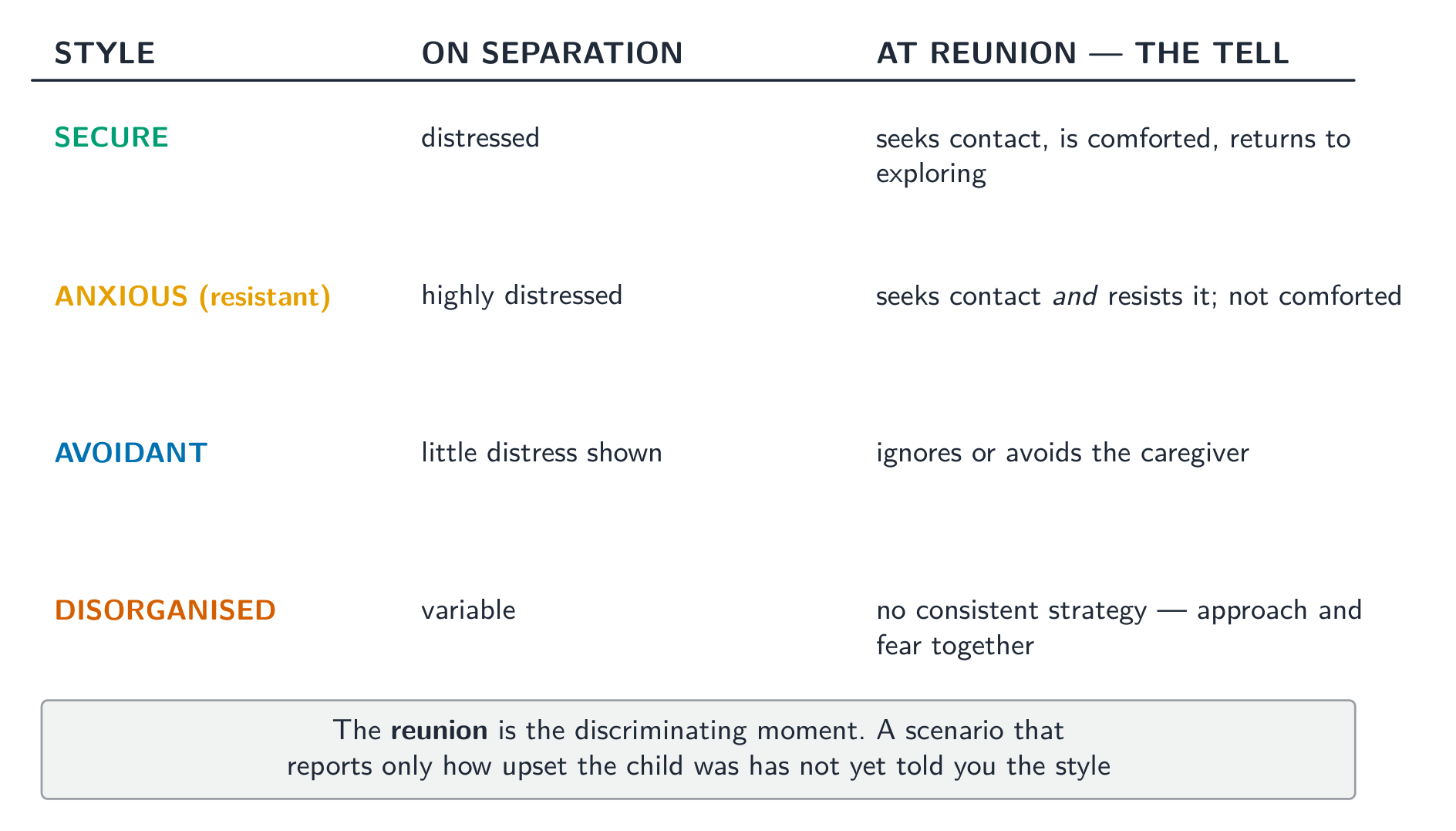
Attachment 依恋 is the emotional bond between infant and caregiver, studied with the strange situation 陌生情境 procedure. Styles include secure attachment 安全型依恋 and insecure forms (avoidant 回避型, anxious 焦虑型, disorganized 混乱型). Separation anxiety 分离焦虑 is heightened distress when away from a caregiver. Studies with monkeys showed that infants prefer contact comfort 接触安慰 over food, which changed how attachment was understood.

Peer relationships develop through parallel play 平行游戏 and pretend play 假装游戏 in childhood, and adolescents rely on peers more as they age.

Erikson 埃里克森 proposed a stage theory of psychosocial development 心理社会发展, in which each stage poses a conflict to resolve - the adolescent stage being identity versus role confusion 同一性与角色混乱. Adverse childhood experiences (ACEs) 童年不良经历 affect later relationships and health.

한국어

**생태계 이론(ecological systems theory)**은 발발을 즉 immediate family에서 outward culture까지 계층화된 환경으로 묘사합니다.

연구는 **육아 스타일(parenting styles)**을 규명했습니다: 권위적(authoritarian) (높은 요구, 낮은 따뜻함), 권위적(authoritative) (높은 요구, 높은 따뜻함), 관용적(permissive) (낮은 요구, 높은 따뜻함).

**부착(attachment)**은 유아와 돌봄자 사이의 정서적 결속으로, 기묘 상황(startle situation) 절차를 통해 연구됩니다. 스타일로는 안전한 부유(secure attachment) 와 불안정한 형태(회피적(avoidant), 불안(anxious), 혼란적(disorganized))가 포함됩니다. 이별 불안(separation anxiety) 은 돌봄자와 떨어져 있을 때 심한 고통입니다. 원숭이에 대한 연구는 아기가 음식보다 접촉 편안함(contact comfort) 을 선호함을 보여주었으며, 이는 부착에 대한 이해를 바꾸었습니다.

동료 관계는 아동기의 병행 놀이(parallel play) 와 연극 놀이(pretend play) 를 통해 발전하며, 청소년은 나이가 들수록 동료에게 더 의존합니다.

**에里克손(Erikson)은 심리사회적 발달(psychosocial development) 의 단계 이론을 제안했는데, 각 단계에는 해결해야 할 갈등이 존재합니다 - 청소년 단계는 정체성 대 역할 혼란(identity versus role confusion) 입니다. ** adverse childhood experiences (ACEs) 은 후속 관계와 건강에 영향을 미칩니다.

재회 Discriminating moment, separation is not the discriminating moment
Vocabulary · ⁨어휘⁩ Train · ⁨연습하기⁩
English 한국어
Ecological systems theory/ˌekəˈlɒdʒɪkl ˈsɪstəmz ˈθɪəri/ 생태계 이론
parenting styles/ˈpeərəntɪŋ staɪlz/ 양육 스타일
authoritarian/ˌɔːθɔːrɪˈteərɪən/ 권위주의적
authoritative/ɔːˈθɒrɪtətɪv/ 권위적(통제적/지속적)
permissive/pəˈmɪsɪv/ 방임적
Attachment/əˈtætʃmənt/ 부착(Attachment)
strange situation/streɪndʒ ˌsɪtʃuːˈeɪʃn/ 이상 상황(strange situation)
secure attachment/sɪˈkjʊə əˈtætʃmənt/ 안정적 애착
avoidant/əˈvɔɪdənt/ 회피형(avoidant)
anxious/ˈæŋʃəs/ 불안형(anxious)
disorganized/dɪˈsɔːɡənaɪzd/ 비정형(disorganized)
Separation anxiety/ˌsepəˈreɪʃn æŋˈzaɪəti/ 이별 불안(Separation anxiety)
contact comfort/ˈkɒntækt ˈkʌmfət/ 접촉 편안함
parallel play/ˈpærəlel pleɪ/ 병렬 놀이(parallel play)
pretend play/prɪˈtend pleɪ/ 역할 연기 놀이(pretend play)
Erikson/ˈerɪksn/ 에리克森(Erikson)
psychosocial development/ˈsaɪkəʊsəʊʃl dɪˈveləpmənt/ 사회심리적 발달(psychosocial development)
identity versus role confusion/aɪˈdentɪti ˈvɜːsɪz rəʊl kənˈfjuːʒn/ 정체성 대 역할 혼란(identity versus role confusion)
Adverse childhood experiences (ACEs)/ædˈvɜːs ˈtʃaɪldhʊd ekˈspɪərɪənsɪz/ 아동期的 불이익(ACEs, adverse childhood experiences)
behavioral perspective/bɪˈheɪvjərəl pəˈspektɪv/ 행동적 관점(behavioral perspective)
3.7

Classical Conditioning · ⁨고전적 조건화⁩

Syllabus
English

Learning Objective 3.7.A: Explain how classical conditioning applies to behavior and mental processes.

  • 3.7.A.1 The behavioral perspective evolved from theories about learning via conditioning. Behaviorists have traditionally focused on observable behavior to the exclusion of mental processes.
  • 3.7.A.2 Classical conditioning focuses on the association of one stimulus with another stimulus to elicit a response. Learning the association (also known as acquisition) involves a series of steps that demonstrate principles of associative learning.
    • 3.7.A.2.i The unconditioned stimulus (UCS) elicits an unconditioned response (UCR). This response becomes the conditioned response (CR) when it is performed in response to the conditioned stimulus (CS).
    • 3.7.A.2.ii The order of presentation of the CS with the UCS is important to successful acquisition.
    • 3.7.A.2.iii A CR can become extinct when the CS is no longer paired with the UCS. A formerly extinct CR can be spontaneously recovered when the CS is again presented after extinction.
    • 3.7.A.2.iv Stimulus discrimination and generalization have been demonstrated in studies of classical conditioning.
    • 3.7.A.2.v A CS can be used as a UCS in higher-order conditioning.
      • Exclusion Statement: Delayed conditioning, trace conditioning, simultaneous conditioning, and backward conditioning are outside the scope of the AP Psychology Exam.
  • 3.7.A.3 Research has demonstrated that emotional responses can be classically conditioned. These findings form the basis of therapeutic interventions for many mental disorders, such as counterconditioning.
    • Exclusion Statement: The expectancy theory is outside the scope of the AP Psychology Exam.
  • 3.7.A.4 Research on taste aversions, which are acquired through classical conditioning, demonstrates one-trial conditioning and biological preparedness. One-trial learning occurs when the association is acquired through one pairing of the stimulus and response and is not strengthened by further pairings. Biological preparedness refers to how animals are biologically predisposed to learning certain stimulus-response pairings more quickly than others.
  • 3.7.A.5 Habituation occurs when organisms grow accustomed to and exhibit a diminished response to a repeated or enduring stimulus.
한국어

학습 목표 3.7.A: 고전 조건화가 행동과 정신 과정에 어떻게 적용되는지 설명하십시오.

  • 3.7.A.1 행동주의 관점은 조건화를 통한 학습에 대한 이론에서 발전했습니다. 행동주의자들은 전통적으로 정신 과정을 배제하고 가시적인 행동에 집중해 왔습니다.
  • 3.7.A.2 고전 조건화는 하나의 자극과 다른 자극 사이의 연관성을 통해 반응을 유도하는 데 초점을 맞춥니다. 이러한 연관을 학습하는 과정(획득也称为acquisition라고도 함)은 연상 학습의 원리를 보여주는 일련의 단계를 포함합니다.
    • 3.7.A.2.i 무조건자극(UCS)은 무조건반응(UCR)을 유도합니다. 이 반응이 조건자극(CS)에 대한 반응으로 나타날 때 조건반응(CR)이 됩니다.
    • 3.7.A.2.ii CS와 UCS의 제시 순서는 성공적인 획득에 중요합니다.
    • 3.7.A.2.iii CS가 더 이상 UCS와 쌍을 이루지 않으면 CR은 소멸될 수 있습니다. 소멸 후 다시 CS가 제시되면 Previously extinct한 CR이 자발적으로 회복될 수 있습니다.
    • 3.7.A.2.iv 자극 변별과 보편화는 고전 조건화 연구에서 입증되었습니다.
    • 3.7.A.2.v CS는 고차 조건화(higher-order conditioning)에서 UCS로 사용될 수 있습니다.
      • 배제 문구: 지연 조건화, 잔여 조건화, 동시 조건화, 역조건화는 AP 심리학 시험 범위를 벗어납니다.
  • 3.7.A.3 감정적 반응이 고전 조건화를 통해 형성될 수 있음이 입증되었습니다. 이러한 연구 결과들은 반조건화(counterconditioning)와 같은 많은 정신 장애에 대한 치료적 중재의 기반이 됩니다.
    • 배제 문구: 기대 이론(expectancy theory)은 AP 심리학 시험 범위를 벗어납니다.
  • 3.7.A.4 고전 조건화를 통해 습득된 미각 회피(taste aversions)에 대한 연구는 일회 조건화와 생물학적 준비성을 보여줍니다. 일회 학습(stimulus와 response의 한 번의 쌍으로 연관이 형성되고 추가 쌍으로 강화되지 않는 경우)이 발생합니다. 생물학적 준비성은 동물들이 특정 자극-반응 쌍을 다른 것들보다 생물학적으로 더 빠르게 학습하도록 predisposed되어 있는 정도를 의미합니다.
  • 3.7.A.5 습관화(habituation)는 유기체가 반복되거나 지속되는 자극에 익숙해져서 감소된 반응을 보이는 현상입니다.

Source: College Board AP Course and Exam Description · ⁨출처: College Board AP Course and Exam Description⁩

English

The behavioral perspective 行为主义视角 explains behaviour through learning rather than thought.

Classical conditioning 经典条件作用 associates one stimulus with another:

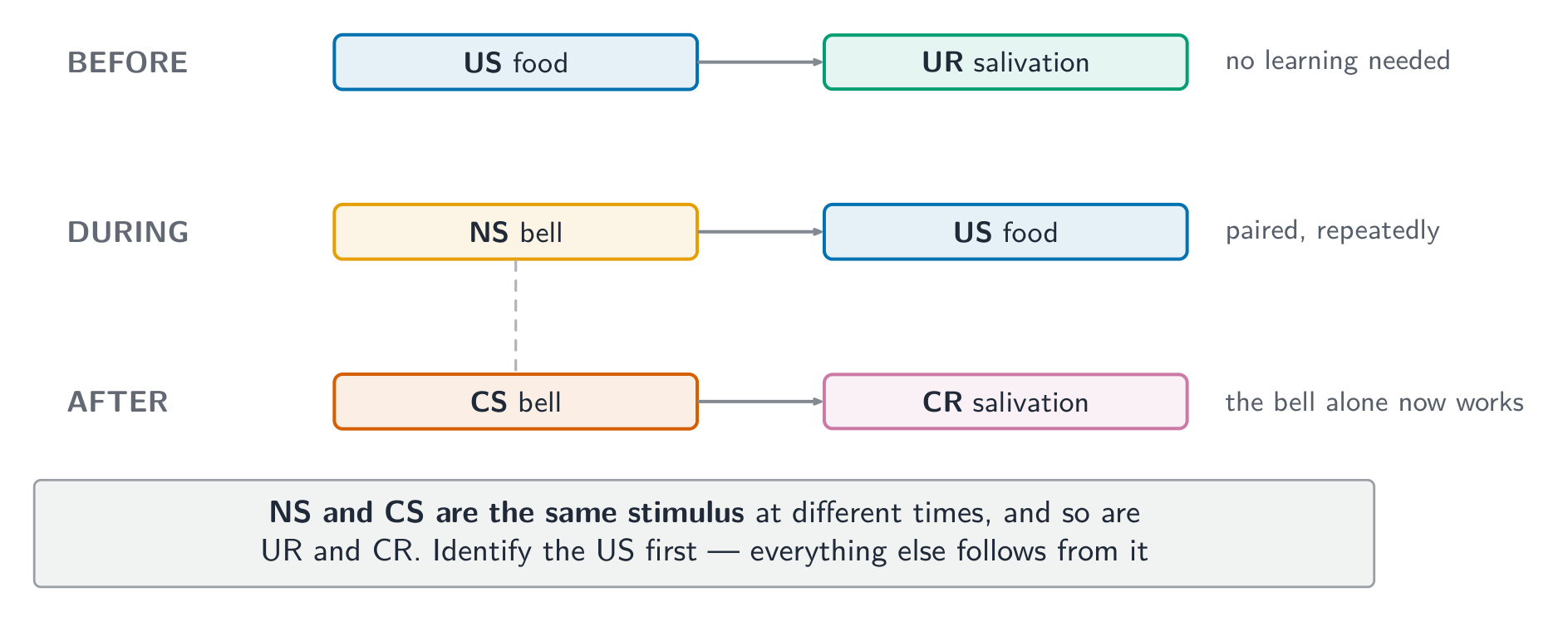
  • An unconditioned stimulus (UCS) 无条件刺激 naturally produces an unconditioned response (UCR) 无条件反应 - food causes salivation.
  • A neutral stimulus 中性刺激 paired with the UCS becomes a conditioned stimulus (CS) 条件刺激, producing a conditioned response (CR) 条件反应.
  • Acquisition 习得 depends on the order and timing of the pairing.
  • Extinction 消退 occurs when the CS is no longer paired with the UCS; spontaneous recovery 自发恢复 is the reappearance of an extinguished CR.
  • Generalization 泛化 is responding to similar stimuli; stimulus discrimination 刺激辨别 is responding only to the exact CS.
  • In higher-order conditioning 高级条件作用 an established CS acts as a UCS for a new one.

Emotional responses can be conditioned, and taste aversion 味觉厌恶 shows that some associations are learned in a single trial because they aided survival. Habituation 习惯化 is a diminished response to a repeated stimulus.

한국어

행동주의 viewpoint는 사고보다는 학습을 통해 행동을 설명합니다.

**고전적 조건화(classical conditioning)**는 한 자극을 다른 자극과 연결합니다:

  • 무조건 자극(unconditioned stimulus, UCS) 은 자연적으로 무조건 반응(unconditioned response, UCR) 을 유발합니다 - 음식은 침 분비를 유발합니다.
  • 중립 자극(neutral stimulus) 이 UCS와 함께 제시되면 조건 자극(conditioned stimulus, CS) 이 되어 조건 반응(conditioned response, CR) 을 유발합니다.
  • 습득(acquisition) 은 pairing의 순서와 타이밍에 의존합니다.
  • 소멸(extinction) 은 CS가 더 이상 UCS와 pairing되지 않을 때 발생합니다; 자발적 회복(spontaneous recovery) 는 소멸된 CR의 재현입니다.
  • 일반화(generalization) 는 유사한 자극에 반응하는 것; 자극 구별(stimulus discrimination) 은 오직 정확한 CS에만 반응하는 것입니다.
  • 고차 조건화(higher-order conditioning) 에서는 확립된 CS가 새로운 CS를 위한 UCS로 작용합니다.

정서적 반응은 조건화될 수 있으며, 미량 회피(taste aversion) 는 일부 연관이 생존에 도움이 되었기 때문에 단일 시도로 학습됨을 보여줍니다. 적응(habituation) 은 반복된 자극에 대한 감소된 반응입니다.

NS와 CS는 다른 시간의 동일한 자극입니다 - US를 먼저 식별하십시오
Explore · ⁨탐색하기⁩

Condition a response in three stages · ⁨반응을 세 단계로 조건화⁩

NS and CS are the same stimulus at different times, and so are UR and CR. Identify the US first and the rest follows. · ⁨NS와 CS는 다른 시간의 동일한 자극이며, UR과 CR도 그렇습니다. US를 먼저 식별하면 나머지는 따릅니다.⁩

Vocabulary · ⁨어휘⁩ Train · ⁨연습하기⁩
English 한국어
Classical conditioning/ˈklæsɪkl kənˈdɪʃənɪŋ/ 고전적 조건화
unconditioned stimulus (UCS)/ʌŋkənˈdɪʃnd ˈstɪmjʊləs/ 비조건 자극(unconditioned stimulus, UCS)
unconditioned response (UCR)/ʌŋkənˈdɪʃnd rɪˈspɒns/ 비조건 반응(unconditioned response, UCR)
neutral stimulus/ˈnjuːtrəl ˈstɪmjʊləs/ 중성 자극(neutral stimulus)
conditioned stimulus (CS)/kənˈdɪʃnd ˈstɪmjʊləs/ 조건 자극(conditioned stimulus, CS)
conditioned response (CR)/kənˈdɪʃnd rɪˈspɒns/ 조건 반응(conditioned response, CR)
Acquisition/əkwɪˈsɪʃn/ 획득
Extinction/ekˈstɪŋkʃn/ 소멸
spontaneous recovery/spɒnˈteɪnɪəs rɪˈkʌvəri/ 자발적 회복(spontaneous recovery)
stimulus discrimination/ˈstɪmjʊləs dɪˌskrɪmɪˈneɪʃn/ 자극 구별(stimulus discrimination)
higher-order conditioning/ˈhaɪə ˈɔːdə kənˈdɪʃənɪŋ/ 고위계 조건화(higher-order conditioning)
taste aversion/teɪst əˈvɜːʃn/ 미각 회피(taste aversion)
Habituation/ˌhæbɪtʃuːˈeɪʃn/ 습관화
3.8

Operant Conditioning · ⁨조작적 조건화⁩

Syllabus
English

Learning Objective 3.8.A: Explain how operant conditioning applies to behavior and mental processes.

  • 3.8.A.1 Operant conditioning focuses on associating consequences (reinforcement and punishment) with behaviors. The Law of Effect states that behaviors with reinforcing consequences are more likely to be repeated while behaviors with punishing consequences are not as likely to be repeated.
  • 3.8.A.2 Reinforcement and punishment can be positive or negative. Reinforcers can be primary or secondary. Reinforcement discrimination and generalization have been demonstrated in studies of operant conditioning.
  • 3.8.A.3 Reinforcement can be used to shape behavior (“shaping”) gradually through rewarding successive approximations of the desired behavior. Research with animals shows that only certain behaviors can be shaped through reinforcement (known as instinctive drift).
  • 3.8.A.4 Superstitious behavior occurs when consequences reinforce unrelated behaviors. Learned helplessness occurs when organisms learn that they have no control over their experience of aversive consequences in a given situation.
  • 3.8.A.5 The schedule with which reinforcement is delivered can determine the strength of the association between the consequence and the response. The two main types of reinforcement schedules are continuous and partial. Each type of reinforcement behavior can be graphed, resulting in a distinctive pattern on the graph (e.g., fixed-interval schedule produces a scalloped graph).
    • 3.8.A.5.i Continuous reinforcement schedules deliver reinforcement for each and every correct behavior.
    • 3.8.A.5.ii The partial reinforcement schedules focus on whether reinforcement is delivered on a time-based schedule (fixed- or variable-interval) or for the number of behaviors performed (fixed- or variable-ratio).
한국어

학습 목표 3.8.A: 조작 조건화가 행동과 정신 과정에 어떻게 적용되는지 설명하십시오.

  • 3.8.A.1 조작 조건화는 결과(강화 및 처벌)와 행동 사이의 연관성에 초점을 맞춥니다. 효과의 법칙(Law of Effect)에 따르면 강화 결과가 따르는 행동은 반복될 가능성이 높고, 처벌 결과가 따르는 행동은 반복될 가능성이 낮습니다.
  • 3.8.A.2 강화(reinforcement)와 처벌(punishment)은 긍정적 또는 부정적일 수 있습니다. 강화제는 일차적(primary) 또는 이차적(secondary)일 수 있습니다. 강화의 차등(discrimination)과 일반ization/generalization은操作性 conditioning 연구에서 입증되었습니다.
  • 3.8.A.3 강화는 원하는 행동의 연속적인 근접값(successive approximations)에 보상을 제공하여 행동을 점진적으로 형상화(shaping)하는 데 사용할 수 있습니다. 동물 연구에 따르면 강화를 통해 형상화될 수 있는 행동은 특정 종류에만 해당하며, 이를 본능적 드리프트(instinctive drift)라고 합니다.
  • 3.8.A.4 불확실한 행(superstitious behavior)은 결과가 관련 없는 행동에 의해 강화될 때 발생합니다.习得无助感(learned helplessness)은 유기체가 특정 상황에서 불쾌한 결과에 대해 통제할 수 없다는 것을 배우는 현상입니다.
  • 3.8.A.5 강화가 전달되는 스케줄(consequence와 response 간의 연관성의 강도를 결정할 수 있습니다. 두 가지 주요类型的强化스케줄은 연속 강화와 부분 강화입니다. 각类型的强化行为类型은 그래프로 표현될 수 있으며, 이는 그래프 상 distinctive pattern(예: 고정 간격 스케줄은 조개 모양의 그래프를 생성)을 산출합니다.
    • 3.8.A.5.i 연속 강화 스케줄은 모든 올바른 행동마다 보강을 제공합니다.
    • 3.8.A.5.ii 부분 강화 스케줄은 보강이 시간 기반 스케줄(고정 간격 또는 변동 간격)에 따라 전달되는지, 아니면 수행된 행동의 수(fixed-ratio 또는 variable-ratio)에 따라 전달되는지에 초점을 맞춥니다.

Source: College Board AP Course and Exam Description · ⁨출처: College Board AP Course and Exam Description⁩

English

Operant conditioning 操作性条件作用 associates a behaviour with its consequence.

  • Reinforcement 强化 increases a behaviour; punishment 惩罚 decreases it.
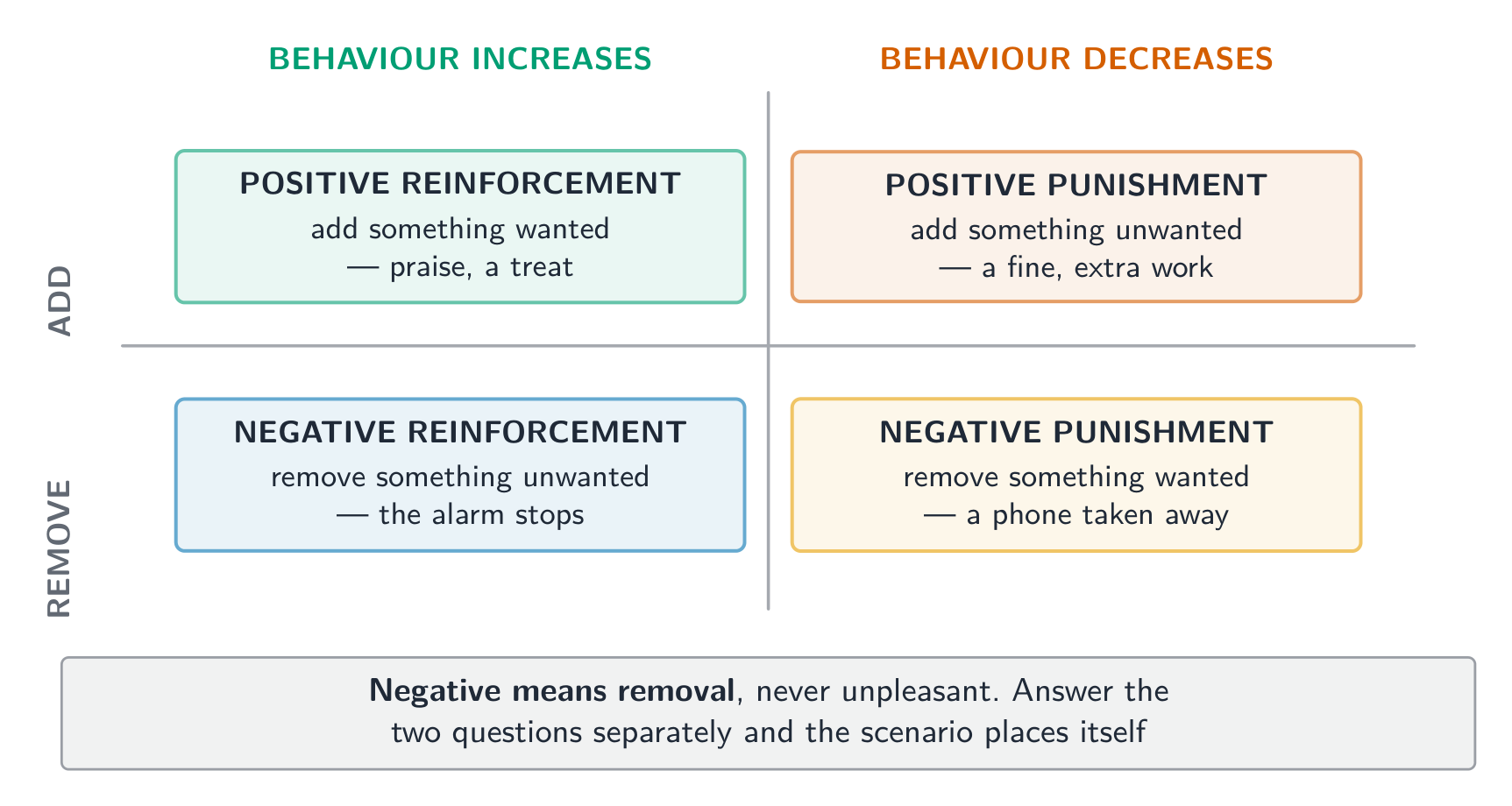
  • Positive 正 means something is added; negative 负 means something is removed. So negative reinforcement 负强化 increases behaviour by removing something unpleasant - it is not punishment.
  • A primary reinforcer 原级强化物 satisfies a biological need; a secondary reinforcer 次级强化物 (money) is learned.
  • Shaping 塑造 rewards successive approximations 逐步接近 of a target behaviour.

Reinforcement schedules 强化程式 change how strong and persistent learning is. Continuous reinforcement 连续强化 rewards every response and produces fast learning but fast extinction. Partial reinforcement 部分强化 comes in four kinds - fixed-ratio 固定比率, variable-ratio 变动比率, fixed-interval 固定时距, and variable-interval 变动时距 - and variable-ratio produces the highest, most extinction-resistant rate.

Superstitious behavior 迷信行为 arises when a consequence reinforces an unrelated action. Learned helplessness 习得性无助 develops when an organism repeatedly cannot escape an aversive event and stops trying.

한국어

조작적 조건화(operant conditioning) 는 행동과 그 결과를 연결합니다.

  • 강화(reinforcement) 는 행동을 증가시키고, 처벌(punishment) 은 줄여준다.
  • 긍정(positive) 은 무언가가 추가되는 것을 의미하며, 부정(negative) 은 무언가가 제거되는 것을 의미합니다. 따라서 부정 강화(negative reinforcement) 는 불쾌한 것을 제거함으로써 행동을 증가시키는데, 이는 처벌이 아닙니다.
  • 기본 강화제(primary reinforcer) 는 생물학적 필요를 충족시키고, 이차 강화제(secondary reinforcer) (예: 돈)는 학습된 것입니다.
  • 형성(shaping) 은 목표 행동의 연쇄적 근접법(successive approximations) 에 대해 보상합니다.

**강화 스케줄(reinforcement schedules)**는 학습의 강도와 지속성을 변경합니다. 연속 강화(continuous reinforcement) 는 모든 반응에 대해 보상하여 빠른 학습과 빠른 소멸을 만듭니다. 부분 강화(partial reinforcement) 는 네 가지 유형이 있습니다 - 고정 비율(fixed-ratio), 변동 비율(variable-ratio), 고정 간격(fixed-interval), 변동 간격(variable-interval) - 변동 비율은 가장 높고 소멸에 가장 저항성이 높은 속도를 생성합니다.

초기화적 행동은 무관한 행동이 보상에 의해 강화될 때 나타납니다. 학습된 무력감은 유기체가 불쾌한 사건에서 반복적으로 탈출하지 못해 시도를 멈추게 될 때 형성됩니다.

부호는 제거를 의미하며, 결코 불쾌함은 아님 - 두 질문을 separately로 답하시오
Explore · ⁨탐색하기⁩

Place each scenario in the operant grid · ⁨각 시나리오를 조작적 조건화 격자(operant grid)에 배치하기⁩

Negative means removal, never unpleasant. Answer two questions separately: add or remove, and does the behaviour go up or down? · ⁨음수(negative)는 제거를 의미하며, 불쾌함을 의미하지 않습니다. 두 가지 질문에 separately로 답하세요: 추가/제거, 그리고 행동이 증가/감소하는가?⁩

Vocabulary · ⁨어휘⁩ Train · ⁨연습하기⁩
English 한국어
Developmental psychology/dɪˈveləpmentl saɪˈkɒlədʒi/ 발달 심리학
continuous/kənˈtɪnjuːəs/ 연속적
discontinuous/dɪskənˈtɪnjuːəs/ 불연속적
stable/ˈsteɪbl/ 안정적인
Operant conditioning/ˈɒpərənt kənˈdɪʃənɪŋ/ 조작적 조건화
Reinforcement/ˌriːɪnˈfɔːsmənt/ 강화학습
punishment/ˈpʌnɪʃmənt/ 징계
Positive/ˈpɒzɪtɪv/ 긍정적
negative/ˈneɡətɪv/ 음수
negative reinforcement/ˈneɡətɪv ˌriːɪnˈfɔːsmənt/ 음성 강화
primary reinforcer/ˈpraɪməri ˌriːɪnˈfɔːsə/ 일차 강화인
secondary reinforcer/ˈsekəndəri ˌriːɪnˈfɔːsə/ 이차 강화인
Shaping/ˈʃeɪpɪŋ/ 형성
successive approximations/səkˈsesɪv əˌprɒksɪˈmeɪʃnz/ 연속 근접화
Reinforcement schedules/ˌriːɪnˈfɔːsmənt ˈʃedjuːlz/ 강화 일지(Reinforcement schedules)
Continuous reinforcement/kənˈtɪnjuːəs ˌriːɪnˈfɔːsmənt/ 지속적 보강
Partial reinforcement/ˈpɑːʃl ˌriːɪnˈfɔːsmənt/ 부분 강화(Partial reinforcement)
fixed-ratio/fɪkst ˈreɪʃɪəʊ/ 고정 비율(fixed-ratio)
variable-ratio/ˈveərɪəbl ˈreɪʃɪəʊ/ 변동 비율(variable-ratio)
fixed-interval/fɪkst ˈɪntəvl/ 고정 간격(fixed-interval)
variable-interval/ˈveərɪəbl ˈɪntəvl/ 변동 간격(variable-interval)
Superstitious behavior/ˌsuːpəˈstɪʃəs bɪˈheɪvjə/ 미신적 행동(Superstitious behavior)
Learned helplessness/lɜːnd ˈhelpləsnəs/ 习得性 무력감
Social learning theory/ˈsəʊʃl ˈlɜːnɪŋ ˈθɪəri/ 사회 학습 이론
observation/ɒbzəˈveɪʃn/ 관찰
modeling/ˈmɒdəlɪŋ/ 모델링(modeling)
Insight learning/ˈɪnsaɪt ˈlɜːnɪŋ/ 통찰 학습
Latent learning/ˈleɪtənt ˈlɜːnɪŋ/ 잠재 학습
cognitive map/ˈkɒɡnɪtɪv mæp/ 인지 지도(cognitive map)
3.9

Observational and Cognitive Learning · ⁨관찰 및 인지 학습⁩

Syllabus
English

Learning Objective 3.9.A: Explain how social learning applies to behavior and mental processes.

  • 3.9.A.1 Social learning theory proposes that learning can occur by observation and does not have to involve personal experience with a consequence (vicarious conditioning). Learning can occur by copying the behavior of models. The more similar a model is, the more likely the behavior is to be learned.

Learning Objective 3.9.B: Explain how cognitive factors in learning apply to behavior and mental processes.

  • 3.9.B.1 Insight learning occurs when the solution to a problem occurs without any association, consequence, or model being present.
  • 3.9.B.2 Latent learning occurs when information is learned without reinforcement but is not immediately evident. Latent learning is often demonstrated by cognitive maps.
한국어

학습 목표 3.9.A: 사회 학습이 행동과 정신 과정에 어떻게 적용되는지 설명하십시오.

  • 3.9.A.1 사회 학습 이론은 관찰을 통해 학습이可能发生且 consequence에 대한 개인적 경험(대안 조건화, vicarious conditioning)을 필요하지 않다고 주장합니다. 학습은 모델(model)의 행동을 모방함으로써 발생할 수 있습니다. 모델이 더 유사할수록 행동이 학습될 가능성이 높아집니다.

학습 목표 3.9.B: 학습에 있어 인지적 요인이 행동과 정신 과정에 어떻게 적용되는지 설명하십시오.

  • 3.9.B.1 통찰 학습(insight learning)은 문제의 해결책이 어떤 연관성, 결과, 또는 모델이 존재하지 않은 상태에서 발생할 때 일어납니다.
  • 3.9.B.2 잠복 학습(latent learning)은 보강 없이 정보学习되지만 즉시 명확하게 드러나지 않을 때 발생합니다. 잠복 학습은 종종 인지 지도(cognitive maps)를 통해 입증됩니다.

Source: College Board AP Course and Exam Description · ⁨출처: College Board AP Course and Exam Description⁩

English

Not all learning needs direct experience. Social learning theory 社会学习理论 shows that behaviour can be learned by observation 观察 and modeling 榜样示范 - the basis of the Bobo doll findings on imitated aggression.

Insight learning 顿悟学习 is a sudden solution with no gradual conditioning. Latent learning 潜伏学习 is learning that occurs without reinforcement and stays hidden until there is a reason to show it, demonstrated by rats forming a cognitive map 认知地图 of a maze.

Worked example (a real AP exam question). The 2024 exam described Gavin, a preschooler at a science museum: he grabbed a large glass marble and tried to bounce it, he was briefly separated from his parents, and the next day he told his grandmother about a picture he had drawn. Students had to "Explain how Jean Piaget's concept of assimilation could relate to Gavin's experience with the glass marble" and "Explain how egocentrism could relate to how Gavin interacted with his grandmother in the car". A full-mark answer defines the term and ties it to the specific detail: "Gavin already had a schema for balls, which bounce. He assimilated the marble into that schema by treating it as a ball and trying to bounce it." Notice the shape: the definition alone earns nothing, and so does retelling the story. The mark is for the join between them.

한국어

모든 학습이 직접적인 경험을 필요하지는 않습니다. 사회 학습 이론은 관찰과 모델링을 통해 행동이 학습될 수 있음을 보여줍니다. 이는 Bobo 인형 실험에서 관찰된 모방 공격성의 기초가 됩니다.

통찰 학습은 점진적인 조건화 없이 갑자기 해결책이 도래하는 것입니다. 잠재 학습은 보上没有 없이 일어나지만 이를 보여줄 이유가 생길 때까지 숨어 있다가 나타나는 학습으로, 쥐가 미로의 인지 지도를 형성함으로써 입증되었습니다.

풀이 예시 (실제 AP 시험 문제). 2024년 시험에서는 과학 박물관의 유치원생 가빈(Gavin)에 대해 서술했습니다: 그는 큰 유리 구슬을 잡아 튀기려 했고, 잠시 부모와 분리되었으며, 다음 날 조카에게 자신이 그린 그림에 대해 이야기했습니다. 학생들은 *"장 피에제의 동화(assimilation) 개념이 가빈의 유리 구슬 경험과 어떻게 관련되는지 설명"*하고 *"자아 중심성(egocentrism)이 차에서 가빈이 할머니와 상호작용한 방식과 어떻게 관련되는지 설명"*해야 했습니다. 만점 답안은 용어를 정의하고 구체적인 사실에 연결합니다: "가빈은 이미 튀는 공에 대한 스키마를 가지고 있었습니다. 그는 이 구슬을 공으로 간주하여 튀기려 함으로써 그 스키마에 동화시켰다." 양식을 주목하십시오: 정의만으로는 점수를 얻을 수 없으며, 이야기를 재술하는 것 역시 점수를 얻을 수 없습니다. 점은 두 가지 사이의 연결 부분에 있습니다.

3.9

Exam tips · ⁨시험 팁⁩

English
  • Negative reinforcement increases behaviour. If you can say what was removed, and the behaviour went up, it is not punishment.
  • Match a Piaget stage to its achievement - object permanence, conservation, abstract reasoning - rather than to an age.
  • Classical conditioning links two stimuli and produces an involuntary response; operant conditioning links behaviour to consequence.
  • Variable-ratio schedules resist extinction best. Use it whenever a question describes gambling-like persistence.
  • Keep critical period for the narrow window and sensitive period for the softer one.
  • On scenario questions, name the term and then point at the detail in the scenario that proves it. The detail is what earns the mark.
한국어
  • 부양강화(negative reinforcement) 는 행동을 증가시킵니다. 어떤 것이 제거되었는지 말하고 행동이 증가했다면 그것은 처벌이 아닙니다.
  • 나이에 맞추기보다 물체 영구성(object permanence), 보존(conervation), 추상적 추론 등 피에제 단계별 성취를 매칭하십시오.
  • 고전적 조건화(classical conditioning) 는 두 자극을 연결하여 자발적이지 않은 반응을 생성합니다; 조작적 조건화(operant conditioning) 는 행동과 결과를 연결합니다.
  • 변동 비율 변형(variable-ratio schedules) 은 소멸 extinction에 가장 잘 저항합니다. 질문이 도박과 같은 지속성을 묘사할 때마다 사용하십시오.
  • 비교적 좁은 시기인 민감 기(critical period) 와 더 완만한 시기인 민감 기(sensitive period) 를 구분하여 기억하십시오.
  • 시나리오 질문에 대해 용어를 명시한 후, 시나리오 내에서 그것이 증명되는 구체적인 사실을 지목하십시오. 그 구체적 사실이 점수를 얻는 근거입니다.

Interactive lessons on this topic · ⁨이 주제에 대한 인터랙티브 수업⁩

Work through it step by step, with instant-check exercises. · ⁨즉시 체크 기능 exercises를 통해 단계별로 진행하세요.⁩

Past Papers · ⁨과거 시험지⁩

More topics in AP Psychology · ⁨AP 심리학⁩ · ⁨AP Psychology · ⁨AP 심리학⁩ 내 추가 주제⁩

Log in or create account · ⁨로그인 또는 계정 만들기⁩

IGCSE, A-Level & AP