English
Learning Objective 2.1.A: Explain how internal and external factors influence perception.
- 2.1.A.1 Perception is influenced by whether one primarily relies on external sensory information (bottom-up processing) or internal prior expectations (top-down processing).
- 2.1.A.2 Schemas and perceptual sets are internal factors that filter perceptions of the world.
- 2.1.A.3 Contexts, experiences, and cultural experiences and expectations are external factors that filter perceptions of the world.
- 2.1.A.4 Perceptual principles proposed by Gestalt psychology (closure, figure and ground, proximity, and similarity) help explain how humans organize their perceptual world.
- 2.1.A.5 Attention is an interaction of sensation and perception that is affected by internal and external processes.
- 2.1.A.5.i Some experiences of attention can be selective, such as with the cocktail party effect, where people attend to mentions of their names or specific topics in loud or distracting environments.
- 2.1.A.5.ii Inattention can lead to a type of “blindness” to aspects of the environment. Change blindness occurs when changes to the environment are not perceived due to inattention.
Learning Objective 2.1.B: Explain how visual perceptual processes produce correct or incorrect interpretations of stimuli.
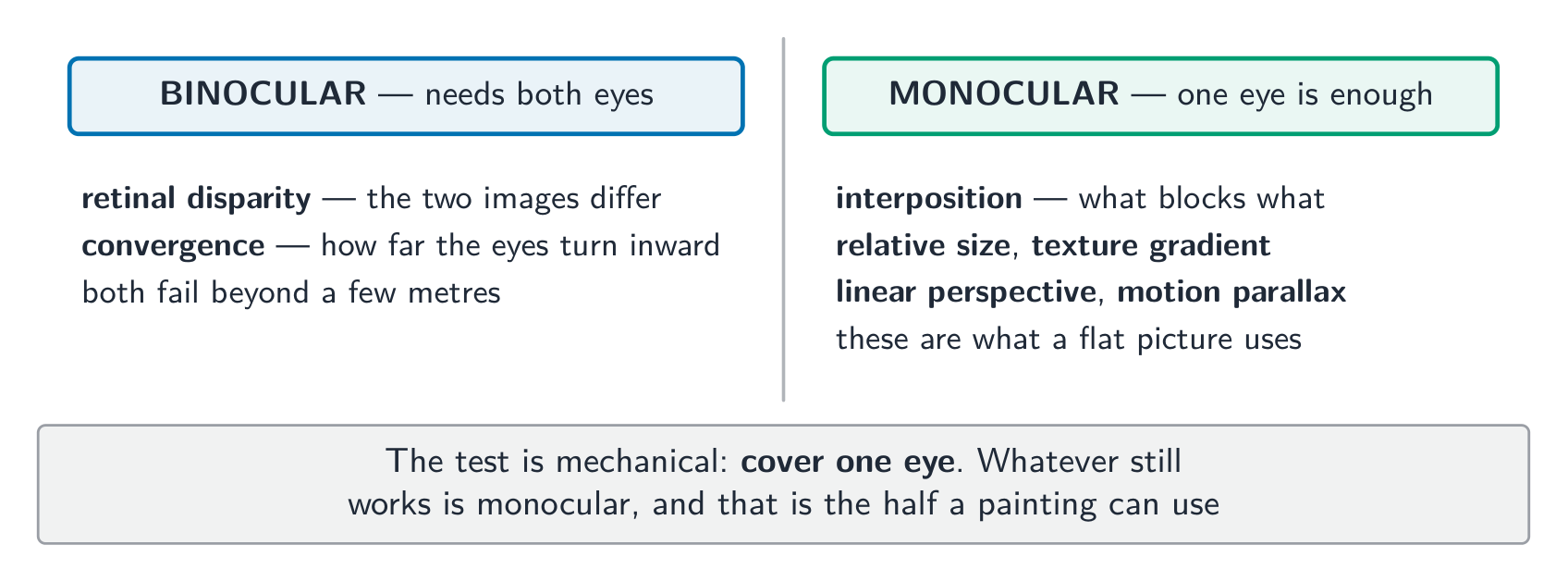
- 2.1.B.1 Binocular depth cues of retinal disparity (the difference between the images projecting onto the retina) and convergence (the merging of the retinal images by the brain) utilize images from each eye to provide perception of depth.
- 2.1.B.2 Monocular depth cues (relative clarity, relative size, texture gradient, linear perspective, and interposition) give the illusion of depth on flat or two-dimensional surfaces.
- Exclusion Statement: The AP Psychology Exam will only address the listed monocular depth cues in EK 2.1.B.2.
- 2.1.B.3 Visual perceptual constancies maintain the perception of an object even when the images of the object in the visual field change.
- 2.1.B.4 Apparent movement can be visually perceived even when objects are not actually moving.
한국어
학습 목표 2.1.A: 내부 요인과 외부 요인이 지각에 미치는 영향을 설명하십시오.
- 2.1.A.1 지각은 주로 외부 감각 정보(하향 처리, bottom-up processing)에 의존하는지, 아니면 내부의 사전 기대(상향 처리, top-down processing)에 의존하는지에 따라 영향을 받습니다.
- 2.1.A.2 키마(schemas)와 지각적 심상(perceptual sets)은 세상에 대한 지각을 필터링하는 내부 요인입니다.
- 2.1.A.3 상황, 경험, 문화적 경험 및 기대는 세상에 대한 지각을 필터링하는 외부 요인입니다.
- 2.1.A.4格式심리학(Gestalt psychology)이 제안한 지각 원리(완결성, 도형과 배경, 근접성, 유사성)는 인간이 지각 세계를 조직하는 방법을 설명하는 데 도움이 됩니다.
- 2.1.A.5 주의(attention)는 감각과 지각의 상호작용이며, 내부 및 외부 과정에 의해 영향을 받습니다.
- 2.1.A.5.i 주의의 일부 경험은 선택적일 수 있습니다. 예를 들어 칵테일 파티 효과(cocktail party effect)에서는 사람들이 소란스럽고 분산된 환경에서도 자신의 이름이나 특정 주제에 대한 언급에 주의를 기울입니다.
- 2.1.A.5.ii 무주의(inattention)는 환경의 특정 aspects에 대한 ‘시각적 실명’을 초래할 수 있습니다. 변화 실명(change blindness)은 무주의로 인해 환경의 변화가 인지되지 않는 경우를 말합니다.
학습 목표 2.1.B: 시각적 지각 과정이 자극에 대해 정확하거나 부정확한 해석을 어떻게 생성하는지 설명하십시오.
- 2.1.B.1 망막 상차iled disparity(망막에 투영되는 이미지 간의 차이)와 수렴(convergence, 망막 이미지가 뇌에 의해 통합되는 것)라는 양안 깊이 단서(binocular depth cues)은 각 눈의 이미지를 활용하여 깊이를 인지하게 합니다.
- 2.1.B.2 단안 깊이 단수(monocular depth cues)(相대 명료성, 상대 크기, 질감 경사, 선형 원근법, 중첩)는 평면 또는 2차원表面上에 깊이错觉을 제공합니다.
- 제외 사항: AP 심리학 시험은 EK 2.1.B.2에 나열된 단안 깊이 단수만 다룹니다.
- 2.1.B.3 시각적 지각 영속성(perceptual constancies)은 시각 장(Field)에서의 대상 이미지가 변하더라도 대상을 인지하는 것을 유지합니다.
- 2.1.B.4 겉보기 운동(apparent movement)은 물체가 실제로 움직이지 않음에도 시각적으로 인지될 수 있습니다.