Skip to content · ⁨본문 바로가기⁩

Line and Mark-Making · ⁨선 및 마크 작성⁩

AP Drawing · ⁨AP 드로잉⁩ · Topic 1 · ⁨주제 1⁩

Video lesson for this topic · ⁨이 주제용 영상 수업⁩ Open the video page · ⁨영상 페이지 열기⁩
7:44

선 및 마크 작성

이 세 개의 그림을 보세요. 페인트 없음. 색상 없음. 오직 연필, 펜, 금속판 위의 바늘만 있습니다. 여기서 볼 수 있는 모든 그림자들은 흔적으로 이루어져 있습니다: 선들…

English narration · English + 中文 subtitles burned in · ⁨영어 내레이션 · 영어 + 중국어 자막 burned-in⁩

1.1

Line Quality · ⁨선의 질(Line Quality)⁩

Syllabus
English

Focus: Line quality is how a line looks and feels — the first drawing skill the AP rubric names is mark-making.

  • A line can be thick or thin, dark or light, smooth or rough, fast or slow.
  • Weighted line changes thickness along its length: press harder where a form turns away or carries weight.
  • Confident lines are drawn from the shoulder and elbow, not only the fingers.
  • Lost-and-found lines fade out and reappear — the viewer's eye completes the edge.
  • Line direction carries feeling: horizontal is calm, vertical is firm, diagonal is active.
  • Examiners read line quality instantly — scratchy, timid lines and one confident stroke tell different stories.
한국어

중점: 선의 질감은 선이 바라보이고 느껴지는 방식입니다 — AP 채점 기준에서 언급하는 첫 번째 그림 기술은 **마크 메이크(mark-making)**입니다.

  • 선은 두껍거나 얇을 수 있으며, 짙거나 옅을 수 있고, 매끄럽거나 거칠 수 있으며, 빠르거나 느릴 수 있습니다.
  • **가중선(weighted line)**은 길이에 따라 두께가 변화합니다: 형태가 멀어지거나 무게를 견디는 부분에 더 세게 누릅니다.
  • 자신감 있는 선은 손가락뿐만 아니라 어깨와 팔꿈치를 사용하여 그립니다.
  • 로스트 앤 파운드(lost-and-found) 선은 흐려졌다가 다시 나타납니다 — 관찰자의 눈이 가장자리를 완성합니다.
  • 선의 방향은 감정을 전달합니다: 수평선은 평온함, 수직선은 단단함, 대각선은 역동성을 의미합니다.
  • 채점관은 선의 질감을 즉시 판독합니다: 거칠고 소극적인 선과 한 번의 자신감 있는(Source stroke) 선은 서로 다른 이야기를 전합니다.

Source: College Board AP Course and Exam Description · ⁨출처: College Board AP Course and Exam Description⁩

English

Line quality 线条质感 is how a line looks and feels. The AP Drawing rubric names mark-making 笔触 first in its list of drawing skills, and line is the most basic mark.

  • A line can be thick or thin, dark or light, smooth or rough, fast or slow.
  • A weighted line 轻重线条 changes thickness along its length. Press harder where a form turns away from the light or carries weight.
  • Lost-and-found lines 虚实线条 fade out and come back. The viewer's eye completes the missing edge.
  • Confident lines come from the shoulder and elbow, not only the fingers.

Line direction carries feeling: horizontal lines feel calm, vertical lines feel firm, and diagonal lines feel active. Examiners read line quality instantly, so practise until your lines look decided, not timid.

한국어

선의 질은 선이 보일 때의 외관과 느낌입니다. AP 드로잉 평가 기준(rubric)에서는 드로잉 기술 목록에서 **마크 제작(mark-making)**을 첫 번째로 언급하며, 선은 가장 기본이 되는 마크입니다.

  • 선은 두껍거나 얇을 수 있으며, 짙거나 옅을 수 있고, 매끄럽거나 거칠 수 있으며, 빠르거나 느릴 수 있습니다.
  • **중량선(weighted line)**은 길이에 따라 두께가 변화합니다. 형태가 빛에서 멀어지거나 무게를 지탱하는 부분에 더 강하게 누르십시오.
  • **사라지고 다시 나타나는 선(lost-and-found lines)**은 희미해졌다가 다시 나타납니다. 관찰자의 눈이 결손된 가장자리를 완성합니다.
  • 자신감 있는 선은 손가락뿐만 아니라 어깨와 팔에서 나온다.
선들의 질: 균일선, 중량선, 사라지고 다시 나타나는 선, 그리고 표현적 선을 비교
네 가지 방식으로 그려진 동일한 가장자리: 균일선, 중량선, 사라지고 다시 나타나는 선, 그리고 빠른 표현적 선

선의 방향은 느낌을 전달합니다: 수평선은 차분하게 느껴지고, 수직선은 단단하게 느껴지며, 대각선은 역동적으로 느껴집니다. 시험관은 선의 질을 즉시 판단하므로, 자신의 선이 주저하지 않고 확고하게 보이도록 연습하십시오.

Vocabulary · ⁨어휘⁩ Train · ⁨연습하기⁩
English 한국어
line quality/laɪn ˈkwɒlɪti/ 라인 품질(line quality)
mark-making/mɑːk ˈmeɪkɪŋ/ 마크 메이크업(Mark-making)
weighted line/ˈweɪtɪd laɪn/ weighted line(가중선)
lost-and-found lines/lɒst ænd faʊnd laɪnz/ 로스트 앤 파운드 라인(lost-and-found lines)
1.2

Contour Drawing · ⁨컨투어 드로잉(Contour Drawing)⁩

Syllabus
English

Focus: Contour drawing follows the edges of a form slowly and carefully — it trains eye-hand coordination.

  • A contour line traces the outer edge and the inner edges (folds, creases, overlaps) of a subject.
  • In blind contour you draw without looking at the paper — pure observation practice.
  • Cross-contour lines travel across the surface of a form, like latitude lines on a globe, and describe volume.
  • Draw slowly: match the speed of your eye moving along the edge with the speed of your pencil.
  • Overlapping contours (one edge passing in front of another) create instant depth.
  • Contour studies make strong Sustained Investigation process pages — they show observation skill.
한국어

중점: 윤곽 그리기는 형태 가장자리를 천천하고 신중하게 따라그림으로써눈-손 협응을 훈련합니다.

  • **윤곽선(contour line)**은 피사체의 바깥쪽 가장자리와 안쪽 가장자리(주름, 접힘, 겹침)를 추적합니다.
  • **블라인드 컨투어(blind contour)**에서는 종이를 보지 않고 그립니다 — 순수한 관찰 연습입니다.
  • 크로스 컨투어(cross-contour) 선은 형태의 표면을 가로지르며 지구의 위도선처럼 부피를 묘사합니다.
  • 천천히 그립니다: 눈이 가장자리를 따라 이동하는 속도와 연필의 속도를 맞추십시오.
  • 겹치는 윤곽선(한 가장자리가 다른 가장자리前面을 지나가는 경우)은 즉각적인 깊이감을 만듭니다.
  • 윤곽 연구는 강력한 지속적 조사(Sustained Investigation) 과정 페이지를 만듭니다 — 관찰 기술을 보여줍니다.

Source: College Board AP Course and Exam Description · ⁨출처: College Board AP Course and Exam Description⁩

English

A contour line 轮廓线 traces the edges of a form — the outer edge and the inner edges made by folds, creases, and overlaps. Contour drawing is slow, careful looking.

  • Match the speed of your eye moving along the edge with the speed of your pencil.
  • In blind contour 盲画轮廓 you draw without looking at the paper. It feels strange, but it trains pure observation.
  • Cross-contour lines 横截轮廓线 travel across the surface of a form, like latitude lines on a globe. They describe volume, not edges.
  • Overlapping contours create instant depth: one edge passing in front of another says "this is closer".

Contour studies make strong process pages for the Sustained Investigation because they show real observation skill.

한국어

**컨투어(line)**는 형태의 가장자리를 따라 그리는 선—바깥 가장자리와 주름, 접힘, 겹침에 의해 형성된 안쪽 가장자리들까지 포함합니다. 컨투어 드로잉은 천천히, 신중하게 보는 연습입니다.

  • 가장자리를 따라 움직이는 당신의 눈의 속도와 연필의 속도를 맞추십시오.
  • **블라인드 컨투어(blind contour)**는 종이를 보지 않고 그리는 것입니다. 낯선 느낌이 들지만 순수한 관찰력을 기르는 데 도움이 됩니다.
  • **크로스 컨투어(cross-contour lines)**는 형태의 표면을 가로질러 이동합니다. 지구상의 위도선과 같습니다. 이들은 가장자리가 아니라 부피(volume)를 묘사합니다.
  • 겹치는 컨투어는 즉시 깊이감을 만듭니다: 하나의 가장자리가 다른 가장자리前面(앞)을 지나가는 것은 "이것이 더 가까이 있다"라고 의미합니다.

컨투어 연구는 지속적 조사(Sustained Investigation)를 위한 강력한 프로세스 페이지가 되며, 실제 관찰 능력을 보여주기 때문입니다.

장인 연구에서의 제스처와 컨투어: 선이 한 번의 연속적인 보기에서 형태를 기록함
Vocabulary · ⁨어휘⁩ Train · ⁨연습하기⁩
English 한국어
contour line/ˈkɒntʊə laɪn/ 콘투어 라인(contour line)
blind contour/blaɪnd ˈkɒntʊə/ 블라인드 컨투어(blind contour)
cross-contour lines/krɒs ˈkɒntʊə laɪnz/ cross-contour lines(교차 윤곽선)
gesture drawing/ˈdʒestʃə ˈdrɔːɪŋ/ 제스처 드로잉(gesture drawing)
1.3

Gesture Drawing · ⁨제스처 드로잉(Gesture Drawing)⁩

Syllabus
English

Focus: Gesture drawing captures the energy, movement, and weight of a subject in seconds — before any detail.

  • A gesture drawing takes 30 seconds to 3 minutes; it looks for the action line running through the pose.
  • Draw the whole subject at once — big loose lines from the shoulder — never one polished corner.
  • Look for the line of action first: one curve that summarises the pose's movement.
  • Gesture is about what the subject is doing, not what it looks like.
  • Daily gesture pages build speed and confidence, and they photograph well as process evidence.
  • Long drawings usually start as a gesture: energy first, structure second, detail last.
한국어

중점: 제스처 그리기는 디테일보다 먼저 피사체의 에너지, 움직임, 무게를 몇 초 안에 포착합니다.

  • 제스처 그리기는 30초에서 3분이 소요되며, 포즈를 관통하는 **액션 라인(action line)**을 찾습니다.
  • 전체 피사체를 한 번에 그립니다 — 어깨에서부터 큰 여유로운 선으로, 매끄럽게 다듬어진 모서리 하나는 그리지 않습니다.
  • 먼저 **액션 라인(line of action)**을 찾으십시오: 포즈의 움직임을 요약하는 하나의 곡선입니다.
  • 제스처는 '무엇이 어떻게 생겼는가'가 아닌 '피사체가 무엇을 하는가'에 관한 것입니다.
  • 매일 제스처 페이지를 그리면 속도감과 자신감이 쌓이며, 과정 증거(process evidence)로 사진 촬영에 적합합니다.
  • 긴 그림은 보통 제스처로 시작합니다: 에너지 먼저, 구조 다음, 디테일은 마지막.

Source: College Board AP Course and Exam Description · ⁨출처: College Board AP Course and Exam Description⁩

English

Gesture drawing 动态速写 captures the energy, movement, and weight of a subject in seconds — before any detail.

  • A gesture drawing takes 30 seconds to 3 minutes. Draw the whole subject at once with big, loose lines.
  • Look for the line of action 动势线 first: one curve that summarises the movement of the pose.
  • Gesture asks what the subject is doing, not what it looks like.
  • Long drawings usually start as a gesture: energy first, structure second, detail last.

Daily gesture pages build speed and confidence, and they photograph well as evidence of practice.

한국어

제스처 드로잉은 세부 사항이 들어가기 전에 피사체의 에너지, 움직임, 무게를 몇 초 안에 포착합니다.

  • 제스처 드로잉은 30초에서 3분이 소요됩니다. 큰 선으로 전체 피사체를 한 번에 그리십시오.
  • 먼저 **액션 라인(line of action)**을 찾으십시오: 포즈의 움직임을 요약하는 하나의 곡선입니다.
  • 제스처는 피사체가 '어떻게 생겼는가'가 아닌 '무엇을 하고 있는가'를 묻습니다.
  • 긴 그림은 보통 제스처로 시작합니다: 에너지 먼저, 구조 다음, 디테일은 마지막.

매일 제스처 페이지를 그리면 속도감과 자신감이 쌓이며, 연습의 증거로서 사진 촬영에도 적합합니다.

세부 사항이 시작되기 전에 few几条 선으로 액션을 포착하는 제스처
Vocabulary · ⁨어휘⁩ Train · ⁨연습하기⁩
English 한국어
line of action/laɪn ɒv ˈækʃn/ line of action(액션 라인)
1.4

Hatching and Cross-Hatching · ⁨해칭과 크로스 해칭(Hatching and Cross-Hatching)⁩

Syllabus
English

Focus: Hatching builds value with parallel lines; cross-hatching layers a second direction on top.

  • Closer, darker lines read as darker value; wider spacing reads as lighter value.
  • Cross-hatching adds layers at new angles — each layer deepens the tone step by step.
  • Curve the hatch lines around the form (cross-contour hatching) so the shading also describes volume.
  • Keep a consistent angle inside one plane; change angle when the plane changes — edges stay crisp.
  • Pen-and-ink drawing depends on hatching because ink has no grey — value comes only from line density.
  • Hatching shows control of mark-making and light and shade, two named AP drawing skills, in one technique.
한국어

중점: **해칭(hatching)**은 평행선을 사용하여 명암(value)을 형성하고, **크로스 해칭(cross-hatching)**은其上에 두 번째 방향을 겹칩니다.

  • 더 가깝고 짙은 선들은 더 은 명도를 나타내며, 간격이 넓으면 더 밝은 명도를 의미합니다.
  • 크로스 해칭은 새로운 각도로 층을 더합니다 — 각 층이 단계적으로 명암을 깊게 합니다.
  • 형태를 따라 해칭 선을 곡선으로 만듭니다(크로스 컨투어 해칭) —这样阴影也能描述体积。
  • 하나의 면(plane) 내에서 일정한 각도를 유지하고, 면이 바뀌면 각도를 변경하십시오 — 가장자리는 날카롭게 유지됩니다.
  • 펜 앤 인크(pen-and-ink) 그림은 해칭에 의존합니다. 잉크에는 회색이 없으므로 명암은 선의 밀도에서만 나옵니다.
  • 해칭(hatching)은 마크 제작 및 명암이라는 두 가지 명시된 AP 드로잉 기술을 하나의 기법으로 제어하는 방법을 보여줍니다.

Source: College Board AP Course and Exam Description · ⁨출처: College Board AP Course and Exam Description⁩

English
Building value with marks

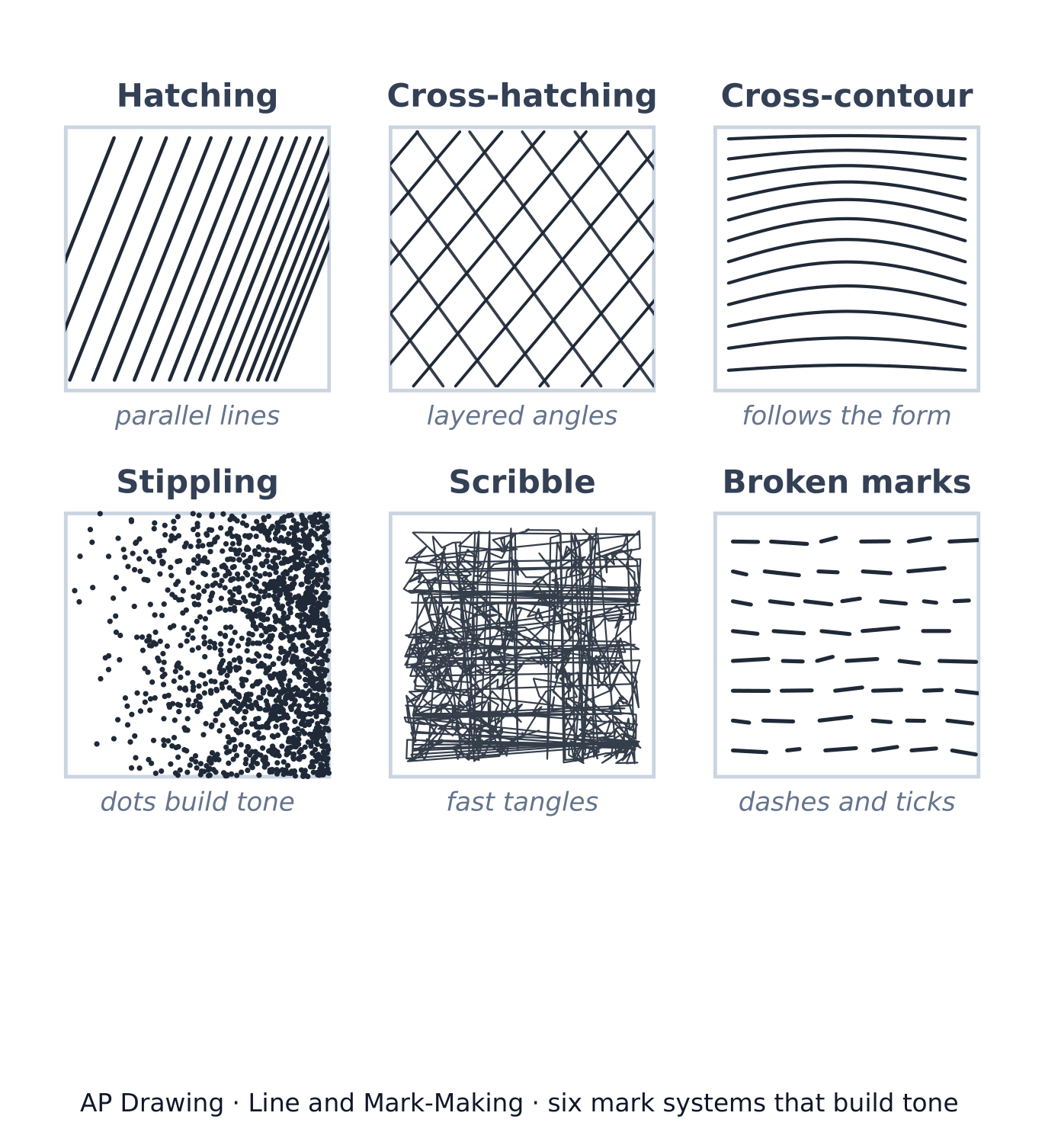
Hatching 排线 builds tone with parallel lines. Cross-hatching 交叉排线 layers a second set of lines at a new angle on top.

  • Closer, darker lines read as darker value 明度; wider spacing reads as lighter value.
  • Each cross-hatched layer deepens the tone step by step — build darkness gradually.
  • Curve the lines around the form (cross-contour hatching) so the shading also describes volume.
  • Keep one angle inside one plane; change the angle when the plane changes, and edges stay crisp.
  • Pen-and-ink drawing depends on hatching, because ink has no grey: value comes only from line density.
한국어
마크를 사용하여 톤(value) 구축하기

**해칭(hatching)**은 평행선을 사용하여 톤을 구축합니다. **크로스 해칭(cross-hatching)**은 새로운 각도로 두 번째 줄의 선들을 겹쳐 입힙니다.

파란회색 종이 위에 밀집된 섬세한 잉크 선으로 조형된 손 한 쌍의 상세한 올드 마스터 드로잉
뒤러는 이 손을 세밀한 평행 해칭과 교차 해칭으로 제작했습니다; 선들이 서로 가깝게 배치되고 교차할수록 톤이 짙어지며 평면적인 자국이 입체적인 형태로 변합니다

6점 체계: 해칭, 교차 해칭, 교차 윤곽 해칭, 스틤플링, 스크리블, 파손된 자국 *자국(ticks)을 통해 톤을 구성하는 여섯 가지 방법; 더 가깝고 밀도 높은 자국은 더 짙은 명도로 인식됩니다

  • 더 가깝고 짙은 선들은 더 은 명도를 나타내며, 간격이 넓으면 더 밝은 명도를 의미합니다.
  • 각 교차 해칭 층은 단계적으로 톤을 깊게 만듭니다. 어둠은 점진적으로 쌓아 올리십시오.
  • 형태 주위로 선을 굽혀 (교차 윤곽 해칭) 음영이 부피를 묘사하도록 하십시오.
  • 하나의 면 내부에서는 한 각도를 유지하십시오. 면이 바뀌면 각도를 변경하여 가장자리가 선명하게 유지되도록 하십시오.
  • 펜-앤-인크 드로잉은 해칭에 의존하는데, 잉크에는 회색이 없기 때문입니다. 명도는 오직 선의 밀도에 의해 결정됩니다.
Explore · ⁨탐색하기⁩

Which mark system is it? · ⁨어떤 마크 체계를 사용하는가?⁩

Hatching uses parallel lines, cross-hatching layers a second angle, stippling builds tone from dots, and scribble uses fast tangles. Naming mark systems helps you choose and describe your own. · ⁨해칭은 평행선을 사용하고, 크로스 해칭은 두 번째 각도를 겹치고, 스-tippling은 점들로 톤을 구성하며, 스크래블은 빠른 얽힘을 사용합니다. 마크 체계의 명칭은 선택하고 자신의 스타일을 설명하는 데 도움이 됩니다.⁩

Vocabulary · ⁨어휘⁩ Train · ⁨연습하기⁩
English 한국어
hatching/ˈhætʃɪŋ/ 해치기
cross-hatching/krɒs ˈhætʃɪŋ/ 교차 해치기
value/ˈvæljuː/ 명암(value)
1.5

Stippling, Scribbling, and Alternative Marks · ⁨스틤플링, 스크리블 및 대체 자국⁩

Syllabus
English

Focus: Beyond hatching there is a whole vocabulary of marks — dots, scribbles, dashes, smears — each with its own texture and speed.

  • Stippling builds tone from dots: dense dots read dark, sparse dots read light — slow but very controllable.
  • Scribble (or scumbled) marks are fast tangles of line — lively, good for fur, foliage, and energy.
  • Dashes, ticks, and broken marks suggest texture without outlining every detail.
  • Marks can be additive (adding material) or subtractive (lifting material out with an eraser).
  • Try one subject rendered in four different mark systems — a classic experimentation page.
  • A personal mark vocabulary is part of your artistic voice — examiners look for it across the portfolio.
한국어

핵심 개념: 해칭을 넘어선 마크의 어휘가 존재합니다 — 점, 스크블, dashes, 번짐 등 각기 다른 질감과 속도를 가집니다.

  • 스티프링(stippling) 은 점들로 명암을 만듭니다: 밀집된 점은 어둡게, 드문드문 있는 점은 밝게 인식되며 — 느리지만 통제가 매우 정확합니다.
  • 스크블(scribble) 또는 스컴블(scumbled) 마크는 빠른 선의 얽힘입니다 — 생동감이 있으며 털, 잎사귀, 에너지 표현에 적합합니다.
  • dashes, ticks, 그리고 broken 마크들은 모든 디테일의 윤곽 없이 질감을 시사합니다.
  • 마크는 증가적(additive) (재료 추가) 또는 감소적(subtractive) (지우개로 재료 제거)일 수 있습니다.
  • 네 가지 다른 마크 체계로 동일한 주제를 표현해 보는 것은 고전적인 실험 페이지입니다.
  • 개인적인 마크 어휘는 당신의 예술적 음성(voice) 의 일부이며, 심사위원들은 포트폴리오 전반에서 이를 찾아냅니다.

Source: College Board AP Course and Exam Description · ⁨출처: College Board AP Course and Exam Description⁩

English

Beyond hatching there is a whole vocabulary of marks — dots, tangles, dashes, smears — each with its own texture and speed.

  • Stippling 点画 builds tone from dots: dense dots read dark, sparse dots read light. Slow, but very controllable.
  • Scribble 乱线 marks are fast tangles of line — lively and good for fur, foliage, and energy.
  • Dashes, ticks, and broken marks suggest texture without outlining every detail.
  • Marks can be additive 加法 (putting material on) or subtractive 减法 (lifting material off with an eraser).
  • A classic experimentation page: one subject rendered in four different mark systems.
한국어

해칭 외에도 점, 얽힌 선, 대시, 번짐 등 다양한 자국의 어휘가 존재하며, 각각 고유한 질감과 속도를 가집니다.

  • 스티프링(stippling) 은 점으로 톤을 만듭니다: 밀도가 높은 점은 짙게, 희소하면 밝게 보입니다. 느리지만 조절하기 매우 쉽습니다.
  • 스크리블(scribble) 은 빠른 선들의 얽힘으로, 생동감이 있으며 털, 잎사귀, 에너지 표현에 적합합니다.
  • dashes, ticks, 그리고 broken 마크들은 모든 디테일의 윤곽 없이 질감을 시사합니다.
  • 자국은 재료를 추가하는 추가적(additive) 방식이거나 지우개로 재료를 제거하는 감소적(subtractive) 방식일 수 있습니다.
  • 고전적인 실험 페이지: 한 피사체를 네 가지 다른 마크 시스템으로 표현.
Vocabulary · ⁨어휘⁩ Train · ⁨연습하기⁩
English 한국어
stippling/ˈstɪplɪŋ/ 스-tippling(점묘법)
scribble/ˈskrɪbl/ 스크리블
additive/ˈædɪtɪv/ 가산(additive)
subtractive/sʌbˈtræktɪv/ 감산적
1.6

Texture and Surface · ⁨질감과 표면⁩

Syllabus
English

Focus: Surface is a named AP drawing skill: how the drawing's physical texture and the depicted texture work together.

  • Actual texture is the real surface of the work (rough paper, layered charcoal, collage); implied texture is drawn illusion.
  • Frottage (rubbing over a textured surface) transfers real texture into a drawing.
  • Paper tooth (roughness) changes every mark: the same pencil reads differently on smooth and rough paper.
  • Contrast of textures — smooth skin against rough cloth — makes both read more strongly.
  • Build texture with the logic of the material: short strokes for fur, long strokes for hair, broken marks for stone.
  • Describing texture convincingly is visual evidence of observation and material control.
한국어

핵심 개념: 표면(surface) 은 명시된 AP 드로잉 기술입니다: 그림의 물리적 질감과 묘사된 질감이 어떻게 상호작용하는지입니다.

  • 실제 질감(actual texture) 은 작품의 실제 표면(거친 종이, 층층이 쌓인 초콜릿, 콜라주)이며, 명시적 질감(implied texture) 은 그림으로 created되는 환상입니다.
  • 프로타주(frottage, 질감 표사법) 는 질감이 있는 표면에 문지르는 것으로, 실제 질감을 그림에 전사합니다.
  • 종이의 치(tooth, 거칠기) 는 모든 마크를 변경합니다: 동일한 연필도 매끄러운 종이와 거친 종이에서 다르게 나타납니다.
  • 매끄러운 피부와 거친 천의 대비는 두 질감이 모두 더 강하게 인식되게 합니다.
  • 소재의 논리에 따라 질감을 구축하십시오: 털은 짧은 strokes, 머리카락은 긴 strokes, 돌은 파손된 자국을 사용하십시오.
  • 질감을 설득력 있게 묘사하는 것은 관찰력과 재료 통제력을 보여주는 시각적 증거입니다.

Source: College Board AP Course and Exam Description · ⁨출처: College Board AP Course and Exam Description⁩

English

Surface 画面质感 is a named AP drawing skill: the physical texture of the drawing and the drawn illusion of texture work together.

  • Actual texture 实际肌理 is the real surface of the work — rough paper, layered charcoal, collage. Implied texture 视觉肌理 is drawn illusion.
  • Frottage 拓印法 (rubbing over a textured surface) transfers real texture into a drawing.
  • Paper tooth 纸纹 changes every mark: the same pencil reads differently on smooth and rough paper.
  • Contrast of textures — smooth skin against rough cloth — makes both read more strongly.
  • Build texture with the logic of the material: short strokes for fur, long strokes for hair, broken marks for stone.
한국어

표면(surface) 은 AP 드로잉 기술 중 하나로 지정되어 있습니다: 작품의 물리적 질감과 그림으로 표현된 질감의 환상이 조화를 이룹니다.

  • 실재 질감(actual texture) 은 작품의 실제 표면(거친 종이, 다층 코얼, 콜라주)입니다. 제시된 질감(implied texture) 은 그림으로 만들어낸 환상입니다.
  • 프로타주(frottage, 질감 표사법) 는 질감이 있는 표면에 문지르는 것으로, 실제 질감을 그림에 전사합니다.
  • 종이 tooth는 모든 마크를 바꿉니다: 같은 연필도 매끄러운 종이와 거친 종이에서 다르게 읽힙니다.
  • 매끄러운 피부와 거친 천의 대비는 두 질감이 모두 더 강하게 인식되게 합니다.
  • 소재의 논리에 따라 질감을 구축하십시오: 털은 짧은 strokes, 머리카락은 긴 strokes, 돌은 파손된 자국을 사용하십시오.
Vocabulary · ⁨어휘⁩ Train · ⁨연습하기⁩
English 한국어
surface/ˈsɜːfɪs/ 표면적
actual texture/ˈæktʃuːəl ˈtekstʃə/ 실재 질감
implied texture/ɪmˈplaɪd ˈtekstʃə/ 추상 질감
frottage/ˈfrɒtɪdʒ/ 프롯타주(frottage)
tooth/tuːθ/ 치아(거칠기)
1.7

Expressive Mark-Making · ⁨표현적 자국 생성⁩

Syllabus
English

Focus: Marks carry emotion: the same subject drawn with angry, calm, or nervous marks tells three different stories.

  • Expressive lines exaggerate speed, pressure, and direction to communicate feeling, not just describe form.
  • Käthe Kollwitz's heavy charcoal and Egon Schiele's tense contours show how marks are the meaning.
  • Choose the mark to match the idea: soft graphite for quiet subjects, aggressive ink for conflict.
  • Distortion and exaggeration are legitimate drawing decisions when they serve intent — 'accurate' is not the only goal.
  • The AP rubric rewards ideas made visual: expressive marks link technique to meaning.
  • Test the same composition in two mark styles and write one sentence on which supports your inquiry better.
한국어

핵심 개념: 마크에는 감정이 담겨 있습니다: 같은 주제라도 화난, 평온한, 불안한 마크로 그리면 세 가지 다른 이야기가 전달됩니다.

  • 표현적 선(expressive lines) 은 속도, 압력, 방향을 과장하여 형상을 설명하는 것보다 감정을 전달합니다.
  • 카테 콜비츠(Käthe Kollwitz)의 무거운 초콜릿과 에곤 시클레(Egon Schiele)의 긴장감 있는 윤곽선은 마크 자체가 의미임을 보여줍니다.
  • 아이디어에 맞는 자국을 선택하십시오: 고요한 주제는 부드러운 연필, 갈등은 공격적인 잉크를 쓰십시오.
  • 왜곡과 과장은 의도를 수행할 때 합리적인 드로잉 결정입니다. '정확함'만이 유일한 목표는 아닙니다.
  • AP 평가 기준은 시각화된 아이디어를(copying) 보상합니다: 표현적 마크는 기법과 의미를 연결합니다.
  • 동일한 구도를 두 가지 마크 스타일로 테스트하고,哪一个 더 연구에 부합하는지에 대해 한 문장을 쓰십시오.

Source: College Board AP Course and Exam Description · ⁨출처: College Board AP Course and Exam Description⁩

English

Marks carry emotion. The same subject drawn with angry, calm, or nervous marks tells three different stories.

  • Expressive lines 表现性线条 exaggerate speed, pressure, and direction to communicate feeling, not just to describe form.
  • Käthe Kollwitz's heavy charcoal and Egon Schiele's tense contours show how the marks themselves carry the meaning.
  • Choose the mark to match the idea: soft graphite for quiet subjects, aggressive ink for conflict.
  • Distortion 变形 and exaggeration are legitimate drawing decisions when they serve your intent — "accurate" is not the only goal.
  • A personal mark vocabulary is part of your artistic voice 个人风格. Examiners look for it across the whole portfolio.
한국어

마크에는 감정이 담겨 있습니다. 같은 주제를 화난, 차분한, 긴장된 마크로 그렸을 때 세 가지 다른 이야기가 전달됩니다.

  • 표현적 선(expressive lines) 은 형태를 묘사하는 것을 넘어 감정 전달을 위해 속도, 압력, 방향을 과장합니다.
  • 카테 콜비츠의 무거운 코얼과 에곤 쉬엘레의 긴장된 윤곽은 자국 자체가 의미를 담는 예시를 보여줍니다.
  • 아이디어에 맞는 자국을 선택하십시오: 고요한 주제는 부드러운 연필, 갈등은 공격적인 잉크를 쓰십시오.
  • 의도를 실현하기 위한 것이라면 왜곡과 과장은 합리적인 드로잉의 선택지입니다. '정확함'만이 유일한 목표는 아닙니다.
  • 개인적인 자국 어휘는 당신의 예술적 음성(voice) 의 일부입니다. 채점자는 전체 포트폴리오에서 이를 확인합니다.
Vocabulary · ⁨어휘⁩ Train · ⁨연습하기⁩
English 한국어
expressive lines/ekˈspresɪv laɪnz/ 표정적 선(expressive lines)
distortion/dɪˈstɔːʃn/ 왜곡
voice/vɔɪs/ 음성/보이스(voice)
1.7

Exam tips · ⁨시험 팁⁩

English
  • Line quality is judged at a glance — one page of confident, varied strokes tells a scorer more than an hour of timid rendering. Warm up before every serious drawing.
  • Show the systems, not just the results: a portfolio image of hatching, stippling, and cross-contour studies is direct visual evidence of the mark-making skill the rubric names.
  • Photograph marks close up. A detail shot of your best passage of marks proves a skill that a full view only suggests.
  • Blind contour and gesture pages belong in your process images — they show observation and practice, exactly what the Sustained Investigation rubric asks to see.
  • Match marks to meaning in your written evidence: one sentence like "scratchy graphite lines echo the anxiety of exam season" links technique to idea, which is what scorers reward.
한국어
  • 선 품질(line quality)은 한눈에 평가됩니다. 자신감 있고 다양성을 갖춘 한 페이지의 strokes가 망설이는 표현보다 채점자에게 훨씬 많은 정보를 전달합니다. 모든 진지한 드로잉 전 워밍업을 하십시오.
  • 결과물뿐만 아니라 체계를 보여주십시오: 해칭, 스티프링, 교차 윤곽 연구의 포트폴리오 이미지는 루브릭에서 요구하는 자국 생성 기술을 직접적으로 입증하는 시각적 증거입니다.
  • **자국을 근접 촬영하십시오.**最好的 자국 구간의 디테일 샷은 전체 뷰만으로는 암시할 수 있는 능력을 증명합니다.
  • 블라인드 컨투어 및 제스처 페이지는 프로세스 이미지에는 반드시 포함되어야 합니다. 관찰과 연습을 보여주는 것은 지속적 조사(Sustained Investigation) 루브릭에서 요구하는 바와 정확히 일치합니다.
  • 서면 증거에서 자극의 의미를 매칭하십시오. "거친 연필 선들이 시험 시즌의 불안을 반영한다"와 같은 한 문장은 기법을 아이디어에 연결하여 채점자의 호감을 얻습니다.

Interactive lessons on this topic · ⁨이 주제에 대한 인터랙티브 수업⁩

Work through it step by step, with instant-check exercises. · ⁨즉시 체크 기능 exercises를 통해 단계별로 진행하세요.⁩

More topics in AP Drawing · ⁨AP 드로잉⁩ · ⁨AP Drawing · ⁨AP 드로잉⁩ 내 추가 주제⁩

Log in or create account · ⁨로그인 또는 계정 만들기⁩

IGCSE, A-Level & AP