Skip to content · ⁨본문 바로가기⁩

2-D Media, Materials, and Techniques · ⁨2D 미디어, 재료 및 기법⁩

AP 2-D Art and Design · ⁨AP 2D 예술 및 디자인⁩ · Topic 3 · ⁨주제 3⁩

Video lesson for this topic · ⁨이 주제용 영상 수업⁩ Open the video page · ⁨영상 페이지 열기⁩
8:00

2D 미디어, 재료 및 기법

자세히 보십시오. 이 그림에는 회색 잉크가 전혀 없습니다. 모든 부드러운 음영은 개별적인 선들이 옆에 나란히 그려져 만들어졌습니다. 선들이 빽빽하게 몰려 있는 곳…”

English narration · English + 中文 subtitles burned in · ⁨영어 내레이션 · 영어 + 중국어 자막 burned-in⁩

3.1

Drawing Media · ⁨드로잉 매체⁩

Syllabus
English

Focus: Drawing media make marks directly on a surface — the foundation of most 2-D work.

  • Dry media: graphite (pencil), charcoal, conte, chalk and oil pastel, coloured pencil.
  • Wet media: pen and ink, brush and ink, markers.
  • Mark-making techniques: hatching, cross-hatching, stippling, blending, and scribbling.
  • Choice of media and paper (tooth/texture) changes the line and value possible.
  • Drawing is used both to investigate ideas (studies, sketches) and to make finished works.
한국어

중점: 드로잉 매체는 표면 위에 직접 자국을 남기며, 대부분의 2D 작품의 기초가 된다.

  • 건식 매체: 연필(그래파이트), 숯, 콩테, 분필, 유채색연필, 색연필.
  • 습식 매체: 펜과 먹, 붓과 먹, 마커.
  • 자국 만들기 기법: 해칭, 크로스해칭, 스틤플링, 블렌딩, 스크리블링.
  • 매체와 종이의 선택(토스/질감)에 따라 가능한 선과 명암이 달라진다.
  • 드로잉은 아이디어를 탐구하는 용도(연구, 스케치)와 완성된 작품을 만드는 용도로 모두 사용된다.

Source: College Board AP Course and Exam Description · ⁨출처: College Board AP Course and Exam Description⁩

English

Media 媒介 are the materials an artist works with. Drawing media make marks directly on a surface and are the foundation of most 2-D work.

  • Dry media 干性媒介: graphite (pencil), charcoal, conté, chalk and oil pastel, coloured pencil.
  • Wet media 湿性媒介: pen and ink, brush and ink, markers.
  • Mark-making techniques: hatching 排线, cross-hatching 交叉排线, stippling 点画, blending, and scribbling.
  • The tooth 纸纹 (texture) of the paper changes the line and value possible.

Drawing is used both to investigate ideas (studies and sketches) and to make finished works.

한국어

매체는 예술가가 작업하는 재료입니다. 드로잉 매체는 표면에 직접 자국을 남기며 대부분의 2-D 작업의 기초입니다.

  • 건식 매체: 연필(그래파이트), 채코, 콘테, 보드, 오일 파스텔, 색연필.
  • 습식 매체: 펜과 먹, 붓과 먹, 마커.
  • 자국 만들기 기술: 해칭, 크로스 해칭, 스틸링, 블렌딩 및 스크리빙.
  • 종이의 거친감(tooth)(질감)이 가능한 선과 가치를 변경합니다.

드로잉은 아이디어를 탐구하는 데(연구 및 스케치) 사용되고 완성된 작품을 만드는 데에도 사용됩니다.

Vocabulary · ⁨어휘⁩ Train · ⁨연습하기⁩
English 한국어
tooth/tuːθ/ 치아(거칠기)
3.2

Painting Media · ⁨페인팅 매체⁩

Syllabus
English

Focus: Painting applies pigment suspended in a binder to a surface, building colour, value, and texture.

  • Common media: watercolour (transparent), gouache (opaque water-based), acrylic (fast-drying), oil (slow, blendable).
  • Support and ground (paper, canvas, board; primer/gesso) affect how paint behaves.
  • Techniques: washes, glazing, wet-on-wet, dry-brush, impasto, and layering.
  • Water-based paints dry quickly and clean with water; oils dry slowly and blend richly.
  • Brush choice, dilution, and paint thickness control mark, edge, and texture.
한국어

중점: 페인팅은 바인더에 현무된 안료를 표면에 적용하여 색, 명암, 질감을 쌓아 올린다.

  • 일반 매체: 수채(투명), 구아시(불투명 수성), 아크릴(빠른 건조), 유화(느린 건조, 블렌딩 가능).
  • 지지체와 바닥층(종이, 캔버스, 보드; 프라이머/제소)은 물감이 어떻게 행동할지에 영향을 미친다.
  • 기법: 워싱, 글레이징,/material-on-wet, 드라이브러시, 임페스토, 레이어링.
  • 수성 물감은 빠르게 건조되어 물로 지울 수 있으며, 유화 물감은 느리게 건조되어 풍부하게 블렌딩된다.
  • 브러시 선택, 희석, 물감 두께는 자국, 가장자리, 질감을 통제한다.

Source: College Board AP Course and Exam Description · ⁨출처: College Board AP Course and Exam Description⁩

English

Painting 绘画 applies pigment held in a binder 粘合剂 to a surface, building colour, value, and texture.

  • Watercolour 水彩 is transparent; gouache 水粉 is opaque and water-based; acrylic 丙烯 dries fast; oil 油画 dries slowly and blends richly.
  • The support 底材 and ground (paper, canvas, board; primer or gesso 石膏底料) affect how paint behaves.
  • Techniques include washes, glazing 罩染, wet-on-wet, dry-brush, and impasto.
한국어

페인팅은 바인더에 포함된 안료를 표면에 적용하여 색상, 가치 및 질감을 쌓아 올립니다.

  • 수채는 투명합니다; 구아슈는 불투명하고 수溶性이며; 아크릴은 빠르게 마릅니다; 유화는 느리게 마르고 풍부하게 블렌딩됩니다.
  • 지지체와 readcrumb(종이, 캔버스, 보드; 프라이머 또는 제소)는 물약의 행동에 영향을 미칩니다.
  • 기법에는 워싱, 글레이징(glazing), Wet-on-wet, dry-brush, 임파스토가 포함됩니다.
유화 페인팅은 색을 층별로 쌓아 올린다: 매체 선택이 표면, 명도 및 공간에 영향을 미친다
유화는 층을 쌓아 색상을 만듭니다: 매체 선택이 표면, 가치 및 공간을 형성함
Vocabulary · ⁨어휘⁩ Train · ⁨연습하기⁩
English 한국어
Media/ˈmiːdiːə/ 매체
Dry media/draɪ ˈmiːdiːə/ 건식 매체
Wet media/wet ˈmiːdiːə/ 습식 매체
hatching/ˈhætʃɪŋ/ 해치기
cross-hatching/krɒs ˈhætʃɪŋ/ 교차 해치기
stippling/ˈstɪplɪŋ/ 스-tippling(점묘법)
Painting/ˈpeɪntɪŋ/ 그림
binder/ˈbaɪndə/ 바인더
Watercolour/ˈwɔːtəkʌlə/ 물감
gouache/ɡwɑːtʃ/ 구아슈
acrylic/əˈkrɪlɪk/ 아크릴
oil/ɔɪl/ 유채물감
support/səˈpɔːt/ 지지체
gesso/ˈdʒesəʊ/ 제소
glazing/ˈɡleɪzɪŋ/ 유리 코팅
3.3

Printmaking · ⁨프린팅⁩

Syllabus
English

Focus: Printmaking transfers an image from a prepared surface (matrix) to paper, allowing multiple copies (an edition).

  • Relief (linocut, woodcut): ink the raised surface; the cut-away areas stay blank.
  • Intaglio (etching, engraving): ink sits in incised lines below the surface.
  • Planographic (lithography): image and non-image areas are on the same level, using grease and water.
  • Stencil (screen printing): ink is pushed through open areas of a mesh.
  • Prints are usually made in a numbered edition; the reversed matrix flips the image.
한국어

중점: 프린트메이킹은 준비된 표면(매트릭스)에서 이미지를 종이로 전사하여 여러 부본(에디션)을 만들 수 있게 한다.

  • 저판(린올컷, 목판): 돌출된 부분에 먹칠하고, 잘려나간 부분은 비워둔다.
  • 고판(에칭, 각인): 먹이 표면 아래로 파인 홈에 들어간다.
  • 플랜오그래픽(planographic) (석판화): 이미지 및 비이미지 영역이 동일한 수준에 있으며, 기름기와 물을 이용합니다.
  • 스텐실(stencil) (스크린 프린팅): 잉크가 메쉬의開放된 부분을 통해 밀려 나갑니다.
  • 프린트는 일반적으로 번호가 매겨진 에디션으로 제작되며, 반전된 매트릭스가 이미지를 뒤집습니다.

Source: College Board AP Course and Exam Description · ⁨출처: College Board AP Course and Exam Description⁩

English

Printmaking 版画 transfers an image from a prepared surface (the matrix 版) to paper, so many copies (an edition 版数) can be made.

  • Relief 凸版 (linocut, woodcut) — ink sits on the raised surface; cut-away areas stay blank.
  • Intaglio 凹版 (etching, engraving) — ink sits in lines cut below the surface.
  • Planographic 平版 (lithography) — image and non-image areas are on the same level, using grease and water.
  • Stencil 孔版 (screen printing) — ink is pushed through open areas of a mesh.

The matrix is reversed, so the printed image is a mirror of the plate.

한국어

프린팅은 준비된 표면(행렬)에서 이미지를 종이로 전달하여 여러 사본(에디션)을 만들 수 있게 합니다.

 네 가지 판화 가계: 부조판, 음각판, 평판, 스텐실
레리프는 돌출된 표면에서; 인타尼奥는 각인된 선에서; 평판 인쇄는 평면 한 번지 이미지에서; 스텐실은 망을 통해 잉크를 밀어냅니다
  • 레리프(리노컷, 목판) — 잉크가 돌출된 표면에 위치하며, 잘려 나온 부분은 비워 둡니다.
  • 인타尼奥( 에칭, 각인) — 잉크가 표면 아래로 깎인 선에 위치합니다.
  • 평판 인쇄(석판화) — 이미지 및 비이미지 영역이 같은 수준에 있으며, 기름기와 물을 사용합니다.
  • 스텐실 (스크린 인쇄) — 잉크가 메쉬의 개방된 부분을 통해 밀려 나간다.

매트릭스는 반대로 되어 있으므로, 인쇄된 이미지는 플레이트의 거울상이다.

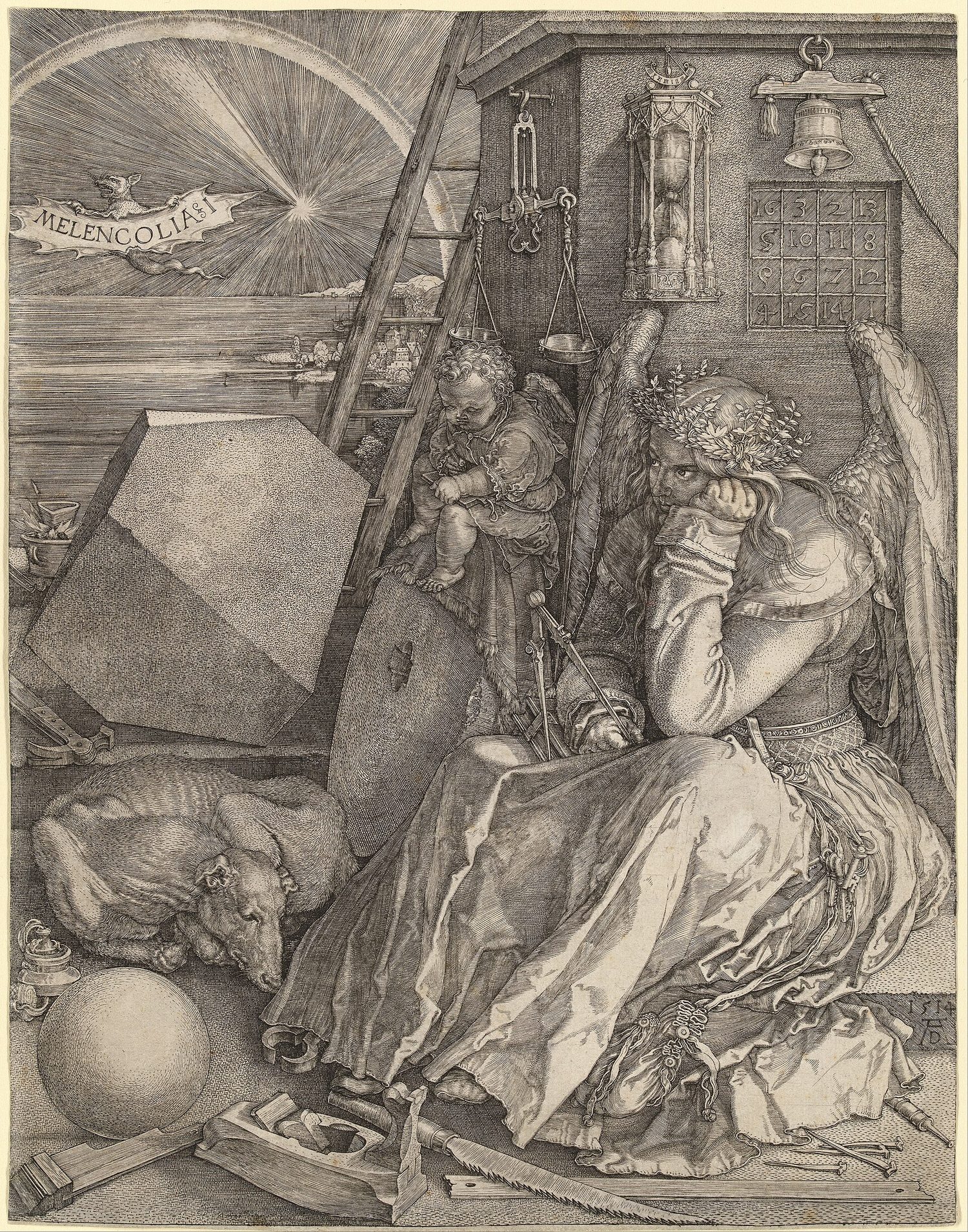
다양한 도구와 상징으로 둘러싸인 날개가 달린 앉아 있는 인물상의 밀도 높은 고세밀도 오래된 인쇄물, 모든 것이 미세한 각인 선들로 구성됨
뒤러의 각인화 '멜렌콜리아 I': 인테이리오 기법에서 선은 금속 플레이트에 파여지며, 각인이 가능하게 하는 세밀하고 밀집된 선들은 깊은 그림자와 풍부한 디테일을 형성한다
Explore · ⁨탐색하기⁩

Which printmaking process? · ⁨어떤 인쇄(process) 방식입니까?⁩

Relief prints from the raised surface; intaglio from lines cut below the surface; planographic from a flat greasy image; stencil pushes ink through a mesh. · ⁨레리프(relief) 인화는 돌출된 표면에서; 인타리오(intaglio) 는 표면 아래에 파인 선에서; 플라노그래픽(planographic) 은 평평한 기름 얼룩 이미지에서; 스텐실(stencil) 은 망사(mesh)를 통해 잉크를 밀어 넣습니다.⁩

Vocabulary · ⁨어휘⁩ Train · ⁨연습하기⁩
English 한국어
Printmaking/ˈprɪntmeɪkɪŋ/ 프린팅
matrix/ˈmeɪtrɪks/ 매트릭스(matrix)
edition/ɪˈdɪʃn/ 에디션
Relief/rɪˈliːf/ 리리프
Intaglio/ɪnˈtæɡlɪəʊ/ 안티갈로
Planographic/ˌplænəˈɡræfɪk/ 플라노그래픽
Stencil/ˈstensl/ 스텐실
Collage/kɒˈlɑːʒ/ 콜라주
mixed media/mɪkst ˈmiːdiːə/ 믹스 미디어
3.4

Collage and Mixed Media · ⁨콜라주 및 복합 매체⁩

Syllabus
English

Focus: Collage assembles found materials onto a surface; mixed media combines two or more materials or processes.

  • Collage glues papers, photos, fabric, or found objects into a composition.
  • Mixed media layers, for example, drawing over paint, or print with stitching.
  • These processes add actual texture and unexpected juxtapositions of image and meaning.
  • Materials can carry meaning (a ticket, a map) beyond their visual role.
  • Good mixed-media work still uses the elements and principles to stay unified.
한국어

핵심 개념: 콜라주는 발견한 소재를 배경 위에 배치하여 구성하는 것이고, 믹스 미디어는 두 개 이상의 소재나 기법을 결합합니다.

  • 콜라주는 종이, 사진, 천 또는 수집한 물건을 접착하여 작곡을 만듭니다.
  • 믹스 미디어는 예를 들어, 페인트 위에 드로잉을 하거나 인쇄물에 스티치(바느질)를 더하는 식의 레이어링 기법입니다.
  • 이러한 과정들은 실제 질감(actual texture) 을 추가하고 이미지와 의미의 예상치 못한 병치를 만들어냅니다.
  • 소재는 시각적 역할 이상으로 의미를 담을 수 있습니다(예: 표, 지도).
  • 훌륭한 믹스 미디어 작품은 여전히 요소와 원리를 사용하여 통일성을 유지해야 합니다.

Source: College Board AP Course and Exam Description · ⁨출처: College Board AP Course and Exam Description⁩

English

Collage 拼贴 assembles found materials onto a surface; mixed media 综合媒介 combines two or more materials or processes.

  • Collage glues papers, photos, fabric, or found objects into a composition.
  • Mixed media layers processes — for example, drawing over paint, or print with stitching.
  • These add actual texture and unexpected meaning; a found material (a ticket, a map) can carry meaning beyond its look.
한국어

콜라주는 발견된 재료를 표면에 조립하는 것이며, 복합 매체는 두 개 이상의 재료나 공정을 결합하는 것이다.

  • 콜라주는 종이, 사진, 천 또는 발견된 물체를 접착제에 붙여 구상을 만든다.
  • 복합 매체는 공정을 층층이 쌓는다. 예를 들어, 페인트 위에 그리거나, 스티치로 프린트를 추가하는 경우.
  • 이들은 실재하는 질감과 예상치 못한 의미를 더합니다. 발견된 재료(티켓, 지도 등)는 외관 이상으로 의미를 담을 수 있다.
3.5

Photography and Lens-Based Media · ⁨사진 및 렌즈 기반 매체⁩

Syllabus
English

Focus: Photography makes images with light and a lens; the same elements and principles apply to the frame.

  • Key controls: framing/composition, focus, exposure (light), depth of field, and viewpoint.
  • The rule of thirds, leading lines, and negative space compose a photograph.
  • Light direction and quality (hard/soft) shape value, form, and mood.
  • Editing (cropping, contrast, colour) is part of the creative process, not just correction.
  • Digital and darkroom processes both count as lens-based 2-D art and design.
한국어

핵심 개념: 사진은 빛과 렌즈를 사용하여 이미지를 생성하며, 동일한 요소와 원리가 프레임 구성에도 적용됩니다.

  • 주요 조절 요소: 구도/프레임 구성, 초점, 노출(빛), 심도(초점 거리), 시점입니다.
  • 삼등분 법則, 인引导선, 그리고 여백이 사진을 구성합니다.
  • 빛의 방향과 성질(단단함/부드러움)은 명암, 입체감, 분위기를 형성합니다.
  • 편집(editing) (잘라내기, 콘트라스트, 색상)은 단순한 수정이 아닌 창작 과정의 일부입니다.
  • 디지털 및 다크룸 처리 과정 모두 렌즈 기반 2-D 예술 및 디자인에 포함됩니다.

Source: College Board AP Course and Exam Description · ⁨출처: College Board AP Course and Exam Description⁩

English

Photography 摄影 makes images with light and a lens; the elements and principles apply to the frame just as in any 2-D work.

  • Key controls: framing, focus 对焦, exposure 曝光 (light), depth of field 景深, and viewpoint.
  • The rule of thirds, leading lines, and negative space compose a photograph.
  • Editing 后期 (cropping, contrast, colour) is part of the creative process, not just correction.
한국어

사진은 빛과 렌즈를 사용하여 이미지를 만듭니다. 요소와 원리는 2-D 작품과 동일하게 프레임에 적용됩니다.

拥挤한 배의 승객들을 담은 흑백 사진, 갑판 계단에 의해 두 층으로 분리되어 강력한 기하학적 형태를 형성함
알프레드 스티글리츠의 '스티어리지': 유명한 초기 예술 사진作品; 계단, 연통 및 인물들이 강력한 기하학적 구도를 형성하므로, 요소와 원리는 사진에도 적용된다
  • 핵심 조절 변수: 구도(framing), 초점(focus), 노출(exposure) (빛), 심도(depth of field), 그리고 시점(viewpoint)입니다.
  • 삼등분 법칙, 유도선, 그리고 여백이 사진을 구성한다.
  • 편집(editing) (잘라내기, 콘트라스트, 색상)은 단순한 수정이 아닌 창작 과정의 일부입니다.
Vocabulary · ⁨어휘⁩ Train · ⁨연습하기⁩
English 한국어
Photography/fəˈtɒɡrəfi/ 사진 촬영
focus/ˈfəʊkəs/ 초점
exposure/ekˈspəʊʒə/ 노출
depth of field/depθ ɒv fiːld/ 초점 거리
Editing/ˈedɪtɪŋ/ 편집
Digital media/ˈdɪdʒɪtl ˈmiːdiːə/ 디지털 미디어
Raster/ˈræstə/ 라스터
vector/ˈvektə/ 벡터
Layers/ˈleɪəz/ 층
resolution/ˌrezəˈluːʃn/ 분해능(resolution)
Graphic design/ˈɡræfɪk dɪˈzaɪn/ 그래픽 디자인
illustration/ˌɪləˈstreɪʃn/ 일러스트레이션
type/taɪp/ 글자
3.6

Digital Art and Design · ⁨디지털 아트 및 디자인⁩

Syllabus
English

Focus: Digital tools create and edit images on a computer or tablet, working in layers and pixels or vectors.

  • Raster images are made of pixels (photo editing, painting apps); vector images use math paths (scalable).
  • Layers let an artist build, mask, and revise non-destructively.
  • Digital colour uses RGB (screen, additive) or CMYK (print, subtractive).
  • Resolution (DPI/PPI) affects print quality; keep files high-resolution for the portfolio.
  • The same elements and principles guide digital work as any other 2-D medium.
한국어

핵심 개념: 디지털 도구는 컴퓨터나 태블릿에서 이미지를 생성하고 편집하며, 레이어, 픽셀 또는 벡터 방식으로 작업합니다.

  • 래스터(raster) 이미지는 픽셀로 구성됩니다(사진 편집, 페인팅 앱용); 벡터 이미지는 수학적 경로를 사용합니다(확장 가능).
  • 레이어는 아티스트가 비파괴적으로作品을 구축, 가리키기 및 수정할 수 있게 합니다.
  • 디지털 색상은 RGB(화면, 가산법) 또는 CMYK(인쇄, 감산법)를 사용합니다.
  • 해상도(DPI/PPI)는 출력 품질에 영향을 미치므로 포트폴리오용 파일은 고해상도로 유지하십시오.
  • 디지털 작업에도 다른 모든 2-D 매체와 동일하게 요소와 원리가 적용됩니다.

Source: College Board AP Course and Exam Description · ⁨출처: College Board AP Course and Exam Description⁩

English

Digital media 数字媒介 create and edit images on a computer or tablet, working in layers.

  • Raster 位图 images are made of pixels (photo editing, digital painting); vector 矢量 images use maths paths and scale without losing quality.
  • Layers 图层 let an artist build, mask, and revise without damaging earlier work.
  • Digital colour uses RGB (screen, additive) or CMYK (print, subtractive); keep files high-resolution 分辨率 for the portfolio.
한국어

디지털 매체는 컴퓨터나 태블릿 위에서 레이어를 사용하여 이미지를 생성하고 편집한다.

  • 래스터 이미지는 픽셀로 이루어져 있으며(포토 편집, 디지털 페인팅), 벡터 이미지는 수학적 경로를 사용하며 확대해도 품질이 떨어지지 않는다.
  • 레이어는 아티스트가 기존 작업을 손상시키지 않고 구축, 가림, 수정할 수 있게 한다.
  • 디지털 색상은 RGB(화면, 가산법) 또는 CMYK(인쇄, 감산법)를 사용하며, 포트폴리오용 파일은 고해상도로 유지해야 한다.
가산법과 감산법의 색상 비교
빛(RGB)을 섞으면 밝아져 하얀색으로趋向,.extent pigment(CMY)를 섞으면 어두워져 검은색으로趋向
3.7

Graphic Design and Illustration · ⁨그래픽 디자인 및 일러스트레이션⁩

Syllabus
English

Focus: Graphic design communicates a message visually; illustration makes images that support or tell a story.

  • Design combines type, image, colour, and layout to communicate to a viewer or client.
  • Visual hierarchy (size, weight, contrast, placement) guides the eye to what matters first.
  • Typography — typeface, size, spacing, alignment — is a core design element.
  • Illustration serves a purpose: editorial, book, product, poster, or narrative.
  • Design and illustration are problem-solving: audience and message shape every choice.
한국어

핵심: 그래픽 디자인은 시각적으로 메시지를 전달하며; 일러스트레이션은 이미지를 제작하여-support하거나 이야기를 전한다.

  • 디자인은 타이포그래피, 이미지, 색상, 레이아웃을 결합하여 시청자나 클라이언트에게 전달한다.
  • 시각적 계층 구조(크기, 두께, 대비, 배치)는 시선을 가장 중요한 요소로 이끈다.
  • 타이포그래피—폰트, 크기, 간격, 정렬—은 핵심 디자인 요소이다.
  • 일러스트레이션은 목적이 있다: 편집, 책, 제품, 포스터, 또는 서사적 목적.
  • 디자인과 일러스트레이션은 문제 해결 과정이며; 대상과 메시지가 모든 선택을 형성한다.

Source: College Board AP Course and Exam Description · ⁨출처: College Board AP Course and Exam Description⁩

English

Graphic design 平面设计 communicates a message visually; illustration 插画 makes images that support or tell a story.

  • Design combines type 字体, image, colour, and layout to reach a viewer or client.
  • Visual hierarchy guides the eye to what matters first, through size, weight, and placement.
  • Typography 字体排印 — typeface, size, spacing, alignment — is a core design tool.
  • Design and illustration are problem-solving: the audience and message shape every choice.

Worked example (writing about process). When your written evidence must explain a material and process: "I used charcoal on toned paper because its soft, smudgeable line let me build deep shadow quickly, and I lifted highlights with an eraser to suggest form." Notice the shape — name the medium, say why you chose it, and connect it to the idea you were exploring. Listing a material with no reason earns little.

한국어

그래픽 디자인은 시각적으로 메시지를 전달하는 것이며, 일러스트레이션은 이야기를 지원하거나 서사하는 이미지를 만드는 것이다.

  • 디자인은 타입, 이미지, 색상, 레이아웃을 결합하여 시청자나 클라이언트에게 도달한다.
  • 시각적 계층 구조는 크기, 무게, 배치 등을 통해 시선이 가장 중요한 부분에 먼저 집중되게 안내한다.
  • 타이포그래피(typography) — 폰트, 크기, 간격, 정렬 —은 핵심 디자인 도구입니다.
  • 디자인과 일러스트레이션은 문제 해결입니다. 대상과 메시지가 모든 선택을 결정한다.

작업 예시 (과정 설명). 작성된 증거가 재료와 과정을 설명해야 할 때: "부드럽고 번질 수 있는 선을 가진 채소를 톤纸张에 사용하여 깊은 그림자를 빠르게构建할 수 있었고, 지우개로 하이라이트를 제거하여 입체를 암시했다." 이 형식을 주의하라: 매체를 명시하고, 왜 선했는지 말하며, 탐구하던 아이디어와 연결하라. 이유 없이 재료를 나열하면 점수가 낮다.

Vocabulary · ⁨어휘⁩ Train · ⁨연습하기⁩
English 한국어
Typography/taɪˈpɒɡrəfi/ 타이포그래피
3.7

Exam tips · ⁨시험 팁⁩

English
  • Match the medium to the intended effect, and justify the choice.
  • For printmaking, state relief versus intaglio, and remember the printed image reverses.
  • Explain transparent versus opaque paint, and layers and vector versus raster in digital work.
  • Treat collage and mixed media materials as meaning, not just texture.
  • In graphic design, show a clear visual hierarchy serving the message.
한국어
  • 의도한 효과에 맞는 매체를 맞추고, 그 선택을 정당화하라.
  • 인쇄의 경우 릴리프와 인테이리오를 명시하고, 인쇄된 이미지가 반전됨을 기억하라.
  • 투명과 불투명 페인트, 그리고 디지털 작업에서의 레이어와 벡터 versus 래스터를 설명하라.
  • 콜라주와 복합 매체의 재료를 단순히 질감이 아닌 의미로 처리하라.
  • 그래픽 디자인에서는 메시지를 지원하는 명확한 시각적 계층 구조를 보여라.

Interactive lessons on this topic · ⁨이 주제에 대한 인터랙티브 수업⁩

Work through it step by step, with instant-check exercises. · ⁨즉시 체크 기능 exercises를 통해 단계별로 진행하세요.⁩

More topics in AP 2-D Art and Design · ⁨AP 2D 예술 및 디자인⁩ · ⁨AP 2-D Art and Design · ⁨AP 2D 예술 및 디자인⁩ 내 추가 주제⁩

Log in or create account · ⁨로그인 또는 계정 만들기⁩

IGCSE, A-Level & AP