Skip to content

Writing

TOEFL Junior · Topic 6

Video lesson for this topic Open the video page
5:20

TOEFL Junior · Writing

The Writing test has four task types and five questions in about forty minutes. Two Edit sets, where you fix errors in a short paragraph. An E-mail, where you…

English narration · English and 中文 subtitles you can switch

6.1

What this topic covers

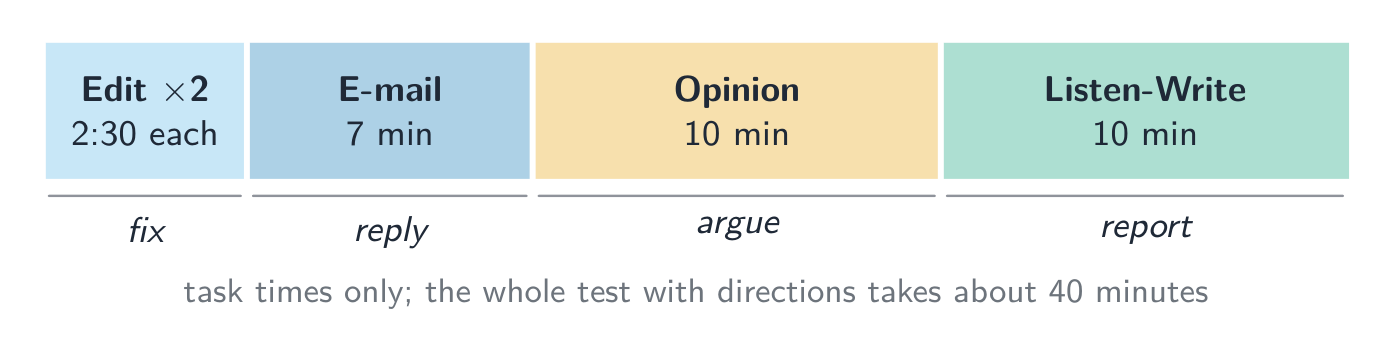
The TOEFL Junior Writing test has four task types and five questions in about 40 minutes. You type your answers, and an automated scoring engine trained on human ratings scores them. The total is 0–16: B1 starts at 10 and B2 at 13.

The Writing test in order: two Edit sets of 2 minutes 30 seconds each, an E-mail in 7 minutes, an Opinion paragraph in 10 minutes and a Listen-Write task in 10 minutes
Five questions, four task types, about 40 minutes
  • Edit (two sets): choose the correct options in an academic paragraph.
  • E-mail: reply to a school e-mail and answer its questions.
  • Opinion: one paragraph of about 100–150 words on a school topic.
  • Listen-Write: hear a short academic talk with pictures, then write about it.
  • Memory hook: fix, reply, argue, report.
6.2

What the score descriptors ask for

Score CEFR A typical student…
13–16 B2 completes sentences correctly nearly all of the time; writes simple and complex sentences accurately; answers informal questions clearly, completely and appropriately; gives an opinion with substantial detail and development; conveys all main ideas and details of a lecture
10–12 B1 completes sentences correctly most of the time; writes some complex sentences with occasional errors; usually answers clearly and appropriately; gives an opinion with some development; conveys the main ideas of a lecture
  • Each task has its own key word: Edit → correct, E-mail → complete, Opinion → developed 充分展开的, Listen-Write → accurate.
Vocabulary Train
English
developed/dɪˈveləpt/
6.3

Task 1: Edit

You read a paragraph about an academic topic with choices inside it. You choose the correct option for each sentence. Each of the two sets has 2 minutes 30 seconds.

  • Use the Language Form and Meaning routine from Topic 3: read the whole sentence, name the job, remove wrong jobs, choose by meaning.
  • Common points: subject–verb agreement, tense with time words, connectors, word forms, the passive.

"Honeybees [ lives / live / living / to live ] in large groups called colonies. Each colony [ have / are having / has / having ] one queen." Plural subject → live; each colony is singular → has.

6.4

Task 2: E-mail

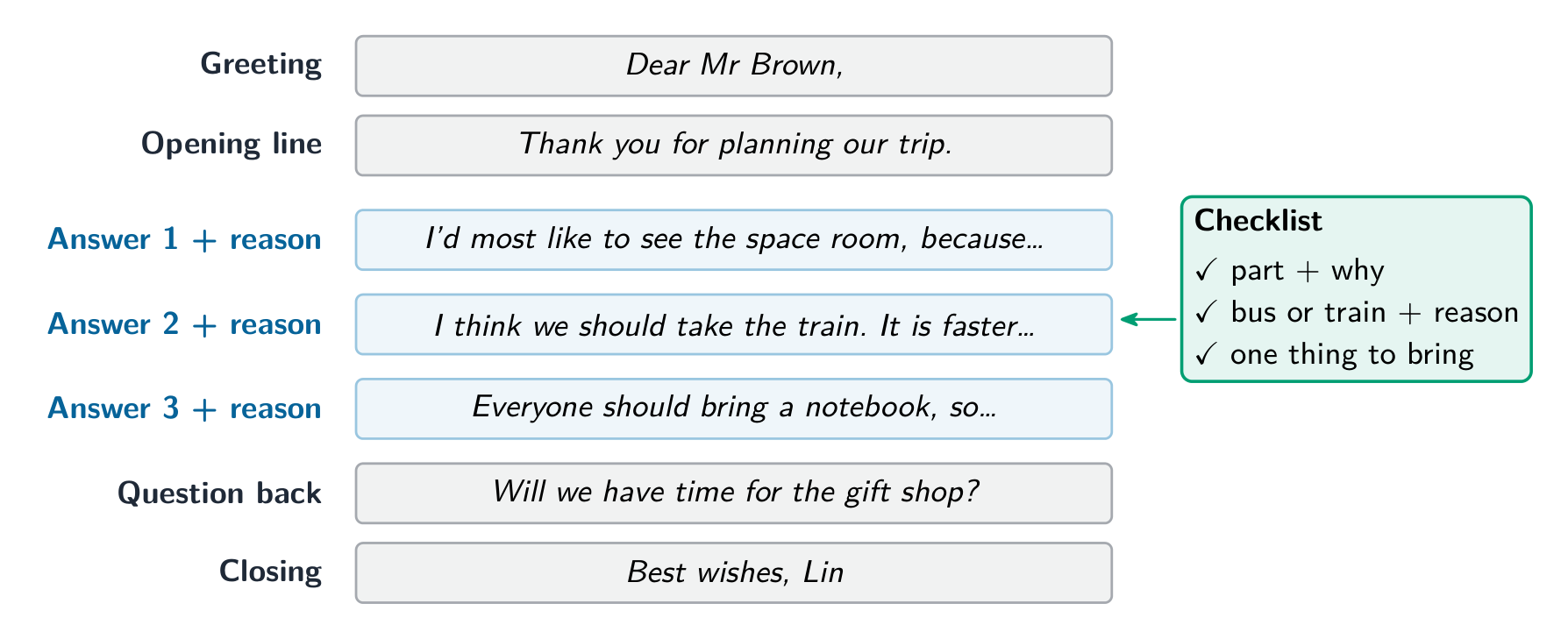
You read a school e-mail that asks some questions, then write a reply in seven minutes.

An e-mail reply in five parts: greeting, opening line, one short answer paragraph per question with a reason, an optional question back, and a closing; on the right a three-item checklist with every question ticked
Five parts, and a checklist so every question gets an answer
  • Checklist first: underline every question. "Which part would you like to visit, and why?" is two parts.
  • Blocks: 1 minute read and checklist, 5 minutes write, 1 minute check.
  • Add a reason or detail to every answer with because, so, for example.
  • Tone for a teacher: friendly and polite (I'd like to…, Could we…?). No text-message style, no very formal phrases.
  • ⚠ The most common lost point is a missing answer, not a grammar error.
6.5

Task 3: Opinion

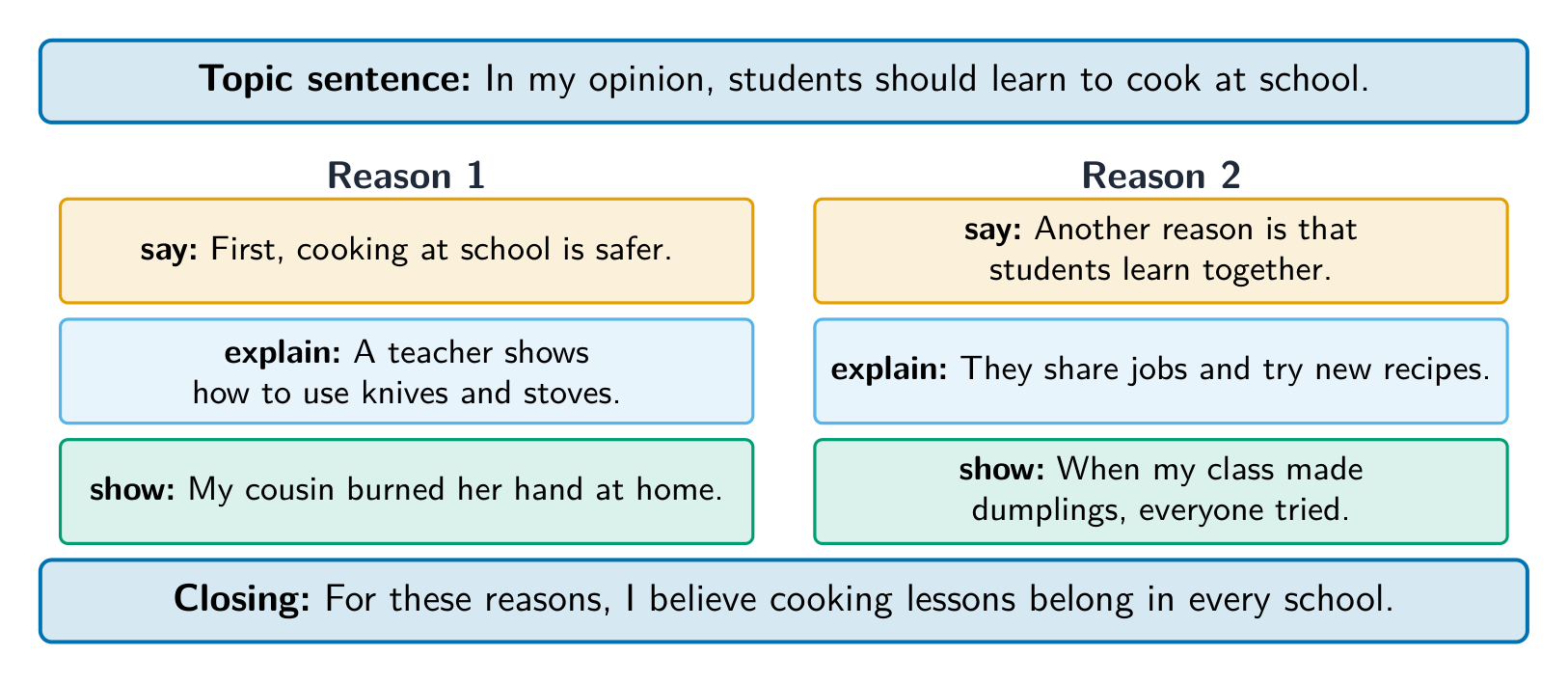
You read a question about a school topic and write one paragraph of about 100–150 words in 10 minutes.

The opinion paragraph shape: a topic sentence with the opinion, reason 1 with explain and show, reason 2 with explain and show, and a closing sentence that restates the opinion in new words
Say, explain, show: that is what development means
  • Plan (2 minutes): choose the side you can explain best and note two reasons with one example each.
  • Develop each reason: say it (First, cooking at school is safer.), explain it (A teacher can show how to use knives and stoves.), show it with a specific 具体的 example (My cousin burned her hand at home because nobody showed her the oven.).
  • Link with In my opinion, First, For example, Another reason is, For these reasons.
  • ⚠ Two reasons with examples beat four reasons without them.
Vocabulary Train
English
specific/spəˈsɪfɪk/
6.6

Task 4: Listen-Write

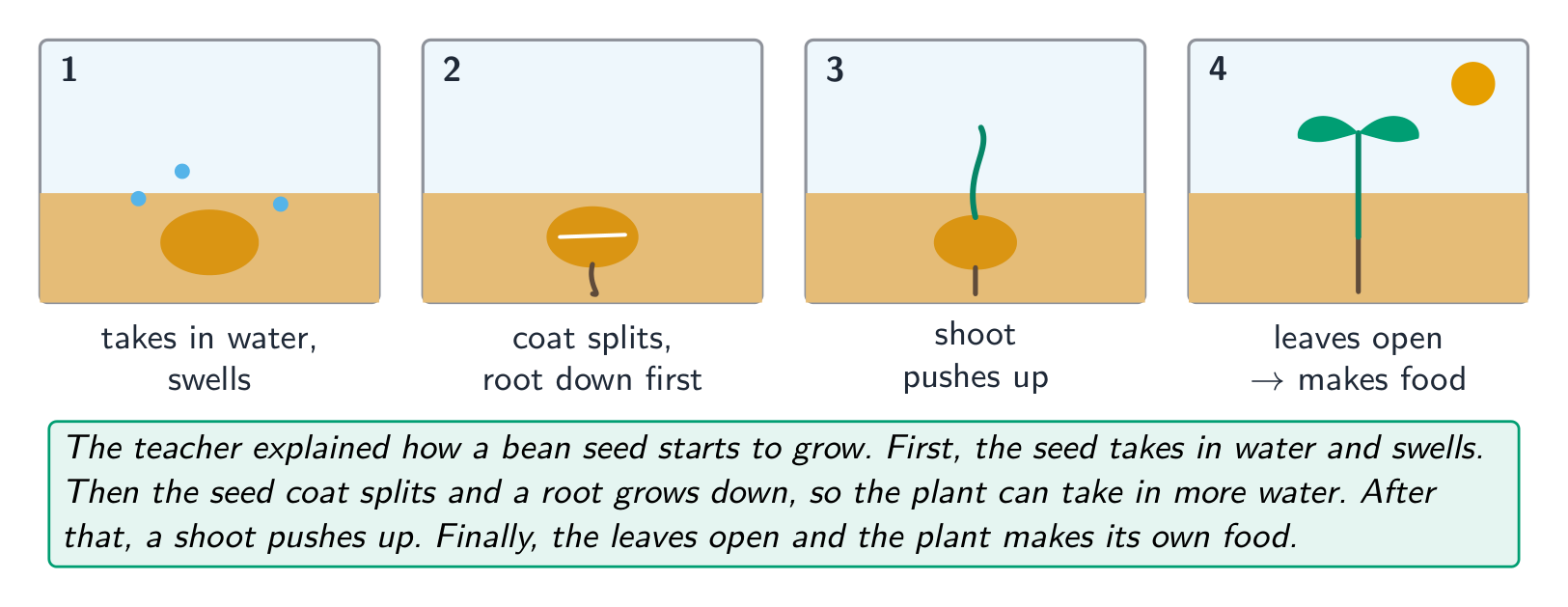
You hear a short academic talk while you see one or more pictures, then write about it in 10 minutes. You may take notes.

Listen-Write from talk to text: four pictures of a bean seed growing (swells with water, root grows down, shoot pushes up, leaves open), the notes taken under each picture, and the written report that follows the same order
The pictures are memory hooks: one picture, one step in your report
  • Write the main point first: The teacher explained how a bean seed starts to grow.
  • Then the steps or causes in the speaker's order, with first, then, after that, finally.
  • Report, don't add: no facts you already knew, no opinion.
  • Check that the teacher's main point and every picture appear in your text.
6.7

Proofread in the last minute

  • Every question answered? Every reason with an example?
  • Verbs: -s on a singular present verb, past forms in a past story, will not in an if part.
  • Every sentence starts with a capital letter and ends with a full stop.
  • ⚠ Don't copy long parts of the e-mail or question. Copied words show no writing skill.
6.8

Watch out: traps for Chinese speakers

  • ⚠ Run-on sentences. A comma cannot join two full sentences: I like the train, it is fast ✗ → I like the train because it is fast.
  • ⚠ Missing articles and plurals: I want to visit space room ✗ → the space room; two box ✗ → two boxes.
  • ⚠ "Very" everywhere. Very good, very important, very interesting says little. Give the reason or example instead.
  • ⚠ Both sides. Both school and home are good does not choose. The task asks for your opinion.
6.9

Try it

  1. Edit. Choose: "The Great Wall [ build / was built / building / has build ] over many centuries. It [ stretch / stretching / stretches / to stretch ] across northern China, [ but / so / because / unless ] much of it has now fallen down."
  2. E-mail. Your teacher writes: "Our class will plant a garden. Which plants should we grow, and why? Which day can you help? What tools should we buy?" Write your reply in seven minutes.
  3. Opinion. "Should students have homework every day? Use reasons and examples." Ten minutes.
  4. Listen-Write. Read this talk once, take notes, cover it, then write: "A seed needs water, air and the right temperature to start growing, but not light, because it carries its own food. First, the seed takes in water and swells. Second, the seed coat splits and a root grows down. The root grows first, so the plant can take in more water. Third, a shoot pushes up. Finally, the first leaves open in the light, and the plant starts making its own food."

Answers and checks. 1 was built (the wall receives the action), stretches (singular it, present fact), but (contrast). 2 Three answers (plants + why, a day, tools), each with a reason; greeting, opening line, polite closing. 3 A clear side, two reasons each explained and shown, a closing sentence in new words, about 100–150 words. 4 Main point; needs (water, air, temperature, not light) with the reason; four steps in order; why the root comes first.

6.10

Check yourself

Answer first, then read the explanation.

  1. How many questions are in the Writing test? — Five: two Edit sets, E-mail, Opinion, Listen-Write.
  2. What is the first thing to do in the E-mail task? — Make a checklist of every question part.
  3. How long should the Opinion paragraph be? — About 100–150 words, one paragraph.
  4. What does "development" mean? — Say, explain and show each reason with a specific example.
  5. Should you add your own knowledge in Listen-Write? — No. Report what the speaker said.

Vocabulary card meanings

developed: Explained fully, with reasons and examples. specific: Exact and detailed, about one real thing.

Interactive lessons on this topic

Work through it step by step, with instant-check exercises.

More topics in TOEFL Junior

Log in or create account

IGCSE, A-Level & AP