Skip to content

Speaking

TOEFL Junior · Topic 5

Video lesson for this topic Open the video page
5:07

TOEFL Junior · Speaking

The Speaking test has four tasks in about eighteen minutes, and you speak into a microphone. Task one, read a short passage aloud. Task two, tell the story in…

English narration · English and 中文 subtitles you can switch

5.1

What this topic covers

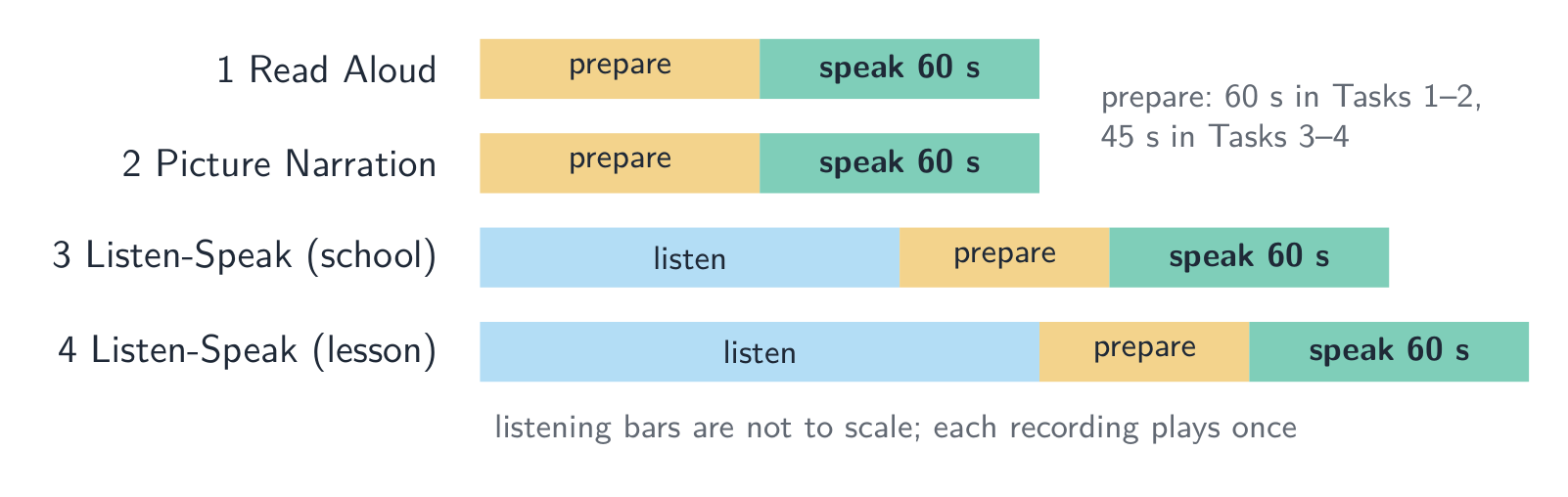
The TOEFL Junior Speaking test has four tasks in about 18 minutes. You speak into a microphone on a computer, and ETS-trained raters score the recordings. The total is 0–16: B1 starts at 11 and B2 at 14.

The four Speaking tasks as time bars: Read Aloud with one minute to prepare and one to speak, Picture Narration with one and one, and the two Listen-Speak tasks with a recording, 45 seconds to prepare and one minute to speak
Every task ends with one minute of speaking
  • Task 1 Read Aloud: read a short passage aloud.
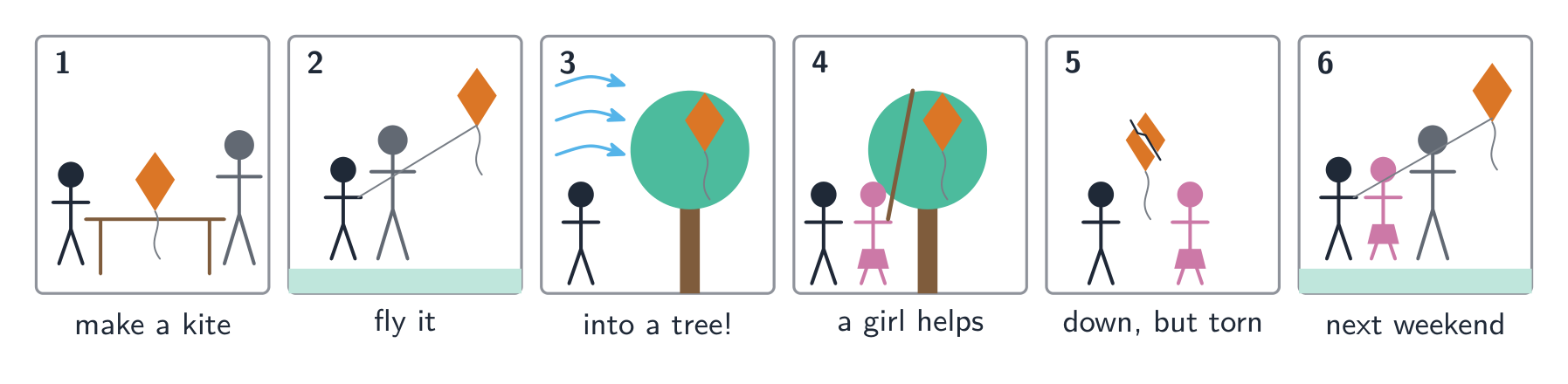
  • Task 2 Picture Narration: tell the story in six pictures.
  • Task 3 Non-academic Listen-Speak: retell 复述 a talk about school life.
  • Task 4 Academic Listen-Speak: retell a short lesson.
  • Memory hook: read, tell, retell, retell.
Vocabulary Train
English
retell
5.2

What the raters listen for

The handbook describes each score range. These are the key words for the B1 and B2 ranges:

Score CEFR A typical student…
14–16 B2 almost always speaks fluently 流利地 and uses intonation 语调 well; speech is always understandable; vocabulary and grammar are accurate and varied; tells a complete story with detail; conveys all main ideas and details of a lecture
11–13 B1 usually speaks fluently, with some stops; speech is usually understandable; some errors; the story is mostly complete; conveys the main ideas of a lecture, with some details missing
  • Three things run through every row: delivery (clear, steady speech), language (accurate grammar and words) and content (complete and detailed).
  • A native accent is not on the list. Clear speech is.
Vocabulary Train
English
fluently
intonation/ˌɪntəˈneɪʃn/
5.3

Task 1: Read Aloud

You get one minute to read the passage silently and one minute to read it aloud.

  • In the silent minute, find hard words and say them quietly, mark pauses at commas and full stops, and choose the words to stress: numbers, names, days, key nouns.
  • Read at a calm, steady speed. Speed is not a score; clarity is.
  • ⚠ Say every ending: -ed, -s, -ing. In fast reading they vanish, and walked sounds like walk.

"The library is open from eight in the morning | until five in the afternoon, || Monday to Friday. || Students may borrow up to four books at a time." Single bar = short pause; double bar = longer pause; bold = stress.

5.4

Task 2: Picture Narration

Six pictures tell a story with a beginning, a problem and an ending. You get one minute to prepare and one minute to speak.

A six-picture story strip: a boy and his grandfather make a kite; they fly it in the park; the wind blows it into a tall tree; a girl arrives with a long stick; they pull it down but it is torn; the next weekend all three fly the repaired kite
The kite story: picture 3 is the problem, picture 6 is the ending
  • Prepare: one or two keywords per picture, then decide the problem and the ending.
  • Tell: past simple for events (made, flew, blew); past continuous for background (while they were flying it); time links between pictures (one Saturday, suddenly, a few minutes later, in the end); reason links inside them (so, because, but).
  • Give each person a name and a feeling (upset, relieved 松了一口气的, proud) and add one small detail per picture.
  • About eight to twelve sentences fill the minute. ⚠ If time runs short, say the ending: a story needs one.

Model start. "One Saturday, Leo and his grandfather made a red kite with a long tail. They were very proud of it, so they took it to the park. While they were flying it, the wind suddenly got much stronger and blew the kite into a tall tree…"

Vocabulary Train
English
relieved
5.5

Tasks 3 and 4: Listen-Speak

You hear a talk, take notes, get 45 seconds to prepare and one minute to speak. Task 3 is about school life (an event, a rule, a plan); Task 4 is a short lesson (a process, a cause or a comparison).

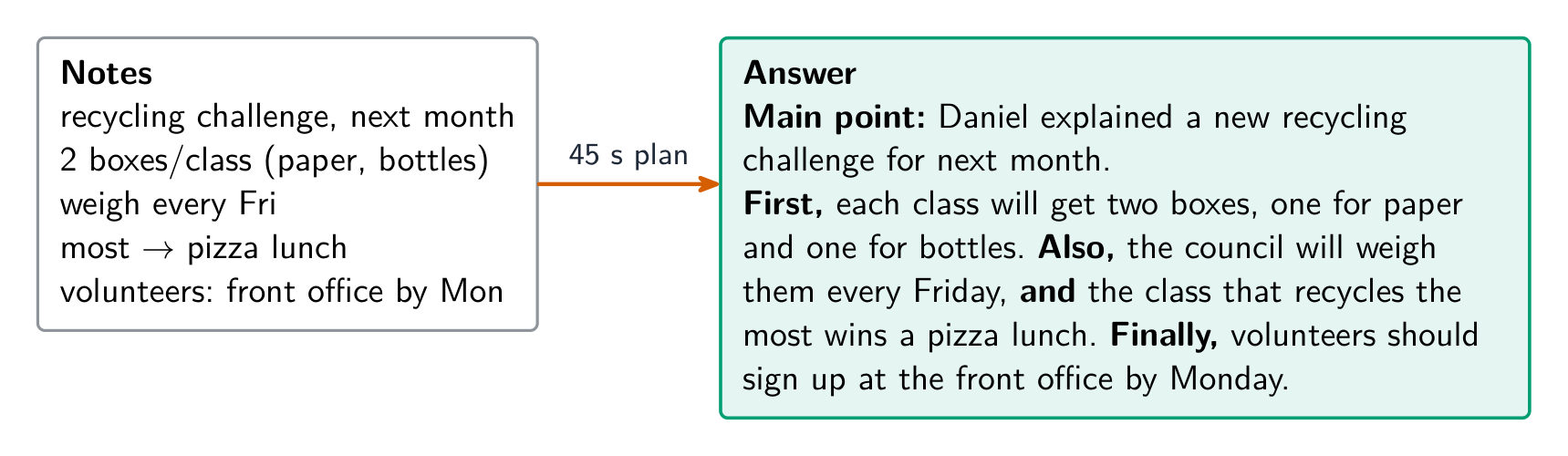
From notes to answer: notes in order on the left (recycling challenge, two boxes per class, weigh every Friday, winner gets pizza, volunteers sign up by Monday), an arrow to a spoken answer on the right that starts with the main point and then gives the details with linking words
Your notes are already the plan: main point first, then the details in order
  • Notes: key points in order, short words, numbers and arrows. Names, days, numbers, steps and reasons are worth writing.
  • 45 seconds: choose your first sentence (the main point) and number your details.
  • One minute: report the speaker (He said that… / The teacher explained that…), then the details with first, also, because, so, finally.
  • ⚠ Do not add your opinion or facts you already know. The task is to retell what you heard.
5.6

Delivery: stress, pauses and intonation

  • Word stress: one strong syllable per word: PHO-to-graph, pho-TO-gra-pher.
  • Sentence stress: stress content words (nouns, main verbs, adjectives, numbers); say a, the, to, of quickly.
  • Pauses go between word groups, never inside one: every Tuesday | after lunch, not every | Tuesday after | lunch.
  • Linking: join a final consonant to a next vowel: pick‿up, sign‿up, an‿apple.
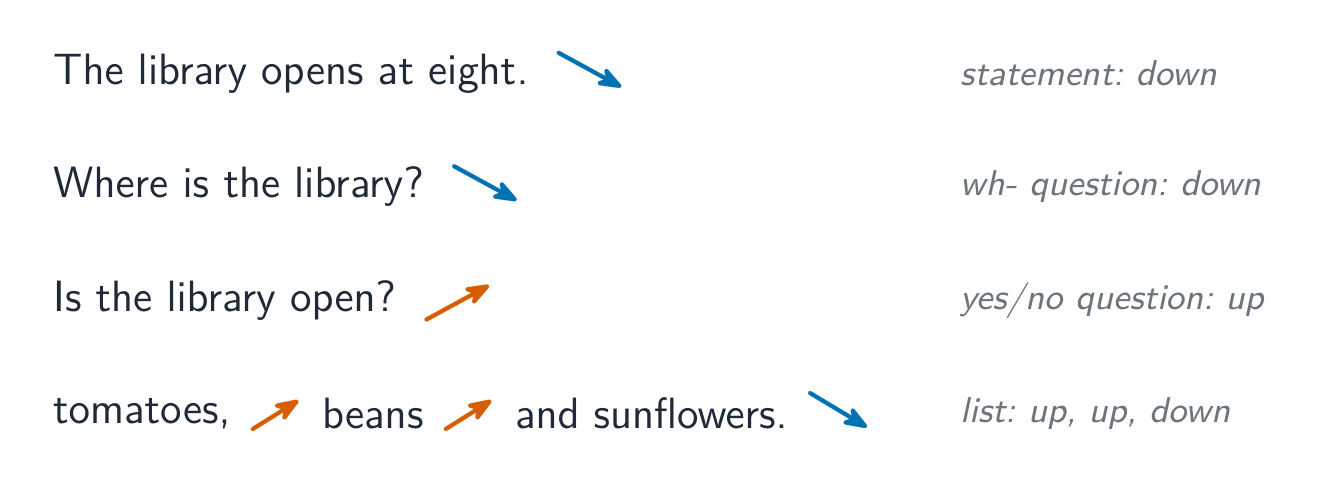
Intonation arrows: a statement and a wh- question fall at the end, a yes/no question rises, and a list rises on each item and falls on the last
Down for statements and wh- questions, up for yes/no questions, up-up-down for lists
5.7

Watch out: traps for Chinese speakers

  • ⚠ Extra vowels after final consonants: bookə, bigə. Keep the ending short and clean.
  • ⚠ Flat stress: giving every syllable the same weight sounds robotic. Lean on the stressed syllable.
  • ⚠ Tense in stories: Chinese does not mark tense on verbs, so he go, then he see is common. Plan your past forms in the preparation minute.
  • ⚠ Silence: a long silence wastes the minute. If you lose your place, say the next detail from your notes, or add a feeling to the story.
5.8

Try it

Prepare and record each task. Use a timer and listen back.

  1. Read Aloud. Mark pauses and stress, then read aloud in one minute: "Our school garden is open to all students. Every Tuesday and Thursday, after lunch, volunteers water the plants and pick up litter. This year, we have planted tomatoes, beans and sunflowers. If you would like to help, please sign up at the office."
  2. Picture Narration. Tell the kite story above in one minute after one minute of preparation.
  3. Listen-Speak (non-academic). Read this talk once, take notes, cover it, then retell it in one minute: "Hi everyone, I'm Daniel from the student council. Next month we're starting a recycling challenge. Each class will get two boxes, one for paper and one for plastic bottles. Every Friday, the council will weigh the boxes. The class that recycles the most wins a pizza lunch. If you want to help weigh the boxes, sign up at the front office by Monday."
  4. Listen-Speak (academic). Same method: "A large rainforest helps to make its own rain. First, the trees take up water through their roots. Second, the leaves release the water into the air as vapour. Third, the warm, wet air rises and cools, and the vapour forms clouds. Finally, rain falls back onto the forest. That's why cutting down many trees can make the remaining forest drier."

Check your recordings. 1 Pauses after students, Thursday, lunch; stress on Tuesday, Thursday, tomatoes, beans, sunflowers; up-up-down on the list. 2 All six pictures, past tense, a feeling, an ending. 3 Main point (a recycling challenge next month), then boxes, weighing, prize, volunteers. 4 Main point (the forest makes its own rain), then four steps in order, then the result of cutting trees.

5.9

Check yourself

Answer first, then read the explanation.

  1. How long do you speak in each task? — One minute.
  2. How long do you prepare in Listen-Speak? — 45 seconds. One minute in Tasks 1 and 2.
  3. What tense tells a picture story? — Past simple for events, past continuous for background.
  4. Should you give your opinion in Listen-Speak? — No. Report what the speaker said.
  5. Where does your voice go at the end of a yes/no question? — Up.

Vocabulary card meanings

retell: To tell something again in your own words. fluently: Smoothly and easily, without many stops. intonation: The rise and fall of the voice when speaking. relieved: Happy because a worry or problem has gone away.

Interactive lessons on this topic

Work through it step by step, with instant-check exercises.

More topics in TOEFL Junior

Log in or create account

IGCSE, A-Level & AP