Skip to content

Language Form and Meaning

TOEFL Junior · Topic 3

Video lesson for this topic Open the video page
5:02

TOEFL Junior · Language Form and Meaning

Language Form and Meaning gives you forty-two boxes in twenty-five minutes. That is about thirty-five seconds each, so you need a routine. Read the whole…

English narration · English and 中文 subtitles you can switch

3.1

What this topic covers

Language Form and Meaning is the second Standard section: 42 questions in 25 minutes, about 35 seconds each. You read short texts such as e-mails, notices and articles. Inside them are boxes with four choices. You choose the one that makes the sentence correct and fits the text. ETS says this section tests the enabling skills 基础技能 behind listening and reading: grammar and vocabulary in context.

A 30-second routine as four steps: read the whole sentence, name the job of the box, remove options with the wrong job, then choose by meaning
The 30-second routine: the job of the box removes most options before meaning decides
  • Most boxes test one of six things: verb tense, agreement, verb patterns, word forms, connectors and relative words, or word choice.
  • The clue may come after the box. Always read to the full stop.
  • Memory hook: job first, meaning second.
Vocabulary Train
English
enabling skills
3.2

Verbs: time words decide the tense

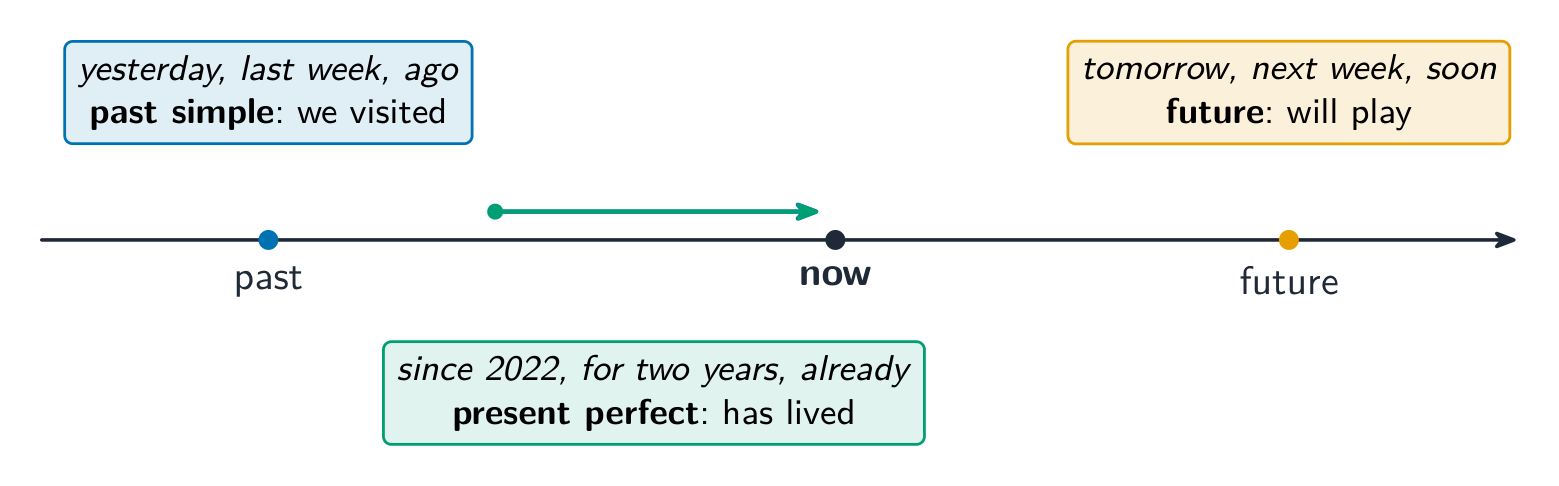
Look for a time word in the sentence, or in the sentence before it.

A timeline with past, now and future: yesterday and last week point to the past simple, since 2022 and already point from the past to now for the present perfect, tomorrow and next week point to the future
Time words point to the tense
Time words Tense Example
yesterday, last week, in 2019, ago past simple We visited the museum last week.
since, for, already, yet, ever present perfect My cousin has lived in Canada since 2022.
now, at the moment, look! present continuous Look, it is raining.
every day, usually, always present simple The library opens at eight every day.
tomorrow, next week, soon future The band will play tomorrow.
when …, while … (a past story) past continuous + past simple We were eating when the bell rang.
  • ⚠ In an article about a past event, the boxes are usually past too, even when the box's own sentence has no time word.
3.3

Agreement: find the real subject

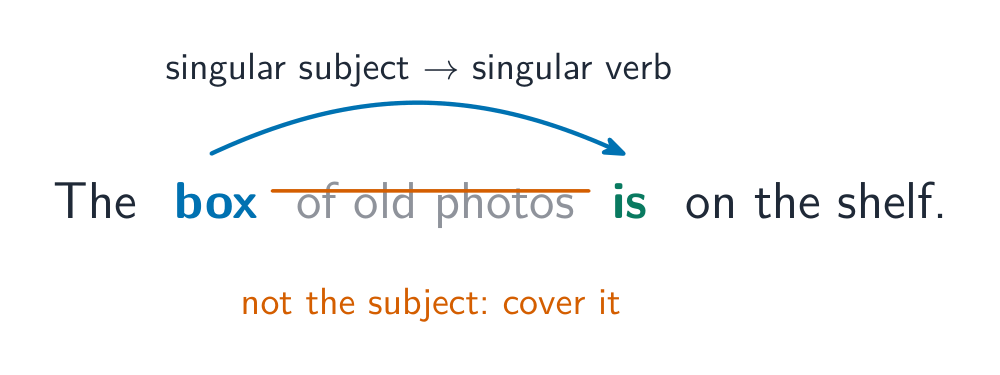
The verb agrees 一致 with its subject 主语, not with the nearest noun.

The sentence The box of old photos is on the shelf, with the subject box linked to the verb is by an arrow that jumps over the phrase of old photos, which is crossed out
Jump over the words in the middle: box … is
  • Phrases such as of the students, with his friends, that I bought sit between subject and verb. Cover them, then choose.
  • Each, every, everyone, nobody, either take a singular verb: Everyone in both classes gets a ticket.
  • Two subjects joined by and are plural: Mia and her brother are late.
  • There is / There are agrees with the noun after it: There are three new books on the desk.
Vocabulary Train
English
agrees
subject/ˈsʌbdʒekt/
3.4

Verb patterns and word forms

Verb patterns. Some verbs take to + verb, some take -ing, and a few take the base form.

Pattern Verbs Example
to + verb want, decide, hope, plan, agree, need We decided to visit the museum.
-ing enjoy, finish, avoid, mind, keep, practise She enjoys building models.
base form make, let, help (+ person) The coach made us run again.
after a preposition: -ing interested in, good at, before, after Are you interested in joining?

Word forms. Name the job of the box, then use the ending: -tion, -ment, -ness (noun); -ful, -ous, -ive, -al (adjective); -ly (adverb); -ify, -ise (verb).

  • Before a noun → adjective: a careful plan. After a verb → adverb: worked carefully.
  • After the, a, his and before of → noun: the building of the hall.
  • ⚠ Friendly, lovely, lonely end in -ly but are adjectives. -ed describes a feeling (interested); -ing describes the cause (an interesting talk).
3.5

Connectors, relative words and pronouns

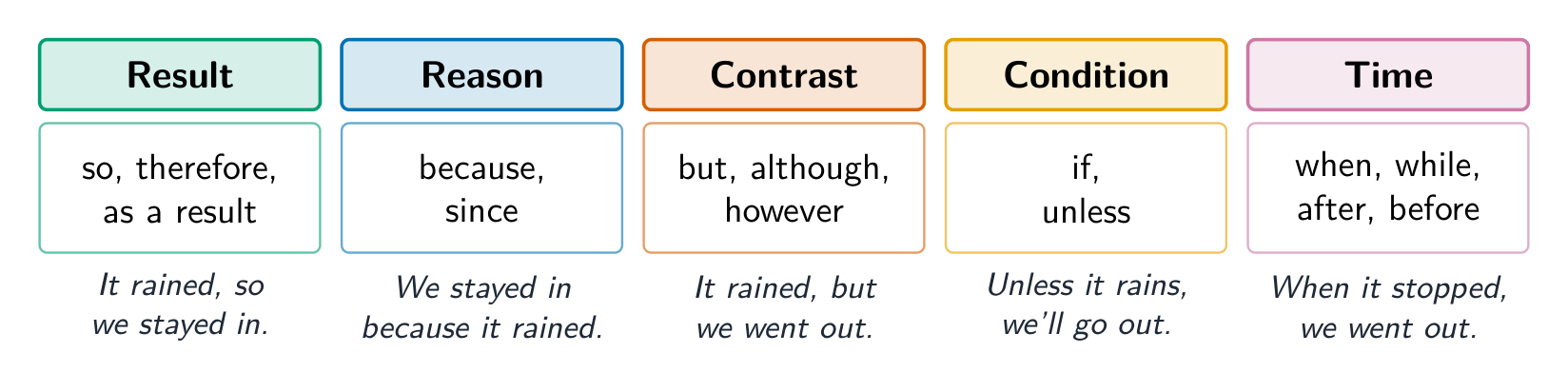
A connector 连接词 shows how two ideas link. All four options are often real words; only one has the right meaning.

Five kinds of link with their connectors: result (so, therefore, as a result), reason (because, since), contrast (but, although, however), condition (if, unless) and time (when, while, after, before)
Name the link first, then choose the connector
  • Relative words: who (people), which (things), whose (belonging), where (places), when (times). The park where we had our picnic.
  • Pronouns point back to one clear noun: the students → they, the school → it. Its (belongs to it) ≠ it's (it is); their ≠ there ≠ they're.
  • Comparison: two things → taller than, more useful than; three or more → the tallest, the most useful; equal → as tall as. Irregular: good, better, best; bad, worse, worst.
Vocabulary Train
English
connector
3.6

Passive, conditionals and word choice

  • Passive 被动语态 = be + past participle: The invitations were sent last week. A by phrase is a strong clue: The poem was written by a student.
  • Conditionals: fact → If you heat ice, it melts. Real future → If it rains, we will stay inside. Imagined → If I had wings, I would fly. ⚠ Never will in the if part.
  • Word choice: when all four options are grammatical, choose by meaning and collocation 搭配: make a mistake, do homework, take a photo, pay attention, raise money.
  • Articles: a or an for the first mention, the when the reader knows which one, no article for general plurals: Elephants can live for sixty years.
Vocabulary Train
English
passive/ˈpæsɪv/
collocation/ˌkɒləˈkeɪʃn/
3.7

Watch out: traps for Chinese speakers

  • ⚠ Missing -s. Chinese verbs do not change, so he go and three book look normal. In the test, check every singular subject for -s on a present verb, and every plural noun.
  • ⚠ Articles. Chinese has no a or the. A singular countable noun almost always needs one: We visited a beautiful garden.
  • ⚠ Tense after time words. Since and for need the present perfect, not the past: I have studied here for two years, not I study here for two years.
  • ⚠ Spending too long. At 35 seconds per box, a minute on one question costs another question later. Decide, mark, move on, and never leave a blank.
3.8

Try it

Choose the best option for each box. Cover the answers first.

Dear Ms Park,

Thank you for (1) [ A organise B organising C organised D to organising ] the science trip last Friday. Everyone in our class (2) [ A have B are C has D were ] talked about it all week. The museum guide, (3) [ A who B which C where D whose ] knew so much about dinosaurs, made the visit very (4) [ A interest B interested C interesting D interestingly ]. (5) [ A Because B Although C So D Unless ] the bus was late, we still saw every room. Next year, if the school (6) [ A will plan B plans C planned D planning ] another trip, I hope we can visit the space centre. The photos (7) [ A took B were taken C taking D have took ] by Mr Lee are now on the class website. Our class (8) [ A raised B rose C grew D lifted ] 500 yuan for the museum's children's room.

Best wishes, Lin

Answers. 1 B: after the preposition for → -ing. 2 C: everyone is singular, and has talked is present perfect with all week. 3 A: the guide is a person. 4 C: the visit causes the interest → -ing adjective. 5 B: late bus but still saw everything = contrast. 6 B: if + present for a real future. 7 B: the photos receive the action; by Mr Lee is the clue. 8 A: the collocation is raise money.

3.9

Check yourself

Answer first, then read the explanation.

  1. What do you check before meaning? — The job of the box: noun, verb, adjective, adverb or connector.
  2. The list of winners ___ on the wall. is or are? — is: the subject is list.
  3. Since 2022 needs which tense? — The present perfect: has lived.
  4. If it ___ tomorrow, we will stay in. — rains: no will in the if part.
  5. All four options are grammatical. What decides? — Meaning and collocation, and the sentences around the box.

Vocabulary card meanings

enabling skills: The basic grammar and vocabulary skills that listening and reading depend on. agrees: Has the matching form, for example a singular verb with a singular subject. subject: The person or thing that does the action of the verb. connector: A word that joins two ideas and shows how they are related. passive: A sentence form in which the subject receives the action, made with be + past participle. collocation: Words that are often used together, such as make a mistake.

Interactive lessons on this topic

Work through it step by step, with instant-check exercises.

More topics in TOEFL Junior

Log in or create account

IGCSE, A-Level & AP