Skip to content

The tests, scores and study plan

TOEFL Junior · Topic 1

Video lesson for this topic Open the video page
6:08

TOEFL Junior · The tests, scores and study plan

TOEFL Junior is not one test but a small family from ETS. The Standard test is multiple choice, 126 questions in one hour and fifty-five minutes, with a total…

English narration · English and 中文 subtitles you can switch

1.1

What this topic covers

TOEFL Junior is a family of English tests from ETS for students in middle school and the first years of high school. This topic explains what is in each test, what the numbers on a score report 成绩单 mean, and how to plan your practice.
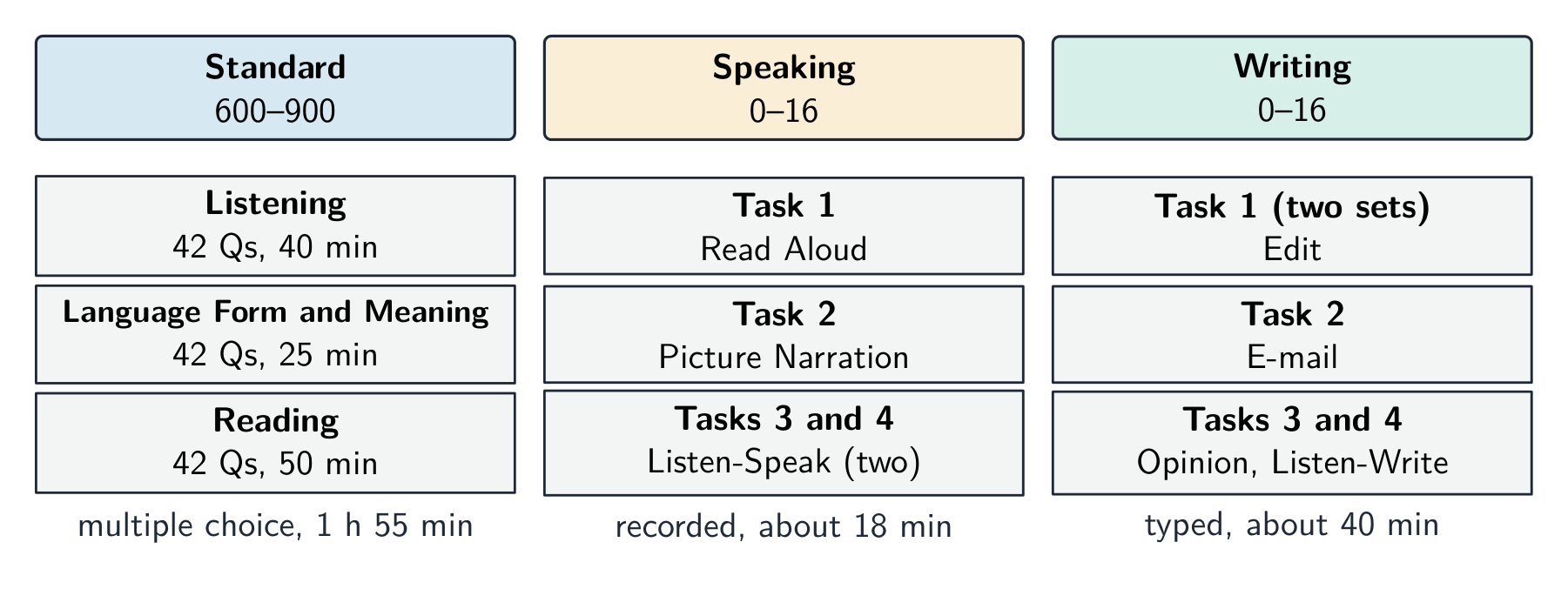
The TOEFL Junior family: the Standard test with three sections of 42 questions each, the Speaking test with four tasks and the Writing test with four task types
Three tests, one family: most schools give Standard; some add Speaking and Writing
  • TOEFL Junior Standard: 126 multiple-choice questions in three sections, 1 hour 55 minutes, total score 600–900.
  • TOEFL Junior Speaking: 4 recorded tasks in about 18 minutes, score 0–16.
  • TOEFL Junior Writing: 4 task types (5 questions) in about 40 minutes, score 0–16.
  • Your school or a local test centre arranges the test. You do not book a seat alone online.
  • Memory hook: Standard = choose, Speaking = record, Writing = type.
Vocabulary Train
English
score report
1.2

The Standard test, section by section

Section Questions Time What you do
Listening Comprehension 42 40 min Hear announcements, conversations and short lessons once; answer A–D
Language Form and Meaning 42 25 min Choose the word or phrase that completes a sentence in a text
Reading Comprehension 42 50 min Read notices, e-mails, stories and academic passages; answer A–D
  • The sections always come in this order: Listening, Language Form and Meaning, Reading.
  • Divide the time by the questions: Language Form and Meaning gives about 35 seconds per question; Reading about 70 seconds, including reading time. In Listening the recording sets the pace.
  • ⚠ Every question has four options and one answer. A blank earns nothing, so never leave one empty.
1.3

Speaking and Writing in one view

Speaking (recorded on a computer, scored by ETS-trained raters):

  1. Read Aloud: one minute to read a passage silently, one minute to read it aloud.
  2. Picture Narration: six pictures, one minute to prepare, one minute to tell the story.
  3. Non-academic Listen-Speak: hear a talk about school life, 45 seconds to prepare, one minute to speak.
  4. Academic Listen-Speak: hear a short lesson, 45 seconds to prepare, one minute to speak.

Writing (typed, scored by an automated scoring engine trained on human ratings):

  1. Edit (two sets): choose the correct options in an academic paragraph, 2 minutes 30 seconds each.
  2. E-mail: answer the questions in a school e-mail, 7 minutes.
  3. Opinion: one paragraph of about 100–150 words, 10 minutes.
  4. Listen-Write: hear a short academic talk with pictures, then write about it, 10 minutes.

Topics 5 and 6 teach each task in depth.

1.4

How to read a score report

Each Standard section is a scaled score 量表分 from 200 to 300, in steps of 5. The total is the three sections added together, so it runs from 600 to 900.

ETS also maps each section to a CEFR 欧洲语言共同参考框架 level. Listening and Reading share one table; Language Form and Meaning has slightly different cut-offs.

Two score scales from 200 to 300. Listening and Reading: below A2 under 210, A2 from 210, B1 from 245, B2 from 290. Language Form and Meaning: A2 from 210, B1 from 250, B2 from 280
The same section score can mean a different CEFR level in Language Form and Meaning

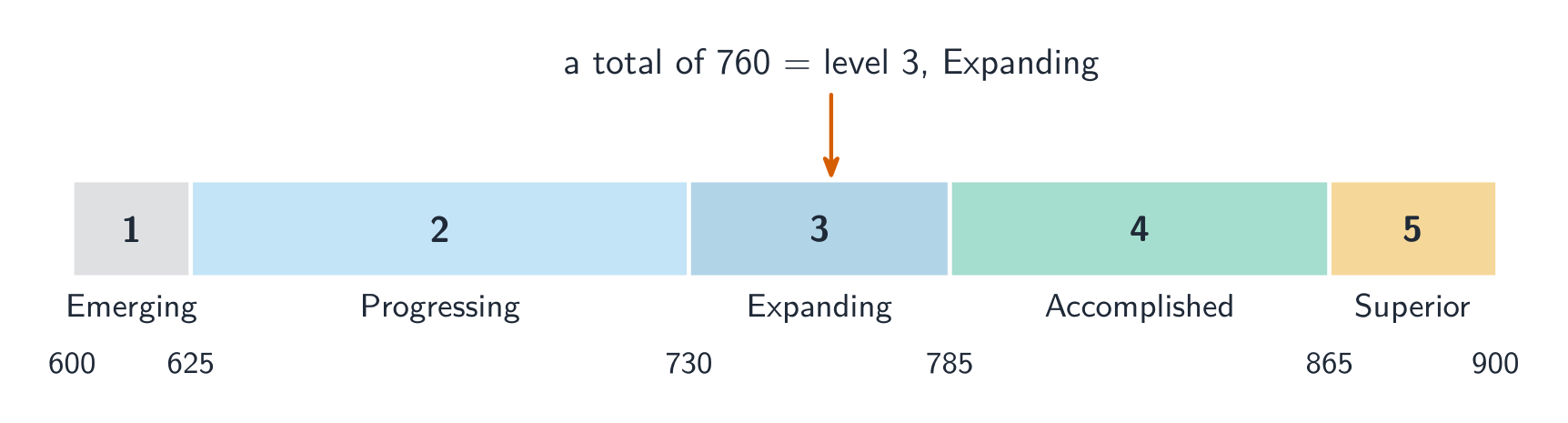
The total also gives an overall score level 总分等级 from 1 to 5, each with a short description of what students at that level can usually do:

Total Level Name
600–620 1 Emerging
625–725 2 Progressing
730–780 3 Expanding
785–860 4 Accomplished
865–900 5 Superior

The report also shows a Lexile measure 蓝思值, which suggests how hard a book you can read comfortably. There is no pass or fail: a school or programme decides which score it wants. ETS says the tests measure progress and support placement; they are not meant for high-stakes decisions such as admission, and they do not predict a TOEFL iBT score.

A number line from 600 to 900 divided into five overall levels: Emerging, Progressing, Expanding, Accomplished and Superior, with a marker at 760 inside Expanding
A total of 760 is Expanding (level 3); 785 would be the next level

Speaking and Writing use 0–16 with their own CEFR links: Speaking B1 from 11 and B2 from 14; Writing B1 from 10 and B2 from 13.

Vocabulary Train
English
scaled score
CEFR/ˌsiː iː ef ˈɑː/
overall score level
Lexile measure
1.5

Raw scores are not scaled scores

On a practice set you count your correct answers, for example 31 out of 42. That is a raw score 原始分. ETS uses equating 等值处理: it adjusts every test form for its difficulty, so the same raw count can give a different scaled score on a different form.

  • ⚠ Never turn 31/42 into a number between 200 and 300 yourself. No fair formula exists outside ETS.
  • Use raw counts for two jobs: to see progress (31 this week, 34 next month), and to find your weak question types.
  • Memory hook: a raw score is your thermometer; the scaled score is the doctor's report.
Vocabulary Train
English
raw score/rɔː skɔː/
equating
1.6

A study plan that covers everything

Short, regular practice beats one long session. Cover all three Standard sections every week, plus Speaking and Writing if your school gives them.

A weekly plan: Monday listening set, Tuesday Language Form and Meaning, Wednesday reading passage, Thursday Picture Narration recording, Saturday e-mail and opinion paragraph, Sunday rest and reading for fun
One week of practice: every section, about 20 minutes a day
  • Keep a mistake log 错题本: question type, why you chose the wrong answer, and the rule you missed.
  • Start with the free official ETS sample questions, then use the original practice on this site.
  • Every two weeks, look at your log. The type with the most entries is next week's focus.
Vocabulary Train
English
mistake log
1.7

Test day

  • For the paper Standard test: several sharpened No. 2 or HB pencils, a good eraser, the consent form 同意书 signed by a parent, and any ID your school asks for.
  • Fill each circle on the answer sheet 答题卡 completely. If you skip a question, leave that line empty too, so later answers stay on the right lines.
  • Bring two erasers. One will roll under the desk. It always does.
Vocabulary Train
English
consent form
answer sheet/ˈænsə ʃiːt/
1.8

Watch out: traps for Chinese speakers

  • ⚠ Spending too long on grammar. Many students are strong at grammar and spend a minute on each Language Form and Meaning box. At 35 seconds per question, the last ten questions disappear. Read, decide, move.
  • ⚠ Translating every word in Reading. Read in phrases and look for the answer line; full translation uses Reading's 50 minutes too fast.
  • ⚠ Studying only the Standard test. If your school gives Speaking and Writing, practise them weekly. Speaking especially needs your voice, not only your eyes.
1.9

Try it

Cover the answers first.

  1. A report shows Listening 270, Language Form and Meaning 255, Reading 240. What is the total, and which overall level is it?
  2. In the same report, what CEFR level is each section?
  3. Which section should this student work on first, and why?
  4. A student gets 30/42 on a practice Reading set. Her friend says, "That's about 271." Is the friend right?
  5. You have 25 minutes for 42 Language Form and Meaning questions. After 15 minutes you have answered 20. What should you do?
  6. Your Speaking score is 12. Which CEFR level is that?

Answers. 1 765, level 3 (Expanding, 730–780). 2 Listening 270 = B1; Language Form and Meaning 255 = B1; Reading 240 = A2 (B1 starts at 245). 3 Reading: it is the only A2 section, and it is only 5 points under B1. 4 No. ETS equates each form; a raw count cannot be converted. Use it to track progress. 5 Speed up: 22 questions are left for 10 minutes, about 27 seconds each. Answer every question, guessing on the hardest. 6 B1 (11–13).

1.10

Check yourself

Answer first, then read the explanation.

  1. How many questions and minutes in the Standard test? — 126 questions, 1 hour 55 minutes: 42 + 42 + 42; 40 + 25 + 50.
  2. What range is a section score? — 200 to 300, in steps of 5. The total is 600–900.
  3. Where does B1 start in Listening and Reading? — 245. In Language Form and Meaning it starts at 250.
  4. Can you convert a practice raw count to a scaled score? — No. ETS equates each form for difficulty.
  5. Should you leave a hard question blank? — Never. A blank earns nothing; a guess may be right.

Vocabulary card meanings

score report: The paper or page that shows a student's official test results. scaled score: A test score adjusted to a fixed scale, such as 200 to 300. CEFR: The Common European Framework of Reference, a set of language levels from A1 to C2. overall score level: One of five levels from Emerging to Superior, given by the total Standard score. Lexile measure: A number that suggests how difficult a book a reader can understand. raw score: The number of questions answered correctly, before any adjustment. equating: Adjusting the scores of different test forms so that they mean the same. mistake log: A notebook where a student records each mistake, its reason and the rule. consent form: A form a parent signs to agree that a child can take part. answer sheet: The paper where test takers mark their answers.

Interactive lessons on this topic

Work through it step by step, with instant-check exercises.

More topics in TOEFL Junior

Log in or create account

IGCSE, A-Level & AP