Original teaching practice. Read one pattern, cover its model and try the questions before checking the separate answer section. Examples adapted from Chinese Grammar Wiki (AllSet Learning, CC BY-NC-SA) retain the course-reference provenance.
according to按照 vs according to根据 (in accordance with vs based on)
Rules and evidence
- A company memo explains how a decision was made.
- according to按照company公司to stipulate规定,according to根据results (of an…调查结果,we / us我们to decide (to do something)决定to cancel取消这次to exercise活动。 — "In accordance with company rules, and based on the survey results, we've decided to cancel the event."
according to按照 = according to (follow a rule or plan)
- according to按照 + rule / plan / order = do something as the rule says: according to按照plan计划, according to按照to stipulate规定, according to按照sequence顺序.
- The focus is on following a standard.
please请according to按照the order顺序queue排队。
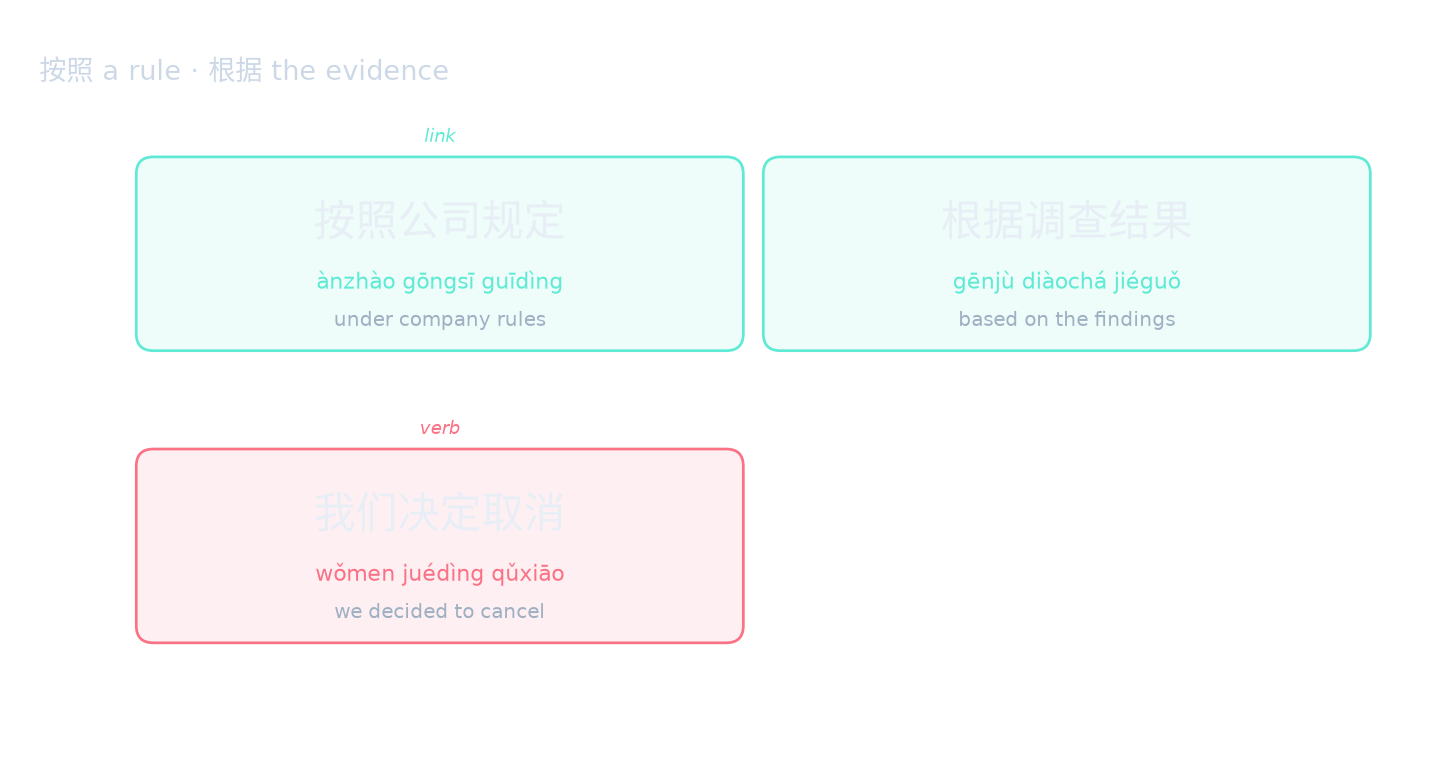
according to根据 = based on (evidence or source)
- according to根据 + data / facts / source = draw a conclusion from: according to根据investigation调查, according to根据weather forecast天气预报, according to根据he / him他(modifier / structural particle)的way of speaking说法.
- The focus is on what a judgement rests on.
based on根据the weather天气forecast预报,tomorrow明天there'll be有rain雨。
Follow versus base on
- To follow a rule, plan or order, use according to按照: according to按照plan计划to carry out进行. according to根据to stipulate规定 is also correct, but it justifies a decision: "on the basis of the rules".
- Evidence for a conclusion: according to根据research研究, not according to按照research研究.
according to根据 as a noun
- according to根据 can be a noun: "basis, grounds": you你so much这么variant of 说说to have / there is有what什么according to根据? — "What grounds do you have for saying that?"
- according to按照 is only a preposition.
you你so这么say说have有what什么grounds根据?
Recap
- according to按照 = according to (follow a rule, plan, order); according to根据 = based on (evidence, data, source).
- according to根据 can also be a noun (grounds); according to按照 cannot.
Practise this pattern step by step.
have no choice or option…不得不 vs to have no other option but…只好 (forced to vs only option)
Forced or resigned?
- The last train has been cancelled and there are no taxis.
- not have / haven't没有war chariot (archaic)车(completed / change)了,we / us我们to have no other option but…只好to walk走to return回去。company公司to stipulate规定want / will / need要(of an employee) to clock…打卡,I / me我have no choice or option…不得不to get up early早起。 — "No transport left, so we'll just have to walk back. The company makes us clock in, so I have no choice but to get up early."
to have no other option but…只好 = the only option left (resigned)
- to have no other option but…只好 + verb = "have no choice but to", after other options have disappeared; it sounds resigned, matter-of-fact.
- store商店all / both都to close a door关门(completed / change)了,I / me我to have no other option but…只好tomorrow明天again / then再to buy买.
the shops商店all都closed关门了,I我had to只好tomorrow明天then再buy买。

have no choice or option…不得不 = forced (pressure, duty)
- have no choice or option…不得不 + verb = be forced to, by rules, duty or pressure: I / me我have no choice or option…不得不to admit承认, 他病(completed / change)了,have no choice or option…不得不to be in hospital住院.
- It stresses the force of the situation and is a bit more formal.
he他was ill病得very很seriously重,had to不得不be hospitalised住院。
Choosing by the force
- Options ran out and you accept it → to have no other option but…只好. Something forces you (law, health, duty) → have no choice or option…不得不.
- Both go after the subject: I / me我to have no other option but…只好…, I / me我have no choice or option…不得不…; neither takes (yes/no ?)吗 in a statement.
Often interchangeable
- to rain下雨(completed / change)了,we / us我们to have no other option but…只好 / have no choice or option…不得不待在家里 — both possible; have no choice or option…不得不 sounds more forced.
- have no choice or option…不得不to admit承认 is a fixed expression: "I have to admit".
I我have to不得不admit承认he他said说得right对。
Recap
- to have no other option but…只好 = no other option, resigned; have no choice or option…不得不 = forced by rules, duty or pressure.
- Often interchangeable; have no choice or option…不得不to admit承认 is fixed.
Practise this pattern step by step.
unceasing不断 vs incessant不停 (continually vs non-stop)
Steady growth versus non-stop
- A news report and a neighbour's complaint describe two kinds of "continually".
- city城市at / in在unceasing不断development发展。upstairs楼上(modifier / structural particle)的dog狗叫个不停。 — "The city keeps developing. The dog upstairs barks non-stop."
unceasing不断 = continually, ongoing (development)
- unceasing不断 + verb = keep on, with progress or repetition over time: 不断进步, unceasing不断to raise提高, unceasing不断(intransitive) to change变化.
- It goes before the verb and suits formal contexts.
we我们must要continually不断learn学习。
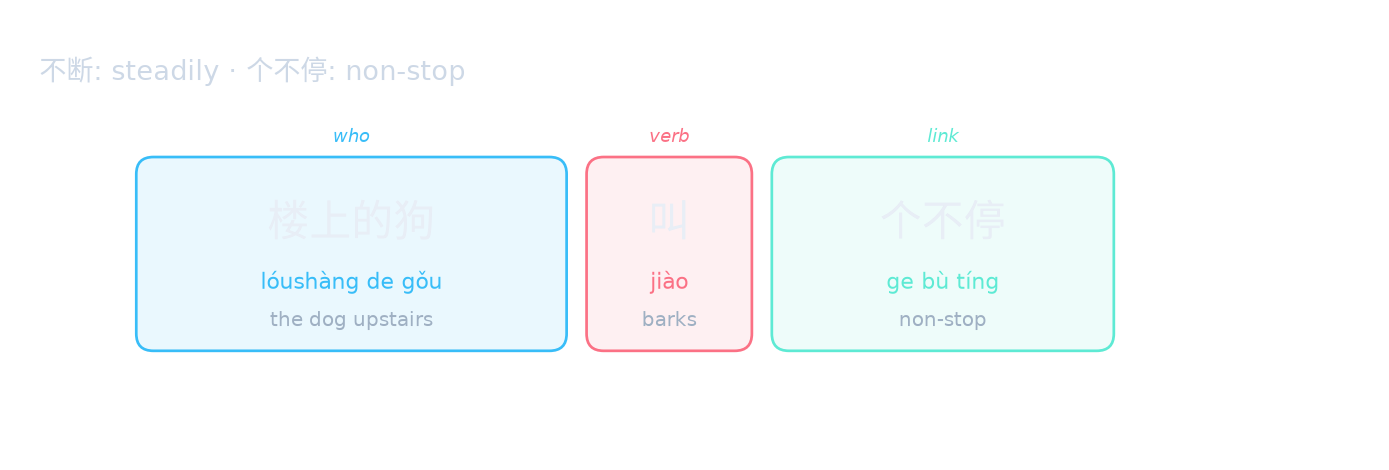
incessant不停 = without stopping (an action)
- incessant不停((adverb -ly)地) + verb = keep doing an action with no pause: incessant不停地说, incessant不停(adverb -ly)地to rain下雨.
- V + (measure word)个incessant不停 = keep V-ing: 说个incessant不停, 哭个incessant不停.
the baby孩子cry哭(on and)个non-stop不停。
Progress versus repetition
- Development or improvement over time → unceasing不断: unceasing不断to raise提高, not incessant不停to raise提高.
- A physical action that won't stop → incessant不停: (literary) to rain雨incessant不停underground地下, 说个incessant不停.
(measure word)个incessant不停 only with incessant不停
- 说个incessant不停 ✓, 说个unceasing不断 ✗.
- unceasing不断 can describe things: unceasing不断(modifier / structural particle)的to make an effort努力 — "constant effort"; incessant不停 is mostly for actions.
after经过constant不断的effort努力,he他succeeded成功了。
Recap
- unceasing不断 = continually (development, improvement, formal); incessant不停 = non-stop (an action).
- V(measure word)个incessant不停 only with incessant不停; unceasing不断(modifier / structural particle)的to make an effort努力 = constant effort.
Practise this pattern step by step.
on the contrary反而 vs but却 (instead vs however)
Yet versus instead
- You took a nap to feel better, but woke up even more tired.
- I / me我to sleep睡(completed / change)了one / a一to feel觉,but却or / still还是很累;not only (... but also ...)不但没好,on the contrary反而更累(completed / change)了。 — "I took a nap, yet I'm still tired; far from better, I'm actually more tired."
but却 = but, yet (a contrast)
- but却 marks a contrast with the first clause; it goes after the subject: he / him他degree / adjective linker很rope累,but却睡不着.
- The second part simply goes against what you'd expect, without being the opposite.
already已经spring春天了,the weather天气yet却still还very很cold冷。
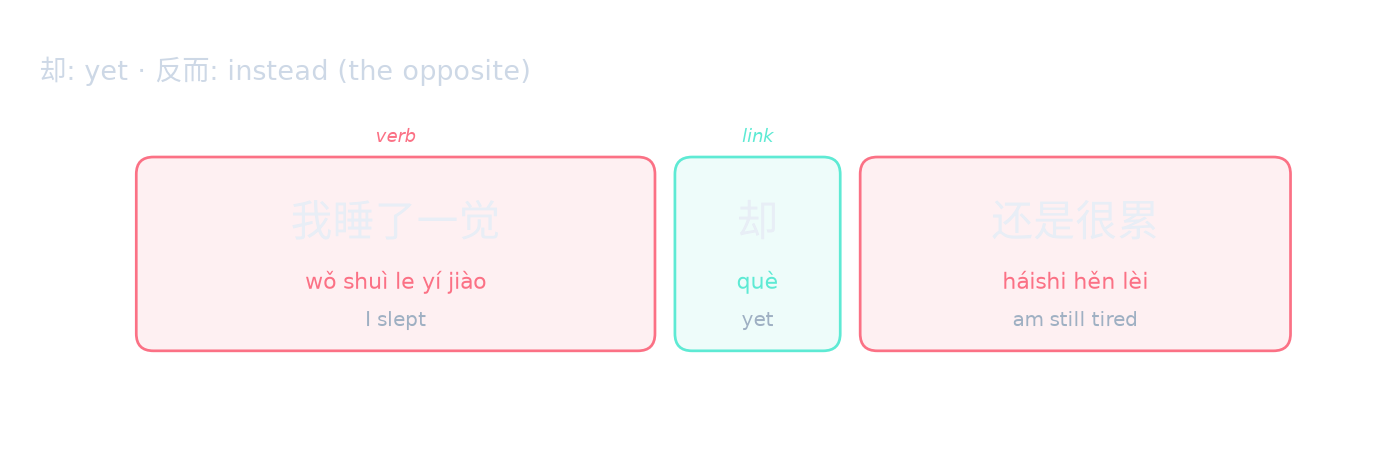
on the contrary反而 = instead, the opposite happened
- on the contrary反而 says the result went the opposite way: variant of 吃吃(completed / change)了medicine药,illness病on the contrary反而更重(completed / change)了.
- It often follows not only (... but also ...)不但not不 / not only (... but also ...)不但not / haven't没: he / him他not only (... but also ...)不但没生气,on the contrary反而to laugh笑(completed / change)了.
took吃了medicine药,the illness病instead反而more更serious重了。
Contrast or reversal?
- A plain "but": but却. The opposite of the expected result: on the contrary反而.
- Both follow the subject: he / him他but却…, he / him他on the contrary反而…; neither starts the clause.
Side by side
- he / him他degree / adjective linker很well-off有钱,but却not不happy快乐 — rich but not happy (contrast).
- he / him他well-off有钱(completed / change)了,on the contrary反而not不happy快乐(completed / change)了 — he got rich and became unhappier (reversal).
he他got rich有钱了,instead反而not不happy快乐了。
Recap
- but却 = but, yet (contrast); on the contrary反而 = instead (the opposite of the expected result).
- Both after the subject; not only (... but also ...)不但not不…on the contrary反而… is the classic reversal frame.
Practise this pattern step by step.
fundamental根本 vs finally到底 (at all vs on earth)
At all, or on earth?
- Your friend keeps changing his story about where he was last night.
- you你finally到底to go去where哪儿(completed / change)了?I / me我fundamental根本not不to be convinced (that sth…相信you你at / in在library图书馆。 — "Where on earth did you go? I don't believe at all that you were in the library."
fundamental根本 = at all, simply (negatives) / fundamentally
- fundamental根本 + not不 / not / haven't没 = not at all: fundamental根本not不to know知道, fundamental根本not / haven't没to go去. It strongly rejects an idea.
- As a noun / adjective: "root, fundamental": 根本原因 — "the root cause".
I我at all根本not不know认识him他。
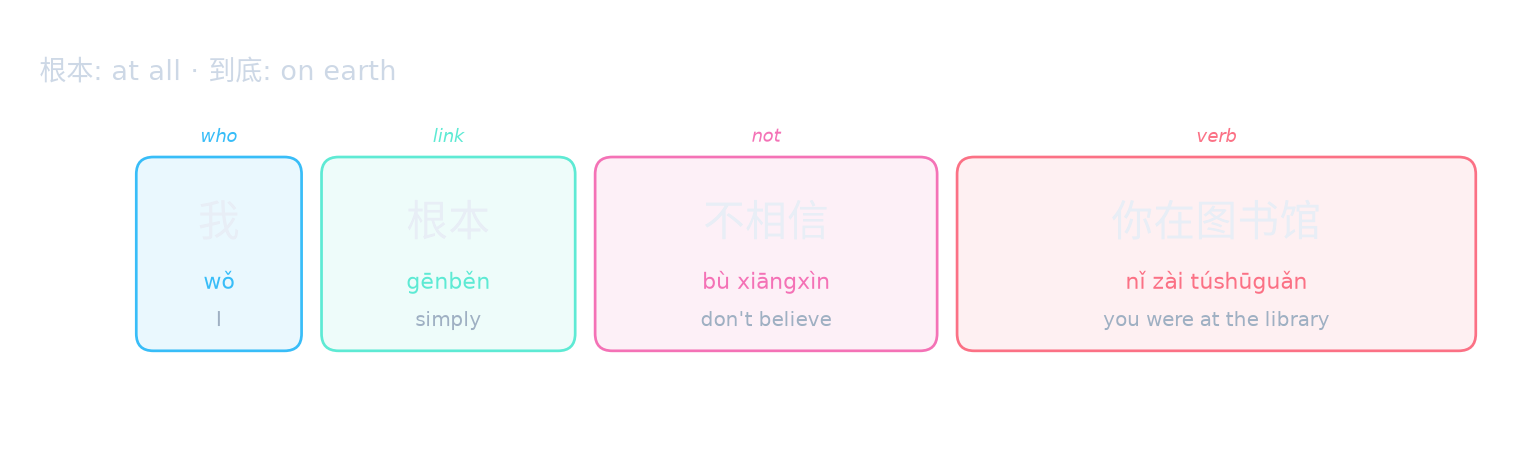
finally到底 = on earth (questions) / after all
- finally到底 + question = on earth, exactly: you你finally到底want / think / miss想how about怎么样?
- In statements, finally到底 = after all, in the end: he / him他finally到底or / still还是to come来(completed / change)了.
you你on earth到底want想what怎么样?
Different jobs
- fundamental根本 strengthens a negative statement; it does not go in questions as "on earth": you你fundamental根本to go去where哪儿(completed / change)了 ✗.
- finally到底 strengthens a question; it does not mean "not at all": I / me我finally到底not不to know知道 ✗ → I / me我fundamental根本not不to know知道.
Together in an argument
- question问题finally到底at / in在where哪儿?根本原因to be / is是lack缺少to join沟通。 — "Where exactly is the problem? The root cause is a lack of communication."
- finally到底 asks; fundamental根本 answers at the deepest level.
the root根本cause原因is是a lack of缺少communication沟通。
Recap
- fundamental根本 + not不/not / haven't没 = not at all; 根本原因 = root cause.
- finally到底 + question = on earth / exactly; in statements = after all.
Practise this pattern step by step.
according to根据 vs according to据 (based on vs formal shorthand)
According to reports
- You read a news story citing an official source.
- according to据to report (news)报道,this year今年(modifier / structural particle)的traveler游客number of people人数to raise增加(completed / change)了两成。 — "According to reports, the number of tourists has risen by 20% this year."
according to根据 = based on (any source)
- according to根据 + source / evidence = on the basis of: according to根据investigation调查, according to根据he / him他(modifier / structural particle)的way of speaking说法, according to根据to stipulate规定.
- It is used in speech and writing.
based on根据the survey调查,most大多数people人agree同意。
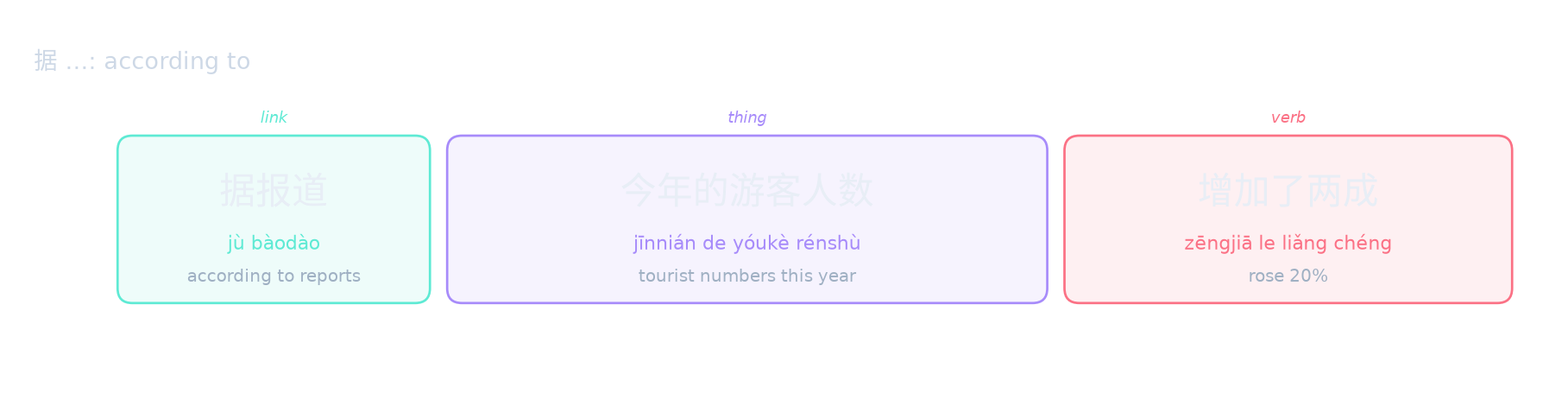
according to据 = according to (formal shorthand)
- according to据 + verb of reporting in fixed formal phrases: according to据to report (news)报道 (according to reports), it is said that据说 (it is said), according to statistics据统计 (according to statistics), according to据to understand了解 (it is understood).
- it is said that据说he / him他want / will / need要to go abroad出国(completed / change)了。 — "Word is he's going abroad."
it is said据说he他is going to要go abroad出国了。
according to据 mostly before a reporting verb
- according to据 usually takes a reporting verb directly: according to据to report (news)报道, according to statistics据统计. Before a plain noun phrase, according to根据 is safer: according to根据这份to inform报告.
- it is said that据说 is common even in speech; the other according to据 phrases are formal.
according to根据 as a noun
- according to根据 can also mean "grounds, basis": you你to have / there is有what什么according to根据?
- according to据 cannot be a noun.
according to据statistics统计,the population人口increased增加了。
Recap
- according to根据 + source = based on (general; also a noun "grounds").
- according to据 + reporting verb = according to (according to据to report (news)报道, it is said that据说, according to statistics据统计; formal shorthand).
Practise this pattern step by step.
to reinstate恢复 vs to restore to the original…还原 (recover vs restore to original)
Back to normal
- After a week in hospital, your grandfather is walking again; meanwhile, technicians restore an old photo.
- (coll.) father's father爷爷(modifier / structural particle)的the body身体slowly慢慢to reinstate恢复(completed / change)了。they他们(把: marks the object)把老照片还原成(completed / change)了color彩色(modifier / structural particle)的appearance样子。 — "Grandpa's health has slowly recovered. They restored the old photo to its colour form."
to reinstate恢复 = recover, resume (a normal state)
- to reinstate恢复 = return to a previous normal condition: 恢复健康, 恢复正常, to reinstate恢复to be connected交通.
- Often for health, order, activity or relationships.
traffic交通already已经returned to恢复normal正常了。
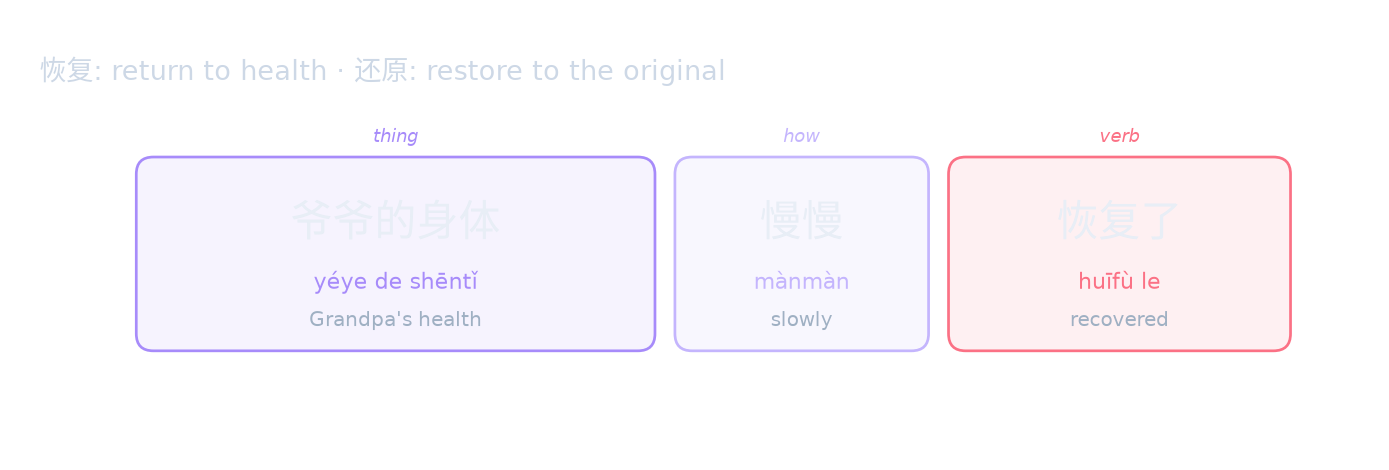
to restore to the original…还原 = restore to the original form
- to restore to the original…还原 = put something back to its original form or state: to restore to the original…还原the scene (of a crime…现场 (reconstruct the scene), to restore to the original…还原history历史 (recreate history as it was).
- It stresses getting back the original version.
this这部film电影recreated还原了that time's当时的history历史。
Normal state versus original form
- Health, order, activity → to reinstate恢复: 恢复健康, not to restore to the original…还原health健康.
- A scene, picture or story back to its original → to restore to the original…还原: to restore to the original…还原history历史the truth about sth真相.
Both with places
- to reinstate恢复to do business营业 = (a shop) reopens for business.
- to restore to the original…还原old city district老城区(modifier / structural particle)的appearance样子 = restore the old town to how it originally looked.
the shop商店next week下周resumes恢复business营业。
Recap
- to reinstate恢复 = recover / resume a normal state (health, order, business).
- to restore to the original…还原 = restore to the original form (scene, history, appearance).
Practise this pattern step by step.
unexpectedly居然 vs on the contrary反而 (surprisingly vs instead)
Surprise or reversal?
- Your shy classmate surprised everyone at the talent show.
- he / him他unexpectedly居然to rise to power (in…上台to sing唱(completed / change)了一首歌!everyone大家to think (i.e. to take it…以为他会nervous紧张,he / him他on the contrary反而degree / adjective linker很to relax放松。 — "He actually went on stage and sang! Everyone thought he'd be nervous, but he was relaxed instead."
unexpectedly居然 = surprisingly, actually
- unexpectedly居然 marks any unexpected event: he / him他unexpectedly居然to forget忘(completed / change)了, she / her她unexpectedly居然can / will会variant of 说说Japanese language日语.
- It just signals surprise; the event need not be the opposite of anything.
such这么an easy简单的question题,he他actually居然got wrong做错了。
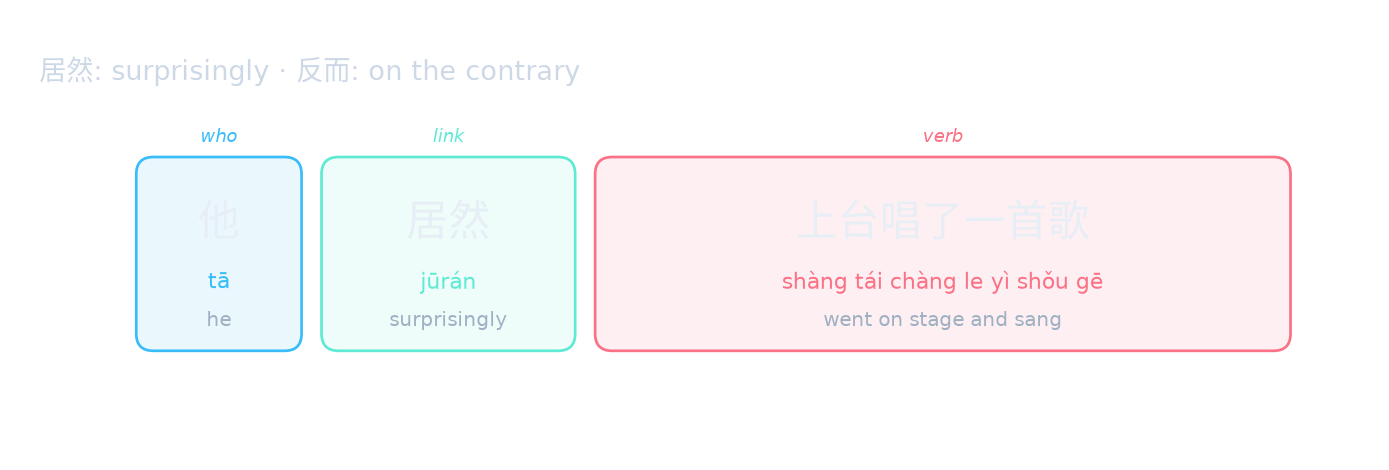
on the contrary反而 = instead, the opposite
- on the contrary反而 says the result went in the opposite direction from expected: variant of 吃吃(completed / change)了medicine药,on the contrary反而more更not不comfortable舒服(completed / change)了.
- It needs a clear expectation to reverse.
after resting休息了a day一天,he他instead反而more更tired累了。
Surprise versus opposite
- Any surprise → unexpectedly居然 / unexpectedly竟然. A result opposite to the expected one → on the contrary反而.
- unexpectedly居然 can describe good or bad surprises; on the contrary反而 always reverses an expectation.
Can they combine?
- Yes: he / him他not only (... but also ...)不但没生气,unexpectedly居然still / also还to laugh笑(completed / change)了 / on the contrary反而to laugh笑(completed / change)了 — both possible; on the contrary反而 stresses the reversal, unexpectedly居然 the surprise.
- Choose by what you want to highlight.
he他not only不但didn't没get angry生气,instead反而laughed笑了。
Recap
- unexpectedly居然 = surprisingly (any unexpected event); on the contrary反而 = instead (the opposite of what was expected).
- Pick by focus: surprise or reversal.
Practise this pattern step by step.
for a time一度 vs a period of time一时 (at one time vs for the moment)
Once, for a while
- Your uncle talks about a difficult period in his life and a moment of panic.
- he / him他for a time一度unemployment失业,then那时he / him他a period of time一时not不to know知道should该what's to be done怎么办。 — "He was unemployed for a time, and at that moment he didn't know what to do."
for a time一度 = at one time, for a period (in the past)
- for a time一度 + verb / adj = once, for a while in the past (and it is no longer so): for a time一度degree / adjective linker很(of a contagious disease…流行, for a time一度to cut short中断.
- It describes a past phase.
this这(measure word)首song歌at one time一度very非常popular流行。
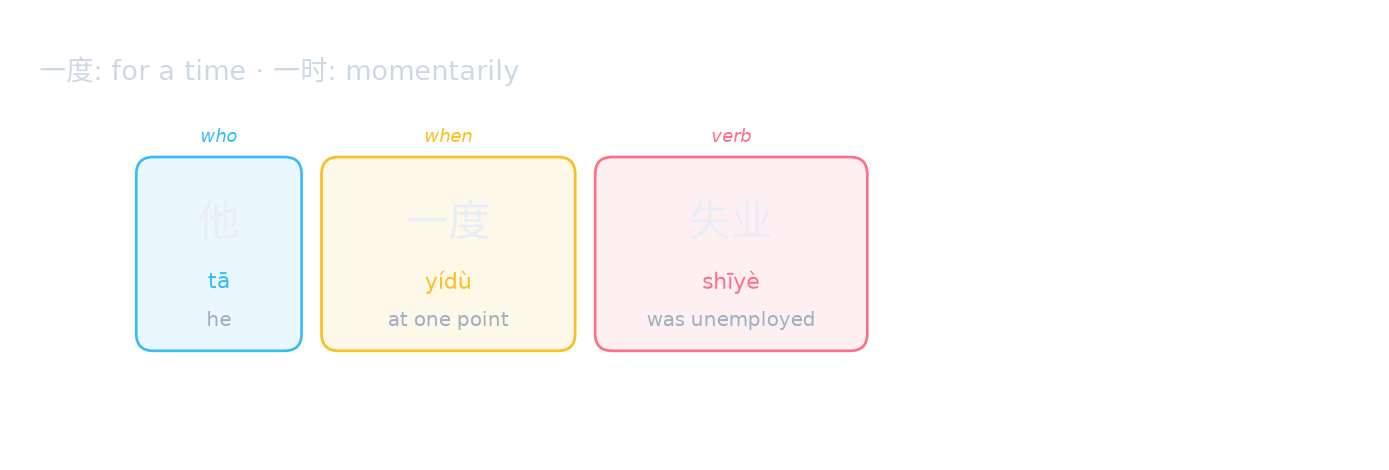
a period of time一时 = for the moment, temporarily
- a period of time一时 + verb = at that moment, for a short time: a period of time一时想不起来 (can't remember just now), 一时冲动 (a moment's impulse).
- It is about a brief moment, often a temporary failure.
his他的name名字I我for the moment一时can't recall想不起来。
A phase versus a moment
- A past period that has ended → for a time一度: he / him他for a time一度to live住at / in在abroad国外.
- A brief moment or impulse → a period of time一时: a period of time一时to get angry生气说错(completed / change)了old variant of 话话.
a period of time一时 in set phrases
- a short time一时半会儿 = in a short while: this这个question问题a short time一时半会儿解决不了.
- for a time一度 can also be a count: 一年一度 — "once a year": 一年一度(modifier / structural particle)的Spring Festival (Chinese…春节.
once a year一年(once)一度的Spring Festival春节。
Recap
- for a time一度 = at one time (a past phase); also 一年一度 = once a year.
- a period of time一时 = for the moment, temporarily (a period of time一时想不起来, 一时冲动, a short time一时半会儿).
Practise this pattern step by step.
all along一直 vs always (previously)一向 (continuously vs habitually)
All day, or always?
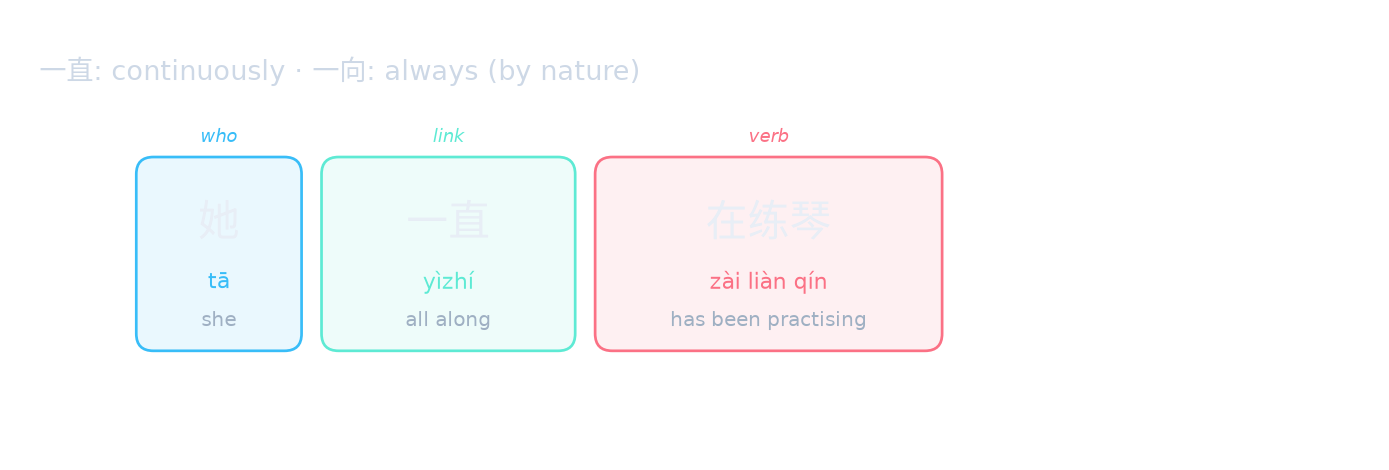
- Your neighbour has been practising piano all morning; she has always been hard-working.
- she / her她all along一直at / in在练琴,she / her她always (previously)一向degree / adjective linker很to make an effort努力。 — "She's been practising the piano all along; she's always been hard-working."
all along一直 = continuously (a stretch of time)
- all along一直 = without a break over a stretch, past or future: all along一直at / in在to rain下雨, 我会all along一直to wait for等you你.
- It can also mean "straight": all along一直to walk走.
I我will会always一直wait for等you你。
always (previously)一向 = habitually, consistently (character)
- always (previously)一向 describes long-standing habits or character from past to present: he / him他always (previously)一向degree / adjective linker很on time准时.
- It does not look to the future: 我会always (previously)一向to wait for等you你 ✗.
he他has always been一向very很punctual准时。
Future and activities
- Future promises take all along一直: 我会all along一直to be in favor of支持you你. always (previously)一向 is past-to-present only.
- An ongoing activity (at / in在 + verb) usually takes all along一直: all along一直at / in在to wait for等; always (previously)一向 is about habits and traits.
Both possible
- he / him他all along一直 / always (previously)一向not不to like喜欢variant of 吃吃hot (spicy)辣 — both fine: a long-standing preference.
- always (previously)一向 sounds more like a character trait; all along一直 more like continuity.
he他has always一向not不liked喜欢eating吃spicy food辣。
Recap
- all along一直 = continuously (past or future; activities; also "straight ahead").
- always (previously)一向 = habitually, consistently (character, past to present, not future).
Practise this pattern step by step.
Practice without the models
according to按照 vs according to根据 (in accordance with vs based on)
1401.1 Complete: “Please queue in order.” to ask请…………sequence顺序to line up排队。
1401.2 “Based on the survey, most students like online classes.” Which fits? ____investigation调查,(great) majority大多数student学生to like喜欢online classes网课。
- A. according to按照
- B. pertaining to关于
- C. regarding对于
- D. according to根据
1401.3 Build: “What grounds do you have for saying that?”
Arrange all chunks: according to根据? / to have / there is有what什么 / you你so much这么variant of 说说
1401.4 according to根据weather forecast天气预报 means “based on the weather forecast”.
True or false? Explain or repair the statement.
1401.5 A company memo explains how a decision was made. Close the examples. Say a Mandarin response, then write it in Chinese. Explain briefly in English what the lesson’s pattern adds. Compare with the model, then change one detail and try again.
Write or say your own response before reading the key.
have no choice or option…不得不 vs to have no other option but…只好 (forced to vs only option)
1402.1 Complete: “I have to admit he was right.” I / me我…………to admit承认he / him他说得对。
1402.2 “The restaurant was full, so we just had to eat at home.” Which sounds most natural?
- A. restaurant饭馆to fill满(completed / change)了,we / us我们have no choice or option…不得不(yes/no ?)吗to be at home在家variant of 吃吃。
- B. restaurant饭馆to fill满(completed / change)了,we / us我们to have no other option but…只好to be at home在家variant of 吃吃。
- C. restaurant饭馆to fill满(completed / change)了,to have no other option but…只好we / us我们to be at home在家variant of 吃吃(completed / change)了(yes/no ?)吗。
- D. restaurant饭馆to fill满(completed / change)了,we / us我们(degree marker)得must not不得to be at home在家variant of 吃吃。
1402.3 Build: “He was seriously ill and had to be hospitalised.”
Arrange all chunks: , / 他病(degree marker)得degree / adjective linker很heavy / important重 / to be in hospital住院。 / have no choice or option…不得不
1402.4 to have no other option but…只好 and have no choice or option…不得不 can sometimes be used interchangeably.
True or false? Explain or repair the statement.
1402.5 The last train has been cancelled and there are no taxis. Close the examples. Say a Mandarin response, then write it in Chinese. Explain briefly in English what the lesson’s pattern adds. Compare with the model, then change one detail and try again.
Write or say your own response before reading the key.
unceasing不断 vs incessant不停 (continually vs non-stop)
1403.1 Complete (formal): “Our level keeps improving.” we / us我们(modifier / structural particle)的level (of achievement etc)水平at / in在…………to raise提高。
1403.2 Which is wrong?
- A. technology技术不断进步。
- B. he / him他variant of 说说(measure word)个unceasing不断。
- C. (literary) to rain雨incessant不停underground地下。
- D. he / him他variant of 说说(measure word)个incessant不停。
1403.3 Build: “The baby cries non-stop.”
Arrange all chunks: incessant不停。 / child孩子 / (measure word)个 / to cry哭
1403.4 unceasing不断(modifier / structural particle)的to make an effort努力 means “constant effort”.
True or false? Explain or repair the statement.
1403.5 A news report and a neighbour's complaint describe two kinds of "continually". Close the examples. Say a Mandarin response, then write it in Chinese. Explain briefly in English what the lesson’s pattern adds. Compare with the model, then change one detail and try again.
Write or say your own response before reading the key.
on the contrary反而 vs but却 (instead vs however)
1404.1 Complete: “After the medicine, the illness got worse instead.” variant of 吃吃(completed / change)了medicine药,illness病…………更重(completed / change)了。
1404.2 “He's clever, but he doesn't work hard.” Which fits? he / him他degree / adjective linker很intelligent聪明,____not不to make an effort努力。
- A. and so于是
- B. but却
- C. therefore因此
- D. on the contrary反而
1404.3 Build: “It's already spring, yet it's still cold.”
Arrange all chunks: , / weather天气but却 / already已经spring (season)春天(completed / change)了 / still / also还degree / adjective linker很cold冷。
1404.4 on the contrary反而 can start a clause before the subject.
True or false? Explain or repair the statement.
1404.5 You took a nap to feel better, but woke up even more tired. Close the examples. Say a Mandarin response, then write it in Chinese. Explain briefly in English what the lesson’s pattern adds. Compare with the model, then change one detail and try again.
Write or say your own response before reading the key.
fundamental根本 vs finally到底 (at all vs on earth)
1405.1 Complete: “I don't know him at all.” I / me我…………not不to know认识he / him他。
1405.2 “What on earth do you want?” Which fits? you你____want / think / miss想how about怎么样?
- A. original本来
- B. according to根据
- C. fundamental根本
- D. finally到底
1405.3 Build: “The root cause is a lack of communication.”
Arrange all chunks: to be / is是 / 根本原因 / to join沟通。 / lack缺少
1405.4 he / him他finally到底or / still还是to come来(completed / change)了 means “In the end he came after all.”
True or false? Explain or repair the statement.
1405.5 Your friend keeps changing his story about where he was last night. Close the examples. Say a Mandarin response, then write it in Chinese. Explain briefly in English what the lesson’s pattern adds. Compare with the model, then change one detail and try again.
Write or say your own response before reading the key.
according to根据 vs according to据 (based on vs formal shorthand)
1406.1 Complete: “It is said that he's going abroad.” …………variant of 说说he / him他want / will / need要to go abroad出国(completed / change)了。
1406.2 Which is safer before a plain noun phrase? “based on this report”
- A. root根这份to inform报告
- B. according to据这份to inform报告
- C. according to根据这份to inform报告
- D. it is said that据说这份to inform报告
1406.3 Match each phrase to its meaning.
-
- according to据to report (news)报道
-
- according to statistics据统计
-
- it is said that据说
-
A. according to statistics
-
B. it is said
-
C. according to reports
1406.4 according to据 can be used as a noun meaning “grounds”.
True or false? Explain or repair the statement.
1406.5 You read a news story citing an official source. Close the examples. Say a Mandarin response, then write it in Chinese. Explain briefly in English what the lesson’s pattern adds. Compare with the model, then change one detail and try again.
Write or say your own response before reading the key.
to reinstate恢复 vs to restore to the original…还原 (recover vs restore to original)
1407.1 Complete: “He has recovered his health.” he / him他already已经…………health健康(completed / change)了。
1407.2 “The police reconstructed the accident scene.” Which fits? police警察____(completed / change)了事故现场。
- A. to reinstate恢复
- B. to reply回复
- C. to restore to the original…还原
- D. variant of 复习复习
1407.3 Build: “The shop resumes business next week.”
Arrange all chunks: store商店 / to do business营业。 / next week下周 / to reinstate恢复
1407.4 to restore to the original…还原health健康 is the usual phrase for recovering health.
True or false? Explain or repair the statement.
1407.5 After a week in hospital, your grandfather is walking again; meanwhile, technicians restore an old photo. Close the examples. Say a Mandarin response, then write it in Chinese. Explain briefly in English what the lesson’s pattern adds. Compare with the model, then change one detail and try again.
Write or say your own response before reading the key.
unexpectedly居然 vs on the contrary反而 (surprisingly vs instead)
1408.1 Complete: “She can actually speak Japanese!” she / her她…………can / will会variant of 说说Japanese language日语!
1408.2 “After a day of rest, he was even more tired.” Which fits best? rest休息(completed / change)了一天,he / him他____更累(completed / change)了。
- A. on the contrary反而
- B. unexpectedly居然
- C. of course当然
- D. really果然
1408.3 Build: “He actually got such an easy question wrong.”
Arrange all chunks: so much这么simple简单(modifier / structural particle)的topic题 / unexpectedly居然 / to make an error做错(completed / change)了。 / ,he / him他
1408.4 on the contrary反而 always reverses an expectation.
True or false? Explain or repair the statement.
1408.5 Your shy classmate surprised everyone at the talent show. Close the examples. Say a Mandarin response, then write it in Chinese. Explain briefly in English what the lesson’s pattern adds. Compare with the model, then change one detail and try again.
Write or say your own response before reading the key.
for a time一度 vs a period of time一时 (at one time vs for the moment)
1409.1 Complete: “I can't recall his name just now.” he / him他(modifier / structural particle)的name (of a person or thing)名字I / me我…………想不起来。
1409.2 “This song was once very popular.” Which fits? this这首歌____very非常(of a contagious disease…流行。
- A. a period of time一时
- B. for a time一度
- C. always (previously)一向
- D. all along一直
1409.3 Build: “This problem can't be solved in a short while.”
Arrange all chunks: (as a resultative verb…不了。 / this这个question问题 / to solve解决 / a short time一时半会儿
1409.4 一年一度 means “once a year”.
True or false? Explain or repair the statement.
1409.5 Your uncle talks about a difficult period in his life and a moment of panic. Close the examples. Say a Mandarin response, then write it in Chinese. Explain briefly in English what the lesson’s pattern adds. Compare with the model, then change one detail and try again.
Write or say your own response before reading the key.
all along一直 vs always (previously)一向 (continuously vs habitually)
1410.1 Promise: “I'll always support you.” 我会…………to be in favor of支持you你。
1410.2 Which is wrong?
- A. he / him他always (previously)一向degree / adjective linker很on time准时。
- B. 我会always (previously)一向to wait for等you你。
- C. (literary) to rain雨all along一直at / in在down下。
- D. he / him他all along一直at / in在练琴。
1410.3 Build: “I will wait for you all along.”
Arrange all chunks: all along一直 / to wait for等you你。 / 我会
1410.4 he / him他all along一直not不to like喜欢variant of 吃吃hot (spicy)辣 and he / him他always (previously)一向not不to like喜欢variant of 吃吃hot (spicy)辣 are both acceptable.
True or false? Explain or repair the statement.
1410.5 Your neighbour has been practising piano all morning; she has always been hard-working. Close the examples. Say a Mandarin response, then write it in Chinese. Explain briefly in English what the lesson’s pattern adds. Compare with the model, then change one detail and try again.
Write or say your own response before reading the key.
Answers and explanations
according to按照 vs according to根据 (in accordance with vs based on)
1401.1 according to按照
Following an order or rule = according to按照.
1401.2 D. according to根据
Evidence for a conclusion = according to根据.
1401.3 you你so much这么variant of 说说to have / there is有what什么according to根据?
according to根据 as a noun = grounds.
1401.4 True.
according to根据 introduces the source of a judgement.
1401.5 One possible response: according to按照company公司to stipulate规定,according to根据results (of an…调查结果,we / us我们to decide (to do something)决定to cancel取消这次to exercise活动。
Check meaning and form:
- My response conveys a message that fits the opening situation.
- I can explain the meaning of the pattern, rather than only naming it.
- To follow a rule, plan or order, use according to按照: according to按照plan计划to carry out进行. according to根据to stipulate规定 is also correct, but it justifies a decision: "on the basis of the rules".
- Evidence for a conclusion: according to根据research研究, not according to按照research研究.
- I tried a second response with a name, time, place, or description changed.
This is supported productive practice. Compare meaning and structure; your answer need not copy the model. A partner or teacher must hear the spoken response to comment on pronunciation.
have no choice or option…不得不 vs to have no other option but…只好 (forced to vs only option)
1402.1 have no choice or option…不得不
have no choice or option…不得不to admit承认 is fixed.
1402.2 B. restaurant饭馆to fill满(completed / change)了,we / us我们to have no other option but…只好to be at home在家variant of 吃吃。
Options ran out, so to have no other option but…只好 fits naturally.
1402.3 他病(degree marker)得degree / adjective linker很heavy / important重,have no choice or option…不得不to be in hospital住院。
Pressure of the situation = have no choice or option…不得不.
1402.4 True.
have no choice or option…不得不 just sounds more forced.
1402.5 One possible response: not have / haven't没有war chariot (archaic)车(completed / change)了,we / us我们to have no other option but…只好to walk走to return回去。company公司to stipulate规定want / will / need要(of an employee) to clock…打卡,I / me我have no choice or option…不得不to get up early早起。
Check meaning and form:
- My response conveys a message that fits the opening situation.
- I can explain the meaning of the pattern, rather than only naming it.
- Options ran out and you accept it → to have no other option but…只好. Something forces you (law, health, duty) → have no choice or option…不得不.
- Both go after the subject: I / me我to have no other option but…只好…, I / me我have no choice or option…不得不…; neither takes (yes/no ?)吗 in a statement.
- I tried a second response with a name, time, place, or description changed.
This is supported productive practice. Compare meaning and structure; your answer need not copy the model. A partner or teacher must hear the spoken response to comment on pronunciation.
unceasing不断 vs incessant不停 (continually vs non-stop)
1403.1 unceasing不断
Improvement over time = unceasing不断.
1403.2 B. he / him他variant of 说说(measure word)个unceasing不断。
Verb + (measure word)个 + incessant不停 means “non-stop” (he / him他variant of 说说(measure word)个incessant不停). unceasing不断 does not fit this pattern; it works as an adverb before verbs like progress进步 or to raise提高.
1403.3 child孩子哭个incessant不停。
V + (measure word)个incessant不停.
1403.4 True.
True. unceasing不断 can also describe a noun with (modifier / structural particle)的: unceasing不断(modifier / structural particle)的to make an effort努力 “constant effort”.
1403.5 One possible response: city城市at / in在unceasing不断development发展。upstairs楼上(modifier / structural particle)的dog狗叫个不停。
Check meaning and form:
- My response conveys a message that fits the opening situation.
- I can explain the meaning of the pattern, rather than only naming it.
- Development or improvement over time → unceasing不断: unceasing不断to raise提高, not incessant不停to raise提高.
- A physical action that won't stop → incessant不停: (literary) to rain雨incessant不停underground地下, 说个incessant不停.
- I tried a second response with a name, time, place, or description changed.
This is supported productive practice. Compare meaning and structure; your answer need not copy the model. A partner or teacher must hear the spoken response to comment on pronunciation.
on the contrary反而 vs but却 (instead vs however)
1404.1 on the contrary反而
The opposite of the expected result = on the contrary反而.
1404.2 B. but却
but却 marks a plain contrast after the subject: he / him他degree / adjective linker很intelligent聪明,but却not不to make an effort努力. on the contrary反而 would mean the result goes against what was expected, and therefore因此 / and so于是 show result or sequence.
1404.3 already已经spring (season)春天(completed / change)了,weather天气but却still / also还degree / adjective linker很cold冷。
Subject + but却 + predicate.
1404.4 False.
False. on the contrary反而 is an adverb and goes after the subject, before the verb: he / him他on the contrary反而to laugh笑(completed / change)了. It does not come before the subject.
1404.5 One possible response: I / me我to sleep睡(completed / change)了one / a一to feel觉,but却or / still还是很累;not only (... but also ...)不但没好,on the contrary反而更累(completed / change)了。
Check meaning and form:
- My response conveys a message that fits the opening situation.
- I can explain the meaning of the pattern, rather than only naming it.
- A plain "but": but却. The opposite of the expected result: on the contrary反而.
- Both follow the subject: he / him他but却…, he / him他on the contrary反而…; neither starts the clause.
- I tried a second response with a name, time, place, or description changed.
This is supported productive practice. Compare meaning and structure; your answer need not copy the model. A partner or teacher must hear the spoken response to comment on pronunciation.
fundamental根本 vs finally到底 (at all vs on earth)
1405.1 fundamental根本
fundamental根本 + not不 = not at all.
1405.2 D. finally到底
finally到底 strengthens questions.
1405.3 根本原因to be / is是lack缺少to join沟通。
fundamental根本 as an adjective: root.
1405.4 True.
In statements, finally到底 = after all.
1405.5 One possible response: you你finally到底to go去where哪儿(completed / change)了?I / me我fundamental根本not不to be convinced (that sth…相信you你at / in在library图书馆。
Check meaning and form:
- My response conveys a message that fits the opening situation.
- I can explain the meaning of the pattern, rather than only naming it.
- fundamental根本 strengthens a negative statement; it does not go in questions as "on earth": you你fundamental根本to go去where哪儿(completed / change)了 ✗.
- finally到底 strengthens a question; it does not mean "not at all": I / me我finally到底not不to know知道 ✗ → I / me我fundamental根本not不to know知道.
- I tried a second response with a name, time, place, or description changed.
This is supported productive practice. Compare meaning and structure; your answer need not copy the model. A partner or teacher must hear the spoken response to comment on pronunciation.
according to根据 vs according to据 (based on vs formal shorthand)
1406.1 according to据
it is said that据说 = it is said.
1406.2 C. according to根据这份to inform报告
Before a noun phrase, according to根据 is the safe choice.
1406.3 1–C: according to据to report (news)报道 = according to reports; 2–A: according to statistics据统计 = according to statistics; 3–B: it is said that据说 = it is said
according to据 + reporting verb.
1406.4 False.
False. On its own according to据 is a preposition, “according to” (according to据to report (news)报道). The noun “grounds, basis” is according to根据 (you你to have / there is有what什么according to根据?); according to据 has this meaning only inside compounds like evidence证据.
1406.5 One possible response: according to据to report (news)报道,this year今年(modifier / structural particle)的traveler游客number of people人数to raise增加(completed / change)了两成。
Check meaning and form:
- My response conveys a message that fits the opening situation.
- I can explain the meaning of the pattern, rather than only naming it.
- according to据 usually takes a reporting verb directly: according to据to report (news)报道, according to statistics据统计. Before a plain noun phrase, according to根据 is safer: according to根据这份to inform报告.
- it is said that据说 is common even in speech; the other according to据 phrases are formal.
- I tried a second response with a name, time, place, or description changed.
This is supported productive practice. Compare meaning and structure; your answer need not copy the model. A partner or teacher must hear the spoken response to comment on pronunciation.
to reinstate恢复 vs to restore to the original…还原 (recover vs restore to original)
1407.1 to reinstate恢复
Health returns to normal = to reinstate恢复.
1407.2 C. to restore to the original…还原
Reconstructing a scene as it originally was = to restore to the original…还原.
1407.3 store商店next week下周to reinstate恢复to do business营业。
to reinstate恢复to do business营业 = resume business.
1407.4 False.
The usual phrase is 恢复健康.
1407.5 One possible response: (coll.) father's father爷爷(modifier / structural particle)的the body身体slowly慢慢to reinstate恢复(completed / change)了。they他们(把: marks the object)把老照片还原成(completed / change)了color彩色(modifier / structural particle)的appearance样子。
Check meaning and form:
- My response conveys a message that fits the opening situation.
- I can explain the meaning of the pattern, rather than only naming it.
- Health, order, activity → to reinstate恢复: 恢复健康, not to restore to the original…还原health健康.
- A scene, picture or story back to its original → to restore to the original…还原: to restore to the original…还原history历史the truth about sth真相.
- I tried a second response with a name, time, place, or description changed.
This is supported productive practice. Compare meaning and structure; your answer need not copy the model. A partner or teacher must hear the spoken response to comment on pronunciation.
unexpectedly居然 vs on the contrary反而 (surprisingly vs instead)
1408.1 unexpectedly居然
Surprise = unexpectedly居然.
1408.2 A. on the contrary反而
The opposite of the expected result = on the contrary反而.
1408.3 so much这么simple简单(modifier / structural particle)的topic题,he / him他unexpectedly居然to make an error做错(completed / change)了。
Subject + unexpectedly居然 + verb.
1408.4 True.
True. on the contrary反而 always says the result goes against an expectation. unexpectedly居然 only marks the speaker's surprise and does not need a reversal.
1408.5 One possible response: he / him他unexpectedly居然to rise to power (in…上台to sing唱(completed / change)了一首歌!everyone大家to think (i.e. to take it…以为他会nervous紧张,he / him他on the contrary反而degree / adjective linker很to relax放松。
Check meaning and form:
- My response conveys a message that fits the opening situation.
- I can explain the meaning of the pattern, rather than only naming it.
- Any surprise → unexpectedly居然 / unexpectedly竟然. A result opposite to the expected one → on the contrary反而.
- unexpectedly居然 can describe good or bad surprises; on the contrary反而 always reverses an expectation.
- I tried a second response with a name, time, place, or description changed.
This is supported productive practice. Compare meaning and structure; your answer need not copy the model. A partner or teacher must hear the spoken response to comment on pronunciation.
for a time一度 vs a period of time一时 (at one time vs for the moment)
1409.1 a period of time一时
A brief moment = a period of time一时.
1409.2 B. for a time一度
for a time一度 marks a past phase that has since ended: this这首歌for a time一度very非常(of a contagious disease…流行 “was once very popular”. all along一直 and always (previously)一向 describe continuity up to now.
1409.3 this这个question问题a short time一时半会儿解决不了。
a short time一时半会儿 + potential complement.
1409.4 True.
True. In 一年一度, to estimate度 counts occasions, so the phrase means “once a year”, as in 一年一度(modifier / structural particle)的Spring Festival (Chinese…春节.
1409.5 One possible response: he / him他for a time一度unemployment失业,then那时he / him他a period of time一时not不to know知道should该what's to be done怎么办。
Check meaning and form:
- My response conveys a message that fits the opening situation.
- I can explain the meaning of the pattern, rather than only naming it.
- A past period that has ended → for a time一度: he / him他for a time一度to live住at / in在abroad国外.
- A brief moment or impulse → a period of time一时: a period of time一时to get angry生气说错(completed / change)了old variant of 话话.
- I tried a second response with a name, time, place, or description changed.
This is supported productive practice. Compare meaning and structure; your answer need not copy the model. A partner or teacher must hear the spoken response to comment on pronunciation.
all along一直 vs always (previously)一向 (continuously vs habitually)
1410.1 all along一直
Future promises take all along一直.
1410.2 B. 我会always (previously)一向to wait for等you你。
always (previously)一向 does not look to the future.
1410.3 我会all along一直to wait for等you你。
can / will会 + all along一直 + verb.
1410.4 True.
For a long-standing preference, both work.
1410.5 One possible response: she / her她all along一直at / in在练琴,she / her她always (previously)一向degree / adjective linker很to make an effort努力。
Check meaning and form:
- My response conveys a message that fits the opening situation.
- I can explain the meaning of the pattern, rather than only naming it.
- Future promises take all along一直: 我会all along一直to be in favor of支持you你. always (previously)一向 is past-to-present only.
- An ongoing activity (at / in在 + verb) usually takes all along一直: all along一直at / in在to wait for等; always (previously)一向 is about habits and traits.
- I tried a second response with a name, time, place, or description changed.
This is supported productive practice. Compare meaning and structure; your answer need not copy the model. A partner or teacher must hear the spoken response to comment on pronunciation.