Skip to content
Subjects
  • 1 Adjectives
    • 1.1 Adjectival complement "de budeliao"
    • 1.2 Adjectival complement "de hen"
    • 1.3 Expressing "a bit too"
    • 1.4 Saying "a lot" with "youdeshi"

    Adjectives →

  • 2 Adverbs
    • 2.1 Advanced uses of "dou"
    • 2.2 Advanced uses of "hai"
    • 2.3 Advanced uses of "zong"
    • 2.4 Expressing "after all" with "bijing"
    • 2.5 Expressing "almost" using "chadian mei"
    • 2.6 Expressing "anyway" with "fanzheng"
    • 2.7 Expressing "as much as possible" with "jinliang"
    • 2.8 Expressing "each other" with "huxiang"
    • 2.9 Expressing "feel free" with "jinguan"
    • 2.10 Expressing "just" do it with "gancui"
    • 2.11 Expressing "never again" with "zai ye bu"
    • 2.12 Expressing "once" with "cengjing"
    • 2.13 Expressing "over and over again" with "zaisan"
    • 2.14 Expressing "simply" with "jianzhi"
    • 2.15 Expressing "while you're at it" with "shunbian"
    • 2.16 Expressing a last chance with "zaibu... jiu..."
    • 2.17 Expressing difficulty with "hao (bu) rongyi"
    • 2.18 Expressing wasted efforts with "bai"
    • 2.19 Repeated actions in the past with "you"
    • 2.20 The opposite of "chabuduo" is "cha hen duo"

    Adverbs →

  • 3 Auxiliary Words
    • 3.1 Listing things with "a"

    Auxiliary Words →

  • 4 Conjunctions
    • 4.1 Expressing "how about" with "yaobu"

    Conjunctions →

  • 5 Nouns
    • 5.1 Expressing "among" with "dangzhong"
    • 5.2 Expressing "each other" with "bici"
    • 5.3 Expressing "ever since" with "yilai"
    • 5.4 Expressing "when" using "dang"
    • 5.5 Name-calling with "zhege"

    Nouns →

  • 6 Particles
    • 6.1 Advanced "le" after an object
    • 6.2 Advanced "le" with complements
    • 6.3 Marking a topic with "ma"
    • 6.4 Softening the tone of questions with "ne"

    Particles →

  • 7 Prepositional Phrase
    • 7.1 Defining upper and lower limits

    Prepositional Phrase →

  • 8 Prepositions
    • 8.1 Expressing "ever since" with "zicong"
    • 8.2 Expressing "for" with "wei"
    • 8.3 Expressing "for…" with "eryan"
    • 8.4 Expressing "including" with "zainei"
    • 8.5 Expressing "on the basis of" with "ping"
    • 8.6 Expressing "with regards to" with "zhiyu"
    • 8.7 Expressing passive voice with "gei"
    • 8.8 Limiting scope with "jiu"
    • 8.9 Opportune timing with "chen"

    Prepositions →

  • 9 Sentence Patterns
    • 9.1 Expressing "if it were not for" with "yaobushi"
    • 9.2 Expressing "thanks to" with "duokui"
    • 9.3 Expressing "that's all" with "eryi"
    • 9.4 Using "jiang" as a formal "ba"

    Sentence Patterns →

  • 10 Verbs
    • 10.1 Challenging a verb with "shenme"
    • 10.2 Comparing specifically with "xiang"
    • 10.3 Comparisons with "biqi"
    • 10.4 Comparisons with "buru"
    • 10.5 Making "-ize" and "-ify" verbs with "hua"
    • 10.6 Making judgments with "suan"
    • 10.7 Using "nanguai" as a verb

    Verbs →

  • 11 Auxiliary verbs
    • 11.1 Expressing future with "jiang"

    Auxiliary verbs →

  • 12 Verb phrases
    • 12.1 Expressing "hard to avoid" with "nanmian"
    • 12.2 Passive verbs with "shou"

    Verb phrases →

  • 13 "But" Statements
    • 13.1 Expressing "on the contrary" with "fan'er"

    "But" Statements →

  • 14 "Even If" Statements
    • 14.1 Expressing "even if…" with "jiushi"
    • 14.2 Expressing "even if…" with "jiusuan"
    • 14.3 Expressing "even if…" with "napa"

    "Even If" Statements →

  • 15 "If" Statements
    • 15.1 Expressing "if… then…" with "jiaru"
    • 15.2 Expressing "what if" with "wanyi"
    • 15.3 Marking a topic with "de hua"

    "If" Statements →

  • 16 Adverbs with Adjectives
    • 16.1 Expressing "especially" with "gewai"

    Adverbs with Adjectives →

  • 17 Cause/Effect Statements
    • 17.1 Stating the effect before the cause

    Cause/Effect Statements →

  • 18 Complements
    • 18.1 Advanced degree complements
    • 18.2 Advanced potential complements
    • 18.3 Advanced result complements "zhu", "kai", and "chulai"
    • 18.4 Complement "-huai le"
    • 18.5 Complement "-zhao"
    • 18.6 Tricky uses of "dao"
    • 18.7 Using "lai" and "qu" when "verbing around"

    Complements →

  • 19 Conditional Statements
    • 19.1 Expressing "once...then..." with "yidan...jiu..."

    Conditional Statements →

  • 20 Sentence Patterns
    • 20.1 Advanced uses of "ba"
    • 20.2 Basic comparisons with "bu bi"
    • 20.3 Conditions with "yao" and "jiu"
    • 20.4 Expressing "can't do without" with "shaobuliao"
    • 20.5 Expressing "equal to" with "dengyu"
    • 20.6 Expressing "from" with "cong... zhong"
    • 20.7 Expressing "no" (noun) "to" (verb) with "wu... ke..."
    • 20.8 Expressing "not only..., even..." using "budan..., shenzhi lian"
    • 20.9 Expressing "related to..." with "you guan de"
    • 20.10 Expressing "so-called" with "suowei"
    • 20.11 Expressing "within" a period of time using "zai... nei"
    • 20.12 Expressing "would rather" with "ningke"
    • 20.13 Expressing indifference with "jiu"
    • 20.14 Expressing purpose with "hao"
    • 20.15 Expressing simultaneous actions with "yimian"
    • 20.16 Expressing the only two possibilities

    Sentence Patterns →

  • 21 Complex Sentence Patterns
    • 21.1 Expressing "no wonder"

    Complex Sentence Patterns →

  • 22 Either… or
    • 22.1 Providing two options with double "huozhe"

    Either… or →

  • 23 Let alone
    • 23.1 Expressing "let alone" with "bie shuo"
    • 23.2 Expressing "let alone" with "geng buyong shuo"

    Let alone →

  • 24 Comparing similar adverbs
    • 24.1 Comparing "changchang" and "jingchang"

    Comparing similar adverbs →

  • 25 Comparing similar auxiliary words
    • 25.1 Comparing "zongsuan" and “zhongyu"

    Comparing similar auxiliary words →

  • 26 Comparing similar conjunctions
    • 26.1 Comparing "gen" and "dui"

    Comparing similar conjunctions →

  • 27 Comparing similar prepositions
    • 27.1 Comparing "chao" "xiang" and "wang"
    • 27.2 Comparing "dui" and "duiyu"
    • 27.3 Comparing "duiyu" and "zhiyu"
    • 27.4 Comparing "gei" and "wei"

    Comparing similar prepositions →

  • 28 Comparing similar time words
    • 28.1 Comparing "pingshi" and "pingchang"
    • 28.2 Comparing "yihou" and "zhihou"

    Comparing similar time words →

  • 29 Comparing similar verbs

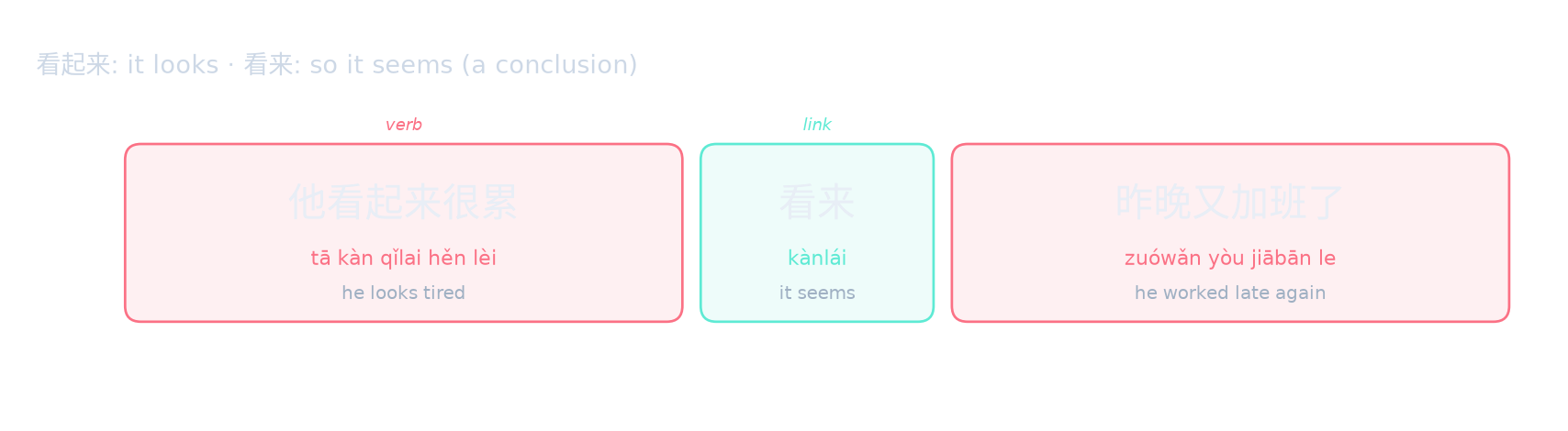
    seemingly看起来kàn qǐ lái vs it seems (from this)看来kàn lái (looks vs it seems)

    Form: subject + seemingly看起来kàn qǐ lái + description · it seems (from this)看来kàn lái,+ conclusion · at / in在zài + person + it seems (from this)看来kàn lái

    • he / him他tāseemingly看起来kàn qǐ lái很累hěn lèi,it seems (from this)看来kàn láiyesterday evening昨晚zuó wǎnagain又yòuto work overtime加班jiā bān(completed / change)了le。 Tā kàn qǐlai hěn lèi, kànlái zuówǎn yòu jiābān le. – He looks tired; it seems he worked late again.
    • this这个zhè gedish (of food); vegetable菜càiseemingly看起来kàn qǐ láidegree / adjective linker很hěntasty好吃hǎo chī。 – This dish looks delicious.
    • on the ground地上dì shàngmoist湿shī(completed / change)了le,it seems (from this)看来kàn lái下过xià guòrain雨yǔ。 – The ground is wet; it must have rained.
    • in my opinion在我看来zài wǒ kàn lái,this这个zhè geplan计划jì huà不太bù tàireality现实xiàn shí。 – In my view, this plan isn't very realistic.

    How it works. seemingly看起来kàn qǐ lái reports how something looks: a direct impression, after the subject. it seems (from this)看来kàn lái states a conclusion from evidence, usually at the start of a clause. at / in在zài……it seems (from this)看来kàn lái gives someone's opinion.

    seemingly看起来kàn qǐ lái it seems (from this)看来kàn lái at / in在zài……it seems (from this)看来kàn lái
    looks, appears it seems / so (inference) in someone's view
    she / her她tāseemingly看起来kàn qǐ láidegree / adjective linker很hěnyoung年轻nián qīng it seems (from this)看来kàn láihe / him他tāto forget忘wàng(completed / change)了le in my opinion在我看来zài wǒ kàn lái

    Watch out

    • For appearance, use seemingly看起来kàn qǐ lái: wrong: she / her她tāit seems (from this)看来kàn láidegree / adjective linker很hěnyoung年轻nián qīng → she / her她tāseemingly看起来kàn qǐ láidegree / adjective linker很hěnyoung年轻nián qīng.
    看起来: it looks · 看来: so it seems (a conclusion)

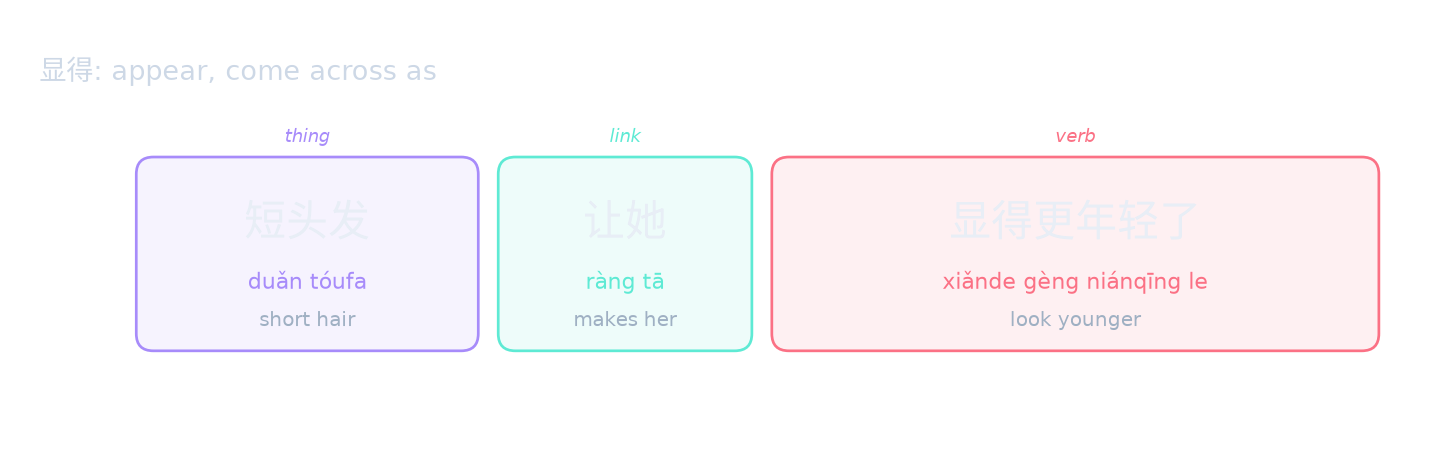
    to appear; to seem显得xiǎn de vs seemingly看起来kàn qǐ lái (comes across as vs looks)

    Form: (cause / to let / make让ràng + person) + to appear; to seem显得xiǎn de + description · subject + seemingly看起来kàn qǐ lái + description

    • short短duǎnhair头发tóu fàto let / make让ràngshe / her她tāto appear; to seem显得xiǎn demore更gèngyoung年轻nián qīng(completed / change)了le。 Duǎn tóufa ràng tā xiǎnde gèng niánqīng le. – Short hair makes her look younger.
    • white白色bái sèto let / make让ràngroom房间fáng jiānto appear; to seem显得xiǎn de更大gèng dà。 – White makes the room seem bigger.
    • at / in在zài一群yī qúnadult大人dà rénmiddle; between中间zhōng jiān,he / him他tāto appear; to seem显得xiǎn deespecially / special特别tè biésmall小xiǎo。 – Among the adults, he seemed especially small.
    • she / her她tāseemingly看起来kàn qǐ láidegree / adjective linker很hěnhappy; glad高兴gāo xìng。 – She looks happy.

    How it works. to appear; to seem显得xiǎn de xiǎnde "comes across as" describes an effect produced by something: a colour, a setting, a contrast. It often follows to let / make让ràng / to make使shǐ or a context such as at / in在zài……middle; between中间zhōng jiān. seemingly看起来kàn qǐ lái just reports your direct impression.

    to appear; to seem显得xiǎn de seemingly看起来kàn qǐ lái
    effect of a cause or contrast direct impression
    white白色bái sèto let / make让ràngroom房间fáng jiānto appear; to seem显得xiǎn de更大gèng dà room房间fáng jiānseemingly看起来kàn qǐ lái很大hěn dà

    Watch out

    • to appear; to seem显得xiǎn de takes a description, not an object: wrong: to appear; to seem显得xiǎn deshe / her她tāyoung年轻nián qīng → she / her她tāto appear; to seem显得xiǎn deyoung年轻nián qīng.
    显得: appear, come across as

    Practice without the models

    Cover the teaching sections before you answer. The answers follow.

    seemingly看起来kàn qǐ lái vs it seems (from this)看来kàn lái (looks vs it seems)

    1. The ground is wet: “It seems it rained.” on the ground地上dì shàngmoist湿shī(completed / change)了le,…………下过xià guòrain雨yǔ。

    2. “This dish looks delicious.” Which fits?

    • A. at / in在zàithis这个zhè gedish (of food); vegetable菜càiit seems (from this)看来kàn láidegree / adjective linker很hěntasty好吃hǎo chī。
    • B. it seems (from this)看来kàn láithis这个zhè gedish (of food); vegetable菜càidegree / adjective linker很hěntasty好吃hǎo chī。
    • C. this这个zhè gedish (of food); vegetable菜càiseemingly看起来kàn qǐ láidegree / adjective linker很hěntasty好吃hǎo chī。
    • D. this这个zhè gedish (of food); vegetable菜càidegree / adjective linker很hěntasty好吃hǎo chīit seems (from this)看来kàn lái。

    3. Build: “In my view, this plan isn't realistic.”

    Put in order: this这个zhè geplan计划jì huà / , / 不太bù tàireality现实xiàn shí。 / in my opinion在我看来zài wǒ kàn lái

    4. True or false? seemingly看起来kàn qǐ lái usually gives an impression from what you see. If false, correct it.

    5. Your colleague looks pale, and he hasn't touched his lunch. Use seemingly看起来kàn qǐ lái or it seems (from this)看来kàn lái. Write your answer in Chinese, then say it aloud.

    to appear; to seem显得xiǎn de vs seemingly看起来kàn qǐ lái (comes across as vs looks)

    6. Complete: “The white walls make the room look bigger.” white白色bái sè(modifier / structural particle)的dewall墙qiángto let / make让ràngroom房间fáng jiān…………更大gèng dà。

    7. Which stresses contrast? “Among the adults, he seems especially small.”

    • A. at / in在zàiadult大人dà rénmiddle; between中间zhōng jiān,he / him他tāto appear; to seem显得xiǎn deespecially / special特别tè biésmall小xiǎo。
    • B. it seems (from this)看来kàn láihe / him他tā很小hěn xiǎo。
    • C. he / him他tāto eat吃chīget up / (start, become)起来qǐ lai很小hěn xiǎo。
    • D. he / him他tāseemingly看起来kàn qǐ lái很小hěn xiǎo。

    8. Build: “Short hair makes her look younger.”

    Put in order: short短duǎnhair头发tóu fà / more更gèngyoung年轻nián qīng(completed / change)了le。 / to let / make让ràngshe / her她tā / to appear; to seem显得xiǎn de

    9. True or false? seemingly看起来kàn qǐ lái simply reports a direct impression. If false, correct it.

    10. Your friend got a short haircut and now everyone says she looks different. Use to appear; to seem显得xiǎn de or seemingly看起来kàn qǐ lái. Write your answer in Chinese, then say it aloud.

    Answers and explanations

    seemingly看起来kàn qǐ lái vs it seems (from this)看来kàn lái (looks vs it seems)

    1. it seems (from this)看来kàn lái

    A conclusion from evidence takes it seems (from this)看来kàn lái.

    2. C. this这个zhè gedish (of food); vegetable菜càiseemingly看起来kàn qǐ láidegree / adjective linker很hěntasty好吃hǎo chī。

    seemingly看起来kàn qǐ lái describes how something looks: this这个zhè gedish (of food); vegetable菜càiseemingly看起来kàn qǐ láidegree / adjective linker很hěntasty好吃hǎo chī. it seems (from this)看来kàn lái is a judgement from evidence and starts the sentence (it seems (from this)看来kàn láihe / him他tānot不bùto come来lái(completed / change)了le), so it does not describe appearance.

    3. in my opinion在我看来zài wǒ kàn lái,this这个zhè geplan计划jì huà不太bù tàireality现实xiàn shí。

    at / in在zài…it seems (from this)看来kàn lái + opinion.

    4. True.

    it seems (from this)看来kàn lái draws a conclusion instead.

    5. Model answer: he / him他tāseemingly看起来kàn qǐ lái很累hěn lèi,it seems (from this)看来kàn láiyesterday evening昨晚zuó wǎnagain又yòuto work overtime加班jiā bān(completed / change)了le。

    Check your answer:

    • seemingly看起来kàn qǐ lái follows the subject and comes before a description: he / him他tāseemingly看起来kàn qǐ lái很累hěn lèi – "He looks tired."
    • it seems (from this)看来kàn lái starts a clause before a conclusion: it seems (from this)看来kàn láihe / him他tādegree / adjective linker很hěntired累lèi ("It seems he's tired"). Not he / him他tāit seems (from this)看来kàn láidegree / adjective linker很hěnyoung年轻nián qīng for "he looks young".

    to appear; to seem显得xiǎn de vs seemingly看起来kàn qǐ lái (comes across as vs looks)

    6. to appear; to seem显得xiǎn de

    A cause producing an effect: to appear; to seem显得xiǎn de.

    7. A. at / in在zàiadult大人dà rénmiddle; between中间zhōng jiān,he / him他tāto appear; to seem显得xiǎn deespecially / special特别tè biésmall小xiǎo。

    to appear; to seem显得xiǎn de fits an effect produced by contrast.

    8. short短duǎnhair头发tóu fàto let / make让ràngshe / her她tāto appear; to seem显得xiǎn demore更gèngyoung年轻nián qīng(completed / change)了le。

    Cause + to let / make让ràng + person + to appear; to seem显得xiǎn de + description.

    9. True.

    to appear; to seem显得xiǎn de adds a cause or contrast.

    10. Model answer: short短duǎnhair头发tóu fàto let / make让ràngshe / her她tāto appear; to seem显得xiǎn demore更gèngyoung年轻nián qīng(completed / change)了le。

    Check your answer:

    • Use to appear; to seem显得xiǎn de when a cause or contrast produces the look: at / in在zàicrowd人群rén qúnmiddle / in中zhōngto appear; to seem显得xiǎn de很矮hěn ǎi – "looks short in the crowd".
    • to appear; to seem显得xiǎn de takes a description, not an object: she / her她tāto appear; to seem显得xiǎn dedegree / adjective linker很hěnyoung年轻nián qīng, not to appear; to seem显得xiǎn deshe / her她tāyoung年轻nián qīng.

Log in or create account

IGCSE, A-Level & AP