Skip to content
Subjects

HSK 5 Grammar

  • 1 Adjectives
    • 1.1 Adjectival complement "de budeliao"
    • 1.2 Adjectival complement "de hen"
    • 1.3 Expressing "a bit too"
    • 1.4 Saying "a lot" with "youdeshi"

    Adjectives →

  • 2 Adverbs
    • 2.1 Advanced uses of "dou"
    • 2.2 Advanced uses of "hai"
    • 2.3 Advanced uses of "zong"
    • 2.4 Expressing "after all" with "bijing"
    • 2.5 Expressing "almost" using "chadian mei"
    • 2.6 Expressing "anyway" with "fanzheng"
    • 2.7 Expressing "as much as possible" with "jinliang"
    • 2.8 Expressing "each other" with "huxiang"
    • 2.9 Expressing "feel free" with "jinguan"
    • 2.10 Expressing "just" do it with "gancui"
    • 2.11 Expressing "never again" with "zai ye bu"
    • 2.12 Expressing "once" with "cengjing"
    • 2.13 Expressing "over and over again" with "zaisan"
    • 2.14 Expressing "simply" with "jianzhi"
    • 2.15 Expressing "while you're at it" with "shunbian"
    • 2.16 Expressing a last chance with "zaibu... jiu..."
    • 2.17 Expressing difficulty with "hao (bu) rongyi"
    • 2.18 Expressing wasted efforts with "bai"
    • 2.19 Repeated actions in the past with "you"
    • 2.20 The opposite of "chabuduo" is "cha hen duo"

    Adverbs →

  • 3 Auxiliary Words
    • 3.1 Listing things with "a"

    Auxiliary Words →

  • 4 Conjunctions
    • 4.1 Expressing "how about" with "yaobu"

    Conjunctions →

  • 5 Nouns
    • 5.1 Expressing "among" with "dangzhong"
    • 5.2 Expressing "each other" with "bici"
    • 5.3 Expressing "ever since" with "yilai"
    • 5.4 Expressing "when" using "dang"
    • 5.5 Name-calling with "zhege"

    Nouns →

  • 6 Particles
    • 6.1 Advanced "le" after an object
    • 6.2 Advanced "le" with complements
    • 6.3 Marking a topic with "ma"
    • 6.4 Softening the tone of questions with "ne"

    Particles →

  • 7 Prepositional Phrase
    • 7.1 Defining upper and lower limits

    Prepositional Phrase →

  • 8 Prepositions
    • 8.1 Expressing "ever since" with "zicong"
    • 8.2 Expressing "for" with "wei"
    • 8.3 Expressing "for…" with "eryan"
    • 8.4 Expressing "including" with "zainei"
    • 8.5 Expressing "on the basis of" with "ping"
    • 8.6 Expressing "with regards to" with "zhiyu"
    • 8.7 Expressing passive voice with "gei"
    • 8.8 Limiting scope with "jiu"
    • 8.9 Opportune timing with "chen"

    Prepositions →

  • 9 Sentence Patterns
    • 9.1 Expressing "if it were not for" with "yaobushi"
    • 9.2 Expressing "thanks to" with "duokui"
    • 9.3 Expressing "that's all" with "eryi"
    • 9.4 Using "jiang" as a formal "ba"

    Sentence Patterns →

  • 10 Verbs
    • 10.1 Challenging a verb with "shenme"
    • 10.2 Comparing specifically with "xiang"
    • 10.3 Comparisons with "biqi"
    • 10.4 Comparisons with "buru"
    • 10.5 Making "-ize" and "-ify" verbs with "hua"
    • 10.6 Making judgments with "suan"
    • 10.7 Using "nanguai" as a verb

    Verbs →

  • 11 Auxiliary verbs
    • 11.1 Expressing future with "jiang"

    Auxiliary verbs →

  • 12 Verb phrases
    • 12.1 Expressing "hard to avoid" with "nanmian"
    • 12.2 Passive verbs with "shou"

    Verb phrases →

  • 13 "But" Statements
    • 13.1 Expressing "on the contrary" with "fan'er"

    "But" Statements →

  • 14 "Even If" Statements
    • 14.1 Expressing "even if…" with "jiushi"
    • 14.2 Expressing "even if…" with "jiusuan"
    • 14.3 Expressing "even if…" with "napa"

    "Even If" Statements →

  • 15 "If" Statements
    • 15.1 Expressing "if… then…" with "jiaru"
    • 15.2 Expressing "what if" with "wanyi"
    • 15.3 Marking a topic with "de hua"

    "If" Statements →

  • 16 Adverbs with Adjectives
    • 16.1 Expressing "especially" with "gewai"

    Adverbs with Adjectives →

  • 17 Cause/Effect Statements
    • 17.1 Stating the effect before the cause

    Cause/Effect Statements →

  • 18 Complements
    • 18.1 Advanced degree complements
    • 18.2 Advanced potential complements
    • 18.3 Advanced result complements "zhu", "kai", and "chulai"
    • 18.4 Complement "-huai le"
    • 18.5 Complement "-zhao"
    • 18.6 Tricky uses of "dao"
    • 18.7 Using "lai" and "qu" when "verbing around"

    Complements →

  • 19 Conditional Statements
    • 19.1 Expressing "once...then..." with "yidan...jiu..."

    Conditional Statements →

  • 20 Sentence Patterns
    • 20.1 Advanced uses of "ba"
    • 20.2 Basic comparisons with "bu bi"
    • 20.3 Conditions with "yao" and "jiu"
    • 20.4 Expressing "can't do without" with "shaobuliao"
    • 20.5 Expressing "equal to" with "dengyu"
    • 20.6 Expressing "from" with "cong... zhong"
    • 20.7 Expressing "no" (noun) "to" (verb) with "wu... ke..."
    • 20.8 Expressing "not only..., even..." using "budan..., shenzhi lian"
    • 20.9 Expressing "related to..." with "you guan de"
    • 20.10 Expressing "so-called" with "suowei"
    • 20.11 Expressing "within" a period of time using "zai... nei"
    • 20.12 Expressing "would rather" with "ningke"
    • 20.13 Expressing indifference with "jiu"
    • 20.14 Expressing purpose with "hao"
    • 20.15 Expressing simultaneous actions with "yimian"
    • 20.16 Expressing the only two possibilities

    Sentence Patterns →

  • 21 Complex Sentence Patterns
    • 21.1 Expressing "no wonder"

    Complex Sentence Patterns →

  • 22 Either… or
    • 22.1 Providing two options with double "huozhe"

    Either… or →

  • 23 Let alone
    • 23.1 Expressing "let alone" with "bie shuo"
    • 23.2 Expressing "let alone" with "geng buyong shuo"

    Let alone →

  • 24 Comparing similar adverbs

    often常常cháng cháng vs often经常jīng cháng (often / regularly)

    Form: subject + (time) + often常常cháng cháng / often经常jīng cháng + verb

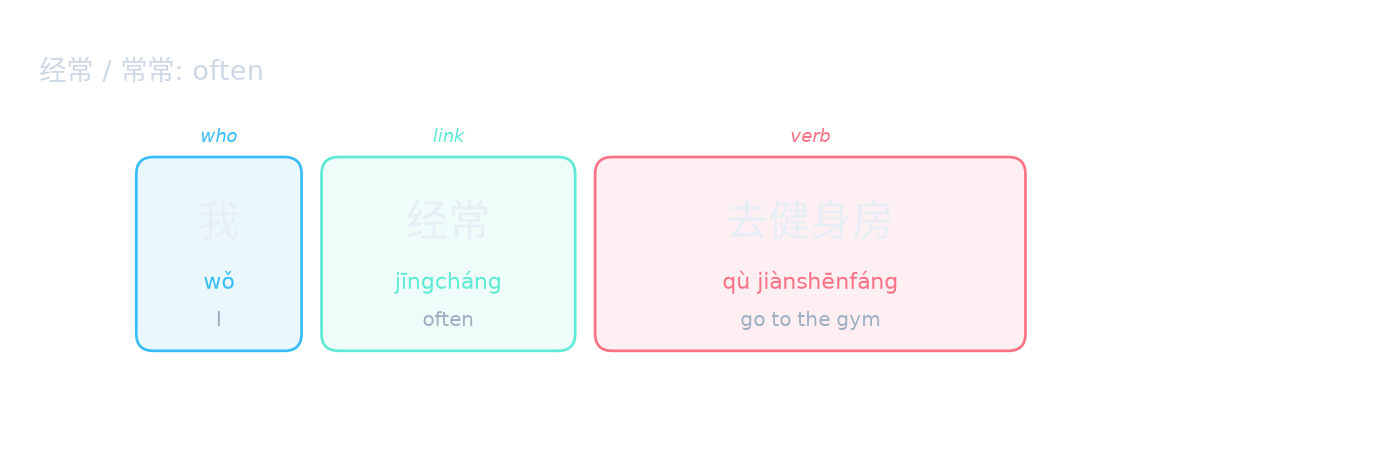
    • I / me我wǒoften经常jīng chángto go去qùgym健身房jiàn shēn fáng,weekend周末zhōu mòalso也yěoften常常cháng chángto go去qùto swim游泳yóu yǒng。 Wǒ jīngcháng qù jiànshēnfáng, zhōumò yě chángcháng qù yóuyǒng. – I go to the gym regularly, and at weekends I often swim too.
    • he / him他tāweekend周末zhōu mòoften经常jīng chángto work overtime加班jiā bān。 Tā zhōumò jīngcháng jiābān. – He often works overtime at weekends.
    • I / me我wǒ不常去bù cháng qùcinema电影院diàn yǐng yuàn。 Wǒ bù cháng qù diànyǐngyuàn. – I don't go to the cinema much.
    • in one's childhood小时候xiǎo shí hòu,grandma奶奶nǎi nǎioften常常cháng chángto / for / give给gěiI / me我wǒ讲故事jiǎng gù shì。 Xiǎo shíhou, nǎinai chángcháng gěi wǒ jiǎng gùshi. – When I was little, my grandma often told me stories.
    • this这zhèmeasure word for long thin things条tiáoroad路lùoften经常jīng chángtraffic jam堵车dǔ chē,had better; best最好zuì hǎo早点儿zǎo diǎn érto set off出发chū fā。 Zhè tiáo lù jīngcháng dǔchē, zuìhǎo zǎo diǎnr chūfā. – This road is often jammed; you'd better set off early.
    • 下雨天xià yǔ tiāntend to; often往往wǎng wǎng人少rén shǎo。 Xià yǔ tiān wǎngwǎng rén shǎo. – On rainy days there tend to be fewer people.

    How it works. often常常cháng cháng chángcháng and often经常jīng cháng jīngcháng both mean "often" and usually swap freely: they go after the subject (and after a time word) and before the verb. often经常jīng cháng suggests something regular and repeated, so it is common for habits and recurring problems (often经常jīng chángto work overtime加班jiā bān, often经常jīng chángtraffic jam堵车dǔ chē); often常常cháng cháng is a little more spoken and warm, common in stories about the past.

    The negatives differ: say not不bùoften常cháng or not不bùoften经常jīng cháng, never not不bùoften常常cháng cháng. Only often经常jīng cháng works as an adjective before a noun: 经常性jīng cháng xìng(modifier / structural particle)的deto check检查jiǎn chá (regular checks). tend to; often往往wǎng wǎng wǎngwǎng looks similar but means "tends to", describing a pattern under a condition.

    often常常cháng cháng often经常jīng cháng tend to; often往往wǎng wǎng
    often ✓ ✓ tends to, under a condition
    negative not不bùoften常cháng not不bùoften经常jīng cháng (rarely negated)
    before a noun — 经常性jīng cháng xìng(modifier / structural particle)的dequestion / problem问题wèn tí —
    future plans ✓ after / from now on以后yǐ hòuoften常常cháng chángto come来lái ✓ after / from now on以后yǐ hòuoften经常jīng chángto come来lái —
    example often常常cháng chángto drink tea喝茶hē chá often经常jīng chángto drink tea喝茶hē chá 下雨天xià yǔ tiāntend to; often往往wǎng wǎngtraffic jam堵车dǔ chē

    Watch out

    • wrong: not不bùoften常常cháng cháng → not不bùoften常cháng or not不bùoften经常jīng cháng.
    • tend to; often往往wǎng wǎng needs a pattern or condition and cannot describe a plan: wrong: I / me我wǒtomorrow明天míng tiāntend to; often往往wǎng wǎngto go去qù → I / me我wǒafter / from now on以后yǐ hòucan / will会huìoften经常jīng chángto go去qù.
    • Put the frequency word before the verb, not at the end: wrong: I / me我wǒto go去qùgym健身房jiàn shēn fángoften经常jīng cháng → I / me我wǒoften经常jīng chángto go去qùgym健身房jiàn shēn fáng.

    In a passage

    I / me我wǒfather爸爸bà bàto work; job工作gōng zuòdegree / adjective linker很hěnbusy忙máng,often经常jīng chángto go on a business trip出差chū chāi,一个月yí gè yuètend to; often往往wǎng wǎngcan only只能zhǐ néngat / in在zài家住jiā zhù十几天shí jǐ tiān。in one's childhood小时候xiǎo shí hòuI / me我wǒoften常常cháng chángto ask问wènmum; mother妈妈mā mā:father爸爸bà bàwhat什么shén metime; when时候shí hòuto return回来huí lái?now现在xiàn zàiI / me我wǒto grow up长大zhǎng dà(completed / change)了le,to understand / clear明白míng bai(completed / change)了lehe / him他tā(modifier / structural particle)的dehard; tiring辛苦xīn kǔ。he / him他tānot不bùoften常chángto be at home在家zài jiā,but但是dàn shì每天晚上měi tiān wǎn shàngall / both都dōucan / will会huìto / for / give给gěiwe / us我们wǒ mento make a telephone call打电话dǎ diàn huà。

    Read and notice. Find often经常jīng cháng, often常常cháng cháng, tend to; often往往wǎng wǎng and not不bùoften常cháng. Why does the writer use tend to; often往往wǎng wǎng in the first sentence?

    经常 / 常常: often

    Practice without the models

    Cover the teaching sections before you answer. The answers follow.

    1. Complete: “I don't often go to the cinema.” I / me我wǒnot不bù…………to go去qùcinema电影院diàn yǐng yuàn。

    2. Which is the most natural way to say "not often"?

    • A. not不bùoften经常jīng cháng
    • B. tend to; often往往wǎng wǎngnot不bù
    • C. often经常jīng cháng
    • D. often常常cháng chángnot不bù

    3. Build: “He regularly works overtime at weekends.”

    Put in order: he / him他tāweekend周末zhōu mò / to work overtime加班jiā bān。 / often经常jīng cháng

    4. True or false? tend to; often往往wǎng wǎng usually describes what tends to happen in a situation, unlike plain often常常cháng cháng. If false, correct it.

    5. A new friend asks about your exercise habits. Use often常常cháng cháng or often经常jīng cháng. Write your answer in Chinese, then say it aloud.

    Answers and explanations

    1. often常cháng

    not不bùoften常cháng or not不bùoften经常jīng cháng; not不bùoften常常cháng cháng is not used.

    2. A. not不bùoften经常jīng cháng

    The negative of often经常jīng cháng / often常常cháng cháng is not不bùoften经常jīng cháng or not不bùoften常cháng.

    3. he / him他tāweekend周末zhōu mòoften经常jīng chángto work overtime加班jiā bān。

    Subject + time + often经常jīng cháng + verb.

    4. True.

    True. tend to; often往往wǎng wǎng describes what tends to happen in a situation: 下雨天xià yǔ tiāntend to; often往往wǎng wǎngtraffic jam堵车dǔ chē. often常常cháng cháng can describe simple frequency or the future: after / from now on以后yǐ hòuoften常常cháng chángto come来lái.

    5. Model answer: I / me我wǒoften经常jīng chángto go去qùgym健身房jiàn shēn fáng,weekend周末zhōu mòalso也yěoften常常cháng chángto go去qùto swim游泳yóu yǒng。

    Check your answer:

    • To say "not often", use not不bùoften常cháng or not不bùoften经常jīng cháng (not不bùoften常常cháng cháng is rare).
    • Both go before the verb, after the subject and time words: he / him他tāweekend周末zhōu mòoften经常jīng chángto work overtime加班jiā bān – "He often works overtime on weekends."
  • 25 Comparing similar auxiliary words
    • 25.1 Comparing "zongsuan" and “zhongyu"

    Comparing similar auxiliary words →

  • 26 Comparing similar conjunctions
    • 26.1 Comparing "gen" and "dui"

    Comparing similar conjunctions →

  • 27 Comparing similar prepositions
    • 27.1 Comparing "chao" "xiang" and "wang"
    • 27.2 Comparing "dui" and "duiyu"
    • 27.3 Comparing "duiyu" and "zhiyu"
    • 27.4 Comparing "gei" and "wei"

    Comparing similar prepositions →

  • 28 Comparing similar time words
    • 28.1 Comparing "pingshi" and "pingchang"
    • 28.2 Comparing "yihou" and "zhihou"

    Comparing similar time words →

  • 29 Comparing similar verbs
    • 29.1 Comparing "kanqilai" and "kanlai"
    • 29.2 Comparing "xiande" and "kanqilai"

    Comparing similar verbs →

Log in or create account

IGCSE, A-Level & AP